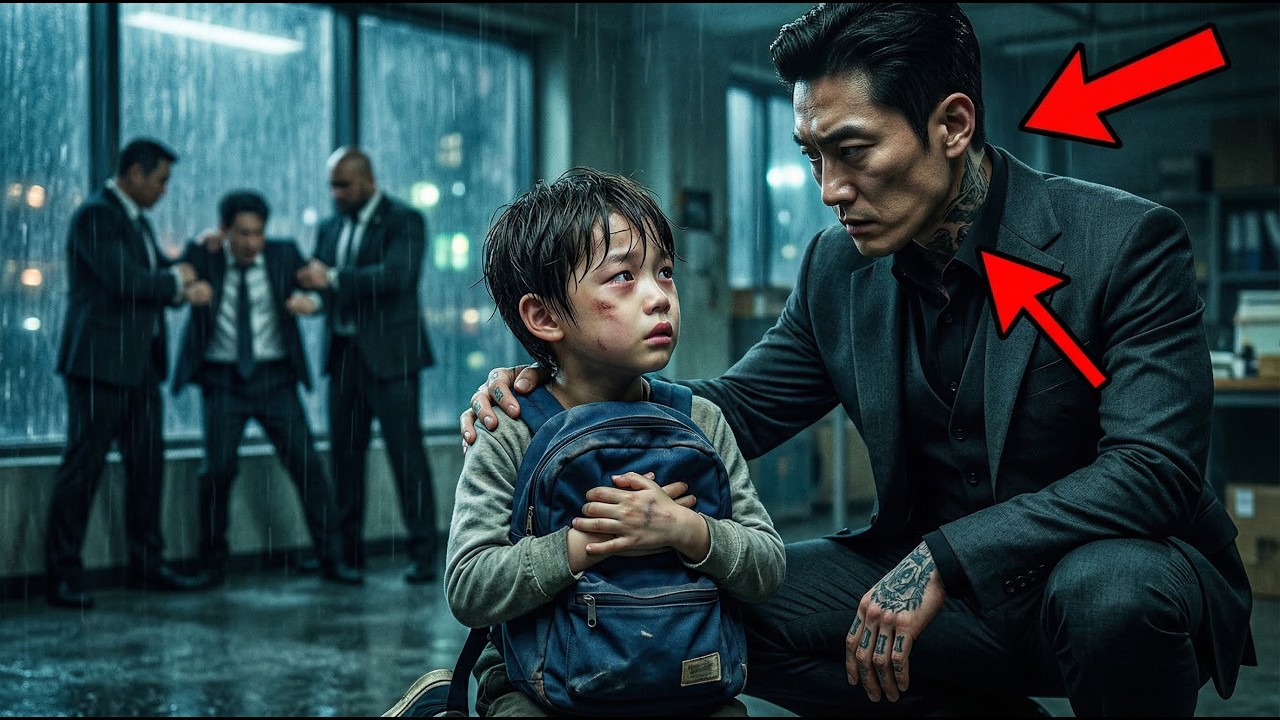
The first thing people got wrong about the Gold Ring Dragon was that he only showed up when blood was already spilled.
They said he was a cleaner of endings. A man who arrived after chaos, never before it.
That was false.
Because on a humid afternoon in Seoul, Kang J-Min—known in darker circles as the Gold Ring Dragon—walked away from a billion-dollar negotiation without a single explanation, just because he saw a child sitting alone on a marble floor of a corporate lobby… holding his father’s blood-soaked sleeve like it was the only thing keeping the world from collapsing.
The deal he abandoned would have expanded his shipping empire across three continents.
But he didn’t even look back.
Not once.
The boy’s name was Noah Reed.
He was seven years old.
Too small for the way he was shaking.
Too quiet for the amount of fear inside him.
A security guard was standing nearby pretending not to notice the bruises forming on the child’s arm. People in suits walked past him like he was part of the architecture—something tragic but irrelevant.
Noah didn’t ask for help.
He just kept whispering the same sentence, over and over.
“My dad didn’t steal anything… he just asked…”
J-Min stopped walking.
That was the moment everything shifted.
Because J-Min didn’t hear a child crying.
He heard a system speaking.
And systems, in his experience, only spoke clearly when they were about to break.
“Where is your father?” J-Min asked calmly.
Noah looked up, eyes swollen.
“They took him,” he said. “Warehouse B… Mr. Shaw said he shouldn’t have asked for money.”
J-Min didn’t react immediately.
But something in his expression cooled.
Not anger.
Precision.
He crouched slightly so he was at eye level with the boy.
“What money?”
Noah hesitated.
Then whispered:
“Medicine money.”
That was the first crack.
Andrew Reed wasn’t supposed to matter.
At least, that’s what Gregory Shaw believed.
Andrew was just another logistics worker at Meridian Freight Systems—one of thousands rotating through night shifts, handling containers that never seemed to match their paperwork.
Invisible people.
Replaceable people.
People who only became visible when they broke rules meant to keep them silent.
But Andrew had broken a different rule.
He had asked for what was owed.
Not extra.
Not favors.
Just the pay already earned.
And for that, Gregory Shaw had decided to make an example.
The warehouse smelled like rust and disinfectant when J-Min arrived.
Not because it was dirty.
Because it had been cleaned too many times in the wrong places.
Andrew Reed was on his knees near the loading dock, shirt torn, lips split, hands tied loosely—not enough to restrain, just enough to humiliate.
Gregory Shaw stood over him, holding a clipboard like it was a weapon of authority.
“You don’t get to question payroll,” Shaw said flatly.
Andrew coughed.
“My son… needs his medication…”
Shaw smiled.
“That’s not my department.”
That was the moment J-Min stepped out of the shadows.
Not fast.
Not loud.
Just inevitable.
The entire warehouse changed temperature when he entered.
Workers stopped moving.
Conversations died mid-sentence.
Even the machinery seemed to hesitate.
Gregory Shaw turned, annoyed first—then cautious, then confused.
Because men like Shaw always recognized power.
But only when it wasn’t supposed to be there.
“Who are you?” Shaw asked.
J-Min looked at him for a long moment.
Then said:
“The consequence.”
No one saw the first phone call.
But within minutes, Meridian Freight Systems began to fracture internally.
Payroll servers locked.
Transaction systems frozen.
External banking channels flagged for compliance breaches.
Contracts that had been “stable” for years suddenly became liabilities.
Not hacked.
Reclassified.
As if someone had gone through the company’s foundation and quietly removed every assumption holding it upright.
Gregory Shaw felt it before he understood it.
His phone vibrated nonstop.
His face tightened.
“What did you do?” he demanded.
J-Min didn’t answer.
He was looking at Andrew.
Not the bruises.
Not the blood.
The exhaustion behind the eyes.
The kind of exhaustion that doesn’t come from a single event.
But from repeated permission to suffer.
“You hit him,” J-Min said finally.
Shaw scoffed. “He’s an employee. He violated procedure.”
J-Min tilted his head slightly.
“And the child?”
That question changed the room.
Because Shaw hadn’t expected that detail to matter.
“He brought him into this,” Shaw said.
No hesitation.
No empathy.
Just accounting.
That was enough.
J-Min raised one hand slightly.
Two men entered the warehouse.
No weapons drawn.
No shouting.
Just presence.
Within seconds, Shaw’s phone was taken from him.
Then his wallet.
Then his access credentials.
Each removal felt symbolic, not physical.
Like pieces of identity being quietly peeled away.
Shaw finally snapped.
“You can’t just walk in here and—”
“I already did,” J-Min interrupted.
Then he turned to one of his men.
“Transfer everything owed. Every unpaid hour. Every penalty. Every medical allowance.”
A pause.
“Triple it.”
Shaw laughed once.
“You think money fixes this?”
J-Min looked at him.
“No,” he said.
“Accountability does.”
Andrew was untied slowly.
No dramatic rescue.
Just release.
Noah ran to his father immediately, almost falling in the process.
Andrew held him like he was afraid the world might take him again if he loosened his grip.
For a moment, everything was quiet.
Too quiet.
Even Shaw seemed unsure whether he had lost or was still in the middle of winning.
Then J-Min spoke again.
“Effective immediately,” he said, “this facility is under external audit.”
Shaw blinked. “What audit?”
J-Min turned slightly.
“The kind you don’t survive.”
The escalation didn’t come from violence.
It came from exposure.
Within hours, Meridian Freight’s internal logs were being pulled apart from the inside.
Hidden wage deductions.
Medical fund misappropriation.
Forced overtime loops disguised as “voluntary extensions.”
And behind it all—Gregory Shaw’s signature appearing in every approval chain like a stain that refused to wash out.
But what no one expected was how deep it went.
Because Meridian wasn’t isolated.
It was connected.
To vendors.
To subcontractors.
To offshore accounts that didn’t exist on paper but existed everywhere money moved.
And at the center of that web…
Was a name J-Min recognized.
Not Shaw.
Someone above him.
Someone who had once sat at his table and called it partnership.
That was the moment the story changed.
Because this wasn’t just about a beaten worker anymore.
It was about a structure that had been quietly feeding itself through suffering for years.
And Andrew Reed—
wasn’t just an employee.
He had been flagged.
Not for punishment.
But for observation.
J-Min stood in the warehouse office alone for a long moment.
Andrew and Noah were being escorted to safety.
Shaw was restrained but still conscious, still watching.
“You don’t understand what this is,” Shaw muttered. “You’re disrupting systems you didn’t build.”
J-Min looked at him.
For the first time, something almost like disappointment crossed his face.
“No,” he said quietly.
“I’m correcting one I helped ignore.”
That was the twist no one saw coming.
Not even Shaw.
Because Andrew Reed wasn’t random.
He had once worked in financial reconciliation for a subsidiary tied to J-Min’s early empire.
Years ago, he had flagged inconsistencies—funds being siphoned through worker compensation channels.
He had been ignored.
Then reassigned.
Then buried in logistics work where no one would listen anymore.
Except he never stopped keeping records.
And those records…
Had been quietly transferred by his son.
Not to authorities.
Not to media.
But into a wooden dinosaur toy he had given Noah on his fifth birthday.
A toy J-Min had noticed the moment he picked the boy up in the lobby.
Because it wasn’t just plastic.
It was modified.
Slightly heavier.
Slightly too precise.
And when J-Min finally opened it later that night—
he found encrypted data.
Names.
Transfers.
Entire networks of wage manipulation hidden under corporate compliance language.
And at the center of it—
a signature chain that led back to people sitting inside J-Min’s own advisory circle.
That was the real shock.
Not Shaw.
Not the warehouse.
Not even the abuse.
But the realization that this system wasn’t surviving by accident.
It was being maintained from within.
The consequence came quietly.
No public spectacle.
No dramatic announcements.
Just removals.
One by one.
Board members disappeared from rosters.
Contracts dissolved.
Assets restructured.
Entire branches of Meridian Freight Systems ceased to exist as legal entities within forty-eight hours.
And Gregory Shaw?
He didn’t go to prison immediately.
That came later.
First, he was erased from decision-making power so completely that even his digital identity lost authority to sign anything.
A man still alive.
But no longer recognized by the system he thought he controlled.
Andrew Reed was relocated.
Not as charity.
As restoration.
His medical treatment was fully covered.
His employment reinstated under protected conditions.
But more importantly—
he was given something no one in his position ever received.
Dignity without surveillance.
Three months later, Noah sat in a quieter room—no longer afraid of silence.
He still had the dinosaur.
Fixed now.
Repaired.
But still chipped at one corner.
J-Min sat across from him, watching him draw something on paper.
“What is that?” he asked.
Noah looked up.
“You,” he said simply.
It was a drawing of a dragon.
Not scary.
Not violent.
Just standing in front of a wall between a small figure and something darker behind it.
J-Min didn’t respond immediately.
Because something unfamiliar had settled in his chest.
Not satisfaction.
Not pride.
Something older.
Recognition.
Gregory Shaw was eventually charged.
But that was no longer the point.
The point had already been made.
Power had been measured.
And found accountable.
The final truth wasn’t about a mafia boss.
Or a warehouse manager.
Or a broken system.
It was about what happens when someone with absolute power stops asking whether intervention is necessary…
and starts asking whether silence is complicity.
Because in the end, the Gold Ring Dragon didn’t save a worker.
He restored a line that should have never been broken.
And the smallest object in the entire story—
a chipped plastic dinosaur in a child’s hand—
proved something no empire ever wants to admit:
Sometimes the most valuable currency in the world… is the truth someone was never supposed to survive long enough to carry.


