 The rain didn’t fall that night like weather.
It fell like a verdict.
Kang J. Min stood at the edge of his penthouse balcony, the city he owned stretching beneath him in endless gold and glass. From up here, people looked like moving secrets—tiny, obedient, replaceable. They always had been.
But that night, something inside him stopped obeying.
Three hours earlier, a man had been dragged into his office. A traitor. A supplier who stole from his network, begged for mercy, cried, promised loyalty. Kang J. Min didn’t listen. He never did anymore.
What broke him wasn’t the betrayal.
It was how easy it was to end it.
One signature. One nod. One life removed like an error in a ledger.
And in the silence afterward, he asked himself a question he had avoided for years:
If everyone disappears when I decide… what does that make me?
By sunrise, Kang J. Min was gone.
No guards. No empire. No name.
Only a worn jacket, a cheap watch, and a man stepping into rain like he was stepping out of a body he no longer wanted to inhabit.
He became nobody in a city that worshipped names.
A rundown diner on the outskirts of the district took him in without asking questions. They called him “Min” because it was short and forgettable. He washed dishes in a back room that smelled like grease and old coffee, where the sound of clattering plates replaced the sound of orders being obeyed.
No one recognized him.
That was the point.
But someone noticed him anyway.
Her name was Nariah.
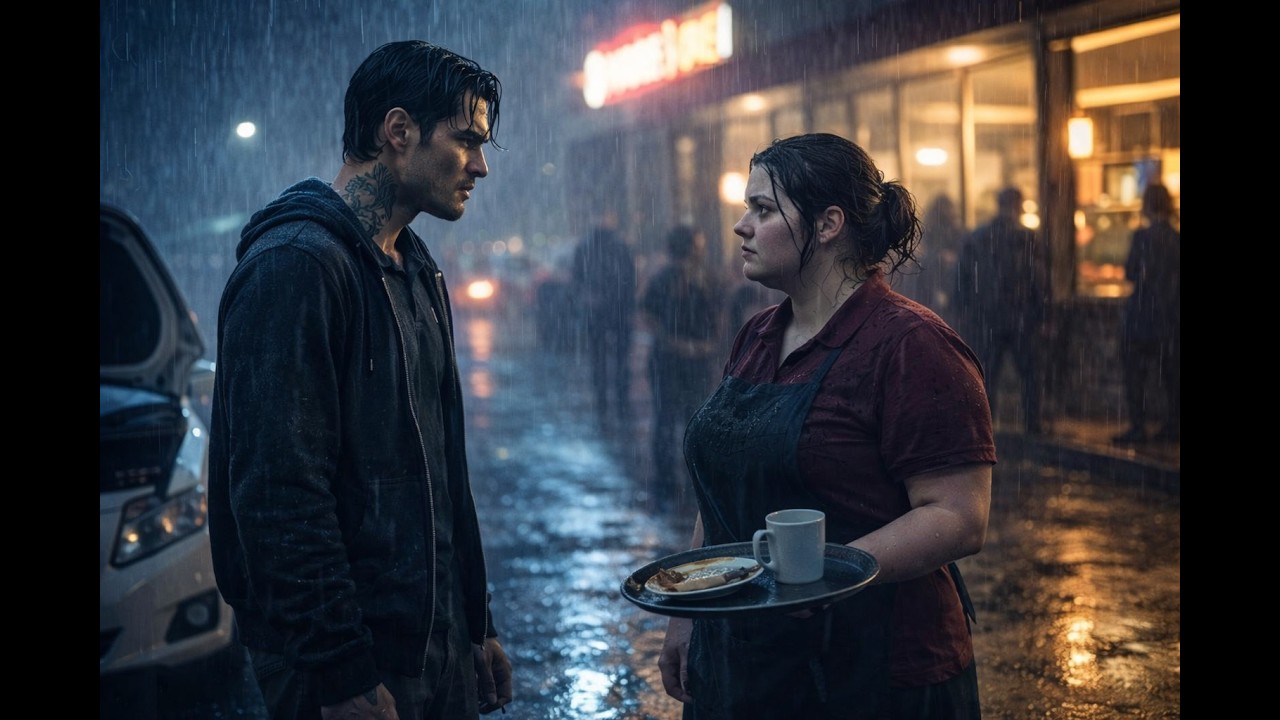
She worked the night shift—waitress, twenty-something, hair tied back too tightly like she was trying not to take up space in the world. The other staff ignored her. Customers ignored her even harder. She moved through the diner like a ghost that had learned to carry trays.
Except she didn’t treat him like a ghost.
On his second night, she placed half a sandwich beside the sink.
“You didn’t eat,” she said simply.
He looked at it, then at her.
“I didn’t order.”
“You look like someone who forgot how.”
It should have annoyed him. It didn’t.
He ate it.
Not because he was hungry.
Because no one had offered him anything without wanting something in return for years.
Days turned into a quiet pattern.
He washed dishes.
She served tables.
The world outside screamed money, power, violence—but inside the diner, everything was reduced to small human gestures: a tired smile, a shared shift, a coffee refilled without asking.
But Kang J. Min was not resting.
He was watching.
Not the customers.
The women.
There were three regular waitresses who rotated through the diner. One flirted with powerful men who came in late at night. Another ignored the homeless who sometimes slept outside. The third laughed too loudly at jokes she didn’t hear properly.
None of them noticed the small tests.
A dropped wallet left on purpose.
A man in ragged clothes asking for water.
A trembling hand reaching for change that wasn’t enough.
Each time, the reactions were different.
But predictable.
Except Nariah.
She was different in ways that didn’t announce themselves.
She gave her own sandwich away when no one was watching.
She refilled coffee for people who didn’t tip.
She sat beside an old man who never ordered anything and pretended he belonged there.
And when Kang J. Min watched her, something unfamiliar tightened in his chest.
Not trust.
Not admiration.
Something more dangerous.
Recognition.
On the eleventh night, trouble walked into the diner wearing leather jackets and cheap arrogance.
Three men.
They didn’t order food.
They ordered attention.
Nariah was the one who approached them first.
“You’re blocking the booth,” she said calmly.
The leader smirked. “Maybe we like it here.”
The diner went quiet in the way places do right before they decide whether someone is about to get hurt.
From the dish station, Kang J. Min didn’t move.
He didn’t need to.
Not anymore.
But something in him did.
Old instincts. Old violence. The version of him that never lost.
He watched as one of the men reached for her wrist.
And stopped himself.
Not with force.
With breath.
Nariah didn’t flinch.
She gently pulled her hand away like she was correcting a misunderstanding.
“You can leave,” she said. “Or I can forget you were ever here.”
The man laughed.
That was his mistake.
Because laughter assumes safety.
And safety was something this diner had never guaranteed.
The situation ended before it escalated further—not because of fear, but because Nariah said something under her breath that made the leader hesitate.
Something Kang J. Min couldn’t hear.
But he saw it.
The shift in power.
The sudden recalibration in the men’s posture.
And then they left.
Too fast.
Too quiet.
Like they had been recognized.
Not threatened.
Recognized.
Kang J. Min watched her after that.
Not as a man hiding from his empire.
But as a man beginning to suspect he had walked into something far more calculated than coincidence.
The black sedan arrived on a Thursday morning.
It didn’t park.
It claimed space.
Three men stepped out in tailored suits that didn’t belong in a place like this. One of them scanned the diner, eyes sharp, trained, waiting for orders that hadn’t yet been spoken.
Kang J. Min felt it before he saw it.
The past doesn’t knock.
It arrives.
From the dish station, he watched the reflection in the metal sink.
His old world had found him.
Or was about to.
But something was wrong.
Because they weren’t looking for him.
They were waiting.
For someone else.
That evening, Nariah didn’t show up for her shift.
Instead, she came in an hour before closing, when the diner was nearly empty.
She wasn’t wearing her uniform.
She wasn’t smiling.
And for the first time since Kang J. Min had met her, she didn’t look like she belonged to the background of anyone’s life.
She looked like the center of it.
She sat at the counter.
Placed a small recorder on the table.
And said, softly:
“You can stop pretending now.”
Kang J. Min froze.
Not because of fear.
Because of understanding.
“You knew,” he said.
It wasn’t a question.
Nariah turned the recorder on.
A red light blinked.
“I knew the moment you walked in here,” she replied.
The diner, suddenly, felt smaller.
“Do you know how hard it is to make someone like you disappear?” she continued. “A man who owns half the city doesn’t just walk into a diner and start washing dishes.”
Kang J. Min’s hands stopped moving.
For the first time in years, he felt something close to exposure.
Not physical.
Existential.
“You weren’t hiding from your empire,” she said. “You were testing it. Testing people. Waiting to see who would treat a broken man like a human being.”
A pause.
Then she leaned forward slightly.
“But you made one mistake.”
His eyes narrowed.
“You assumed you were the only one running a test.”
Silence dropped like a blade.
The diner’s hum faded.
Even the rain outside seemed to wait.
Nariah slid a folder across the counter.
Inside were photos.
Records.
Transfers.
Meetings.
His meetings.
His empire.
His crimes.
Everything he thought was invisible in the underworld of power.
And at the bottom—
A press badge.
Her name.
Investigative Journalist. City Ledger.
Kang J. Min stared at it.
Slowly, the truth rebuilt itself in his mind.
The diner wasn’t random.
Nariah wasn’t random.
The sandwich.
The kindness.
The observation.
The silence.
He had been studied.
Not as a king in exile.
But as a subject.
Nariah watched him carefully now.
“You weren’t testing women,” she said. “You were testing whether your power had poisoned everyone around you.”
A faint, almost sad smile.
“So I gave you your answer.”
The plot twist didn’t feel like revelation.
It felt like collapse.
Because Kang J. Min realized something worse than being exposed.
He realized he had been understood.
Completely.
Before he ever chose to run.
The black sedan outside turned on its headlights.
The men in suits entered the diner.
This time, they weren’t looking for him.
They were looking at him.
Waiting for confirmation.
One step and his empire could be restored.
One command and everything she had gathered could disappear.
But Nariah didn’t look afraid.
She looked finished.
Not with him.
With the illusion.
“You can go back,” she said quietly. “Or you can finally stop pretending you ever wanted to.”
For the first time in his life, Kang J. Min saw his power clearly.
Not as strength.
As gravity.
Something that pulled everything toward destruction.
The room tightened.
The men waited.
The recorder blinked.
And then—
He did something no one in his empire had ever seen him do.
He laughed.
Not loudly.
Not cruelly.
Just once.
Like a man who had finally heard the truth too clearly to argue with it.
He reached into his pocket.
Removed the only thing tying him to his old identity.
A ring.
Heavy. Cold. Marked with a symbol no one outside his world would survive recognizing.
He placed it on the counter.
And slid it toward the men in suits.
“No throne,” he said.
Three words.
Final.
The men didn’t move.
They couldn’t.
Because this wasn’t disobedience.
It was erasure.
The power structure they served had just been voluntarily deleted by the one person who owned it.
Nariah’s expression changed.
Just slightly.
Not victory.
Not relief.
Something quieter.
Understanding.
The kind that comes when a story ends differently than expected, but exactly as it should.
The sedan outside didn’t leave immediately.
It simply stayed on.
Like it didn’t know what to do with a king who refused to be one.
Kang J. Min walked past the suited men.
Past the door.
Past the world that had defined him.
And sat back down on the curb beside the diner.
Nariah followed after a moment.
She didn’t sit too close.
But she didn’t leave either.
The rain had stopped.
The street was wet enough to reflect the sky.
He looked at her.
“You used me,” he said.
“Yes.”
A pause.
“And I used you back,” she added.
That landed differently.
Because it was true.
Not betrayal.
Balance.
For the first time in years, neither of them held absolute power over the story.
Only truth.
Only consequence.
The diner lights flickered behind them.
Life continued inside as if nothing had changed.
But outside, something irreversible had already ended.
The next morning, the empire officially collapsed.
Not through war.
Not through violence.
Through exposure.
Financial networks froze.
Allies disappeared.
Records surfaced in places they were never meant to reach.
And the name Kang J. Min stopped being spoken in fear.
It stopped being spoken at all.
He stayed in the city.
Not as a king.
Not as a fugitive.
Just a man who knew what he used to be capable of.
Nariah published everything.
But she never published his face.
Only the system.
Only the truth.
When asked why, she gave a simple answer:
“Some people don’t need to be destroyed. They just need to be seen clearly enough that they choose to stop.”
One evening, months later, they stood outside the same diner.
It had reopened under a different name.
Different owner.
Different life.
He watched it for a long time.
Then asked quietly, “What would’ve happened if I never walked in?”
Nariah didn’t answer immediately.
Then she said:
“Then you would’ve kept winning until there was nothing left that could survive you.”
A pause.
“But you walked in anyway.”
The weight of that settled between them.
Not as praise.
Not as forgiveness.
As fact.
The final truth wasn’t about mafia bosses or journalists or hidden tests.
It was simpler.
And heavier.
Power doesn’t disappear when you abandon it.
It only reveals who you become when you’re no longer allowed to use it.
And in the end, the most dangerous man in the city wasn’t the one who ruled everything.
It was the one who finally learned how to live without needing to rule at all.
Because that is the moment people either fear you forever…
or remember your name for something no empire can buy.
And somewhere in that quiet, unfinished space between destruction and peace, the city learned a new rule:
Not everyone who disappears is lost.
Some choose to become human instead.
And that changes everything.