For centuries, the rose-red city of Petra has captivated the world with its breathtaking facades carved into sheer desert cliffs, but the most iconic monument of all, the Treasury, has just surrendered a secret so profound that it forces archaeologists to rewrite everything they thought they knew about the ancient Nabataean kingdom. A team of researchers using ground-penetrating radar has detected and then excavated a sealed tomb hidden directly beneath the Treasury, a chamber that had remained untouched for nearly 2,000 years, containing the remains of at least 12 individuals, a stunning find that has no parallel in the history of the site. The discovery, announced exclusively by the American Center of Research and the Jordanian Department of Antiquities, confirms what locals have whispered for generations and what serious scholars had long dismissed as romantic fantasy.
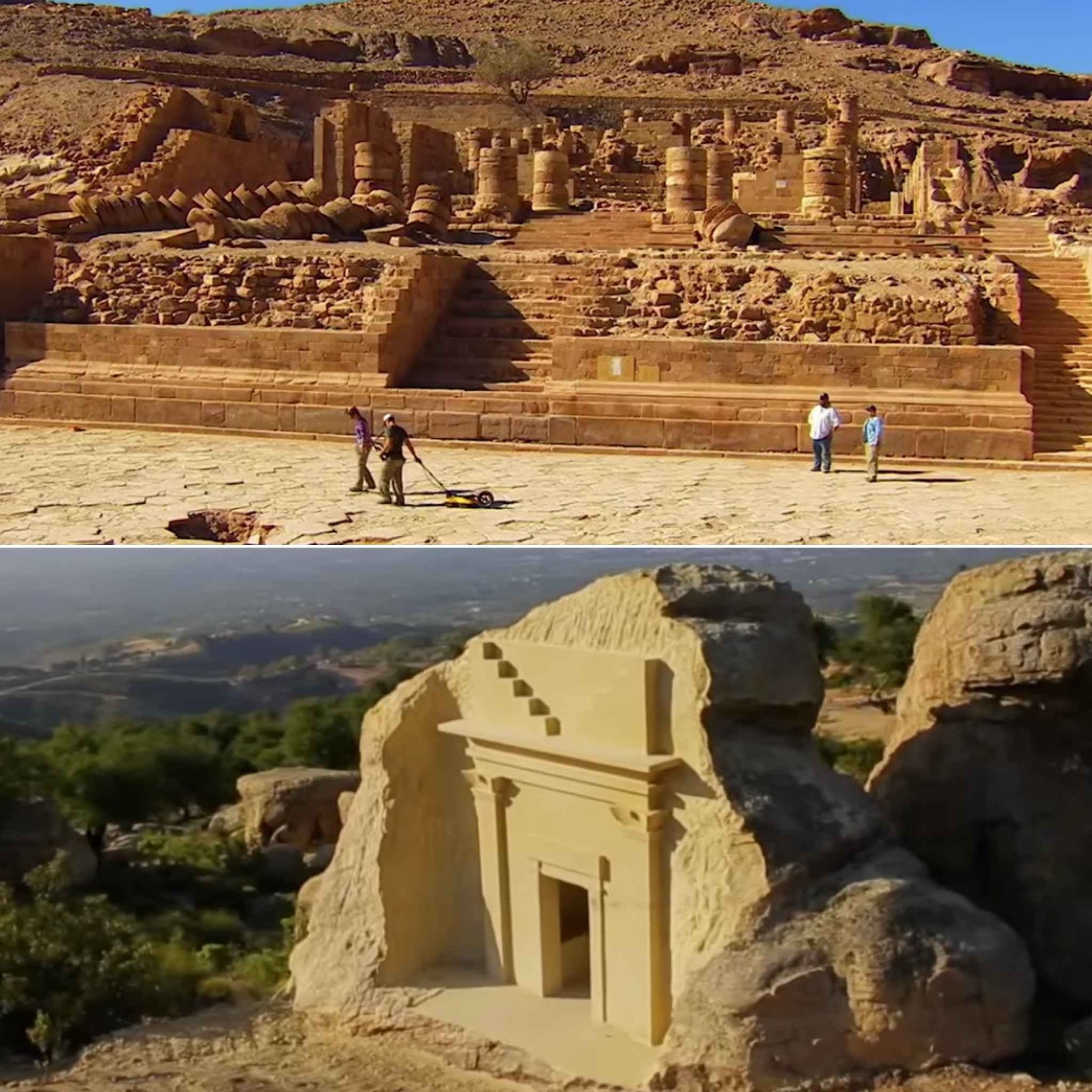
There was a void. The radar picked it up in clean, unmistakable lines, a pocket of empty space buried in the rock beneath the most famous facade in the ancient world. For decades, experts believed that the Treasury, known locally as Al-Khazneh, was nothing more than a beautiful cut in the cliff, a grand tomb perhaps, but hollow only in the sense that its carving was shallow. The idea that something could be hidden deep inside the living rock, sealed and whole, seemed too cinematic to be true. But the technology does not lie. The ground-penetrating radar fired energy into the earth and listened to the echo, and what came back was a shaped, deliberate emptiness, a room with edges that nature could not have created on its own. The team knew instantly that they had found something extraordinary, but even they could not have predicted what awaited them.
The excavation was painstaking, surgical in its precision. The diggers could not simply cut straight down through the monument, one of the modern wonders of the world. Instead, they worked from the outside, digging sideways, brushing away soil in layers only a few centimeters thick. Every handful was sifted, every fragment catalogued. The mood at the site was tense from the very first day because everyone understood that a tomb that has stayed sealed for two millennia can only be opened once, and any mistake would be irreversible. As the team descended, they encountered carved steps and smooth-cut walls, evidence that this was no accidental cavity but a purpose-built chamber, sealed with deliberate skill by the very people who had built the Treasury itself. The blocks fitted so tightly together that barely a breath of air could pass, a closure so complete that the space inside had been isolated from the outside world for the entire span of recorded history.
When the final seal was broken, the first thing to emerge was the air itself, cold, stale, carrying the smell of dust that had been trapped since before the rise of Rome, before the birth of Christ, before most of the modern world existed. To the archaeologists standing in the trench, it felt like inhaling the past, a single long breath held for twenty centuries and released into the desert morning. Then the lights went in, and the radar’s promise gave way to a revelation that left even the most seasoned researchers speechless. The chamber was not empty. It was filled with the dead, arranged with a care that spoke of love, not fear. At least twelve individuals lay on low stone ledges, their skeletons still fully articulated, their bones connected and in proper order, untouched by looters, untouched by the floods that had ravaged other tombs in Petra for centuries.
This is the part that has shaken the archaeological world. In all of Petra, hundreds of tombs line the cliffs, but almost every single one was emptied long ago, stripped clean by ancient thieves or scattered by natural forces. Human remains from the Nabataean period are vanishingly rare, and when they do appear, they are usually broken fragments, a jawbone here, a finger bone there. To find twelve complete, undisturbed burials in a single chamber is not just rare; it is unprecedented. Pierce Paul Creasman, head of the American Center of Research and one of the leads on the dig, described the moment as surreal, a feeling that they had crossed a line that was never meant to be crossed. The bodies were not all the same. Some were adults, others were children, laid to rest beside their elders. Each one had been placed with evident tenderness, some alone, others in pairs, arranged in a way that plainly meant something to the people who had sealed the door behind them.
And then there were the grave goods. Bronze, iron, and ceramic vessels had been set carefully beside the dead, a small jar near one person’s hand, a bowl resting close to another’s feet. Not extravagant heaps of gold, nothing like the fabled pharaoh’s treasure that local legends insisted filled the great urn atop the Treasury, but objects chosen and placed with purpose, the kind of belongings meant to accompany someone into whatever the Nabataeans believed came next. And then the lights found something that turned an extraordinary discovery into a global sensation. One of the skeletons was not resting empty-handed. It was holding a ceramic chalice, a cup raised and rounded, cradled in the bones of the person who had carried it into the dark. The shape was unmistakable, and the connection was immediate for anyone who has ever seen Indiana Jones. The Treasury, after all, is the place where the movies sent Harrison Ford searching for the Holy Grail, and here, in the real tomb beneath that real facade, a real skeleton lay clutching a real cup that looks exactly like a grail.

Of course, the archaeologists are careful to say that this is not the Holy Grail. It is a Nabataean ceramic vessel, ancient and authentic, but its symbolic weight is impossible to ignore. The image of a 2,000-year-old hand still holding a cup in the darkness beneath the most iconic monument in the entire desert is the kind of thing that reminds us that these were not statistics. They were people. Someone long ago decided that this person should carry this cup into eternity, and then they sealed the door behind them so that the choice could never be undone. That decision, that act of deliberate closure, is what has preserved this room so perfectly that the air inside stayed trapped for twenty centuries. Now the question that haunts every archaeologist is also the simplest one: why would anyone seal a tomb so completely?
The honest answer is that we do not know, and the silence on the walls only deepens the mystery. There were no inscriptions, no carved names, no dates, no explanation at all. The Nabataeans, who built this entire city out of living rock and who engineered a complex system of water channels that allowed a city to bloom in the desert, left no written record in this chamber. Into that void, the human imagination pours, as it always has at Petra. Some whisper that the tomb was sealed to contain something dangerous, a plague, a curse, a horror that was never meant to walk free again. But the evidence inside the room argues against that grim interpretation. The bodies were laid out with care, not thrown in panic. The children were placed gently among the adults. The grave goods were arranged with ritual purpose. This room does not tell a story of fear. It tells a story of grief, of devotion, of a community doing something solemn for their dead, and then locking it away to keep them safe forever.
The irony is profound. The very thing that allows our imaginations to run wild, that total and perfect closure, is also the thing that preserved these people so completely that modern science can now make them speak. The real revelations are still coming, not in the canyon, but in laboratories far from Petra. DNA analysis is underway to determine whether these twelve individuals are linked by blood, whether they are a single family laid to rest across generations, or whether they were brought together for some other reason that we cannot yet see. If they share a bloodline, the tomb becomes a snapshot of a Nabataean household, a small dynasty preserved in stone. If they do not, the meaning tilts in a completely different direction, pointing toward an event, perhaps a ritual sacrifice or a collective burial after a catastrophe. One genetic test could swing the entire story one way or the other.
But the bones and the teeth hold far more than just genetics. Chemical isotope analysis can read the traces locked into a person’s own remains and reconstruct what they ate and where they grew up. A diet rich in imported goods would point toward individuals of high status, people who lived well inside a wealthy trading kingdom that controlled the frankincense and myrrh routes from southern Arabia to the Mediterranean. Evidence of a simpler local diet would tell a very different story, of ordinary lives lived in the shadow of a great and glittering city. The same techniques can reveal whether someone spent their childhood in this valley or arrived from a distant land, opening a window onto how people moved across the ancient world. Then there are the vessels, including that chalice. The grave goods may still carry microscopic residue, the faint chemical ghosts of whatever they once held. Residue analysis could pick up traces of wine, of oil, of incense, of offerings whose true nature we can only guess at now.
Until that laboratory work is finished, every interpretation has to stay provisional, every conclusion held loosely. The team is in no hurry to outrun the evidence because they understand something fundamental. People who lived and died 2,000 years ago, who left behind no name and no written word, who vanished from history the moment that door was sealed, can still tell us where they were born, how they lived, what they ate, and perhaps even who they were to one another. The body itself becomes the document. In a tomb where the walls stayed blank and the silence held for twenty centuries, these quiet witnesses may end up speaking more clearly than any inscription ever could have. And they are just about ready to begin. The DNA analysis is expected to yield results within the coming months, and the archaeological world is holding its breath.

Now, step back and look at what all of this adds up to because the Treasury can never be seen the same way again. It is not just a beautiful face in the cliff anymore. It is a door. For 2,000 years, the most photographed monument in all of Petra was sitting directly on top of a hidden human story. Twelve people, their belongings, a cup held in the dark, and nobody had the faintest idea. The monument that came to represent the entire city to the outside world was the whole time the lid on something far more intimate and far more human than any of the millions who stood before it could have guessed. And that should make the hair on the back of your neck stand up just a little because if a sealed tomb could survive intact, untouched beneath the single most visited spot in all of Petra, then what on earth is still waiting under everything else?
The hundreds of other tombs lining the cliffs, the unexplored slopes, the valleys in the desert of Jordan that have barely been touched at all. The same kind of technology that found this room keeps turning up voids and anomalies and buried structures right across the region, and every one of them is a chapter that nobody has read yet. That is the truth this sealed room leaves us with, not a curse, not a massacre, not some buried horror dragged into the light, but something quieter and far more profound. The most familiar places on Earth can still be hiding the most extraordinary things right beneath the feet of people who think they already know the whole story. Petra was never finished talking. We had simply stopped expecting it to speak, and it just proved in the most unforgettable way that the rose-red city has only begun to give up what it knows.
As the scientific analysis proceeds, the world watches with a mixture of awe and anticipation. The tomb beneath the Treasury has already changed the way we understand Nabataean funerary practices. The presence of children among the adults challenges older theories that suggested only elites were buried in such prominent locations. The careful arrangement of the bodies and the inclusion of grave goods points to a complex set of beliefs about the afterlife, beliefs that we are only now beginning to glimpse. The discovery also raises urgent questions about preservation. The Jordanian authorities and the international research team are working closely to ensure that the tomb and its contents are protected for future study. The site has been sealed again temporarily while the excavation data is analyzed, and a long-term plan for conservation is being developed. The Treasury itself remains open to visitors, but the area immediately around the newly discovered chamber is now a restricted archaeological zone.
The excitement among scholars is palpable. For decades, Petra has been studied primarily through its monumental architecture and its inscriptions. The discovery of an intact burial assemblage offers a completely new kind of evidence, one that can answer questions about daily life, health, diet, and social structure that were previously unanswerable. The isotopic analysis of the teeth, for example, can reveal whether these individuals drank locally sourced water or water from distant springs, which would indicate mobility or trade connections. The study of the bones can determine age, sex, and even signs of disease or injury. The ceramic vessels can be dated and traced to their places of origin. The chalice itself, though not the Grail, is a masterwork of Nabataean pottery, and its preservation is exceptional. Every object in that room is a piece of a puzzle that archaeologists have been trying to solve for 200 years.
The story of how the tomb was found is also a story of technological progress. It was not a lucky accidental dig that uncovered it, but a deliberate, scientific search. For decades, local guides and Bedouin storytellers had spoken of hidden chambers beneath the Treasury. Western scholars dismissed these tales as folklore, but the persistent oral tradition kept the idea alive. Then, in 2020, a team led by geophysicist Richard Bates from the University of St. Andrews conducted a remote sensing survey of the area around the Treasury. Using ground-penetrating radar and electromagnetic conductivity instruments, they mapped the subsurface in unprecedented detail. The data revealed a distinct anomaly, a void about six meters deep, with a shape that was too regular to be natural. It took another three years to secure the necessary permissions and funding to excavate. The work began in early 2024, and the breakthrough came in the summer of that same year.

The excavation team included specialists from the American Center of Research, the Jordanian Department of Antiquities, and several international universities. They worked in extreme conditions, with temperatures in the canyon often exceeding 40 degrees Celsius. The dig site was covered with a protective tent to shield it from the sun and from the thousands of tourists who pass by the Treasury every day. The secrecy of the operation was remarkable. The team released no information until the tomb was fully opened and documented, fearing that premature announcements could attract looters or cause a media frenzy that would compromise the scientific work. Now that the discovery has been made public, the response has been overwhelming. News outlets around the world have picked up the story, and social media is buzzing with theories about the chalice and the identity of the 12 individuals. Some have even speculated that the tomb might be that of Aretas IV, the Nabataean king who ruled during the time of Christ and who is often associated with the construction of the Treasury. But the archaeologists caution against jumping to conclusions.
There is no direct evidence linking the tomb to Aretas IV or any other known historical figure. The lack of inscriptions is frustrating, but it is also typical of many Nabataean tombs. The Nabataeans were a people who borrowed artistic styles from Greece, Rome, Egypt, and Mesopotamia, but they left relatively few written records in their tombs. Their language, a dialect of Aramaic, is only partially deciphered, and most inscriptions that survive are short and formulaic. The fact that this tomb has no text at all may indicate that it belonged to a family that was wealthy and important enough to be buried at the foot of the Treasury but not royal enough to merit a carved epitaph. Or it may indicate that the tomb was sealed in haste, perhaps after a sudden death or a period of crisis. The team is exploring all possibilities, and the DNA results will be critical in narrowing them down.
The chalice, meanwhile, has become the symbol of the entire discovery. It is a simple ceramic cup, about 15 centimeters tall, with a flared rim and a narrow stem. It is not made of gold or silver, but it is beautifully proportioned and perfectly preserved. The skeleton holding it is believed to be an adult, possibly female, based on preliminary osteological analysis. The cup was nestled in the crook of the right arm, as if the person had been holding it when they were laid to rest. This is highly unusual. Grave goods in Nabataean tombs are typically placed beside the body, not clutched in its hands. The positioning suggests a very personal connection between the deceased and the vessel, perhaps indicating that it was a favorite cup used in life, or a ritual object of special significance. The resemblance to the iconic image of the Holy Grail from film and legend is uncanny, but the archaeologists insist that this is purely coincidental. The cup is Nabataean, dating to the first century BCE or first century CE, contemporary with the construction of the Treasury itself.
As the weeks pass, the scientific community is bracing for more surprises. The preliminary DNA analysis is expected to be completed within the next month. The results will be published in a peer-reviewed journal, and the team has promised to release the data openly so that other researchers can verify and build upon the findings. The Jordanian government has expressed its full support for the research, recognizing that the discovery has the potential to boost tourism and to deepen the world’s appreciation of Jordan’s cultural heritage. King Abdullah II has been briefed on the findings, and there are plans to create a special exhibition at the Petra Archaeological Park that will display replicas of the grave goods and explain the significance of the tomb. The original artifacts, including the chalice, will be kept in a controlled environment at the Jordan Museum in Amman, where they can be studied and preserved for future generations.
But beyond the scientific and political implications, there is a human story that resonates across the millennia. Twelve individuals, sealed in a room beneath a monument that would become one of the wonders of the world, forgotten by history for 2,000 years, and now brought back to light by a combination of modern technology and old-fashioned determination. Their names are lost, but their presence is undeniable. They were loved, they were mourned, and they were laid to rest with a care that transcends time. The sealed room beneath the Treasury has not solved the mystery of Petra. It has only deepened it. And that is exactly what makes this discovery so breathtaking. The rose-red city has spoken at last, but its message is still being deciphered. The tomb is open, but the story is far from over. The world waits for the next line of the translation, for the genetic tests, the chemical analyses, the residue studies that will turn bones and pottery into voices. And when those voices speak, Petra will never be the same. Neither will we.