Mount Tendurk, Turkey – A team of archaeologists has pulled back the veil on one of history’s most enduring mysteries, revealing evidence that has reignited the global debate over the existence of Noah’s Ark. Using ground-penetrating radar and subsurface imaging, researchers have mapped a massive, boat-shaped formation buried deep beneath a volcanic slope in eastern Turkey. The discovery, made at the Durupinar site on Mount Tendurk, has left the scientific community grappling with data that defies easy explanation. What they found is not a simple rock formation but a structured anomaly with clean angles, symmetrical compartments, and dimensions that align almost perfectly with ancient texts.
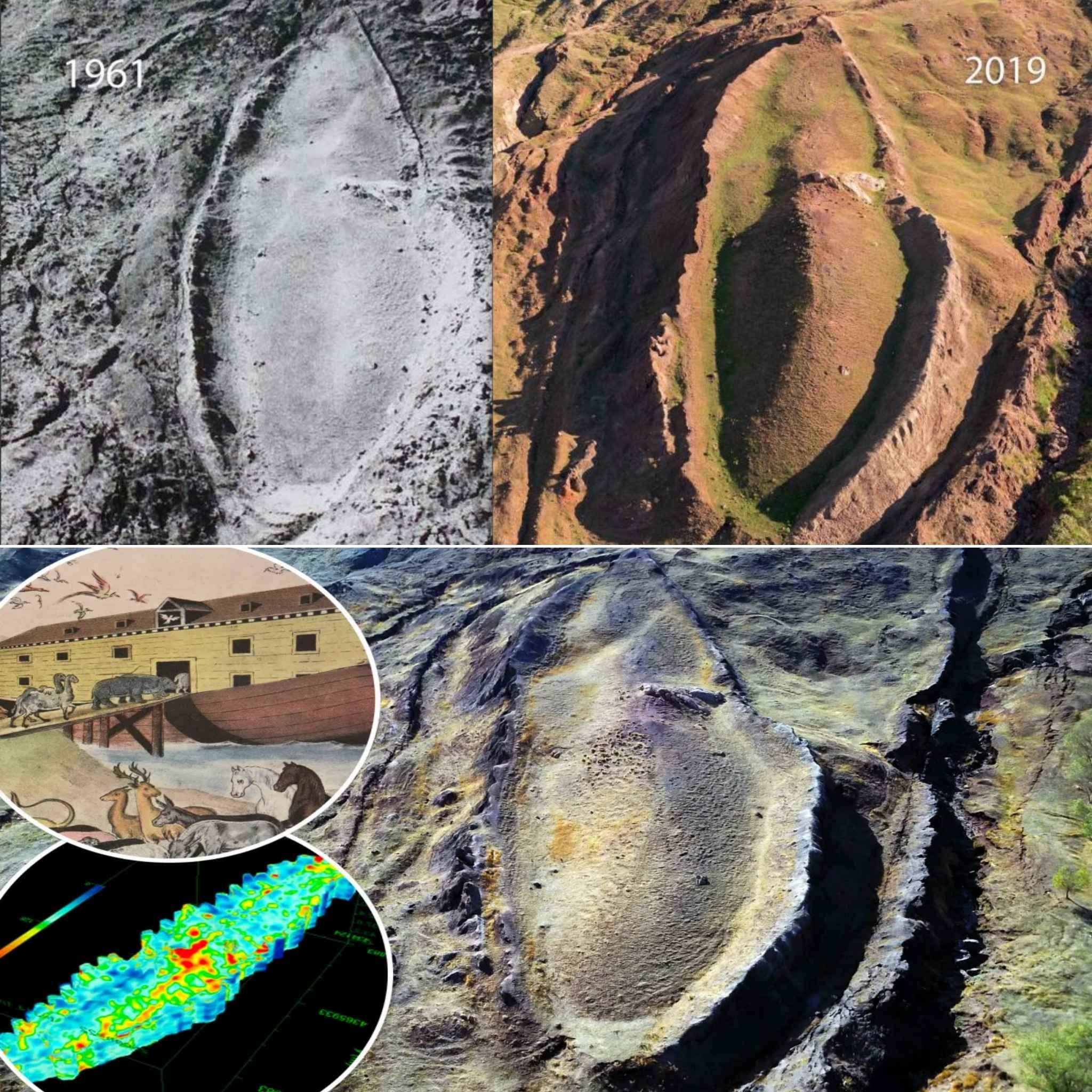
The revelation comes after months of meticulous scanning and soil analysis, and the team is choosing their words carefully. They are not declaring victory, but they cannot ignore what the machines are telling them. The site, long dismissed as a natural curiosity, is now the focal point of a high-stakes investigation that blends archaeology, geology, and faith into a single, combustible question: Could this be the vessel that survived the great flood?
The formation stretches more than 500 feet in length, a near-perfect oval with a pointed bow and rounded stern. It sits on the slopes of Mount Tendurk, a harsh, jagged volcano in the rugged terrain near the more famous Mount Ararat in eastern Turkey. This is not a place people wander into; it is dry, remote, and punishing, the kind of land where a secret could rest for millennia without disturbance. Yet for generations, locals have pointed to this shape, telling the same story their great-grandparents told. From the air, it is impossible to ignore: a long, symmetrical indentation pressed into the earth like the ghost of an enormous vessel.
Modern technology finally allowed the team to see beneath the surface. They walked the instruments across the formation grid by grid, expecting to find chaos, crumbled rock, and jagged layering. Instead, their screens flashed back straight lines, right angles, layered sections stacked like floors in a building, and symmetrical compartments spaced with a regularity that erosion simply does not produce. These patterns extended roughly 8 to 20 feet underground, well below the reach of wind and weather. Whatever is buried there does not look like an accident; it looks built.
Nature carves canyons and raises mountains, but it almost never draws a straight line. Straight lines, right angles, and repeating compartments at a fixed depth are the fingerprints of intention, not geology. The measurements hidden inside that formation matched the proportions written in an ancient text thousands of years old—not roughly, but close enough to make the researchers standing on that ridge go very quiet. They stopped guessing and started testing.
Soil samples pulled from inside the outline were compared to dirt just a few feet outside. They did not match. The soil inside carried more organic material, the chemical ghost of once-living matter, exactly the kind of trace you would expect from wood that rotted away over an unthinkable span of time. The mineral balance was off too, and even the plants growing on top of the shape looked subtly different from everything around them, as if the ground itself was keeping a secret it could not quite hide.
Scattered around the site, the team found massive stone slabs taller than a person with holes deliberately carved through them near the top. To some, they look exactly like anchor stones, the kind you would drop to steady an enormous vessel against a current strong enough to drag it. Who cut them and when remains unknown. Local families for generations have passed down fragments of the story: odd objects surfacing after storms, strange streaks in the soil, pieces of wood gone hard as rock found impossibly high up. Nothing that proves anything on its own, but enough small nagging clues to keep the question alive across centuries.
Then came the drilling. The team lowered cameras built to slip into tight underground gaps, fully expecting to find blackness, dirt, and dead stone. What came back on the feed instead sent a ripple around the world. Down in those shadowed cavities, there was order: repeating patterns, sharp-edged hollows, divisions that looked less like geology and more like rooms, compartments, the inside of something designed to hold things and keep them apart.

The researchers are not shouting that they have found the ark. They are saying something far more careful and far more unsettling: we cannot explain this yet. The formation refuses to behave like rock. The soil refuses to behave like soil. The interior refuses to look like an accident. You are left with a problem that will not let go of you—something structured buried in a mountain that should hold nothing but lava and stone.
This is not the first time someone has stood on a slope in eastern Turkey and sworn they found the ark. Decades earlier, Ron Wyatt, a nurse anesthetist from Tennessee, staked his entire life on that exact claim. He saw a photograph of the boat-shaped outline and felt a certainty that cost him the next chapter of his life. Wyatt spent more than two decades traveling across deserts and mountains, claiming to have located nearly a hundred biblical relics. He never had the data to prove it; the tools that might have settled the argument did not exist yet. He died still believing, still dismissed, still waiting for a kind of proof he had no way to pull out of the ground himself.
The modern team with the radar and the drills is not alone. The hunt for the ark is ancient, one of the oldest manhunts on Earth. The first-century historian Flavius Josephus wrote that pieces of the ark were still lying in the mountains of Armenia. Early Christian writers, medieval scholars, and Islamic geographers all insisted the same thing: the ark was real, physical, and up there somewhere. The flood story appears in roughly 200 cultures worldwide, from the Near East to the Americas to islands in the Pacific. Different gods, different heroes, same catastrophe.
Irving Finkel of the British Museum decoded a Babylonian tablet describing a giant circular boat with precise measurements. Someone in India built a replica from those instructions, and it floated. The ancient world was not only telling flood stories; in at least one case, they were leaving behind blueprints.
For most of history, the search ran on nothing but word of mouth and hopeful eyes. In 1876, traveler James Bryce climbed high on Mount Ararat, well above the tree line, and found a piece of worked timber lying in the rock and ice. He carried it down the mountain, convinced he was holding a splinter of the ark itself. Claim, buzz, doubt, silence. In 1959, Turkish army captain Ilhan Durupinar spotted the boat-shaped outline during an aerial mapping mission. Early investigators trekked out, took measurements, and delivered the verdict: natural, just mud and lava. The site went quiet for years.
In 1908, an old man named George Hegopian swore that as a boy, his uncle led him up into the Ahora Gorge and set him down on top of a vast wooden structure half buried in the ice. He walked across the roof of the ark with his own two feet. It is a breathtaking story that falls apart under scrutiny, but he carried it to his grave. Dozens of expeditions chased his memory up that mountain and came back with nothing.

In 2010, a Hong Kong-based media group dropped dramatic footage of team members standing inside a wooden chamber high on Ararat, announcing they had found the ark. It was global news for five minutes, then people noticed the straw looked fresh, the cobwebs intact, and the claim collapsed under its own weight. Every generation gets its turn, every claim gets its headline, and every time the same quiet ending: eyewitnesses, blurry photos, gut feelings, and faith, but never the one thing that could close the case for good.
That is why the radar changes everything. For the first time, the people standing on that ridge are not pointing at a shadow and asking you to believe them. They are holding measurements. The dimensions hidden inside the formation match the proportions written in the book of Genesis almost uncomfortably. The soil chemistry inside the outline is different from the surrounding earth. The interior compartments are arranged with a regularity that natural processes cannot replicate.
While everyone was staring up at the mountains, a very different explorer decided the real evidence might be hiding in the opposite direction entirely—straight down, under the water. Robert Ballard, the man who found the Titanic, turned his attention to the oldest flood story humanity has. In 2012, he announced he would take robotic submersibles into the Black Sea to look for the remains of a drowned world. The theory is that thousands of years ago, the Black Sea was a freshwater lake ringed with human settlements, until the rising Mediterranean burst through the Bosphorus Strait with the force of a waterfall many times the size of Niagara, swallowing the land hour by hour.
Ballard’s robots found an ancient shoreline sealed in place, about 400 feet down. Carbon-dated shells from that old beach pointed to roughly 5,000 years before the common era, landing squarely in the window some scholars tie to flood traditions. He summed up what that disaster would have meant for the people who lived through it: it was probably a very bad day. The artifacts the robots pulled from the gloom suggested those people had not packed up and strolled away; they had been driven out fast by water that took everything.
The discovery on Mount Tendurk and Ballard’s findings beneath the Black Sea create two trails running in opposite directions, yet both point to the same ancient catastrophe. The moment that ridge in Turkey lit up the radar, the story stopped being an archaeology story and became something far more combustible: a place where faith, science, and history all slam into each other at once.
For people who grew up on the story of Noah, this hits like a memory they had quietly folded away, coming suddenly back to life. The bedtime tale, the children’s picture of the boat and the pairs of animals, is abruptly shadowed by the thought that maybe the outline of the real thing is pressed into a mountainside right now. Nobody handed them proof, but the whisper of it changes the texture of the world. It makes the old stories feel less like inventions to comfort ourselves and more like things we are slowly remembering.

The scientists do what scientists do: they get cautious. They argue over whether those buried shapes are petrified wood or a cruel coincidence of geology. Rock can fake a straight line. Dirt can play tricks. Hope has fooled smart people before. And yet, the thing under that mountain still refuses to behave the way the surrounding rock behaves. More than a few researchers find themselves stuck in the one place scientists hate most: admitting out loud that they cannot fully explain it.
The historians widen the lens even further. Nearly every ancient civilization on Earth carried a flood story. Maybe the real discovery is not a vessel at all, but a shared scar—a memory so enormous that humanity carried it across thousands of years and dozens of cultures because something genuinely happened. The location of this site lines up unnervingly well with the old accounts that point to the mountains of Ararat.
Meanwhile, the public has gone a little wild. People who never read a single word of archaeology are suddenly squinting at radar scans like exam questions. The skeptics dig in hard, warning that excitement does not rewrite the laws of geology, that wood that old should be long gone, that we have been burned by ark hoaxes before. The believers push right back, pointing at the crisp signatures of those internal compartments, the soil that does not match, the dimensions that echo an ancient text. They are not claiming it is the ark; only that whatever this is, it is not ordinary.
Here is the quiet miracle buried in all that noise: this strange shape in a far-off mountain did something almost nothing in the modern world can do anymore. It pulled people who agree on nothing into the same conversation—believers talking geology, scientists cracking open ancient texts, strangers on opposite sides of every divide leaning toward the same hole in the ground, asking the same question.
You can see that pull in the strangest places. In the Netherlands, a man built a full-size replica of Noah’s Ark just to stand inside the scale of it. In Kentucky, the Ark Encounter rises as an enormous wooden recreation that draws crowds by the thousands. Nobody builds a 400-foot ship in a field for a story they think is meaningless. They build it because some part of them needs the thing to be real. Needs to walk its decks and feel the timbers. Needs the legend to have a body.
The story of Noah was never really about a boat. It was about survival, about loss, about the wild hope that the world can be wiped clean and life gets to begin again. That is why a shadow under the soil can stop your breath. It is not just an artifact. It is a piece of our own oldest imagination, finally pressing back up through the dirt.
The drilling is not finished. The testing is not finished. The argument is nowhere close to over. The truth is still down there in the dark, waiting for the next sample, the next scan, the next answer. The researchers have walked away from that mountain with something they cannot explain, and the whole world is arguing about what it means. For two thousand years, the search ran on belief and almost nothing else. Now for the first time, the measurements are in hand. The soil is speaking. The buried shape is refusing to be dismissed. The story under this mountain is far from over, and the next piece of evidence could change everything.