A Texas woman convicted of one of the most brutal and calculated murders in recent state history remains on death row tonight, her execution date still set by the courts, even as the victims’ family waits for a closure that may take decades. Taylor Renee Parker, now 31, was sentenced to die by lethal injection in November 2022 for the October 2020 slaying of her pregnant friend, Reagan Simmons Hancock, and the theft of Hancock’s unborn child. The case, which shocked the nation, involved a meticulously staged false pregnancy, a hammer, a scalpel, and a cold disregard for human life that prosecutors called pure evil. But despite the finality of the death sentence, Texas law and the slow machinery of capital punishment mean Parker’s last meal and last words remain distant possibilities, not current realities.
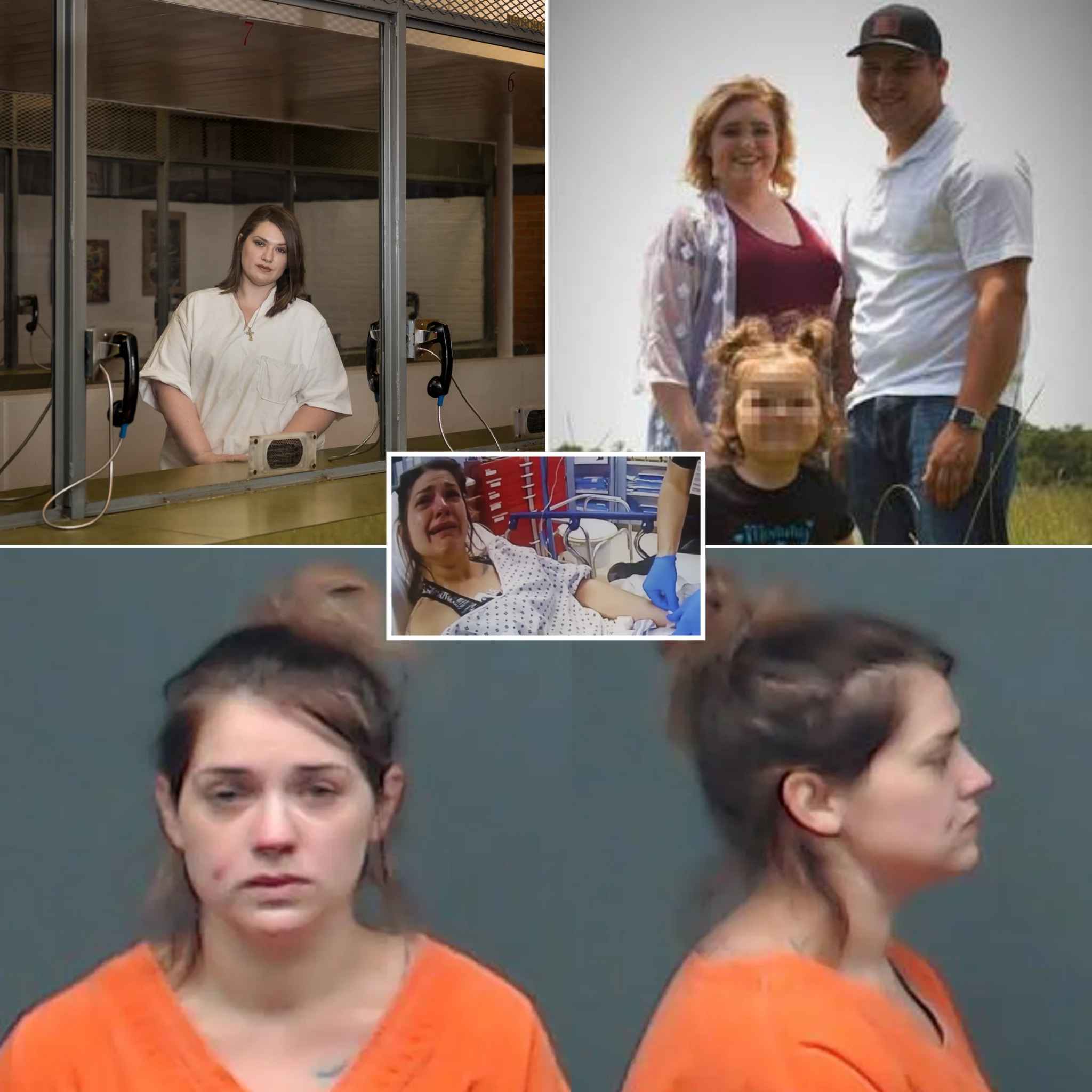
On the morning of October 9, 2020, Reagan Simmons Hancock, 21, was seven and a half months pregnant and at home in New Boston, Texas, with her three-year-old daughter, Kinley. She was preparing for a routine doctor’s appointment. Her mother arrived minutes later to find her daughter dead on the floor, stabbed more than 100 times, her skull crushed with a hammer, and her abdomen sliced open. The baby, later named Braxland Sage Hancock, was gone. Parker, then 27, was already speeding toward the Oklahoma border with the infant in her lap. The baby died shortly after arrival at a hospital. Parker initially claimed she had just given birth, but doctors quickly discovered she had no uterus—she had undergone a full hysterectomy years earlier. The lie collapsed, and the investigation revealed a dark, premeditated plan.
Parker had spent nearly ten months faking a pregnancy. She told her boyfriend, Wade Griffin, and her family that she was expecting. She wore a fake baby bump, printed ultrasound images from the internet, and even threw herself a gender reveal party. In Facebook messages, she described feeling kicks and posted photos of nursery items. All of it was a fabrication, a desperate attempt to keep Griffin from leaving her. But the deception soon turned violent. Parker began researching how to perform a C-section at home, how to induce labor, and how to cut a baby from a womb. She visited pregnancy clinics under false pretenses and even called in a bomb threat to delay a nonexistent appointment. She then reconnected with Hancock, a former client from her photography work, and monitored her pregnancy online. Hancock had no idea she had been marked.
 On the morning of the murder, Parker left her home in Sims, Texas, carrying a scalpel, a hammer, a fake hospital badge, and a diaper bag. She told her boyfriend she was having labor pains and heading to a hospital. Instead, she drove to Hancock’s home. Hancock let her inside without suspicion. There were no signs of forced entry. Within minutes, Parker attacked. She struck Hancock repeatedly with the hammer, crushing her skull. Then she used the knife to stab her more than 100 times in the face, neck, chest, stomach, and back. Hancock fought back, suffering deep cuts on her hands, but she was overpowered. Parker then used the scalpel to cut a crude C-section across Hancock’s abdomen, pulling the baby from the womb. The infant, Braxland Sage, was alive when taken but died from oxygen deprivation shortly after. In the back room, Hancock’s three-year-old daughter Kinley woke to the screams. A forensic psychologist later confirmed Hancock was conscious and fighting until nearly the end.
Parker fled toward Oklahoma. A state trooper pulled her over for speeding near the border. She jumped out of the car holding the baby, screaming that she had just given birth. The trooper noted the absence of afterbirth and a clean appearance inconsistent with recent delivery. Emergency medical services arrived and transported both Parker and the baby to a hospital in Idabel, Oklahoma. There, doctors confirmed Parker had no uterus, making childbirth impossible. The baby was pronounced dead. Back in New Boston, Hancock’s mother, Jessica Brooks, arrived at the home and discovered the gruesome scene. She called 911 in hysterics, saying her daughter’s stomach had been cut open and the baby was gone. Detectives quickly linked the hospital report in Oklahoma to the crime scene in Texas. By 10:20 a.m., Parker was detained.
The trial began in September 2022. Prosecutors presented overwhelming evidence: Google searches for C-section techniques, fake ultrasound images, a bomb threat to a women’s clinic, and phone calls from jail in which Parker never expressed remorse. The defense argued that Parker suffered from borderline personality disorder and years of trauma, but the jury rejected that claim. On October 3, 2022, after just over an hour of deliberation, the jury found her guilty of capital murder of a child and kidnapping resulting in death. On November 9, 2022, the same jury returned the death penalty. Judge John Tidwell pronounced the sentence: death by lethal injection. Parker showed no emotion. In the gallery, Hancock’s mother stood and spoke directly to Parker, saying, “You deserve to be removed from this earth.”

Parker was transferred to the Mountain View Unit in Gatesville, Texas, the state’s facility for female death row inmates. She is housed in solitary confinement for 23 hours a day in a six-by-ten-foot cell. As of now, no execution date has been set. Under Texas law, capital sentences trigger an automatic appeals process that can last decades. Inmates often wait 10, 20, even 30 years before the state carries out the sentence. Some die of natural causes or illness before their execution. Parker’s last meal and last words, if they ever come, will be recorded only when the Texas Department of Criminal Justice schedules her lethal injection. For now, she remains alive, confined, and waiting.
The case has drawn national attention for its chilling premeditation and the depth of Parker’s deception. Unlike many violent crimes, this was not a spur-of-the-moment act of rage. It was a ten-month campaign of lies, research, and deliberate planning. Parker had no prior criminal record, no history of violence, and no diagnosed mental illness. She was, by all accounts, a small-town photographer who built a fantasy world to keep a man. That fantasy ended with two deaths and a life sentence that could take decades to fulfill.
 Reagan Simmons Hancock’s family continues to grieve. Her mother, Jessica Brooks, has become an advocate for victims’ rights and speaks publicly about the case. She has said that the death sentence brings a measure of justice, but the pain of losing her daughter and unborn grandson never fades. The three-year-old Kinley, now six, lives with relatives and is receiving counseling. The town of New Boston, a rural community of fewer than 5,000 people, remains haunted by the crime. Residents remember Hancock as a devoted mother and Parker as a familiar face who once seemed harmless.
The legal process for Parker is far from over. Federal appeals are expected, and her attorneys may argue that the death sentence is disproportionate given her lack of prior violence. However, Texas law allows capital punishment for murder committed during a kidnapping, and the jury found that Parker kidnapped the unborn child. The state’s highest criminal court, the Texas Court of Criminal Appeals, automatically reviews all death sentences. That review could take years. If upheld, Parker will eventually receive a date for execution. At that time, the state will offer her a last meal, typically chosen from a menu of available items, and allow her to make a final statement. Those details remain months or years away.
For now, the title of this story, “Taylor Renee Parker Execution + Last Meal + Last Words,” points not to an event that has occurred but to a future that is still uncertain. The execution has not been scheduled. No last meal has been requested. No last words have been spoken. What is certain is that Parker is the 17th woman on Texas death row, and her crime remains one of the most horrific in the state’s history. The public waits, the family waits, and the justice system grinds forward at its own pace. When the day finally comes, it will be a moment of finality for a case that began with a lie and ended with a stolen life. Until then, Taylor Renee Parker sits in a concrete cell in Gatesville, her fate sealed but delayed, her last meal unserved, her last words unwritten.