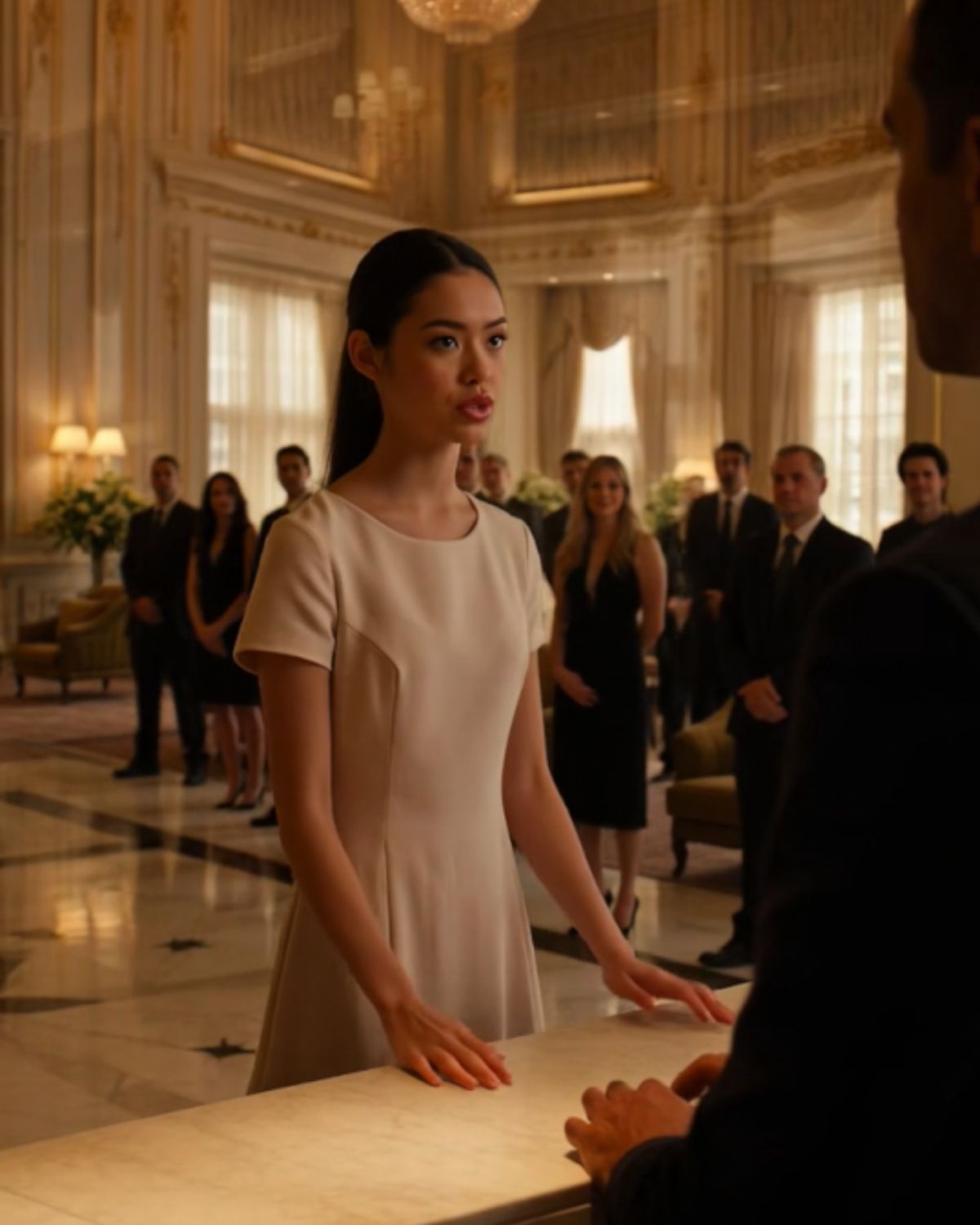
 They laughed at her dress before they checked her name.
That was the first mistake.
The second mistake was laughing loudly enough for the entire lobby to hear.
The young woman stood beneath the golden chandelier of The Grand Aurelia Hotel, holding a small handbag with both hands. Her dress was plain blue cotton, the kind someone might buy from a discount rack and wear carefully because it was the best thing they had. Her shoes were clean but old. Her hair was tied back with a black ribbon.
Everything around her looked like it had been designed to make ordinary people feel out of place.
The marble floors were polished so brightly they reflected the chandelier above. White orchids stood in tall glass vases near the reception desk. Guests moved through the lobby in tailored suits, silk scarves, diamond watches, and shoes that clicked confidently against the stone.
A pianist played near the lounge.
A bellman rolled designer luggage toward the private elevator.
At the center of the front desk, behind a long counter of white marble and brushed gold, stood Nathaniel Cross, the hotel’s general manager.
He noticed the young woman the moment she walked in.
Not because she caused trouble.
Not because she spoke loudly.
Not because she looked lost.
He noticed her because, in his mind, she looked wrong.
Nathaniel Cross had spent fifteen years in luxury hospitality, and somewhere along the way, he had confused price with worth. He could identify a watch brand from six feet away. He could guess the cost of a handbag before a guest reached the desk. He knew which guests deserved champagne without asking and which ones should be watched by security.
He wore a charcoal suit, a gold name badge, and the kind of smile that appeared only when money did.
The young woman approached the front desk quietly.
“Good afternoon,” she said. “I’m here to check in.”
Before the receptionist could respond, Nathaniel stepped forward and looked at her dress.
Then he laughed.
It was not a large laugh.
It was worse.
A short, sharp laugh meant to tell her she had already been measured and dismissed.
“Are you lost?” he asked. “This hotel is far too expensive for someone like you.”
Two guests nearby turned.
A man in a white linen jacket smirked.
The woman beside him covered her mouth, but not enough to hide her smile.
The young woman’s fingers tightened slightly around her handbag.
Her name was Emily Carter.
She was twenty-seven years old, a school librarian from a small town two hours outside the city. She was not used to places like The Grand Aurelia. She was used to children asking for picture books, old computers that froze during checkout, and parents apologizing because they returned novels late.
She was calm by nature.
But she was nervous.
Not because she could not afford to be there.
Because she knew people might assume she could not.
She had almost worn something else that morning. She had stood in front of her closet for twenty minutes, staring at the few dresses she owned. The blue one was simple, but it was clean, pressed, and familiar.
Her younger sister had said, “Wear it. You don’t need to look rich to deserve respect.”
Emily had smiled at the time.
Now, standing in that shining lobby while strangers laughed at her, those words felt heavier than she expected.
Still, she lifted her chin.
“I have a reservation,” she said.
Nathaniel’s smirk deepened.
“For what?” he asked. “A cleaning job?”
The guests nearby laughed again.
This time, louder.
The receptionist behind the desk, a young man named Daniel, froze with his hand above the keyboard.
Several employees heard it.
A bellman glanced over and looked away.
A security guard near the elevator shifted uncomfortably.
A woman waiting in line lowered her sunglasses and stared at Nathaniel as if she was trying to decide whether she had heard him correctly.
Emily did not answer immediately.
She looked at Nathaniel for one long second.
Then she placed her small handbag on the counter and spoke to the receptionist, not the manager.
“Reservation under Carter.”
Nathaniel made a show of sighing.
“Daniel, please don’t waste time. We have actual guests waiting.”
The woman with sunglasses stepped forward slightly.
“I believe she said she has a reservation.”
Nathaniel turned his polished smile toward her. “Of course, madam. We will handle it.”
But his eyes, when they returned to Emily, were cold.
Daniel typed the name.
Carter.
At first, nothing happened.
Then the screen loaded.
His expression changed.
He leaned closer.
Then closer again.
His fingers stopped moving.
Nathaniel noticed.
“What is it?”
Daniel did not answer.
His eyes moved from the screen to Emily, then back to the screen.
Nathaniel’s impatience sharpened.
“Daniel.”
The receptionist swallowed.
“Sir…”
The lobby seemed to quiet around that single word.
Daniel looked at the screen one more time, as if hoping the computer might say something different.
Then he whispered, “She booked the Presidential Suite.”
The laughter died.
All at once.
The man in the white linen jacket lowered his glass.
The woman beside him stopped smiling.
The bellman slowly turned his head.
The security guard straightened.
Even the pianist seemed to soften his playing, as if the music itself understood something had shifted.
Nathaniel stared at Daniel.
“What?”
Daniel cleared his throat, but his voice still shook.
“Ms. Emily Carter. Three nights. Presidential Suite. Full advance payment. Private elevator access. VIP arrival note.”
For the first time since Emily entered the hotel, Nathaniel actually looked at her face.
Not her dress.
Not her shoes.
Not her handbag.
Her face.
And what he saw there made him uncomfortable.
She was not shocked.
She was not trying to prove herself.
She was not enjoying his humiliation.
She simply looked tired of a world where people like him needed a number on a screen before remembering basic manners.
Nathaniel’s smile had disappeared.
His mouth opened slightly.
The color in his face began to change, fading under the chandelier light.
The two guests who had laughed beside him suddenly became very interested in the marble floor.
Emily reached into her handbag and pulled out her identification card.
She placed it on the counter.
Daniel picked it up with both hands, as respectfully as if she had handed him something fragile.
“Thank you, Ms. Carter,” he said softly.
Nathaniel recovered just enough to speak.
“Ms. Carter, I believe there has been a misunderstanding.”
Emily looked at him.
“No, there hasn’t.”
The words were quiet.
But the room heard them.
Nathaniel blinked.
Emily continued, “You saw my dress and decided who I was. That was not a misunderstanding. That was a choice.”
The woman with sunglasses nodded once.
The man in the linen jacket looked away.
Daniel remained still behind the desk, holding Emily’s ID.
Nathaniel’s jaw tightened. He glanced around the lobby and realized that the audience he had used to embarrass her had now become witnesses against him.
That was when his posture changed.
His shoulders, once squared with authority, lowered slightly.
His eyes flickered toward the guests, then toward the security guard, then back to Emily.
He was not sorry when he insulted her.
He was sorry when the computer contradicted him.
And everyone could see it.
“Ms. Carter,” he said carefully, “allow us to make this right. Perhaps a complimentary spa treatment or—”
“I didn’t ask for compensation,” Emily said.
That stopped him.
“I asked to check in.”
Daniel quickly returned her ID.
“Yes, Ms. Carter. Of course.”
His hands moved across the keyboard.
Nathaniel stood beside him, silent now. His face carried the stiff look of a man trying to disappear while standing directly under a chandelier.
But Emily was not finished.
She turned slightly toward the two guests who had laughed.
The woman’s cheeks flushed.
The man cleared his throat and pretended to read a message on his phone.
Emily did not insult them.
She did not need to.
She only looked at them long enough for their laughter to find its way back to them.
Then she turned to Nathaniel.
“Next time,” she said firmly, “check the name before judging the dress.”
The sentence landed across the marble lobby like a bell.
Daniel lowered his eyes, not from shame but from the weight of it.
The security guard’s expression softened.
A woman near the line whispered, “Good for her.”
Nathaniel had no answer.
For the first time that afternoon, the man who had spoken so sharply had nothing useful to say.
Daniel reached beneath the counter and opened a velvet-lined drawer reserved for the hotel’s highest-tier guests. Inside were the golden keycards used for the Presidential Suite and private elevator access.
He took one out carefully.
The card caught the chandelier light as he placed it on a small leather tray.
“Ms. Carter,” he said, his voice steadier now, “welcome to The Grand Aurelia. Your suite is ready. The Presidential Suite is on the top floor, and your private elevator is just to the left of the lounge. Our concierge will be happy to assist you with anything you need.”
Emily looked at the golden keycard.
For a moment, her hands did not move.
Not because she was overwhelmed by the luxury.
Because she was remembering how close she had come to turning around when Nathaniel laughed.
She thought about her mother, who had worked double shifts as a seamstress and taught her daughters never to measure themselves by rooms they had not yet entered.
She thought about her sister, who had stood in the doorway that morning and told her she deserved respect.
She thought about the long year that had brought her there.
Because Emily Carter had not booked the Presidential Suite for vanity.
She had booked it for her mother.
For thirty-one years, her mother, Rosa Carter, had cleaned rooms in hotels she could never afford to sleep in.
Budget motels at first.
Then business hotels.
Then a resort where guests left half-used bottles of perfume on the bathroom counter and complained if the towels were folded wrong.
Rosa never complained in front of her daughters.
She came home tired, soaked her feet in warm water, and packed lunches for the next day.
When Emily was twelve, she asked, “Mom, do you ever wish you could stay in one of those rooms instead of cleaning them?”
Rosa smiled and said, “One day, maybe I’ll sit in a hotel robe and order breakfast without checking the price.”
Emily never forgot that.
Years passed.
Emily became a librarian.
Her sister became a nurse.
Their mother’s knees got worse.
And then, after a small piece of land their grandfather had owned was sold to a developer, the Carter family received more money than they had ever imagined.
Not billionaire money.
Not endless money.
But enough for Emily to do one thing she had quietly promised herself as a child.
She booked the Presidential Suite at The Grand Aurelia because it had been the hotel her mother used to pass every morning on the bus to work.
Three nights.
Top floor.
Breakfast included.
No price-checking.
No apologizing.
No feeling like she had to leave before someone noticed she did not belong.
Her mother was arriving in two hours.
Emily had come early to make sure everything was perfect.
And instead, she had been laughed at in the lobby.
Daniel slid the keycard closer.
Emily picked it up.
“Thank you,” she said.
Her voice was polite, but the warmth was not for Nathaniel.
Daniel stepped out from behind the desk.
“I can escort you to the elevator, Ms. Carter.”
Nathaniel suddenly moved.
“I’ll escort her personally.”
Emily looked at him.
“No.”
One word.
Clean.
Calm.
Final.
Nathaniel stopped.
Daniel stood straighter.
The security guard near the elevator stepped aside respectfully as Emily walked past the front desk.
The lobby followed her with their eyes.
The cheap blue dress moved through the most expensive room in the building, and nobody laughed now.
Near the lounge, the woman with sunglasses smiled faintly.
The man in the linen jacket kept his head down.
Nathaniel remained by the front desk, frozen beneath the chandelier that had made him look powerful only minutes earlier.
Now it made him look exposed.
Emily reached the private elevator.
Daniel tapped a staff card, then gestured to the golden reader.
Emily placed her keycard against it.
The elevator doors opened with a soft chime.
Inside, the walls were mirrored and trimmed in gold.
Before stepping in, Emily looked back once.
Not at the guests.
Not at the marble.
At Nathaniel.
He was still standing there with his lips pressed together, his face pale, his hands clasped uselessly in front of him.
That was the moment of recognition.
Not when Daniel said “Presidential Suite.”
Not when the golden keycard appeared.
But now, when Nathaniel looked at the young woman he had mocked and understood that her dress had told him nothing about her worth.
Only his reaction had told everyone everything about his.
The doors closed.
And the lobby slowly began to breathe again.
But the story did not end there.
Because humiliation leaves marks, even when people pretend it was only a mistake.
Upstairs, Emily stepped into the Presidential Suite and stood still.
The room was larger than her entire apartment.
Floor-to-ceiling windows looked over the city. A grand piano stood near the sitting area. Fresh flowers covered the dining table. The bedroom doors were open, revealing white linens, gold lamps, and a balcony with glass railings.
On the table was a welcome note.
Dear Ms. Carter,
Welcome to The Grand Aurelia. We are honored to host you.
Emily read it twice.
Then she laughed softly.
Not because it was funny.
Because downstairs, the honor had needed a screen to confirm it.
She placed her handbag on a chair and walked to the window.
Her phone buzzed.
It was her sister.
Is it beautiful?
Emily looked at the city below.
Then she typed back:
Yes. Mom is going to cry.
She did not mention Nathaniel.
Not yet.
Two hours later, Rosa Carter arrived.
She wore her best church dress, a lavender cardigan, and comfortable shoes. Her hair was freshly curled. Emily met her at the entrance before anyone else could.
This time, the doorman opened the door immediately.
“Welcome to The Grand Aurelia,” he said warmly.
Rosa looked around the lobby with wide eyes.
“Oh my,” she whispered.
Emily smiled. “Wait until you see upstairs.”
At the front desk, Daniel stood ready.
Nathaniel was not there.
A different manager, a woman named Claire Beaumont, approached them with a respectful smile.
“Ms. Carter,” she said to Emily, then turned to Rosa. “Mrs. Carter, welcome. We are very glad to have you with us.”
Rosa blinked. “You know my name?”
“Of course.”
Emily watched her mother absorb that.
For years, Rosa had worn name tags in hotels. Guests knew her name only when they needed extra towels or wanted to complain.
Now, in one of the finest hotels in the city, someone had learned her name before she asked.
Rosa’s eyes grew shiny.
Emily gently took her hand.
“Come on, Mom.”
As they walked toward the private elevator, Rosa leaned close.
“Are you sure we’re allowed to use that one?”
Emily squeezed her hand.
“Yes,” she said. “We are.”
The elevator doors opened.
The same golden interior greeted them.
Rosa stepped in slowly, as if afraid to touch anything.
When they reached the suite, she stopped in the doorway.
For several seconds, she said nothing.
Then she covered her mouth with both hands.
“Emily…”
“I promised you,” Emily said softly.
Rosa turned to her, confused.
“What do you mean?”
Emily smiled through tears.
“When I was twelve, you said maybe one day you’d wear a hotel robe and order breakfast without checking the price.”
Rosa began crying then.
Not loudly.
Just the kind of quiet crying that comes when someone realizes a child remembered a pain they tried to hide.
Emily hugged her.
Downstairs, the consequences had already begun.
Claire Beaumont had reviewed the lobby footage within an hour. The hotel did not need a formal complaint to know what had happened. The camera showed Emily entering calmly, Nathaniel approaching, the guests laughing, and Daniel freezing at the computer before the reveal.
But footage only captured behavior.
It did not capture culture.
So Claire started asking questions.
Daniel admitted Nathaniel often judged walk-in guests by appearance before allowing check-in.
The doorman admitted he had been told to “prioritize premium arrivals.”
A bellman said Nathaniel had once instructed him not to offer luggage help to a family carrying plastic shopping bags.
A hostess from the hotel restaurant confessed that guests who looked “budget” were often seated in the back, even with reservations.
The two guests who had laughed were quietly moved to a different floor after Claire personally informed them that mocking another paying guest violated the hotel’s standards of conduct.
Nathaniel was called into a private office.
He entered with the stiff confidence of a man who believed apologies were tools, not truths.
Claire sat across from him with the printed incident report on the desk.
“Did you ask Ms. Carter if she was lost?”
Nathaniel exhaled. “It was a greeting taken out of context.”
“Did you say the hotel was too expensive for someone like her?”
He looked away.
“Claire, you know how lobby management works.”
“Answer the question.”
His jaw tightened.
“Yes.”
“Did you ask if her reservation was for a cleaning job?”
Silence.
Claire waited.
Nathaniel rubbed his forehead. “It was a poor choice of words.”
“No,” Claire said. “It was a clear choice of values.”
That sentence made him look up.
Claire slid a document across the desk.
It was not just the incident report.
It was a list.
Four guest complaints from the past three months. Three employee statements. Two unresolved reviews that mentioned appearance-based treatment. One internal note where Nathaniel had written, “Luxury perception must be protected at the first point of contact.”
Nathaniel stared at the page.
His face shifted.
He had thought this was one moment.
Now he saw it had become a pattern with paper trails.
Claire folded her hands.
“You are suspended effective immediately pending final review.”
His eyes widened.
“Suspended? Over one guest misunderstanding?”
“Over repeated conduct that exposed this hotel to reputational damage and, more importantly, humiliated people we were supposed to serve.”
Nathaniel leaned back.
For the first time all day, he looked truly shaken.
“But she booked the Presidential Suite,” he said, as if that was the part that made the insult serious.
Claire’s expression hardened.
“That is still what you do not understand.”
He stopped.
“If she had booked the smallest room in this building, your behavior would be just as unacceptable.”
Nathaniel had no answer.
By morning, the general manager’s gold name badge had been removed from the front desk roster.
Emily did not know that yet.
She was having breakfast with her mother on the balcony.
Rosa sat wrapped in a hotel robe, looking out at the city while a silver tray rested between them. Pancakes, fruit, coffee, orange juice, and a small vase with one white rose.
Rosa picked up the menu, glanced at the prices, and put it down quickly.
Emily noticed.
“Mom,” she said gently. “Order whatever you want.”
Rosa laughed through embarrassment. “I know, I know.”
“No price-checking.”
Rosa looked at her daughter.
Then she smiled.
“No price-checking.”
They spent the day like tourists in their own dream.
They visited the spa, where Rosa kept apologizing for asking questions until the attendant told her, “Mrs. Carter, this is your day.”
They walked through the garden terrace.
They ordered tea in the lounge.
And everywhere they went, staff greeted them respectfully.
Not perfectly.
Respectfully.
That evening, when Emily returned to the suite, she found a handwritten note from Claire Beaumont.
Ms. Carter,
What happened during your arrival was unacceptable. I am deeply sorry. Thank you for your grace today. Please know that action has been taken, and further review is underway. Your mother’s stay is our privilege.
Emily read the note silently.
Then she handed it to Rosa.
Her mother read it once.
Then again.
“What happened when you arrived?” Rosa asked.
Emily sat beside her and told her the truth.
Not dramatically.
Not bitterly.
Just plainly.
Rosa listened without interrupting.
When Emily finished, her mother looked down at the cheap blue dress hanging neatly over the chair.
The same dress Nathaniel had laughed at.
Rosa stood slowly, walked to it, and touched the sleeve.
“I made you that dress,” she said.
Emily nodded.
“I know.”
Rosa had stitched it years earlier from fabric she bought on sale. She had adjusted the waist twice. Repaired one seam by hand. Pressed it carefully whenever Emily needed something nice.
Rosa turned back to her daughter.
“That man didn’t laugh at a cheap dress,” she said quietly. “He laughed at work he did not recognize.”
Emily’s throat tightened.
The next morning, Claire asked Emily if she would be willing to meet privately.
Emily agreed.
They sat in a quiet office off the lobby. Claire apologized again, this time without corporate language.
Emily appreciated that.
Then Claire said something unexpected.
“Ms. Carter, your mother worked in hotels, didn’t she?”
Emily looked surprised. “How did you know?”
“The way you watched the housekeeping staff yesterday. You moved aside before they asked. Most guests don’t notice their carts.”
Emily smiled faintly.
“My mother cleaned rooms for thirty-one years.”
Claire nodded.
“That explains something.”
“What?”
“You did not walk in here trying to be treated like royalty,” Claire said. “You walked in hoping your mother would be treated like a person.”
Emily looked down at her hands.
For a few seconds, the office was quiet.
Then Emily said, “That should not be a luxury.”
Claire nodded.
“No. It should not.”
That conversation led to more than an apology.
The Grand Aurelia created a new training module using the incident as a case study, with Emily’s permission but without her name. The title was simple:
Check the Reservation. Check Your Bias First.
Daniel, the receptionist who had spoken the truth at the computer, was promoted into guest relations training. The doorman team was retrained. The restaurant seating policy was audited. Staff were instructed never to use appearance as a measure of value, wealth, or belonging.
Nathaniel Cross was terminated after the final review confirmed a repeated pattern of discriminatory guest treatment.
The two guests who laughed never received the quiet upgrade they had been expecting for their anniversary stay.
Instead, they received a polite reminder that The Grand Aurelia reserved the right to refuse service to guests who harassed or demeaned others.
For Emily and Rosa, the rest of the stay became something neither of them would forget.
On the final morning, Rosa stood at the balcony in her hotel robe, holding a cup of coffee with both hands.
The city was still waking up.
“I used to clean rooms like this,” she said.
Emily stood beside her.
“I know.”
Rosa looked around the suite.
“The strange thing is, I don’t envy it anymore.”
Emily turned to her. “Why?”
Her mother smiled.
“Because now I know the room was never what I wanted.”
She looked at her daughter.
“I wanted to feel, just once, like I did not have to apologize for being there.”
Emily reached for her hand.
When they checked out later that day, Daniel stood at the front desk with a genuine smile.
“How was your stay, Mrs. Carter?” he asked.
Rosa smiled back.
“It was beautiful.”
Then she looked at Emily.
“Especially the parts money couldn’t buy.”
Daniel respectfully handed Emily the receipt in a leather folder.
There were no extra charges.
No hidden fees.
No awkward glances.
Just a proper farewell.
As Emily and Rosa walked toward the revolving doors, they passed the spot where Nathaniel had laughed at the blue dress.
Emily slowed for half a second.
Rosa noticed.
“You okay?”
Emily nodded.
Then she looked down at the dress beneath her coat.
The fabric was still simple.
Still inexpensive.
Still repaired at the seam.
But it carried something no luxury brand could sell.
Her mother’s hands.
Her childhood promise.
Her quiet dignity.
At the door, the bellman smiled.
“Have a safe trip home, Ms. Carter. Mrs. Carter.”
Rosa stepped outside first.
Emily followed, then paused and looked back across the lobby.
The marble still shone.
The chandeliers still glittered.
The guests still looked elegant.
But the room no longer felt like it was asking her to prove she belonged.
Behind the front desk, Daniel was helping an elderly man in a faded jacket.
He did not hesitate.
He did not look at the man’s shoes.
He simply smiled and said, “Welcome. Do you have a reservation?”
Emily smiled.
That was enough.
Months later, a new receptionist at The Grand Aurelia heard the story during training.
“Is it true?” she asked Daniel. “The woman in the cheap dress really booked the Presidential Suite?”
Daniel looked toward the private elevator.
“Yes,” he said.
“And the manager got fired?”
“Yes.”
The trainee shook her head. “That must have been embarrassing for him.”
Daniel paused.
Then he said, “It should have been embarrassing before we knew what room she booked.”
The trainee went quiet.
Daniel placed a golden keycard on the counter for a guest arriving in plain clothes.
Then he added, “The suite did not make her worthy of respect. It only exposed the people who thought she wasn’t.”
Because a dress can tell you what someone is wearing, but only your reaction tells the world who you are.