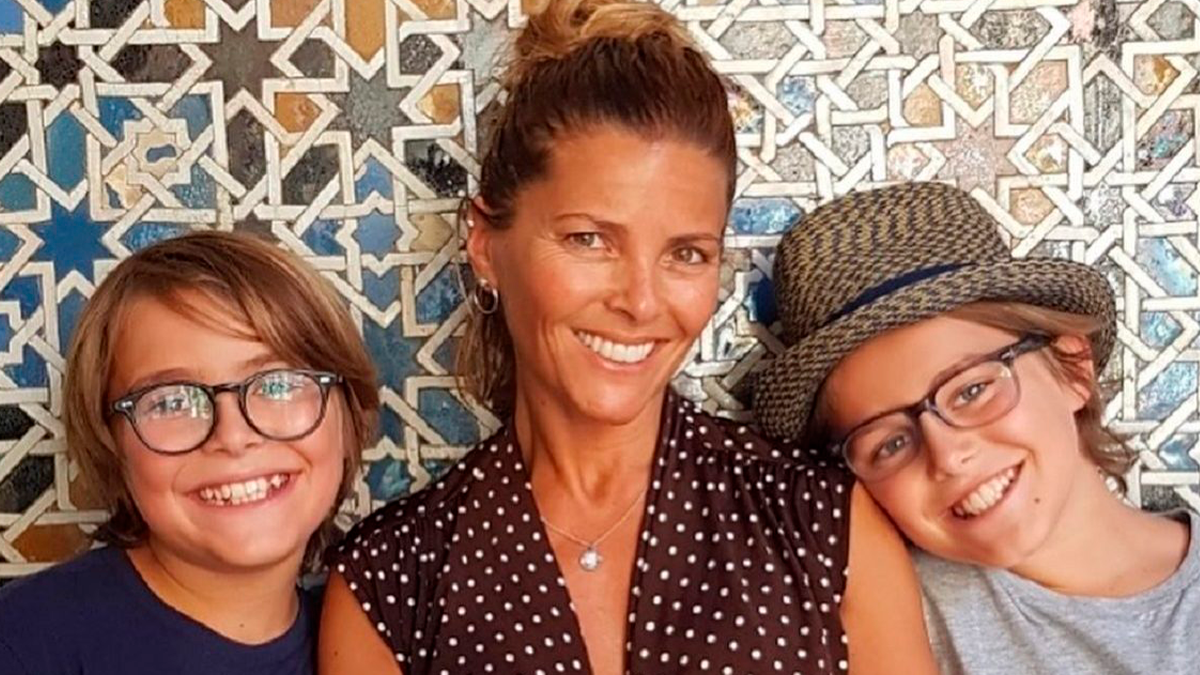
Maye Musk: Escaping Abuse, Rebuilding Her Life, and Raising Three Extraordinary Children on Her Own
Maye Musk has lived many lives in one. To some, she is known as the elegant silver-haired model who became a global fashion figure in her 60s and 70s. To others, she is the mother of Elon Musk, one of the most famous and polarizing entrepreneurs in the world. But behind the polished magazine covers, the red lipstick, the couture runways, and the public image of confidence is a far more difficult and powerful story — one shaped by survival, escape, reinvention, and a fierce determination to raise her children without fear.
In a Harper’s Bazaar feature, Maye Musk appeared in a playful space-themed fashion shoot inspired by the golden age of futuristic glamour. Surrounded by astronaut helmets, NASA-style patches, toy rockets, metallic outfits, oversized sunglasses, and silver flight suits, she joked about getting ready for space. The moment felt fitting. As the mother of Elon Musk, the founder of SpaceX, Maye carries a natural connection to the idea of space exploration. But the setting was not one of her son’s laboratories or launch facilities. It was a Hollywood Hills photo shoot — part fantasy, part fashion, and part tribute to the extraordinary world that now surrounds her family name.
Yet Maye Musk’s real story did not begin with rockets, billion-dollar companies, or magazine spreads. For much of her early adult life, she endured a painful and frightening marriage that she has described as abusive. During those years, she felt trapped, financially vulnerable, and afraid for her safety. The life she now represents — glamorous, independent, confident, and admired — was once unimaginable to her.
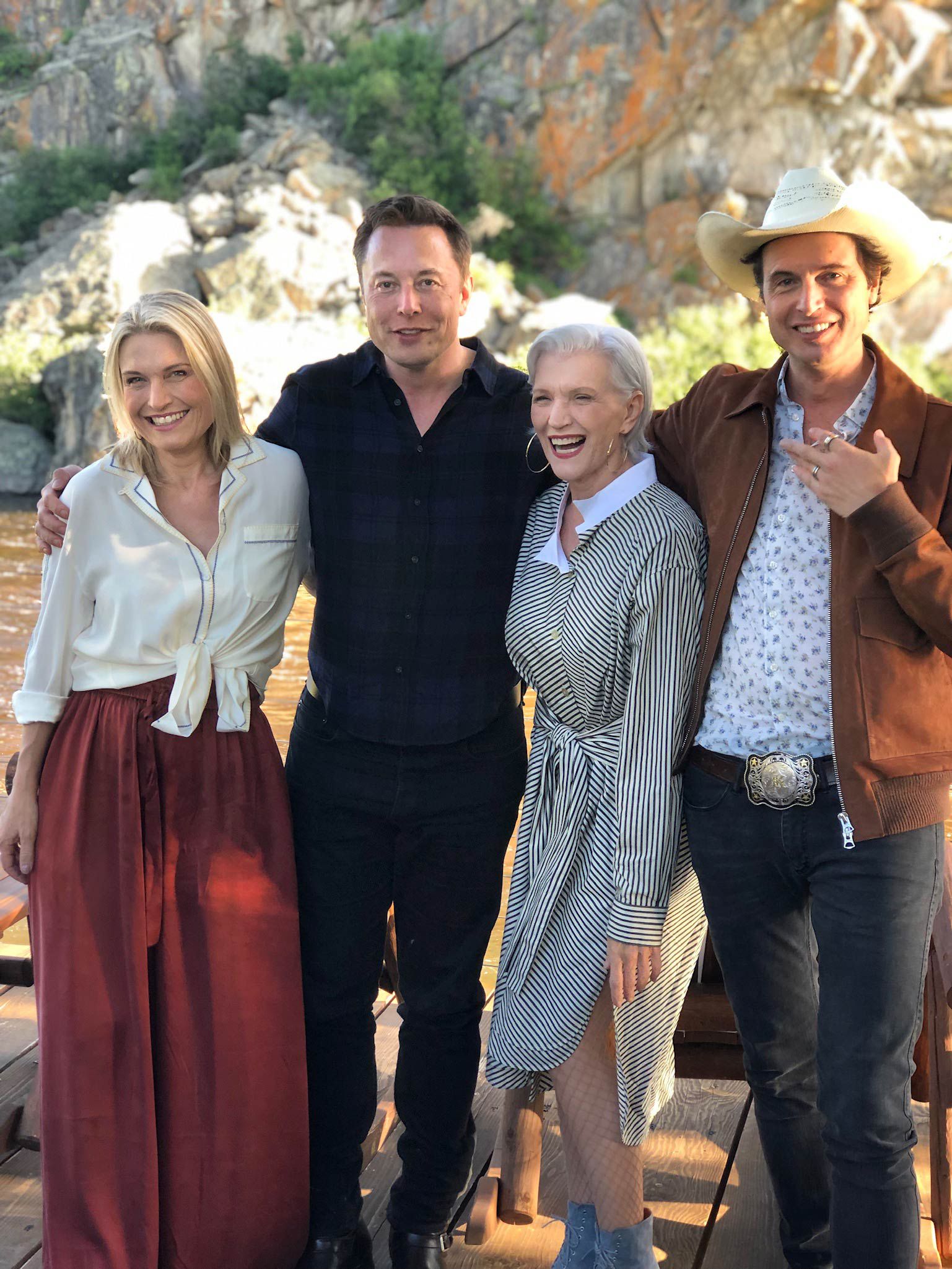
After escaping that marriage, Maye had to rebuild everything from the beginning. She left with three children: Elon, then a young boy; Kimbal, who would later become a businessman and food entrepreneur; and Tosca, who would go on to build a career as a filmmaker and producer. There was no easy transition, no instant security, and no guarantee that she would be able to keep the family stable. She had to work, survive, and parent all at once.
To support her children, Maye built careers in nutrition and modeling. As a dietitian, she used her education and professional training to create a practical source of income. As a model, she took whatever work she could find, appearing in catalogues, department store campaigns, and commercial projects long before the fashion world began celebrating her as a style icon. Her later success on couture runways and magazine covers did not come early. As she has pointed out, walking major fashion shows such as Dolce & Gabbana happened much later in life — not in her 20s, but in her 60s.

That late-career rise is one of the reasons Maye Musk’s story resonates so strongly. She did not become an international symbol of elegance because life had been easy. She became one because she kept moving through hardship, disappointment, and reinvention. Her public image today is not built on youth or perfection, but on endurance.
In her book A Woman Makes a Plan, Maye Musk shares the long arc of that journey. The memoir is not only a collection of memories, but also a guide to how she survived difficult chapters and rebuilt her life piece by piece. It includes personal reflections, family photos, practical advice, and even simple recipes from her own life. The title itself reflects the philosophy that carried her forward: when life becomes unstable, a woman makes a plan, adjusts, and keeps going.
Her childhood also helped shape that spirit of independence. Born in Canada and raised largely in South Africa, Maye grew up in an adventurous family that was far from ordinary. Her parents traveled through the Kalahari in search of the legendary Lost City, sometimes flying in her father’s small plane. That upbringing gave her a sense of courage, curiosity, and self-reliance that would later become essential when she had to face danger and uncertainty as an adult.
Over time, Maye went from beauty pageant contestant to respected nutritionist, single mother, working model, author, public speaker, and global fashion figure. Her life did not follow one clean path. It was a series of resets, each requiring resilience and discipline. She had to learn how to provide for her children while also protecting her own sense of identity.
One of the most discussed parts of Maye Musk’s story is how she raised three unusually successful children. People often ask her how she managed to raise “geniuses,” especially given Elon Musk’s extraordinary career in technology, space, electric vehicles, and artificial intelligence. But Maye’s answer is not complicated or overly polished. She has said that she gave her children freedom to develop their own interests and explore their own ideas.

Rather than controlling every part of their lives, she treated them as capable individuals. She did not hover over their homework, force them into rigid routines, or try to design their futures for them. Instead, she gave them responsibility and honesty. Her children understood that if they disrupted her work, she might lose income — and if she lost income, they might lose stability. That reality made them independent early.
Maye has described her parenting style as treating her children less like children and more like people. She trusted them to think, learn, try, fail, and pursue what interested them. Elon’s obsession with technology, Kimbal’s interest in business and food, and Tosca’s passion for film all developed in an environment where curiosity was not treated as a distraction, but as something worth following.
That parenting philosophy reflects Maye’s broader life philosophy. She did not try to control every outcome because, in her own life, she often could not. Instead, she focused on preparation, honesty, work, and adaptability. She gave her children space, but also showed them what survival looked like. They saw her work hard. They saw her rebuild. They saw her keep going even when the circumstances were difficult.

Today, Maye Musk stands as more than the mother of famous children. She is a public figure with her own legacy — a woman who escaped abuse, raised three children alone, built multiple careers, and found some of her greatest professional success at an age when many people are told to slow down or disappear.
Her story is powerful because it refuses the idea that life must peak early, or that hardship permanently defines a person. Maye Musk’s journey shows that reinvention can happen again and again. It can begin after fear, after divorce, after poverty, after professional rejection, and even after decades of being overlooked.
Behind the silver hair and camera-ready confidence is a woman who learned how to survive first, then how to thrive. And perhaps that is the most meaningful part of her story: before Maye Musk became a symbol of aging boldly and living visibly, she was a mother making plans in the middle of crisis — determined to protect her children, rebuild her future, and never let hardship have the final word.