PART ONE
The Seat That Wasn’t Empty
The train had not yet left Washington, D.C., and someone was already sitting in Vivian Cole’s seat.
Not leaning against it by mistake. Not hovering beside it with a confused ticket in one hand and an apology waiting on the tongue.
Sitting.
Settled.
A man in a charcoal cashmere coat had spread himself across Seat 1A like a judge taking the bench. One ankle rested on the opposite knee. A crystal tumbler sweated beside his elbow. His leather briefcase occupied the narrow space where Vivian’s overnight bag should have gone. His newspaper covered his face, but the headline trembled slightly each time the train’s heating system exhaled through the brass vents above him.
Vivian stopped in the doorway of the VIP car.
Behind her, the late-December platform groaned with travelers escaping the cold. Wheels clicked over tile. A child cried into a scarf. Somewhere outside, a conductor’s whistle sliced through the metallic fog hanging over Union Station.
Inside the VIP car, everything pretended to be calm.
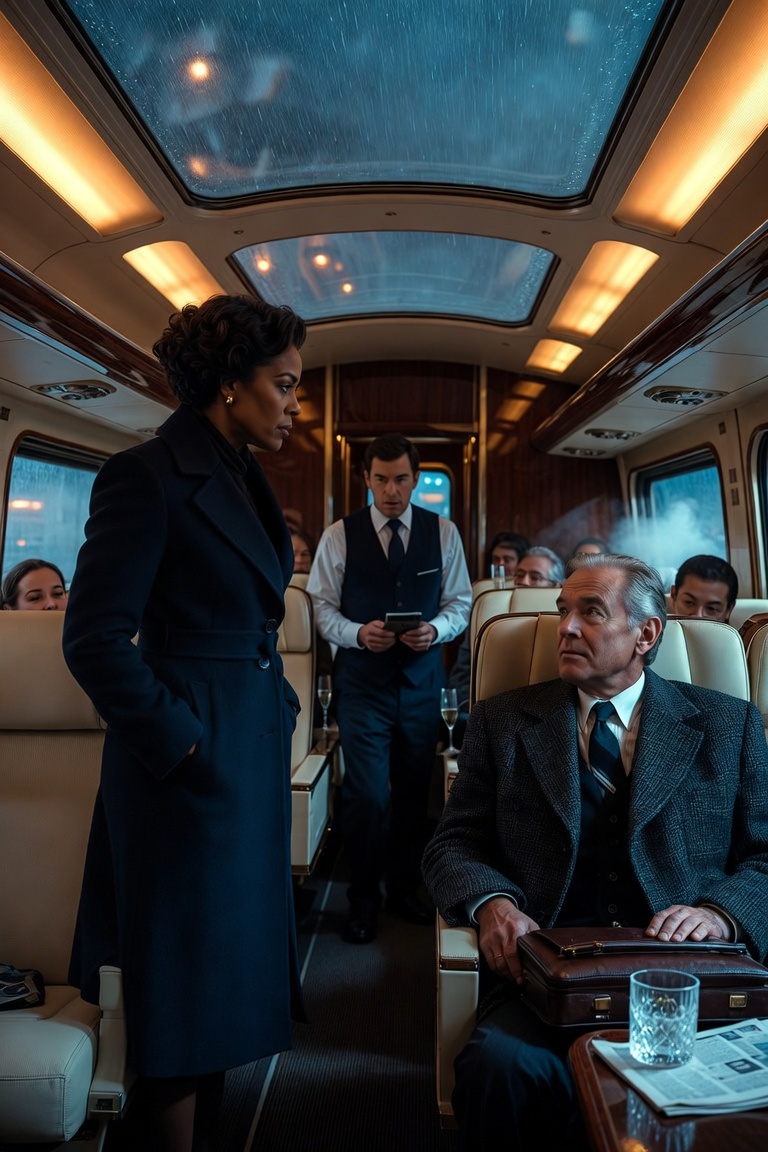
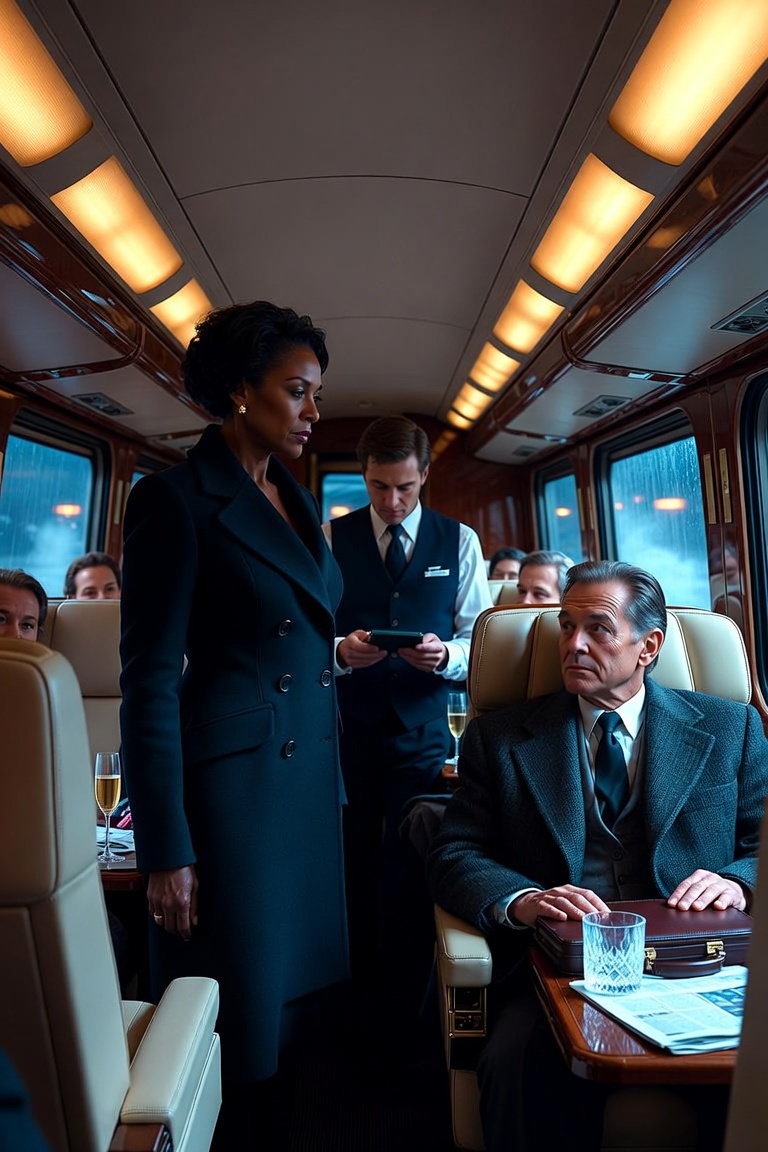
Amber lights glowed under polished walnut trim. Cream leather seats faced broad windows streaked with winter rain. Low jazz slipped from hidden speakers, soft enough to make the rich feel private. The air smelled of bergamot, roasted coffee, and the faint chemical polish used on expensive wood.
Vivian’s gloved fingers tightened once around the handle of her black carry-on.
Then she moved forward.
She was fifty-two, though no one ever guessed it correctly. People usually added or subtracted years depending on what they needed from her. Men who wanted to dismiss her called her “ma’am” too early. Younger women who recognized discipline when they saw it studied the smooth gray streak in her cropped natural hair and decided she was timeless. Her coat was navy wool, tailored but not flashy. Her earrings were small gold discs. Her shoes had the quiet shine of someone who knew the difference between elegance and performance.
Seat 1A faced the forward window.
The best seat in the car.
The one she had reserved three weeks ago.
The one she had specifically requested because she needed to watch the line.
Vivian stopped beside the man’s newspaper.
“Excuse me,” she said.
The newspaper did not move.
Across the aisle, a young couple with matching champagne flutes looked up. The woman’s smile stiffened, as if she had been caught watching something she had paid not to see. Two rows back, an elderly man lowered his tablet just enough to peer over the top.
Vivian waited.
The train gave a low mechanical shudder beneath their feet.
The newspaper finally folded.
The man behind it had a face built for boardrooms and courtroom sketches. Silver hair combed back from a high forehead. Pale blue eyes. A mouth that looked most natural when saying no. He glanced at Vivian, then at her carry-on, then at the brass number plate above his seat.
1A.
A small smile touched one corner of his mouth.
“Yes?”
“That’s my seat.”
His smile did not vanish. It simply cooled.
“I doubt that.”
Vivian slid her ticket from the inner pocket of her coat and held it out without flourish.
The man did not take it.
He looked at the ticket the way some people look at street flyers pressed into their hands by strangers.
“I’m afraid there’s been a misunderstanding.”
“There has,” Vivian said. “You’re in my seat.”
A man in a navy vest appeared from the front service galley. Late twenties. Brown skin. Careful posture. His name tag read Marcus Bell. His eyes flicked from Vivian to the seated passenger, and something like worry passed through them before training smoothed it away.
“Good afternoon,” Marcus said. “Is everything all right?”
The seated man sighed, as if kindness had become expensive.
“This woman seems confused about her accommodations.”
Vivian did not look at him.
She looked at Marcus.
“My ticket is for Seat 1A.”
Marcus reached for the ticket. His hand paused halfway, then continued. He scanned it with a small black device. The screen flashed green.
The sound was tiny.
In the sealed hush of the VIP car, it landed like a gavel.
Marcus swallowed.
“Yes, ma’am. This ticket is valid.”
The man in the seat set down his newspaper.
“Scan mine.”
He pulled out his phone and angled the glowing screen toward Marcus.
Marcus scanned it.
A red light flashed.
This sound was even smaller.
No one in the car moved.
The man’s jaw shifted once. “Your device is wrong.”
Marcus’s thumb hovered over the scanner. “Sir, it’s showing your assigned seat is 3C.”
“Impossible.”
“3C,” Marcus repeated gently. “Also in the VIP car.”
The man looked toward Seat 3C as if Marcus had suggested he sleep in the luggage rack. Seat 3C was fine. Wide. Reclining. Near the window. But it was not 1A.
And in places like this, the difference between fine and first was often treated like a moral injury.
The man turned back to Vivian.
“There are circumstances you’re not aware of.”
Vivian’s face did not change. “Then you should explain them while standing.”
The young woman across the aisle pressed her champagne flute to her lips and forgot to drink.
Marcus cleared his throat.
“Sir, I’ll need to ask you to move to your assigned seat.”
The man’s eyes cut to him.
“I know your general manager.”
Marcus’s shoulders stayed level, but the skin beside his right eye tightened.
Vivian noticed.
She noticed everything.
The man leaned back again, reclaiming the seat with his spine. “I was assured this would be handled.”
Vivian tilted her head slightly.
“By whom?”
The man looked at her for a moment too long.
Then he smiled again.
“People who understand how things work.”
Vivian slipped her ticket back into her coat.
Outside the window, rain crawled down the glass in crooked silver threads. Beyond it, workers in orange vests moved between pillars of steam, coupling hoses, checking doors, waving signals through the weather. Ordinary people doing necessary things while extraordinary people argued about cushions.
Vivian turned to Marcus.
“Who paid for it?”
Marcus blinked.
“Ma’am?”
“This seat.” Her voice remained low. “Who paid for it?”
The man gave a dry laugh.
“What kind of question is that?”
Vivian looked down at him.
“The kind people forget to ask before stealing something.”
A flush crawled up the man’s neck.
Marcus glanced toward the front of the car, where another attendant stood frozen near the galley curtain. She was a blonde woman in her forties with sharp cheekbones and sharper eyes. Her badge read Candace Vale. She saw Marcus looking and shook her head once.
Small.
Warning.
Vivian saw that too.
The man stood abruptly, forcing Marcus to step back.
He was tall. Taller than Vivian by nearly a foot. The movement filled the aisle with his coat, his cologne, his belief that space belonged to him unless proven otherwise.
“Do you know who I am?” he asked.
Vivian looked at the hollow of his throat, where his pulse tapped too quickly.
“No,” she said. “But I’m beginning to understand who you think you are.”
The couple across the aisle went still.
The elderly man’s tablet dimmed in his hand.
The train’s intercom chimed overhead.
“Ladies and gentlemen, welcome aboard the Capital Meridian. Our nonstop service to Chicago will depart shortly.”
The man lowered his voice.
“You’re making a mistake.”
Vivian stepped closer to Seat 1A, not enough to touch him, but enough that the smell of his cologne sharpened between them.
“No,” she said. “Someone made a mistake before I arrived.”
The front door of the VIP car opened.
A second man entered.
Mid-fifties. Expensive gray suit. Red tie. Smooth bald head catching the warm overhead light. He carried no luggage. His smile arrived before he did.
“Mr. Whitaker,” he said, spreading both hands. “I apologize for the confusion.”
The seated man’s anger folded into relief.
“There you are.”
Marcus’s face lost a degree of color.
Candace disappeared behind the galley curtain.
Vivian turned.
The man in the gray suit looked at her with professional warmth. Not real warmth. The kind sold in corporate seminars, polished until it could slide over almost any surface.
“Ma’am,” he said, “I’m Richard Hayes, executive guest liaison for Meridian Rail. We’ve had a slight reassignment issue.”
Vivian said nothing.
Richard Hayes’s smile widened to cover the silence.
“We’ll be happy to move you to another premium seat and offer complimentary meal service for the duration of your trip.”
The words hung in the polished car.
Complimentary.
Move you.
Another.
Vivian let her gaze drift past him, to the narrow service mirror mounted near the galley. In it, she saw Marcus staring at the floor. She saw the elderly man watching with his mouth slightly open. She saw Mr. Whitaker smoothing his coat as if the matter had ended.
Then she looked back at Richard.
“Who reassigned it?”
Richard’s smile flickered. “Excuse me?”
“My seat.” Vivian’s voice did not rise. “Who reassigned it?”
Richard’s eyes moved once to Mr. Whitaker, then back to her.
“It’s a little more complicated than that.”
“Then simplify it.”
A low chuckle came from Mr. Whitaker.
Richard’s jaw tightened.
“Ma’am, with respect, operational seating adjustments are within the company’s discretion.”
Vivian reached into her coat again.
This time she did not remove her ticket.
She removed a folded cream envelope.
The paper was thick, almost old-fashioned. Her name was printed on the front in dark blue ink.
Vivian Cole.
She opened it slowly.
Richard glanced at it. His smile thinned.
Vivian removed a receipt.
Not an email printout. Not a mobile boarding pass. A receipt on company letterhead, stamped and signed.
She held it between two fingers.
“Seat 1A. Private VIP forward compartment. Washington to Chicago. Paid in full.”
Richard’s eyes lowered to the total.
For the first time since entering the car, he stopped smiling.
Mr. Whitaker noticed.
“What is it?” he asked.
Richard did not answer.
Vivian folded the receipt once and slipped it back into the envelope.
“So,” she said, “I’ll ask again.”
The train lurched.
A low, deep pull rolled beneath the floor as the Capital Meridian began to move.
Outside, the platform slid backward in a smear of lights, faces, pillars, rain.
Inside the VIP car, Vivian Cole stood in the aisle while two men stared at her as if the train itself had betrayed them.
“Who paid for the seat,” she asked, “before I did?”
Richard Hayes looked toward the galley curtain.
Marcus looked at Richard.
Mr. Whitaker looked at Vivian.
And somewhere behind the sealed service door, a phone began to ring.
Not a passenger’s phone.
The train phone.
The old emergency line built into the VIP car wall.
Candace stepped out from the galley, pale now, holding the receiver away from her ear as if it had burned her.
“Mr. Hayes,” she said.
Richard did not move.
Candace’s eyes found Vivian.
Then dropped.
“It’s Chicago headquarters.”
The train picked up speed.
Candace swallowed.
“They’re asking why the chairwoman’s seat was given away.”
Chapter Two
The Woman Nobody Briefed
Richard Hayes forgot to breathe.
It lasted only a second, but Vivian saw it. A break in the mask. The body telling the truth before the mouth could prepare a lie.
Mr. Whitaker’s brow creased.
“Chairwoman?”
The word did not belong in his mouth yet. It came out bent, uncertain, stripped of its usual obedience.
Vivian turned toward the window.
Washington was slipping away now, the station lights dissolving into tunnels and wet concrete. In the glass, her reflection floated over the darkness: navy coat, gold earrings, calm eyes. Behind that reflection, Richard Hayes looked smaller than he had two minutes earlier.
He recovered by clearing his throat.
“Candace,” he said, “take that call in the galley.”
Candace did not move.
The receiver crackled in her hand.
A voice leaked through, faint but sharp. “Put Hayes on the line. Now.”
Marcus looked at Vivian.
Not at her clothes. Not at her seat. At her face.
Recognition did not arrive all at once. It came like dawn under a closed door. Slow. Impossible to stop.
Vivian gave him the smallest nod.
Not permission.
Reassurance.
Richard reached for the receiver. Candace handed it over too quickly and stepped back.
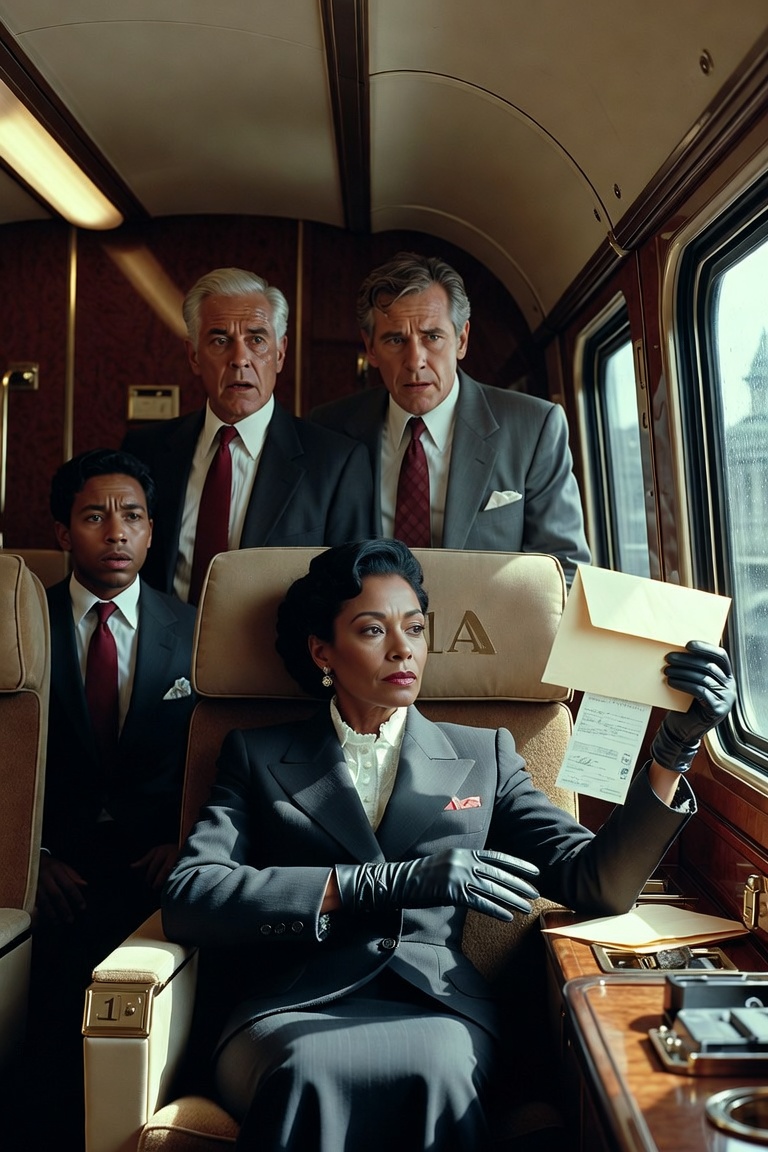
“Yes,” Richard said into the phone. “This is Hayes.”
He listened.
His eyes flicked toward Vivian, then away.
“No, I was not informed she would be traveling under—”
He stopped.
The voice on the other end grew louder. Not clear enough for the passengers to hear every word, but clear enough to hear anger wearing a suit.
Richard’s face tightened.
“Yes, I understand the sensitivity.”
Vivian watched him carefully.
Sensitivity. A favorite corporate word. It made harm sound like weather. It made insult sound accidental. It allowed men in offices to discuss human beings without touching blood.
Mr. Whitaker stepped closer to Richard.
“What is going on?”
Richard lifted one finger.
A dangerous choice.
Whitaker’s eyes narrowed.
No one who had donated seven figures to transportation policy committees enjoyed being fingered into silence.
Vivian finally moved.
She took her carry-on, lifted it into the overhead compartment above Seat 1A, and did it without asking anyone to step aside. Mr. Whitaker had to shift back or be struck by the bag.
The elderly man two rows back coughed into his fist to hide a laugh.
Vivian removed her gloves finger by finger.
Black leather. Cashmere lining. A gift from her father twenty-three years ago, before the stroke took his right side and then his speech. He had given them to her after her first public hearing, when three senators and one railroad lobbyist had tried to smile her into a corner.
“Hands warm,” he had said then, “mind cold.”
It was one of the last complete sentences he ever gave her.
She laid the gloves on the small side table by the window and sat.
Seat 1A accepted her without ceremony.
The leather was warm from another man’s body.
She did not flinch.
That bothered Whitaker more than anger would have.
Richard lowered the receiver.
His complexion had changed from polished pink to paper white.
“Madam Chairwoman,” he said.
The words moved through the car like a dropped glass.
The young woman across the aisle lowered her champagne flute.
Her husband whispered, “Oh my God.”
Vivian looked up at Richard.
“Mr. Hayes.”
Whitaker turned fully toward her.
“You’re Vivian Cole?”
She looked at him now. “Yes.”
His mouth opened, but no apology came out. Men like Whitaker often needed a room to tilt before they understood the floor had moved.
Richard stepped into the aisle.
“Madam Chairwoman, I want to personally apologize for this unfortunate mix-up.”
Vivian looked at Seat 3C, then at him.
“Is that what we’re calling it?”
Richard’s smile tried to reassemble itself. “A failure of internal communication.”
Marcus lowered his eyes.
Vivian saw the shame in the young man’s face and knew it did not belong to him.
“Marcus,” she said.
His head lifted.
“Yes, ma’am?”
“Did you change my seat?”
“No, ma’am.”
“Did Candace?”
Candace’s lips parted. “No, ma’am.”
“Did anyone on this train scan my ticket before I boarded?”
Marcus shook his head.
“No.”
Vivian leaned back.
“Then it wasn’t a mix-up. It happened before boarding.”
Richard’s nostrils flared.
Whitaker adjusted his cufflinks. The gesture was meant to restore him. It failed.
“Ms. Cole,” he said, choosing not to use the title everyone else had just learned, “perhaps we can resolve this privately.”
Vivian’s eyes settled on him.
“Privately is how it happened.”
A silence followed.
The train emerged from the tunnel into the gray afternoon. Water streaked the windows. The Potomac appeared briefly to the left, broad and cold under a low sky. In the distance, the city’s monuments looked carved from bone.
Richard bent toward Vivian, lowering his voice.
“Madam Chairwoman, I assure you, Mr. Whitaker is a valued strategic partner.”
“I’m sure he has been valued by many people.”
Whitaker’s jaw tightened.
Richard pressed on. “There were external considerations.”
Vivian waited.
He leaned closer.
“Political considerations.”
The old man two rows back raised his tablet again, though the screen remained dark. Recording without recording. Listening like a retired prosecutor.
Vivian rested one hand on the armrest.
“Mr. Hayes, I have spent thirty-one years in rooms where men used the word political to excuse cowardice. Be more specific.”
Richard straightened.
The VIP car was too quiet now. Even the jazz seemed to have retreated behind the walls.
Whitaker spoke first.
“I chair the National Rail Modernization Coalition.”
“Yes,” Vivian said.
“You know my work?”
“I know your invoices.”
A faint sound came from the young woman across the aisle. Not quite a laugh. Not quite a gasp.
Whitaker’s face hardened.
“My coalition has helped secure billions for rail expansion.”
“And delayed safety compliance in four states.”
His eyes sharpened. “That’s a gross oversimplification.”
“Your lawyers thought so too.”
Richard’s hand twitched near his phone.
Vivian saw it.
“Don’t,” she said.
Richard froze.
She did not look at him when she said it.
That made it worse.
Whitaker stepped closer to her seat. “I don’t appreciate being ambushed on a train.”
Vivian looked out the window.
“You took my seat.”
“I was given this seat.”
“And you never wondered why the woman holding a paid ticket was expected to disappear?”
His face changed again.
Not guilt.
Something uglier.
Recognition without remorse.
He had wondered.
Of course he had wondered.
He had looked at her coat, her hair, her face, her body in the aisle, and he had placed her somewhere beneath his inconvenience. Not with cartoon hatred. Not with a villain’s sneer. Something more ordinary. More useful. He had placed her outside the circle of people who could cost him anything.
That was the wound Vivian knew best.
Not the slur shouted from a truck. Not the door slammed in public. Those were crude instruments.
The sharper blade was the polite assumption that she could be moved.
Her father had spent his life being moved.
From counters. From entrances. From promotion lists. From neighborhoods that suddenly became desirable after men like him had survived them long enough to make them safe.
Vivian had built a career asking one question in different rooms.
Who benefits when certain people are expected to move?
She turned from the window.
“Mr. Whitaker, sit in 3C.”
His eyebrows lifted. “Excuse me?”
“You heard me.”
Richard stepped in. “Perhaps, given the tension, we could place Mr. Whitaker in the rear executive suite and—”
“No,” Vivian said.
Richard stopped.
“Seat 3C is his assigned seat. The one he paid for. The one he considered appropriate for someone else once he had mine.” She looked at Whitaker. “Sit there.”
Whitaker’s nostrils flared.
“I don’t take orders from you.”
Vivian reached for the small service screen built into the wall beside her seat. Her fingers moved quickly through the menu. The screen lit with her itinerary, then a private company dashboard hidden behind a two-factor prompt.
Richard saw the interface.
His mouth went dry.
Vivian entered six digits.
The Meridian Rail corporate seal appeared.
Under it: Chair Access — Active.
Whitaker looked at the screen.
Then at Richard.
Then back at Vivian.
“You’re not just chairwoman of the board,” he said.
Vivian’s thumb hovered over the screen.
“No.”
The train rocked gently, steel wheels singing beneath them.
Vivian tapped a file marked Guest Conduct Override.
Richard took one step forward. “Madam Chairwoman, please.”
She looked at him.
There it was again.
Please.
Not the please of respect.
The please of a man begging the fire not to reach the curtains because he had already smelled smoke.
Vivian opened the file.
Names appeared.
Dates.
Seat changes.
VIP upgrades.
Manual overrides.
Complaints closed without resolution.
Marcus stared at the screen from where he stood.
Candace pressed a hand to her mouth.
Vivian scrolled once.
Twice.
Her eyes stopped.
She had expected one stolen seat.
She had not expected seventeen.
Her voice lowered.
“Mr. Hayes.”
Richard closed his eyes.
Only for a moment.
But it was enough.
Vivian turned the screen toward him.
“Why does my name appear on a passenger displacement list from March?”
Whitaker looked at Richard.
“What list?”
Richard’s mouth opened.
No sound came.
Vivian’s finger rested beneath the first entry.
Passenger: Evelyn Carter. Age 68. Seat 1A. Reassigned to Coach Overflow. Reason: Chairwoman Hold.
Vivian read the line again.
Chairwoman Hold.
Her name had been used before.
Not by her.
Not for her.
Used like a skeleton key.
Used to move people no one expected to fight.
A coldness entered the car that had nothing to do with December.
Vivian looked up.
“Who authorized this?”
The train lights flickered once.
Then the intercom clicked on.
A man’s voice filled the VIP car, smooth and unfamiliar.
“Ladies and gentlemen, we apologize for the brief delay in premium service. Please remain seated.”
Vivian looked toward the ceiling speaker.
Richard’s face had changed.
Fear now.
Real fear.
Marcus whispered, “That’s not the conductor.”
The intercom clicked again.
The voice returned, softer this time.
“Madam Chairwoman, welcome aboard.”
Vivian did not move.
The voice smiled through static.
“We’ve been waiting for you.”