At 2:00 in the morning, Mark Bennett’s phone rang.
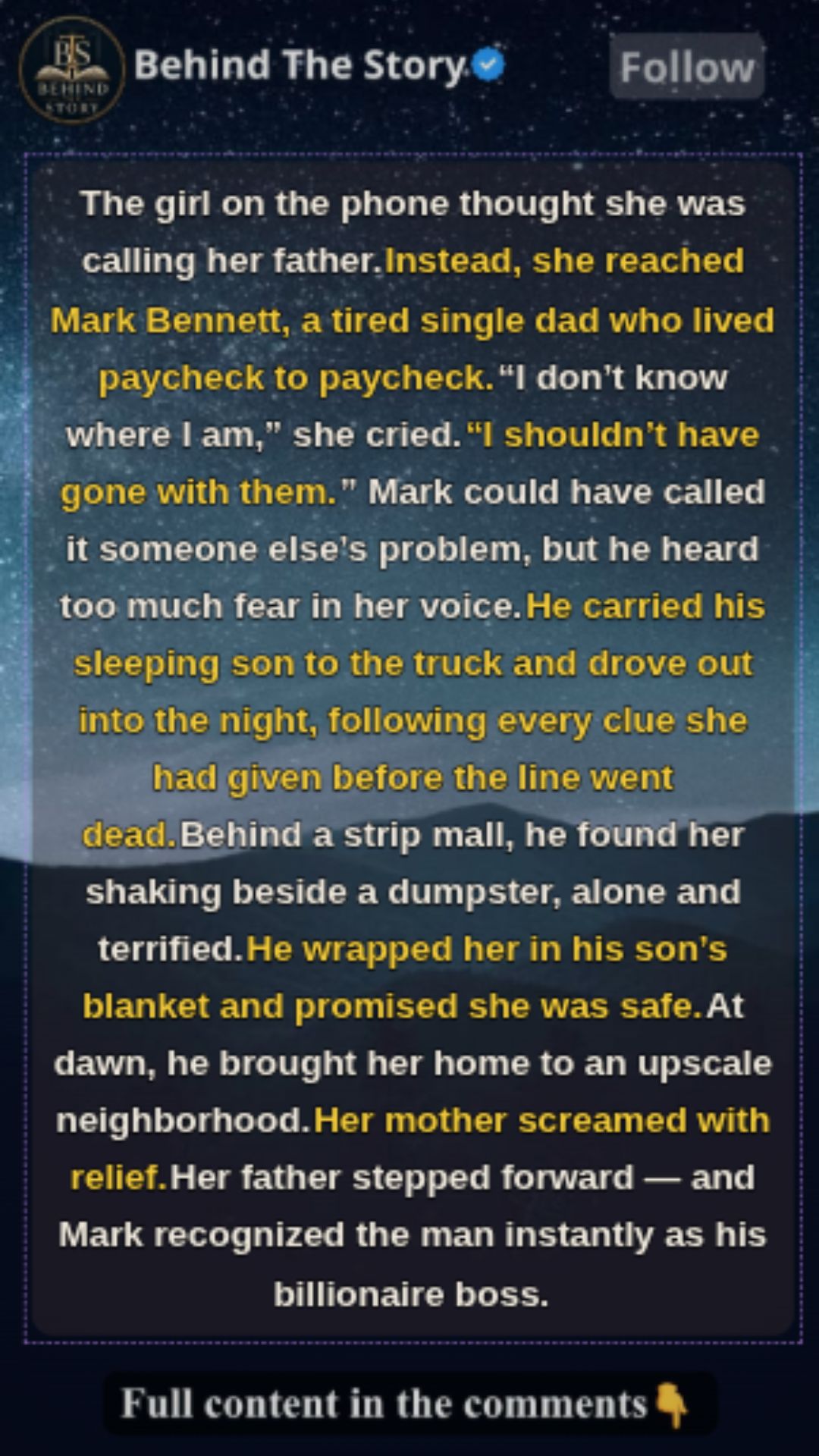
The sound cut through the silence of his tiny apartment like an alarm. For one terrifying second, he thought something had happened to his five-year-old son, Noah, sleeping in the next room.
Mark sat up fast, his body heavy with exhaustion. He had only been asleep for two hours after another night shift cleaning offices downtown. His back ached. His hands were rough from chemicals. His life had become a cycle of work, bills, school lunches, and pretending he was not tired enough to collapse.
He grabbed the phone.
“Hello?”
A girl’s voice trembled on the other end.
“Dad?” she whispered. “I don’t know where I am.”
Mark froze.
The voice was young. Scared. Barely holding together.
“This isn’t your dad,” Mark said carefully. “My name is Mark. Are you hurt?”
The girl began to cry.
“I didn’t mean to call you. I’m sorry. I just… I don’t know what happened. I left the party. I’m cold.”
Then the line went dead.
Mark stared at the phone.
He called back. No answer. Again. No answer. The voicemail said the name Hannah.
He looked toward Noah’s bedroom. His little boy was sleeping peacefully, one arm wrapped around a stuffed dinosaur. Every responsible part of Mark told him to stay. He was a single father. He could not run into the night chasing a stranger’s emergency.
But the girl’s voice would not leave his head.
Dad, I don’t know where I am.
Mark closed his eyes.
Then he grabbed his coat, lifted Noah gently from bed, wrapped him in a blanket, and carried him to the old pickup truck.
“I hope someone would do the same for you,” Mark whispered, buckling his son into the back seat.
The city was nearly empty. Streetlights reflected off wet pavement. Mark drove slowly through the dark, calling the number again and again. No answer. He checked nearby streets, gas stations, alleys behind shopping centers — anywhere a scared teenager might hide after running from trouble.
Twenty minutes later, his headlights swept across the back of an old strip mall.
He saw her beside a dumpster.
A teenage girl sat curled against the brick wall, barefoot, shaking, mascara streaked down her face. She looked smaller than her voice had sounded on the phone.
Mark stopped the truck but did not rush toward her. He stepped out slowly, raising both hands so she could see he was not a threat.
“Hannah?” he called softly. “My name is Mark. You called me by mistake.”
She looked up, terrified.
“I’m not your dad,” he said. “But I came because you sounded like you needed help.”
Hannah started crying again. “I’m sorry. I didn’t mean to bother you.”
“You didn’t bother me.”
He opened the passenger door and pulled out Noah’s spare blanket. “Let’s get you warm first. Then we’ll figure out where home is.”
She hesitated, then let him wrap the blanket around her shoulders.
On the drive, Hannah spoke in broken pieces. There had been a party. Older kids. Drinks she should not have taken. A room she did not want to be in. A feeling that something was wrong. So she ran.
Mark did not lecture her. He did not ask cruel questions. He only listened.
“You did the right thing leaving,” he said. “Now we’re getting you home.”
By the time they reached her neighborhood, dawn had begun to touch the sky.
The houses grew larger. The lawns cleaner. The gates taller.
When Mark pulled into the driveway of a modern mansion, the front door flew open. A woman ran out barefoot, her robe loose around her shoulders, her face destroyed by fear.
“Hannah!”
The girl jumped from the truck and collapsed into her mother’s arms.
Mark stepped back, giving them space. He was ready to leave quietly. He had done what he came to do.
Then another figure appeared in the doorway.
A man in a wrinkled suit walked out slowly, his face pale from a sleepless night.
“Are you the man who brought my daughter home?” he asked.
Mark nodded. “She called the wrong number. I just helped her get back.”
The man reached out and shook his hand.
“Alan Foster.”
Mark’s stomach dropped.
Alan Foster was the CEO of the company whose offices Mark cleaned every night.
Mark had seen his name on glass doors, company emails, framed awards in the lobby. But he had never met him. Men like Alan Foster did not usually notice men like Mark Bennett.
Alan’s eyes dropped briefly to the cleaning-company badge still clipped to Mark’s jacket.
“You work in my building,” Alan said quietly.
“Yes, sir. Night crew.”
Alan looked stunned. “You finished a night shift, got a wrong call from a stranger, and still drove out to find my daughter?”
Mark glanced back at the truck, where Noah was still asleep in the back seat.
“She sounded scared,” he said. “I couldn’t ignore it.”
Alan’s wife insisted he come inside. Mark tried to refuse, but Hannah hugged him again and whispered, “Thank you for answering.”
So he followed them into the house, feeling completely out of place among marble floors, glass walls, and furniture that probably cost more than his truck.
In the kitchen, Alan poured him coffee with his own hands.
For a while, nobody spoke much. Hannah sat wrapped in a blanket beside her mother. Noah slept against Mark’s shoulder. Alan stood near the counter, watching the man who had done what all his wealth could not do that night.
Finally, Alan asked, “Why?”
Mark looked up.
“Why would you leave your home at two in the morning for a girl you didn’t know?”
Mark looked down at Noah, his son’s warm breath against his shirt.
“Because one day,” he said quietly, “my boy might call someone. And I pray that person answers.”
Alan looked away.
That answer hit him harder than any speech could have.
After breakfast, Mark thanked them and stood to leave. He was exhausted. He still had laundry to do, bills to think about, and another shift waiting for him that night.
But Alan stopped him at the door.
“Mr. Bennett,” he said, holding out an envelope, “I can’t let you leave without giving something back.”
Mark immediately shook his head. “Sir, I didn’t do it for money.”
“I know,” Alan said. “That’s why this matters.”
Inside the envelope was not cash.
It was an offer letter.
Full-time facilities supervisor. Day shift. Salary three times higher than what Mark currently made. Health benefits. Paid leave. Coverage for him and Noah.
Mark read it twice before he understood.
His throat tightened. “I don’t know what to say.”
Alan’s voice softened.
“You showed up for my daughter when I couldn’t. Let me show up for your son.”
Mark tried to speak, but the years caught up to him all at once: the unpaid bills, the lonely nights, the fear of getting sick, the guilt of never having enough time for Noah. He looked at the letter, then at his sleeping boy.
For the first time in years, survival did not feel like the only option.
He accepted.
On the drive home, morning sunlight warmed the windshield. Noah finally woke up in the back seat, rubbing his eyes.
“Daddy?” he mumbled. “Where are we?”
Mark laughed softly, tears slipping down his face before he could stop them.
“We’re going home,” he said. “And I got a new job today.”
Noah smiled sleepily, as if that made perfect sense.
Mark looked at the road ahead.
A few hours earlier, he had been a tired man answering a wrong number in the dark. He had no plan, no reward in mind, no reason to believe kindness would give anything back.
He had only heard a frightened voice and chosen not to look away.
Sometimes, goodness is not convenient. Sometimes, it arrives when you are tired, broke, and barely holding your own life together.
But when someone calls from the dark, and someone else chooses to answer, the world changes.
That night, Mark did not just bring a lost girl home.
He brought hope back to his own life.