 A Kind Bellboy Helped A Poor Guest — The Next Morning, He Became The New Manager.
The man arrived at The Meridian Crown Hotel just after midnight, dragging an old brown suitcase with one broken wheel across the wet pavement.
The entrance looked too grand for him.
Two golden doors stood beneath a glass canopy. Warm light spilled from chandeliers inside the lobby. A line of polished black cars waited near the valet stand. Guests in tailored coats stepped out under umbrellas, laughing softly as doormen greeted them by name.
The man had no driver.
No umbrella.
No designer luggage.
He wore a faded gray coat, scuffed shoes, and a simple wool cap pulled low over his forehead. Rain dotted his shoulders. His suitcase made a rough scraping sound each time the broken wheel caught against the stone.
A valet saw him first.
Then looked away.
A doorman watched him struggle up the curb, then turned to open the door for a couple in evening clothes.
Inside, two receptionists glanced toward the entrance through the glass. One of them raised her eyebrows. The other gave a tiny shrug.
The man stopped beneath the canopy and looked up at the hotel sign.
The Meridian Crown.
Five stars.
Forty-two floors.
One of the most expensive hotels in the city.
He adjusted his grip on the suitcase handle and stepped toward the entrance.
The doorman did open the door, but not with the smile he had given the other guests. He opened it just enough, without eye contact, as if hoping the man would change his mind and walk back out into the rain.
The man entered quietly.
The lobby was almost empty, but it still felt alive with wealth. Marble floors reflected the ceiling lights. Gold-framed mirrors lined the walls. A grand piano sat near a flower arrangement taller than a person. Behind the reception desk, a clock showed the time in New York, London, Dubai, Tokyo, and Singapore.
The man paused just inside the door.
For a moment, nobody moved toward him.
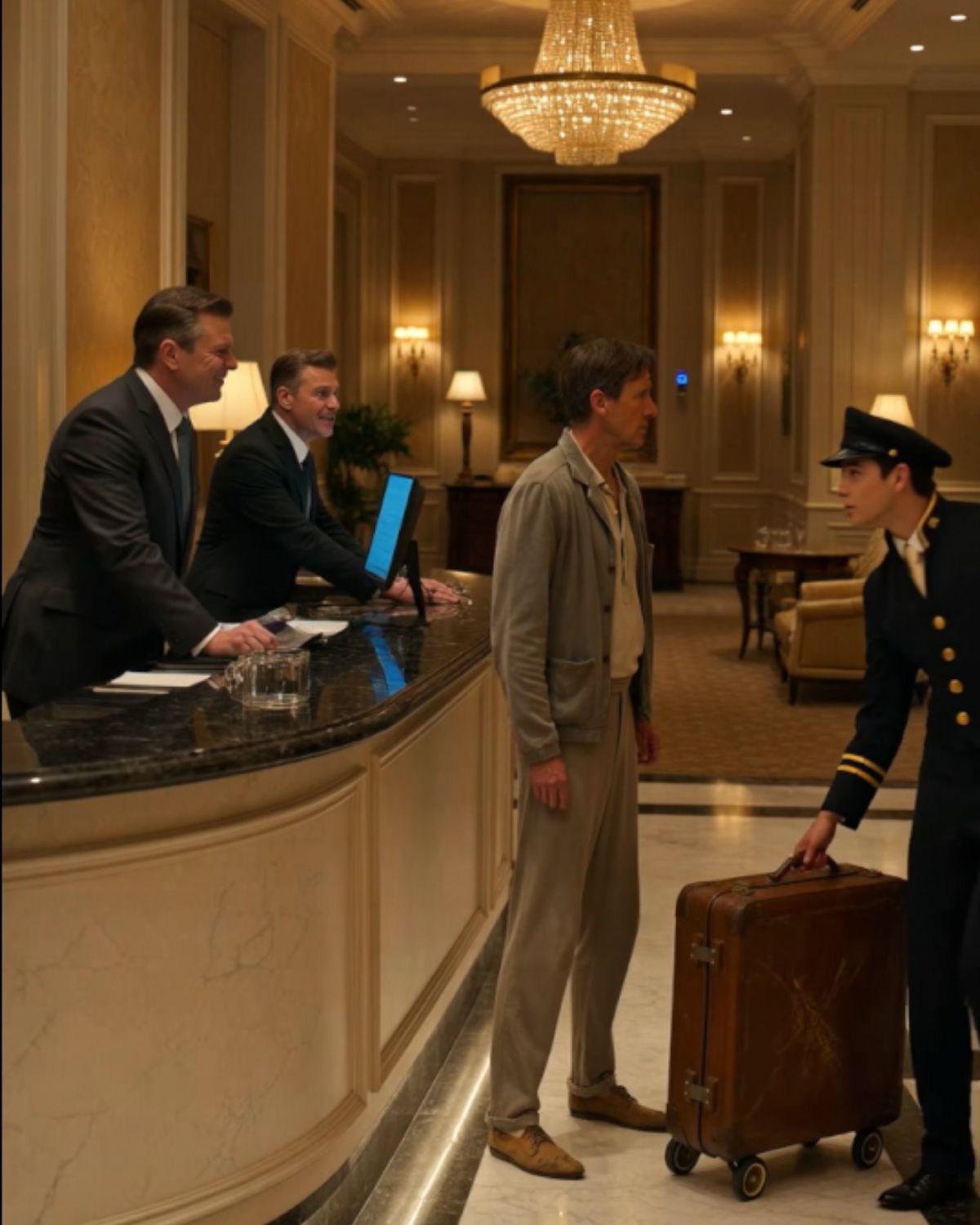
At the front desk, the night supervisor, Adrian Cole, looked up from the computer.
Adrian was thirty-seven, sharp-faced, perfectly groomed, and deeply proud of the title on his name tag: Front Desk Supervisor. He wore his authority the way some people wear cologne—too much, and in every direction.
He glanced at the man’s coat, then at the old suitcase.
Then he leaned slightly toward the junior receptionist beside him.
“Don’t waste time on him,” Adrian said quietly. “He probably can’t afford this place.”
The receptionist, Maya, looked uncomfortable. “He might have a reservation.”
Adrian gave her a thin smile. “People with reservations here don’t arrive looking like they slept at the bus station.”
The man heard enough to understand.
His face did not change.
He simply pulled the suitcase forward another few inches.
The broken wheel scraped loudly across the marble.
Adrian winced.
Not out of sympathy.
Out of embarrassment.
Near the bell stand, a young bellboy named Ethan Walker was organizing luggage tags for the morning departures.
He heard the scrape too.
He turned and saw the man standing alone by the entrance, one hand still on the suitcase, rainwater gathering in small dark spots on the marble around his shoes.
Ethan had worked at The Meridian Crown for nine months.
He was twenty-four, the youngest bellboy on the night shift, and still treated by some senior staff like a temporary decoration in a red uniform. He lived with his mother and younger sister in a small apartment forty minutes away by bus. He took every overtime shift he could get, not because he loved polishing luggage carts at two in the morning, but because his sister’s college application fees were due and his mother’s hours at the bakery had been cut.
He knew what it felt like to enter a place and sense that people had already priced you.
So when he saw the man being ignored, Ethan did not wait for anyone’s permission.
He walked across the lobby with a luggage cart and stopped beside him.
“Good evening, sir,” Ethan said warmly. “Welcome to The Meridian Crown. Let me help you with that.”
The man looked at him.
Not quickly.
Carefully.
As if he had been waiting to see who would be the first person to speak to him like he belonged indoors.
“That’s kind of you,” the man said.
His voice was soft, tired, but steady.
Ethan smiled. “Long trip?”
“Longer than expected.”
“I’m sorry to hear that, sir. We’ll try to make the rest of your night easier.”
Ethan lifted the suitcase before the man could struggle with it again. It was heavier than it looked. The handle was loose. The corner was cracked. One of the brass latches had been repaired with tape.
Adrian watched from the front desk with visible irritation.
Ethan brought the man toward reception.
Maya straightened immediately. “Good evening, sir. Do you have a reservation with us?”
The man reached into his coat pocket and pulled out a worn leather wallet.
Before he could answer, Adrian stepped forward.
“Sir,” Adrian said, forcing a professional tone that carried no warmth, “this hotel requires a valid reservation and a credit card for incidentals.”
The man looked at him. “I understand.”
Adrian’s eyes flicked to the suitcase. “Our room rates tonight start at six hundred dollars.”
Maya looked down.
Ethan stood still beside the luggage cart.
The man opened his wallet and removed an ID and a credit card. He placed both on the desk.
“My reservation is under Harrison,” he said. “Thomas Harrison.”
Maya typed the name.
Her expression changed.
“Yes, Mr. Harrison,” she said quickly. “We have you in a deluxe king room for one night.”
Adrian leaned closer to the screen.
His face tightened for half a second.
The reservation was real.
Paid in full.
He recovered quickly. “Of course. We simply have to be careful at this hour.”
Mr. Harrison said nothing.
That made Adrian talk more.
“We’ve had people wander in from the street before,” he added. “Some only want to use the lobby or ask for money.”
Maya’s fingers paused above the keyboard.
Ethan glanced at Mr. Harrison.
The guest’s expression remained polite, but his eyes took in everything: Adrian’s tone, Maya’s discomfort, Ethan’s silence, the doorman pretending not to listen from across the lobby.
Ethan stepped forward slightly.
“Mr. Harrison, would you like some hot tea sent to your room after check-in?” he asked. “It’s raining hard outside. I can ask room service before they close the overnight station.”
Mr. Harrison turned to him.
“That would be very nice,” he said. “Thank you.”
Adrian gave Ethan a look that meant stop interfering.
Ethan pretended not to see it.
Maya handed over the key card. “Room 1812, sir. Elevators are to your right.”
Ethan reached for the luggage cart. “I’ll show you up.”
Adrian cleared his throat. “Ethan.”
Ethan stopped.
Adrian smiled without showing kindness. “The Parkers in suite 2104 are expecting their luggage from storage. That is a priority.”
Ethan knew the Parkers. They were regular guests who tipped well and complained better.
“I’ll take Mr. Harrison up first, sir,” Ethan said. “Then I’ll return for the Parkers’ luggage right away.”
Adrian’s eyes hardened.
“Ethan,” he said, lower now, “use judgment.”
The message was clear.
Do not waste time on the man with the old suitcase.
Mr. Harrison looked at Ethan.
The young bellboy felt the weight of the moment. Not because he knew who the man was. He did not. To Ethan, Mr. Harrison was simply a tired guest who had paid for a room and deserved help getting there.
So Ethan nodded politely to Adrian.
“I am, sir.”
The words hung in the lobby.
Maya lowered her face to hide the smallest smile.
Adrian did not smile at all.
Ethan guided Mr. Harrison toward the elevator hallway. The camera of that moment would have moved with them, leaving behind the bright reception desk and entering the quieter corridor lined with brass elevator doors. The lobby music faded. The lights became softer. The sound of the suitcase wheels became smooth now that it was on the cart.
Ethan pressed the button.
The elevator doors opened with a quiet chime.
He stepped aside and held them.
“After you, sir.”
Mr. Harrison entered, watching him.
Ethan rolled the luggage cart in after him and pressed 18.
For several floors, neither spoke.
Then Mr. Harrison said, “You heard what your supervisor said.”
Ethan kept his eyes forward. “Yes, sir.”
“And you helped me anyway.”
Ethan gave a small nod. “You’re a guest.”
Mr. Harrison looked at him through the elevator reflection. “That was enough?”
“It should be.”
The elevator passed floor 11.
Mr. Harrison’s face softened slightly. “Most people don’t think that way when they believe no one important is watching.”
Ethan did not answer immediately.
Then he said, “My mother cleans offices at night. She wears an old coat to work too. I’d hope someone would still open the door for her.”
Mr. Harrison looked down at the suitcase cart.
Ethan added, “Everyone deserves respect here, sir. Not because of the room they booked. Because they walked through the door.”
The elevator doors opened on the eighteenth floor.
The corridor was quiet and elegant. Thick carpet swallowed their footsteps. Wall lamps cast gold circles of light along cream wallpaper. A faint scent of cedar and fresh linen floated in the air.
Ethan led the way to room 1812.
He opened the door and stepped aside.
The room was spacious, with a king bed, city views, a writing desk, and heavy curtains drawn halfway open. Rain streaked the glass. The skyline shimmered beyond it like a field of lights.
Ethan placed the suitcase on the luggage rack gently, not letting the damaged corner hit the wall.
“Would you like me to show you the room features?” he asked.
Mr. Harrison removed his cap. His hair was silver at the temples.
“Just the basics.”
Ethan showed him the thermostat, the blackout curtains, the safe, the phone, and the room service menu. He checked that the bathroom towels were stocked and noticed one hand towel missing.
“I’ll bring an extra towel with the tea,” Ethan said.
“You noticed that?”
“Yes, sir.”
Mr. Harrison looked at him again, that same careful look.
Ethan moved toward the door. “Is there anything else I can do for you tonight?”
Mr. Harrison paused.
“You can answer something honestly.”
Ethan stood straighter. “I’ll try.”
“Was tonight unusual?”
Ethan knew what he meant.
He also knew what could happen if he criticized the hotel.
So he chose the truth without making it dramatic.
“No, sir,” he said. “Not unusual enough.”
Mr. Harrison nodded slowly.
“Thank you, Ethan.”
The bellboy blinked. “You remember my name?”
“It’s on your tag.”
“Most people don’t read it.”
“I do.”
Ethan gave a polite smile. “I’ll send the tea up, Mr. Harrison. Have a restful night.”
When Ethan returned downstairs, Adrian was waiting near the bell stand.
“Are you proud of yourself?” he asked quietly.
Ethan put the luggage cart back in place. “I helped a guest to his room.”
“You delayed service for a suite guest.”
“I’ll handle the Parkers now.”
Adrian stepped closer. “You need to understand something if you want to last here. This hotel survives because we know who matters. You don’t spend fifteen minutes carrying a torn suitcase upstairs when a platinum guest is waiting.”
Ethan looked toward the elevators, then back at him.
“With respect, sir, if he paid for a room, he matters.”
Adrian gave a short laugh. “That attitude is why you’re still carrying bags.”
Ethan said nothing.
He had learned that silence could protect a paycheck.
But Maya heard from the reception desk. So did the doorman. So did Clara from housekeeping, who had come to ask for a maintenance key.
By 1:10 a.m., Ethan had delivered the Parkers’ luggage, sent hot tea to room 1812, added two towels, and checked that Mr. Harrison’s suitcase had not been damaged further during handling.
He did not expect a tip.
He did not receive one.
That did not bother him.
By 2:00 a.m., the hotel had settled into its overnight rhythm. The lobby emptied. The chandeliers dimmed slightly. Rain continued tapping against the glass canopy outside.
In room 1812, Thomas Harrison sat at the writing desk with a laptop open.
On the screen was a document titled:
Meridian Crown Service Quality Inspection — Night Arrival Assessment.
He typed slowly.
Arrival experience: Selective service observed.
Doorman ignored guest based on appearance.
Front Desk Supervisor Adrian Cole made prejudicial comments within guest hearing range.
Receptionist Maya Patel remained professional but hesitant under supervisor pressure.
Bellboy Ethan Walker proactively assisted without prompting, used respectful language, ensured comfort, identified missing room item, and upheld brand values under internal pressure.
He paused after that last sentence.
Then added:
Recommend immediate leadership review at front desk. Recommend Ethan Walker for management development track.
He closed the laptop.
The poor-looking guest was not poor.
The old suitcase was not an accident.
The coat, the scuffed shoes, the late arrival, even the broken wheel had all been part of a planned inspection arranged by the hotel’s new ownership group.
For two months, the Meridian Crown had been under quiet review. Guest complaints had increased. Staff turnover had risen. Online ratings still looked good because management responded beautifully in public, but internal surveys told another story.
The new owners wanted to know whether the hotel had a training problem, a staffing problem, or a culture problem.
Thomas Harrison had spent twenty-five years in hospitality investments. He had inspected resorts in Singapore, business hotels in London, airport lounges in Dubai, and family-run inns in Vermont. He knew every property had polished corners before a scheduled inspection.
So he preferred arriving when nobody was ready.
Late.
Wet.
Underestimated.
By morning, the rain had stopped.
The hotel entrance shone under pale sunlight. Black cars returned. Guests moved through the lobby with coffee cups and rolling luggage. Staff members prepared for the daily briefing in the meeting room behind the executive offices.
Ethan arrived ten minutes early.
He always did.
His uniform was freshly pressed. His shoes were polished, though the right sole was beginning to wear thin. He had slept only four hours after the night shift, but he came in because Adrian had scheduled him for the morning luggage rush too.
At 8:30 a.m., all department heads and selected front-line staff were called into the staff meeting room.
That alone was strange.
Bellboys were rarely invited unless someone had complained.
The room was clean and formal, with a long table, a screen, and framed photos of the hotel from its opening year. Managers stood near the front. Receptionists lined one wall. Bell staff, housekeeping, security, and concierge employees stood in neat rows.
Adrian entered last, carrying a tablet and wearing the confident look of a man expecting to impress someone.
The general manager, Rebecca Sloan, stood at the head of the room.
She looked more serious than usual.
“Thank you for coming in on short notice,” she said. “As many of you know, the hotel completed its ownership transition this week. Last night, we had an unannounced service-quality inspection.”
A shift moved through the room.
Adrian looked up.
Maya’s eyes widened slightly.
Ethan stood near the back, hands folded behind him.
Rebecca continued, “The inspection was conducted during the overnight arrival window.”
The door opened.
Everyone turned.
The tired man from the night before walked in.
But he was no longer wearing the faded gray coat.
Thomas Harrison entered in a sharp navy business suit, white shirt, dark tie, polished shoes, and a watch that looked expensive without trying to prove it. His hair was neatly combed. He carried a leather folder instead of an old suitcase.
For one second, the room did not understand.
Then it did.
Maya’s hand flew to her mouth.
The doorman stared at the floor.
Adrian turned pale so quickly it seemed the blood had been switched off behind his skin.
Ethan’s lips parted.
Mr. Harrison looked around the room calmly.
Rebecca said, “This is Mr. Thomas Harrison, representative of the new ownership group. He inspected our service last night.”
The silence became heavy.
Not ordinary silence.
The kind that forms when people begin replaying their own behavior in reverse.
Adrian lowered his tablet slowly.
Mr. Harrison stepped to the front of the room.
“Good morning,” he said. “Last night, I arrived at this property as a guest who appeared tired, underdressed, and inconvenient.”
No one moved.
“I was ignored at the entrance. I was discussed at the front desk as though I could not hear. I was treated as a problem before I had created one.”
Adrian’s jaw tightened.
Mr. Harrison did not look at him yet.
“That matters,” he continued, “because luxury hospitality is not proven by how warmly we treat people who arrive in expensive cars. That is easy. Luxury hospitality is proven when a guest arrives with nothing that benefits your ego, and you still remember your standards.”
Rebecca stood with her hands folded, face unreadable.
Mr. Harrison opened the folder.
“Several employees failed that test last night.”
The doorman swallowed.
Adrian stared at the floor.
Then Mr. Harrison’s voice changed—not softer, but clearer.
“One employee passed it before he knew there was a test.”
Ethan felt several people glance toward him.
He did not move.
Mr. Harrison looked directly at him.
“Ethan Walker.”
Ethan straightened. “Yes, sir.”
“You approached me at the entrance without being asked. You greeted me properly. You carried my suitcase carefully even though it was old and damaged. You offered tea because you noticed I was wet and tired. You checked the room instead of rushing out. You noticed a missing towel. And when pressured by your supervisor to prioritize a guest who looked more profitable, you said, ‘If he paid for a room, he matters.’”
The room turned toward Ethan fully now.
His face warmed.
He had not known anyone heard that.
Adrian did.
That was the moment his expression changed from fear to humiliation.
Mr. Harrison finally looked at him.
“Mr. Cole.”
Adrian lifted his head. “Sir, I can explain.”
“I’m sure you can.”
Adrian swallowed. “My priority was protecting the standards of the hotel. At that hour, we often get walk-ins who are not guests, and I was trying to prevent disruption.”
Mr. Harrison held his gaze.
“You did not protect the hotel’s standards. You confused standards with status.”
Adrian’s mouth closed.
Mr. Harrison continued, “You assumed a guest did not belong here because of his clothing. You advised an employee not to waste time on him. You spoke within earshot. Then you criticized the one staff member who behaved correctly.”
Adrian looked toward Rebecca.
She did not help him.
Mr. Harrison said, “That is not supervision. That is contamination.”
The word struck the room.
Adrian’s shoulders dropped slightly.
For the first time, the man who had spent years ranking guests by shoes, watches, luggage, and credit card color seemed unable to rank himself out of trouble.
Mr. Harrison turned back to the staff.
“Let me be clear. This hotel is not replacing professionalism with sentiment. Ethan is not being rewarded because he was merely nice. Kindness alone is not a management qualification.”
Ethan looked down, almost relieved that someone had said it.
Mr. Harrison continued, “He is being recognized because he demonstrated operational judgment under pressure. He identified guest needs, protected brand reputation, maintained service consistency, and showed respect without knowing whether he would be praised or tipped.”
Rebecca nodded.
“Effective today,” she said, “Adrian Cole is being removed from front desk supervisory duties pending a full leadership review.”
Adrian closed his eyes briefly.
No one spoke.
Rebecca looked toward Ethan.
“Ethan Walker will enter a ninety-day management development program as Assistant Manager Trainee for Guest Services. He will shadow front desk operations, concierge, housekeeping coordination, and service recovery. If he completes the program successfully, he will be considered for a permanent assistant manager role.”
The room exhaled.
That was why it felt believable.
He was not handed an office because he carried one suitcase.
He was given a path because he had shown the one quality no training manual could fake.
Ethan stood frozen.
“Ma’am,” he said, voice low, “I don’t know what to say.”
Rebecca’s expression softened. “Say you’ll learn fast.”
Ethan nodded. “I will.”
Mr. Harrison smiled for the first time.
“I believe that.”
Maya started clapping.
For half a second, she was alone.
Then Clara from housekeeping joined.
Then the bell staff.
Then most of the room.
The applause was not loud like a celebration.
It was steady, sincere, and maybe a little guilty.
Ethan did not know where to look. His hands remained behind his back, but his eyes shone. He thought of his mother coming home after cleaning offices where executives never learned her name. He thought of his sister filling out scholarship forms at the kitchen table. He thought of all the people who had walked into beautiful places and been made to feel ugly.
Across the room, Adrian kept his head lowered.
Not dramatically.
Completely.
The recognition had arrived too late to save his position but early enough to show him exactly what he had become.
Mr. Harrison closed his folder.
“From this morning forward,” he said, “every department will undergo service retraining. Not the scripted kind. The real kind. We will measure response times, complaint handling, accessibility, staff conduct, and how guests are treated before anyone knows their spending power.”
He paused.
“And we will also review how supervisors treat junior staff. Because a hotel that disrespects its own people will eventually disrespect its guests.”
Several employees looked at one another.
That sentence mattered to them.
Ethan looked toward Adrian, not with triumph, but with something calmer. He had not wanted the man destroyed. He had wanted the work to mean something.
After the meeting, the staff slowly left the room.
Maya stopped beside Ethan.
“You deserve it,” she said.
Ethan gave a nervous laugh. “I’m still trying to understand what just happened.”
“You helped the right guest.”
Ethan shook his head. “No. I helped a guest.”
Maya smiled. “That’s why you deserve it.”
Near the doorway, Adrian stood alone.
For a moment, Ethan thought he would walk past without speaking.
But Adrian stopped.
His face was stiff, pride fighting with embarrassment.
“Walker,” he said.
Ethan turned. “Yes, sir?”
Adrian looked like he hated the word he was about to say.
Then he said it anyway.
“I was wrong last night.”
Ethan did not answer immediately.
Adrian looked toward the hallway, then back at him.
“And not just last night.”
That was all he could manage.
Maybe it was not enough.
But it was the first honest thing Ethan had ever heard from him.
Ethan nodded once. “I appreciate you saying that.”
Adrian left without another word.
Later that afternoon, Ethan was given a temporary badge that read:
Ethan Walker
Assistant Manager Trainee — Guest Services
He held it in his hand for several seconds before pinning it to his jacket.
It felt heavier than his old name tag.
Not because of the title.
Because of the responsibility.
That evening, he stood again near the hotel entrance, this time shadowing the guest services manager. A taxi pulled up. An elderly woman stepped out slowly with a small floral suitcase. Her coat was old. Her shoes were practical. She looked up at the hotel with uncertainty.
Before anyone could decide whether she looked important, Ethan walked forward.
“Good evening, ma’am,” he said warmly. “Welcome to The Meridian Crown. Let me help you.”
She smiled with relief.
Behind him, through the glass doors, the lobby lights glowed against the marble floor. The hotel looked the same as it had the night before. Same chandeliers. Same piano. Same golden desk. Same polished elevators.
But something had shifted.
Not enough to fix everything in one day.
Enough to begin.
The next morning, people would still talk about the poor-looking guest who arrived with a broken suitcase and turned out to be the owner’s representative. They would talk about Adrian’s face when Mr. Harrison walked into the meeting room in a suit. They would talk about Ethan’s promotion and whether it was luck, timing, or destiny.
But Ethan knew the truth.
It had not started with a promotion.
It started with a choice no one was applauding.
A wet guest at midnight.
An old suitcase.
A lobby full of people pretending not to see him.
And one bellboy who remembered that respect is not a luxury service reserved for people who look rich.
Sometimes the smallest act of dignity becomes the interview you did not know you were taking.