PART I — “THE WALLS DON’T ECHO NAMES”
The corridor smelled like polished metal and old air-conditioning—too cold for California, too sterile for anything that called itself human.
Captain Elias Mercer noticed it the moment he stepped off the elevator.
His boots hit the floor in a rhythm that didn’t belong to hesitation. Three steps in, he slowed—not because he wanted to, but because something at the end of the hallway refused to behave like background noise.
Laughter.
Not loud. Not open. The kind that stayed behind teeth.
He turned the corner.
And saw her.
She stood near the briefing room door, half-turned, holding a tablet against her chest like it could shield her from physics. Navy utilities, slightly too loose at the shoulders, sleeves rolled with precise care that no one bothered to notice. Her hair was tied back without rebellion or flair—just regulation trying not to look like survival.
Around her, three junior officers formed a loose semicircle.
One of them—Lieutenant Brannock—leaned against the wall with the comfort of someone who had never been told “no” in a tone that mattered.
“You still using that old clearance tag?” Brannock asked.
No one expected an answer. That was the point.
The woman—Lieutenant Commander Rhea Kincaid—didn’t react immediately. Her eyes stayed on the tablet. A second too long. A practiced delay that had the shape of restraint.
Then she spoke.
“Yes.”
Just that.
Brannock smiled wider. “Two years and still paperwork duty. You ever think about transferring? Logistics maybe? Something… quieter.”
A soft chuckle from behind him.
Someone else added, “She likes the view here. All these important doors she can’t go through.”
Another ripple of laughter.
Rhea adjusted her grip on the tablet.
No flinch. No glare. No visible crack.
But Mercer saw her thumb press once against the edge—just enough pressure to whiten the skin.
He recognized that kind of control.
It wasn’t peace.
It was containment.
A door hissed open behind them. A civilian contractor walked past, didn’t look at anyone, didn’t intervene. That was normal. That was the system.
Brannock pushed off the wall slightly, stepping closer.
“You ever wonder,” he said, lowering his voice like it was a privilege, “why someone like you ends up stuck here?”
Rhea finally looked up.
Her eyes were not soft. That was the first mistake people made.
They were focused. Measured. Like distance markers on a range.
“I’m assigned here,” she said.
Brannock tilted his head. “That’s not what I asked.”
A beat of silence stretched too long for comfort.
Then—
Footsteps.
Not hers.
From behind.
Captain Mercer stepped into the space like a correction.
No announcement. No introduction. Just presence.
The air changed.
Brannock noticed first. His posture shifted half a degree—confident body language recalculating itself.
“Captain,” Brannock said carefully.
Mercer didn’t look at him.
He was looking at Rhea.
Not her face.
Her collar.
There was something there that didn’t belong in open corridors.
A patch—small, almost intentionally understated. Dark fabric. No visible insignia at first glance.
But Mercer had spent long enough around classified programs to recognize the difference between decoration and concealment.
His gaze sharpened.
Rhea noticed.
Her hand moved—subtle, immediate—angling her body half a step to the side.
Too late.
Mercer saw it.
Not the patch.
The edge of what the patch hid.
A symbol that didn’t exist in any publicly acknowledged roster.
His throat went dry in a way he hadn’t felt since Afghanistan.
Brannock tried to fill the silence. “Sir, we were just—”
“Quiet,” Mercer said.
One word.
No volume increase.
Still enough to collapse the conversation.
Brannock froze mid-breath.
Rhea didn’t move.
But something in her shoulders changed. A micro-adjustment. Like a soldier hearing her name called in a language she stopped expecting.
Mercer took one step closer.
Then another.
The corridor felt narrower.
“What unit are you assigned to?” he asked.
Rhea hesitated.
That hesitation lasted less than a second.
But Mercer saw it.
Because people didn’t hesitate unless the answer carried weight.
“Naval Systems Integration,” she said.
Brannock laughed under his breath. “See? Told you. Paperwork.”
Mercer didn’t react to him.
He was still looking at Rhea.
“That’s your official assignment,” he said.
Not a question.
Rhea’s eyes flicked—just once—to the hallway camera above them.
Then back to him.
“Yes, Captain.”
A pause.
Mercer exhaled slowly through his nose.
Then he did something that made the corridor go quiet in a different way.
He stepped closer again.
Close enough now that the others instinctively shifted back.
And said, very quietly:
“Show me your collar.”
Brannock blinked. “Sir?”
Mercer didn’t look away from Rhea.
“Now.”
The word didn’t carry authority.
It carried memory.
Rhea held his gaze.
For the first time, something behind her eyes moved.
Not fear.
Recognition.
Slowly, she lifted her hand.
Her fingers touched the edge of her collar.
Paused.
Then turned it outward.
The fabric folded back.
And the corridor stopped existing properly.
Because beneath the standard navy cloth—stitched into a layer that should not have been accessible on a public assignment—was a small, matte-black emblem.
Not printed.
Not embroidered.
Embedded.
Angular. Minimal. Unmistakable to anyone who had ever been cleared above their pay grade.
Mercer didn’t move.
But something in his face changed—like a door inside him had been opened without permission.
Behind him, Brannock’s voice cracked slightly.
“What… is that?”
No one answered.
The emblem wasn’t supposed to be visible.
Not here.
Not like this.
Rhea lowered her hand slowly, letting the collar fall back into place as if nothing had happened.
But everything had.
Mercer finally spoke again.
His voice was lower now.
Different.
“Who put you on this corridor?”
Rhea’s jaw tightened.
“I was assigned by Naval Personnel.”
Mercer shook his head once.
“No,” he said. “That’s not what I asked either.”
Silence pressed in from all sides.
Even the hallway seemed to hold its breath.
Then—
A distant alarm chirped once.
Not loud.
Just a tone.
Enough to make Mercer’s eyes flick toward the end of the corridor.
Rhea noticed immediately.
So did Brannock.
“What was that?” someone muttered.
Mercer took one step back.
His expression had changed again.
Calculation now.
Not shock.
Recognition turning into consequence.
He looked at Rhea one more time.
Then said, almost to himself:
“They said this program was closed.”
Rhea’s voice was quieter now.
“They said a lot of things.”
The alarm chirped again.
Twice.
Longer this time.
And from the far end of the hallway, a security door began to descend.
Slowly.
Deliberately.
Like it had just remembered how to close.
Brannock stepped forward slightly. “Sir, what’s happening?”
Mercer didn’t answer.
Because his attention was locked on the emblem again.
On what it meant.
On what it cost.
And on the fact that someone had just been pretending not to see it for two years.
Rhea turned her head slightly toward the descending door.
Then back to Mercer.
Her voice was almost calm.
“They finally noticed,” she said.
Mercer’s eyes narrowed.
“Noticed what?”
Rhea looked at him.
And for the first time—
There was something like exhaustion behind her focus.
“That I was still here.”
The door at the end of the corridor slammed halfway shut.
A metallic echo rolled through the building.
And somewhere beyond it, footsteps began to run.
Toward them.
Not away.
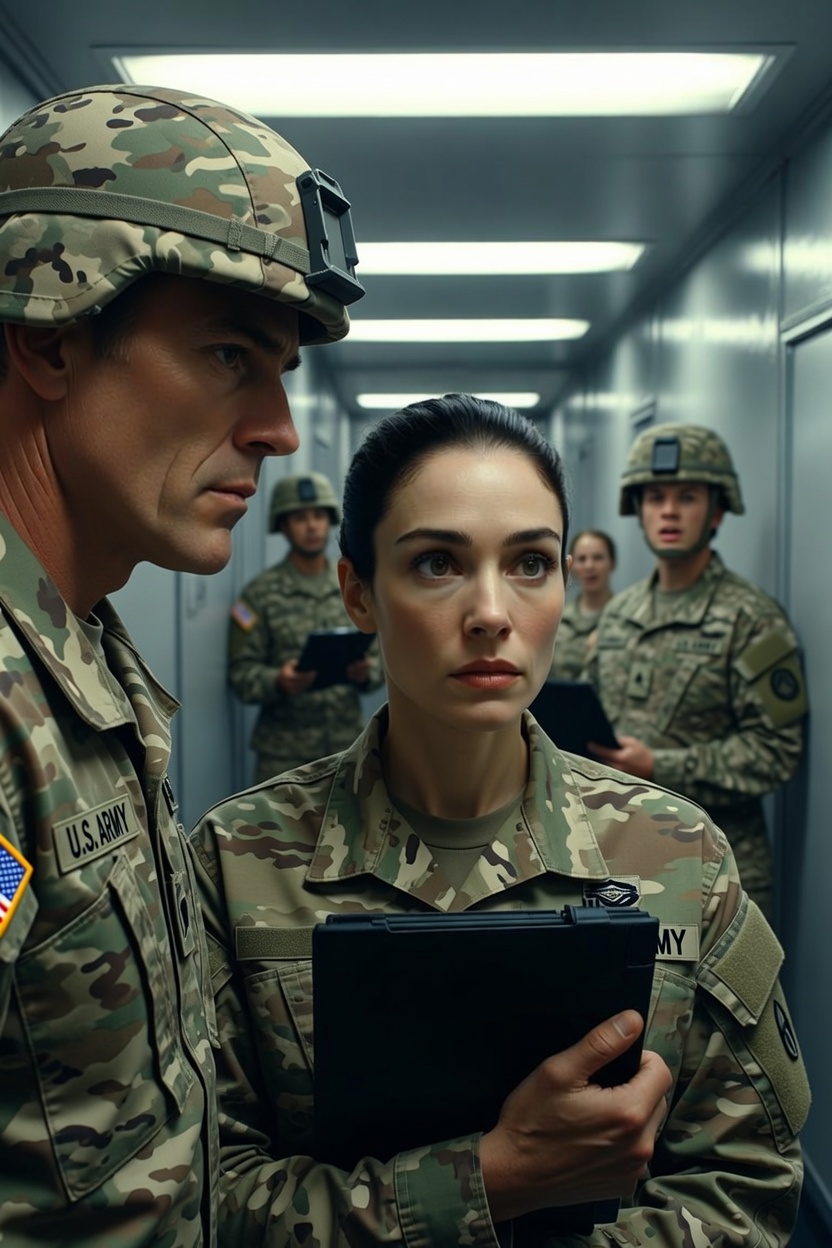
Mercer took a breath.
Slow.
Controlled.
Then spoke one final sentence before everything changed direction:
“Lieutenant Commander Kincaid… what exactly have you been assigned to guard?”
Rhea didn’t answer immediately.
Her eyes shifted to the emblem under her collar.
Then back to him.
And when she spoke, it wasn’t explanation.
It was warning.
“Something your clearance says doesn’t exist.”
The corridor lights flickered once.
And went red.


