People at CrossTech whispered about Viviane Cross the way others whispered about storms.
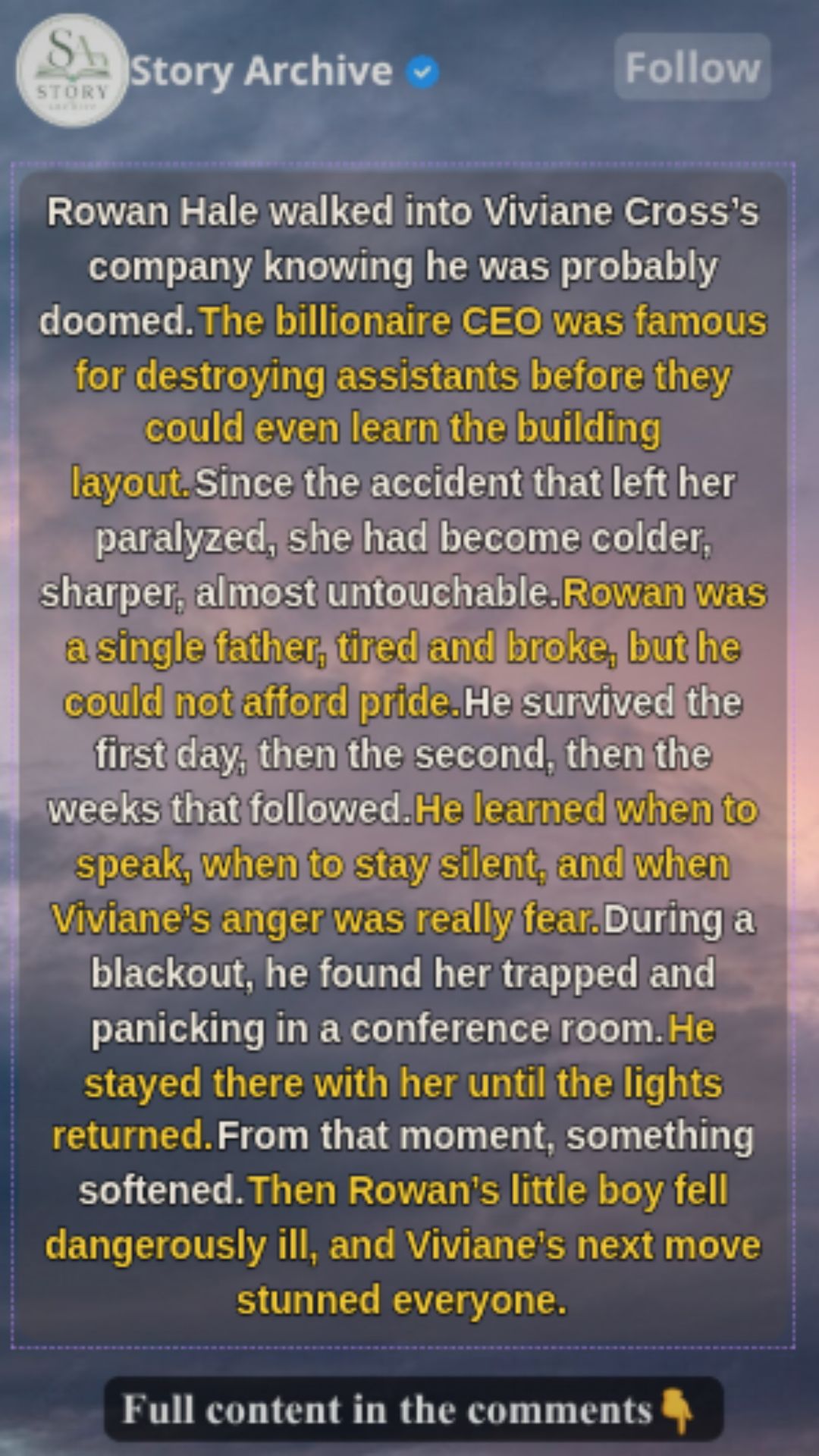
She was brilliant, powerful, and feared. As CEO of a billion-dollar technology company, she could dismantle a boardroom with one sentence and silence an entire floor with one look. Assistants came and went like casualties. One lasted three hours. Another left crying before lunch. A third resigned by email from the lobby.
No one survived Viviane Cross.
Not since the accident.
Three years earlier, a crash had left her paralyzed from the neck down. Her mind remained sharp, almost frighteningly so, but the warmth people once remembered had disappeared behind cold eyes and cutting words. She sat in a custom motorized wheelchair in a glass office above the city, surrounded by success, money, and silence.
Then Rowan Hale walked in.
He was not polished like the others. He was a single father with tired eyes, one good suit, and a stack of unpaid bills waiting at home. His eight-year-old son, Eli, depended on him, and Rowan had reached the point where pride mattered less than survival. The job paid more than anything he had ever been offered. If he could endure Viviane, he could keep the lights on, pay rent, and maybe breathe again.
Viviane looked him over once.
“You’ll quit by noon,” she said.
Rowan placed his notebook on the desk.
“Then I’d better work quickly before that.”
Her eyes narrowed.
The first day was brutal.
Viviane criticized everything. His schedule formatting. His call transfers. The timing of her meetings. The temperature of her tea. The way he anticipated too much, then too little. Every mistake, no matter how small, became evidence that he was unprepared, unqualified, and replaceable.
By evening, Rowan’s nerves were shredded.
But he did not argue.
He did not storm out.
He went home, unlocked his small apartment, and found Eli asleep on the sofa with a schoolbook open on his chest, waiting for his father to return.
Rowan stood there in the dim light, exhausted beyond words.
Then he covered his son with a blanket and whispered, “One more day.”
So he came back.
And then he came back again.
Days became weeks.
Viviane tried to break him with silence, sarcasm, impossible standards, and sudden demands. Rowan learned her routines, her preferences, the rhythm of her pain hidden beneath anger. He noticed what others had missed. She was sharpest when she was tired. Cruelest after medical appointments. Quietest when her gaze drifted toward the framed photo on her shelf — a photo of Viviane before the accident, standing beside people who no longer visited.
Rowan began to understand.
Viviane was not only difficult.
She was lonely.
He never said that aloud. He simply stayed.
One evening, after the office emptied, Rowan found her staring out at the city lights.
“Do you need anything before I go?” he asked.
Viviane did not look at him. “Why are you still here?”
“Because my shift isn’t over.”
“That is not what I asked.”
Rowan paused.
Then he said, “Because leaving is easy. Staying is usually where the real work begins.”
For the first time, Viviane had no reply.
The turning point came during CrossTech’s annual investor event.
The building was full. Executives moved between conference rooms. Screens glowed with presentations worth millions. Then, without warning, the power failed.
The elevators stopped. Systems shut down. Emergency lights flickered red along the walls. People panicked, rushing to protect files, hardware, contracts, and their own reputations.
Rowan thought of Viviane immediately.
He found her trapped in a dark conference room, her wheelchair locked in place by the outage. Her face was pale, but she refused to show fear.
“Go fix the presentation,” she snapped.
Rowan pulled up a chair beside her.
“No.”
Her eyes flashed. “Excuse me?”
“I’m staying.”
For nearly two hours, he stayed beside her in the emergency glow. He gave her updates. Kept his voice steady. Made calls. Found a backup battery. Told her when people were safe and when systems were returning.
Viviane’s breathing slowly calmed.
When the lights finally came back, she looked at Rowan differently.
Not like an employee.
Like someone who had not abandoned her.
After that night, something shifted.
Viviane still had sharp edges, but she no longer used them on Rowan without thinking. She asked about Eli once, then again. She began noticing the fatigue Rowan tried to hide, the way he skipped lunch, the way he answered school calls with quiet fear and tenderness.
Then Rowan’s world cracked.
Eli became seriously ill and was rushed to the hospital.
Rowan called from the emergency room, voice strained, trying to sound professional while fear tore through him.
“I’m sorry,” he said. “I can’t come in today. My son—”
“I know,” Viviane interrupted.
Less than an hour later, she arrived at the hospital.
Rowan was stunned.
Viviane entered with her driver, her medical aide, and a calm authority that made hospital administrators stand straighter. She helped with paperwork, contacted specialists, and arranged for Eli to be seen by one of the best pediatric doctors in the city.
Rowan stood in the hallway, overwhelmed.
“You didn’t have to do this,” he said.
Viviane looked through the glass at Eli sleeping in the hospital bed.
“No,” she said quietly. “But you didn’t have to stay with me in the dark.”
For the first time, Rowan saw the truth clearly.
Viviane Cross was not heartless.
She was wounded.
The world had taken her body, then taken her friends, then taken her trust. Every assistant who walked out had confirmed what she already feared: eventually, everyone left.
Rowan had simply refused to prove her right.
Months later, CrossTech held its twentieth anniversary gala.
The auditorium glittered with lights. Hundreds of employees filled the room. Investors, executives, and journalists waited for Viviane to deliver the usual speech about innovation, growth, and market leadership.
But she did not begin with numbers.
She began with loss.
She spoke of building a company from a small apartment. Of ambition. Of the accident. Of waking up in a body she could no longer command. Of watching people disappear because pain made them uncomfortable.
The room went silent.
Then she said Rowan’s name.
He froze in the third row.
“Many people came to work for me,” Viviane said, her voice shaking for the first time anyone could remember. “Most left because I made it easy for them to leave. Rowan Hale stayed. Not because I deserved it. Not because the work was simple. But because he understood something I had forgotten.”
She looked directly at him.
“Kindness is not weakness. It is endurance.”
The room rose in applause.
Viviane blinked through tears, no longer hiding them. Rowan stood slowly, his own eyes wet, thinking of every hard morning, every unpaid bill, every moment he had almost given up but chose to return.
He had taken the job to save his son’s future.
He never expected to help save someone else.
After the ceremony, Viviane found him near the side of the stage.
“I used to think everyone leaves,” she said.
Rowan smiled gently.
“Some people stay.”
For Viviane, those words became the beginning of healing.
For Rowan, the job became more than survival. It became proof that ordinary patience could reach places money, power, and fear never could.
In the end, he did not change Viviane by fighting her.
He changed her by showing up.
Again and again.
Until the woman everyone feared remembered what it felt like to be seen.


