They Dragged a Female Soldier Behind a Moving Army Truck
Minutes Later, the Entire Unit Saluted Her
Chapter One
The rope burned before she felt the ground.
Specialist Mara Vance hit the gravel on her left shoulder, hard enough to knock the breath out of her and send white sparks across her vision. For one stunned second, the sky rolled above her in broken pieces—gray clouds, the black belly of an Army truck, the pale flash of morning sun caught on a side mirror.
Then the truck lurched forward again.
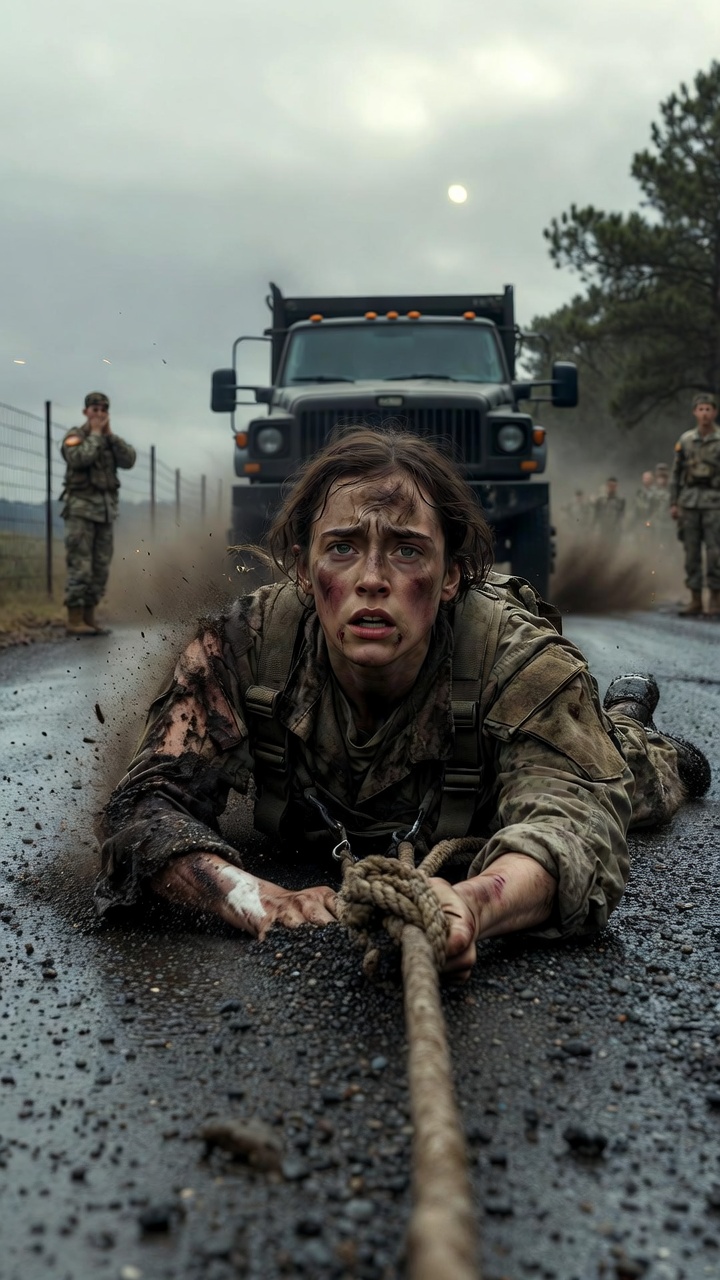
The rope snapped tight around her harness.
Mara’s body jerked across the training road.
Gravel tore at her sleeves. Dust filled her mouth. Somewhere behind the roar of the engine, someone shouted her name, but the sound came thin and far away, swallowed by diesel and wind and the rattle of loose metal in the truck bed.
She dug both boots into the road.
The soles skipped. Slid. Caught nothing.
Her fingers clawed at the rope clipped to her gear. Her gloves were slick with dirt. The knot was wrong. Too tight. Too deliberate.
Ten yards ahead, the truck kept moving.
Slow enough to look accidental.
Fast enough to hurt.
The morning cold had not burned off yet. It lay low over Fort Granger’s southern training lanes, turning the pines into dark shapes behind the wire fence. The air smelled of wet clay, fuel, pine sap, and the sharp iron scent of blood where Mara’s cheek had scraped open against the ground.
She twisted, trying to roll onto her back.
Pain shot through her ribs.
Her teeth clicked shut.
The world narrowed to a rope, a road, and the rear tires grinding away in front of her.
“Stop the truck!” someone screamed.
Not enough voices.
Not enough movement.
Mara saw boots on the side of the road. Soldiers standing. Watching. Some frozen. Some half-reaching, as if their bodies wanted to move but their fear had gotten there first.
Private Henson had both hands over his mouth.
Corporal Rusk stared at the rope with his jaw hanging open.
Sergeant Dale Corman stood near the ditch, shoulders squared, arms loose at his sides, face unreadable beneath the brim of his patrol cap.
He was not shouting.
That detail sank into Mara’s mind deeper than the rocks cutting through her uniform.
Corman was not shouting.
The truck dragged her another fifteen feet before the engine finally coughed down and the brakes shrieked.
Silence fell in pieces.
First the tires stopped crunching.
Then the metal tailgate stopped rattling.
Then even the birds seemed to pull their wings close and wait.
Mara lay on her side in the dust, one knee bent under her, one arm stretched toward the grass at the road’s edge. Her chest rose once. Fell. Rose again, but smaller.
Nobody moved.
The rope remained tight.
Still connected.
Still accusing.
Mara lifted her head just enough to see the truck’s rear plate blurred through dust.
A dark drop fell from her chin to the gravel.
Then another.
She tasted blood and grit and something older than either—humiliation, hot and bitter, pressed behind her teeth.
A door opened at the front of the convoy.
Boots hit the road.
Heavy steps. Measured. Not hurried.
Lieutenant Colonel Elias Rourke came into view from the left, his face stone-still, his uniform clean enough to look carved. He had arrived ten minutes earlier to observe the company’s field readiness drill, the kind of visit that made young soldiers tuck in loose straps and made older sergeants stand a little taller.
He stopped halfway between the truck and Mara.
His eyes moved from her torn sleeve to the rope clipped at her harness, then to the soldiers along the road.
No one spoke.
Rourke crouched beside Mara, one knee in the dust. He did not touch her at first.
“Mara,” he said quietly.
Her eyes found his.
She hated that he used her first name. Not because it was wrong, but because kindness, at that moment, felt like one more thing she might not survive.
“Can you breathe?”
She nodded once.
Barely.
His gaze sharpened. “Say it.”
Mara swallowed. Dust scraped down her throat.
“I can breathe, sir.”
The words came out broken.
Rourke’s face did not change, but something moved in his eyes—something colder than anger.
He looked over his shoulder.
“Medic.”
No one moved fast enough.
Rourke stood.
The silence broke under his voice.
“Medic!”
Specialist Owen Pike sprinted from the second vehicle so quickly his aid bag slammed against his thigh. He dropped beside Mara, scissors already in his hand.
Rourke pointed at the rope.
“Cut it.”
Pike sliced through the line.
The tension vanished.
Mara’s body loosened all at once, and the pain flooded in.
Her vision dipped black at the edges.
Rourke turned toward the formation.
The whole training lane seemed to hold its breath.
“Who secured that line?”
No answer.
The wind moved across the wet grass. A loose cargo strap tapped against the truck’s side.
Rourke’s eyes traveled from face to face.
“Who,” he asked again, quieter now, “secured that line?”
Sergeant Corman shifted his weight.
It was almost nothing. A heel pressing deeper into gravel. A tiny movement of the jaw.
Mara saw it.
So did Rourke.
But before the lieutenant colonel could speak, Mara’s hand lifted from the dust.
Not much.
Just enough to close around the torn edge of her sleeve.
Her fingers were shaking.
Rourke glanced down.
Mara’s eyes were still open.
She was looking past him now.
Not at Corman.
Not at the truck.
At the American flag stitched on the shoulder of every uniform standing over her.
Then her lips moved.
Pike leaned close.
“What did she say?” Rourke asked.
Pike looked up slowly.
His face had gone pale.
“She said, ‘Don’t let them bury it.’”
Rourke straightened.
Behind him, the first siren started in the distance.
And in the ditch beside the road, half-hidden under crushed grass, a young private’s phone lay recording everything.
Chapter Two
Three months earlier, Mara Vance had learned that a barracks hallway could feel longer than a battlefield.
She stood outside Room 214 with a laundry bag over one shoulder and a cardboard box pressed against her hip. The hallway smelled of floor wax, old coffee, damp boots, and the faint chemical bite of industrial cleaner. Fluorescent lights hummed overhead, turning everyone’s skin the color of paper.
A television laughed somewhere behind a closed door.
A washing machine thumped out of rhythm downstairs.
Mara shifted the box higher and read the laminated sign taped to the door.
SECOND PLATOON FEMALE BILLET
AUTHORIZED PERSONNEL ONLY
The sign had been printed in a hurry. The paper inside was crooked.
She stared at it for a second longer than she needed to.
Behind her, someone whispered, “That’s her.”
The whisper traveled badly. It hit every wall.
Mara did not turn around.
She balanced the box against one knee, dug the key from her pocket, and unlocked the door.
Inside, the room had two beds, two lockers, one narrow window, and the depressing personality of government furniture. One bed was made tight enough to bounce a coin. The other had been stripped bare. A thin mattress lay exposed, gray-blue under the fluorescent light.
On the desk, someone had left a sticky note.
WELCOME TO SECOND PLATOON.
The words had been written in black marker.
Underneath, in smaller letters, someone had added:
TRY NOT TO CRY.
Mara set the box down.
For a moment, she only looked at it.
Then she peeled the note from the desk, folded it once, and dropped it into the trash can beside the chair.
Her roommate’s locker opened.
Private First Class Talia Mercer leaned around the metal door with a toothbrush in her mouth and one eyebrow raised. She was twenty-three, small-boned, sharp-eyed, with hair braided close to her scalp and a face that seemed built for surviving other people’s foolishness. Foam clung to the corner of her mouth.
“You Vance?”
Mara nodded.
Talia took the toothbrush out. “You touch my protein bars, I’ll report you to God.”
Mara blinked.
Talia stared at her.
Then Mara said, “Does God outrank the first sergeant?”
“Depends on the paperwork.”
Mara almost smiled.
Almost.
Talia noticed anyway. She shut her locker with one hip.
“Top bunk’s yours. The heater screams at 0200. Window sticks. Shower on this floor runs hot for eight seconds, then remembers it hates women.”
Mara picked up her laundry bag.
“Good to know.”
Talia looked her over—not in the way men did when they thought they were being subtle, and not in the way senior leaders did when measuring future problems. Talia looked like she was counting damage.
“You came from Charlie Company?”
“Yes.”
“Heard you ran a nine-mile ruck with a stress fracture.”
Mara set the bag on the upper bunk. “It wasn’t nine.”
Talia waited.
“It was eight point seven.”
This time Talia smiled.
Not warmly. Not yet.
But enough.
“Second Platoon loves numbers,” Talia said. “They’ll call that lying.”
“I’ll survive.”
The words came too fast.
Too clean.
Talia’s smile disappeared.
Outside the door, boots passed slowly.
Not marching. Listening.
Talia lowered her voice.
“Maybe don’t make survival your whole personality here.”
Mara looked at the bare mattress. At the walls painted the color of surrender. At the tiny window showing a slice of motor pool fence and a row of trucks parked nose to tail like sleeping animals.
“I’ll consider it.”
Talia watched her for another second, then turned back to the sink.
“That means no.”
Mara said nothing.
Because Talia was right.
Survival had been Mara’s whole personality long before the Army taught her how to blouse her boots.
At twenty-six, Specialist Mara Vance had the kind of face people remembered only after they learned something unsettling about her. Brown hair cut just above regulation length. Gray eyes that did not beg to be liked. A small scar under her chin from a childhood fall she never talked about. Another scar along her left forearm, thin and white, from a training accident that had not been an accident.
She was five foot seven, lean from years of carrying weight without asking who might help. She moved quietly, not because she was timid, but because noise had once made her mother flinch.
Her father, Raymond Vance, had been a mechanic in northern Kentucky with hands always black around the nails and a temper that went silent before it went dangerous. Her mother had died when Mara was seventeen, not all at once, but in slow hospital increments after years of choosing not to leave.
Mara joined the Army two days after the funeral.
She did not join for flags or college money or speeches about service.
She joined because the recruiter had an office with bright lights, a working air conditioner, and a poster showing a woman in uniform staring toward a horizon that looked clean.
Mara wanted clean.
Nine years later, she had learned that no place was clean. Not completely.
But some places had rules.
And rules, when enforced, could become a kind of mercy.
Second Platoon did not feel merciful.
By 0530 the next morning, Mara stood in formation while cold rain fell through the dark and collected along the brim of her cap. Floodlights shone across the company area, flattening faces into hard planes. Soldiers stamped their boots, blew into their hands, and pretended they were not watching the new transfer.
Sergeant Dale Corman walked the line.
He was thirty-eight, broad through the shoulders, with a close-cropped beard already showing gray and eyes the washed-out blue of winter roads. The soldiers called him “Cormac” behind his back because he looked like a man who had walked out of a book where everyone died in the snow.
He had three combat patches, a Bronze Star no one asked about, and a reputation for building soldiers who did not break.
He stopped in front of Mara.
Rain ticked against his patrol cap.
“Specialist Vance.”
“Sergeant.”
His eyes dipped to her boots, then rose. “You know why you’re here?”
Mara kept her gaze forward. “Needs of the Army, Sergeant.”
A few soldiers smirked.
Corman smiled without showing teeth.
“Wrong. You’re here because Charlie Company got tired of you making noise.”
The rain seemed to get louder.
Mara’s face did not move.
Corman stepped closer.
“I don’t like noise. I don’t like drama. I don’t like soldiers who think a sworn statement makes them special.”
Mara could feel every person in formation listening.
He leaned in just enough for her to smell coffee on his breath.
“You understand me?”
“Yes, Sergeant.”
“Good. Because in my platoon, we fix things in-house.”
He moved on.
Mara’s fingers curled once against her palms, hidden by the seams of her gloves.
At the far end of the formation, Talia Mercer stared straight ahead, but her jaw had tightened.
The first sergeant called the company to attention.
Orders rolled out. Vehicles. Inspection. Load plans. Range prep. Nothing unusual.
That was how isolation began—not with a door slammed in her face, but with normal commands spoken around her as if she were already absent.
By lunch, no one sat beside her.
By dinner, her name had become a warning.
By the end of the week, someone had taped another note inside her locker.
SNITCHES GET PEOPLE KILLED.
This time Mara did not throw it away.
She folded it carefully and placed it in the back pocket of her notebook.
A rule, she had learned, meant nothing unless someone wrote down how it had been broken.
Chapter Three
Captain Nadine Calder believed a unit could rot from the center while still passing inspection.
She had seen it before.
Fresh paint on barracks walls. Perfectly aligned vehicles. Soldiers who answered questions too quickly. Leaders who smiled at visitors with their mouths and watched their people with their fists.
Calder stood inside the battalion conference room at 1900 hours, one hand wrapped around a paper cup of coffee that had gone cold twenty minutes earlier. Rain tapped against the windows. Outside, Fort Granger glowed under sodium lights, all fences and wet asphalt and silhouettes of pine trees bending in the wind.
On the screen at the front of the room, Second Platoon’s readiness metrics looked excellent.
Green across the board.
Maintenance: green.
Weapons qualification: green.
Medical readiness: green.
Discipline: green.
Captain Brooks, the company commander, looked pleased with himself.
Calder did not.
She sat near the end of the table, quiet, dark hair pulled into a tight bun, sleeves rolled with almost mathematical precision. At forty-two, she had the controlled stillness of someone who had once been underestimated and had developed patience sharp enough to cut wire.
Her left hand bore a faint scar across the knuckles, a souvenir from an overturned vehicle in Kandahar. Her right thumb tapped once against the coffee cup whenever someone lied with confidence.
It tapped now.
Major Leland Price, the executive officer, leaned back in his chair.
“Second Platoon continues to outperform. Sergeant Corman has them dialed in.”
Captain Brooks nodded. “He’s old-school, sir. Hard, but fair.”
Calder looked at the slide.
Hard, but fair.
The Army loved that phrase. It covered a multitude of sins. Leaders used it when they did not want to ask what hard meant to the people underneath it.
Lieutenant Colonel Rourke sat at the head of the table, silent.
He was fifty-one, tall, with a lined face and close-cut silver hair. Nothing about him was loud. Even his displeasure moved quietly. But people straightened when his eyes settled on them.
He turned one page in the packet before him.
“Captain Calder,” he said. “You disagree?”
Every head turned.
Brooks’s smile tightened.
Calder set down her coffee.
“I have concerns.”
Brooks exhaled through his nose.
“With Second Platoon?” Rourke asked.
“Yes, sir.”
“What concerns?”
Calder glanced at Brooks, then back to Rourke. “Informal reports. Pattern indicators. Small things that don’t show up cleanly in metrics.”
Price’s pen paused.
Brooks folded his arms. “With respect, ma’am, if there were formal complaints, I’d know.”
Calder looked at him.
“That assumes soldiers feel safe making formal complaints.”
The room cooled.
Rourke’s eyes remained on Calder.
“Be specific.”
Calder opened a folder. Inside were three pages, each marked with careful notes.
“Two transfers requested within six months. Both declined exit interviews. One soldier withdrew a behavioral health appointment after his squad leader asked why he needed it. Another reported lost equipment, paid for it, then later told supply he had found it damaged in a dumpster. No investigation.”
Brooks shifted. “That happens in every unit.”
“Not always with the same platoon.”
Price leaned forward. “Are you accusing Sergeant Corman of misconduct?”
“I’m saying his platoon has silence where there should be friction.”
Brooks laughed once, too sharply. “Maybe he just runs a tight ship.”
Calder’s thumb tapped the cup.
“Ships sink quietly too, sir.”
No one smiled.
Rourke closed the packet.
“Continue watching it.”
Brooks’s face flushed. “Sir—”
Rourke lifted one hand.
The room obeyed.
“Captain Calder, keep your notes. Captain Brooks, I expect you to know your company better than your slides do.”
Brooks stared at the table.
“Yes, sir.”
The meeting moved on.
Numbers. Fuel. Scheduling. Range conflicts.
But Calder’s mind stayed on the name she had written at the bottom of her last page.
VANCE, MARA E.
TRANSFER FROM C CO.
PRIOR SWORN STATEMENT AGAINST NCO.
CURRENTLY ASSIGNED 2PLT.
After the meeting, Brooks caught her in the hallway.
“Ma’am.”
Calder stopped.
The hall outside battalion headquarters smelled of wet wool, printer toner, and the bitter remains of burnt coffee. A custodian pushed a mop bucket at the far end, wheels squeaking over tile.
Brooks waited until the custodian turned the corner.
“I don’t appreciate being blindsided in there.”
Calder faced him fully.
“You were not blindsided. You were informed.”
“With incomplete information.”
“That’s usually how concerns begin.”
Brooks lowered his voice. “Corman is my best NCO.”
“Best at what?”
His eyes narrowed.
Calder let the question hang between them.
Brooks was thirty-four, handsome in the polished way of officers who had never missed a promotion gate. He believed in clean lines, measurable output, and never letting senior leaders see disorder. His fear was not failure. It was exposure.
Calder knew the type because she had almost become it.
He said, “You don’t know him.”
“I know numbers don’t bruise.”
“That’s a serious implication.”
“Yes.”
Rain rattled harder against the hallway windows.
Brooks looked away first.
Calder softened her voice, but not the words.
“Talk to your soldiers before someone outside your company has to.”
Brooks gave a small, humorless smile.
“Is that advice or a threat?”
Calder picked up her folder.
“It’s a clock.”
She walked away before he could answer.
At the barracks across post, Mara Vance sat on the edge of her bunk with a needle in one hand and her torn rucksack strap in the other.
The room was dark except for Talia’s desk lamp.
Talia lay on her bed, boots off, one arm over her eyes.
“You report the locker note?”
Mara pulled the thread through nylon.
“No.”
Talia lifted her arm.
“That is the wrong answer.”
“I documented it.”
“That is the Army answer.”
Mara tied a knot with her teeth.
“The Army answer is the only one that holds up.”
Talia sat up slowly. “You think paper protects you?”
Mara did not answer.
Talia swung her legs over the bed. “Paper didn’t protect Phelps.”
Mara’s needle stopped.
Private Ryan Phelps had been one of the transfers Calder mentioned, though Mara did not know that. He had left Second Platoon two months before she arrived. People said he had been weak, dramatic, lazy. People said a lot of things when the person was gone and could not correct them.
“What happened to him?” Mara asked.
Talia looked at the door.
The hallway was quiet.
Too quiet.
“He got tired,” Talia said. “That’s what happened.”
Mara waited.
Talia rubbed both hands over her face.
“They ran him every night. Not PT. Not corrective training. Just stupid stuff. Carrying water cans. Pushing trucks. Low crawling through gravel. Always after lights out. Always just enough to make him useless the next day.”
“Who?”
Talia looked at her.
“You know who.”
Mara’s throat tightened.
“Why didn’t anyone say anything?”
Talia laughed without humor.
“You been here a week and you’re asking that?”
Mara set down the rucksack.
Talia’s voice dropped.
“Corman doesn’t touch everyone. That’s the trick. He picks one person and lets everybody else feel grateful it isn’t them. Then he makes them help just enough so they can’t report without reporting themselves.”
Outside, a door shut somewhere down the hall.
Both women stopped talking.
Footsteps passed.
Paused.
Moved on.
Talia breathed again.
Mara picked up her needle.
Talia watched her.
“You’re thinking you can beat him by being perfect.”
Mara pushed the needle through the strap.
“I’m thinking he can’t punish what he can’t document.”
“He documents whatever he wants.”
“Then I document better.”
Talia stared at her for a long moment.
Under the lamp, Mara’s face looked carved from tired stone.
“You scared?” Talia asked.
Mara tied off the thread.
The honest answer sat between her ribs like a blade.
Yes.
She was scared of being alone in a room full of uniforms. Scared of becoming the kind of cautionary tale soldiers lowered their voices to tell. Scared that one day the rules would fail completely, and she would have nothing left but her own stubborn bones.
But her mother had once taught her that fear was safest when nobody else could hold it.
So Mara said, “Not enough.”
Talia looked away.
“That’s what worries me.”
Before Mara could respond, something struck the window.
A small, hard tap.
Then another.
Talia stood.
Mara killed the lamp.
The room fell black.
A third tap.
Mara moved to the side of the window and peered out.
Below, in the thin rain near the motor pool fence, someone stood under the shadow of the stairwell.
Not close enough to identify.
Close enough to be seen.
A phone screen lit for half a second.
Then vanished.
Talia whispered, “Don’t open it.”
Mara did not.
A final object struck the glass and dropped to the sill outside.
Then footsteps retreated into rain.
Mara waited ten seconds before raising the window.
Cold air slid into the room.
On the sill lay a spent brass casing wrapped in masking tape.
Mara unwrapped it.
Three words had been written on the tape in black ink.
LAST WARNING, VANCE.
Talia’s breath caught behind her.
Mara stared at the casing in her palm.
Then she did something that frightened Talia more than anger would have.
She smiled.
Small.
Cold.
Heartbroken.
“They spelled my name right,” Mara said.
Chapter Four
Sergeant Dale Corman did not think of himself as cruel.
Cruelty, to his mind, was wasteful. Emotional. Sloppy.
He thought of himself as necessary.
The Army had grown soft around the edges, padded with briefings and hotlines and laminated cards that told soldiers where to take their feelings. He had watched men freeze under fire because no one had taught them that pain was not a stop sign. He had watched young leaders look to PowerPoint slides for courage. He had watched good soldiers die because someone, somewhere, had confused kindness with preparation.
At least, that was the story he told himself.
It was not entirely false.
That made it dangerous.
Corman stood outside the maintenance bay at 2130, smoking a cigarette beneath the overhang while rain hissed beyond the concrete. The bay doors were open, and inside, soldiers worked under white lights on the convoy vehicles for Friday’s readiness evaluation.
Sockets clicked.
Engines groaned.
Someone cursed softly after banging a knuckle against metal.
The smell of grease and wet uniforms hung heavy in the air.
Corman watched Mara Vance kneel beside the rear axle of a cargo truck, torque wrench in hand, sleeves damp, hair tucked tight beneath her cap. She worked carefully. Too carefully. Checked everything twice. Wrote down numbers. Asked questions only when needed. Did not complain.
That should have pleased him.
It did not.
People like Vance made rooms divide.
They arrived with quiet eyes and hidden files and a belief that the system existed to protect them from consequence. They used the language of accountability as a knife. Corman had known one before. Staff Sergeant Albright, back at Fort Polk. Good NCO. Loud mouth. Career ended after a private accused him of hazing because the kid could not handle night land navigation. Sixteen years of service gone because paper believed tears.
Corman had testified for Albright.
It had not mattered.
Since then, he had trusted performance over testimony.
Pain over paperwork.
Loyalty over complaint.
He took one last drag and crushed the cigarette beneath his boot.
Private Henson approached with a clipboard clutched too tightly.
“Sergeant?”
Corman looked at him.
Henson swallowed. He was nineteen, all elbows and fear, with acne along his jaw and a habit of saying “sorry” before anyone accused him of anything.
“Spare tow lines inventoried. Two short from the last layout.”
Corman held out his hand.
Henson passed him the clipboard.
Corman scanned the sheet.
“Find them.”
“Yes, Sergeant.”
Henson did not move.
Corman looked up.
“What?”
The private’s eyes flicked toward Mara.
“Nothing, Sergeant.”
Corman stepped closer.
Rainwater dripped from the overhang behind him.
“You got something lodged in your throat, Henson?”
“No, Sergeant.”
“Then stop choking.”
Henson nodded quickly and hurried away.
Inside the bay, Corporal Mason Rusk laughed at something another soldier said. Rusk was twenty-eight, thick-necked, restless, always grinning a second too late. He had been passed over for promotion twice and blamed everyone except the man in the mirror. Corman used him carefully. Rusk wanted approval badly enough to mistake it for leadership.
Corman raised two fingers.
Rusk came over.
“Sergeant?”
“Vance giving you any trouble?”
Rusk glanced back at her. “Nah. She just acts like she’s better than everybody.”
“How?”
“Writing stuff down. Checking load straps like we’re idiots.”
“Are you?”
Rusk’s grin faltered.
“No, Sergeant.”
“Then don’t sound like one.”
Rusk stiffened. “Roger.”
Corman watched Mara stand and wipe grease from her glove. For a brief second, she looked toward him.
Not defiant.
Not afraid.
That was worse.
Fear created order. Defiance created punishment. But Mara looked at him like she was memorizing him.
Corman felt something old tighten beneath his ribs.
A memory: fluorescent lights, a conference room, three officers looking at him as though he were a disease. Albright sitting beside him, face gray. A young private outside the glass wall crying into his mother’s shoulder.
Corman had hated the boy for crying.
Later, alone in his truck, he had hated himself for hating him.
He turned away.
“Rusk.”
“Yeah, Sergeant?”
“Friday’s evaluation matters. Battalion will be watching.”
“I know.”
“No mistakes.”
“Roger.”
Corman’s eyes moved back to Mara.
“And no distractions.”
Rusk followed his gaze.
This time, the grin returned.
Slowly.
“Understood.”
Corman should have corrected him.
He should have said, That is not what I mean.
He should have cut the grin off Rusk’s face with one clean sentence.
Instead, he said nothing.
And silence, in a bad unit, always gave orders.
Across the bay, Mara tightened the final bolt and marked the maintenance sheet.
Talia Mercer approached, carrying two oil-stained rags.
“You feel that?”
Mara kept writing. “Rain?”
“No. Stupid gathering in the air.”
Mara capped her pen.
Talia leaned closer.
“Corman and Rusk have been looking at you like you’re a locked door.”
Mara slid the sheet into a folder. “Maybe they forgot the key.”
“Mara.”
The use of her first name made her look up.
Talia’s face was serious now.
“Listen to me. Friday, do your job. Nothing extra. No hero stuff. No calling anything out unless it’ll kill somebody that second.”
Mara’s eyes moved past Talia to the line of vehicles.
“What if it kills somebody later?”
Talia’s mouth tightened.
“That’s how they get you.”
Mara thought of the casing on the window sill, now sealed in a plastic bag beneath her mattress. Thought of the locker notes. The missing gloves. The night someone poured energy drink into her boots. The morning her weapon had been moved six inches during inspection so she would look careless. The laughter that followed her into rooms and disappeared when leaders entered.
A thousand little cuts.
None deep enough alone.
Together, a map.
“I’m already got,” Mara said.
Talia stared at her.
Mara’s voice softened.
“I know what you’re trying to do.”
“Keep you alive?”
“Keep me quiet.”
Talia flinched as if struck.
Mara regretted it immediately.
But the words were out.
Talia looked down at the rag in her hand.
“You think quiet is cowardice.”
“No.”
“You do.”
Mara said nothing.
Talia’s eyes shone under the maintenance lights, but her voice stayed low and hard.
“You know what happened after Phelps left? His squad leader cried in the latrine. Big guy. Morales. Used to bench a house. He sat on the floor with his hands over his ears because he could still hear Phelps begging them to stop. He didn’t report it. You know why?”
Mara’s throat moved.
Talia stepped closer.
“Because he had helped. One night. One stupid night. Corman told him everybody had to carry their share. So Morales held a flashlight while Phelps crawled through gravel. Didn’t touch him. Didn’t laugh. Just held the light. And that was enough. After that, Corman owned him.”
The bay noise faded around Mara.
Talia wiped at her cheek angrily, as if the tear offended her.
“So don’t stand there thinking everybody who’s quiet is safe. Some people are just buried different.”
Mara looked toward the soldiers working under the vehicles.
Henson. Rusk. Morales, who never met her eyes. Others who laughed too loudly or left rooms too quickly.
For the first time, she saw not just a wall around Corman, but hands trapped inside it.
Talia tossed the rag onto a workbench.
“Friday,” she said. “Please. Just survive Friday.”
Mara watched her walk away.
Outside, thunder rolled over the training fields.
Inside, a tow line hung from a hook near the rear of Truck 17.
Its tag had been scratched clean.
Chapter Five
Friday morning arrived with a sky the color of bruised steel.
Fort Granger’s southern training lane stretched between rows of pine and low scrub, the road still wet from days of rain. Puddles reflected the convoy lights in broken orange pieces. Mist clung to the ditches. Somewhere beyond the tree line, artillery thudded from another range, distant enough to sound like weather.
Second Platoon formed beside the trucks at 0615.
Everyone looked tired.
Everyone looked watched.
That was what battalion presence did. It turned ordinary movements into performance. Straps were checked three times. Helmets adjusted. Voices lowered. Laughter trimmed away.
Lieutenant Colonel Rourke arrived in a black government SUV with Captain Calder in the passenger seat and Major Price behind them. Captain Brooks was already there, moving briskly between vehicles, smiling too much, clipboard in hand.
Sergeant Corman called the platoon to attention.
Boots struck gravel.
Mara stood in the second rank, face forward, chin level. The left side of her jaw still held a faint yellow shadow from where someone had “accidentally” clipped her with an equipment case two days earlier. Her gloves were clean. Her weapon was clean. Her notebook rode in the cargo pocket of her trousers, sealed in a waterproof sleeve.
Talia stood two soldiers away.
Close enough for Mara to feel her worry.
Rourke inspected the formation without ceremony. He asked questions that sounded simple and revealed everything. Fuel plan. Casualty evacuation route. Radio frequency. Lost comms procedure. Tie-down standards.
Soldiers answered.
Some well.
Some not.
When he stopped in front of Mara, the air changed.
“Specialist Vance.”
“Sir.”
“You’re convoy assistant driver for Truck 17?”
“Yes, sir.”
“Secondary duty?”
“Rear security and load verification, sir.”
Rourke studied her face.
Not the bruise.
Her eyes.
“Any issues with the vehicle?”
Mara felt Corman’s gaze like a hand closing around the back of her neck.
She could say no.
She could survive Friday.
She could let the scratched tow line stay scratched, let the undocumented equipment discrepancy remain one more shadow in a unit full of them.
Talia’s words moved through her.
Some people are just buried different.
Mara looked at Rourke.
“Yes, sir.”
The silence was instant.
Brooks stopped writing.
Corman’s face did not move.
Rourke waited.
Mara turned toward Truck 17.
“Rear tow line is missing its inventory tag. It was listed present last layout, then reported short, then reappeared without documentation. I requested replacement or re-tagging yesterday. It has not been done.”
Rusk muttered something under his breath.
Rourke heard it.
His eyes did not leave Mara.
“Show me.”
Mara stepped out of formation.
Every bootstep on gravel seemed louder than it should have.
She led Rourke to the rear of Truck 17. Captain Calder followed. Brooks came next, jaw tight. Corman trailed behind them with the contained patience of a man waiting for weather to pass.
Mara lifted the tow line from its hook.
The rope was thick, dark from use, one metal clasp scarred along the edge. Where the inventory tag should have been, only a frayed plastic loop remained.
Rourke took the line in his gloved hand.
Calder leaned in.
“Who signed the equipment check?”
Brooks flipped pages. “Corporal Rusk.”
Rusk’s grin had vanished.
Corman stepped forward. “Sir, it’s a minor admin issue. Line is serviceable. We can correct the tag after the lane.”
Rourke looked at him.
“Did Specialist Vance report it yesterday?”
Corman’s pause lasted less than a second.
“Yes, sir.”
“And you chose to roll with undocumented recovery equipment during an evaluated lane?”
Corman’s eyes hardened, but his voice stayed steady.
“Sir, I assessed it as low risk.”
Calder touched the frayed loop.
“Who scratched the clasp?”
No answer.
Rourke handed the line back to Mara.
“Remove it from service.”
Corman’s jaw flexed.
“Sir, we need a tow line for the recovery drill.”
“Then use one with a tag.”
Brooks stepped in quickly. “We can pull one from Truck 12.”
“Do that.”
Mara carried the line toward the equipment pile.
She could feel the platoon watching.
Some with resentment.
Some with fear.
One or two with something dangerously close to relief.
The evaluation continued.
For the next two hours, Second Platoon moved through the lane under a tightening sky. They loaded, staged, rolled, stopped, reacted to simulated contact, treated a mock casualty, changed a tire under time pressure, and established security in a muddy clearing while Rourke, Calder, and Price watched from different angles.
Mara did her job.
Nothing extra.
No speeches.
No visible triumph.
She checked straps, scanned tree lines, passed water to Henson when his hands shook too badly to unscrew his canteen, and corrected a radio fill error before it cost the team points.
Corman saw all of it.
That was the problem.
Competence gave her allies without permission.
By 0935, the platoon moved to the final phase: recovery under pressure. A disabled vehicle had to be simulated, secured, linked, and moved while maintaining security. The replacement tow line from Truck 12 had been installed and checked.
Everything should have gone clean.
But mistakes in rotten units rarely arrived alone.
Truck 17 halted at the edge of the training road. Mara dismounted with rear security, boots sinking into wet gravel. Rusk climbed into the truck bed to retrieve chocks. Henson stood near the rear, pale and sweating despite the cold.
Mara saw his hands.
Empty.
“Henson,” she said. “Where’s your gloves?”
He looked at her, startled.
“I—I had them.”
“Get another pair.”
“I’m okay.”
“No. Get another pair.”
Rusk barked from the truck bed, “Quit mothering him, Vance.”
Mara ignored him.
Henson looked between them.
Corman approached from the front vehicle, his face dark under the brim of his cap.
“What’s the issue?”
“No issue, Sergeant,” Henson said too quickly.
Mara turned. “Private Henson is handling recovery gear without gloves.”
Corman looked at Henson’s bare hands.
Then at Mara.
“Private Henson can speak for himself.”
Henson’s throat worked.
“I’m good, Sergeant.”
Mara looked at his fingers, already reddened from cold and metal.
Corman stepped closer.
“This is an evaluated lane, Vance. Not a classroom.”
Mara held his gaze.
“Safety doesn’t pause for evaluation.”
Rusk laughed from the truck bed.
A small sound.
Enough.
Corman’s eyes flicked upward.
“Rusk. Get down.”
Rusk jumped from the tailgate.
Corman looked at Mara.
“Since Specialist Vance is so concerned with safety, she can demonstrate rear recovery movement.”
Talia, standing twenty feet away, turned sharply.
“Sergeant—”
Corman cut her off.
“Did I ask you, Mercer?”
Talia’s lips pressed shut.
Rourke and Calder were farther up the road, speaking with Brooks near the lead vehicle. Not far, but blocked by the truck and the curve of the lane.
Corman pointed to the rear.
“Vance. Clip in as guide. Standard walking control. Truck moves five feet. You signal stop. We assess spacing.”
Mara looked at the setup.
A guide line could be used in training to maintain position, but it was never meant to be clipped hard to a soldier’s harness without a breakaway. Never behind a vehicle without a second safety observer. Never with a driver who had not been briefed.
Her eyes moved to the rope Rusk held.
Not the tagged replacement.
The scratched line.
The one removed from service.
Her stomach went cold.
“That line was deadlined, Sergeant.”
Corman’s voice dropped.
“Are you refusing a lawful order?”
The words landed exactly where he intended.
Around them, soldiers froze.
Mara could refuse.
She should refuse.
But refusal in front of the platoon would become the story before the truth did. Corman knew that. Rusk knew that. Even Henson seemed to know it, his face draining of color.
Mara looked at the rope.
At the clasp.
At the knot already tied near the end.
Too neat.
Prepared.
She turned slightly and saw Talia shake her head once.
Please.
Mara reached into her cargo pocket, touched the edge of her notebook sleeve, and made a choice that would later haunt every person standing there.
She raised her voice.
“Specialist Vance complying under protest. Safety concern noted. Deadlined tow line being used against prior instruction.”
Corman’s eyes flashed.
Rusk’s grin died.
And thirty yards away, Captain Calder turned her head.
Not fully.
Just enough.
Mara clipped the line to her harness, but not where Rusk pointed. She clipped it to a side loop, leaving her right hand on the release.
Corman saw.
“Rear loop.”
“That’s not safe.”
“Rear loop, Specialist.”
The platoon watched.
The trees watched.
The whole wet morning seemed to lean closer.
Mara unclipped the line.
Her fingers moved slowly.
She could feel the release beneath her thumb.
Rusk stepped behind her.
“Here,” he said. “Since you’re struggling.”
His hand closed over the clasp.
He clipped it to the rear loop of her harness.
Then he pulled the knot tight.
Too tight.
Mara turned her head.
Rusk avoided her eyes.
Corman lifted one hand toward the driver.
“Five feet.”
The truck engine growled.
Mara planted her boots.
“Driver not briefed!” she shouted.
The truck moved.
Not five feet.
Faster.
The rope snapped tight.
Mara’s boots slid.
For one suspended second, she remained upright, body arched backward, arms out, trying to catch balance against physics and betrayal.
Then she fell.
The first impact took her shoulder.
The second took her breath.
The third took the skin from her cheek.
The truck kept moving.
Someone screamed.
Talia ran first.
Corman grabbed her arm.
She tore free so hard his fingernails scratched her sleeve.
“Stop the truck!”
Henson stumbled backward, eyes wide, lips moving soundlessly.
Rusk stood with both hands lifted, as if innocence were a posture he could rehearse.
At the front of the lane, Captain Calder sprinted.
Rourke followed half a step behind.
Captain Brooks turned white.
The truck dragged Mara through gravel and mud, past the rear wheel track, past the place where the road curved toward the pines.
Her hand found the rope.
The knot held.
Her glove slipped.
She did not scream.
That, somehow, made it worse.
She fought silently, violently, knees striking rock, boots carving shallow lines into the road, one arm reaching toward a ditch she could not reach.
Private Henson moved.
No one ordered him.
No one stopped him.
The nineteen-year-old who apologized to furniture lunged toward the truck’s side, grabbed the metal step, and hauled himself up while it rolled. His boot slipped. His chin struck the door. Blood flashed bright on his lip.
He slammed his fist against the cab window.
“Stop! Stop! Stop!”
The driver braked.
The truck screamed to a halt.
Dust and exhaust rolled over the lane.
Mara lay still.
For half a breath, nobody knew whether she was conscious.
Then her fingers moved.
Just two of them.
Dragging through dirt toward the flag on her shoulder.
Rourke reached her first.
Calder dropped beside him.
Pike, the medic, sprinted in from the rear vehicle.
Corman stood ten yards away, chest rising and falling.
Rusk whispered, “Oh God.”
Talia was on her knees near Mara’s boots, shaking so hard she could not touch her.
Rourke crouched.
“Mara. Can you breathe?”
“I can breathe, sir.”
The words barely existed.
But they existed.
And because they existed, the morning became something else.
Not an accident.
Not a misunderstanding.
A witness.
Pike cut the rope.
Calder picked up the severed end, looked at the knot, then at Rusk.
Her face changed.
Not dramatically. Not loudly.
But the woman who stood was not the same woman who had knelt.
Rourke turned toward the platoon.
“Who secured that line?”
Silence.
Rain began again, soft at first, ticking on helmets and hoods and the torn metal tailgate.
“Who secured that line?”
Rusk’s mouth opened.
Closed.
Corman took one step forward.
“Sir, I directed a training movement. The vehicle accelerated unexpectedly. I accept responsibility for lack of control.”
Calder looked at him.
“You directed use of deadlined equipment after being told not to.”
Corman’s eyes flicked toward her.
“I assessed—”
“No,” Rourke said.
One word.
Flat.
Final.
Corman stopped.
Rourke’s voice carried across the road.
“All Second Platoon personnel, step away from the vehicles. Hands visible. No one touches equipment. No one speaks to each other about what happened. Captain Calder, secure the line. Major Price, call military police and battalion legal. Captain Brooks, you are relieved of control of this lane until further notice.”
Brooks looked as if he had been slapped.
“Sir—”
“Now.”
Brooks stepped back.
The siren approached from the main road.
Mara’s eyes fluttered.
Pike worked fast, checking her ribs, shoulder, pupils. “Stay with me, Vance.”
Mara’s fingers closed weakly around his sleeve.
“Phone,” she whispered.
Pike leaned close. “What?”
“Ditch.”
Calder heard.
Her head turned toward the grass near the road.
There, half-hidden beneath crushed weeds and rainwater, lay Private Henson’s phone.
Still recording.
The screen showed a red dot.
Calder walked to it, crouched, and picked it up with two fingers.
The siren grew louder.
Henson looked down at his boots.
His face was streaked with rain and blood from his split lip.
“I didn’t know what else to do,” he said.
No one answered.
Because for once, doing something had been enough.
The ambulance arrived in a spray of gravel. Two medics jumped out with a stretcher. Rourke stepped aside only when they needed room, but his eyes never left Mara.
As they lifted her, she gritted her teeth so hard the muscles in her neck stood out.
Talia took one step forward.
Then stopped, unsure whether she was allowed.
Mara saw her.
Through pain, through rain, through the circle of uniforms and shame, Mara lifted two fingers from the stretcher.
Not a wave.
Permission.
Talia came apart in silence.
She pressed Mara’s torn glove between both hands for one second before the medics loaded her into the ambulance.
The doors slammed.
The siren turned the air blue and red.
Then she was gone.
And Second Platoon remained on the road with the rope, the recording, and the shape of what they had allowed.
Rourke faced them.
His voice did not rise.
That made it worse.
“Every soldier here will write a sworn statement before leaving this training area. Every soldier here will tell the truth. Not the convenient truth. Not the group truth. The truth.”
Rain ran from the brim of Corman’s cap.
Rourke looked at him.
“Sergeant Corman, remove your weapon and step away from the formation.”
Corman’s face went blank.
Rusk stared at him.
Henson started crying and tried to hide it with his sleeve.
Corman slowly removed his rifle sling from his shoulder and placed the weapon on the wet gravel.
For the first time since Mara had arrived in Second Platoon, the platoon saw their sergeant look small.
Military police vehicles rolled into view.
But before they reached the lane, something happened that no one ordered.
Talia Mercer stepped forward.
She turned toward the road where the ambulance had disappeared.
Her boots came together.
Her spine straightened.
Her right hand rose to the brim of her cap.
A salute.
For one second, she stood alone.
Then Henson raised his shaking hand.
Then Morales.
Then Pike.
Then soldiers who had laughed.
Soldiers who had looked away.
Soldiers who had been afraid.
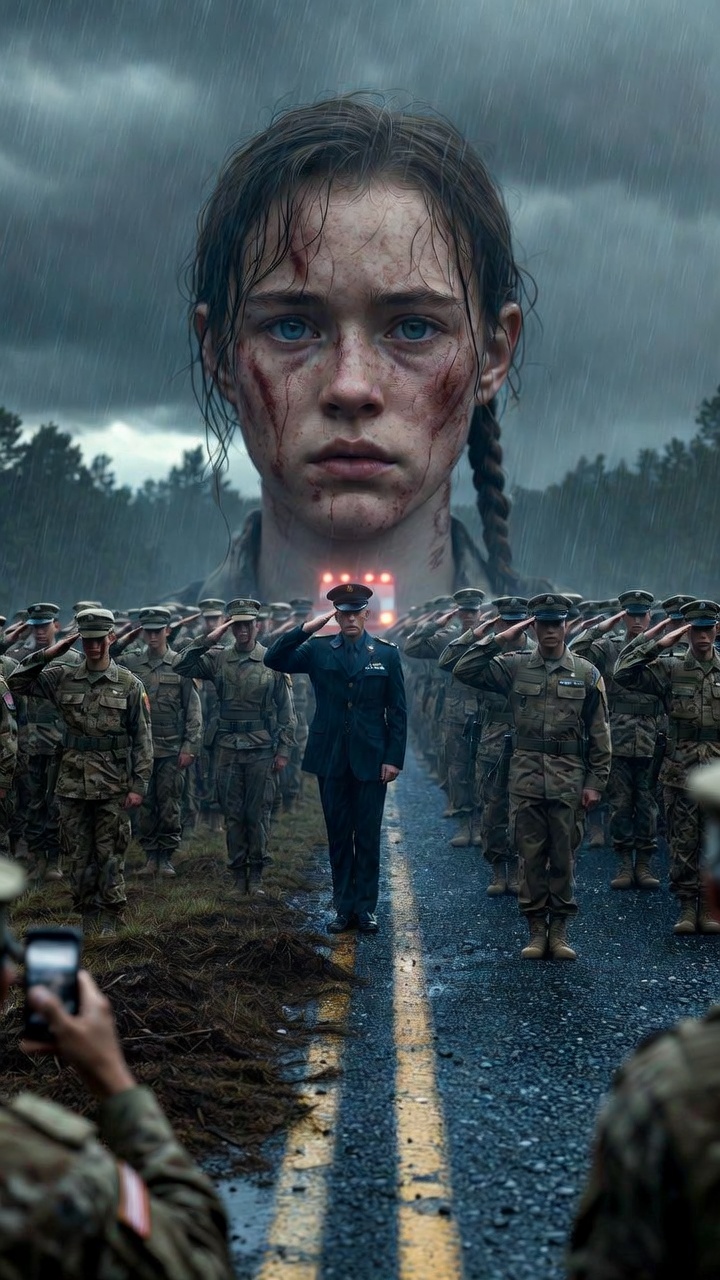
One by one, Second Platoon turned toward the empty road and saluted the woman they had failed.
Rourke watched them.
His face revealed nothing.
Captain Calder’s eyes shone, but her hand was steady when she raised it too.
Even Major Price saluted.
The rain fell harder.
No music swelled. No speech redeemed the moment. No single gesture erased what had happened.
But across the training lane, under a bruised morning sky, an entire unit held its salute until the ambulance vanished beyond the pines.
Only Sergeant Corman did not raise his hand.
He stood beside his weapon, rain dripping from his jaw, staring at the road as if he were watching his own life leave in the back of that ambulance.
Then Captain Calder lowered her salute and turned toward him.
“Sergeant,” she said, “this is where silence ends.”
Corman looked at her.
Behind his eyes, something broke.
And from the ditch, in the phone still held in Calder’s gloved hand, Mara’s recorded voice played faintly through the rain.
“Safety concern noted.”
Every soldier heard it.
Every soldier understood.
The story had already begun speaking without them.