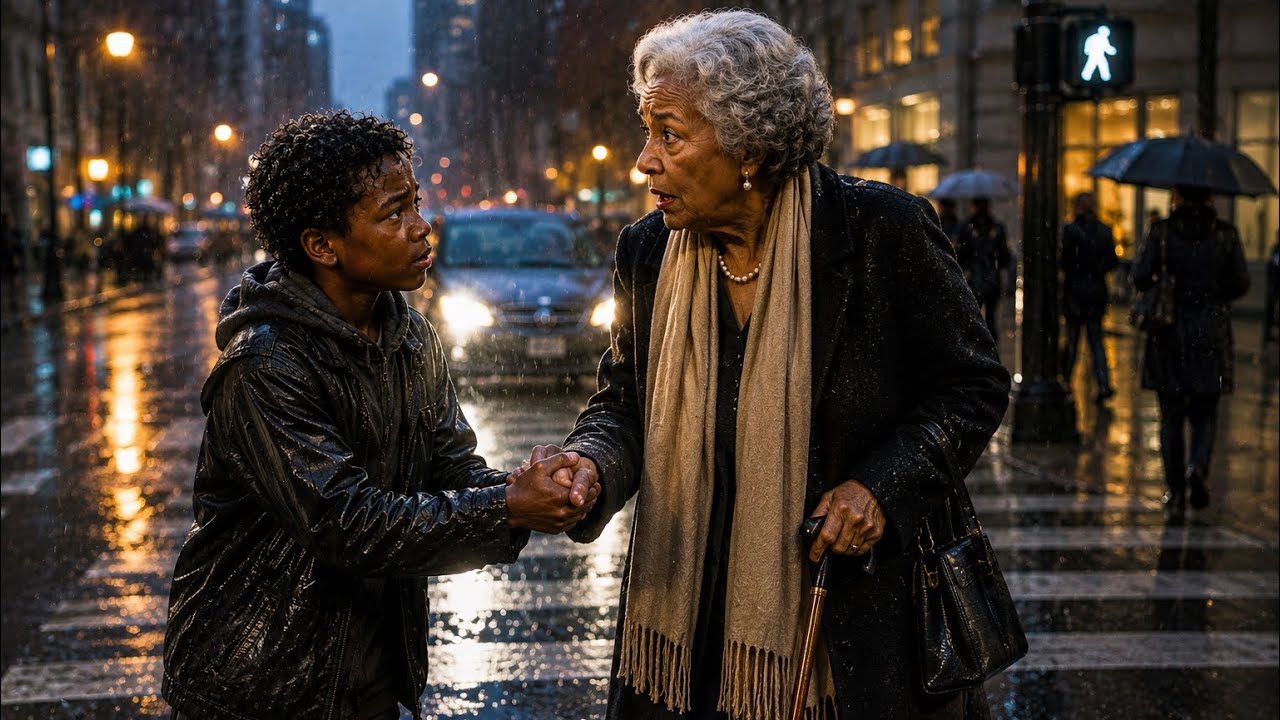
The boy stepped into traffic before anyone understood what he was doing.
A bus horn screamed.
A taxi swerved.
A motorbike cut so close to his knees that the driver shouted something angry over his shoulder.
But the boy did not jump back.
He lifted one hand toward the cars, as if his small palm could stop an entire city, and reached the other hand toward the elderly woman frozen at the edge of the crosswalk.
“Ma’am,” he called, trying to sound braver than he felt. “Take my hand.”
The woman stood trembling beside the curb, one foot already in the street, one foot still on the pavement. Her white hair had slipped loose from its neat bun. Her black handbag hung open at her elbow. Her face had gone pale beneath the noise of horns, engines, and impatient strangers.
The pedestrian light had changed too quickly.
Halfway across the road, a delivery truck had turned too sharply and frightened her back. Now she was trapped in the middle lane of Maxwell Avenue, unable to move forward, unable to retreat, while traffic pressed around her like water around a stone.
People saw her.
Of course they saw her.
They slowed down, looked annoyed, checked their watches, lifted their phones, muttered about old people who should not cross alone.
But nobody stepped into the street.
Nobody except a thin, barefoot boy in a torn brown jacket with one pocket hanging loose.
His name was Kofi Mensah.
He was thirteen years old.
He had not eaten in two days.
And at that moment, the only thing between a frightened woman and a line of moving cars was a homeless boy everyone else had learned to ignore.
“Come on,” Kofi said, stretching his hand farther. “I’ve got you.”
The woman looked at him with wet, terrified eyes.
“I can’t,” she whispered.
“Yes, you can.”
A driver leaned on his horn.
Kofi turned his head. “Stop!”
The driver shouted back, “Move, kid!”
Kofi did not move.
His heart hammered so hard he could feel it in his throat. His legs wanted to run. Every survival instinct he had developed from sleeping under bridges, dodging police patrols, and hiding from men who kicked children awake told him this was stupid.
But the woman’s hand was shaking.
And Kofi knew what it felt like to shake in public while everyone pretended not to see.
So he stepped closer.
The woman finally reached for him.
Her fingers were cold.
The moment her hand touched his, something in her face changed. Not relief yet. Trust was too big to arrive that quickly. But she stopped looking at the cars and started looking at the boy.
“That’s it,” Kofi said. “Look at me, not them.”
He walked backward through the traffic, one step at a time.
A bus hissed so close behind him that hot air brushed his neck.
A man on a scooter cursed.
A woman in a luxury car raised both hands, furious that her morning had been delayed by fifteen seconds of someone else’s fear.
Kofi kept his grip steady.
“Almost there,” he said.
He did not know if they were almost there.
He said it because sometimes hope only needed a sentence to stand on.
The woman stumbled near the final lane.
Kofi tightened his hand around hers and shifted his body in front of her, taking the impact of a side mirror against his shoulder. Pain flashed down his arm.
He gasped, but he did not let go.
“Keep going,” he said.
Three more steps.
Two.
One.
They reached the curb just as the traffic surged behind them.
The woman collapsed onto the low stone wall outside the pharmacy, one hand pressed to her chest. Kofi stood beside her, breathing hard, his shoulder throbbing, his knees trembling so badly he had to lean against the wall to stay upright.
A few people clapped awkwardly.
Not many.
Most had already continued walking.
One man said, “Brave kid,” then disappeared into the crowd without asking whether the brave kid had shoes.
The woman lifted her face toward him.
“You saved me,” she said.
Kofi shrugged, uncomfortable with the words.
“You were stuck.”
“What is your name?”
“Kofi.”
“Kofi what?”
He hesitated.
Names were dangerous when adults asked too many questions.
“Kofi,” he repeated.
The woman studied him more carefully now. His cracked lips. His dirty shirt. The bruise near his jaw. The jacket too large for him and too thin for the wind. The way his eyes kept scanning the street, checking exits, checking threats, checking whether kindness had become a trap.
Then she looked down.
Something small and white had fallen from the torn pocket of his jacket during the crossing.
It rested near her shoe.
A mint candy.
Still wrapped.
Cheap, round, and slightly crushed at the edge.
The woman stared at it.
All the color left her face.
Kofi quickly bent to pick it up, embarrassed.
“Sorry,” he said. “It’s mine.”
But before he could take it, the woman covered her mouth with one trembling hand.
A sound escaped her.
Not a sob exactly.
Something older than that.
Kofi froze.
“Ma’am?”
She reached toward the mint with such care that he stepped back, confused.
“Where did you get this?” she whispered.
Kofi looked at the candy, then at her.
“A man gave it to me yesterday. Outside the train station.”
“What man?”
“I don’t know. Old man. Gray hat. He said he didn’t have money, but he had this.” Kofi swallowed. “He said when your mouth tastes sweet, maybe your day can still turn.”
The woman closed her eyes.
A tear slid down her cheek.
Kofi felt panic rise in him.
He had made adults angry before. He had made them suspicious. He had made them uncomfortable. But he had never made a rich-looking woman cry with candy.
“I can give it back,” he said quickly. “I didn’t steal it.”
Her eyes opened.
“No,” she said. “No, child. I know you didn’t.”
Her voice had changed.
It was softer now, but heavier too, like a door opening onto a room no one had entered for years.
She picked up the mint and placed it gently in his palm.
“Keep it,” she said. “Please.”
Kofi curled his fingers around it.
The woman wiped her face, but the tears kept coming.
“Decades ago,” she said, almost to herself, “someone gave me one just like it.”
Kofi did not know what to say.
She looked at the street they had crossed, but her eyes were somewhere else.
“I was nineteen,” she continued. “Alone in a new city. I had one suitcase, no job, and seven coins in my purse. I sat outside a bakery and cried because I had not eaten all day, and a stranger sat beside me.”
The noise of Maxwell Avenue moved around them, but Kofi listened.
“He did not give me a speech. He did not ask why I had failed. He simply handed me a mint and said, ‘Sweetness is proof the world has not finished with you yet.’”
Her mouth trembled.
“I kept that wrapper for twenty years.”
Kofi looked down at the candy in his hand.
He had almost eaten it twice.
Once the night before, under the overpass when his stomach burned.
Once that morning, when the smell of fried bread from a kiosk had made him dizzy.
But for some reason, he had kept it.
Not because he believed in hope.
Because he wanted to.
The woman straightened slowly.
“My name is Evelyn Hart.”
Kofi had heard that name.
Not in conversation.
On buildings.
Hart Medical Center. Hart Children’s Library. Hart Tower. Hart Global Holdings. Her face had appeared on newspapers people used to wrap roasted peanuts. She was one of the richest women in the country. Some called her a billionaire. Some called her cold. Some called her impossible to reach.
And she was sitting on a stone wall, crying over his mint candy.
Kofi looked at his dirty hands.
Then at her polished shoes.
Something in him prepared to run.
Rich people could turn kind and cruel very quickly. One minute they pitied you. The next minute they called security because your poverty had touched their sleeve.
Evelyn saw the shift in his body.
“Please don’t leave,” she said.
Kofi looked at the road.
“I have to go.”
“Where?”
He did not answer.
She understood the silence too quickly.
“Where did you sleep last night?”
Kofi’s jaw tightened.
“Somewhere.”
“Was it safe?”
He almost laughed.
Safe was a word for doors that locked from the inside.
“I’m fine.”
Evelyn looked at his feet.
He tucked one behind the other.
The pavement had rubbed his soles raw.
“When did you last eat?” she asked.
Kofi’s eyes flickered toward the bakery across the street.
That betrayed him.
Evelyn’s face changed again.
Not pity.
Not charity.
Recognition.
As if she had been forced to look into a mirror she thought she had escaped.
“Kofi,” she said quietly, “come with me for breakfast.”
“No.”
The answer came too fast.
She nodded. “All right.”
That surprised him.
Most adults got offended when poor children refused help. They acted as if hunger removed your right to say no.
Evelyn continued, “Then let me sit here with you for a moment.”
Kofi frowned.
“Why?”
“Because you just risked your life to help me cross a street. The least I can do is not rush you.”
He did not know what to do with that.
So he stood there.
She sat there.
For a full minute, they said nothing.
The city swallowed the silence.
Finally, Evelyn opened her handbag and took out a clean handkerchief. She did not reach for his injured shoulder. She only held it out.
“You’re bleeding.”
Kofi looked down.
The side mirror had cut the skin near his upper arm. A thin red line had soaked through the sleeve.
He had not noticed.
Pain was strange that way. Hunger shouted louder.
Kofi took the handkerchief but did not use it.
“It’ll stop.”
“Maybe,” Evelyn said. “But it does not have to stop alone.”
That sentence unsettled him more than the traffic had.
A black car pulled up beside them. The driver stepped out quickly, eyes wide with panic.
“Mrs. Hart, thank God. We lost you near the corner. Are you hurt?”
“I’m all right, Samuel.”
The driver looked at Kofi, then at the blood on his sleeve, then back at Evelyn.
“This boy helped me,” Evelyn said.
Samuel’s expression changed instantly. Respect replaced suspicion.
“Thank you,” he said to Kofi.
Kofi looked away.
Evelyn stood carefully.
“Kofi, I will ask only once more. Please have breakfast with me. After that, you may leave. No questions you don’t want to answer.”
His stomach cramped at the word breakfast.
He hated that his body answered before his pride did.
Evelyn noticed, but she did not smile.
That helped.
Kofi looked at the mint in his hand.
Then at the woman he had pulled across the street.
“One meal,” he said.
“One meal,” Evelyn agreed.
They went to a small café three doors down because Kofi refused to get into the black car.
Evelyn did not argue.
Inside, the hostess nearly stopped him at the entrance. Her eyes moved over his torn jacket and bare feet with practiced judgment.
Then she saw Evelyn.
Her mouth opened.
“Mrs. Hart, we didn’t realize—”
“No,” Evelyn said calmly. “You didn’t.”
The hostess flushed and led them to a booth near the window.
Kofi sat at the edge of the seat.
He kept his feet under him, ready to run. He placed the mint beside his cup like a tiny guard.
When the waiter came, Evelyn ordered tea.
Kofi ordered nothing.
The waiter waited.
Evelyn said, “Anything you like.”
Kofi stared at the menu.
The prices made no sense to him.
One omelet cost more than what he usually collected in a day carrying bags at the market.
“I’m not that hungry,” he lied.
His stomach growled loudly enough for the waiter to hear.
Kofi’s face burned.
Evelyn did not react.
“Bring eggs, toast, porridge, fruit, milk, and pancakes,” she said. “And pack anything he does not finish.”
Kofi looked at her sharply. “I said one meal.”
“It is one meal,” she said. “A complete one.”
He wanted to be angry.
Then the food arrived.
Steam rose from the plates. Butter melted into pancakes. The porridge smelled of cinnamon. There was honey in a small glass jar, clean silverware, thick bread, sliced mango, and milk so cold condensation gathered on the glass.
Kofi picked up his fork slowly.
At first, he ate carefully.
Then hunger took over.
He tried to stop himself.
He failed.
He ate like a child who had learned that food could vanish if he waited too long.
Evelyn looked out the window while he ate, giving him the dignity of not being watched.
Only after the first plate was empty did she ask, “Do you have family?”
Kofi wiped his mouth with the back of his hand, then remembered the napkin and used that.
“My mother died.”
“I’m sorry.”
He nodded once.
“My father left before I could remember him. My aunt took me for a while. Then her husband said I was not his responsibility.”
Evelyn’s hand tightened around her teacup.
“How long ago?”
“Two years.”
“You’ve been outside for two years?”
“Not always outside,” he said, as if that made it better. “Sometimes churches. Sometimes bus stations. Sometimes under the bridge near the east road when it rains.”
Evelyn’s face remained still, but her eyes filled again.
Kofi noticed and looked away.
“Don’t cry.”
“I’m trying not to.”
“People cry, then they leave.”
Evelyn absorbed that without defending herself.
“What happened two days ago?” she asked.
Kofi glanced at her.
“You said you hadn’t eaten.”
“I didn’t say that.”
“Your body did.”
He stared at the table.
A child should not have to decide whether truth is more dangerous than hunger.
Finally, he said, “A man took my coins while I was sleeping.”
“Where?”
“Under the overpass.”
“Did he hurt you?”
Kofi touched his jaw without thinking.
Evelyn saw.
Her voice lowered. “Kofi.”
“I’m fine.”
“You are not fine.”
The words should have made him angry.
Instead, they made him tired.
So tired he stopped holding his face together.
His shoulders sank. His fork lowered. The room blurred a little.
“I don’t want to go to a shelter,” he whispered. “They separate people. They take things. Bigger boys wait until the lights go off. And nobody believes you unless you bleed.”
Evelyn closed her eyes for one second.
When she opened them, she did not look like a billionaire.
She looked like a woman who had just been handed a responsibility and knew she could not put it down.
“You do not have to decide everything today,” she said. “But you need a safe place tonight.”
Kofi shook his head. “No.”
“Yes.”
“No.”
Evelyn leaned forward, not touching him, not trapping him.
“Listen to me. You helped me when no one else did. Now I am going to help you. Not because I owe you. Not because you are a project. Because no child should sleep under an overpass while I have rooms in my home with nobody in them.”
Kofi stared at her.
That sounded too large to trust.
He had heard promises before. People loved making promises to children because children had no power to collect them.
“One night,” she said. “A doctor for your shoulder. Food. A bed. A door you may close. Tomorrow, we speak to people who know how to help properly.”
“And if I leave?”
“You may leave.”
“And if I take something?”
Evelyn’s face softened with pain.
“Then we will talk about why you felt you had to.”
That answer confused him.
It confused him enough to stay.
Evelyn Hart’s home stood behind white gates on a hill overlooking the city. It was not flashy in the way Kofi expected billionaire houses to be. There were no gold statues, no fountains with angels, no red carpets. It was large, quiet, bright, and filled with books, paintings, flowers, and the kind of silence that came from rooms too rarely used.
A woman named Grace opened the door.
She was Evelyn’s house manager, tall, warm-faced, with gray at her temples and eyes that could read a person faster than a page.
“Mrs. Hart,” Grace said. “We were worried.”
“I’m safe,” Evelyn replied. “Thanks to Kofi.”
Grace looked at the boy.
Not at his clothes first.
At his face.
That was the first thing Kofi noticed.
“Hello, Kofi,” she said. “You must be cold.”
He did not answer.
Grace did not force one.
Within an hour, a doctor had cleaned his shoulder, wrapped his feet, checked the bruise near his jaw, and left behind medicine. Kofi endured it all with clenched fists, waiting for someone to say he was too much trouble.
No one did.
Grace showed him to a guest room with pale blue walls and a bed covered in a white blanket.
Kofi stood at the doorway.
“Is this your room?” Grace asked gently.
He shook his head.
“It’s too clean.”
Grace smiled sadly. “Rooms are meant to be lived in.”
He stepped inside like he was entering a museum.
There were folded clothes on the chair. Soap in the bathroom. A toothbrush still in its package. A lamp beside the bed. A glass of water.
Kofi touched the blanket with one finger.
Then he pulled his hand back.
“Do I have to sleep on top?”
Grace looked puzzled.
“So I don’t dirty it.”
Her face tightened.
“No, sweetheart. You sleep inside the bed.”
That night, Kofi took the mint candy from his torn pocket and placed it under the pillow.
He did not eat it.
He slept with his shoes beside the bed and the chair pushed against the door.
At 3:18 in the morning, he woke from a dream of horns and headlights.
For a second, he forgot where he was.
He grabbed for the mint.
His fingers closed around the wrapper.
Still there.
He breathed.
The next morning, he came downstairs expecting the house to correct its mistake.
Instead, breakfast waited.
Porridge. Bread. Fruit. Tea.
Evelyn sat at the table reading a document, but she closed it when he entered.
“Good morning, Kofi.”
He looked behind him, as if another Kofi might be there.
Grace placed a bowl in front of him.
He did not eat until Evelyn did.
Over the next week, the one night became many.
But Evelyn did not simply keep him hidden in kindness. She did the harder thing. She called social workers, lawyers, doctors, and child welfare officers. She asked what was legal. She asked what was safe. She asked what Kofi wanted.
At first, Kofi answered everything with shrugs.
Where did he live before?
Shrug.
Did he know any relatives?
Shrug.
Did he want to remain with Mrs. Hart temporarily?
Long shrug.
Then one afternoon, a social worker named Mr. Daniel asked, “Kofi, do you feel safe here?”
Kofi looked at Evelyn.
She did not nod.
She did not smile encouragingly.
She let the answer belong to him.
Kofi reached into his pocket and touched the mint.
“Yes,” he said.
It was the first yes that changed everything.
Temporary placement became guardianship.
Guardianship became a petition for adoption.
Months passed in paperwork, home visits, interviews, and court dates. Kofi learned that adults could create mountains of documents to prove what a child already knew from whether someone knocked before entering his room.
Evelyn showed up for every meeting.
On time.
No assistant in her place.
No rushed signature.
No “handle this for me.”
She sat beside him in plain chairs under buzzing lights and answered questions like any other person asking to care for a child.
Once, after a long appointment, Kofi asked her, “Couldn’t you just pay someone to make it faster?”
Evelyn looked at him.
“I could try.”
“Why don’t you?”
“Because you are not a business deal. You are a boy. And boys deserve things done right.”
He looked out the car window so she would not see his face.
The adoption hearing happened on a rainy morning.
Kofi wore a navy sweater Grace had chosen and shoes that still felt too new. Evelyn wore a simple cream dress and the pearl earrings she said she wore only for days she wanted to remember.
The judge asked Kofi if he understood what adoption meant.
He said, “It means I can stay.”
The judge smiled gently. “Yes. And more than that.”
Kofi looked at Evelyn.
“It means someone waits for me.”
Evelyn pressed a hand to her mouth.
The judge signed the order.
Grace cried first.
Then Evelyn.
Kofi did not cry until they reached the hallway and Evelyn knelt in front of him, not caring that her dress touched the courthouse floor.
“My son,” she whispered.
Kofi held onto her shoulders with both hands.
And for the first time since his mother died, he let an adult hold him without planning how to let go.
People later said Evelyn Hart saved Kofi.
That was only half the truth.
Kofi had saved her first.
Before him, Evelyn’s life had been full but empty in a way wealth could disguise. She had companies, foundations, speeches, portraits, invitations, and buildings with her name carved into stone.
But she came home to quiet rooms.
She ate dinner at tables set for one.
She signed checks to help children she never met and told herself it was enough.
Then a starving boy had stepped in front of traffic and held out his hand.
He forced her to remember the mint.
The stranger.
The girl she had once been.
The part of herself she had buried under success.
But while home became safer, the world outside did not become kinder overnight.
When Kofi started at Ridgeway Preparatory School, Evelyn hoped structure would help him.
She was wrong about one thing.
Structure did not protect him from cruelty.
On the first day, a boy named Adrian Bell saw Kofi’s careful posture, his quiet answers, and the way he flinched when a locker slammed.
At lunch, Adrian leaned across the table.
“My mother said Mrs. Hart adopted you from the street,” he said loudly.
The table went quiet.
Kofi kept his eyes on his food.
Adrian smiled. “Is that true? Did she find you in a bin?”
A girl giggled.
Another boy looked uncomfortable but said nothing.
Kofi’s hand moved to his pocket.
The mint was there.
He had carried it every day since the adoption. The wrapper was worn now, the candy inside cracked, but he kept it like proof that one small thing could hold a person together.
“I asked you a question,” Adrian said.
Kofi stood and walked away.
That should have been the end of it.
It was not.
The comments followed him.
“Street boy.”
“Charity case.”
“Billionaire’s pet.”
“Did you sleep under the desk before she bought you a bed?”
Teachers stopped some of it when they heard it, but children skilled in cruelty learn to speak where adults are not listening.
Kofi stopped raising his hand.
He stopped eating lunch in the cafeteria.
He began hiding behind the library during break.
Evelyn noticed the change by the second week.
At dinner, she asked, “How was school?”
“Fine.”
She set down her fork.
Kofi knew that look.
It was the look adults used when fine had failed.
“Try again.”
He pushed rice around his plate.
“I don’t belong there.”
“Why?”
He shrugged.
Evelyn waited.
Finally, he said, “Because they know.”
“Know what?”
“That I was homeless.”
Evelyn’s face tightened.
“And what do they think that means?”
Kofi’s voice became quiet.
“That I’m dirty. Or lucky. Or something you collected because rich people get bored.”
Evelyn closed her eyes.
Anger crossed her face, but she did not aim it at him.
“Names,” she said.
Kofi shook his head. “No.”
“Kofi.”
“No. If you go there, it gets worse.”
She wanted to argue.
She did not.
Instead, she asked, “What do you want to do?”
He looked up, surprised.
Nobody had asked him that before. Adults usually asked only so they could explain why their plan was better.
“I want to leave.”
Evelyn’s heart broke quietly.
“Leave school?”
“Leave everything.”
The words slipped out before he could stop them.
The room went still.
Grace, standing near the sideboard, lowered her eyes.
Evelyn moved slowly from her chair and sat beside him.
“Do you remember what the man told me when I was young?” she asked.
Kofi nodded.
“Sweetness is proof the world has not finished with you yet.”
Kofi pulled the mint from his pocket and placed it on the table.
“It doesn’t feel sweet anymore.”
Evelyn looked at the worn wrapper.
“No,” she said. “Some days it won’t.”
He looked at her sharply.
She continued, “Hope is not a feeling that stays clean in your pocket. Sometimes it gets crushed. Sometimes it feels ridiculous to keep carrying it.”
Kofi stared at the mint.
“But if someone cruel can make you throw it away,” Evelyn said, “then cruelty gets to decide what your life means.”
Kofi’s jaw tightened.
She placed her hand beside his, not on top of it.
“You do not have to prove anything to those children. But do not let them convince you that the worst place you slept is the most important thing about you.”
His eyes filled, and he hated it.
“What if they never stop?”
“Then we make sure the adults do their jobs. And if they fail, I will become very difficult.”
Despite himself, Kofi almost smiled.
Evelyn leaned closer.
“But you, my son, must not disappear to make small people comfortable.”
The next day, Evelyn requested a meeting with the school.
She did not arrive with cameras.
She did not threaten donations.
She brought Kofi’s reports, dates, names he had finally agreed to share, and a calm voice that made the headmaster sit straighter.
Adrian’s parents were called.
So were other students involved.
At first, Adrian smirked in the conference room, confident in the protection of his family’s status. His father was a board member. His mother chaired the annual gala. He was used to consequences being softened before they reached him.
The headmaster cleared his throat.
“We want to handle this sensitively.”
Evelyn looked at him. “For whom?”
The room froze.
Adrian’s mother shifted. “Boys sometimes tease.”
Kofi’s hands tightened in his lap.
Evelyn turned to her.
“Teasing is calling someone’s haircut funny. Telling an adopted child he was found in a bin is not teasing. It is cruelty wearing a school uniform.”
Adrian looked down.
His father frowned. “We don’t know that he meant harm.”
Kofi suddenly spoke.
“Yes, he did.”
Every adult turned.
His voice was low, but steady.
“He waited until teachers left. He said it at lunch. In the hallway. By the lockers. He told people Mrs. Hart bought me because I looked sad in pictures.”
Adrian’s face changed.
The smirk was gone.
Kofi reached into his pocket and held the mint under the table, fingers closing around it.
“You wanted people to laugh,” Kofi said, looking directly at him. “They did. So yes. You meant harm.”
Adrian’s mouth opened, but no words came.
There it was.
The moment of recognition.
It did not come with dramatic apologies or tears.
It came as a slow flush rising from Adrian’s collar to his cheeks. His eyes moved around the room, searching for someone to rescue him from the truth. His mother looked stunned. His father looked embarrassed. The headmaster looked at the file in front of him because paperwork suddenly felt safer than the boy he had failed to protect.
Adrian stared at Kofi.
For the first time, he saw not a target, not a story, not a rumor.
A person.
His shoulders dropped.
“I’m sorry,” he whispered.
Kofi did not answer quickly.
He had learned that apologies were sometimes used to make the injured person responsible for the room feeling better.
Finally, he said, “Don’t say sorry to finish this. Change.”
The silence after that was heavier than any punishment.
Adrian was suspended.
The school instituted a real anti-bullying policy, not the kind printed in handbooks and ignored in hallways. Teachers received training. Students attended workshops led by youth advocates. Kofi was offered counseling and a quiet place to go when the day became too loud.
It did not fix everything immediately.
Nothing real does.
Some students avoided him after that, not out of cruelty but discomfort. Others became kinder in performative ways that annoyed him more. A few approached quietly and said they were sorry for laughing.
Kofi learned to accept apologies without pretending nothing had happened.
He also learned to raise his hand again.
In science, first.
Then history.
Then during a debate on public policy, where he calmly explained why shelters should not be designed by people who had never spoken to the children inside them.
The class went silent.
The teacher asked him to continue.
He did.
Years passed.
Kofi grew taller than Evelyn by sixteen.
By seventeen, he was speaking at youth forums.
By nineteen, he was studying social policy and urban development.
By twenty-two, he had visited more shelters, underpasses, foster homes, schools, clinics, and courtrooms than most officials who claimed expertise. He listened more than he spoke. He took notes in small black notebooks. He remembered names.
He never forgot the overpass.
He never forgot the mint.
Evelyn grew older, but she did not slow down. She redirected part of her fortune toward programs shaped not by donors’ egos but by children’s actual needs: emergency beds that did not separate siblings, mobile clinics, school meal partnerships, legal aid for abandoned minors, transitional housing for young adults leaving care.
At every board meeting, Kofi asked the same question.
“Who did we ask before deciding this?”
If the answer was not “the people affected,” the proposal went back.
Some executives found him difficult.
Evelyn found him necessary.
On the morning Kofi turned twenty-four, he stood in front of a renovated brick building on the east side of the city, not far from the overpass where he had once slept.
Above the entrance, covered by a white cloth, was a sign waiting to be revealed.
Evelyn House Foundation.
A crowd had gathered outside: reporters, city officials, teachers, social workers, former street children, foster families, donors, nurses, volunteers, and children holding paper cups of warm milk from the breakfast station inside.
Kofi stood at the podium in a dark suit, but in his pocket was the same old mint.
The wrapper had faded.
The candy had long ago hardened into something no one should eat.
But he still carried it.
Evelyn sat in the front row, silver hair shining in the sun, eyes fixed on the boy who was no longer a boy.
Grace sat beside her, holding tissues before the speech even began.
Kofi looked at the crowd.
For a moment, he saw traffic.
He heard horns.
He felt the old fear in his knees.
Then he saw Evelyn at the curb, trembling, hand reaching for his.
He began.
“When I was thirteen, I believed invisibility was the safest way to survive.”
The crowd quieted.
“I slept under overpasses. I learned which shops threw away food after closing. I learned to wake up before security guards arrived. I learned that people could step around a child on the pavement and still consider themselves good.”
Evelyn closed her eyes.
“One morning, I saw a woman trapped in the middle of a busy street. I did not know her name. I did not know she was wealthy. I did not know she had buildings, companies, lawyers, or the power to change my life.”
He looked at her.
“I only knew she looked afraid.”
The cameras clicked softly.
“So I held out my hand.”
Kofi reached into his pocket and took out the mint.
A murmur moved through the crowd.
“This fell from my pocket that day,” he said. “A stranger had given it to me when I was hungry. He told me sweetness was proof the world had not finished with me yet.”
He held it up.
“I did not believe him then. Not fully. But someone else did.”
Evelyn pressed a tissue to her eyes.
“Mrs. Evelyn Hart saw this mint and remembered being a hungry young woman with no one to call. She could have thanked me and gone home. She could have written a check. She could have asked an assistant to handle it.”
Kofi paused.
“She held on.”
The crowd remained still.
“She held on through paperwork. Through fear. Through school meetings. Through my anger. Through nights when I did not know how to trust a bed. Through every moment when loving me was not simple.”
His voice lowered.
“That is what changed my life. Not money alone. Not rescue. Not pity. A hand that did not let go when the story became inconvenient.”
He turned toward the building behind him.
“Evelyn House exists because thousands of children are still waiting at dangerous crossings. Some are hungry. Some are sleeping outside. Some are being bullied in classrooms. Some have homes with walls but no safety. Some have learned to stop asking for help because every promise they ever heard came with an expiration date.”
Kofi looked back at the crowd.
“We are here to become the promise that stays.”
Applause began, but he lifted a hand gently.
“I want to say this especially to every child standing here today. You are not the worst thing that happened to you. You are not the place you slept. You are not the meal you missed. You are not the insult someone used because they were too small to see your worth.”
Several children in the front row stared up at him.
“If someone holds your hand when you need it most, never let go. And when you are strong enough, become that hand for someone else.”
The applause rose then.
Loud.
Full.
Uncontrolled.
Evelyn stood slowly, clapping with tears streaming down her face. Grace stood beside her. Then the children stood. Then the officials, the donors, the teachers, the workers, the reporters.
Kofi stepped away from the podium and walked to Evelyn.
For a second, the crowd faded.
He was thirteen again.
Hungry.
Barefoot.
Holding out his hand.
She was trembling at the curb.
Alive because he had stopped.
He knelt beside her chair.
“You ready?” he asked.
Evelyn laughed through tears. “For what?”
He smiled.
“To cross.”
She placed her hand in his.
Together, they walked to the covered sign.
The mayor offered to help with the ribbon, but Kofi gently shook his head and handed the scissors to a little girl named Ama, who had arrived at Evelyn House the week before with her baby brother and a backpack containing everything they owned.
Ama looked shocked.
“Me?”
Kofi nodded.
“You.”
Her small hands trembled as she cut the ribbon.
The cloth fell.
EVELYN HOUSE FOUNDATION
The doors opened.
Inside were clean beds, bright classrooms, counseling rooms, a kitchen already serving food, a medical clinic, legal support offices, and a wall painted with one sentence in blue letters:
The world is not finished with you yet.
People walked through the building with tears in their eyes.
But Kofi watched the children.
One boy stood in the doorway of a bedroom, touching the blanket the way Kofi once had.
A teenager filled a plate and looked around, waiting for someone to say she had taken too much.
A little boy placed a toy car carefully on a shelf, then looked back to make sure it would still be there.
Kofi knew those movements.
He knew those fears.
And now he knew how to answer them.
With patience.
With structure.
With food.
With dignity.
With someone waiting.
That evening, after the crowd left and the last reporter packed away their camera, Kofi walked alone to the overpass nearby.
The city had painted over some of the graffiti. New lights had been installed along the road. But the concrete still held the memory of cold nights.
He stood beneath it, listening to traffic overhead.
Evelyn joined him quietly.
“You shouldn’t be standing out here alone,” she said.
Kofi smiled. “I’m not.”
She looked up at the underside of the bridge.
“Is this where you slept?”
“Sometimes.”
She nodded, eyes wet again.
“I wish I had found you sooner.”
Kofi turned to her.
“You found me when I was still here.”
She took that in.
Then he pulled the mint from his pocket and placed it in her hand.
Evelyn stared at it.
“Kofi, no.”
“Yes.”
“It’s yours.”
“It was never only mine.”
Her fingers closed around the wrapper.
He said, “The stranger gave it to you first, in a way. Then someone gave it to me. Then you gave it back to my life.”
Evelyn pressed it to her heart.
Neither spoke for a while.
Above them, cars rushed over the road where people still hurried, still worried, still missed things right in front of them.
But now, a few streets away, a building stood with lights on.
Beds ready.
Food warm.
Doors open.
Children expected.
Years later, people would tell Kofi’s story as if it began with a billionaire saving a homeless boy.
But those who knew the truth told it differently.
It began when a hungry child saw fear in someone else’s eyes and chose to help anyway.
It began when a woman remembered the taste of hope from a cheap mint candy.
It began when two strangers held hands in the middle of traffic and neither understood that both were being rescued.
One act of kindness changed two lives.
Then those two lives built a place that changed thousands more.
So share this with someone who needs hope today, because the smallest kindness you carry in your pocket may become the reason someone else survives long enough to change the world.


