They did not just execute the man who tried to kill Hitler.

They tried to erase his children.
On the night of July 20, 1944, in Berlin, Colonel Claus Schenk Graf von Stauffenberg was stood against a wall in the courtyard of the Bendlerblock and shot by firing squad. Only hours earlier, he had placed a bomb inside Hitler’s Wolf’s Lair. The bomb exploded. Men died. Hitler survived.
By morning, the Nazi state had already begun writing the next chapter of revenge.
Not justice.
Revenge.
In the offices of the SS, the question was no longer, “Who helped Stauffenberg?”
The question became, “Who carries his blood?”
Heinrich Himmler understood something terrifying about power. Killing one man could make him a martyr. Destroying his name could frighten an entire country.
So the punishment was widened.
Not just to conspirators.
Not just to officers.
Not just to men who had signed papers, attended meetings, or whispered about a Germany without Hitler.
It was extended to wives, brothers, cousins, in-laws, grandparents, and children who were too young to understand why adults suddenly lowered their voices when the radio mentioned their father.
The Nazis called it Sippenhaft.
Kin liability.
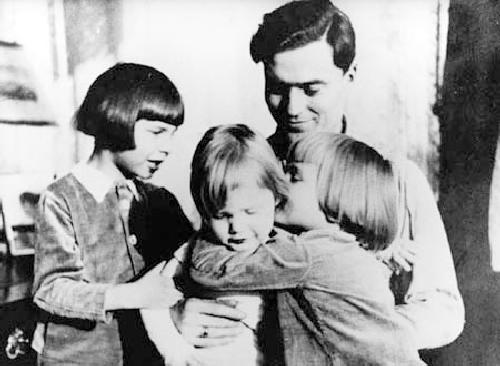
![Claus von Stauffenberg's last known photo with his family, 1944 [612x443] : r/HistoryPorn](https://i.redd.it/7vofwktjehz81.jpg)
A crime of blood.
If one member of a family betrayed the Reich, the family itself would be treated like evidence.
And the Stauffenberg name, once an old aristocratic name in southern Germany, became a target to be hunted.
Claus’s younger brother Berthold, a lawyer and one of the men involved in the resistance network, was arrested, dragged before the People’s Court, humiliated in a show trial, and executed in August 1944.
His other brother, Alexander, was not part of the assassination attempt. He was serving far away in Greece. That did not matter. His surname was enough. He too was arrested.
Across Germany, phones rang in the houses of relatives.
Doors were struck before dawn.
An elderly aunt was told to pack quickly.
A cousin was taken from his office.
In-laws who had never held a weapon were questioned like traitors.
A family connection became a sentence.
The regime did not behave like it was punishing a failed assassination.
It behaved like it was uprooting a tree.
The trunk had been cut down in Berlin. Now the roots had to be torn out of the ground.
At Lautlingen Castle, where members of the Stauffenberg family had gathered, the atmosphere changed overnight. Before July 20, it had been a family home: children running through rooms, letters arriving from the front, adults speaking carefully about the war.
After July 20, every window felt watched.
Nina von Stauffenberg, Claus’s wife, was pregnant with their fifth child when the Gestapo came for her.
She had four children at the time: Berthold, Heimeran, Franz-Ludwig, and Valerie. The youngest was still small enough to cling to a dress when strangers entered a room.

Nina knew her husband was dead.
She also knew the men standing in front of her were not finished.
One officer asked her whether she had known about the plot.
She answered with control.
Not weakness.
Control.
That was what made the interrogators angrier.
They expected tears. They expected pleading. They expected the widow of a condemned man to collapse under the weight of their uniforms.
Instead, Nina stood there with a pregnant body, a shattered private world, and the kind of silence that made brutal men feel strangely small.
The children watched from nearby rooms.
They did not understand the language of political revenge.
They understood boots.
They understood their mother’s face.
They understood that no one had come to explain.
Soon, the punishment moved from the adults to the children.
That was the moment the revenge became something colder.
The Nazis were not satisfied with imprisoning the widow. They wanted to separate the children from her. They wanted to remove them from their family, their homes, their name, and eventually their memory of who they were.
A child can survive losing a house.
A child can survive losing toys.
But if you take away a child’s name, you are trying to take away the bridge back to themselves.
The order was simple in its cruelty: the Stauffenberg children were to be taken away and placed under false identities.
The name “Stauffenberg” was not to be spoken.
The children were given another surname.
Meister.
A neat, ordinary German name.
A name with no history attached to it.
A name that did not echo through courtrooms, execution yards, or SS files.
On paper, Berthold von Stauffenberg became Berthold Meister.
Heimeran became Heimeran Meister.
Franz-Ludwig became Franz-Ludwig Meister.
Valerie became Valerie Meister.
To a bureaucrat, it was just ink.
To a child, it was theft.
They were sent to a children’s home in Bad Sachsa, in the Harz Mountains, along with other children from families connected to the July 20 resistance. The location looked harmless from the outside. Beds. Meals. Rules. Adults with keys. Children in rows.
But the purpose was not care.
It was containment.
The children were watched, corrected, and reminded that their old names were dangerous. They were not to speak about their parents. They were not to ask too many questions. They were not to say the word Stauffenberg as if it belonged to them.
A staff member once looked over a list and paused at one of the boys.
“Meister,” she said.
The boy did not answer immediately.
His real name sat behind his teeth.
The woman looked up.
“I said Meister.”
Only then did he respond.
Around him, other children noticed.
Because children notice everything adults think they hide.
They noticed which names sounded new.
They noticed who cried quietly at night.
They noticed who froze when certain surnames were mentioned.
They noticed that some children had arrived with the same kind of fear in their eyes — not the fear of being lost, but the fear of being deliberately misplaced.
In Berlin, the SS files continued to grow.
Confiscations were recorded.
Arrests were recorded.
Transfers were recorded.
Even unborn children were caught in the logic of revenge.
Nina, imprisoned while pregnant, gave birth after Claus’s execution. Her youngest daughter, Konstanze, entered the world without ever seeing her father, under a regime that considered her blood suspicious before she could speak.
This was the true madness of Sippenhaft.
It did not require proof.
It did not require action.
It did not require guilt.
It only required connection.
A family photograph became evidence.
A baptismal record became evidence.
A shared surname became evidence.
And in Bad Sachsa, the children were expected to become blank.
But there was one problem the Nazis had not calculated.
They believed names lived in documents.
They forgot names live in people.
At first, the children obeyed because children are trained to obey adults, especially in frightening places.
They answered to “Meister.”
They kept their eyes down.
They did not correct the staff.
But at night, when the building settled and the official voices disappeared, the truth began to move.
A whisper in a dormitory.
A question under a blanket.
“What was your name before?”
No one answered immediately.
The room was dark.
Some children were afraid it was a trap.
Then one older boy finally said his real name.
Not loudly.
Not dramatically.
Just clearly enough for the others to hear.
The silence changed.
Another child whispered a family name.
Then another.
And another.
One by one, in a room the Nazis thought they controlled, the children began giving back to each other what the state had stolen.
The Stauffenberg children heard names they recognized.
Cousins.
Families connected through blood, marriage, friendship, and resistance.
Suddenly the home was no longer a place full of strangers.
It was a map.
A hidden Germany inside a dormitory.
A Germany of fathers who had been hanged, mothers who had been arrested, houses that had been searched, and children who were told to become someone else.
That was the plot twist the regime never saw coming.
By separating the children, they had not erased the families.
They had gathered the evidence of their cruelty into one place.
Every false name proved the lie.
Every frightened child proved the revenge.
Every whispered real surname became a record no SS clerk could burn.
One morning, a supervisor entered the room earlier than usual and stopped near the doorway.
The children had been speaking.
Not loudly.
But not carefully enough.
She heard a name that was not supposed to exist there.
Stauffenberg.
Her face tightened.
The boy who had said it looked up.
For a second, no one moved.
The supervisor’s hand remained on the doorframe. Her eyes went from one child to another, and something passed across her expression that was not anger yet.
It was recognition.
She understood, all at once, that the plan was failing in the smallest possible room.
These children knew.
They knew their names.
They knew each other.
They knew the adults had lied.
And worse, they were no longer alone.
The woman ordered silence, but the silence did not belong to her anymore.
A false name works only when the person wearing it accepts the lie.
The children had stopped accepting it.
Outside Bad Sachsa, the war was turning.
Cities burned.
Front lines collapsed.
The men who had spoken of a thousand-year Reich began moving papers, hiding orders, and pretending they had only followed instructions.
The same officials who had once signed arrest warrants with confidence started measuring their words.
The same clerks who had stamped false names onto children’s files began wondering who would read those files after the war.
Power has a smell when it begins to rot.
People notice.
The guards notice.
The secretaries notice.
Even children notice.
In the final months, the tone around the children changed. Commands became less sharp. Some adults avoided eye contact. Others acted as if they had always been kind.
But children remember the first version of people.
They remember who slammed the door.
They remember who took the letters.
They remember who said, “That is not your name.”
When the Nazi regime finally collapsed in 1945, the great machinery of terror did not fall like a stage curtain. It broke in pieces. Camps were opened. Prisoners were found. Records surfaced. Families searched for the missing.
And the children who had been renamed began to return.
Not all wounds were visible.
A returned child does not simply step back into a family and become whole.
There were empty chairs.
There were fathers who would never come home.
There were mothers who had aged years in months.
There were houses that had been searched, possessions gone, relatives dead, names stained by propaganda and then slowly restored by truth.
But the Stauffenberg children still had the one thing the regime had tried hardest to steal.
They had their name.
Nina survived.
Her children survived.
The baby born after Claus’s death survived.
Alexander survived the war.
The family the Nazis wanted “extinguished down to the last member” did not disappear.
And Berthold, the eldest son of Claus, would grow up to serve in the army of postwar West Germany — wearing, without apology, the name the Nazis had tried to bury.
That is the consequence no dictator understands.
You can kill a man.
You can seize his property.
You can drag his brother into a courtroom and call it justice.
You can arrest his pregnant wife.
You can put his children in a home, change their surname, and order them to answer when strangers call them something else.
But you cannot permanently erase a name that people are brave enough to remember.
Years later, what remains most chilling is not only that the Nazis punished adults for resistance.
It is that they looked at children and saw enemies.
A small boy in a dormitory.
A little girl missing her mother.
An unborn baby.
To the regime, they were threats because they carried a memory.
And that tells us something about tyrants.
They are not only afraid of bombs.
They are afraid of children who know the truth.
They are afraid of family stories.
They are afraid of names spoken softly in dark rooms.
They are afraid of the day a child grows up and says, “This is what they did to us.”
The Stauffenberg story is often told through the explosion at the Wolf’s Lair, the failed coup, the firing squad in Berlin, and the men who paid with their lives.
But the quieter story may be even more powerful.
Because after the gunfire ended, the battle moved into nurseries, prisons, files, and children’s dormitories.
It became a battle over memory.
And in that battle, the children won.
Not with weapons.
Not with speeches.
Not with revenge.
They won by remembering who they were.
The Nazis tried to turn Stauffenberg into a forbidden word.
History turned it into a name people still speak.
And sometimes, the strongest act of resistance is simply refusing to let anyone rename your soul.