
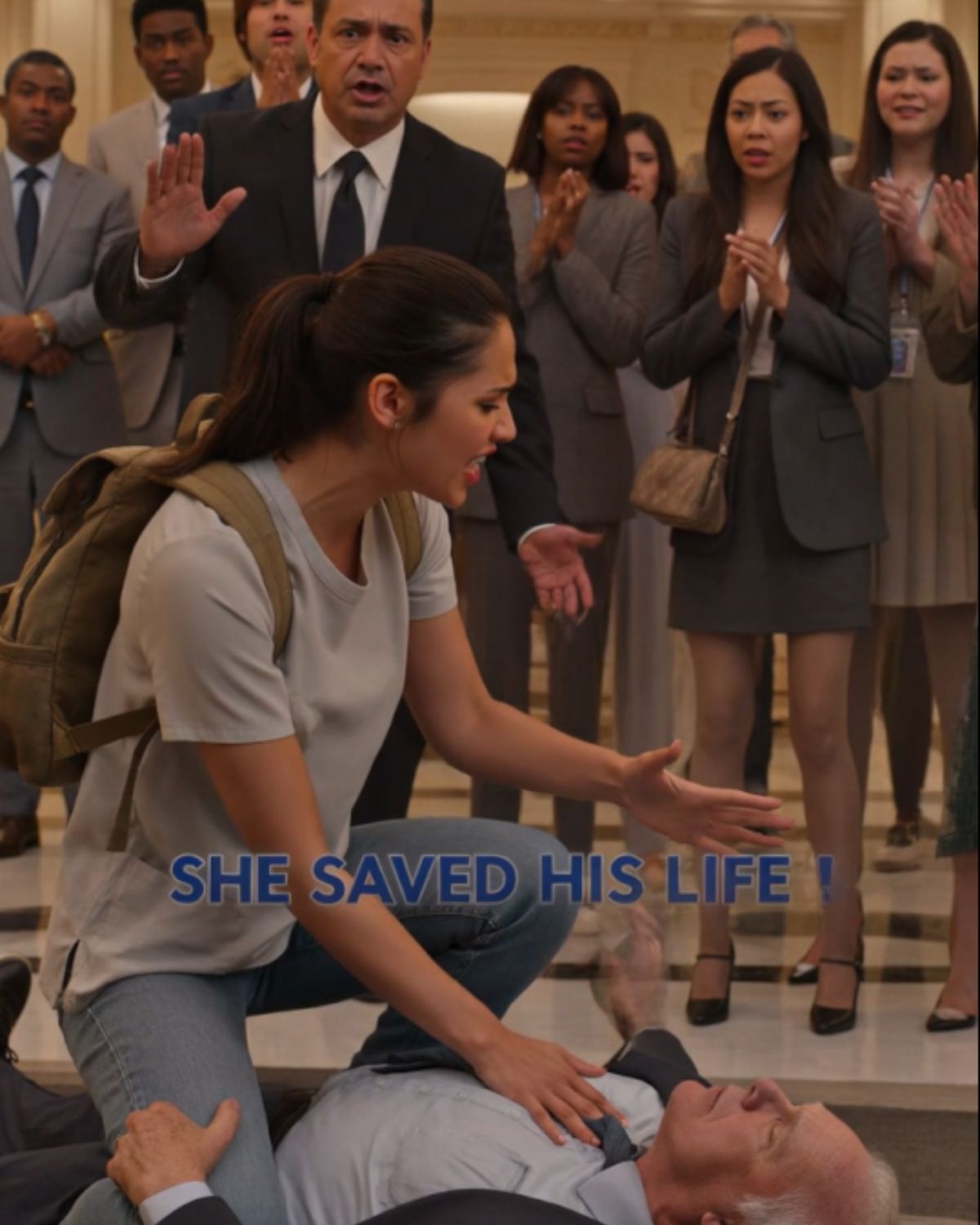
 The rain had just stopped when Amara Lewis walked past the entrance of the Whitmore Grand Hotel.
It was 7:18 in the evening.
The hotel glowed like a palace against the wet city street. Golden lights poured through the glass doors. Black cars lined the driveway. Bellboys in pressed uniforms moved between guests with umbrellas. Inside, chandeliers shimmered over marble floors, and a pianist played softly in the lobby bar.
Amara did not belong to that world.
At least, that was what people usually decided when they saw her.
She was twenty-six, wearing a faded blue jacket over plain hospital scrubs, her hair tied back in a tired bun, and worn black shoes that had survived too many twelve-hour shifts. An old backpack hung from one shoulder. Inside were a half-empty water bottle, a folded uniform top, a pair of compression socks, and a sandwich she had forgotten to eat.
She had just finished a brutal shift at St. Mary’s Emergency Department.
Three car accident patients.
One elderly woman with chest pain.
A child with a fever that would not break.
A man who kept apologizing because he could not afford his medication.
By the time Amara clocked out, her legs felt hollow.
She had missed the first bus, and instead of waiting twenty minutes in the cold, she decided to walk to the next stop near the hotel district.
She was thinking about nothing except getting home, taking off her shoes, and sleeping.
Then she heard a sound.
Not a scream.
A dull, heavy thud.
Amara turned.
Near the hotel driveway, just beyond the red carpet entrance, an elderly man had collapsed beside a stone planter.
At first, people did not understand what had happened.
A bellboy looked over, confused.
A couple in evening clothes stepped back.
A driver leaned out of his car and said, “Sir?”
The elderly man did not answer.
He lay on his side, one hand near his chest, his silver hair damp from the wet pavement. His walking cane had rolled under a parked car.
Amara’s exhaustion disappeared.
She ran.
“Sir?” she called, dropping to her knees beside him. “Can you hear me?”
No response.
She carefully rolled him onto his back, supporting his neck as much as she could.
His face was pale.
Too pale.
His lips had a bluish tint.
Amara placed two fingers at the side of his neck.
For one second, the whole world narrowed to that pulse.
Weak.
Irregular.
Then fading.
Her training took over.
She looked up at the stunned bellboy.
“You. Call emergency services now.”
The boy blinked.
“Now!” Amara shouted.
He jumped and grabbed his radio.
Amara turned toward the hotel entrance.
“Bring the AED! First-aid kit too. Move!”
The bellboy stared again.
She pointed toward the doors.
“Automated external defibrillator. AED. Most hotels have one. Get it now!”
A woman in a black dress whispered, “Is she a doctor?”
Amara did not look up.
“I’m a nurse,” she said, checking the man’s breathing. “And he needs help right now.”
The man’s chest barely moved.
Then stopped.
Amara’s stomach tightened.
“No,” she whispered.
She tilted his head carefully, checked his airway, then shouted toward the entrance again.
“Call 911! Tell them adult male, possible cardiac arrest, Whitmore Grand entrance. Bring the AED!”
Nobody moved fast enough.
The bellboy was still speaking into his radio, panicked and unclear.
Another staff member stood frozen by the revolving door.
Guests gathered in a circle, watching as if this were something happening on a screen.
Amara looked at them and understood the problem.
They were waiting for someone important to take control.
They did not realize the important seconds were already leaving.
She stood and ran into the hotel.
The transition from the driveway to the lobby felt unreal.
Outside was cold pavement, panic, and a man dying.
Inside was polished marble, warm air, golden light, soft piano music, and wealthy guests turning to stare at a breathless young woman in worn shoes rushing through their perfect lobby.
Amara went straight to the reception desk.
“I need your AED and first-aid kit now,” she said.
The front desk manager looked up sharply.
His name was Malcolm Pierce.
He was tall, impeccably dressed, and proud of the fact that no guest ever saw him lose control. He believed luxury was built on calm surfaces. No raised voices. No disorder. No unpleasantness in front of paying guests.
And Amara, damp from the pavement, hair loose around her face, backpack slipping from her shoulder, looked like disorder.
“Miss,” Malcolm said coldly, “you can’t run in here like that.”
Amara stared at him.
“A man collapsed outside. I’m a nurse. I need your first-aid kit and AED right now.”
Malcolm glanced at her scrubs beneath the old jacket.
Then at her worn shoes.
Then at the guests watching from the lobby lounge.
His mouth tightened.
“If there is an incident outside, our security team will handle it.”
“Your security team is not handling it. He has no normal breathing. I may need to start CPR.”
That should have changed everything.
It did not.
Malcolm’s eyes flicked to her backpack.
“Do you have identification?”
Amara could barely believe what she was hearing.
“I have a dying man outside your front door.”
“Miss, calm down.”
“Do not tell me to calm down. Bring the AED.”
A nearby receptionist looked nervous.
“Mr. Pierce, maybe we should—”
Malcolm lifted one hand to silence her.
“Security,” he called.
Two security guards near the side corridor turned.
Amara’s face hardened.
“You are wasting time.”
“Miss, you cannot storm into a five-star hotel and start giving orders.”
“I can when someone is in cardiac arrest.”
Several guests whispered.
“She says she’s a nurse.”
“Is someone really outside?”
“Why isn’t anyone helping?”
Amara pointed toward the entrance.
“Every second matters. If his heart has stopped, waiting for permission can kill him.”
That sentence finally reached one person.
A young bellboy named Theo burst through the service door holding a red AED case and a white first-aid box.
“I found it!” he shouted.
Amara turned immediately.
“Good. Bring it outside.”
Malcolm stepped forward.
“Theo, wait. We need to follow protocol.”
Amara looked at him with a kind of disbelief that made the receptionist lower her eyes.
“Protocol is calling emergency services and using the AED when someone collapses. Your protocol is currently standing in the way.”
She grabbed the AED case from Theo.
Malcolm reached as if to stop her.
Theo surprised everyone by stepping between them.
“She knows what she’s doing,” he said.
Malcolm froze.
The lobby went quiet.
Theo’s face was pale, but he did not move.
Amara did not waste one more second.
She ran back outside with the AED.
Theo followed with the first-aid kit.
The scene at the driveway had worsened.
The elderly man lay flat on the wet pavement now. A driver stood nearby holding a phone to his ear, finally speaking to emergency dispatch. Guests formed a frightened half-circle around the body. Someone was crying softly.
Amara dropped beside the man again.
“No normal breathing,” she said. “I’m starting compressions.”
She placed the heel of one hand in the center of his chest, the other hand on top, locked her elbows, and began CPR.
One.
Two.
Three.
Four.
Her shoulders burned almost immediately.
She had already worked twelve hours.
Her wrists ached.
Her knees pressed into cold pavement.
But she pushed hard and fast, counting under her breath.
“Thirty compressions. Theo, open the AED. Turn it on.”
Theo fumbled with the case.
Amara did not stop.
“Stay calm. Open the lid. Follow the voice prompts.”
The AED powered on.
A mechanical voice spoke clearly.
“Apply pads to patient’s bare chest.”
Amara looked up.
“You in the gray coat,” she said to a guest standing nearby. “Help me open his shirt.”
The man hesitated.
Amara’s voice sharpened.
“Now.”
He dropped to his knees and helped tear open the elderly man’s dress shirt. Buttons scattered across the pavement.
Theo held the pads, hands shaking.
Amara guided him.
“One pad upper right chest. One pad lower left side. Good.”
The AED voice continued.
“Analyzing heart rhythm. Do not touch the patient.”
Amara lifted her hands.
“Everybody back. Nobody touch him.”
The crowd stepped away.
The driveway fell silent.
Even the hotel doors seemed to stop moving.
The AED beeped.
“Shock advised. Charging.”
A woman gasped.
Theo whispered, “Oh my God.”
Amara looked at him.
“Theo. Stay with me.”
He nodded quickly.
The AED voice spoke again.
“Press flashing shock button.”
Amara looked around.
“Clear!”
She checked the man’s body. No one touching.
“Clear.”
She pressed the button.
The man’s body jerked.
The crowd cried out.
Amara immediately resumed compressions.
“Call 911 again,” she shouted. “Tell them shock delivered. CPR in progress.”
The driver repeated it into the phone, voice trembling.
Amara kept going.
Her breath grew heavy.
Her arms screamed.
Rainwater seeped through her knees.
A memory flashed through her mind: her nursing instructor years ago, standing over a CPR mannequin and saying, “You do not rise to the occasion. You fall back on training. So train until your hands know what to do when your fear doesn’t.”
Her hands knew.
“Come on,” she whispered to the man. “Come on. Stay with us.”
The AED analyzed again.
“No shock advised. Continue CPR.”
Amara continued.
A hotel guest stepped forward.
“I know CPR,” he said. “I took a course last year.”
“Good,” Amara said. “On my count, switch with me. Same pace, hard and fast. Don’t bend your elbows.”
He nodded.
They switched.
Amara grabbed the first-aid kit and checked the man’s airway again.
A faint movement.
She leaned closer.
A gasp.
Then another.
The man’s chest rose weakly.
“Stop compressions,” Amara said. “He’s breathing. Keep him flat. Don’t sit him up.”
The man coughed.
The sound was small, rough, and beautiful.
The crowd gasped in relief.
Theo covered his mouth with one hand.
Amara supported the man’s head and monitored his breathing.
“Sir,” she said gently. “Can you hear me?”
His eyelids fluttered.
Slowly, the elderly man opened his eyes.
Confusion moved across his face first.
Then fear.
Amara leaned closer.
“You collapsed. Help is coming. Try not to move.”
His lips trembled.
“Eleanor…” he whispered.
Amara did not know who Eleanor was.
She only said, “You’re safe right now. Stay with me.”
At that moment, the hotel general manager came running outside.
Richard Hale was in his late fifties, silver-haired, usually composed, and known for never appearing rushed in front of guests.
Now he looked terrified.
He pushed through the crowd, saw the man on the ground, and stopped as if the pavement had vanished beneath him.
“Oh my God,” he said.
Malcolm Pierce, the rude front desk manager, came out behind him, breathless and annoyed until he saw Richard’s face.
Richard looked at the elderly man.
Then at Amara.
Then back at the elderly man.
“That’s Mr. Whitmore,” he said, voice breaking. “That’s Arthur Whitmore. The chairman of this hotel.”
The words moved through the crowd like electricity.
Guests turned toward one another.
The bellboys froze.
The receptionist at the door covered her mouth.
Malcolm’s face went pale.
Arthur Whitmore.
Chairman of Whitmore Hospitality Group.
Owner of the hotel.
The man whose portrait hung in the executive hallway.
The man whose name was on the building.
And moments ago, the staff had almost let him die because the woman asking for help did not look important enough to believe.
Malcolm stared at Amara.
He saw her now.
Not the old backpack.
Not the worn shoes.
Not the simple clothes.
He saw her bloody knuckles from the pavement, her soaked knees, the sweat on her forehead, the calm control in her eyes, and the AED pads still attached to the chairman’s chest.
The recognition hit him hard.
His mouth opened.
No words came.
Arthur Whitmore moved his hand weakly.
Amara noticed immediately and held it.
“Don’t try to get up,” she said. “Paramedics are almost here.”
Arthur’s fingers closed around hers with surprising strength.
His voice was faint.
“You saved my life.”
Amara swallowed.
Her face changed for the first time.
Not pride.
Not performance.
Emotion, quickly controlled by training.
“I only did what anyone should do.”
Arthur looked toward the hotel entrance.
His eyes moved over Richard, Theo, the staff, the watching guests, and finally Malcolm.
Even weak, his expression sharpened.
“Anyone,” he repeated softly. “But she did.”
The sirens arrived then.
Blue and red lights reflected across the hotel’s golden doors.
Paramedics rushed from the ambulance with equipment. Amara gave them a clear handoff.
“Male, approximately seventies. Witnessed collapse. Initially unresponsive, no normal breathing. CPR started. AED applied. One shock delivered. Return of spontaneous breathing before EMS arrival. Pulse present, weak but improving.”
One paramedic looked at her.
“You medical?”
“ER nurse. St. Mary’s.”
He nodded with respect.
“Good work.”
They placed Arthur on a stretcher, connected monitors, checked vitals, and prepared transport.
Arthur did not let go of Amara’s hand until the paramedic gently told him they needed to move him.
Before they lifted the stretcher, Arthur looked at Richard.
“Take care of her.”
Richard nodded immediately.
“Of course, sir.”
Arthur’s eyes shifted to Amara.
“Please,” he whispered.
The ambulance doors closed.
The siren faded down the street.
For several seconds, no one spoke.
The luxury hotel entrance looked different now.
The red carpet was wet.
The marble steps were marked with rain, shoe prints, and the urgency of a life almost lost.
The guests who had whispered earlier now stood quietly, ashamed of how slowly they had moved.
Theo still held the first-aid kit, hands trembling.
Amara stood near the planter, breathing hard, her jacket damp, her backpack lying on the ground where she had dropped it.
Richard approached her carefully.
“Miss…”
“Amara Lewis.”
“Ms. Lewis,” he said, voice full of respect. “Thank you. I don’t know how to properly say what you just did.”
Amara picked up her backpack.
“I’m glad the AED was available.”
Theo stepped forward.
“You told me what to do.”
“You moved fast,” Amara said. “That mattered.”
Theo’s eyes filled slightly.
“I almost didn’t.”
“But you did.”
That small mercy seemed to steady him.
Malcolm stood behind Richard, face ashen.
He looked smaller now. Not physically, but in certainty.
The same man who had blocked her in the lobby now could barely meet her eyes.
“Ms. Lewis,” he said quietly.
Amara turned.
He swallowed.
“I owe you an apology.”
The staff watched.
Guests watched.
Richard did not interrupt.
Malcolm continued, voice unsteady.
“You came in asking for emergency equipment, and I judged you by your appearance. I delayed you. I called security instead of listening.”
His eyes flicked toward the driveway where Arthur had fallen.
“If Theo had not brought the AED…”
He stopped.
The ending of that sentence was too frightening to say.
Amara looked at him for a long moment.
Her voice stayed calm.
“You didn’t need to know I was a nurse to listen when I said someone had collapsed.”
Malcolm flinched.
She continued, “You didn’t need to know he was the chairman to move quickly.”
The sentence struck every staff member there.
Because it was true.
Arthur Whitmore’s title had changed the way they saw the emergency.
But it should not have changed the urgency.
A life had been on the pavement before anyone knew it was an important life.
Richard turned slowly toward Malcolm.
“We will discuss this inside.”
Malcolm nodded, looking at the ground.
But Amara shook her head slightly.
“Please don’t only punish him.”
Richard looked surprised.
“He was wrong,” Amara said. “But the problem was bigger than one person. Nobody knew where the AED was at first. Staff hesitated. People waited for permission. That can’t happen in a hotel this size.”
Richard absorbed that.
“You’re right.”
She adjusted the strap of her backpack.
“Emergency response needs training. Clear roles. Drills. Someone at the desk should be able to call 911 while someone else retrieves the AED. Security should know CPR. Bell staff too. If Theo had been thirty seconds later, this could have ended differently.”
Theo looked down at the AED case.
Richard’s expression changed.
He had expected gratitude.
Maybe embarrassment.
Maybe a lawsuit threat.
Instead, this tired nurse in worn shoes was giving him the truth he needed most.
Not revenge.
Prevention.
“You’re right,” he said again. “And we will fix it.”
Amara nodded.
“Good.”
She started to step away.
Richard stopped her gently.
“Ms. Lewis, please come inside. At least let us get you dry. Coffee, tea, something to eat.”
Amara hesitated.
She looked toward the lobby.
The same lobby where she had been blocked.
The same desk where Malcolm had called security.
The same marble floor where guests had stared at her like she was a problem.
Richard noticed.
His face softened with shame.
“You are welcome here,” he said. “And you should have been the moment you walked in.”
Amara looked at him.
Then at Theo, still pale.
Then at the AED in his hands.
“All right,” she said. “For a few minutes.”
The transition back into the hotel felt different.
When Amara entered this time, no one blocked her.
The lobby seemed to part around her.
Guests lowered their voices. Staff stood straighter. A receptionist hurried to bring towels. Another brought water. Someone from the restaurant brought hot tea and a bowl of soup without being asked.
Amara sat in a quiet first-aid area near the VIP lounge while Richard arranged a private space.
Theo stood nearby, still holding the AED case like he could not let go of it.
“You can put it down,” Amara said.
He looked at the case, then laughed nervously.
“Right.”
He placed it on the table.
“My hands won’t stop shaking.”
“That’s normal.”
“I thought I was going to mess up.”
“You didn’t.”
“I didn’t know the chairman was outside.”
Amara took the tea from the receptionist.
“That shouldn’t matter.”
Theo nodded slowly.
“I know.”
Then he looked at her.
“But it does, doesn’t it? People move faster for important people.”
Amara held the cup with both hands.
“In the hospital, the body doesn’t care about status. A heart stops the same way in a billionaire as it does in a man sleeping under a bridge.”
Theo sat with that.
The receptionist who had brought the tea stood in the doorway, listening.
So did Richard.
Amara continued, “That’s why we train. Training gets there before judgment does.”
Richard stepped fully into the room.
“Would you be willing to help us with that training?”
Amara looked up.
“I’m not a consultant.”
“I know.”
“I’m an emergency nurse who just finished a shift.”
“I know that too.”
For the first time all evening, she almost smiled.
Richard said, “Then perhaps we start by paying for your time properly and building the program around what you saw tonight.”
Amara looked at him carefully.
“Not a photo opportunity.”
“No.”
“Not a press release about how much you care.”
“No.”
“Real training. All staff. Front desk, security, bellboys, restaurant, housekeeping.”
“Yes.”
“And the AED needs to be accessible. Not locked in a closet only one person knows about.”
Richard nodded.
“Done.”
Theo raised his hand slightly.
“I want to be in the first training.”
Richard looked at him.
“You will be.”
From the doorway, Malcolm spoke quietly.
“So do I.”
Everyone turned.
He looked destroyed.
But not performatively.
Really.
“I don’t deserve to ask,” he said. “But I need to learn what I should have done.”
Amara studied him.
Her anger had not vanished.
But she had spent too many years in emergency rooms to believe people were only their worst moment. She had seen drunk drivers sob beside hospital beds. Fathers who had been careless become gentle. Nurses make mistakes and spend years becoming better because of them.
Consequences mattered.
So did change.
“Then learn,” she said.
Malcolm nodded.
“I will.”
Richard’s phone rang.
He looked at the screen, then answered immediately.
“Yes?”
The room went still.
His face shifted.
Relief.
He looked at Amara.
“He’s stable. Awake. The doctors say the early CPR and AED use likely saved his life.”
Theo sat down hard in the nearest chair.
The receptionist began crying quietly.
Amara closed her eyes for one second.
She had heard good news after emergencies before, but it never became ordinary.
A life continuing was never ordinary.
Richard lowered the phone.
“He’s asking for you.”
Amara opened her eyes.
“Now?”
“At the hospital, when you’re able. Not tonight if you’re exhausted.”
Amara gave a small tired laugh.
“I am exhausted.”
“Tomorrow, then.”
She nodded.
“Tomorrow.”
The next morning, Amara almost did not go.
She woke in her small apartment with sore arms, bruised knees, and a headache from sleeping too little. Her worn shoes sat by the door, still damp from the night before. Her backpack leaned against the wall. Her phone showed three missed calls from unknown numbers and one message from Richard Hale.
Mr. Whitmore is awake and stable. He asked again if you would visit. Only if you feel comfortable.
Amara stared at the message.
Part of her wanted to ignore it.
She had done her job as a nurse, even off-duty.
She did not need thanks from a chairman.
She did not need to be paraded around a hospital room while executives discovered humility for one afternoon.
But she remembered Arthur’s hand gripping hers.
You saved my life.
She remembered his face when he repeated:
Anyone. But she did.
So she went.
At St. Mary’s, the same hospital where she worked, the staff on the cardiac floor greeted her with raised eyebrows and knowing smiles. News traveled fast in hospitals. It traveled even faster when one of their own saved a powerful man outside a luxury hotel.
Arthur Whitmore was in a private room, sitting slightly upright with monitors beside him. He looked smaller than he had probably looked in boardrooms, but his eyes were alert.
Richard stood near the window.
Theo was there too, awkward in his bellboy uniform, holding a small bouquet from the hotel staff.
Malcolm stood by the door, hands folded, silent.
Arthur turned when Amara entered.
“There she is,” he said.
His voice was weak, but warm.
Amara stepped closer.
“How are you feeling, Mr. Whitmore?”
“Alive,” he said. “Which I understand is largely your fault.”
Theo laughed nervously.
Amara smiled.
“The paramedics and doctors did the advanced care. I just started the chain.”
Arthur looked at her seriously.
“Without the first link, there is no chain.”
She accepted that quietly.
Arthur gestured to the chair beside his bed.
“Please.”
She sat.
For a moment, he simply looked at her.
Not like a chairman looking at an employee.
Not like a rich man looking at a poor nurse.
Like a person looking at the reason he still had breath.
“I heard what happened in the lobby,” he said.
The room grew tense.
Malcolm looked down.
Arthur continued, “I heard you asked for help and were stopped.”
Amara glanced at Malcolm.
“I was delayed.”
Arthur’s mouth tightened.
“That delay could have cost my life.”
No one spoke.
Malcolm stepped forward.
“Mr. Whitmore, I take full responsibility. I misjudged the situation and Ms. Lewis. I judged her appearance instead of the emergency. There is no excuse.”
Arthur looked at him for a long moment.
“No,” he said. “There isn’t.”
Malcolm’s face tightened, but he nodded.
Arthur turned to Richard.
“What has been done?”
Richard answered immediately.
“Emergency response review began this morning. AED location changes are being implemented. Staff training will be mandatory. Ms. Lewis has agreed to advise if compensated properly and if the program is real, not symbolic.”
Arthur’s eyes moved back to Amara.
“Good.”
Then he looked at Theo.
“And this young man?”
Theo straightened.
Arthur said, “I’m told you brought the AED when others hesitated.”
Theo swallowed.
“Ms. Lewis told me to.”
“And you listened.”
Theo nodded.
Arthur smiled faintly.
“Listening saved my life too.”
Theo’s eyes reddened.
“Thank you, sir.”
Arthur leaned back, tired but determined.
“I built that hotel with my late wife. We wanted it to represent dignity. Not luxury alone. Dignity.” He paused to catch his breath. “Last night, dignity came through the door wearing worn shoes, and my staff almost turned it away.”
Amara looked down.
The sentence was heavy because it was true.
Arthur continued, “Ms. Lewis, I owe you more than gratitude.”
She looked up quickly.
“You don’t owe me anything.”
“I disagree.”
“I don’t want a reward.”
“I understand.”
“Mr. Whitmore—”
He raised one weak hand.
“Let me finish before refusing everything.”
That made Richard smile slightly.
Arthur said, “I have spent years funding medical galas and hospital wings. Important things. But last night showed me something simpler and more urgent. People need emergency training where emergencies actually happen. Hotels. restaurants. offices. train stations. apartment buildings.”
Amara’s expression shifted.
He continued, “I want to create a public emergency response training fund. CPR, AED awareness, first-aid readiness. Free training for service workers across the city. Not because they serve wealthy guests. Because they serve human beings.”
Amara sat very still.
Arthur looked at her.
“And I want it shaped by people who know what happens in real emergencies. Nurses. paramedics. Not executives guessing from conference tables.”
For the first time, Amara saw something beyond apology.
A consequence that could matter.
“That would help,” she said quietly.
Arthur nodded.
“Then help me build it.”
Months later, the Whitmore Grand Hotel looked the same to guests.
The marble still shone.
The chandeliers still glowed.
The doormen still opened car doors.
But behind the elegance, something had changed.
There were AED signs clearly visible near the lobby, ballroom, gym, and restaurant corridor. Staff did not just know where the devices were. They knew how to use them. Front desk staff practiced emergency call scripts. Bellboys trained in crowd control. Security trained in CPR. Housekeeping learned how to respond if a guest collapsed in a room. Restaurant staff practiced choking response.
The first training session was led by Amara.
She arrived in simple clothes again.
This time, nobody stopped her.
Malcolm was seated in the front row.
Theo sat beside him.
Richard stood at the back.
Arthur, still recovering, joined by video from home.
Amara stood beside a CPR mannequin and looked at the staff.
“Emergencies are not polite,” she began. “They do not wait for the right guest, the right outfit, the right manager, or the right moment. Someone collapses, and the clock starts.”
The room was silent.
She pointed to the AED on the wall.
“This machine is simple because it is designed for panic. It talks to you. It tells you what to do. But it cannot walk itself to the patient. That part is yours.”
Theo nodded.
Malcolm wrote notes.
Amara continued, “Your first job is not to decide whether someone looks credible. Your first job is to recognize danger and activate help.”
Her eyes moved briefly to Malcolm.
He did not look away.
That mattered.
After the session, he approached her.
“Ms. Lewis.”
“Yes?”
“I wanted you to know I’ve stepped down from front desk management.”
Amara was surprised.
“You resigned?”
“No. Mr. Hale reassigned me to operations while I retrain. I asked for it.”
She studied him.
“I realized I liked controlling the lobby more than serving people in it,” he said.
That was honest enough to be uncomfortable.
“And now?”
“Now I’m trying to become useful.”
Amara nodded.
“That’s a good place to start.”
He looked at the AED training room.
“I keep thinking about those seconds. How many we lost because of me.”
“You can’t get them back.”
“I know.”
“But you can protect the next ones.”
He looked at her.
“Yes.”
A year after Arthur Whitmore’s collapse, the Whitmore Response Fund had trained more than eight thousand service workers across the city.
Hotel staff.
restaurant hosts.
Bus station attendants.
Security guards.
Mall employees.
Apartment concierges.
School receptionists.
People who were often first on scene but rarely treated as part of the emergency system.
Theo became one of the fund’s most dedicated trainers, telling every class, “I was shaking so badly I could barely open the AED case. Do it anyway.”
Malcolm completed his retraining and returned to guest services in a different role. He became known not for cold perfection, but for calm emergency readiness. Once, when a housekeeper fainted in a hallway, he responded within seconds, called medical help, cleared space, and stayed with her until paramedics arrived.
He later wrote Amara a note:
I used to think professionalism meant keeping the lobby quiet. Now I know it means knowing when to break the silence.
Amara kept the note in her backpack.
Arthur recovered slowly, then steadily.
At the fund’s first anniversary event, he stood on the stage of the Whitmore Grand ballroom with a cane in one hand and Amara seated in the front row.
The room was full of hotel workers, nurses, paramedics, trainees, and city officials.
Arthur looked older than before.
But also more alive.
“One year ago,” he said, “I collapsed outside my own hotel.”
The room grew quiet.
“I do not remember hitting the pavement. I do not remember the panic around me. But I remember waking to a young nurse holding my hand and telling me not to move.”
He looked at Amara.
“She had just finished a long hospital shift. She was tired. She was not dressed like the people my staff was trained to impress. And because of that, some people failed to listen when she asked for help.”
Amara lowered her eyes.
Arthur continued, “I was the chairman of the hotel. But that title did not restart my heart. Her training did. Her urgency did. Her refusal to be dismissed did.”
Applause rose, but he lifted his hand gently.
“The lesson is not that staff should have recognized me. The lesson is that they should have recognized an emergency. The lesson is that human life should never have to prove its status before receiving help.”
Malcolm stood at the side of the ballroom, eyes wet.
Theo clapped hard.
Arthur’s voice softened.
“Ms. Lewis told me she only did what anyone should do. She was right. And our mission is to make sure more people are ready to do it.”
He turned toward her.
“Amara, please join me.”
She looked surprised.
Richard nodded from the aisle.
Amara stood, smoothing her simple dress, and walked to the stage.
The entire ballroom rose to its feet.
Not for a celebrity.
Not for a billionaire.
For a nurse in worn shoes who had run toward a collapsed stranger when everyone else hesitated.
Arthur took her hand.
The applause grew louder.
Amara looked uncomfortable with it, but she did not pull away.
When the room quieted, she stepped to the microphone.
“I’m grateful,” she said. “But I want to be clear about something. That night was not a miracle.”
The room listened.
“It was training. It was CPR. It was an AED. It was one bellboy running instead of freezing. It was emergency dispatch answering. It was paramedics arriving. It was a chain.”
She looked across the crowd.
“A chain only works when the first person acts.”
She paused.
“Please be that person.”
No one moved.
Then she added, “Not because the person on the ground might be rich. Not because they might be powerful. Not because their name might be on the building. Because they are breathing, or they are not. Because they are someone’s father, mother, sister, brother, friend, or stranger worth saving.”
Arthur’s grip tightened around his cane.
Amara’s voice remained calm.
“If someone runs into your lobby asking for help, listen first. Judge later, or better yet, don’t judge at all.”
The applause this time was different.
Deeper.
Earned.
That evening, after the event, Amara walked through the hotel entrance alone.
The same entrance.
The same golden lights.
The same driveway where Arthur had collapsed.
Theo was outside helping guests into cars. When he saw her, he smiled.
“Need a taxi, Nurse Lewis?”
She smiled back.
“No. I’m taking the bus.”
Malcolm, standing near the doors, stepped forward.
“At least let us walk you to the stop.”
Amara raised an eyebrow.
“We?”
Theo lifted an umbrella.
“It might rain.”
Amara looked up at the sky.
Clouds had gathered again over the city.
She accepted the umbrella.
As they walked toward the bus stop, the hotel glowing behind them, Amara thought about how close everything had come to ending differently.
A man on the pavement.
A locked-away AED.
A manager blocking the wrong person.
A bellboy brave enough to move.
A crowd learning, too late but not too late, that dignity should never depend on appearance.
Arthur Whitmore lived because help arrived in time.
But the hotel changed because the truth arrived with it.
A tired nurse in worn shoes rushed through golden doors and reminded everyone inside that real value is not measured by clothing, money, title, or status.
It is measured in the moment someone needs help, and you decide whether to act.
Because sometimes the person you dismiss at the door is the one carrying the knowledge, courage, and compassion that can save a life.


