
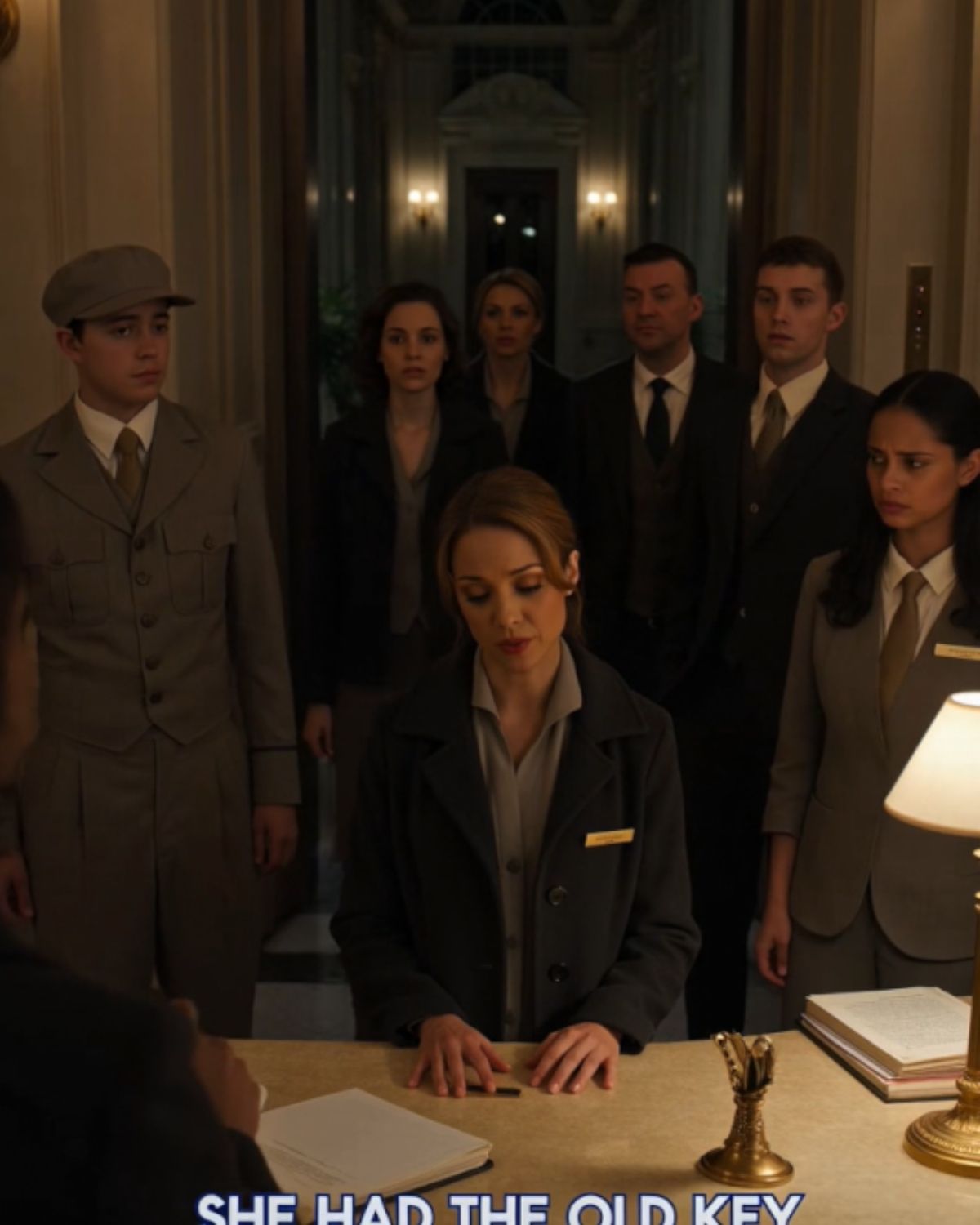
The woman arrived at the Harrington Palace Hotel at 9:17 on a rainy Thursday night.
She did not arrive in a black car.
She did not have a driver, an assistant, or a designer luggage set.
She stepped through the revolving glass doors alone, carrying one small brown suitcase with a leather handle worn smooth from years of use. Her dark coat was simple. Her hair was pinned neatly at the back of her neck. She wore no visible jewelry except a plain wedding ring and a thin silver watch.
At first, nobody noticed her.
That was exactly what she wanted.
The Harrington Palace was the kind of hotel that taught people where to look. Marble floors. Gold chandeliers. Bellboys in white gloves. Receptionists with perfect smiles. Guests in tailored coats drifting through the lobby as if elegance were a language they had spoken since birth.
A pianist played softly near the lounge.
A couple posed for photos beside a fountain of white orchids.
At the reception desk, three guests were checking in for a private charity auction upstairs. A bellboy hurried past with monogrammed luggage. A security guard stood near the elevator bank, trying to look invisible while watching everyone.
The quiet woman stopped just inside the lobby.
Her eyes moved slowly across the room.
Not with admiration.
With memory.
The ceiling mural had been restored, but she still recognized the gold border. The front desk had been replaced with white marble, but the old brass clock remained above it. The fountain was new. The orchids were new. The smell was different too: expensive perfume, polished wood, and fresh lilies instead of cigar smoke and old carpet.
But the building was the same.
No matter how many times people repainted history, some walls remembered.
She walked toward reception.
The young receptionist looked up and smiled.
“Good evening, ma’am. Welcome to the Harrington Palace. Do you have a reservation?”
The woman placed her suitcase beside her feet.
“Yes,” she said softly. “I want the old Room 707.”
The receptionist’s smile disappeared.
It did not fade politely.
It vanished.
Her fingers froze above the keyboard.
For a second, the only sound at the desk was the quiet tap of rain against the lobby windows.
“I’m sorry?” the receptionist said.
“The old Room 707,” the woman repeated.
The receptionist glanced toward the manager’s station near the wall.
A bellboy walking behind the desk stopped mid-step.
Another receptionist lifted her eyes.
The security guard near the elevator turned his head slightly.
The woman saw all of it.
She had expected surprise.
She had not expected fear.
The receptionist swallowed.
“Ma’am, I’m not sure what you mean by old Room 707.”
The woman’s face did not change.
“Yes, you are.”
A bellboy near the luggage cart leaned toward another staff member and whispered, “No one asks for 707.”
The woman heard him.
So did the receptionist.
Her face turned pale.
“One moment, please,” she said.
She picked up the phone beneath the counter and pressed one button.
Her voice dropped.
“Mr. Vale? Someone at front desk just requested Room 707.”
There was a pause.
The receptionist looked up at the woman.
Then quickly away.
“Yes,” she whispered. “She said the old room.”
Another pause.
“No, sir. I haven’t said anything.”
In the staff office behind the lobby, hotel manager Adrian Vale stood so quickly his chair rolled back into the wall.
He was in his late forties, polished, careful, and loyal to the Harrington Palace in the way men become loyal to institutions that gave them status. He had worked there for eighteen years. He knew every suite, every major guest, every hidden hallway, every scandal the hotel buried under renovations.
And nobody had asked for Room 707 in years.
Not because guests did not want it.
Because guests did not know it existed.
The current seventh floor had rooms 701 through 718, but the official system skipped one number. Between 706 and 708, there was a locked service panel, a false wall, and a door with an old brass plaque covered by years of dust.
Room 707 had once been the private VIP suite of Victor Langford, the hotel’s former owner.
Then came the scandal.
A police raid.
Missing money.
Destroyed records.
A death called a heart attack by some and something darker by others.
After Victor Langford was removed from the hotel’s history, Room 707 was sealed.
The new ownership said it was under structural review.
The staff called it storage.
The old employees knew better than to mention it.
Adrian picked up his phone.
“Who is she?” he asked.
The receptionist answered from the lobby.
“I don’t know. She has no entourage. One suitcase. Dark coat. Calm.”
“Name?”
“I haven’t asked yet.”
“Do not enter anything into the system. I’m coming.”
Adrian hung up.
For a moment, he stood still in the office.
On the wall behind him hung a framed black-and-white photograph of the Harrington Palace from 1964. The original owner stood at the entrance, shaking hands with city officials.
Victor Langford had been cropped out of every modern display.
But Adrian knew the uncropped version.
He had seen it once in the basement archive.
Victor stood on the far left, one hand on the shoulder of a little girl in a white dress.
Adrian had never forgotten her face.
Outside, in the lobby, the woman waited.
She did not ask why people were whispering.
She did not look nervous.
She only watched.
The receptionist tried to recover her professional smile.
“Ma’am, our manager will assist you shortly.”
“I’m sure he will.”
“May I have your name?”
The woman reached into her coat pocket and removed a small passport wallet.
“Eleanor Shaw.”
The receptionist typed the name into the reservation system.
This time, the screen responded.
Reservation found.
Eleanor Shaw.
One night.
Standard deluxe room.
Prepaid.
No special requests.
No VIP markers.
No notes.
The receptionist frowned.
“I see a reservation under Shaw, but not for Room 707.”
“I know.”
“Then why request—”
Adrian Vale appeared before she could finish.
“Mrs. Shaw,” he said carefully. “Good evening. I’m Adrian Vale, general manager.”
The woman turned toward him.
Their eyes met.
Adrian felt something cold move through him.
He had never met her before.
But the eyes were familiar.
Not from a guest profile.
From an old photograph in the archive.
Gray-green eyes.
Victor Langford’s eyes.
“Mr. Vale,” she said.
He gave a small, controlled smile.
“I understand there may be some confusion about your room request.”
“There is no confusion.”
“Room 707 is unavailable.”
“Unavailable is not the same as gone.”
The staff behind the desk went completely still.
Adrian’s jaw tightened.
“Mrs. Shaw, perhaps we can discuss this privately.”
“We can discuss it here.”
A guest at the next counter looked over.
Adrian lowered his voice.
“That room has been out of use for many years.”
“Seventeen years,” she said.
The number landed hard.
Adrian’s face shifted before he could stop it.
The woman noticed.
“You do know the room,” she said.
He hesitated.
“I know of it.”
She opened her handbag.
The lobby seemed to quiet around the movement.
From inside, she removed an old brass key card.
Not a modern plastic hotel card.
A real brass access card from another era, rectangular, scratched at the corners, engraved with one number:
707
She placed it gently on the marble counter.
“It was my father’s room.”
The lobby went silent.
Not politely.
Completely.
The receptionist stared at the key.
The bellboy stopped breathing for a second.
The security guard near the elevator stepped forward, then stopped when Adrian lifted one hand.
Adrian looked at the woman.
“Who are you?”
Her voice stayed soft.
“Eleanor Langford Shaw.”
The name moved through the staff like a door opening in a sealed room.
Langford.
The name the hotel no longer printed.
The name removed from brochures, awards, plaques, staff manuals, and website history pages.
The name that once belonged to the man who owned the Harrington Palace before the city’s most elegant hotel nearly collapsed under scandal.
Adrian’s throat tightened.
“Mrs. Shaw,” he said slowly, “I think it would be better if we spoke in my office.”
“I have spent seventeen years being told what would be better,” she said. “I came for Room 707.”
The receptionist looked at Adrian.
Adrian looked toward the guests.
Whispers had begun.
Not loud yet.
But growing.
He could feel control slipping.
He smiled tightly.
“Of course. We’ll verify the key and review access protocols.”
Eleanor picked up the brass card.
“No.”
Adrian froze.
She held his gaze.
“You will take me upstairs now.”
His voice lowered.
“That floor section is not prepared for guests.”
“I am not here as a guest.”
The truth entered the room quietly.
Adrian’s expression changed.
Eleanor continued, “I am here as the daughter of the man this hotel erased.”
No one moved.
Then Adrian made the only decision left to him.
He turned to the receptionist.
“Hold all calls. No one discusses this with guests.”
He looked at security.
“Call maintenance. Have them meet us on seven.”
Then he faced Eleanor.
“This way.”
They walked toward the elevator bank.
The transition from the lobby to the elevator hallway felt like a shift in time.
Behind them, the chandeliers continued glowing, the pianist resumed playing too softly, and guests pretended not to watch. Ahead, the private elevator doors reflected Eleanor’s face, calm but pale.
Adrian stood beside her.
Two staff members followed: Luis from security and Mara from maintenance, a woman in her sixties who had worked at the Harrington Palace long enough to remember what younger staff only whispered about.
When Mara saw Eleanor, her face changed.
She did not ask a question.
She knew.
The elevator opened with a soft chime.
Inside, nobody spoke.
The doors closed.
The hotel sounds faded.
Eleanor looked at the brass panel as the numbers rose.
Her breathing changed at the seventh floor.
Just slightly.
But Adrian noticed.
The elevator doors opened onto a quiet hallway.
The seventh floor had been renovated like the rest of the hotel: soft cream walls, dark carpet, gold sconces, framed city photographs. But as they walked past 701, 703, 705, the hallway seemed to grow colder.
At Room 706, Adrian stopped.
On the wall beyond it stood a narrow service panel painted the same color as the corridor.
Mara stepped forward with a ring of keys.
Her hand trembled.
Adrian noticed.
“You have access?”
Mara nodded.
“I kept the old maintenance key.”
“Why?”
She looked at Eleanor.
“Someone should have.”
Adrian said nothing.
Mara unlocked the service panel.
Behind it was a second door.
Older.
Darker.
Its brass plaque was coated with dust, but the number could still be read.
707
Eleanor stood still.
The sight of it hit harder than she expected.
For seventeen years, she had imagined this door.
She had seen it in court files, newspaper archives, dreams, and memory fragments from childhood. Her father’s hand on the handle. His laugh from inside. The smell of tobacco and sandalwood. The sound of men arguing after midnight while she hid behind her mother’s skirt.
And then the final night.
Police lights.
Shouting.
Her mother pulling her down the service stairs.
A headline the next morning.
VICTOR LANGFORD DEAD AS HOTEL FRAUD SCANDAL DEEPENS
After that, nothing was simple.
Accounts frozen.
Assets seized.
Her mother humiliated.
Family name destroyed.
Eleanor sent away to relatives under a new surname.
The hotel sold, renovated, rebranded, and polished until the Langford name existed only as a stain people stepped around.
Adrian stood behind her.
“Mrs. Shaw,” he said quietly, “what are you looking for?”
She did not turn.
“The truth.”
Mara looked down.
Adrian’s voice was cautious.
“The investigations ended years ago.”
“No,” Eleanor said. “They were closed. That is not the same thing.”
Luis shifted uncomfortably.
Eleanor touched the dusty plaque.
“My father was many things,” she said. “Proud. Difficult. Secretive. Too trusting of men who wore better suits than morals. But he did not steal from this hotel.”
Adrian said nothing.
“You disagree?” she asked.
“I was not in management then.”
“But you know the story they tell.”
He hesitated.
“Yes.”
“And you believe it?”
Adrian looked at the sealed door.
“I believed what was left for us to believe.”
Eleanor turned to him.
“That is why I came.”
She inserted the brass key card into the old mechanical reader.
Nothing happened.
Mara stepped forward.
“The system was disconnected years ago.”
Eleanor closed her eyes briefly.
Of course.
Mara opened her toolbox and removed a manual override key.
Adrian looked at her.
“Mara.”
She did not look away from the door.
“I cleaned this hallway the night Mr. Langford died.”
The corridor went still.
Eleanor’s face tightened.
Mara continued, voice low.
“I was twenty-eight. Night shift. I heard arguing inside. Three men. Maybe four. Mr. Langford sounded angry, not afraid. He kept saying, ‘I won’t sign it.’”
Eleanor’s hand tightened around the brass card.
Adrian stared at Mara.
“Why didn’t you say this?”
“I did,” Mara whispered. “To the police officer in the lobby. He wrote nothing down.”
Eleanor’s eyes filled, but she did not cry.
Not yet.
Mara inserted the override key.
The lock resisted.
Then clicked.
The sound moved through the hallway like a memory waking up.
Mara stepped back.
Eleanor placed her hand on the handle.
For the first time, her calm cracked.
She was no longer simply a quiet woman in a dark coat.
She was a daughter standing outside the last room where her father had been alive.
She pushed the door open.
Dust moved into the hallway.
The room smelled stale, dry, and sealed.
Adrian turned on his phone flashlight. Mara found the old switch near the door.
The lights flickered once.
Twice.
Then came on dimly.
Room 707 was not a normal hotel room.
It was a suite frozen in another time.
Heavy curtains. Dark wood furniture. A private bar. A desk near the window. Old carpet. Covered mirrors. A sofa with a white sheet thrown over it. Dust lay thick over everything, but beneath it, the old elegance remained.
Eleanor stepped inside slowly.
The staff stayed near the doorway, unsure whether they were allowed to follow.
She walked past the sitting area toward the desk.
There was a stain on the carpet near the corner.
Not blood.
Old spilled coffee, perhaps.
Or something else.
She looked at the wall behind the desk.
A rectangular patch showed where a painting had once hung.
“My father kept a portrait there,” she said.
Mara nodded.
“Your mother and you.”
Eleanor looked at her sharply.
Mara’s eyes softened.
“You wore a white dress. Yellow ribbon.”
Eleanor almost lost her breath.
She remembered the dress.
Her mother had tied the ribbon twice because Eleanor kept pulling it loose.
Adrian stepped inside carefully.
“Mrs. Shaw, why now?”
Eleanor looked toward the windows.
Below them, the city moved as if nothing important had ever happened in this room.
“Because two months ago, my mother died,” she said. “And three days before she passed, she told me something.”
The room seemed to lean closer.
Eleanor continued.
“She said my father left something in 707. Something that would prove he refused to sign away the hotel to the men who later accused him of stealing from it.”
Adrian frowned.
“That would have come out in court.”
“There was no trial. He died first.”
The truth sat heavily.
Eleanor walked to the desk.
The drawers were empty.
Of course they were.
The room had been searched, sanitized, sealed.
She had expected that.
But her mother had not said drawer.
She had said, Your father trusted old buildings more than new people.
Eleanor turned slowly, examining the room.
Old buildings.
Her father loved hidden things.
Service corridors. Original floor plans. Mechanical panels. Antique safes. He used to tell her, “Every grand hotel has a second body beneath the first. Guests see the face. Staff know the bones.”
She looked at the wall where the portrait had hung.
Then at the baseboard beneath it.
The wood paneling looked slightly uneven.
“Mara,” she said. “Do you have a tool?”
Mara stepped forward immediately and handed her a small flat screwdriver.
Adrian looked uneasy.
“Mrs. Shaw—”
Eleanor knelt, ignoring the dust on her coat.
She pressed the screwdriver against the edge of the panel.
It did not move at first.
Then the bottom loosened.
Mara came beside her and helped.
Together, they eased the panel open.
Behind it was a narrow cavity.
Inside sat a metal document box.
Adrian’s face changed.
Luis whispered, “Oh my God.”
Eleanor reached in with both hands and pulled it out.
The box was dusty, but intact.
Its lock was old.
She looked at the brass key card in her hand.
On the back, beneath years of scratches, was a tiny fold-out key.
Her father had hidden it there.
A sound escaped her.
Half laugh.
Half sob.
She opened the box.
Inside were files.
Photographs.
A cassette recorder.
Several signed letters.
And a sealed envelope with her name written in her father’s handwriting.
To my Ellie, if they make me disappear from the truth.
Eleanor covered her mouth.
For seventeen years, she had trained herself not to cry when people said his name like a warning.
But handwriting was different.
Handwriting did not care what newspapers printed.
Mara began to cry quietly.
Adrian stood frozen, staring at the documents.
Eleanor opened the first file.
The top page was a contract.
Not signed.
Marked in red ink.
Below it were copies of financial transfers, board meeting notes, and letters between investors. The names were visible.
Some belonged to men long retired.
One belonged to the current holding company that had purchased the hotel after the scandal.
Adrian stepped closer.
His voice was barely audible.
“This suggests Langford didn’t embezzle the hotel funds.”
Eleanor looked up.
“No,” she said. “It suggests he found out who did.”
Adrian’s face went pale.
The panic in the lobby had been about reputation.
This was bigger.
This was history.
The history of the hotel had been built on a lie.
Eleanor picked up the cassette recorder.
Mara pointed to a dusty outlet.
“If the tape is still good, we can transfer it. Not here. Carefully.”
Eleanor nodded.
She took the envelope with her name and held it against her chest.
Adrian looked at her.
“Mrs. Shaw…”
She turned.
For once, he had no polished manager’s voice left.
“I’m sorry.”
She looked around Room 707.
At the dust.
The sealed furniture.
The hidden box.
The years stolen by silence.
“For what?” she asked.
“For repeating a story I never verified.”
The answer surprised her.
It was honest.
That made it harder.
Eleanor looked at him for a long moment.
“You were not the first.”
“No,” Adrian said. “But I helped keep the door closed.”
The words landed in him as much as in her.
Outside the suite, several staff members stood in the corridor, having followed at a distance. Receptionists. Bellboys. Security. Housekeeping. All frozen now, watching the woman with the document box.
They had expected scandal.
Maybe drama.
Maybe an unstable guest with an old obsession.
Instead, they were watching a daughter recover the voice of a man the hotel had erased.
Eleanor walked toward the door.
In the corridor, the bellboy who had whispered “No one asks for 707” lowered his eyes.
Adrian stepped beside her.
“What do you want to do now?”
Eleanor looked back into the room.
“I want copies made. Proper custody. Lawyers. Independent review. No hotel archive. No private handling by your ownership group.”
Adrian nodded immediately.
“Agreed.”
“I want my father’s name restored if the documents prove what I believe they prove.”
“Yes.”
“And I want Room 707 opened again.”
Adrian looked startled.
“As a suite?”
“No.”
She looked at the dusty plaque.
“As a room of record. A place where the truth is not sealed away because it is inconvenient.”
Mara nodded through tears.
“That’s what it should be.”
Eleanor looked down at the envelope in her hand.
Then she stepped back into the room alone.
The staff stayed outside.
She sat on the old sofa and opened the letter.
The paper shook slightly in her hands.
My Ellie,
If you are reading this, then the truth took longer than I hoped.
I am sorry.
Not because I stole. I did not.
Not because I gave up the hotel. I tried not to.
I am sorry because I trusted men who knew the price of everything in this building and the value of nothing inside it.
They want me to sign papers that would protect them and bury what they have done. I will not.
If something happens to me, remember this: a good name is not kept clean by silence. It is kept clean by truth, even when truth arrives late.
Do not spend your life defending me to people who prefer the lie.
Live.
Love your mother.
Become someone no room can erase.
And if you ever return to 707, know that I did not leave because I stopped loving this hotel.
I left proof because I loved you more.
Your father,
Victor
Eleanor pressed the letter to her face.
This time, she cried.
Not loudly.
Not like a scene.
Like a woman finally allowed to grieve the father she had lost twice.
First to death.
Then to a lie.
In the corridor, no one spoke.
Adrian turned away, ashamed of how many times he had described Victor Langford as “the disgraced former owner” during staff tours.
Mara wiped her face with both hands.
Luis stood still, hat in hand.
The hotel below them continued operating. Guests ordered drinks. Elevators moved. Luggage rolled across marble. The pianist played another song.
But on the seventh floor, history changed direction.
Later that night, Eleanor returned to the lobby with the document box under one arm and Adrian walking beside her.
The staff watched her differently now.
Not because she was rich.
Not because she had power.
Because she had walked into a polished building and asked for the one room everyone had been trained to fear.
At the reception desk, the young receptionist stood.
“Mrs. Shaw,” she said softly. “I’m sorry for how I reacted earlier.”
Eleanor looked at her.
“You were afraid.”
The receptionist nodded.
“Yes.”
“Ask yourself who taught you to be afraid of a room.”
The receptionist swallowed.
“I will.”
Adrian stepped forward.
“Mrs. Shaw will be staying in the private library suite tonight,” he said. “No disturbances. No calls transferred without approval.”
Eleanor turned to him.
“I’ll stay in my original room.”
He looked confused.
“The deluxe room?”
“Yes.”
“Mrs. Shaw, we can upgrade you.”
“I didn’t come for luxury.”
He understood and nodded.
“Of course.”
As she began walking toward the elevator, the hotel’s owner, Charles Everett, entered the lobby from the side entrance with two attorneys and a public relations advisor.
Someone had called him.
His face was tight with anger disguised as concern.
“Mrs. Shaw,” he said. “I understand there has been an unauthorized entry into a sealed area of the hotel.”
Eleanor stopped.
The staff froze again.
Adrian’s shoulders stiffened.
Charles Everett walked closer, smiling without warmth.
“I wish you had contacted my office first. These matters require discretion.”
Eleanor looked at him.
“Discretion is what buried my father.”
His smile faded.
The attorneys shifted.
Charles lowered his voice.
“You have no idea what you’ve opened.”
Eleanor held up the document box.
“I think I do.”
His eyes flicked toward the box.
For one second, his face revealed too much.
Fear.
Not annoyance.
Not legal concern.
Fear.
Adrian saw it.
So did Mara.
So did Eleanor.
Charles recovered quickly.
“Those materials belong to the hotel.”
Eleanor’s voice stayed calm.
“Some do. Some belong to my family. All belong to the truth.”
“This is not the place to discuss—”
She cut him off.
“No. This lobby is exactly the place.”
Guests nearby slowed.
Staff looked up.
Charles’s jaw tightened.
Eleanor continued, “For seventeen years, this hotel profited from erasing Victor Langford while quietly benefiting from the deal that followed his death. His portrait disappeared. His name disappeared. His daughter disappeared.”
Her voice did not rise.
That made people listen harder.
“But Room 707 remained locked because someone here knew the room still mattered.”
Charles looked toward Adrian.
“Mr. Vale, control this situation.”
Adrian stood very still.
That was the moment.
A manager who had protected the hotel’s version of history now had to choose whether the hotel deserved protection from the truth.
He looked at Eleanor.
Then at the box.
Then at Charles Everett.
“No,” Adrian said.
Charles stared at him.
“Excuse me?”
Adrian’s voice was steady, though his face was pale.
“I will not interfere with Mrs. Shaw’s materials. I will assist with an independent review.”
The lobby went silent again.
Charles’s expression hardened.
“You may want to consider your position.”
Adrian nodded once.
“I am.”
Mara stepped forward from near the elevator.
“So am I.”
Luis followed.
“And me.”
The young receptionist behind the desk said quietly, “Me too.”
One by one, not dramatically, not like a movie crowd, but like people realizing that silence had become participation, the staff stopped looking away.
Charles saw it.
The power in the room shifted.
Not fully to Eleanor.
To the truth.
His attorneys whispered to him urgently.
He stepped back.
“This will be handled legally.”
Eleanor nodded.
“Yes. It will.”
Charles turned and left the lobby with his team.
The golden lobby lights suddenly seemed harsher than before.
Adrian exhaled slowly.
Eleanor looked at him.
“Thank you.”
He shook his head.
“Don’t thank me yet. I was late.”
She looked toward the seventh-floor elevators.
“Late is better than never, if it keeps walking.”
Over the following weeks, Room 707 became the center of a quiet storm.
The documents were authenticated.
The tape was restored.
The voice on it was Victor Langford’s, calm but furious, refusing to sign a fraudulent transfer agreement that would protect investors who had siphoned money through shell vendors and planned to blame him when the numbers collapsed.
There were other voices too.
Names.
Threats.
A final line from Victor:
“If you want my hotel, you’ll have to steal more than paper.”
The independent review confirmed what Eleanor’s mother had carried to her grave.
Victor Langford had not stolen from the Harrington Palace.
He had discovered who did.
His death was not reinvestigated as murder; there was not enough evidence for that. Reality was not as neat as people wanted. But the financial scandal was rewritten. Publicly. Legally. Permanently.
The hotel issued a statement.
Eleanor rejected the first draft because it used the phrase “new information has come to light.”
“No,” she told Adrian. “Information did not come to light. It was hidden in a wall.”
The final statement was clearer.
The Harrington Palace acknowledged that Victor Langford had been wrongly blamed for the financial collapse that led to the hotel’s sale. It announced the restoration of his place in the hotel’s official history and the creation of an archive room inside Suite 707.
Charles Everett resigned from the board three months later.
Quietly.
Men like him often left quietly when noise finally became dangerous.
Room 707 was cleaned, but not renovated beyond recognition.
Eleanor insisted on that.
The dust was removed. The furniture restored. The hidden panel preserved behind glass. Her father’s letter displayed only in part, with private sections kept by the family. The recovered documents were digitized. The old brass plaque was polished but not replaced.
On opening night, the hotel staff gathered on the seventh floor.
No guests.
No press in the room yet.
Just the people who had stood in the corridor the night Eleanor opened the door.
Adrian spoke first.
“For years, we called this room unavailable,” he said. “That was easier than saying we were afraid of what it held.”
Mara stood beside Eleanor, holding a tissue.
Adrian continued, “Hotels are built on memory. Weddings. departures. reunions. final goodbyes. We keep those memories for guests every day. But we failed to keep our own honestly.”
He turned to Eleanor.
“Mrs. Shaw, thank you for asking for the room.”
Eleanor looked at the door.
“I wasn’t asking,” she said gently. “I was coming home to a locked place.”
Mara stepped forward and handed her the old brass key card.
Eleanor accepted it.
This time, her hand did not tremble.
The door opened.
Room 707 was no longer a sealed wound.
It was a record.
On the wall near the entrance hung an uncropped photograph from 1964.
Victor Langford stood beside the original hotel entrance, one hand resting on the shoulder of a little girl in a white dress with a yellow ribbon.
Beneath it, a plaque read:
VICTOR LANGFORD
Former Owner of the Harrington Palace Hotel
Wrongly erased. Rightfully remembered.
Eleanor stood before the photograph for a long time.
Adrian approached quietly.
“Does it feel like justice?”
She considered the question.
“No,” she said. “Justice would have let my father live long enough to clear his own name.”
Adrian nodded.
She continued.
“But it feels like the lie is finally tired.”
That was enough for now.
Months later, guests began asking about Room 707 for a different reason.
Not because it was haunted.
Not because of rumors.
Because it became part of the hotel tour.
The old VIP suite where a daughter returned under her married name, asked for a room nobody was supposed to mention, and uncovered proof hidden behind a wall.
The staff told the story carefully.
Not as gossip.
As a warning.
The young receptionist who first froze at the request became one of the best storytellers.
She always ended the tour with the same sentence:
“Buildings remember what people try to bury.”
One evening, long after the archive opened, Eleanor visited the hotel alone again.
No suitcase this time.
No dark coat.
No need to hide.
She walked through the lobby slowly. The pianist played near the lounge. The chandeliers glowed. Guests checked in. Bellboys moved luggage. Life continued in the way hotels always promise it will.
Adrian met her near the elevator.
“707?”
She nodded.
They rode up together.
The seventh-floor corridor no longer felt cold.
At the door, Eleanor stopped and touched the polished plaque.
Adrian asked, “Do you still hear him here?”
She smiled faintly.
“Sometimes.”
“And what does he say?”
She looked at the door.
“That the truth does not need to shout. It only needs someone willing to open the room.”
Adrian nodded.
She unlocked Room 707 and stepped inside.
Behind her, the door remained open.
That was the most important part.
For seventeen years, the Harrington Palace had been a hotel that hid a room.
Now it was a hotel that admitted why the room had been hidden.
And because one quiet woman walked in with a small suitcase, an old brass key, and a name people thought they had buried, a father returned to history, a staff learned courage, and a locked door became proof that no lie stays sealed forever when someone still loves the truth enough to come back.


