The first call came at 5:07 in the morning.
Ethan Cole saw the unknown number flash across the glass surface of his nightstand and almost let it die.
His penthouse was silent in the way expensive places are silent. No pipes knocking. No neighbors coughing through thin walls. No traffic bleeding through cheap windows. Just the faint hum of climate control, the distant glow of the city below, and the soft tick of the antique watch he never wore but always kept wound.
Everything in Ethan’s life had a place.
His phone sat twelve inches from the edge of the nightstand. His shoes were lined beneath the bench at the foot of the bed. His calendar had already decided the next fourteen hours of his life before he opened his eyes.
5:30 — gym.
6:15 — shower.
6:40 — black coffee, no sugar.
7:00 — market briefing.
8:10 — driver downstairs.
No calls before 7:00.
No unscheduled meetings.
No disruptions unless someone was dying.
The phone stopped ringing.
Ethan closed his eyes again.
Then it rang a second time.
He turned his head on the pillow and stared at the number. No name. No location he recognized at first glance. Probably a wrong number. Possibly a reporter. Sometimes people found ways to reach men like him before dawn, thinking urgency could replace permission.
It rang until the room felt less quiet.
Ethan reached for it with irritation already in his hand.
“This is Ethan,” he said, his voice low and sharp.
For a moment, there was nothing.
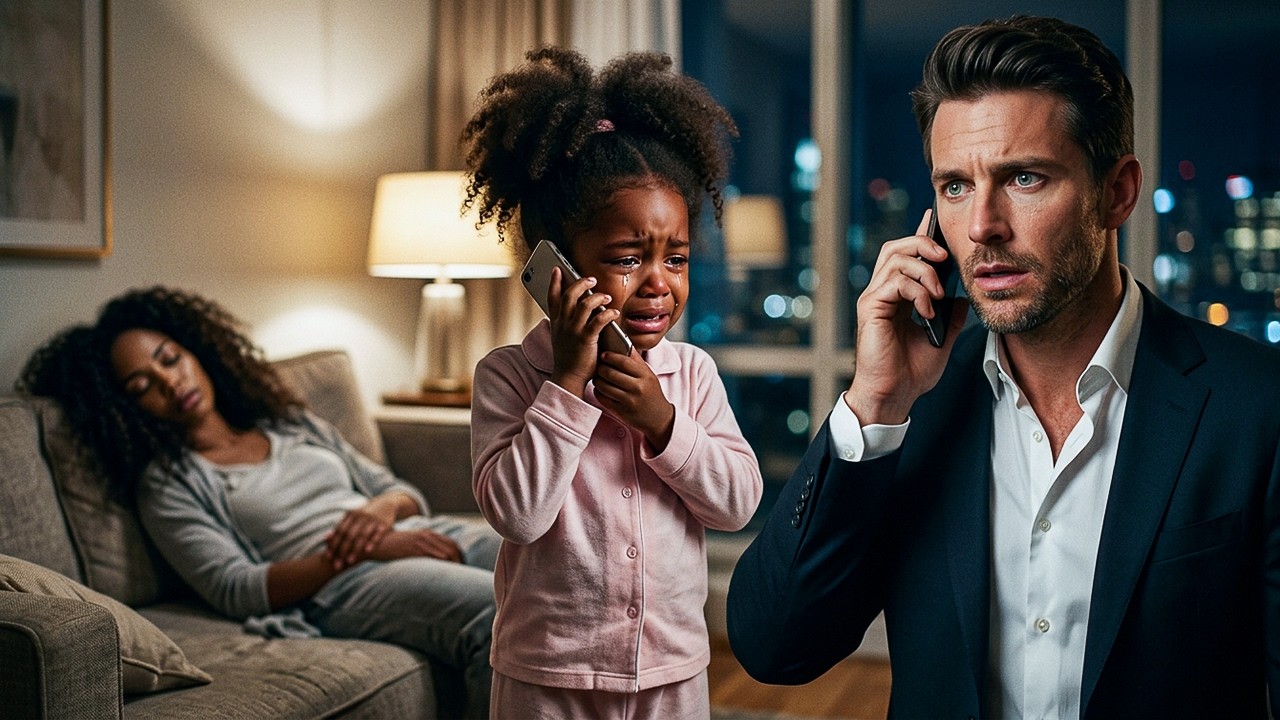
Then he heard breathing.
Small breathing.
Shaky. Uneven. Too close to the microphone.
Ethan sat up.
“Hello?”
A tiny voice came through.
“Is this… Ethan?”

The irritation left him before he understood why.
“Yes,” he said carefully. “Who is this?”
There was a wet sniffle. Then a whisper.
“My mommy won’t wake up.”
Ethan’s bare feet touched the floor.
Outside, the city was still gray, not yet morning, not quite night. Inside, the temperature-controlled air suddenly felt cold against his skin.
“What’s your name?” he asked.
“Lily.”
“How old are you, Lily?”
“Five.”
Ethan stood.
His entire schedule disappeared from his mind.
“Lily, where is your mommy right now?”
“In the kitchen.”
“Is she sitting? Standing? Lying down?”
“She fell.” Lily’s voice broke on the word. “She was making pancakes. Then the bowl fell. Then she fell too.”
Ethan moved quickly now, crossing the room toward the desk where his tablet, watch, and car keys sat in a neat row.
“Can you see her?”
“Yes.”
“Tell me exactly what you see.”
“She’s on the floor. Her hair is in the milk. I told her to get up because the pancakes are getting ruined, but she didn’t answer.”
Ethan gripped the back of his chair.
“Is she breathing?”
“I don’t know.”
“That’s okay. We’re going to check together. Do not shake her. Do not pull her. Stay on the phone with me.”
There was a rustling sound, then a tiny gasp.
“I’m scared.”
“I know,” Ethan said. “But you’re doing very well. I need you to be my helper for a minute. Can you go close to Mommy’s face without touching her?”
“I’m close.”
“Look at her chest or her tummy. Is it moving up and down?”
Silence.
Ethan heard the small sounds of a child trying to understand something no child should have to understand.
“I think… a little.”
“Good. That’s good. Is there blood anywhere?”
“No. Just milk.”
“Is the door locked?”
“I think so.”
“Are you alone in the house?”
“Yes.”
Ethan was already dialing emergency services from his desk phone while keeping Lily on speaker from his mobile.
When the dispatcher answered, he gave the facts with the precision that had built companies and closed billion-dollar deals.

Unresponsive adult female. Child alone. Possible collapse. Kitchen floor. Unknown medical cause.
Then the dispatcher asked for the address.
Ethan turned back to the phone.
“Lily, I need your address. Do you know it?”
“My mommy says I’m supposed to know it, but I forget when I’m scared.”
“That’s all right. Look around the kitchen. Is there paper on the fridge? A note? Anything with numbers?”
Another rustle. A chair scraping. A magnet clicking against metal.
“There’s a yellow paper.”
“Good. Can you read it to me?”
“I can read some words.”
“Read what you can.”
Lily breathed hard into the phone.
“It says… emergency. Mommy said if bad things happen, call nine-one-one. Then it says… call Ethan.”
Ethan went still.
The dispatcher’s voice continued through the desk phone, asking him to confirm location, but Ethan barely heard it.
“Lily,” he said slowly, “what does the paper say after my name?”
“Your number.”
His throat tightened.
“Does it say Mommy’s name?”
“Yes.”
“What is Mommy’s name?”
“Emma.”
The name hit him so hard that for one second, he forgot the child was listening.
Emma.
Not Emily. Not Ella. Not some stranger with a common name and a strange coincidence.
Emma.
A kitchen with pancakes. A little girl with his number on the fridge. A yellow emergency note written by a woman from a life Ethan had locked away so tightly he had convinced himself it no longer existed.
“Lily,” he said, quieter now, “what is your mommy’s last name?”
“Brooks.”
Ethan closed his eyes.
Emma Brooks.
The dispatcher’s voice sharpened. “Sir, do you have the address?”
Ethan forced air back into his lungs.
“Lily, read me the street if you can.”
“There are numbers first. One… seven… four. Then it says Harbor.”
Ethan’s head lifted.
Harbor.
No.
“Harbor Lane?” he asked.
“Yes. Harbor Lane. Blue house.”
The room seemed to tilt.
A blue house with a white porch.
A narrow street that smelled of salt and rain.
A cracked front step he had promised to fix one summer and never did.
Emma laughing at him from the porch swing with flour on her cheek because he had burned toast and claimed it was “rustic.”
Ethan gave the dispatcher the full address before Lily finished reading it. He knew the town. He knew the street. He knew the house.
He had once known the woman lying on the kitchen floor.
Help was on the way.
But Ethan was already moving.
He pulled on a shirt, grabbed his coat, and left the penthouse so fast the bedroom lights were still turning on behind him. The elevator opened to a private foyer. His driver was not scheduled for another three hours. Ethan didn’t wait.
He drove himself.
The city was waking in pale layers as his car cut through empty streets. In the cup holder, his phone remained on speaker.
“Lily,” he said, keeping his voice steady, “are you still near Mommy?”
“Yes.”
“You’re doing great. I want you to sit near the kitchen door, not too close to the stove. Can you do that?”
“The pancakes are still on.”
Ethan’s hands tightened on the wheel.
“Do not touch the stove. Is there smoke?”
“No.”
“Good. Stay away from it.”
“My mommy says I’m not allowed to touch hot things.”
“Your mommy is right.”
“Do you know my mommy?”
The question landed softly, which somehow made it worse.
Ethan stared at the road ahead.
“Yes,” he said after a moment. “I knew her a long time ago.”
“She said you were good.”
Ethan’s jaw clenched.
The word did not fit him comfortably.
Good.
He had been called brilliant. Ruthless. Disciplined. Visionary. Impossible. Difficult. Unreachable.
But good was a word from another life.
“What else did she say?” he asked before he could stop himself.
“She said if I ever got really scared and couldn’t find Aunt Claire, I should call Ethan because Ethan listens when it matters.”
A sound escaped him that was not quite a laugh and not quite pain.
Emma had once said that to his face.
You don’t listen when people talk, Ethan. You listen when things break.
He had been twenty-seven then. Ambitious in a way that made him feel chosen instead of selfish. Emma had run the bookstore on Cedar Street, the one with handwritten recommendations tucked under every shelf. He had lived above it for eight months while building his first company out of a borrowed office and a stubborn belief that sleep was optional.
She had brought him coffee when he forgot meals.
He had fixed her website after it crashed during a holiday sale.
They had shared cheap wine on the porch of that blue house while fog rolled off the water.
And then the investors came.
The city called.
The future opened.
Ethan left with a suitcase, a laptop, and a promise that distance was temporary.
The promise died quietly in a folder of unread messages.
“Does Mommy have a phone?” Ethan asked.
“It’s on the floor. It has milk on it.”
“Okay. Don’t touch it.”
“I tried before. It was slippery.”
“That’s okay. You did the right thing calling from the paper.”
“My mommy made me practice. She said brave doesn’t mean not crying. Brave means doing the next right thing while you’re crying.”
Ethan swallowed.
That was Emma too.
Not polished. Not dramatic. Just true.
He merged onto the coastal highway as the first hard line of sunrise cut across the horizon. The city fell behind him. Glass towers gave way to low buildings, then service stations, then the long gray road toward the sea.
The closer he got, the more the past stopped feeling like memory and started feeling like accusation.
He remembered Emma standing in front of him at the train station, hands in the pockets of her yellow coat.
“You’re leaving more than a town,” she had said.
He had kissed her forehead like tenderness could excuse cowardice.
“I’ll call tonight.”
He did not call that night.
He called three days later, from a hotel in Manhattan, between meetings, distracted and excited and already halfway gone.
They lasted four months after that.
Then one argument became three.
Three became silence.
Silence became years.
He told himself she deserved someone present. He told himself walking away was cleaner than dragging her through his ambition. He told himself a lot of things that sounded noble when no one was around to challenge them.
But Emma had kept his number.
Not in an old box.
Not buried in a diary.
On the refrigerator.
For emergencies.
“Lily,” he said, “do you hear anything outside?”
The phone shifted.
“I hear a loud car.”
“That might be the ambulance. Stay where you are.”
“It’s getting louder.”
“Good.”
“Mommy still won’t wake up.”
“I know. Help is almost there.”
“Are you coming too?”
Ethan looked at the speedometer and eased his foot down harder.
“Yes.”
“Do you know where my house is?”
“Yes.”
“How?”
He did not answer right away.
“Because I’ve been there before.”
“You have?”
“Yes.”
“Did you eat pancakes there?”
Ethan let out a breath.
“Once. A long time ago.”
“Were they good?”
“They were terrible,” he said.
Lily went silent.
Then, very softly, she said, “Mommy makes good pancakes now.”
A laugh caught in Ethan’s throat and broke there.
“I believe that.”
The siren grew louder through the phone.
Then came pounding.
Lily gasped.
“Someone’s at the door.”
“Lily, listen to me. Ask who it is.”
Her voice became very small. “Who is it?”
A muffled man’s voice answered. “Paramedics. We’re here to help your mom.”
Ethan gripped the wheel.
“Lily, do you see a lock on the door?”
“Yes.”
“Can you reach it?”
“I have to stand on the stool.”
“Move slowly. Keep the phone with you. Unlock the door, then step back.”
He heard the clatter of the phone being set down, the scrape of a stool, a small grunt, then the click of a lock.
The door opened.
Voices filled the kitchen.
Adult voices. Trained voices. Calm voices that knew how to make chaos smaller.
“Ma’am? Can you hear me?”
“Pulse present.”
“Possible seizure or hypoglycemic episode.”
“Child is here.”
“Lily, sweetheart, step over here with me.”
Ethan closed his eyes for half a second while driving, then opened them again immediately.
A paramedic picked up the phone.
“Who am I speaking with?”
“Ethan Cole. I called it in. I’m on my way.”
“Are you family?”
The question came without weight, routine and procedural.
Ethan’s answer did not come as quickly.
“I’m…” He stared at the road. “I’m someone she trusted enough to put on the emergency list.”
There was a pause.
“That’ll do for now,” the paramedic said. “She’s alive. We’re transporting her to St. Anne’s in Bayshore.”
Alive.
The word loosened something in Ethan’s chest.
“Is Lily going with her?”
“We’re checking. We’re trying to reach next of kin.”
“I’m twenty minutes out.”
Another pause.
“Mr. Cole?”
“Yes.”
“The child keeps asking for you.”
Ethan drove the rest of the way with both hands on the wheel and the past sitting beside him like a passenger he could no longer ignore.
Bayshore had not changed as much as it should have.
That was the first cruel thing.
The bakery still sat on the corner near the marina. The old theater sign still had one dead bulb in the letter R. The bookstore on Cedar Street had a new awning but the same crooked brick step.
He passed it too quickly and still saw everything.
A woman in a yellow coat.
A stack of books in the window.
Emma’s handwriting on a chalkboard: Stories are cheaper than therapy and sometimes better.
The blue house on Harbor Lane appeared at the end of the block with an ambulance in front of it and a police cruiser behind it.
The porch needed paint.
The swing was gone.
The front door stood open.
Ethan parked badly, half over the curb, and got out before the engine fully quieted.
A young police officer turned as he approached. “Sir, you can’t—”
“I’m Ethan Cole.”
The name did what names like his often did. It created a brief hesitation. Recognition. Calculation.
Before the officer could decide whether money mattered in a medical emergency, a little girl appeared in the doorway wearing pink pajamas with tiny clouds on them.
Her dark hair was tangled on one side. Her socks did not match. Her face was blotchy from crying.
She looked at Ethan as if she had been told about him in bedtime stories but had not expected him to be real.
“Ethan?”
He crouched immediately.
“Yes.”
She ran to him.
It was not graceful. It was not cinematic. It was a child moving toward the only familiar name in a morning full of strangers.
Ethan caught her carefully, one hand behind her back, the other bracing her small shoulder. She smelled like maple syrup and fear.
“My mommy went in the ambulance,” she said into his coat.
“I know.”
“They put things on her.”
“That’s to help her.”
“She didn’t say bye.”
Ethan closed his eyes.
“She’s getting help now.”
Lily pulled back and looked at him.
“You came.”
The words were simple.
They hit harder than any accusation ever had.
“Yes,” he said. “I came.”
Inside the kitchen, the bowl was still broken on the floor. Batter had spread under the table. A carton of milk lay on its side, empty now, white liquid dried along the grout lines.
On the refrigerator, held by a ladybug magnet, was the yellow paper.
Ethan saw his own name written in Emma’s handwriting.
Not typed.
Not copied from a contact list.
Written by hand.
In case of emergency: Call 911 first. Then call Ethan.
Underneath, in smaller letters, Emma had added:
He will know what to do.
Ethan stood in front of that paper for a long time.
A police officer cleared her throat gently. “Sir, do you know Ms. Brooks?”
“Yes.”
“How well?”
Ethan looked at the note again.
Not well enough, he thought.
Out loud, he said, “A long time ago, very well.”
The officer nodded toward the hallway. “We found medication in the bathroom. Looks like she may have had a medical condition. Do you know anything about that?”
“No.”
The answer ashamed him the moment it left his mouth.
He knew Emma’s favorite tea. He knew she hated carnations. He knew she reread the same three novels every winter and cried at one particular chapter every time.
But he did not know if she had been sick.
He did not know she had a daughter.
He did not know why his name was still on her fridge.
A neighbor arrived ten minutes later, breathless and wrapped in a cardigan.
“Lily,” she cried, dropping to her knees.
“Aunt Claire.”
The woman hugged the child tightly, then looked up at Ethan. Her face changed.
Not with confusion.
With recognition.
“You,” she said.
Ethan straightened.
Claire had been Emma’s best friend. Shorter hair now. Lines around her eyes. The same blunt stare.
“Claire,” he said.
She looked him up and down, taking in the tailored coat, the expensive watch, the man the magazines photographed but never knew.
“I wondered if she’d actually call you one day.”
“She didn’t,” Ethan said. “Lily did.”
Claire’s mouth tightened.
“Of course she did. Emma always prepared for the worst alone.”
That sentence found its mark.
Ethan did not defend himself.
Lily stood between them, holding the sleeve of his coat with one small fist.
Claire noticed.
Something in her expression softened, but only for the child.
“We need to go to the hospital,” she said.
“I’ll drive,” Ethan said.
Claire almost laughed.
“You think you can just walk back into this town, into this house, and drive us to the hospital?”
“No,” Ethan said. “I think Emma is there, Lily is scared, and my car is fastest.”
Claire stared at him.
For once, Ethan’s power did not impress anyone in the room.
Then Lily whispered, “Please.”
That ended the argument.
The drive to St. Anne’s took twelve minutes.
Claire sat in the back with Lily. Ethan drove in silence while the child leaned against her aunt’s side, clutching a stuffed rabbit someone had found on the sofa.
At the hospital, the waiting room smelled like disinfectant and burnt coffee. A television mounted in the corner played a morning news segment with no sound. Nurses moved through automatic doors with the urgency of people who had learned not to waste steps.
Ethan gave his name at the desk.
Again, recognition flickered.
Again, it did not matter.
Only one name mattered now.
Emma Brooks.
They waited.
Lily colored on a clipboard with crayons a nurse brought her. Claire made calls in a low voice. Ethan stood near the vending machines because sitting felt like pretending he had a right to be comfortable.
After forty minutes, a doctor came out.
“Family of Emma Brooks?”
Claire stood.
Lily looked up.
Ethan did not move until Claire glanced at him once, reluctantly allowing him into the circle.
The doctor explained that Emma had suffered a severe hypoglycemic episode complicated by exhaustion and dehydration. She was stable. Unconscious, but stable. They expected her to wake within hours.
Lily began crying again, this time from relief.
Claire covered her mouth.
Ethan turned away, pressing two fingers against his eyes, not to hide tears exactly, but to hold himself together before something inside him split open in public.
“She’ll be monitored closely,” the doctor said. “She’s lucky someone called quickly.”
Claire looked down at Lily.
Lily looked at Ethan.
And Ethan looked at the floor.
Because everyone in that hallway knew the truth.
A five-year-old had saved her mother because a woman Ethan once left behind had prepared her daughter to survive without depending on anyone.
Hours later, Emma woke.
Ethan was not in the room when it happened. Claire went in first. Then Lily.
Through the narrow window in the door, Ethan saw Lily climb carefully onto the bed and press her face into Emma’s shoulder. He saw Emma’s hand rise weakly and settle on her daughter’s back.
Then Claire said something.
Emma turned her head toward the door.
Their eyes met through the glass.
Ten years collapsed into one look.
Emma looked older, of course. So did he. But her eyes were the same steady brown, the same eyes that had once seen through every polished version of him.
She did not smile.
She did not look surprised.
That almost broke him more than anything.
A nurse opened the door.
“She says you can come in.”
Ethan entered slowly, like a man stepping into a room where he had once broken something and left before hearing it shatter.
Lily sat tucked beside Emma, holding her hand.
Claire stood near the window with her arms crossed.
Emma’s voice was rough when she spoke.
“You answered.”
Ethan nodded.
“I almost didn’t.”
Something moved across Emma’s face. Not anger. Not forgiveness.
Recognition.
“That sounds like you.”
He looked down.
“I’m sorry.”
Claire made a small sound from the window, but Emma lifted one finger without looking at her. Claire went silent.
Emma studied him.
“For what?”
The question was not soft.
Ethan could have chosen the easy apology. Sorry you got sick. Sorry this happened. Sorry Lily was scared.
But the yellow note on the refrigerator had followed him into the hospital.
“For leaving badly,” he said. “For telling myself silence was kindness. For becoming someone who could be reached by bankers, lawyers, and board members at any hour, but not by you.”
The room went quiet.
Lily looked between them, too young to understand the shape of the confession but old enough to feel its weight.
Emma closed her eyes for a moment.
When she opened them, there were tears there, but they did not fall.
“I stopped waiting a long time ago,” she said.
“I know.”
“No, Ethan. You don’t.” Her voice stayed calm, which made it harder to bear. “Waiting is active at first. You check your phone. You rewrite messages. You defend someone to your friends because they don’t understand him like you do. Then one day waiting becomes embarrassing. Then it becomes exhausting. Then it becomes something you bury because you need to keep living.”
Ethan stood beside the bed, silent.
Emma looked at Lily.
“And then you have a child, and everything you buried starts asking whether it can still hurt her.”
Ethan’s eyes moved to Lily.
There it was.
The thing he had not allowed himself to ask since the call.
The thing that had sat behind every mile, every memory, every breath.
Emma saw it.
So did Claire.
Lily was drawing circles on Emma’s blanket with one finger, unaware that the adults in the room had stepped onto the edge of a cliff.
Emma said, “She’s not yours.”
Ethan felt something inside him drop.
Claire looked away.
Emma’s face did not change.
“But you wondered,” she said.
He nodded once.
“Yes.”
“I knew you would.”
“Why keep my number?”
Emma looked toward the window, where late morning light washed the hospital wall.
“Because before you became Ethan Cole, the unreachable billionaire, you were the only person who ever stayed calm when the ceiling fell in.”
He remembered then.
Not metaphorically.
Actually.
The storm.
The bookstore.
The upstairs leak that burst through the ceiling during a winter gale, soaking half her inventory. He had spent six hours carrying books to dry places, calling contractors, making lists, keeping Emma from panicking as water ran down the walls.
At two in the morning, she had said, “You’re annoying, impossible, and emotionally constipated, but when disaster comes, you know exactly what to do.”
He had laughed.
She had not.
She had meant it.
Emma squeezed Lily’s hand.
“When I got diagnosed, I made emergency plans. Claire. The neighbors. 911. The school. And you. Not because I wanted you back. Not because I was waiting. Because Lily deserved every possible chance if something went wrong.”
Ethan looked at the child.
The twist was not that Lily was his daughter.
The twist was worse.
Emma had not called him out of love.
She had called on the best part of him because she no longer trusted the rest.
For the first time in years, Ethan Cole had no position to take. No negotiation to control. No room to command.
He had only the truth.
He had been useful in an emergency and absent in a life.
Lily looked up at him.
“Are you sad?”
Ethan crouched beside the bed, so his face was level with hers.
“Yes.”
“Because Mommy got sick?”
“Yes,” he said. “And because I should have visited your mommy a long time ago.”
Lily considered this with the seriousness only children can bring to simple facts.
“You can visit now.”
Claire’s eyes sharpened.
Emma’s hand stilled.
Ethan did not look away from Lily.
“Only if your mommy wants that.”
Lily turned to Emma.
“Do you?”
Emma’s lips pressed together. Her gaze moved from Lily to Ethan.
There was history in the room. Hurt. Pride. A thousand unsaid things stacked like boxes in a locked attic.
But there was also a yellow note on a refrigerator.
There was a child who had done the next right thing while crying.
And there was a man who had finally answered.
“We’ll start,” Emma said slowly, “with him fixing the porch step.”
Claire blinked.
Then she laughed once, unwillingly.
Ethan looked at Emma.
“The porch step?”
“It’s still cracked,” she said. “You promised.”
A small silence followed.
Then Ethan nodded.
“I did.”
“And no drivers. No assistants. No sending a contractor and calling it personal growth.”
For the first time that morning, Ethan almost smiled.
“I’ll fix it myself.”
Claire pointed at him from the window.
“I want witnesses.”
“You’ll have them,” Ethan said.
Emma leaned back against the pillow, exhausted but awake. Lily curled against her side, calmer now, the stuffed rabbit pressed under her chin.
Outside the room, hospital life continued. Wheels rolled. Phones rang. Someone laughed near the nurses’ station. Somewhere, another family was waiting for news that would change them.
Ethan stayed until visiting hours ended.
Not because anyone asked him to.
Because leaving was no longer the easiest thing he knew how to do.
Two days later, Emma came home.
By then, Ethan had already been to the hardware store.
The whole town seemed to hear about it before he parked on Harbor Lane. By noon, Claire was on the porch with coffee. Mrs. Alvarez from next door pretended to water plants she had already drowned. The mailman slowed down twice. Lily sat on the top step wearing a plastic construction helmet and holding a box of screws like she was supervising a skyscraper.
Ethan Cole, the man whose name appeared on financial news panels and skyscraper plaques, knelt in front of a cracked porch step in rolled-up sleeves and read the instructions on a repair kit.
Claire took one photo.
Then another.
“Insurance,” she said.
Emma stood inside the screen door, pale but smiling faintly.
“You’re doing it wrong,” she called.
Ethan looked up.
“You haven’t even seen what I’m doing.”
“I remember your bookshelf phase.”
Lily gasped.
“Did he break books?”
“No,” Emma said. “He built a shelf that leaned like it had secrets.”
Mrs. Alvarez laughed so loudly she stopped pretending to water the flowers.
Ethan looked at the porch, then at the three women watching him.
For most of his adult life, rooms had gone quiet when he entered.
This was different.
Here, people did not fear him. They did not need him. They were not impressed by the polished version of his life.
They were simply waiting to see whether his actions would match his words.
By late afternoon, the step was fixed.
Not perfectly.
But solid.
Lily tested it first, hopping on it three times.
“It works!”
Claire inspected it like a building official.
“It’ll do.”
Emma stepped onto it last.
Ethan stood at the bottom of the porch.
For one quiet second, no one spoke.
Emma looked down at the repaired step. Then at him.
In her eyes, he saw the moment she understood something had changed—not because he had apologized in a hospital room, not because he was rich, not because he could solve emergencies with a phone call, but because he had come back for something small when no one was dying.
That was the recognition that mattered.
Not dramatic.
Not loud.
Just a woman looking at a man she once loved and realizing he had finally learned the difference between showing up when disaster strikes and staying when life continues.
Ethan reached into his pocket and pulled out the old yellow note from the fridge.
Emma had let him replace it that morning with a new one.
This time, it had Claire first. 911. The doctor. The school.
And Ethan.
Still there.
But not as a ghost from the past.
As a person who had earned the right to answer again.
Lily leaned against Emma’s leg.
“Will Ethan come for pancakes?”
Emma looked at him.
Ethan looked at the house, the porch, the child, the woman who had survived him, survived illness, survived years of doing hard things without applause.
“I’d like that,” he said.
Emma lifted an eyebrow.
“You’re not allowed to judge them.”
“I would never.”
Claire snorted.
Lily pointed at him.
“And you have to answer the phone.”
Ethan crouched in front of her.
“I will.”
“Even early?”
He nodded.
“Especially early.”
Years later, Ethan would still remember that dawn call as the moment his life divided in two.
Before it, he believed control was strength.
After it, he understood that the people who trust you in an emergency are not asking for your power.
They are asking whether there is still a human being underneath it.
And sometimes, the call that interrupts your perfect life is the only one that can finally save it.