On the morning of November 30, 1941, the road out of Riga was almost silent.

Thousands of people moved through the freezing air in long, broken lines, their shoes scraping against the hard dirt, their breath rising in pale clouds. Mothers held children close. Elderly men stumbled forward with bundles tied in cloth. Some carried blankets. Some carried family photographs. Most carried nothing except the terrible knowledge that the people taken before them had not come back.
No one said the name of the place waiting ahead.
They only knew the direction.
Out toward the forest.
Out toward Rumbula.
At first, it looked like another forced relocation, another order in a city that had already learned to fear paper notices, boots on stairs, and voices in German outside apartment doors. But there was something different that morning. The guards were not rushing people toward a station. There were no trains visible in the distance. The road did not lead to work barracks or another crowded quarter.
It led away from the city.
And in occupied Riga, that meant something no one wanted to say aloud.
Only months earlier, in the summer of 1941, Latvia had been caught in the great tearing open of the Eastern Front. Germany launched Operation Barbarossa against the Soviet Union, and as the Red Army withdrew from Riga, power collapsed in the streets almost overnight. Offices emptied. Prisons opened or burned. Families hid what documents they could. People who had survived one occupation suddenly found themselves facing another.
Then the German army entered.

Behind the soldiers came other men, quieter men, organized men. They did not arrive only to hold territory. The SS security units that followed the front carried lists, orders, and a mission that was never meant to be temporary. In the language of the regime, they were hunting “racial enemies.” In practice, it meant neighbors, shopkeepers, doctors, teachers, children, and grandparents.
Riga’s Jewish community, one of the old communities of the Baltic, was trapped almost immediately.
The machinery did not appear all at once. It was assembled piece by piece, with uniforms, offices, local collaborators, and a steady lesson in fear. German commanders set the direction. SS and police structures enforced it. But the violence also needed local hands, local streets, local knowledge.
That was where men like Viktors Arājs entered the story.
Arājs was not the most powerful man in Latvia. He did not command armies. He did not write the ideology that made murder sound like administration. But he understood the new order quickly. Under German authority, his unit, later known as the Arājs Kommando, became one of the instruments through which terror was made local. They knew the language. They knew the neighborhoods. They knew which doors to knock on.
And the city began to change.
Jewish residents were marked, restricted, humiliated, and pushed out of ordinary life one order at a time. Rights disappeared first. Then property. Then movement. Then safety.
On July 4, 1941, the Great Choral Synagogue of Riga was set on fire.
For many who watched, that day became a warning that the old world was not simply being controlled. It was being erased. Flames climbed through a building that had once held prayers, weddings, funerals, and voices raised in song. People nearby understood that a synagogue was not only wood and stone. It was memory. It was identity. It was proof that a community had belonged somewhere.
By autumn, the Riga Ghetto had become a cage.
Families were crowded behind fences and guarded streets. Hunger sharpened faces. Rumors traveled faster than food. People whispered about shootings outside the city, about pits in forests, about trucks leaving full and returning empty. Every rumor sounded impossible at first. Then another family disappeared. Then another.
Still, many tried to survive by doing what people do when the world becomes unbearable: they focused on the next hour. Find bread. Keep the children warm. Hide a watch. Save a photograph. Remember a name.
But above them, decisions were being made.
The German authorities wanted the ghetto emptied. Space was needed. Orders had come. The killing system that had already moved across the Baltic was now turning toward Riga at full scale.
So on November 30, before dawn, the doors began to open.
Not gently.
Boots hit stairways. Voices shouted. Families were forced into the streets with whatever they could grab in minutes. The cold did not wait for anyone to dress properly. Children cried because they were tired, because they were frightened, because adults who usually had answers suddenly had none.
The column began moving.
Past buildings where curtains shifted and quickly fell back.
Past corners where guards stood with weapons.
Past the edge of the city, where the road widened and the silence grew heavier.
Somewhere ahead, in the Rumbula forest, preparations had already been made.
And by the time the first people saw the trees, the truth was close enough to hear.
[Confirm to continue Part 2]
Part 2 began before most of Riga was fully awake.
The order had not been announced as a death sentence. It was written and enforced like an evacuation. People in the ghetto were told to prepare, to gather, to move. That was how the machinery worked best: not by revealing the final destination, but by giving each victim one more instruction to obey.
Stand in the street.
Bring only what you can carry.
Walk.
Anyone too weak to walk was treated as a problem to be removed immediately.
That morning, the ghetto was no longer a neighborhood of frightened families. It became a sorting ground. German SS men and police units moved through the streets with Latvian auxiliaries. Doors were kicked open. Rooms were searched. People were dragged from beds. The elderly, the sick, and small children who slowed the process were beaten, shot, or forced into the same columns as everyone else.
There was no space left for illusion.
The violence was not chaotic. That was what made it more terrifying. It had rhythm. It had routes. It had men assigned to drive people forward and other men assigned to search for those hiding behind walls, under beds, in cellars, anywhere a human being could fold themselves small enough to hope.
Viktors Arājs and members of the Arājs Kommando were part of that local engine of terror. They were not strangers lost in an unfamiliar city. They understood the streets. They knew which courtyards connected to which stairwells. They knew how fear sounded in Latvian, Russian, German, and Yiddish. Under German command, their usefulness was simple and devastating: they made occupation personal.
In one apartment, a woman tried to delay the guards by saying her mother could not walk.
A rifle butt answered her.
In another, a father wrapped his little boy’s feet in cloth because the child’s shoes had disappeared in the confusion. He had no time to tie them properly. He lifted the boy, carried him down the stairs, and stepped into a street already full of people being pushed forward.
The column grew block by block.
People did not walk as individuals anymore. They became a moving mass of coats, bundles, trembling hands, and faces turned toward the ground. Guards shouted whenever the line slowed. Those who fell risked being shot where they lay. The purpose was not only to move people out of the ghetto. It was to break them before they arrived.
Witnesses in Riga later remembered the sound.
Not one sound, but many layered together.
Boots on frozen ground. Wheels creaking. Children crying. German commands. Latvian voices. The dull crack of gunfire from behind the line when someone collapsed or resisted. Then silence from everyone who still had enough strength to keep walking.
The road to Rumbula was several miles long, but distance was only part of the cruelty. The route was designed to exhaust. The weather helped the killers. The cold pressed into thin coats. Feet went numb. Elderly people leaned on sons and daughters until the guards forced them apart. Mothers carried babies until their arms shook. People who had spent weeks hungry in the ghetto were now driven forward under threat of death.
And still, some tried to protect each other.
A young woman tightened her scarf around her younger sister’s neck when the child began shaking. An old man gave his gloves to a boy he did not know. A mother whispered to her daughter not to look at the guards, only at her sleeve, only at the sleeve, keep walking, keep walking.
Small acts of love survived even there.
That was one of the things the murderers never fully understood.
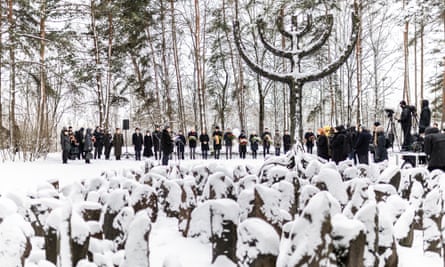
By the time the first columns approached the forest, the operation had already been prepared with administrative care. Rumbula was not chosen at random. It lay outside the city, away from the center of civilian life but close enough for mass transport by foot. Pits had been dug in advance. Units had been placed along the route. Guards had been positioned to prevent escape.
Everything that followed was meant to be efficient.
At the edge of the killing site, the final deception fell away.
People were ordered to remove outer clothing. Then more. Coats, shoes, scarves, watches, rings, documents, photographs — the last physical traces of ordinary life were stripped away and piled under guard. Items that had been held with desperate care since dawn were suddenly meaningless in the hands of men who saw every possession as loot before death.
Some still did not understand.
Or perhaps they understood and the mind refused to accept it.
A man asked where the work camp was.
No one answered.
A woman asked whether the children should keep their shoes because of the cold.
A guard laughed.
The line moved again, but now it was no longer a road. It was a funnel. People were forced toward the pits in smaller groups. They heard gunfire before they saw its source. They saw faces ahead change as the truth reached them. One person stopped. Another screamed. A guard shoved them forward.
Behind them, more columns were still coming from Riga.
This was the scale of it. Not a single burst of violence. Not an uncontrolled massacre by men who had lost discipline. It was organized killing, carried out in waves, sustained by command structures, logistics, and the cooperation of men who chose to participate.
Inside Riga, those who were not taken in the first sweep waited in terror.
Some hid in attics or behind false walls. Some listened from behind locked doors as the ghetto emptied around them. Every sound from the street became a message. A truck passing. A shout. A shot. Then the absence of voices.
That absence was worse.
Because a city can sometimes pretend not to see a crime while it is happening. But it cannot pretend not to notice when thousands of people vanish from its streets.
By evening, the first day of killing had already turned Rumbula into one of the darkest names in the history of occupied Europe. Yet the operation was not finished. The machinery had not reached its full appetite. More people remained in the ghetto. More orders would follow. More columns would be formed.
And among those still trapped behind the fences, a terrible realization began to spread.
The people taken that morning were not being relocated.
They were being erased….