The first time Marcus Johnson learned how cold the world could be, he was ten years old.

Not the kind of cold that makes people pull their coats tighter and hurry home. Not the kind that disappears once you step inside a warm room. This was Detroit in late January, the kind of winter that pressed its hands against your ribs and stayed there. Snow had been falling since before sunrise, turning sidewalks into gray slush and making the wind feel like broken glass.
Marcus had been walking for nearly two hours.
His coat was too small, torn beneath one arm, and the zipper had stopped working sometime the previous week. He kept one hand tucked inside it, trying to hold the fabric closed, while the other gripped a plastic grocery bag with nothing inside. His shoes were wet. His socks were worse. Every few steps, he told himself not to think about his feet because thinking made the pain sharper.
His little brother, Andre, was waiting for him in an abandoned factory six blocks away.
Andre was seven. He had a cough that sounded deeper than it should have, and that morning he had asked Marcus, in a voice that tried to be brave, “You think we’ll eat today?”
Marcus had said yes.
He had no idea how.
Their mother had disappeared three days earlier after leaving to “find help.” Their father was a memory Marcus barely knew how to carry. The factory had become the closest thing to shelter because one side of the loading dock still had a roof, and behind a stack of broken pallets, the wind didn’t hit quite as hard.
That was where Andre was waiting.
So Marcus kept walking.
He tried the back door of a bakery first, but a man in a white apron shouted before Marcus could get a full sentence out.
“Get away from here. We’re not running a charity.”
At a gas station, a woman behind the counter looked at his coat, then at his face, and slid the little window shut before he could ask whether they had anything they were going to throw away.
Outside a convenience store on Gratiot Avenue, Marcus stood for almost ten minutes watching people go in and out. They came out carrying coffee, chips, cigarettes, small bags of food they barely noticed. He waited until a man in a red parka pushed the door open, then slipped inside behind him, hoping only for a few minutes of warmth.
The heat hit him so suddenly his eyes watered.
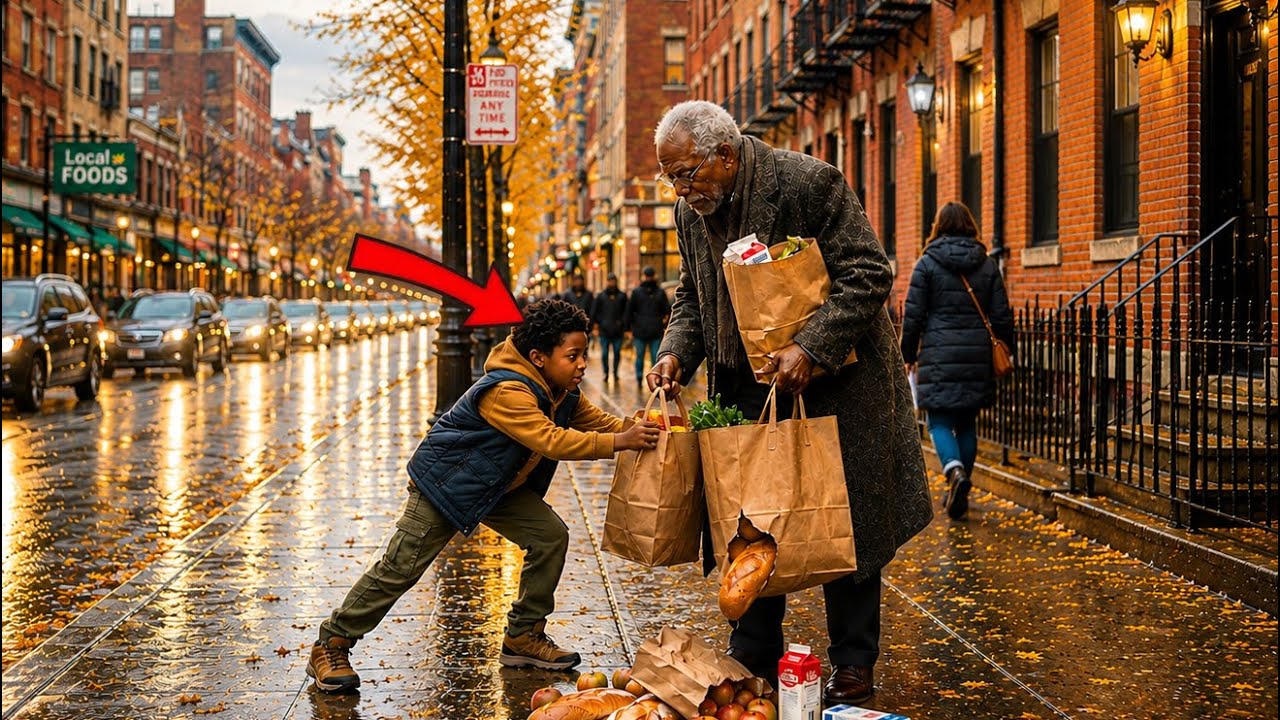
He stood by the candy rack, not touching anything, trying to stop his teeth from chattering. The smell of hot dogs turning under the warmer made his stomach cramp so hard he bent forward.
“Hey.”
Marcus looked up.
The store manager was coming toward him from behind the counter, a thick man with a trimmed beard and a face already set in irritation.
“You buying something?”
Marcus swallowed. “No, sir. I just—”
“Then out.”
“It’s cold outside.”
“Not my problem.”
A couple near the soda fridge glanced over, then looked away. One of them gave a short laugh under his breath, the kind people make when someone else’s pain makes them uncomfortable and they want to pretend it’s funny.
Marcus stepped backward. “Can I just stand here for a minute?”
The manager pointed at the door.
“Out. Now.”
Marcus went.
The wind slapped him the second he stepped outside. For a moment he stood beneath the store awning, holding the empty plastic bag, staring at the traffic crawling through the snow. Cars moved past with headlights glowing yellow in the storm. Inside them, people sat warm, sealed away from him as if he were something on the other side of glass.
Then he saw a man in a dark wool coat come out of the convenience store holding a paper bag.
The man wore polished shoes and leather gloves. He was tall, clean, important-looking in a way Marcus had learned to recognize. Adults like that rarely saw children like him, but hunger makes a person try things pride would never allow.
Marcus walked toward him.
“Sir?”

The man didn’t stop.
“Sir, please. Do you have any food? Just a piece of bread or something?”
The man glanced down for half a second. His eyes moved over Marcus’s torn coat, wet shoes, hollow face.
Then he looked away.
“I don’t carry cash,” he said, though Marcus hadn’t asked for money.
He climbed into a black sedan and shut the door. A moment later, the car pulled off, tires slicing through the dirty snow.
Marcus stood there long after it left.
Something inside him went very quiet.
He had been hungry before. He had been cold before. He had been scared more times than he could count. But standing outside that store, with the smell of food still clinging to his clothes and nobody willing to look at him for more than a second, Marcus felt a thought settle in his chest with terrifying calm.
Maybe nobody would care if he disappeared.
Maybe he and Andre could vanish into the winter, and the city would keep moving. The buses would keep running. The store lights would stay on. People would still buy coffee, laugh into their phones, complain about the weather.
And no one would know their names.
Marcus slid down against the brick wall beside the store and pulled his knees to his chest. He tried to cry, but even that seemed to take more strength than he had left. His fingers had gone stiff. His stomach had stopped growling and now only burned.
That was when a voice beside him said, “Baby, what’s your name?”
Marcus flinched.
A woman had stopped in front of him. She was Black, maybe in her late thirties, wearing a plain brown coat and a knitted gray hat dusted with snow. She didn’t look rich. Her boots were worn at the edges, and one of her gloves had been mended with dark thread. In one hand, she held a folded bus schedule. In the other, a small purse.
But she was looking directly at him.
Not through him.
At him.
Marcus hesitated. “Marcus.”
The woman slowly lowered herself until she was crouching at his level. Not standing over him. Not scolding. Not asking where his parents were in that sharp tone adults used when they already believed the worst.
“Marcus,” she repeated gently. “When was the last time you ate?”
He tried to answer quickly. He wanted to sound stronger than he felt.
“Yesterday.”
The woman’s eyes changed.
“Marcus.”
He looked down.
“Two days,” he whispered. Then, after a pause, “Maybe three.”
Snow collected on the shoulders of her coat. For a second, she said nothing. Then she opened her purse.
Marcus saw almost nothing inside. A pack of tissues. A bus pass. A small bottle of aspirin. A folded photograph. A few bills pressed flat against the lining.
She looked at the money for a moment.
It was not the look of someone deciding whether a child deserved help.
It was the look of someone calculating what she could go without.
Then she stood and held out her hand.
“Come on.”
Marcus didn’t move. People had said “come on” to him before, and it usually meant they were about to move him away from somewhere.
The woman seemed to understand.
“My name is Sophia,” she said. “I’m going to get you something hot to eat.”
Inside the convenience store, the manager opened his mouth when he saw Marcus return. Sophia turned her head and looked at him once. She didn’t raise her voice. She didn’t threaten him. She simply looked at him with a firmness that made the words die in his throat.
She bought a hot sandwich, a cup of chicken soup, a small carton of orange juice, a packet of cookies, and a hot chocolate so warm Marcus had to hold it with both hands through the paper sleeve.
They sat outside under the awning because Marcus was too afraid to sit inside.
At first he tried to eat slowly. He thought that was what polite people did. But after the first bite of the sandwich, his body took over. He shook as he chewed. Not from the cold anymore, but from the shock of being fed. The soup burned his tongue, and he didn’t care. The hot chocolate made his eyes fill before he could stop it.
Sophia noticed him wrapping half the sandwich back in its paper.
“You don’t like it?” she asked softly.
Marcus shook his head fast. “No, ma’am. I do.”
“Then why are you saving it?”
He held the sandwich tighter.
“My brother.”
Sophia became very still.
Marcus looked away, ashamed for reasons he could not explain. “He’s seven. He’s waiting for me. I told him I’d bring something.”
For a moment, the only sound was traffic and the wind pushing snow across the sidewalk.
Then Sophia stood up.
Marcus looked at her purse. He had already seen what was inside. He knew there couldn’t be much left. Maybe nothing. He started to say it was okay, that Andre could have his half, that he didn’t need more.
But Sophia was already walking back into the store.
This time, she bought another sandwich. Another soup. Another juice. More cookies. The manager rang everything up without making eye contact.
When Sophia returned, she placed the second bag carefully into Marcus’s hands.
“This one is for Andre.”
Marcus stared at it.
He was ten years old, but in that moment he understood something many grown people never do. He understood that kindness from someone who has plenty is good, but kindness from someone who has almost nothing costs something different. Sophia had not given him leftovers. She had not given him spare change.
She had given him what she needed.
His face crumpled before he could stop it.
He cried then. Hard. Quiet at first, then with his whole body, his shoulders shaking beneath the torn coat. Sophia sat beside him and put one arm around him, not asking him to stop, not telling him to be strong.
Marcus held the food bag against his chest like it was something sacred.
“I’ll pay you back,” he said through tears.
Sophia smiled, but her eyes were wet too. “You don’t owe me anything, baby.”
“I do.” He wiped his face with the back of his hand. “One day, I’m gonna come back. I’m gonna find you, and I’m gonna thank you for real.”
Sophia studied him for a long second. The wind tugged at the edge of her hat. Snowflakes melted on her cheeks.
Then she reached out and squeezed his hand.
“Then you make sure you live long enough to do that, Marcus Johnson.”
He nodded.
“And when you get the chance,” she added, “you help somebody else before the world teaches you not to.”
Marcus never forgot those words.
He picked up both bags of food, tucked them inside his coat to keep them warm, and stood. His legs were still weak, but something in him had shifted. The city had not changed. The snow was still falling. The wind was still cruel. Andre was still waiting in a freezing factory with an empty stomach.
But now Marcus had proof.
Somebody had seen him.
He looked back once before he ran. Sophia stood beneath the awning, one hand raised, her small purse tucked under her arm, watching him disappear into the storm.
Marcus ran through the snow as fast as his wet shoes would let him, carrying hot food for his brother and a promise he did not yet understand would shape the rest of his life.
For years after that winter afternoon, Marcus Johnson measured his life in small victories.
A dry pair of socks.
A sandwich that did not have to be split exactly in half.
A night when Andre slept without coughing.
A morning when nobody told them to move along.
The world did not become kinder because Sophia had been kind once. Detroit did not soften around them. The abandoned factory was eventually boarded up, then fenced off, then swallowed by another developer’s plan that never fully happened. Marcus and Andre moved from one temporary place to another, sometimes with distant relatives, sometimes in shelters, sometimes in rooms where the heat worked only when someone remembered to pay the bill.
But Marcus carried Sophia’s words like a match in his pocket.
You help somebody else before the world teaches you not to.
He didn’t repeat them out loud. He wasn’t that kind of boy. Marcus was quiet, observant, the sort of kid adults underestimated because he rarely argued. But when the hunger got bad, when someone laughed at his shoes, when a teacher asked him why he kept falling asleep in class as if exhaustion were a personal failure, he would think of a woman in a brown coat counting her last bills in a convenience store.
And he would keep going.
By thirteen, Marcus was washing windshields near a gas station until the owner chased him off.
By fourteen, he was collecting cans from alleys before school.
By fifteen, he was carrying boxes at a small grocery on weekends, paid in cash and sometimes in dented cans the owner couldn’t sell.
By sixteen, he was bussing tables at a diner after closing, wiping up coffee rings and scraping plates into black trash bags while Andre did homework in a back booth under fluorescent lights.
Almost every dollar Marcus earned had a direction before it touched his hand. Rent. Food. Andre’s school supplies. Medicine when the cough came back. Bus fare. Laundry. A used winter coat. A pair of shoes without holes.
He never said he was tired.
Andre knew anyway.
“You don’t gotta do all this,” Andre told him one night behind the diner, watching Marcus rinse mop water from a bucket with cracked red hands.
Marcus looked at him. Andre was taller now, still thin, still carrying that old factory winter somewhere in his bones.
“Yes, I do,” Marcus said.
That was the whole conversation.
The summer Marcus turned seventeen, rain came down for three straight days and turned the alleys behind the supermarket into rivers of dirty water. He had picked up a few hours hauling flattened cardboard into a recycling bin behind the building. It was miserable work, but the assistant manager paid cash at the end of the shift and sometimes let him take bruised apples from the produce crate.
Marcus worked with his hood pulled low, stacking wet cardboard until his sleeves clung to his arms. The rain made everything heavier. By the time the last stack was done, his back ached and his palms were raw.
That was when he saw the wallet.
It was half-hidden beneath a soggy produce box near the loading dock, dark leather, expensive-looking, the kind of thing Marcus had only seen in the hands of men who never checked prices before buying something.
He picked it up and looked around.
The alley was empty.
No cameras pointed toward the cardboard bins. The back door had closed behind the stock clerk. Traffic hissed beyond the alley entrance, but nobody was looking at him.
Marcus opened the wallet.
For a moment, he forgot the rain.
There were thick bills inside. Twenties. Fifties. Hundreds. More cash than Marcus had ever held in his life. Behind the cash were credit cards, a driver’s license, a business card with embossed letters, and a small photograph of a little girl missing two front teeth.
Marcus stood under the dripping awning with the wallet open in his hand.
The money was enough to change everything for a while.
Not forever. Marcus knew better than to dream that big. But it could pay the overdue electric bill. It could buy groceries that didn’t come from clearance shelves. It could get Andre a doctor’s appointment without waiting until things became an emergency. It could buy time.
Time was the one thing poor people were always trying to purchase in pieces.
He closed the wallet and shoved it into his jacket.
At home, Andre saw his face before Marcus said a word.
Their room was on the second floor of a house split into rentals, with thin walls and a radiator that knocked like somebody trapped inside it. A single lamp sat on the floor because the table had broken months earlier. Andre was at the window, doing math homework on the sill.
“What happened?” Andre asked.
Marcus took out the wallet and set it on the mattress.
Andre stared.
Then he opened it.
His eyes widened slowly, not with greed at first, but with disbelief. He counted the money twice. Then a third time.
“Marcus,” he whispered. “This is over nine hundred dollars.”
Marcus said nothing.
Andre looked toward the door, then back at him. “Where’d you find it?”
“Behind the supermarket.”
“Anybody see you?”
“No.”
The rain tapped against the window.
Andre sat down on the edge of the mattress, the wallet in his hands. He was fourteen then, old enough to understand bills, hunger, and how often good choices came with bad consequences.
“We could use this,” he said carefully.
Marcus leaned against the wall.
Andre’s voice got smaller. “I’m not saying steal. I’m just saying… people like this probably have insurance or credit cards or whatever. Look at that wallet. Whoever owns it isn’t missing meals.”
Marcus looked at the photograph tucked behind the license. The little girl with missing teeth was smiling in a backyard somewhere, holding a purple balloon.
Andre kept going, and Marcus could hear shame fighting with desperation in every word.
“The landlord came again today. Said Friday is the last day. And my inhaler is almost empty. You said you’d figure it out, but maybe this is it. Maybe this is how.”
Marcus closed his eyes.
That was the part nobody understood about poverty unless they had lived close enough to hear it breathe. It did not always ask you to do something evil. Sometimes it asked you to do something understandable. Something quiet. Something nobody would ever know about.
It whispered in practical terms.
Nobody saw.
You need it more.
The world never gave you anything.
For a long minute, Marcus let himself imagine it.
He imagined paying the landlord before the man could pound on the door again. He imagined Andre sleeping with medicine beside the bed. He imagined walking into a grocery store and buying food without counting coins in his palm. He imagined one week—just one week—without the constant fear of the next thing breaking.
Then he saw Sophia.
Not like a dream. Not dramatic. Just a memory sharp enough to hurt.
Her standing under the awning, opening a purse that had almost nothing inside.
Her buying food for a boy she did not know.
Her saying, You don’t owe me anything.
Marcus opened his eyes.
Andre watched him, already knowing the answer and hating it.
“We have to return it,” Marcus said.
Andre’s mouth tightened. “You always do this.”
“Do what?”
“Act like being good is gonna save us.”
Marcus did not answer right away. He picked up the wallet and wiped rainwater from the leather with his sleeve.
“Maybe it won’t save us,” he said. “But I’m not letting the world decide who we become.”
Andre looked away.
The address on the driver’s license led Marcus to a brick house near East English Village, the kind with trimmed hedges, a security light, and a porch that had clearly been painted on purpose. Marcus walked there in the rain because bus fare had gone toward milk the day before.
He almost turned back twice.
Not because he wanted the money now, but because houses like that made him feel like he didn’t belong on the sidewalk in front of them. He imagined someone opening the door and accusing him before he could explain. He imagined police. He imagined laughter.
Still, he climbed the porch steps and knocked.
A woman opened the door, mid-forties, wearing a navy cardigan and the tired expression of someone interrupted during a problem. Her eyes dropped immediately to Marcus’s shoes, then to his damp hoodie.
“Yes?”
Marcus held out the wallet.
“I found this behind the supermarket on Mack Avenue. The address was inside.”
The woman stared at it.
Then she snatched it from his hand and opened it, counting quickly. Her breathing changed when she saw the cash was still there.
“Harold!” she called over her shoulder. “He found it.”
A man appeared behind her, the owner of the wallet. Broad shoulders, silver watch, phone in one hand. He looked at Marcus as if trying to decide what kind of story this was.
“You took anything?” the man asked.
The question hit harder than Marcus expected.
“No, sir.”
The man counted anyway.
Marcus stood on the porch with rainwater dripping from his sleeves, watching a stranger confirm his honesty dollar by dollar.
The woman saw the photograph had not been moved. Something softened in her face.
“Everything’s here,” she said quietly.
The man looked up. For the first time, he seemed almost embarrassed.
“You walked all the way here?”
Marcus nodded.
“In this weather?”
“Yes, sir.”
The man glanced at his wife. Then he pulled two hundred-dollar bills from the wallet and held them out.
Marcus froze.
“Take it,” the man said. “Reward.”
Marcus looked at the money.
Two hundred dollars would solve three problems by morning. Maybe four.
But there was something in the man’s tone that made the money feel less like gratitude and more like a way to close the door quickly.
Marcus shook his head.
“I didn’t bring it back for that.”
The man frowned, confused.
The woman stepped forward. “What’s your name?”
“Marcus Johnson.”
She repeated it, as if committing it somewhere. “Marcus, wait here.”
She disappeared into the house. The man remained by the door, uncomfortable now, shifting his weight. Neither of them spoke.
When the woman returned, she was holding a grocery bag.
Not leftovers. Not scraps.
A full bag.
Bread, peanut butter, canned soup, apples, instant oatmeal, and a box of crackers. She also held a business card, but unlike the one in the wallet, this one had a handwritten number on the back.
“My brother owns an auto repair shop,” she said. “They need someone after school to clean, organize parts, maybe help with basic work if you’re willing to learn. It’s not much at first.”
Marcus stared at the card.
“It’s honest work,” she added. “And from the look of you, you’re not afraid of that.”
Marcus took the bag with both hands.
For the second time in his life, a simple bag of food felt heavier than it should have.
The man cleared his throat. “I’m sorry about what I asked.”
Marcus nodded once.
He didn’t know what to do with apologies yet.
That job at the repair shop changed the direction of Marcus’s life.
Not all at once. Life rarely changes like a movie. He still got hungry. He still wore shoes too long after they should have been thrown away. He still studied late under weak light while Andre slept a few feet away. But the shop gave him something poverty had tried to keep from him.
A skill.
The owner, Mr. Alvarez, was a patient man with oil permanently worked into the lines of his hands. He noticed that Marcus watched more than he talked. He noticed that Marcus remembered where every tool belonged after being shown once. He noticed that the boy stayed late without being asked, sweeping floors so clean they shone under the shop lights.
One evening, when Marcus was wiping down a workbench, Mr. Alvarez tossed him a pair of gloves.
“Come here,” he said. “You’re gonna learn how to change brake pads.”
Marcus looked behind him, as if there might be another person in the room.
Mr. Alvarez laughed. “I’m talking to you.”
From that day on, Marcus learned everything he could.
He learned engines by sound. He learned which customers were honest, which ones were desperate, and which ones thought a young Black kid in stained work pants couldn’t possibly understand what they were saying. He learned to stay calm when men twice his age talked down to him. He learned that anger could waste energy he needed for something better.
And every Friday, when he got paid, he put money in three places.
Bills.
Andre.
A small envelope inside a shoebox.
On the outside of that envelope, in handwriting only he ever saw, Marcus had written one word.
Sophia.
He still did not know her last name. He did not know where she lived. He did not know whether she had children, whether she was still in Detroit, whether she even remembered the boy under the convenience store awning.
But he remembered.
Years passed.
Marcus finished high school with grease under his fingernails and homework done during lunch breaks. Andre’s health improved. The landlord stopped knocking because rent started arriving on time. The shoebox envelope grew slowly, painfully, ten dollars here, five dollars there, sometimes emptied during emergencies and started again from nothing.
Marcus never stopped rebuilding it.
By twenty-one, he was working full-time at the shop and taking night classes in business administration at a community college.
By twenty-four, he was managing inventory, talking to suppliers, training new hires, and noticing how many good workers never got promoted because nobody had ever taught them how to step into a room with confidence.
By twenty-seven, he opened a small mobile repair service with a used van, borrowed tools, and a reputation for showing up when he said he would.
People trusted Marcus because he did not oversell. He did not talk fast. He explained the problem, gave the price, and did the work right.
That was enough.
By thirty-two, Johnson Fleet Services had twelve employees and contracts with local delivery companies. By thirty-six, it had expanded into logistics maintenance, vehicle inspections, and commercial repair. Marcus wore clean shirts now. He sat in meetings with people who used words like “partnership” and “scale.” He had an office with glass walls and a receptionist who still found it funny that the CEO preferred eating lunch with the mechanics.
But the envelope never left his desk.
It was no longer made of paper. It had become a private account, then a foundation fund, then a quiet mission Marcus rarely discussed. The first file in that fund had a name typed across the top.
SOPHIA PROJECT.
He had hired people to search old records. He checked shelter volunteer lists, church outreach groups, public assistance offices, neighborhood directories. He visited the convenience store once, years later, but it had become a vape shop with new owners who knew nothing about a woman in a brown coat.
Still, Marcus kept looking.
Because some promises do not fade with time.
They wait.
And Marcus had no idea that the woman he had been searching for was much closer than he thought.