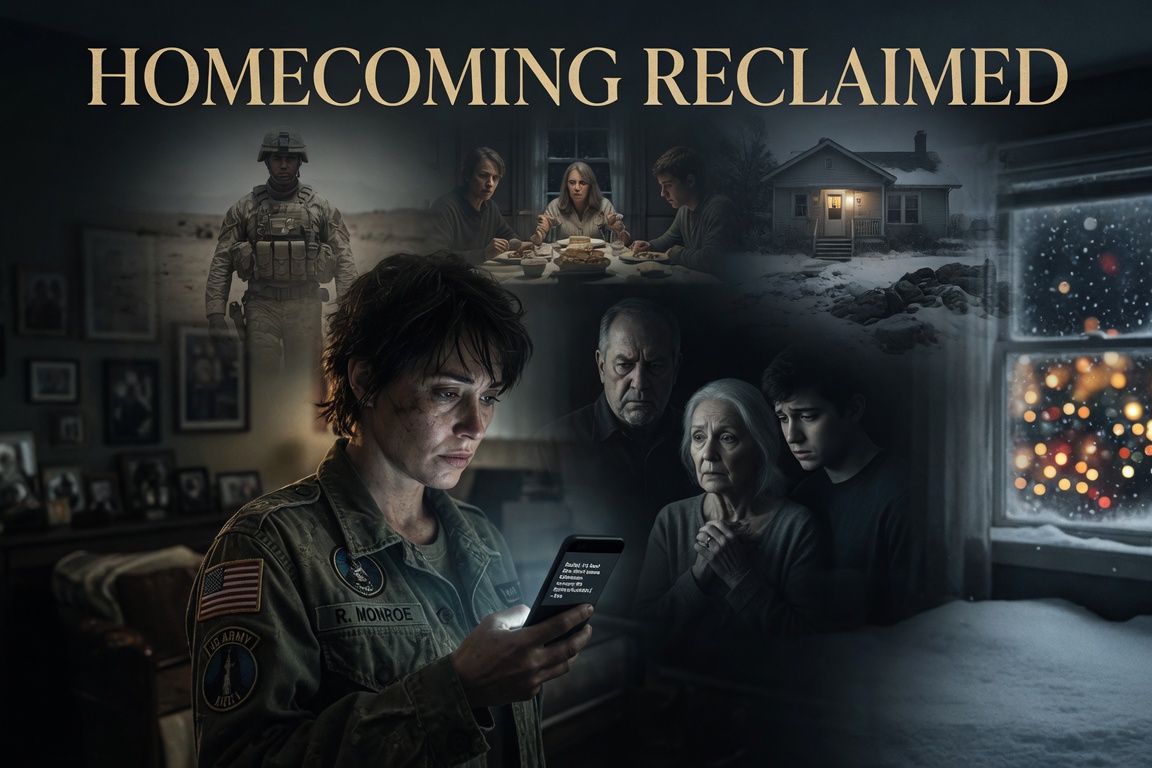
The message came while Captain Elise Monroe was sitting beneath a plastic Christmas wreath in the military lounge at Denver International Airport, watching snow erase the runway one white sheet at a time.
Her duffel sat between her boots. Her dress uniform hung in a black garment bag over the chair beside her. In her lap was a small blue box wrapped with silver ribbon—her father’s Christmas gift.
Inside it was her mother’s old firehouse medal, restored.
Elise had spent six months tracking it down after it disappeared from a drawer in the house where she grew up. A jeweler in Colorado Springs had cleaned the smoke-stained bronze, repaired the clasp, and polished the engraved name until the letters shone again.
MARGARET MONROE.
Her mother had worn that medal once, standing beside Harold Monroe outside Station 12, both of them younger, both of them laughing in a photograph Elise used to keep folded inside her field notebook.
Now her father’s name lit up her phone.
Dad.
For one foolish second, Elise smiled.
Then she opened the message.
Don’t come home in uniform. Caleb deserves one peaceful Christmas without your shadow. If you need to visit, come after New Year’s.
The airport noise thinned.
A child nearby squealed over a candy cane. A woman in a red sweater laughed into her phone. Somewhere overhead, a speaker played “Have Yourself a Merry Little Christmas” too softly to comfort anyone.
Elise read the message again.
Her thumb hovered over the keyboard.
I already bought the ticket.
Delete.
What did I do?
Delete.
I haven’t been home for Christmas in seven years.
Delete.
She turned the phone face down on her knee.
Outside the window, a plane rolled into the storm and disappeared before it reached the end of the runway.
Elise looked at the restored medal in her lap. Her fingers tightened around the box until the ribbon bit into her skin.
A man across the lounge lowered his newspaper.
He was in his late fifties, wearing a dark wool coat and the wary expression of someone who had spent too many years recognizing trouble before it introduced itself. His eyes moved from Elise’s uniform bag to her face.
“You’re Margaret Monroe’s girl,” he said.
Elise went still.
“Depends who’s asking.”
The man folded the newspaper. “Tom Vickers. I worked fires with your dad before his knees went bad.”
She remembered him vaguely: a tall man at backyard barbecues, always smelling faintly of smoke and peppermint gum.
He looked toward her phone.
“You’re going back to Maple Ridge?”
“That was the plan.”
His jaw shifted.
“Then don’t sign anything.”
The words landed colder than the snow outside.
Elise leaned forward. “What?”
Tom stood, buttoning his coat with one hand. “If Harold knows you’re coming, that lawyer will move fast.”
“What lawyer?”
He glanced toward the lounge entrance, then back at her.
“Victor Hale.”
Elise knew the name. Everyone in Maple Ridge knew Victor Hale. Family attorney. Church donor. Man with silver hair, polished shoes, and a handshake soft enough to make you forget to count your fingers afterward.
Tom slipped a business card onto the small table beside her.
“Your mother was scared of him before she died,” he said.
Elise’s pulse did not jump. It sank.
Combat had taught her that fear could be loud. Real danger was often quiet.
“What did my mother know?”
Tom’s eyes softened, but he was already stepping away.
“Enough to hide something from your father.”
By the time Elise stood, he had vanished into the flow of delayed passengers.
Her phone buzzed again.
Dad:
Please don’t make this harder than it has to be.
Elise stared at the message.
Then she picked up the medal box, slid it into her duffel, and walked toward her gate.
She did not cancel her flight.
The Monroe house sat at the end of a narrow road lined with frozen maples, their black branches scratching at a low December sky. Christmas lights glowed along the porch rail, red and white bulbs blinking against the gray afternoon. Smoke rose from the chimney. Somewhere inside, cinnamon and roasted turkey warmed the air.
For seven years, Elise had imagined this moment.
The front door opening.
Her father’s rough hands on her shoulders.
Caleb rolling his eyes but smiling anyway.
Her mother’s absence hurting, yes, but maybe hurting less because they were all finally under the same roof.
Instead, when Elise stepped onto the porch, the curtains shifted.
No one opened the door.
She knocked.
Inside, voices dropped.
Snow melted on her boots.
She knocked again.
The door opened six inches.
Caleb stood there in a green sweater, hair too carefully styled, smile already defensive.
“Elise.”
Not Sis.
Not you made it.
Not Merry Christmas.
Just her name, like an unexpected bill.
“Caleb.”
His eyes flicked to the garment bag in her hand.
“You wore it?”
“No.”
“But you brought it.”
“It’s my uniform.”
He laughed once through his nose. “Of course it is.”
Behind him, her father’s voice came from the hall.
“Let her in before the neighbors start looking.”
Caleb stepped aside.
The house smelled exactly the same. Pine. Coffee. Woodsmoke. Her mother’s vanilla candles. Underneath it all, the faint mineral scent of old pipes and winter dust.
But the walls had changed.
Elise noticed before she took off her coat.
The family photographs along the staircase had been rearranged. Caleb at his high school graduation. Caleb with his construction crew. Caleb holding a fish. Caleb beside Harold at a charity golf event.
Elise appeared once.
Far down the hallway.
A faded photograph from basic training, half hidden behind a wreath.
Her father stood near the living room archway.
Harold Monroe had once seemed carved from oak. Broad shoulders, thick wrists, firefighter’s posture even in retirement. Now his hair had gone mostly white, and the skin beneath his eyes sagged with sleeplessness. But his jaw was the same—set hard enough to turn love into a command.
“You made it,” he said.
“I did.”
His gaze dropped to the garment bag.
“I asked you not to bring that.”
Elise set her duffel down gently.
“No. You asked me not to come home as myself.”
Caleb made a sound. “Here we go.”
Harold’s eyes cut toward him. “Not now.”
From the kitchen, a woman appeared with a dish towel in her hands. Lila, Caleb’s wife. Pretty, nervous, six months pregnant, wearing the expression of someone who had learned to survive Monroe family tension by becoming useful.
“Elise,” she said softly. “Merry Christmas.”
Elise gave her the first real smile she had managed all day.
“Merry Christmas, Lila.”
Lila glanced at Harold. “Dinner’s almost ready.”
“Good,” Harold said. “We’ll eat like a family.”
No one moved.
The word family hung there like a decoration too heavy for its hook.
Dinner was served at six.
The dining room glowed under amber light. Snow tapped against the windows. The old grandfather clock ticked beside the china cabinet, steady as a heart no one trusted.
Harold sat at the head of the table. Caleb sat to his right. Lila beside Caleb. Elise sat opposite them, in the chair that had once been her mother’s.
No one mentioned that.
For the first ten minutes, they passed food and pretended.
Turkey. Potatoes. Green beans. Cranberry sauce in the crystal bowl Margaret had loved.
Caleb talked about a construction project downtown. Harold nodded too hard. Lila asked Elise about the flight. Elise answered without details. She knew the shape of fragile rooms.
Then Caleb looked at her hands.
“You still do that?”
Elise glanced down.
Her fingers were aligned beside her plate, still except for the thumb resting lightly over the knuckle of her index finger.
“Do what?”
“Sit like you’re waiting for incoming fire.”
Harold’s fork stopped.
Elise picked up her water glass.
“I’m sitting.”
Caleb smiled at Lila, but his eyes stayed on Elise. “Must be exhausting. Turning every room into a battlefield.”
Elise took a sip.
The water tasted faintly of lemon and old silver.
Harold cleared his throat. “Your brother’s had a hard year.”
“I didn’t say he hadn’t.”
“He doesn’t need judgment.”
Elise set the glass down.
“Did I judge him?”
Caleb leaned back. “You don’t have to. You just show up with that look.”
“What look?”
“The one that says you’ve seen real problems and the rest of us are wasting your time.”
Elise looked at her brother.
He was twenty-nine, but in the candlelight she could still see the boy who used to follow her barefoot across the backyard, begging her to teach him how to climb the maple tree. He had been all knees and questions then. Now he wore charm like armor and resentment like a second shirt.
“I came home for Christmas,” she said.
“No,” Caleb said. “You came home to remind everyone you’re the hero.”
The word hero struck the table and broke open.
Harold’s jaw tightened.
Lila stared at her plate.
Elise’s voice stayed low. “I never asked anyone to call me that.”
“You didn’t have to.” Caleb’s cheeks flushed. “Mom did it enough.”
The clock ticked.
Elise did not move.
There it was.
Not the Army.
Not the uniform.
Their mother.
Harold slammed his palm once against the table. Silverware jumped. Lila flinched.
“Enough.”
Caleb pushed back his chair. “No, Dad. You wanted peace? This is why we don’t have it. She walks in after years gone, and suddenly everything is about Elise again.”
Elise folded her napkin.
Not because she was calm.
Because if her hands had nothing to do, they might shake.
“I was deployed.”
“You volunteered.”
“Yes.”
“You left us with Mom.”
Elise’s eyes lifted.
Harold looked away.
Lila whispered, “Caleb.”
But Caleb was standing now.
“You know what she was like at the end? Do you? The oxygen machine, the bills, Dad sleeping in a chair, me driving her to appointments because you were somewhere classified and important?”
Elise felt the old wound open without blood.
“I sent money every month.”
Caleb laughed.
“Money. Great. She wanted you.”
Snow scratched harder at the glass.
Elise saw her mother in a hospital bed, pale hand wrapped around Elise’s wrist during one short emergency leave. Don’t let them make you feel guilty for surviving your own life, Margaret had whispered. Then Harold had entered the room, and her mother had smiled like pain was something polite women hid.
Elise looked at her father.
“You told me she didn’t want visitors.”
Harold’s face went rigid.
Caleb blinked.
Lila slowly turned toward Harold.
Elise’s voice sharpened. “You told me the doctors said visitors exhausted her.”
Harold’s throat moved.
“She was weak.”
“She asked for me?”
He said nothing.
The silence answered.
Elise stood so slowly her chair barely made a sound.
Caleb’s anger faltered.
“Ellie—”
She hated that he used the old nickname now.
Harold reached for authority and found only habit.
“Sit down.”
Elise looked at him.
On battlefields, men had screamed in her face. Officers had snapped commands under fire. Dying soldiers had clawed at her sleeves. None of it had prepared her for the sound of her father’s voice trying to keep a lie alive at a Christmas table.
“No,” she said.
Then she walked upstairs.
Her childhood bedroom had become a storage room.
Boxes of tax files. A folded treadmill. Caleb’s old fishing rods. A broken lamp. The twin bed was gone.
Elise stood in the doorway and let the house finish speaking.
Then she crossed the hall to her mother’s sewing room.
The door was open.
It had always been locked after Margaret died.
Inside, the air smelled of dust, lavender sachets, and old fabric. Moonlight spilled across a sewing machine, stacked quilts, and a narrow writing desk beneath the window.
The desk drawer hung open.
Elise crouched.
Empty folders. Torn envelope scraps. A missing lockbox.
Someone had searched the room badly and in a hurry.
Her gaze caught on the wastebasket.
A crumpled paper lay beneath thread clippings.
She pulled it out and smoothed it against the desk.
Legal language. Transfer agreement. Monroe Family Residence. Margaret Monroe Veterans Relief Trust.
At the bottom, beside Caleb’s printed name, was a signature.
Elise Monroe.
Her signature.
Almost perfect.
Almost.
The real one had a sharper downward stroke on the M. Her Army paperwork had trained her hand into precision. Whoever forged it had copied a birthday card.
Footsteps sounded behind her.
Harold stood in the doorway.
His face had gone pale.
“Elise.”
She held up the paper.
“What is this?”
He looked at the signature, then at the floor.
“Where did you find that?”
“In Mom’s sewing room.” Her fingers tightened around the paper. “Why is my name on a transfer document?”
Harold stepped inside and shut the door behind him.
That scared her more than if he had yelled.
“Your brother made mistakes.”
Elise stared at him.
The words were so small compared to the crime that for a moment she could not understand them.
“Mistakes?”
“He borrowed against the trust.”
“Mom’s veterans trust?”
Harold rubbed both hands over his face. When he lowered them, he looked older than he had downstairs.
“He thought he could put it back.”
“Forging my signature is not borrowing.”
“He was drowning, Elise.”
“So you threw him Mom’s money?”
His eyes flashed. “I tried to keep this family from falling apart.”
“It was already falling apart. You just didn’t want anyone to see the pieces.”
Harold’s mouth tightened.
“Victor said if we transferred the house and consolidated the trust under Caleb’s management, we could repair it quietly.”
Victor.
Tom Vickers’s warning returned.
Don’t sign anything.
Elise looked at the torn document.
“When was this supposed to happen?”
Harold did not answer.
Downstairs, the doorbell rang.
The sound echoed through the house like a verdict.
Elise walked past her father.
In the foyer, Victor Hale was removing black leather gloves.
He wore a charcoal overcoat dusted with snow, silver hair combed back, smile gentle enough for grieving families and guilty men.
Caleb stood near the dining room, face tight.
Lila held one hand protectively over her belly.
Victor looked up and saw Elise on the stairs.
“Captain Monroe,” he said warmly. “What a surprise.”
Elise descended one step at a time.
“Not to everyone.”
Victor’s smile did not move, but something behind it cooled.
Harold came down behind her.
Victor glanced at him.
“Harold. I thought we agreed this would be handled after the holiday dinner.”
Elise reached the bottom step.
“What exactly were you handling?”
Victor set his briefcase on the entry table.
“Family matters.”
Elise looked at the snow melting from his shoes onto her mother’s rug.
“My name is on those matters.”
“Your father has power of attorney for certain estate issues.”
“No,” Elise said. “He doesn’t.”
A small silence.
Victor’s eyes narrowed by a fraction.
Elise reached into her duffel beside the door, pulled out a folder, and opened it.
“I had Mom’s estate documents reviewed after she died. She named me co-trustee. Any transfer requires my notarized consent, in person, with two witnesses.”
Harold looked at her sharply.
Victor remained composed.
“Documents can be amended.”
“Not by a dead woman.”
Caleb stepped forward. “You don’t understand what’s going on.”
Elise turned to him.
“Then explain it.”
He opened his mouth.
Nothing came.
Victor sighed, as if saddened by everyone’s lack of maturity.
“Elise, your brother is about to become a father. This family has obligations. Your service is admirable, but you have been absent from local realities for a long time.”
“Local realities?”
“Medical debts. Property taxes. Business losses.” His voice softened. “Your father tried to protect you from the burden.”
“No,” Elise said. “He protected Caleb from consequences.”
Caleb’s face reddened. “I was here.”
The words cracked out of him.
“I was here when Mom couldn’t breathe. I was here when Dad forgot to eat. I was here when the roof leaked and the bank called. You sent checks and medals and sad little emails from war zones, and everyone acted like that made you noble.”
Elise felt Lila watching them, one hand over the child inside her.
“You’re right,” Elise said.
Caleb stopped.
“I wasn’t here enough.”
His anger stumbled, confused by the absence of a fight.
Elise took one step closer.
“But you forged my name. You raided a trust Mom built for veterans’ widows. You let Dad lie to me about her asking for me. And you were going to sign away this house on Christmas Eve while hoping I stayed obediently across the country.”
Caleb’s eyes shone. “I didn’t want to lose everything.”
Elise looked at him for a long moment.
Then she said, “So you decided I would.”
Victor closed his briefcase.
“I think emotions are running high.”
Elise turned to him.
“You’re not leaving with those papers.”
His smile returned.
“My dear, paper is rarely the only copy.”
A floorboard creaked behind them.
Lila had moved to the dining room doorway. Her face was pale, but her voice was clear.
“I recorded that.”
Victor looked at her.
For the first time, his mask cracked.
“What?”
Lila held up her phone. Her hand shook, but she did not lower it.
“I recorded all of it. The part about the transfer. The part about Elise’s signature. The part where Caleb didn’t deny it.”
Caleb whispered, “Lila…”
She looked at him, tears gathering.
“Our baby is not being born into a house built on theft.”
Victor’s voice turned flat.
“You have no idea what you’re doing.”
Elise stepped between him and Lila.
“Careful.”
Victor studied her. The softness was gone now.
“There are charity records with your name on them, Captain. Military contacts. Donations routed through accounts you had access to.”
Elise’s eyes did not leave his.
“There it is.”
Harold frowned. “Victor?”
Victor ignored him.
“You think uniforms make people untouchable?” he said quietly. “They make people useful. Public loves a fallen hero. Especially one with classified gaps no one can explain.”
Elise felt the room settle around the threat.
Caleb looked sick.
Harold’s face drained.
Finally, he was seeing the man he had invited into the house.
Elise picked up her phone and tapped the screen.
A call connected.
Tom Vickers’s voice came through.
“You got him?”
Elise looked at Victor.
“Yes.”
From outside, red and blue lights washed across the snow-covered windows.
Not sirens.
Just light.
Quiet. Beautiful. Final.
Victor turned toward the front door as two county investigators stepped onto the porch with Tom behind them and a woman in a dark coat holding a folder thick enough to ruin several lives.
Harold whispered, “What did you do?”
Elise looked at her father.
“What you should have done.”
The next hour moved without mercy.
Documents came out of Victor’s briefcase. More were found in his car. Caleb sat at the dining table with his head in his hands while Lila cried silently beside the Christmas tree. Harold stood by the fireplace, one hand braced on the mantel, staring at Margaret’s photograph as if waiting for her to tell him how far he had fallen.
Victor Hale did not shout when they cuffed him.
Men like him saved shouting for people without options.
At the door, he paused and looked back at Elise.
“You think this heals anything?”
Snow blew in behind him.
Elise held his gaze.
“No.”
His mouth tightened.
“It just stops the bleeding.”
They took him into the night.
By midnight, the house was quiet.
Caleb had confessed enough to bury himself and not enough to save his pride. Lila had gone upstairs to pack a bag. Harold remained in the living room, sitting in his old chair, the fire dying beside him.
Elise stood at the mantel with the blue gift box in her hands.
Her mother’s photograph watched from the center.
Margaret Monroe in her firehouse jacket, laughing into sunlight.
Harold’s voice came broken from behind her.
“She asked for you.”
Elise closed her eyes.
“I know.”
“I told myself she was confused from the medicine.”
The fire popped.
“She asked for you every day that last week.”
Elise’s fingers curled around the box.
Harold’s breathing changed.
Not crying.
Not yet.
Something harder.
“I was angry,” he said. “You could go where you were needed, and I was stuck here watching her die. Caleb was falling apart. Bills everywhere. Victor talking like he had answers.” His voice dropped. “And your mother still asked for you.”
Elise turned.
Her father’s face was wet now.
He looked ashamed of the tears, which made them worse.
“I hated you for being the one she wanted.”
The room went still.
There was the truth.
Ugly.
Human.
Late.
Elise walked to the chair opposite him and sat.
For a while, she said nothing.
Outside, wind pushed snow against the house. Upstairs, a drawer opened and shut. The old clock marked Christmas morning one slow second at a time.
Finally, Elise placed the blue box on the table between them.
“I brought this for you.”
Harold looked at it as if it might burn him.
With thick fingers, he untied the ribbon.
When he opened the lid, the restored medal caught the firelight.
His face folded.
He picked it up like it was alive.
“I thought this was gone.”
“It was pawned.”
Harold flinched.
“I found it.”
His thumb passed over Margaret’s name.
“I don’t deserve this.”
“No,” Elise said.
He looked up.
She did not soften it.
“You don’t.”
His mouth trembled.
“But Mom did.”
That broke him.
Harold bent forward over the medal and covered his face with one hand. The sound that came from him was not loud. It was worse than loud. It was the sound of a proud man finally running out of walls.
Elise sat with him until the fire became embers.
She did not touch his shoulder.
Not yet.
Christmas morning arrived gray and cold.
The town church bell rang at eight, echoing through Maple Ridge in solemn bronze waves. Snow lay clean over the streets, covering tire marks, broken branches, old footprints. The world looked forgiven from a distance.
Elise wore her dress uniform to the veterans’ Christmas service.
Not to make a point.
Because she was done hiding.
The church smelled of pine garland, candle wax, wet wool, and old wood. People turned when she entered. Some recognized her slowly. Some recognized the uniform first. Tom Vickers stood near the back and gave her a small nod.
Harold entered behind her.
He wore his fire department dress coat.
For the first time since she arrived, he did not look like a man trying to control the room. He looked like a man trying to survive it honestly.
Caleb came in late with Lila.
They sat apart from Harold.
That was right.
Consequences needed space.
Near the end of the service, the pastor asked if anyone wanted to speak in memory of those who served, those who sacrificed, and those who kept faith through hard winters.
Harold stood.
A murmur passed through the pews.
Elise’s body tightened out of habit.
Her father walked to the front slowly.
His hands shook when he gripped the lectern.
“I was fire chief in this town for twenty-three years,” he said. “Most of you know that. Some of you respected me for it.”
He swallowed.
“I let that respect make me proud. Then I let pride make me cruel.”
The church was silent.
Caleb stared at the floor.
Harold looked at Elise.
“My daughter came home for Christmas after years of serving this country. Before she arrived, I told her not to come in uniform. I told myself I was keeping peace.”
His voice cracked.
“I was keeping lies.”
Elise felt every eye turn toward her.
She kept her face still, but inside something old and frozen shifted.
Harold continued.
“My wife, Margaret, believed service meant protecting people who had no one standing beside them. Elise learned that from her. I should have honored it. Instead, I punished her for it.”
He drew a breath that seemed to hurt.
“So today, in front of this town, I want to say what I should have said at my own front door.”
He stepped away from the lectern.
Faced her.
“Welcome home, Captain Monroe.”
No applause came at first.
Only silence.
Deep.
Full.
Then Tom Vickers stood.
One pew after another followed.
The sound rose slowly—not wild, not theatrical, but steady. Hands meeting hands. Boots shifting against wood. People standing because sometimes a town knows when it has witnessed a wound named out loud.
Elise did not cry.
Not there.
But her vision blurred, and for once she did not fight it.
After the service, Caleb found her outside beneath the church steps.
Snowflakes caught in his hair. His eyes were red. Lila waited near the car, arms folded over her coat.
“I’m turning myself in tomorrow,” he said.
Elise looked at him.
“That’s good.”
He nodded, swallowing hard.
“I don’t expect you to forgive me.”
“Good.”
A faint, broken smile touched his mouth.
“You always did have terrible bedside manner.”
Elise almost smiled.
Almost.
Caleb looked toward Lila.
“I was so tired of being the one who stayed,” he said. “I turned it into permission.”
Elise followed his gaze.
Lila stood under the falling snow, carrying their child and her own decision.
“You still have time to become someone your kid can trust,” Elise said.
Caleb’s face tightened.
“I don’t know how.”
Elise pulled on her gloves.
“Start by telling the truth when it costs you.”
He nodded.
Not redeemed.
Not ruined.
Human.
Harold was waiting by the truck.
For a moment, father and daughter stood beneath the gray Christmas sky without knowing what shape to make of each other.
Then Harold opened the passenger door.
Not commanding.
Offering.
Elise looked at the seat, then at him.
“I’m not staying long.”
“I know.”
“I’m not pretending everything is fine.”
“I know.”
“And I’m not taking care of everyone just because I came home.”
Harold nodded.
Snow gathered on his shoulders.
“I know.”
She studied him.
The old fire chief. The failed husband. The guilty father. The man who had hurt her. The man who had stood in church and named it.
No one was only one thing.
That was the hardest mercy.
Elise climbed into the truck.
Harold closed the door gently.
As they drove through Maple Ridge, Christmas lights blinked in windows, soft and stubborn against the storm. The restored medal hung from the rearview mirror, Margaret’s name flashing whenever the truck passed beneath a streetlamp.
Harold kept both hands on the wheel.
After a mile, he said, “Your mother would have liked seeing you in that uniform.”
Elise watched the town slide by.
“She did see me once.”
He glanced over.
“At the hospital,” Elise said. “I came straight from base. Didn’t have time to change.”
Harold’s throat moved.
“She didn’t tell me.”
“She said you’d make it about rules.”
For the first time in years, Harold laughed.
It broke halfway into something close to grief.
Elise looked out at the snow.
Her phone buzzed with messages from investigators, Army contacts, and one from Tom Vickers that simply read: Margaret would be proud.
She turned the phone face down.
The road ahead was white, uncertain, and open.
For years, Elise had believed coming home meant finding the family she lost.
Now she understood.
Sometimes coming home meant standing in the wreckage long enough for everyone to stop lying about the fire.
And if anything survived after that—
it had a chance to be real.