The first thing Caleb Mercer noticed was that the barn was too quiet.
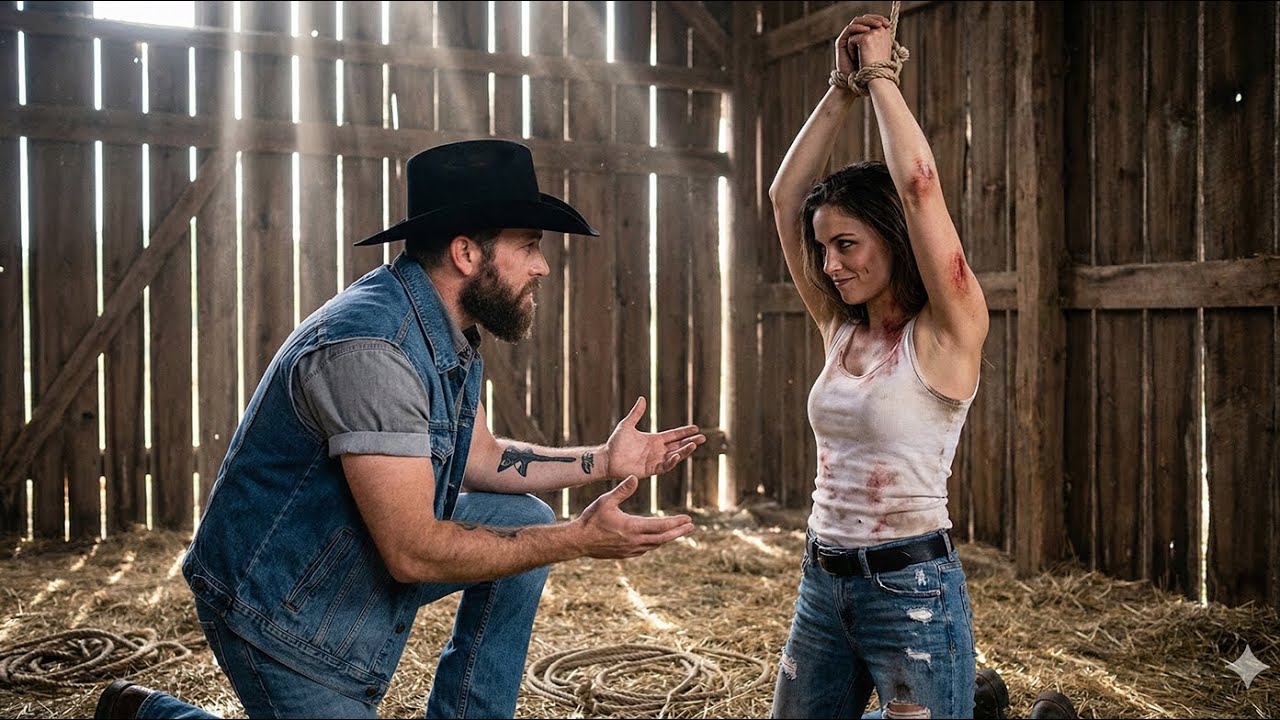
Not peaceful.
Quiet.
There was a difference any rancher could feel in his bones.
A healthy barn had a sound to it. Hooves shifting against packed dirt. Tails flicking. Leather creaking. A low nicker from a restless mare. Even the flies made their own kind of noise when the air was warm enough.
But the barn behind the old Langford place sat under the late afternoon sun like it was holding its breath.
Caleb stood beside his pickup with one hand resting on the tailgate, looking across the yard at the sagging double doors. A For Sale sign leaned near the fence, half-buried in weeds. Behind it, the house sat with its curtains drawn, paint peeling off the porch rails, two broken rocking chairs facing the empty road.
He had driven forty miles to buy a horse.
That was all.
A chestnut gelding, twelve years old, good with cattle, supposedly sound in the knees. The ad had been short, posted in a county Facebook group by a man named Earl Langford.
Need gone today. Cash only.
Caleb did not love those words.
But winter was six weeks away, and he had lost his best working horse to colic in September. A good ranch horse could make the difference between a hard season and a brutal one. He had called the number, asked the right questions, and Earl had answered just enough of them to keep him from hanging up.
Now Caleb wished he had trusted the feeling in his stomach.
Earl Langford stepped out of the house wiping his hands on a gray dish towel.
He was a tall man in his late fifties, broad through the shoulders, with a sunburned neck and the confident walk of someone who had spent his life believing locked doors and raised voices were the same thing as authority.
“You Mercer?” Earl called.
“That’s right.”
“Horse is in the barn.”
Earl did not offer a handshake.
Caleb did not reach for one.
He had dealt with men like Earl before. Men who spoke in short sentences because they thought it made them sound honest. Men who looked at your boots, your truck, your face, and decided how much respect to give you before you had said ten words.
Caleb was forty-six, weathered and quiet, with a limp in his left leg from a fence accident that nearly took his knee fifteen years earlier. He did not dress like a man with much money. His hat was sweat-stained. His denim jacket had been patched twice at the elbow. His pickup was old enough to vote.
People underestimated him often.
He rarely corrected them.
Earl looked past him at the truck and smirked. “You brought cash?”
“I brought questions first.”
The smirk faded a little.
“Horse is sound,” Earl said. “That’s all you need to know.”
Caleb glanced toward the barn again.
A thin line of dark water had run out from under one of the doors and dried in the dirt. Not mud. Something washed out. Something someone had tried to clean in a hurry.
“Mind if I look him over?”
“That’s why you’re here, ain’t it?”
Earl turned and started toward the barn.
Caleb followed, keeping a few steps behind.
The yard had the defeated look of a place where too many things had been left unfinished. A rusted tractor sat near the shed with one tire sunk flat into the soil. Empty feed bags had been stuffed behind a rain barrel. A dog chain lay coiled near the porch, but there was no dog.
Halfway to the barn, Caleb heard something.
Not from the barn.
From the house.
A dull thump.
Then silence.
Caleb stopped.
Earl turned too quickly. “What?”
“You got someone inside?”
“My sister,” Earl said. “Sick. Don’t like visitors.”
His answer came fast.
Too fast.
Caleb kept his face still. That was a habit he had learned from working cattle and angry men. Sudden concern could spook both.
“Sorry to hear that,” Caleb said.
Earl stared at him for an extra second, then pulled open the barn door with a hard tug.
The smell hit Caleb first.
Old hay. Damp wood. Manure that had not been cleared in too long.
And underneath it, something sour.
Fear had a smell. Caleb had never known how to explain that to people who had not spent their lives around animals. It was sharp, stale, almost metallic. It clung to walls. It rose from skin. It made every living thing nearby act like lightning was about to strike.
Inside the barn, three stalls stood empty.
The fourth held the chestnut gelding.
The horse lifted his head as Caleb entered, ears twitching forward. He was thin along the topline, not starving, but neglected. His coat had lost its shine, and one rear fetlock was swollen just enough to matter.
Caleb walked slowly toward him, palm open.
“Easy, boy.”
The gelding blinked, watched him, then lowered his head an inch.
Good mind, Caleb thought.
Bad owner.
Earl leaned against the stall post. “Told you. Good horse.”
Caleb ran a hand along the gelding’s neck, then down the shoulder. The horse flinched when his fingers reached the ribs.
“How long’s he been standing?”
“He ain’t been standing. I ride him.”
“Not lately.”
Earl’s jaw tightened. “You buying or wasting my time?”
Caleb crouched near the swollen fetlock. There was heat in it. Not catastrophic, but enough that Earl had either missed it or hidden it.
Neither possibility improved the price.
Then Caleb saw the scratch marks.
They were not on the horse.
They were on the inside wall of the stall behind him.
Five lines, dragged through old dust on the lower boards.
Not made by hooves.
Too narrow.
Too deliberate.
Caleb stood slowly.
Earl’s eyes followed him.
“What’s behind that wall?” Caleb asked.
“Storage.”
“I’d like to see it.”
“No, you wouldn’t.”
There it was.
A small sentence, but it changed the air.
Caleb turned from the horse and looked at Earl. The man’s arms were crossed now. Not casual. Blocking. His boots had shifted slightly, placing himself between Caleb and the back corner of the barn.
Caleb had walked into enough bad situations to know the moment when leaving became safer than asking.
But leaving had never sat well with him.
Not when something living was trapped.
He pointed toward the gelding. “You said cash only. I don’t buy a horse without seeing feed, tack, and papers.”
“Papers are in the house.”
“Then get them.”
Earl did not move.
For the first time, his confidence slipped. Just a fraction. His eyes cut toward the back wall.
Caleb saw it.
So did the horse.
The gelding raised his head and let out a low, uneasy sound.
Then from somewhere behind the boards came the faintest noise.
A breath.
Not an animal.
A human breath.
Caleb felt every muscle in his body go still.
Earl’s hand dropped toward his belt.
“Maybe this ain’t the horse for you,” Earl said.
Caleb looked at the man’s hand, then back at his face. His voice stayed level.
“Maybe not.”
He took one step backward, as if agreeing. Earl’s shoulders relaxed just enough.
That was when Caleb moved.
He did not lunge at Earl. He did not shout. He simply turned toward the nearest stall hook, grabbed the old iron latch bar hanging from it, and swung it hard against the warped boards at the back of the stall.
The first strike cracked the wood.
Earl exploded forward. “Hey!”
The horse startled, slamming against the gate.
Caleb swung again.
This time the board split.
A strip of darkness opened behind the wall.
And from inside that darkness, someone whimpered.
Earl grabbed Caleb by the shoulder, but Caleb twisted, using the man’s momentum to drive him into the stall post. Earl hit with a grunt and stumbled back, more surprised than hurt.
Caleb tore at the broken board with both hands.
Splinters bit into his palms.
The gap widened.
At first, he saw only black.
Then a shape.
A bare foot pulled back from the light.
A trembling hand.
A woman’s face, pale under dirt and bruises, turned away as if light itself could hurt her.
She was crouched in a space no bigger than a tack closet, knees drawn to her chest, wrists bound in front of her with a length of chain fastened to an iron ring sunk into the floor.
For one second, Caleb could not breathe.
The woman looked up at him.
Her lips were cracked. Her hair had been cut unevenly, like someone had taken scissors to it in anger. One eye was swollen nearly shut.
But the other eye was open.
And it was not empty.
It was afraid.
It was angry.
It was alive.
Behind Caleb, Earl’s voice turned cold.
“You don’t know what you’re looking at.”
Caleb kept his eyes on the woman.
He lowered himself slowly, making his body smaller, gentler, the same way he did with a terrified horse.
“My name is Caleb,” he said. “I’m not with him.”
The woman stared at him as if she had forgotten how to believe words.
Earl stepped closer.
“She’s crazy,” he said. “She’s my wife. She hurts herself. You understand? You just broke into private property and assaulted me.”
Caleb did not look back.
Because the woman had moved her chained hands.
Not toward him.
Toward the dirt beside her knee.
There, scratched into the floor with something sharp, were three words.
Not crazy.
Not wife.
Help Maya Reed.
Caleb’s blood went cold.
Maya Reed.
He knew that name.
Everyone in three counties knew that name.
She was the woman who had vanished from a gas station off Route 19 eleven months earlier. Her photo had been on flyers, church boards, diner windows, and the evening news until slowly, cruelly, people began speaking of her in the past tense.
Earl Langford had just made one mistake.
He thought Caleb had come alone.
Caleb reached into his jacket pocket, his fingers closing around the phone he had started recording with the moment he heard that first thump in the house.
Then, from outside the barn, tires crunched over gravel.
Earl turned toward the sound.
Caleb did too.
A black county sheriff’s cruiser rolled into the yard.
Then another.
And another.
Earl’s face changed before anyone said a word.
[Confirm to continue Part 2]