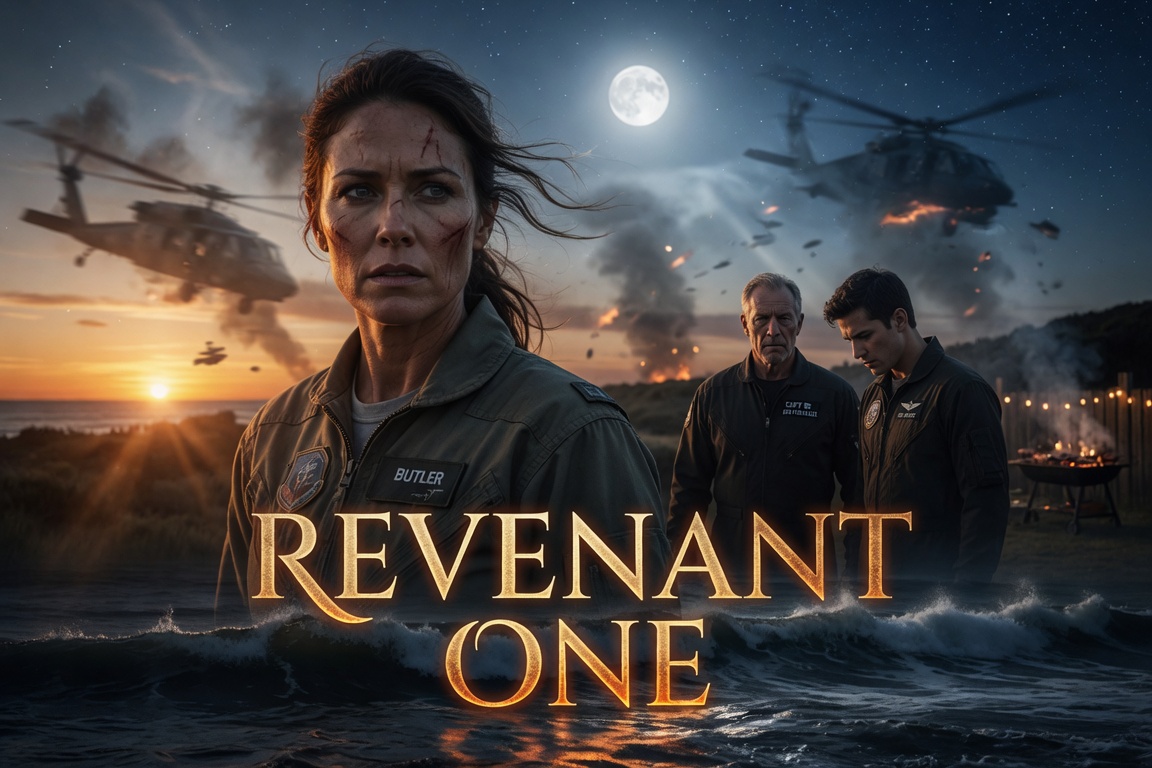
The first insult came before the ribs were off the grill.
I had been standing near the folding table with a paper plate in my hand, watching smoke drift over my uncle’s backyard in slow blue ribbons, when my cousin Blake raised his beer and said, “Careful, everyone. The family war hero is here. Hide your lawn chairs.”
A few people laughed because that was what people did around Blake.
They laughed early, before deciding whether something was funny.
The July heat pressed against the grass. Cicadas screamed from the oak trees. Someone’s children ran through a sprinkler near the fence, shrieking every time the cold water hit their backs. The smell of charcoal, barbecue sauce, cut watermelon, and sunscreen hung thick in the air.
I set my plate down.
Blake grinned wider.
He was thirty-four, tan, expensive sunglasses pushed into his hair, a golf shirt stretched across gym-built shoulders. He had never served. He had once spent fourteen months telling strangers he “almost joined,” which was apparently enough to make him an expert on everyone who had.
“Relax, Nora,” he said. “I’m just saying. You were logistics, right? Like shipping boxes with a rifle?”
My aunt Marlene whispered, “Blake.”
But she smiled when she said it.
My father looked into his drink.
That hurt more.
Uncle Ray, Blake’s dad, stood at the grill with tongs in one hand, smoke curling around his forearms. Retired Navy SEAL. Silver hair. Weathered face. The kind of man who could make a room behave without raising his voice.
He had not heard Blake.
Or maybe he had and was waiting to see what I would do.
I looked at my cousin.
“I moved people,” I said.
Blake chuckled. “Right. Very brave. Did the staplers make it home safe?”
This time the laughter came thinner.
My younger sister closed her eyes.
My mother touched the cross at her neck.
I could have answered. I could have told him about the convoy outside Kandahar, the dust storm in Syria, the night a helicopter came in sideways with hydraulic failure and seven wounded men strapped inside. I could have told him that logistics, in the wrong valley, meant deciding who got ammunition, who got blood, who got ten more minutes of life.
Instead, I picked up a plastic fork.
The fork bent in my fingers.
Not broke.
Bent.
That was when the old radio on Uncle Ray’s workbench crackled.
No one noticed at first. The grill hissed. Children screamed. Blake kept smiling.
Then a voice came through the speaker, distorted but clear enough to slice the yard open.
“Revenant One, confirm secure channel. Revenant One, do you copy?”
The fork slipped from my hand.
Uncle Ray turned from the grill.
His face changed before anyone else understood.
Smoke rolled between us.
The radio crackled again.
“Revenant One, this is Watchtower. We have a problem.”
Blake’s smile faded.
Uncle Ray set the tongs down very carefully.
He looked at the radio.
Then at me.
For one long second, he was not my uncle. Not a retired SEAL in cargo shorts at a family barbecue. He was a man hearing a ghost answer from the wrong grave.
“Nora,” he said quietly.
I did not move.
Behind me, Blake laughed once, uncertain.
“What’s Revenant One? Some video game thing?”
Uncle Ray turned on his son.
The backyard went silent fast enough for the sprinkler to sound loud.
“Apologize,” he said.
Blake blinked. “Dad—”
“Now.”
The word cracked across the yard.
Blake’s face flushed. “For what?”
Ray stepped away from the grill.
Every line in his body had gone hard.
“For mocking the woman who pulled my team out of hell when command wrote us off as dead.”
No one breathed.
Blake looked at me.
Then at his father.
Then back at me.
And for the first time since I had come home, my family saw something in my silence they could not laugh away.
My name is Nora Hale.
Most of my family thought I spent twelve years in the military behind a desk.
That was partly my fault.
Silence had been easier than explanation. Classification had done the rest. When people asked what I did, I said operations support. When they asked if I had ever been “in the real stuff,” I smiled and changed the subject. When Blake joked that I had probably gotten combat pay for bad coffee, I let him.
There are some rooms you survive by not entering.
Family was one of mine.
The barbecue was supposed to be simple. Uncle Ray’s retirement anniversary. Burgers. Beer. Fireworks later by the lake. My mother had begged me to come because “it would mean a lot to Ray,” and because she still believed time could soften a family without anyone naming what had hardened it.
I arrived in jeans, boots, and a white shirt with sleeves long enough to cover the scar along my left forearm.
My father hugged me with one arm.
My mother hugged me with both and held too long.
Blake gave me a salute with two fingers and called me “GI Jane from Accounting.”
That was before the ribs.
Before the radio.
Before my old call sign rose out of the workbench like a buried thing refusing to stay underground.
Uncle Ray crossed the yard toward the radio.
His wife Marlene tried to touch his arm.
“Ray?”
He did not stop.
The radio sat beside a tray of tools, half hidden under a rag. Old military surplus casing. Scuffed black metal. Antenna taped near the base. Ray had rebuilt it years ago, mostly for weather bands and nostalgia.
It should not have received that frequency.
Not from Watchtower.
Not here.
Ray picked up the handset.
His eyes stayed on mine.
“Watchtower, identify authentication.”
A burst of static.
Then: “Red glass. July rain. Eleven bells.”
Ray’s face drained.
My stomach went cold.
Blake looked around. “Okay, seriously, what is this?”
No one answered him.
Ray held the handset out toward me.
I could feel every person in the yard watching.
My mother’s hand covered her mouth.
My father’s beer hung forgotten at his side.
I took the handset.
The plastic was warm from the sun.
“This is Revenant One,” I said.
The words tasted like dust and smoke.
“Send traffic.”
Static hissed.
Then a man’s voice, lower now.
“Asset Meridian surfaced. Your name is in the packet. So is Crosswind.”
Ray’s hand tightened on the edge of the workbench.
Crosswind.
His old team.
The one I was never supposed to have saved.
The one official records claimed had been rescued by a routine extraction after a communications blackout.
The one that came home because I disobeyed a direct order, re-tasked aircraft without authorization, and walked a classified convoy through hostile territory using an old sewer map, a broken satellite phone, and a prayer I did not believe in.
Ray’s team.
Blake’s father.
I looked at Ray.
His eyes had gone sharp with the same recognition I saw years ago through night vision and burning sand.
“Who else has the packet?” I asked.
“Unknown. Local law enforcement pinged once. Federal review opened. You need to secure the original witness.”
The line cracked.
Then died.
The sprinkler kept ticking across the grass.
No one moved.
A child whispered, “Mommy, is Aunt Nora a spy?”
Marlene sat down slowly in a lawn chair.
Blake stared at his father.
“Dad?”
Ray turned to him.
“You heard me.”
Blake’s jaw worked.
“You can’t just bark at me and expect—”
Ray stepped closer.
Blake stopped talking.
That was the thing about men who had truly been dangerous. They did not need to perform it.
Ray’s voice lowered.
“You mocked what you did not understand. You do that often. Today you did it to someone who carried men you call heroes while you were busy borrowing their shine at fundraisers.”
Blake’s face reddened.
“I didn’t know.”
“No,” Ray said. “You didn’t ask.”
The words moved through the yard and found several other people too.
My father looked away.
My aunt stared at her hands.
Blake swallowed.
For a second, something young and ashamed flashed behind his arrogance.
Then he buried it.
“Fine,” he muttered. “Sorry.”
Ray’s eyes hardened.
Nora, he looked at me as if asking permission.
I shook my head once.
Not now.
Public humiliation was easy. Too easy. And it never repaired what pride had broken.
I set the handset down.
“I need the garage,” I said.
Ray nodded immediately.
That frightened my family more than if he had argued.
The garage smelled of gasoline, cut wood, old fishing gear, and the faint mildew of summer storms. Ray shut the door behind us, muting the backyard into a smear of voices and cicadas.
For a moment, we stood in the dim light between stacked coolers and shelves of paint cans.
Then Ray turned to me.
“You never told them.”
“No.”
“You never told Blake.”
“I didn’t save your team so your son would be impressed at barbecues.”
His face tightened.
Not offended.
Wounded.
Raymond Cole had been a SEAL for twenty-two years. Men had followed him through doors they knew might not open again. But fatherhood had always been the mission that left him unsure where to put his hands.
“He became unbearable,” Ray said.
“I noticed.”
“That’s on me.”
I looked through the small garage window. Blake stood alone near the fence now, beer untouched in his hand. The family had rearranged itself around the new knowledge, leaving him in a circle of empty grass.
“He wanted your respect,” I said.
Ray laughed once without humor.
“So he borrowed mine.”
“People do worse when they feel invisible.”
Ray looked at me.
“Speaking from experience?”
I did not answer.
His expression softened.
“Your father should have stood up for you.”
“He didn’t know.”
“He knew enough to stay quiet.”
The words hit harder because they were true.
Ray went to a locked cabinet behind the workbench and entered a code. Inside were old files, sealed bags, a pistol safe, and a gray metal case I recognized immediately.
My throat tightened.
“You kept it?”
He pulled the case out.
“I was told to destroy it.”
“So was I.”
“Figured one of us should remain bad at following orders.”
He set the case on the workbench and opened it.
Inside lay a battered helmet camera, a folded map sealed in plastic, and a small black drive wrapped in oilcloth.
Operation Ash Lantern.
The name had been scrubbed from public reports.
Not from memory.
Ray touched the helmet camera like it might still be warm.
“This Meridian thing,” he said. “You know what it is?”
“I know who.”
He looked up.
My voice dropped.
“Samuel Meridian. Defense contractor liaison. He rerouted extraction support that night. The official explanation was system failure.”
Ray’s eyes darkened.
“And unofficial?”
“He sold the delay.”
The garage seemed to shrink.
Outside, laughter tried to restart and failed.
Ray’s voice went flat.
“To who?”
“Militia brokers. Private buyers. Men who wanted proof they could choke an American response window.”
Ray stared at me.
“You knew?”
“I suspected. Couldn’t prove it.”
“And now?”
“Now Watchtower says he surfaced.”
Ray looked down at the black drive.
“What’s on this?”
“Enough to show the team wasn’t abandoned by weather, confusion, or bad luck.”
“And Crosswind?”
I met his eyes.
“Enough to show someone in your family helped bury the civilian side.”
Ray went still.
“My family?”
I heard the pain before the anger.
“That’s why I came today.”
His hand gripped the edge of the bench.
“You came for the barbecue because of this?”
“I came because my mother asked.”
“That’s not an answer.”
“It’s the only one I had before the radio.”
Ray studied my face.
“You knew Blake was involved?”
“No.”
“Who then?”
I looked toward the backyard.
Through the garage window, my father stood near the cooler, speaking with Aunt Marlene. His shoulders were rounded. He looked smaller than he had in my childhood, less like the man who taught me to change a tire in the rain and more like someone who had spent years avoiding a door he knew would open eventually.
“My father,” I said.
Ray’s expression shifted from disbelief to refusal.
“Alan?”
I nodded.
“He worked county procurement after I deployed. Meridian used shell contracts to move equipment through local emergency channels. Some signatures match Dad’s department access.”
Ray stepped back.
“No.”
“I’m not saying he knew what he was signing.”
“But he signed.”
“Yes.”
Ray rubbed a hand across his mouth.
“Does he know?”
“I think he suspects.”
Outside, Blake looked toward the garage.
His face was no longer arrogant.
It was afraid.
Ray followed my gaze.
“And my son?”
“Blake runs the veterans charity auctions now.”
“So?”
“Meridian donated through three of them.”
The words struck him clean.
Ray closed his eyes once.
When he opened them, the SEAL was gone.
Only the father remained.
“Damn it, Blake.”
The side door creaked open.
Blake stood there.
He had heard enough.
His beer was gone. His sunglasses hung crooked from his collar. Without them, his eyes looked younger, less protected.
“What did I do?” he asked.
Ray’s voice cut low. “Get out.”
“No.” Blake stepped inside. “You don’t get to talk about me like I’m some criminal and then tell me to leave.”
I turned toward him.
“Did Samuel Meridian donate to Honor Line Foundation?”
Blake blinked.
The name landed.
Not unfamiliar.
Not expected.
“I deal with donors all the time.”
“Answer.”
His eyes flicked to Ray.
“Yes. Maybe. I don’t know. He used a company name.”
“Which one?”
“Meridian Strategic Response.” Blake swallowed. “They sponsored the lake gala.”
Ray’s face tightened.
“How much?”
Blake shifted.
“Blake.”
“Two hundred fifty thousand.”
The garage fell silent.
Ray stared at his son like he had just found a live grenade in his hand.
“What did he want?”
“Nothing.”
I waited.
Blake’s jaw worked.
“He wanted introductions.”
“To who?” I asked.
“County emergency management. Procurement people. Dad’s old network.” He looked at Ray. “He said they were building disaster response infrastructure for veterans’ communities.”
Ray’s voice was rough. “And you believed him?”
Blake exploded.
“Yes, I believed him. Because he spoke to me like I mattered.”
The words rang off the garage walls.
His face twisted immediately, ashamed of the truth.
But it was out.
Ray did not move.
Blake looked at him, years of resentment burning through the cracks.
“Everywhere I go, I’m Ray Cole’s son. SEAL legend’s kid. You think that’s easy? People ask what team I served on before they ask my name. They look disappointed when I say I didn’t.”
Ray’s mouth opened.
Blake cut him off.
“And then Nora comes home, quiet and mysterious, and even she gets the look. The respect. The room shifts around her. I get jokes. I get ‘almost joined.’ I get charity committees because I’m useful near your name.”
His eyes shone.
“So yeah. When Meridian treated me like a man with influence, I liked it.”
The admission sat between them, ugly and human.
Ray’s voice softened.
“Son—”
“No.” Blake wiped his mouth with the back of his hand. “Don’t ‘son’ me now.”
I watched them both.
The easy version of this story would have made Blake a fool and Ray a saint.
Real families were rarely that clean.
I stepped closer.
“Blake, did Meridian ever ask you to move files? Guest lists? Donor records?”
He looked at me.
Suspicion returned, but weaker.
“Yes.”
“What kind?”
“Old rosters. Veteran contacts. Emergency contractors. People who attended Dad’s fundraisers.”
“Did you send him Ray’s old team list?”
Blake’s face went pale.
Ray stopped breathing.
“I didn’t know what it was,” Blake whispered.
The backyard noise vanished behind the blood rushing in my ears.
“When?”
“Three months ago.”
“How?”
“Foundation archive. Dad had boxes. I digitized everything for donor outreach.” Blake looked at Ray desperately. “I thought it was history.”
Ray turned away, both hands on his head.
I closed the gray case.
Meridian had Crosswind’s names.
Watchtower’s warning made sense now.
The original witness.
Someone from Crosswind was still vulnerable.
Ray lowered his hands.
“Who’s the witness?”
I hesitated.
He saw it.
“Nora.”
I looked at him.
“You.”
The lake road was empty by late afternoon.
The barbecue ended without fireworks.
Families left in clusters, carrying foil-covered plates and questions no one wanted answered near children. My mother hugged me before she left. Her arms shook. My father tried to speak, but no words came out. He touched my shoulder instead, then seemed ashamed he had touched so little and went to the car.
Ray told Marlene to take the kids inside.
Blake stayed.
That surprised me.
He sat on the garage steps, elbows on knees, looking at the grass where his old life had cracked.
Ray and I spread files across the workbench.
Crosswind team records. Foundation donor lists. County procurement contracts. Meridian’s shell company payments. My father’s signatures appeared on three emergency logistics approvals tied to obsolete rescue equipment.
Equipment that never reached any disaster zone.
Equipment that matched crates photographed in Ash Lantern’s hostile market corridor eight years earlier.
Ray stared at the images.
“You think Alan helped move military-grade gear?”
“I think Alan signed off on surplus transfers he didn’t understand.”
Ray looked at me.
“And you didn’t confront him?”
“He had a heart attack last year.”
Ray’s face softened.
“That doesn’t clear him.”
“No.”
“But it slowed you.”
I looked at the photo of my father’s signature.
“Yes.”
Blake entered quietly.
“I found something.”
He held up his laptop.
Ray’s jaw tightened. “You were told to stay off foundation systems.”
Blake flinched but held his ground.
“I know where Meridian is.”
I straightened.
“How?”
“He sent a meeting request this morning. I thought it was about the fall gala.” Blake turned the screen. “Private event tonight. Oyster Point Marina. He wants me to bring Dad.”
Ray’s eyes narrowed.
“Why?”
Blake looked at the floor.
“Because I told him Dad still had the helmet cam.”
The room went cold.
Ray moved so fast Blake stepped back.
“You what?”
“I didn’t know!” Blake’s voice cracked. “He asked about memorabilia from Crosswind. Said there was a museum grant. I mentioned the camera. That’s all.”
Ray’s hands curled into fists.
I stepped between them.
“Ray.”
His eyes stayed on Blake.
“Dad,” Blake whispered, “I swear I didn’t know.”
Ray’s jaw clenched hard enough to hurt.
For a moment, I thought he would say something that could not be taken back.
Instead, he turned and drove his fist into the wooden shelf beside him.
A paint can jumped.
Blake flinched.
Ray stood breathing through his nose, knuckles bleeding.
“Get the first aid kit,” I said.
Blake stared.
“Move.”
He moved.
Ray looked at me, shame flickering across his face.
“I almost became my father.”
I said nothing.
Some confessions deserved air.
Night settled over Oyster Point Marina with a wet, copper-colored moon caught behind clouds.
The docks smelled of salt, diesel, and rotting seaweed. Boats knocked softly against their slips. A restaurant across the water spilled jazz and yellow light onto the black surface of the bay. Wind pulled at my jacket and carried voices in broken pieces.
Meridian Strategic Response had rented a private boathouse at the far end.
No federal team. Not yet.
Watchtower had gone dark after the radio transmission. We had no warrant, no backup we could trust quickly, and too many family fingerprints on too many documents.
So we went carefully.
Ray drove.
I sat passenger.
Blake sat in the back, quiet, one knee bouncing until Ray told him to stop and then apologized under his breath for the tone.
That apology did more damage to Blake than the order.
At the marina entrance, Ray parked under a dead security light.
“I go in,” he said.
“No,” I replied.
“He asked for me.”
“He asked for the camera.”
“I can handle Meridian.”
“I know.” I checked the small recorder under my collar. “But can you handle hearing what your son gave him?”
Ray looked through the windshield.
Blake lowered his eyes.
Ray’s voice came tired.
“That was cruel.”
“Yes.”
He nodded once.
“Fair.”
Blake leaned forward.
“I should go.”
“No,” Ray and I said together.
He sat back.
“I need to fix it.”
I turned toward him.
“This isn’t a broken fence.”
His face reddened.
“I know what it is.”
“Do you?”
He held my gaze.
For once, no joke came.
“I gave a predator names because I wanted to feel important.”
Ray closed his eyes.
Blake swallowed.
“I know what it is.”
Silence filled the truck.
Then Ray reached into the center console and pulled out an old challenge coin. He handed it back without looking.
Blake took it.
“What’s this?”
“Crosswind coin,” Ray said. “You don’t earn it by being impressive. You earn it by being accountable.”
Blake stared at the coin in his palm.
His mouth trembled.
Ray opened the door.
“Stay in the truck.”
Blake nodded.
We walked toward the boathouse together.
Inside, Samuel Meridian waited beneath hanging bulbs that swayed in the sea wind.
He was not what most people expected from evil. No scar. No sneer. No black suit. He wore a beige linen jacket, open collar, expensive loafers. Late fifties, calm eyes, smooth hands. He looked like a man who could explain a theft so well you would thank him for taking only half.
“Raymond Cole,” he said warmly.
Ray stopped ten feet away.
“Meridian.”
“And Nora Hale.” Meridian’s eyes brightened. “Revenant One in the flesh. I admit, I expected someone taller.”
I smiled faintly.
“I expected someone braver.”
His smile held.
“Fair.”
Behind him, two men stood near a table. Security. Private. Armed under jackets.
On the table sat wine, contracts, and a black hard case.
Meridian gestured toward chairs.
“Please. No need for theater.”
Ray’s voice was flat.
“You bought my son.”
Meridian sighed.
“I invested in a young man desperate to be seen.”
Ray took one step.
I touched his arm.
Meridian noticed.
“Still saving him, Nora?”
“Habit.”
“Dangerous habit. It made quite a mess eight years ago.”
My fingers stayed relaxed at my sides.
“You mean when your buyers lost leverage because Crosswind survived?”
He poured wine into one glass.
“My buyers. Your commanders. Local officials. Everyone wants clean hands after dirty work succeeds.”
Ray’s face darkened.
Meridian lifted the glass.
“You think I created the market? No. I serviced it. Disaster contracts, surplus gear, emergency corridors. All perfectly legal until someone decides legality is embarrassing.”
“And Ash Lantern?”
His eyes flicked to me.
There.
A small crack.
“A tragedy of timing.”
“You sold our extraction window.”
“I sold information. What others did with it was beyond scope.”
Ray moved before I could stop him.
One of Meridian’s guards reached inside his jacket.
I stepped into his line, caught his wrist, twisted, and drove him face-first into the table. The wine glass shattered. The second guard drew halfway before Ray hit him with the kind of short, ugly strike that ended arguments without looking cinematic.
Meridian did not run.
That worried me.
He merely stepped back, brushing wine from his cuff.
“Very emotional.”
Ray had the second guard pinned against a post.
I held the first man’s weapon in my hand, pointed at the floor.
Meridian smiled at me.
“You always were the complication.”
“Open the case.”
“No.”
I raised the weapon slightly.
He looked almost amused.
“You won’t shoot me.”
“No.”
Ray said, “I might.”
Meridian looked at him and decided not to test that.
He opened the case.
Inside were copies of documents, old drives, foundation records, and a photograph that made my stomach drop.
My father.
Alan Hale.
Standing beside Meridian at a county emergency procurement event six years earlier.
Smiling.
Holding a folder stamped with the county seal.
Ray looked at me.
I forced my breathing flat.
Meridian’s voice softened.
“Your father was not evil, Nora. He was tired. Underpaid. Proud. Very proud. Men like that only need one favor framed as public service.”
“What did he sign?”
“Access pathways. Equipment transfers. Storage approvals.” Meridian tilted his head. “He never asked where the inventory went. That was his gift.”
I looked at the photograph.
My father’s smile seemed to belong to another life.
Ray’s voice came low.
“You used families.”
“I used needs.” Meridian’s eyes hardened. “You military men love pretending sacrifice ends when you come home. It doesn’t. It becomes mortgages, medical bills, sons living under shadows, daughters carrying secrets until they rot. I simply understood the economy of shame.”
A sound came from the doorway.
Blake stood there.
He had not stayed in the truck.
His face was pale, Crosswind coin clenched in his fist.
Meridian smiled.
“Blake. Good. Perhaps you can explain to your father that nobody is innocent in a system that rewards silence.”
Blake stepped inside.
Ray’s voice cracked. “I told you to stay back.”
Blake ignored him.
His eyes stayed on Meridian.
“You said my dad wanted me involved.”
Meridian shrugged lightly.
“Your father wanted many things. Mostly not to look too closely.”
Blake’s jaw trembled.
“You said Honor Line would fund veteran housing.”
“It did. Some.”
“You said I was building something.”
“You were.”
Meridian’s smile sharpened.
“A door.”
Blake looked at the table. The records. The armed men on the floor. The photograph of my father.
Then he reached into his jacket.
Ray lunged. “Blake, no!”
But Blake did not pull a gun.
He pulled out his phone.
Screen lit.
Recording.
“I got all of it,” he said.
Meridian’s face changed.
For the first time, fear entered the room.
Outside, tires hissed over wet gravel.
Blue lights washed across the boathouse windows.
Blake swallowed, but his hand stayed up.
“I called the number Nora gave Dad,” he said. “Watchtower wasn’t dark. They were waiting for confirmation.”
Meridian stepped toward him.
I raised the weapon.
“Don’t.”
Federal agents breached the boathouse thirty seconds later.
Meridian did not fight.
Men like him never fight when witnesses are present.
He only looked at Blake as agents cuffed him.
“You think this makes you your father’s son?”
Blake’s hand tightened around the coin.
“No,” he said. “It makes me responsible for what I did with his name.”
Ray turned away.
His eyes were wet.
By sunrise, my father was sitting at Ray’s kitchen table.
He looked ill.
Not from age. Not from his heart. From truth.
Alan Hale had always been a gentle man in public. High school history teacher before county administration. Soft voice. Careful hands. He remembered birthdays, mailed newspaper clippings, and fixed loose cabinet doors without being asked.
He had also stayed silent while people mocked my service.
Because he had feared what my service might uncover about him.
The kitchen smelled of burnt coffee and rain-damp clothes. Ray stood near the sink, one hand bandaged. Blake sat on the back steps outside, visible through the screen door, turning the Crosswind coin over and over in his fingers.
My mother sat beside my father.
She had cried until her face looked scrubbed raw.
I placed the photograph in front of Dad.
He looked at it.
His shoulders sagged.
“I thought it was disaster relief.”
His voice barely carried.
“I know.”
He looked up, startled.
“I did, Nora. At first. Meridian came through Victor County Emergency. He said surplus equipment could be redirected to underserved communities. Shelters. Flood zones.” His mouth twisted. “It sounded good.”
“When did you know it wasn’t?”
His eyes filled.
My mother reached for his hand.
He did not take it.
“After Ash Lantern.”
The name hit the room.
Ray turned from the sink.
My father looked at him.
“I saw the news reports about your team. Then I saw inventory numbers on a shipment Meridian had pushed through. Same serial range as gear mentioned in a restricted inquiry. I asked him. He told me if I kept digging, Nora’s name would end up in hearings.”
My mother whispered, “Alan.”
He looked at me.
“I thought I was protecting you.”
The old poison.
So many sins wore that sentence like a uniform.
My voice stayed quiet.
“You protected yourself from having to tell me.”
His face crumpled.
“Yes.”
It was the first honest thing he had given me in years.
I sat across from him.
“Why didn’t you stand up for me yesterday?”
He closed his eyes.
When he opened them, shame had made him smaller.
“Because every joke Blake made sounded less dangerous than the question I was afraid you’d ask.”
My mother began crying again, silently.
Ray walked to the table and sat down.
No anger now.
That would come later.
This was the hour for facts.
“Alan,” he said, “men died.”
My father nodded.
“I know.”
“Men almost stayed dead.”
“I know.”
“My son helped Meridian because I raised him in my shadow and never noticed he was suffocating there.”
Blake looked up from the steps.
Ray’s voice roughened.
“That’s on me. But this—” He tapped the photograph. “This is on you.”
My father accepted the hit without defending.
“I’ll give a statement.”
“You’ll give more than that,” I said.
He looked at me.
“You’ll give records. Emails. Access logs. Names. Every favor. Every signature. Every time Meridian called and you answered.”
His hands trembled.
“That could send me to prison.”
I held his gaze.
“Yes.”
My mother made a small wounded sound.
Dad nodded slowly.
Tears slipped down into the creases beside his mouth.
“All right.”
No one praised him.
That mattered.
Doing the right thing late did not deserve applause. It deserved documentation.
That afternoon, the barbecue tables were still in Ray’s yard.
Paper plates curled under humidity. A half-empty bowl of potato salad sat forgotten in melted ice. The grill cover hung crooked. Children’s plastic cups lay near the fence like evidence of a party abandoned mid-laugh.
Blake stood near the oak tree when I came outside.
He had not slept.
Neither had I.
His eyes were swollen, his shirt wrinkled, his old arrogance stripped down to something bruised and uncertain.
“I owe you more than sorry,” he said.
“Yes.”
He nodded.
Good.
“I used you as a joke because I was jealous.”
“I know.”
“That doesn’t make it better.”
“No.”
He looked toward the garage.
“Dad told me what Revenant One means.”
My chest tightened.
“Did he?”
“Revenant. Someone who comes back from the dead.” Blake tried to smile and failed. “He said the team gave it to you because command listed them gone, and you brought them back.”
I watched a cicada shell cling empty to the tree bark.
“It wasn’t that clean.”
“I figured.”
Silence moved between us.
Not comfortable.
But no longer false.
Blake reached into his pocket and held out the Crosswind coin.
“I shouldn’t keep this.”
“No,” Ray said from behind us.
We turned.
He stood on the porch, one shoulder against the post.
“You should earn it.”
Blake’s mouth tightened.
“How?”
Ray looked at him for a long moment.
“Start by apologizing properly.”
Blake faced me.
No audience now. No beer. No sunglasses. No family waiting to laugh.
“I’m sorry, Nora,” he said. “Not just for the barbecue. For every time I made your silence into permission. For using your service as a punchline because I couldn’t stand the idea that you had done something I never had the courage to do.”
His voice shook.
“And I’m sorry I helped a man hurt people while pretending I was helping veterans.”
I looked at him.
The old me might have softened the moment to rescue him from discomfort.
I did not.
“Apology accepted,” I said. “Trust is not restored.”
He nodded.
“I know.”
Ray stepped down into the yard.
The three of us stood under the oak tree while the sun lowered behind the fence and turned the wet grass gold.
My mother watched from the kitchen window, one hand pressed to her chest. My father sat behind her at the table, writing his statement page by page.
The family had not healed.
It had only stopped lying.
Sometimes that was the first clean breath after years underground.
Two weeks later, the Honor Line Foundation shut down pending investigation.
Meridian’s arrest made the news in careful language. Defense contractor fraud. Misuse of veteran charity channels. Federal procurement violations. Possible connection to overseas equipment diversion.
Operation Ash Lantern remained mostly buried.
But not erased.
Ray gave a sealed statement. So did my father. Blake turned over donor records and testified before a grand jury. He looked sick on the courthouse steps, but he did not run from cameras. That counted for something.
Not redemption.
Something.
I returned to the base on a Sunday morning.
At the airport, Ray walked me to security.
He wore jeans, a faded SEAL T-shirt, and the tired face of a man who had spent two weeks learning his heroes and failures shared a roof.
Blake came too.
He stood awkwardly beside a vending machine, holding coffee no one drank.
My father was not there.
He had wanted to come.
I told him no.
Not as punishment.
As boundary.
That was a word I was still learning how to use without guilt.
Ray stopped before the security line.
“I never thanked you right,” he said.
“You did.”
“No.” His eyes held mine. “At the barbecue, I defended you because I was ashamed. Years ago, I stayed quiet because you asked me to. I let that silence cost you with your family.”
“It was classified.”
“Not all gratitude is classified.”
I looked away first.
The terminal smelled of coffee, carpet cleaner, jet fuel, and strangers leaving pieces of themselves in plastic bins.
Ray reached into his pocket.
Not the Crosswind coin.
A different one.
Blackened at the edges.
Ash Lantern.
My throat tightened.
“I thought that was lost.”
“Found it in the helmet case.”
He placed it in my palm.
One side bore a scratched symbol: a lantern inside a storm cloud.
The other side had three words.
REV ONE RETURNS.
I closed my fingers around it.
Blake stepped forward.
“I’m going to rebuild the foundation,” he said quickly, then winced. “No. Not rebuild. That sounds stupid. I’m going to help investigators finish cleaning it out. Then if anything comes after, it won’t have my name on it unless I earn that.”
Ray looked at him with quiet pride he did not try to hide this time.
“Good,” I said.
Blake swallowed.
“Also, I signed up for EMT training.”
That surprised me.
He gave a small, embarrassed shrug.
“Figured if I’m going to talk about service, I should try some.”
I nodded.
“Don’t make it a performance.”
“I won’t.”
Then, after a beat, he added, “Or I’ll try not to.”
That was honest enough to make me almost smile.
My boarding group was called.
Ray hugged me.
Not carefully. Not like family afraid of medals or scars.
Like a man hugging someone who had once walked into fire and come back carrying his life.
Blake held out his hand.
I looked at it.
Then shook it.
He looked relieved enough to nearly ruin it with a joke, then stopped himself.
Progress.
At the entrance to security, I turned back.
Ray stood straight.
Blake beside him.
Father and son, both damaged, both still standing.
Ray lifted two fingers to his brow.
Not a full salute.
A private one.
I returned it.
On the plane, I took the window seat.
Clouds covered the city below, soft and white, hiding roads, houses, backyards, grills, garages, and all the places where families hurt each other in ordinary daylight.
I opened my hand.
The Ash Lantern coin rested in my palm.
REV ONE RETURNS.
For years, I thought returning meant walking back into old rooms and waiting for people to finally understand who I was.
I was wrong.
Returning was not about being welcomed.
It was about arriving whole enough not to shrink.
At the barbecue, my cousin mocked me.
Then his father heard my call sign.
But the moment that changed everything was not the apology.
It was what came after.
The silence broke.
The truth stood up.
And this time, I did not sit back down.