My mother-in-law waited until the room was full.
That was her style.
She stepped into the drill hall at Fort Redmond wearing a cream coat, red lipstick, and the calm face of a woman who had rehearsed cruelty in front of a mirror. Behind her came my husband, Aaron, eyes lowered, jaw tight, one hand gripping a leather folder like it might bite him.
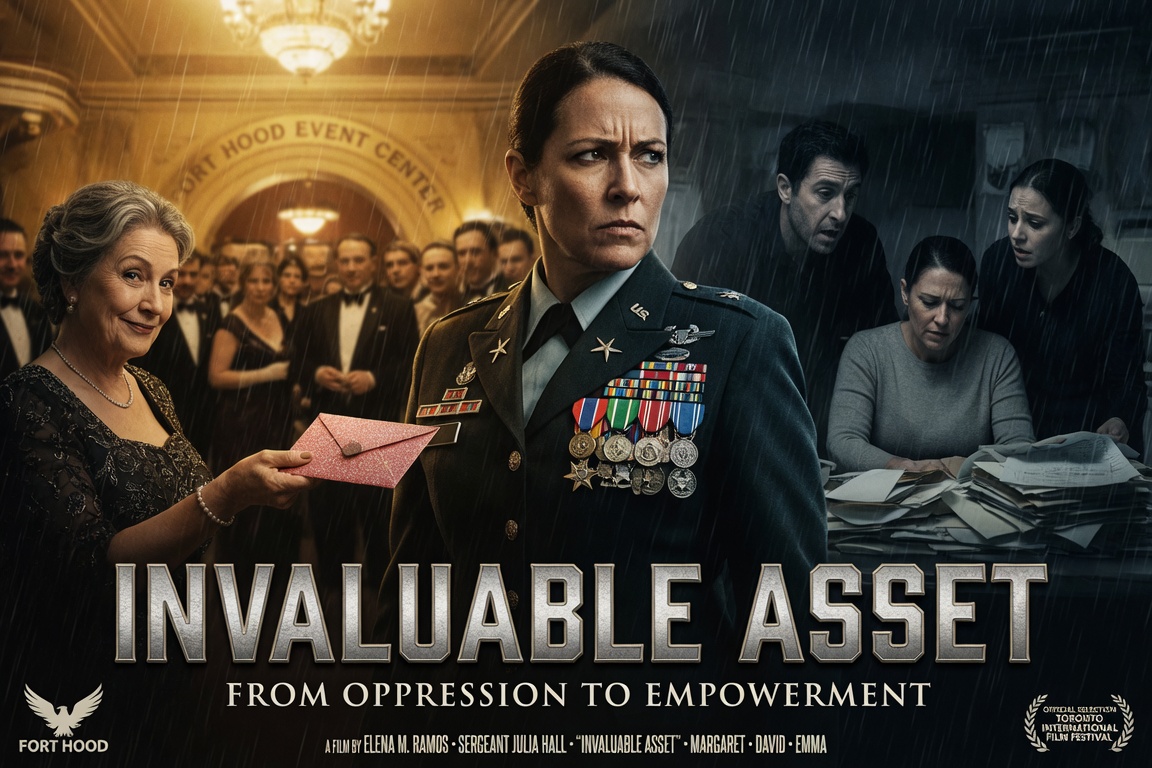
My soldiers were still in formation.
Boots aligned. Shoulders squared. Morning light cutting through the high windows. The floor smelled of wax, dust, and cold metal. Somewhere outside, a truck backed up with three sharp beeps.
I stood at the front of the room in uniform.
Captain Julia Mercer.
Thirty-four years old.
Twelve years Army.
Two deployments.
One marriage dying in public.
My mother-in-law stopped three feet from me.
“Julia,” Vivian Mercer said, her voice soft enough to sound elegant. “You’ve embarrassed this family long enough.”
No one moved.
Aaron’s eyes flicked toward mine, then away.
That hurt more than the folder.
Vivian took the papers from him and held them out.
“Sign these. Give my son back his life.”
A young lieutenant in the first row swallowed hard.
Someone’s sleeve brushed against a uniform seam.
The tiny sound carried.
I looked at the papers.
Divorce Petition.
Asset Waiver.
Spousal Release.
At the bottom, yellow tabs marked every place they expected me to surrender.
I did not reach for them.
Vivian smiled.
“You always did enjoy making everything dramatic.”
I looked past her to Aaron.
“Is this what you want?”
His throat moved.
He said nothing.
That was answer enough.
So I took the papers.
Vivian’s smile widened.
She thought silence meant defeat.
People often did.
I folded the papers once, tucked them beneath my arm, and faced my unit.
“Dismissed.”
No one moved for half a second.
Then the room obeyed.
Boots struck the floor. Rows broke apart. Soldiers looked anywhere but at me. Pity moved through the drill hall like smoke, and I hated it more than humiliation.
Vivian leaned closer.
“Good girl.”
The words barely left her mouth before Aaron flinched.
I looked at her hand, still gloved in cream leather.
Then at her face.
“I’ll sign them,” I said.
Her eyes brightened.
“At the Army Ball.”
The smile faded.
“What?”
I stepped closer, lowering my voice so only she and Aaron could hear.
“If your family wants an audience, Vivian, let’s give them one.”
The Army Ball was three nights later.
By then, everyone on base had heard some version of what happened. Stories grow legs in military towns. By Friday, I had been abandoned, disgraced, cheated on, promoted, pregnant, arrested, and secretly rich depending on which commissary aisle you stood in.
The truth was quieter.
Aaron and I had been broken for a long time.
Not because love vanished in one dramatic storm. It left like water through a hairline crack: slowly, invisibly, then all at once.
When we married, he was charming and restless, a civilian contractor with soft hands and big plans. He liked telling people his wife was Army, but he did not like what the Army required. Missed dinners. Late calls. Men and women trusting me with things he could not understand. He wanted the shine of my uniform without the weight of my duty.
Vivian made that worse.
She believed marriage meant orbit.
Her son at the center.
Everyone else adjusting.
At first, she corrected recipes. Then my posture. Then my schedule. Then the way I spoke to Aaron when he interrupted me. When I deployed the second time, she told people I had chosen “career glory” over family.
Aaron never corrected her.
That was the first betrayal.
The crime came later.
The Army Ball took place in the Grand Meridian Hotel, a stone building downtown with brass doors, marble floors, and chandeliers large enough to make everyone look slightly more important than they were. Rain slicked the streets outside. Valets moved under black umbrellas. Dress uniforms flashed beneath the portico.
Inside, the ballroom glowed amber and gold.
Tables dressed in white linen. Flags behind the stage. A string quartet near the entrance. The smell of roses, steak, perfume, and polished wood. Laughter too bright. Glasses chiming. Officers greeting each other with careful warmth.
I arrived alone.
Not in a gown.
In dress blues.
The room noticed.
Then pretended not to.
My commander, Colonel Harris, saw me from across the ballroom. His face tightened with concern, but he did not approach. Good commander. He knew some battles had to start before rescue meant anything.
Aaron stood near Table Seven with Vivian and a cluster of donors from Mercer Logistics, his family company. He wore a black tuxedo. Vivian wore emerald silk and diamonds at her throat.
She saw me and smiled.
The kind of smile people use when they mistake restraint for weakness.
I walked toward them.
Aaron’s hand tightened around his glass.
“You came,” he said.
“You invited me.”
Vivian’s eyes moved over my uniform.
“This is a formal event, Julia.”
“It is.”
“I meant for women.”
I looked at her emerald dress.
“So did I.”
One of the donors coughed into his drink.
Aaron stepped closer.
“Can we not do this tonight?”
I almost laughed.
Three nights ago, he had let his mother hand me divorce papers in front of my soldiers.
Tonight, he wanted privacy.
I reached into my small black clutch and removed the folded petition.
Vivian’s posture sharpened.
“Do you have a pen?”
Her eyes glittered.
Aaron whispered, “Julia.”
I looked at him.
There was a time when I could read his face like weather. Now all I saw was fear wearing his features.
“You wanted me to sign.”
Vivian opened her purse and handed me a gold pen.
Of course she had one.
A woman like Vivian always came prepared to collect surrender.
Dinner ended. Speeches began. Awards were presented. Men and women stood beneath the flags and received applause for service no speech could fully hold.
I sat at Table Twelve between an old warrant officer and an orthopedic surgeon who worked with wounded veterans. Both pretended not to watch me watch Aaron.
Vivian waited until dessert.
Then she stood.
She had not been scheduled to speak.
That did not stop her.
She walked to the stage with the confidence of someone used to money opening doors faster than permission. The emcee hesitated. Vivian touched his arm, smiled, and took the microphone.
“Forgive me,” she said. “I promise to be brief.”
People who say that rarely are.
She looked across the ballroom at Aaron, then at me.
“Tonight is about service. Sacrifice. Family.” Her voice warmed on the last word. “Some families serve by wearing the uniform. Others serve by supporting those who do.”
A few polite nods.
My fork rested beside untouched cake.
Vivian continued.
“My son Aaron has given years of his life supporting military contracts, veteran employment initiatives, and the spouses who often bear burdens quietly.”
Aaron stared at the table.
He knew.
Maybe not all of it.
Enough.
Vivian lifted a hand toward me.
“And sometimes, the kindest thing we can do is release one another with dignity.”
The ballroom shifted.
Colonel Harris stood halfway.
I shook my head once.
Not yet.
Vivian looked satisfied.
“Julia, dear. You said you would sign.”
Every head turned.
The room held four hundred people.
Officers. Spouses. contractors. donors. soldiers from my unit. My commander. Aaron’s clients. Vivian’s friends.
Exactly the audience she wanted.
I stood.
The chair legs made a small sound against the floor.
I carried the papers to the stage.
Vivian held out the gold pen.
Her hand was steady.
Mine was steadier.
I placed the divorce petition on the podium and signed where the yellow tabs waited.
Julia Anne Mercer.
One page.
Then another.
Then another.
The microphone caught the scratch of the pen.
When I finished, Vivian’s smile looked almost tender.
“Thank you,” she said.
I turned the last page around.
“Now read what I signed.”
Her smile paused.
“I beg your pardon?”
I tapped the page.
“Read it.”
Aaron stood.
“Julia, don’t.”
I looked down at him from the stage.
“You should have said that to your mother in the drill hall.”
The room went silent.
Vivian picked up the top sheet, annoyed now.
Her eyes moved over the text.
Then stopped.
The color left her face.
Because the document I had signed was not the waiver she gave me.
It was an acceptance of uncontested divorce on grounds of fraud, financial coercion, and conspiracy to misappropriate federal veteran employment funds through Mercer Logistics.
Behind her, the ballroom doors opened.
Two investigators walked in.
Vivian lowered the page slowly.
“What have you done?”
I took the microphone from her hand.
For the first time that night, my voice carried.
“I accepted the divorce.”
Aaron’s face crumpled.
“And I declined to carry the crime.”
No one moved.
No one ate.
No one breathed loudly.
I looked at Aaron.
“You forged my name on three veteran hiring certifications.”
His eyes closed.
Vivian snapped, “That is a lie.”
I turned to her.
“You used my military status to qualify Mercer Logistics for federal preference contracts. You submitted reports claiming disabled veterans were hired into positions that never existed. You routed funds through a spouse outreach program under my signature.”
Colonel Harris’s face had gone stone-hard.
The orthopedic surgeon at my table whispered, “God.”
Vivian lifted her chin.
“My company has helped hundreds of military families.”
“Some,” I said. “Enough to look clean. Not enough to be honest.”
Aaron stepped toward the stage.
“I didn’t know how far it went.”
That sentence broke something in me, but not loudly.
I looked at my husband.
“You knew my signature was on documents I never saw.”
He swallowed.
“Yes.”
“You knew your mother used my unit photos in proposals without permission.”
“Yes.”
“You knew she served me divorce papers in front of my soldiers to make me look unstable before I could report it.”
His lips parted.
No sound.
Vivian slapped the podium.
“Enough.”
The crack echoed through the ballroom.
There she was.
Not elegant.
Not grieving.
Afraid.
The lead investigator reached the stage.
“Mrs. Vivian Mercer, we need you to come with us.”
Vivian looked at the room.
All her donors. Her friends. Her carefully fed reputation.
Then at me.
“You ungrateful little soldier.”
Aaron flinched.
I did not.
“I was your daughter-in-law,” I said. “You made me evidence.”
Her mouth trembled.
The investigators escorted her down the stage steps.
No one applauded.
Good.
This was not theater anymore.
This was consequence.
Aaron remained near the stage, eyes wet.
“Julia.”
I looked at him for what felt like the last time.
He looked younger than thirty-eight. Smaller. A boy who had mistaken silence for loyalty until it cost him a marriage.
“I was scared of her,” he said.
“I know.”
“I thought if I kept her calm, we could fix it quietly.”
“You chose quiet over me.”
His face twisted.
“Yes.”
The word landed between us.
At least it was honest.
I stepped down from the stage and handed him the gold pen.
His mother’s pen.
His inheritance.
His problem.
“The divorce is signed,” I said.
Then I walked past him.
My soldiers stood as I crossed the ballroom.
Not all at once.
First Lieutenant Grant.
Then Sergeant Willis.
Then the rest of my unit, chairs sliding back, dress uniforms straightening, eyes forward.
No one saluted indoors at a formal dinner.
They did not salute.
They stood.
That was worse.
That was better.
That was the thing I had not known I needed.
Colonel Harris waited near the exit.
“You all right, Captain?”
I looked back once.
Aaron stood alone beneath the chandeliers.
Vivian’s emerald scarf lay on the floor near the stage like shed skin.
“No, sir,” I said.
Colonel Harris nodded.
“Good answer.”
Outside, rain fell hard over the hotel awning.
The air smelled of wet pavement, exhaust, and roses from the lobby arrangements. I stood beneath the portico, breathing like I had just climbed out of deep water.
My phone buzzed.
A message from Aaron.
I’m sorry.
I stared at it until the screen dimmed.
Then I deleted it.
Not because sorry meant nothing.
Because tonight, it did not get to mean everything.
Six months later, Mercer Logistics lost its federal contracts.
Vivian accepted a plea deal after three former employees testified. Aaron cooperated, paid restitution, and signed the final divorce papers without contesting a single term. The veteran outreach program was rebuilt under independent oversight, led by the same people Vivian had once used as decoration in brochures.
As for me, I kept serving.
Not because I had something to prove.
Because service had never belonged to the people who tried to use it against me.
On a cold morning in November, I stood in another drill hall with a new group of soldiers in front of me. The floor smelled the same: wax, dust, metal. Sunlight cut through high windows. Boots aligned.
A private in the front row looked nervous enough to faint.
I knew that look.
It reminded me that strength was not a permanent state. Sometimes it was just the next breath taken in public.
After formation, Sergeant Willis approached with a clipboard.
“Ma’am,” she said, “the new spouse resource policy is ready for review.”
I took it.
At the bottom, where a signature line waited, my name had already been typed.
CAPT. JULIA A. MERCER
No one else’s hand pretending to be mine.
No one using my silence.
No one deciding my dignity was theirs to spend.
I signed.
Outside, the flag snapped in the winter wind.
For a moment, I thought of the Army Ball. The gold pen. Vivian’s face when she realized paper could cut both ways. Aaron’s apology arriving too late. My unit standing in a room built to watch me fall.
People called it revenge later.
They were wrong.
Revenge would have been shouting.
Revenge would have been making them bleed because I had bled.
What I chose was cleaner.
I signed my name.
I told the truth.
And I walked out with everything they thought humiliation would take from me.