Daniel Harper woke up every morning at 4:47.
Not 4:45. Not 5:00.
4:47.
It was the quietest minute in his house.
Before the kettle hissed. Before the lunchbox lids clicked shut. Before his eight-year-old daughter, Lily, shuffled down the hallway in her unicorn socks, rubbing sleep from her eyes and asking if pancakes counted as breakfast twice in one week.
Daniel had been a single father for four years.
His wife, Emily, died from ovarian cancer when Lily was four.
Since then, life had become a rhythm Daniel never asked for but learned to perform with precision.
Wake before dawn.
Pack Lily’s lunch.
Check her homework folder.
Make breakfast.
Braid her hair badly, then fix it after she laughed.
Walk her to the bus stop or drive her to school in his old blue pickup truck when the weather was rough.
Then take the city bus across town to a small rented office above a closed-down print shop, where most people assumed he repaired laptops for a living.
To be fair, Daniel looked like someone who fixed computers.
He wore plain gray hoodies, old jeans, scuffed boots, and a canvas jacket with a missing button. His truck had a dent near the back wheel and made a coughing sound every time the temperature dropped below forty degrees.
He did not wear designer suits.
He did not own a luxury watch.
He did not speak loudly into phones in restaurants.
He did not park in front of expensive buildings so people could see what he drove.
Most people who met Daniel saw an exhausted father trying to keep life together with coffee, patience, and duct tape.
Very few knew the truth.
Daniel Harper was one of the most respected cybersecurity specialists in the private financial sector. His firm protected international payment networks, investment platforms, and banking infrastructure for companies most people had only seen in headlines.
He had quietly built security systems that prevented attacks on billion-dollar portfolios.
He had consulted for institutions in London, Singapore, Zurich, and New York.
He had also invested early in three financial technology companies that later exploded in value.
By thirty-six, Daniel was wealthy enough to never work another day in his life.
But Lily did not know the size of his investment accounts.
She knew her father made excellent scrambled eggs.
She knew he always came to school performances, even if he stood in the back with his laptop bag still over one shoulder.
She knew he clipped coupons, compared grocery prices, and made her write thank-you cards after birthday parties.
Daniel wanted it that way.
Emily had grown up with very little. Before she died, she had made Daniel promise one thing.
“Don’t let money raise her,” she whispered from her hospital bed. “You raise her.”
So Daniel kept their life simple.
Not fake poor. Not performative.
Simple.
Lily had clean clothes, books, music lessons, and a father who listened when she talked about clouds shaped like animals.
She also had chores.
She packed part of her own lunch. She put away laundry. She donated toys before getting new ones.
Daniel believed comfort was a gift, but entitlement was a disease.
And he refused to let his daughter catch it.
That Thursday morning, everything went wrong before the sun came up.
Rain hammered against the kitchen windows so hard it sounded like someone throwing handfuls of gravel at the glass.
Lily came downstairs flushed and quiet, which scared Daniel more than any fever.
His daughter was rarely quiet.
He touched the back of his hand to her forehead.
Warm.
Not dangerously hot, but enough.
“Head hurt?” he asked.
“A little,” Lily whispered.
Daniel checked her temperature, gave her medicine, emailed her teacher, repacked her lunch into softer foods, and sat with her while she drank half a cup of tea with honey.
By the time Lily insisted she still wanted to go to school because “Thursday is library day,” Daniel was already behind schedule.
Then his phone buzzed with a banking notification.
A routine business payment had bounced from his everyday checking account.
Daniel frowned.
That account was not where he kept serious money. It was just the small local bank account he used for groceries, bills, Lily’s school activities, and daily expenses. He kept a modest balance there on purpose.
But an overnight service fee had posted before an automatic transfer landed.
The account had slipped below the minimum requirement by nine dollars.
Nine dollars.
Daniel rubbed his forehead and stared at the notification.
It was annoying, not serious.
He had other accounts. Large ones. Very large ones.
He could fix it in minutes.
But the bank’s app was glitching, and because the bounced payment involved a linked account verification, the message said he needed to visit a branch.
So after dropping Lily at school, then turning around ten minutes later because the nurse called to say Lily looked worse and should probably go home, Daniel drove to the nearest branch with his daughter wrapped in a hoodie in the passenger seat.
The bank was called Northbridge Community Bank, though there was nothing warm or community-like about the downtown branch that morning.
The lobby smelled like wet coats, printer toner, and expensive floor cleaner.
Customers stood in a slow-moving line, shaking umbrellas and checking phones. Behind the glass, tellers spoke in soft professional voices.
Daniel held Lily’s hand.
She leaned against his side, pale but alert.
“I just need to make a transfer,” he told her. “Then we’ll go home and watch that penguin documentary again.”
“The one where the baby falls over?” Lily asked.
“That’s most penguin documentaries.”
She almost smiled.
Daniel stepped up to the reception desk and explained the problem to a young employee named Marcus, whose name tag sat crooked on his jacket.
Marcus looked at Daniel’s worn hoodie, then at the child beside him.
“Okay, sir,” he said carefully. “Let me see what I can do.”
He typed for a moment, then hesitated.
“I may need manager approval because the account has a hold attached after the returned payment.”
“That’s fine,” Daniel said. “It’s only nine dollars under the threshold. I can transfer funds from another account immediately.”
Marcus nodded and walked toward the glass office at the side of the lobby.
Inside sat Rebecca Lawson.
Branch manager.
Twenty years in banking.
Perfect hair. Navy suit. Gold bracelet. Smile sharp enough to cut paper.
Rebecca had built her career on appearances.
She noticed watches before faces.
Shoes before voices.
Posture before problems.
To her, people announced their value before they ever opened their mouths.
A man in a tailored suit was “worth assisting personally.”
A woman with a designer bag was “a priority relationship.”
A tired father in an old hoodie with a sick child beside him was “a small-account issue.”
Rebecca looked through the glass wall at Daniel and frowned before Marcus finished speaking.
She walked out with the expression of someone already inconvenienced.
“Mr. Harper?” she asked, though she said his name like it had disappointed her.
“Yes,” Daniel said. “Thank you. I just need to transfer money from another account to cover a small shortfall.”
Rebecca glanced at the screen Marcus had left open.
“Nine dollars below the required minimum,” she said.
“That’s right,” Daniel replied. “The service fee posted before the transfer. I can resolve it now.”
Rebecca folded her arms.
“Mr. Harper, part of maintaining a bank account is understanding your responsibilities.”
Daniel paused.
Several people in line looked over.
Lily’s fingers tightened around his.
“I understand,” Daniel said calmly. “This was timing. I’m not disputing the fee. I just need to move funds.”
Rebecca’s voice grew louder.
“These policies exist because customers need financial discipline. We can’t simply make exceptions whenever someone fails to manage their account.”
The lobby quieted.
Daniel glanced down at Lily.
Her cheeks were red from fever, and her eyes moved between her father and the woman in the suit.
“I’m not asking for an exception,” Daniel said. “I’m asking to deposit money.”
Rebecca gave a small laugh that contained no humor.
“Sir, you are asking my staff to stop serving other customers because your account fell below the minimum by nine dollars.”
A man near the deposit slips turned away, embarrassed.
A woman in a beige coat lowered her eyes.
No one said anything.
Daniel kept his voice even.
“My daughter is sick. I’d like to handle this quickly and leave. Please tell me what is required.”
Rebecca looked at Lily, then back at Daniel.
“Bringing a child into the bank doesn’t change policy.”
That was the first moment Daniel’s expression shifted.
Not anger.
Not yet.
Just a stillness.
The kind that comes when a decent person realizes someone has chosen cruelty when kindness would have cost nothing.
Lily looked down at her shoes.
Daniel placed one hand gently on her shoulder.
“Ms. Lawson,” he said, reading her name tag, “this does not need to become uncomfortable.”
Rebecca’s eyebrows rose.
“Are you threatening me?”
“No,” Daniel said. “I’m asking you to help resolve a simple issue.”
Rebecca stepped closer, her voice now carrying across the entire lobby.
“Mr. Harper, what I see is a customer with an overdrawn account, a returned payment, and an unwillingness to accept responsibility. You may not like hearing that, but poor financial habits have consequences.”
The words landed in the lobby like dropped glass.
Lily’s lower lip trembled.
Daniel saw it.
So did Marcus.
The young employee looked like he wanted to disappear.
“Please don’t speak that way in front of my daughter,” Daniel said quietly.
Rebecca smiled.
“Then perhaps you should set a better example for her.”
For three seconds, nobody moved.
Rain tapped against the tall front windows.
A printer beeped behind the teller counter.
Daniel inhaled once.
Slowly.
“May I speak with someone else?” he asked.
“I am the branch manager,” Rebecca said.
“Then I’d like the number for your regional office.”
Rebecca’s face hardened.
“Security.”
An older guard near the entrance looked up, startled.
Daniel turned his head slightly.
The guard hesitated.
Rebecca pointed toward Daniel as if he had raised his voice, thrown something, caused a scene.
“This customer is becoming disruptive. Please escort him out.”
Marcus whispered, “Ms. Lawson, he didn’t—”
Rebecca cut him off with a look.
The guard approached Daniel with visible discomfort.
“Sir,” he said softly, “I’m sorry, but…”
Daniel nodded.
“I understand.”
He picked up Lily’s small backpack from the floor.
“Come on, sweetheart.”
“Daddy,” Lily whispered, “did we do something wrong?”
Every parent in that lobby felt that question.
Even the ones who kept staring at their phones.
Daniel crouched slightly, zipped her hoodie to her chin, and said, “No. Sometimes people forget that rules are supposed to serve people, not humiliate them.”
Then he stood.
The guard walked beside them, not touching Daniel, not needing to.
The whole lobby watched.
A few customers looked away because shame is easier to avoid when it belongs to someone else.
One man near the ATM raised his phone just enough to record.
A teller wiped her eye quickly and pretended to organize receipts.
Rebecca stood with her arms folded, chin lifted, satisfied.
Daniel walked out holding his daughter’s hand.
He did not argue.
He did not shout.
He did not threaten anyone with who he really was.
That would have been easy.
But Daniel had learned from grief that power used in anger usually teaches the wrong lesson.
Outside, the rain had softened to a cold mist.
Lily leaned against him under the bank awning.
“Daddy, why was she so mean?”
Daniel looked through the window.
Rebecca was already speaking to Marcus, probably correcting him for almost showing decency.
Then he looked back at his daughter.
“Because some people think how much money someone appears to have tells them how much respect that person deserves.”
“That’s wrong,” Lily said.
“Yes,” Daniel said. “Very wrong.”
“Are you mad?”
Daniel thought about it.
He was tired.
He was humiliated.
He was angry in the quiet way responsible people get angry when they know a child has just witnessed something ugly.
But he smiled gently.
“I’m disappointed,” he said. “And I want you to remember something. The way one person behaves badly should never become permission for us to behave badly too. Kindness matters most when someone else decides to be cruel.”
Lily nodded, though her eyes were wet.
Then Daniel’s phone buzzed.
He almost ignored it.
But the name on the screen made him pause.
Elliot Chen.
His financial adviser.
Daniel opened the message.
Daniel, final disbursement just cleared. International acquisition closed ahead of schedule. Net proceeds of $86,400,000 have posted to your investment account. Strongly recommend moving funds into a dedicated private wealth institution for tax planning, cross-border liquidity, and asset protection. Call when ready.
Daniel stared at the screen.
The rain tapped on his sleeve.
Lily sneezed.
Behind him, through the glass, Northbridge Community Bank continued operating as if nothing had happened.
Daniel slowly looked back at the branch.
Eighty-six million dollars.
Inside, Rebecca Lawson had just humiliated him over nine.
For a moment, Daniel stood perfectly still.
It would have been easy to walk away forever.
It would have been easy to call Elliot, move everything with a signature, and let Northbridge lose a relationship it never knew it had.
But Daniel believed people should have one chance to see themselves clearly.
Not two.
One.
He put his phone in his pocket.
Then he took Lily’s hand again.
“Daddy?” she asked.
“We need to go back inside.”
Her eyes widened.
“Why?”
Daniel opened the bank door.
“Because sometimes the lesson isn’t finished.”
The lobby went quiet the second he stepped back in.
Rebecca turned from the teller counter, irritation flashing across her face.
“Mr. Harper,” she said sharply, “I thought I made myself clear.”
“You did,” Daniel said.
His voice was calm enough to make the room colder.
“I need to make one transaction.”
Rebecca laughed under her breath.
“We are not reopening your account issue in the lobby.”
“This is not about the nine dollars.”
Daniel walked to Marcus’s desk and placed his debit card, driver’s license, and a folded account document on the counter.
“I need assistance transferring eighty-six million, four hundred thousand dollars out of Northbridge.”
Marcus blinked.
“I’m sorry?”
Rebecca’s face tightened.
Daniel repeated it.
“Eighty-six million, four hundred thousand dollars. I would like to move it today.”
Someone in line whispered, “Did he say million?”
Marcus looked at the paperwork.
Then at Daniel.
Then at the screen.
His fingers trembled as he typed.
Rebecca stepped forward.
“That’s enough,” she said. “This is not amusing.”
Daniel did not look at her.
“Please verify the investment account ending in 7712,” he said to Marcus. “There may be additional authorization required. I’m prepared for that.”
Marcus entered the information.
The computer loaded.
Once.
Twice.
Then his face changed.
Not a little.
Completely.
The color drained from his cheeks.
He leaned closer to the monitor as if the number might rearrange itself into something ordinary.
Rebecca saw his expression and moved behind him.
“What is it?” she snapped.
Marcus swallowed.
“Ms. Lawson…”
Rebecca looked at the screen.
And there it was.
Daniel Harper.
Northbridge investment relationship.
Available posted balance: $86,400,000.
For the first time that morning, Rebecca had nothing to say.
Her mouth opened, but no sound came out.
The lobby noticed.
Everyone noticed.
The woman in the beige coat lifted her head.
 The man with the phone kept recording.
The security guard stared at the floor like he wished he had chosen a different Thursday to work.
Rebecca’s face turned pale beneath her makeup.
Her shoulders dropped by half an inch.
The certainty that had carried her through the morning vanished from her eyes.
That was the moment.
Not when she read the number.
When she realized the man she had shamed in front of his sick daughter was not powerless.
He had simply been polite.
The internal phone rang behind the counter.
Then another.
A teller answered, looked toward Daniel, and whispered urgently into the receiver.
Marcus’s screen flashed with a high-value account alert.
A senior operations manager appeared from a back office.
Then another employee.
The branch shifted from bored routine to controlled panic.
Rebecca moved toward Daniel with a smile so sudden it looked painful.
“Mr. Harper,” she said, her voice soft now. “I believe there has been a misunderstanding.”
Daniel finally turned to her.
Lily stood close to his side.
Rebecca clasped her hands.
“Please, let’s step into my office. We can provide coffee, tea, anything for your daughter. I’m sure we can resolve this in a way that reflects the value of your relationship with Northbridge.”
The words “value of your relationship” hung in the air.
Daniel looked at her for a long second.
Then he said, “A few minutes ago, the value of my relationship with Northbridge was nine dollars.”
Rebecca flinched.
No one spoke.
Daniel continued, still calm.
“You did not become more respectful because you learned I was a good person. You became more respectful because you learned I was a wealthy one.”
Rebecca’s lips pressed together.
“I apologize if my tone came across—”
“No,” Daniel said. “Your tone did not come across. Your values came across.”
Marcus looked down.
The teller behind the counter stopped pretending not to listen.
Daniel’s voice remained steady, but every person in that lobby heard it.
“Respect that appears only after seeing someone’s balance is not respect. It is customer service dressed up as decency. Kindness should be the starting point, not a premium benefit.”
Rebecca’s eyes shone now, but not from sadness.
From fear.
The kind of fear people feel when they realize consequences have found the exact address.
The glass doors opened behind Daniel.
A man in a charcoal overcoat entered quickly, followed by another staff member carrying a tablet.
“Mr. Harper?” he asked.
Daniel turned.
“I’m Alan Price, regional director for Northbridge. I was just notified of the transfer request.”
Rebecca’s face changed again.
The panic deepened.
Alan looked around the room and understood enough from the silence to know he had walked into a disaster.
“Mr. Harper,” he said carefully, “I’d like to personally apologize for whatever happened here today.”
Daniel said nothing.
Alan looked at Lily, then at the security guard, then at Rebecca.
His jaw tightened.
“We take client dignity very seriously.”
Daniel glanced toward Rebecca.
“I’m glad to hear that.”
Alan lowered his voice.
“May we discuss this privately? I would appreciate the opportunity to retain your business.”
Daniel considered him.
“I appreciate your apology,” he said. “And I believe you mean it. But this did not happen in private, Mr. Price. It happened in the lobby, in front of customers, employees, and my daughter.”
Alan looked pained.
Daniel continued.
“A financial institution can make mistakes. Systems fail. Transfers delay. Fees post at bad times. I understand all of that. What I cannot accept is trusting major assets to an institution where basic humanity depends on clothing.”
Rebecca stared at the floor.
The regional director exhaled slowly.
“I understand.”
“I will complete the transfer,” Daniel said. “Not out of revenge. Because trust was broken publicly, and it cannot be repaired quietly in a conference room.”
That sentence ended the negotiation.
Within an hour, the transfer process began under direct regional supervision.
Within three hours, Northbridge’s private client retention team had been pulled into emergency calls.
By the end of the day, Daniel’s funds were moving to a private wealth institution recommended by Elliot Chen.
But the money was only the beginning.
The video hit social media that evening.
It was not dramatic in the way internet videos usually are.
No shouting.
No thrown objects.
No wild confrontation.
Just a tired father in a hoodie.
A sick little girl holding his hand.
A bank manager publicly lecturing him about financial discipline over nine dollars.
Then the same father calmly returning to transfer eighty-six million dollars.
That was why people watched it.
Because it felt real.
Because almost everyone had been Daniel at least once.
Judged by a shirt.
Dismissed by a title.
Talked down to by someone standing behind a counter with just enough power to enjoy using it.
The story spread through financial circles first.
Then local news.
Then national outlets.
“Single Father Humiliated at Bank Over $9 Later Transfers $86 Million.”
Northbridge released a statement about client dignity, internal review, and commitment to respectful service.
But the investigation uncovered something worse than one bad morning.
Rebecca Lawson had a history.
An elderly man had filed a complaint after she mocked him for misunderstanding online banking.
A newly arrived immigrant family had reported that she spoke slowly and loudly to them even after they explained they spoke English.
A warehouse worker had written that Rebecca refused to explain a loan denial and told him to “come back when his finances were more serious.”
A single mother had complained that Rebecca made her cry during a mortgage consultation.
Each complaint had been documented.
Each had been softened.
Each had been filed away because Rebecca’s branch numbers were strong and no one important had left.
That was the phrase one internal email used.
No one important.
This time, someone finally asked the right question.
Who gets to decide that?
Rebecca was terminated before the week ended.
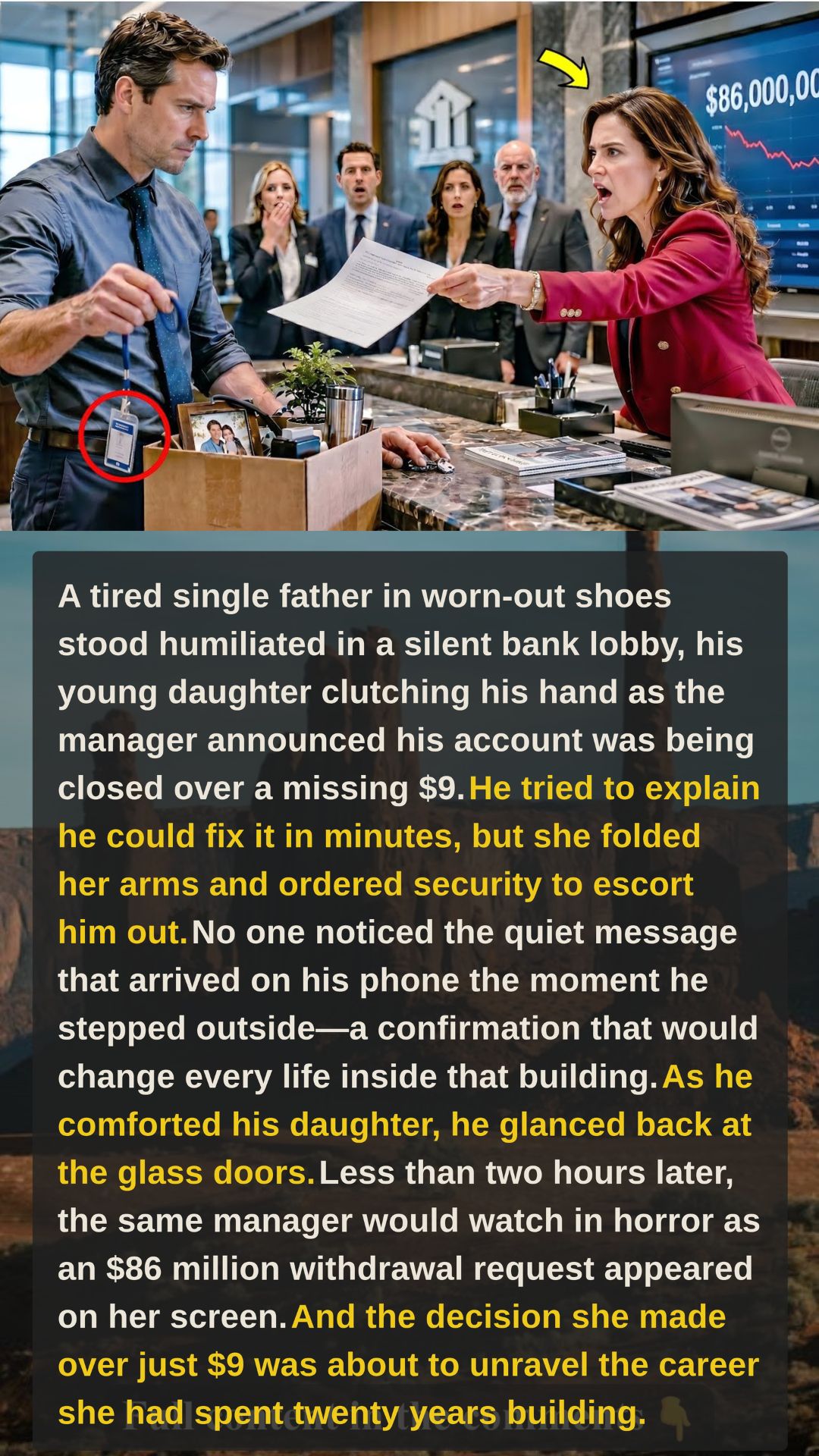
Twenty years of banking ended with one cardboard box.
On Friday afternoon, she walked out through the same lobby where she had humiliated Daniel Harper.
There were no cameras this time.
No raised voices.
No speech.
Just Rebecca holding a box with a framed certificate, a coffee mug, a small desk plant, and a nameplate wrapped in tissue paper.
Marcus watched from behind the counter.
So did the security guard.
Rebecca paused near the door.
For one second, her eyes moved toward the spot where Daniel had stood with Lily.
Her face looked smaller somehow.
Not because she had lost her job.
Because she finally understood what she had spent years losing before that.
Every customer she had dismissed.
Every person she had measured by shoes, coats, accents, balances, and paperwork.
Every complaint she thought did not matter because the people making them had no power.
They all mattered now.
They had always mattered.
She pushed the door open and stepped into the cold air.
Daniel did not celebrate.
He refused most interview requests.
He did not post a long statement.
He did not go on television to embarrass Rebecca further.
When a reporter finally reached him outside Lily’s school, Daniel only said, “I hope this makes banks train people to treat every customer with dignity before they know what that customer is worth.”
Then he got into his old blue pickup truck and drove home.
The next Monday, Daniel woke up again at 4:47.
He made oatmeal with cinnamon because Lily said pancakes were “for weekends and emergencies.”
He packed her lunch.
He checked her homework folder.
He drove her to school in the same dented truck.
Life did not suddenly become louder because people knew he had money.
Daniel would not allow it.
But something did change.
Three months later, the Harper Foundation opened quietly.
Its first programs helped single parents with emergency childcare, financial literacy, vocational training, and small startup grants.
The first grant went to a widowed mother who wanted to open a mobile bookkeeping service.
The second helped a father pay for after-school care while he completed an electrician certification.
The third funded weekend financial classes at a community center two blocks from the Northbridge branch.
Daniel attended the first class.
He sat in the back.
No suit.
No speech.
Just jeans, a gray sweater, and a paper cup of coffee.
When someone asked why he started the foundation, he looked at Lily, who was helping stack workbooks on a table, and said, “Because shame should never be the price of needing help.”
Years later, people still told the story of the bank manager who judged a man by his hoodie and lost an eighty-six-million-dollar client.
But the better story was never about the money.
It was about a father who had every reason to humiliate someone back and chose instead to expose the truth without becoming cruel.
It was about a little girl who learned that dignity is not something rich people buy.
It is something decent people give.
And it was about a lobby full of witnesses who saw, in real time, the oldest lesson in the world become impossible to ignore:
Treat people with respect before you know who they are, because the person you look down on today may be the one who reveals who you really are.


