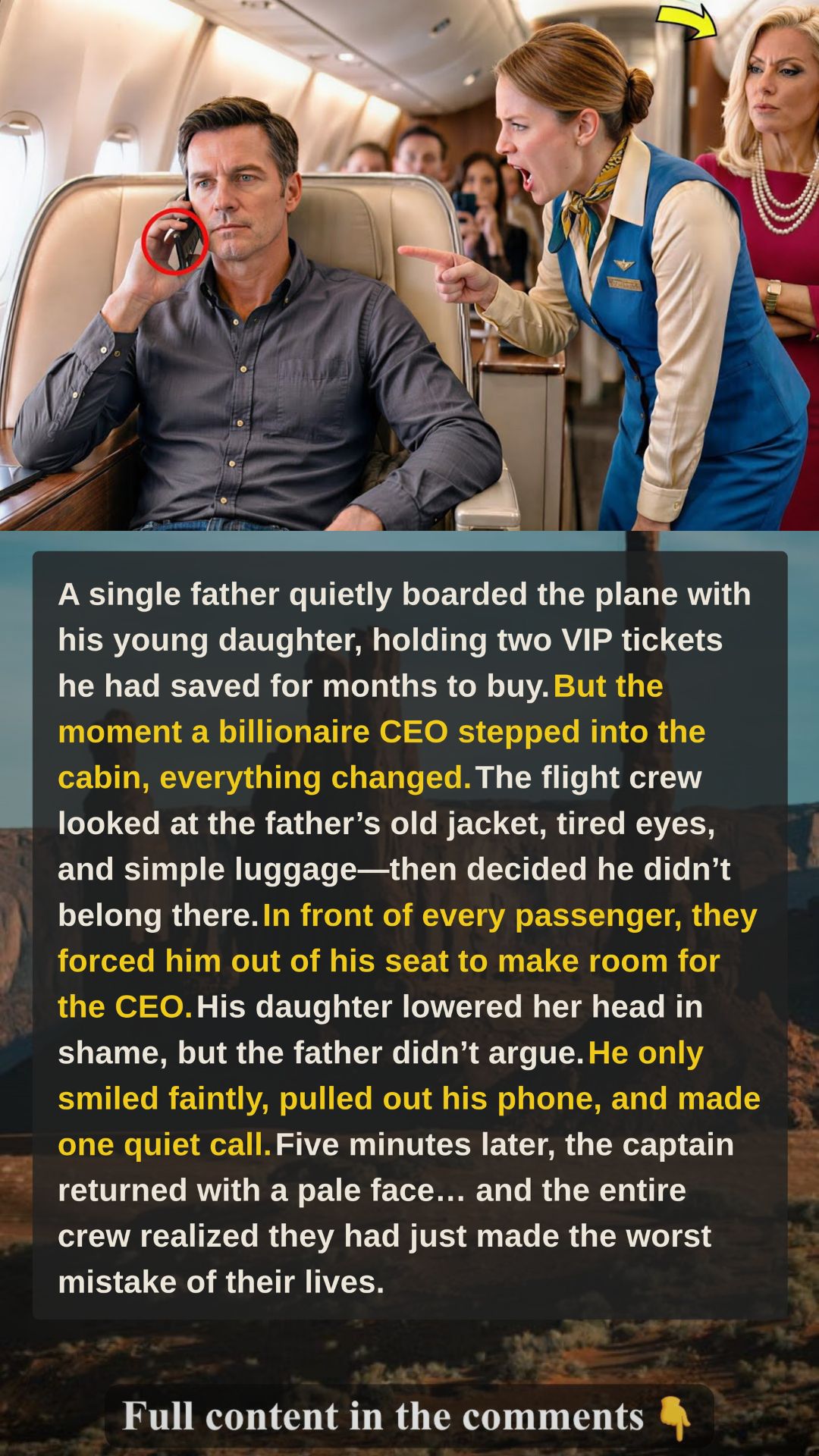
The single father was already holding his daughter’s teddy bear, her backpack, and both boarding passes when the cabin manager looked him in the eye and said, “Sir, we need you to move to economy.”
Daniel Harper thought he had misheard her.
His eight-year-old daughter, Lily, was sitting by the window in the VIP cabin, her small hands pressed against the glass, waiting to see the clouds from above for the first time in her life. Her birthday ribbon was tied around the ear of her worn brown teddy bear. Her sneakers didn’t reach the floor. Her eyes were bright in a way Daniel hadn’t seen in months.
He had saved for almost a year for these two seats.
And now, before the plane had even left the gate, someone was telling him they did not belong there.
Daniel looked down at the boarding passes in his hand.
Seat 2A.
Seat 2B.
Paid in full.
Booked six weeks earlier.
He kept his voice calm because Lily was listening.
“I’m sorry,” he said. “There must be some mistake. These are our seats.”
The cabin manager barely looked at the tickets.
Behind her, a woman in a cream designer suit stood near the aisle with a leather handbag, a phone in one hand, and an assistant hovering beside her. She did not look angry. She looked inconvenienced, as if the world had briefly failed to arrange itself properly around her.
The cabin manager lowered her voice, but not enough.
“We have a high-priority passenger who needs this section. We’re asking for your cooperation.”
Daniel’s hand tightened around the boarding passes.
Lily turned from the window.
“Daddy,” she whispered, “did we do something bad?”
That was the moment something inside Daniel cracked quietly.
Not loudly. Not dramatically.
Just enough for him to feel it.
Because he had spent three years making sure Lily never felt unwanted.
Three years since her mother, Rachel, had died of cancer.
Three years of early alarms before sunrise, cereal poured into a chipped blue bowl, lunch packed while coffee went cold, bus rides to work, double shifts when he could get them, homework at the kitchen table, and bedtime stories he sometimes read with his eyes half-closed from exhaustion.
Three years of learning how to braid hair from online videos.
Three years of standing in school offices, doctor’s waiting rooms, grocery lines, and parent-teacher meetings alone.
Three years of keeping one promise.
On Rachel’s last good day, when the hospital room smelled of antiseptic and the late afternoon light fell softly across her face, she had taken Daniel’s hand and said, “Promise me Lily will never feel alone.”
Daniel had promised.
He had not promised that life would be easy. He had not promised that he would never cry in the laundry room after Lily went to sleep. He had not promised that he would always know what to do.
But he had promised his daughter would never feel like she was facing the world by herself.
That promise became the shape of his life.
He stopped buying new clothes. He walked to work whenever the weather allowed. He repaired the same pair of shoes twice. He accepted extra hours at the warehouse even when his back hurt. Every few weeks, he put a little money into an envelope marked “Lily’s birthday.”
When Lily asked once why the envelope had a plane drawn on it, he smiled and said, “That’s a secret mission.”
The secret mission was simple.
He wanted to give his daughter one day that felt big.
Not expensive for the sake of showing off. Not luxurious because he cared about luxury. He just wanted Lily to see the ocean from above the clouds, the way Rachel had once described it to her when she was too little to remember.
“Your mom used to say the sea looks like a piece of sky that fell down to earth,” Daniel had told her.
Lily had listened with her teddy bear under her chin.
“Can we see it one day?”
“One day,” Daniel said.
And now that day had come.
At the airport that morning, Lily had worn her best yellow cardigan. She had asked the check-in agent three times if they were really flying “in the fancy seats.” The agent had smiled and told her, “Yes, birthday girl, you are.”
Daniel had felt something warm rise in his chest.
For once, he was not thinking about bills, late fees, groceries, or the hospital debt that still arrived in pale envelopes with sharp black print.
He was just a father watching his child step into a dream.
The VIP cabin felt unreal to them.
Wide seats. Soft lights. Polished trays. A flight attendant offering Lily orange juice before takeoff. A real pillow on the seat. A window all to herself.
Lily had looked at Daniel like he had moved the moon closer.
“Daddy,” she whispered, “this is the best day ever.”
Daniel had turned his face toward the aisle so she would not see his eyes fill.
Then the woman in the cream suit boarded.
The temperature in the cabin changed before anyone said a word.
The flight attendants straightened. The gate agent stepped on board. The cabin manager’s smile became tight and anxious. The woman’s assistant murmured something into her ear and pointed toward Daniel and Lily’s row.
Passengers noticed.
Nobody needed an announcement to understand that someone powerful had arrived.
The cabin manager walked directly to Daniel.
That was how the best day ever began to fall apart.
“Sir,” she repeated, “we need you to gather your belongings.”
Daniel handed her the boarding passes.
“I bought these seats,” he said quietly. “For my daughter’s birthday. We checked in properly.”
“I understand,” the cabin manager said, in the tone of someone who did not intend to understand anything. “But operational needs require a seating adjustment.”
The phrase sounded practiced.
“Operational needs?” Daniel asked.
The woman in the cream suit glanced at her watch.
Her assistant sighed.
A businessman across the aisle looked down at his phone. An elderly woman two rows back watched with troubled eyes. Somewhere behind them, someone had started recording.
Daniel stayed seated.
“Are we being downgraded?” he asked.
The cabin manager’s expression hardened.
“You’ll be accommodated in economy.”
“Will we be refunded?”
“That can be handled after the flight.”
“Why can’t she sit in the seat she purchased?” Daniel asked, nodding toward the woman.
The cabin manager’s lips pressed together.
“Sir, I’m asking you not to make this difficult.”
That sentence did what insults often do.
It made the innocent person sound guilty.
Lily slid closer to Daniel. Her teddy bear was crushed against her chest.
“Daddy, I can sit in a small seat,” she whispered. “It’s okay.”
Daniel looked at his daughter.
She was trying to rescue him.
An eight-year-old child was making herself smaller because adults in uniforms had decided her joy was less important than a stranger’s status.
Daniel felt heat rise in his face, but he swallowed it.
“I’m not trying to make anything difficult,” he said. “I just want what I paid for.”
The cabin manager stepped back and spoke into her radio. A moment later, another crew member arrived, followed by a gate supervisor with a badge swinging from her neck.
The supervisor did not ask Daniel what had happened. She did not kneel to Lily. She did not inspect the tickets closely.
She said, “Sir, we can call security, or you can cooperate and allow this flight to depart on time.”
The word security moved through the cabin like a cold draft.
Lily’s eyes widened.
Daniel could feel passengers watching. Some with sympathy. Some with discomfort. Some with the blank look people wear when they want injustice to end but do not want to be involved in ending it.
He imagined Lily being led off the plane on her birthday.
He imagined her crying at the gate.
He imagined the story she would carry afterward: the day Daddy tried to give her something beautiful, and the whole plane watched them be removed.
So Daniel stood.
Not because he was wrong.
Because his daughter was eight.
He folded the boarding passes carefully and put them in his jacket pocket. Then he picked up Lily’s backpack, her teddy bear, and the small gift bag containing a seashell necklace he had bought from a discount shop because Lily loved anything that reminded her of her mother.
“Come on, sweetheart,” he said softly.
Lily slid out of the seat.
The woman in the cream suit moved into 2A without a word.
Not one apology.
Not one glance at the child whose birthday seat she had taken.
As Daniel and Lily walked down the aisle, the cabin was silent except for the soft thud of Daniel’s shoes and the wheels of the assistant’s carry-on bag being lifted into the overhead bin.
Lily looked back once.
“But Daddy,” she whispered, “it was my birthday surprise.”
Daniel knelt in the aisle beside her, even though people were waiting behind them.
“I know,” he said.
His voice almost failed him, but he steadied it.
“Listen to me. A seat is just a seat. The important thing is that we’re together. Nobody can take that part.”
A woman nearby covered her mouth.
The elderly passenger who had been watching wiped her eyes.
Daniel took Lily’s hand and continued toward economy.
Their new seats were near the back, beside the restrooms. Lily sat by the window, but the wing blocked most of the view. Daniel buckled her seatbelt and placed the teddy bear in her lap.
He tried to smile.
She tried to smile back.
Both of them failed.
Five minutes later, the front door of the plane opened again.
A man stepped inside wearing a simple navy jacket, no tie, and carrying a small leather bag that looked older than the plane itself. He was in his late sixties, maybe early seventies, with silver hair and the kind of quiet posture that did not ask for attention.
Most passengers barely looked up.
But the pilot did.
The captain came out of the cockpit so quickly that the first officer followed him into the doorway. The gate supervisor froze. The cabin manager turned pale.
The man in the navy jacket stopped near the front galley and looked around.
“Captain,” he said calmly.
“Mr. Lawson,” the captain replied, his voice suddenly formal.
The name traveled through the crew faster than any announcement.
Michael Lawson.
Founder of Lawson Atlantic Airways.
Largest individual shareholder.
The man whose photograph appeared in the company’s training manuals, annual reports, and employee onboarding videos.
But most passengers did not know that yet.
Daniel certainly didn’t.
Michael Lawson had a habit very few people outside the company knew about. Several times a year, he flew anonymously on his own airline. No entourage. No special treatment. No warning to the crew beyond what was legally necessary. He wanted to see what passengers saw when executives were not standing nearby.
That morning, before boarding, a passenger in row three had quietly sent a message through a private investor contact listed on a corporate ethics page. She had included a photo of Daniel’s boarding passes and a short video of the exchange.
The message had reached Michael while he was still in the terminal.
He had not boarded immediately.
He had watched.
Now he stood at the front of the aircraft, looking at seat 2A.
The woman in the cream suit gave him a polished smile.
“Michael,” she said, as if they belonged to the same world.
He did not return the smile.
Instead, he looked at the cabin manager.
“Why are Mr. Harper and his daughter seated in economy?”
The cabin manager’s mouth opened.
No words came out.
The gate supervisor looked at the floor.
The assistant in the aisle stopped pretending to type.
Michael’s voice remained even.
“I asked a question.”
The silence became heavy enough for everyone to feel.
Finally, a passenger stood up. It was the elderly woman who had wiped her eyes earlier.
“They were removed from their seats,” she said. “They showed their tickets. They didn’t argue. That little girl was sitting there for her birthday.”
Another passenger raised his phone.
“I recorded it,” he said.
Then another person spoke.
“He never raised his voice.”
Another added, “They threatened security.”
A woman near the front said, “The CEO took the seat after they moved.”
The word CEO landed differently now.
The woman in the cream suit shifted in Daniel’s old seat.
For the first time since boarding, she looked uncomfortable.
Michael listened without interrupting.
Then he walked down the aisle.
Not to the crew.
Not to the woman in 2A.
To row 24.
Daniel looked up as Michael stopped beside him.
“Mr. Harper?” Michael asked.
Daniel stood halfway, confused.
“Yes?”
“I’m Michael Lawson. I owe you and your daughter an apology.”
Daniel blinked.
Lily looked from her father to the older man.
Michael crouched slightly so he was closer to Lily’s eye level.
“And you must be Lily.”
She nodded, holding her teddy bear tight.
“I hear today is your birthday.”
“Yes,” she said softly.
“Were you excited about the flight?”
Lily looked at Daniel before answering. Children often check whether the truth will hurt their parents.
Daniel gave the smallest nod.
Lily swallowed.
“Daddy worked really hard for the seats,” she said. “He said Mommy would have liked me to see the ocean from the clouds. But then we had to move because someone more important came.”
The plane went completely still.
That sentence did more than accuse anyone.
It revealed the whole wound.
Someone more important.
Daniel closed his eyes for a second.
The cabin manager stared at the floor. The gate supervisor’s face flushed. The woman in the cream suit stopped moving altogether.
Michael remained crouched in the aisle, but his expression changed.
Not into anger.
Into something more dangerous.
Clarity.
He stood slowly and turned toward the front of the plane.
“No,” he said, loud enough for every passenger to hear. “That is not what this airline believes.”
He walked back to the VIP cabin.
The woman in the cream suit began, “Michael, this is being blown out of proportion—”
He raised one hand.
She stopped.
That was her moment of recognition.
Her confident smile disappeared first. Then the color left her cheeks. Her shoulders, which had been held high since she boarded, lowered by an inch. She looked around and saw the phones, the faces, the witnesses. She saw that the silence around her was no longer obedience.
It was judgment.
Michael turned to the crew.
“Delay departure,” he said.
The captain nodded immediately.
Michael faced the entire cabin.
“Every employee on this aircraft represents this company. Not when it is easy. Not only when a wealthy passenger is watching. Every time they decide who deserves respect.”
Nobody moved.
“A paid seat is not taken from a father and child because another passenger appears more important. A child’s birthday is not treated as an inconvenience. A quiet man’s dignity is not something this airline is free to spend.”
The cabin manager’s eyes filled with tears, but Michael did not soften.
“To Mr. Harper and Lily, your seats will be returned immediately.”
The passengers erupted.
It started with one clap.
Then another.
Then the whole cabin burst into applause so sudden and loud that Lily jumped in her seat.
Daniel did not clap.
He sat very still, one hand over his daughter’s.
Michael turned to the woman in 2A.
“Ms. Whitmore, you will sit in the seat assigned on your boarding pass.”
Her assistant opened his mouth.
Michael looked at him once.
He closed it.
Ms. Whitmore rose slowly. She avoided Lily’s eyes as she passed row 24. She avoided Daniel’s too. The walk back to her actual seat was shorter than Daniel’s had been, but it looked far longer.
Then Michael addressed the cabin manager and gate supervisor.
“You are relieved of duty effective immediately. You will leave this aircraft before departure. Replacement crew will be assigned.”
The cabin manager whispered, “Mr. Lawson, please—”
He said, “You had multiple chances to do the right thing before I arrived.”
That ended it.
Two replacement crew members boarded within minutes. The removed staff stepped off the plane under the gaze of passengers who had watched them misuse authority and then lose it.
When Daniel and Lily returned to seats 2A and 2B, nobody stayed silent.
People smiled at Lily. Someone wished her happy birthday. The elderly woman gave her a small wrapped candy from her purse. A businessman who had avoided eye contact earlier finally looked at Daniel and said, “I should have spoken up. I’m sorry.”
Daniel nodded.
He did not shame the man.
He understood fear.
But Lily, climbing back into the window seat, looked at her father with wonder.
“Daddy,” she whispered, “we got the clouds back.”
Daniel laughed once, softly, because if he didn’t laugh, he might cry.
“Yes,” he said. “We did.”
After takeoff, the plane rose through a blanket of gray and broke into sunlight.
Below them, the clouds stretched like white fields. Far in the distance, the ocean appeared, blue and endless, exactly like Rachel had once described.
Lily pressed her teddy bear to the window.
Daniel looked at her face instead of the view.
That was enough.
A little later, Michael Lawson came back and asked if he could sit with them for a while. Not in the empty VIP seat beside another executive. Not in some symbolic place of power. He sat across the aisle from Daniel and asked him questions no one on that plane had thought to ask earlier.
What kind of work did he do?
How long had he been raising Lily alone?
What had Rachel been like?
Daniel answered slowly at first.
He did not turn his pain into a performance. He simply told the truth.
He worked warehouse logistics. He sometimes took overnight inventory shifts. Rachel’s treatment had left bills behind, but he did not regret a dollar spent trying to save her. Lily loved drawing maps, collecting shells, and asking questions about places they could not yet afford to visit.
Michael listened.
Really listened.
At one point, Daniel said, “I wasn’t trying to embarrass anyone. I just didn’t want my daughter to think people like us should move whenever someone with more money walks in.”
Michael looked toward the window.
“That may be the clearest description of customer dignity I’ve ever heard,” he said.
Daniel gave a tired smile.
“I’m just a dad.”
Michael shook his head.
“No. You’re exactly the kind of person companies forget to listen to.”
When the plane landed, Michael handed Daniel a card.
“Come to our headquarters next week,” he said. “Not for paperwork. Not for a public relations apology. I want to talk to you about something real.”
Daniel assumed it would be compensation. Maybe a refund. Maybe a formal apology in a conference room with bottled water and legal language.
He went anyway.
One week later, Daniel walked into Lawson Atlantic headquarters wearing the same navy jacket he wore to church and school meetings. He expected to meet a customer service director.
Instead, Michael was waiting for him.
On the table were printed screenshots from passenger videos, internal reports, training materials, and a folder with Daniel’s name on it.
Michael did not waste time.
“We have been searching for a Director of Customer Experience for eight months,” he said. “We interviewed people with impressive resumes. Hospitality executives. Consultants. Former airline managers.”
Daniel looked confused.
Michael continued.
“Most of them understood systems. Very few understood people.”
Daniel’s hands rested stiffly on his knees.
“I’ve never worked for an airline.”
“I know.”
“I don’t have a degree in customer relations.”
“I know that too.”
Michael leaned forward.
“But on that plane, under humiliation, you protected your daughter’s heart without surrendering your dignity. You stayed calm when others abused procedure. You understood the difference between policy and humanity. That is harder to train than aviation software.”
Daniel did not speak for a long moment.
He thought of Rachel.
He thought of Lily asking if they had done something bad.
He thought of every tired parent at every counter, every worker in worn shoes, every passenger who had ever been judged by clothes, accent, age, disability, or the size of their bank account.
“What would the job be?” he asked.
“To help rebuild how we treat people,” Michael said. “Training, escalation policies, complaint review, passenger dignity standards. You would have experienced managers under you. You would learn the industry. But the compass has to come from someone who remembers what it feels like to be powerless.”
Daniel looked down at the folder.
For years, he had thought survival was the limit of what life would allow him.
Work. Bills. Dinner. Homework. Sleep. Repeat.
Now someone was offering him a chance to make sure what happened to Lily did not become just another ugly story people forgot after scrolling past it.
He accepted.
Not because the title impressed him.
Because the purpose did.
One year later, Lawson Atlantic had changed in ways passengers could feel.
The company introduced a Passenger Dignity Policy that applied to every cabin, every route, every fare class. Staff were trained to resolve conflicts based on fairness, not status. No employee could downgrade a passenger without documented cause and supervisor review. Special treatment could no longer come at the expense of someone else’s paid rights.
Daniel helped design training sessions using real situations.
Not corporate slogans.
Real moments.
A mother traveling with a child with autism.
An elderly man confused by a gate change.
A janitor flying home for his brother’s funeral.
A young couple in economy who deserved the same courtesy as anyone in first class.
Employees who handled difficult moments with patience were rewarded publicly. Complaints were reviewed not just for legal exposure, but for human impact. Managers were evaluated on whether their teams protected dignity under pressure.
Customer satisfaction reached the highest level in the airline’s history.
But Daniel cared more about the smaller signs.
A gate agent kneeling to speak gently to a frightened child.
A flight attendant refusing to move a passenger just because someone “important” asked.
A supervisor apologizing before a situation became a scandal.
The story of Daniel and Lily’s birthday flight spread online after passengers posted their videos. Millions watched the moment a quiet father walked his daughter down the aisle after losing seats he had paid for. Millions watched the founder return those seats and remove the people who had abused their authority.
Parents commented that Daniel’s restraint taught them more than any speech could.
Workers in hotels, restaurants, hospitals, banks, and airports shared the story with captions like, “This is why how we treat people matters.”
Some people focused on Michael Lawson’s decision.
Others focused on the cabin manager’s downfall.
But the people who understood the heart of the story focused on Lily.
Years later, she would not remember the exact model of the plane. She would not remember the menu in the VIP cabin or the brand of the woman’s handbag.
She would remember her father’s hand holding hers when they were being humiliated.
She would remember that he did not shout, did not beg, and did not teach her to hate.
She would remember that when the world tried to make them feel small, he stayed steady enough for both of them.
And she would remember what he told her as the clouds opened and the ocean appeared below.
“Real worth,” Daniel said, “isn’t in the seat someone gives you. It’s in the way you treat people when you think nobody powerful is watching.”
Lily looked out at the endless blue, her teddy bear pressed against her heart.
She did not fully understand it then.
But one day she would.
Because that flight was never really about a VIP seat.
It was about a tired father who kept a promise to a woman he loved, a little girl who learned that dignity can survive humiliation, and an airline that changed because one child said the quiet truth out loud.
Money can buy a better seat, but it can never buy the kind of character that makes an entire plane stand up and clap.