My sister laughed before I even sat down.
Not loudly at first.
Just a bright little sound over the rim of her wineglass, sharp enough to make everyone at the table look at me and soft enough for her to pretend it was harmless.
“Elise,” she said, smiling in that careful way people smile when they want the knife to look decorative, “you wore the uniform to dinner?”
My mother’s fork paused above her salad.
My father glanced at my sleeves, then at the candles, as if my dress blues had tracked dirt across the white tablecloth.
My sister’s husband, Graham, looked up from his phone.
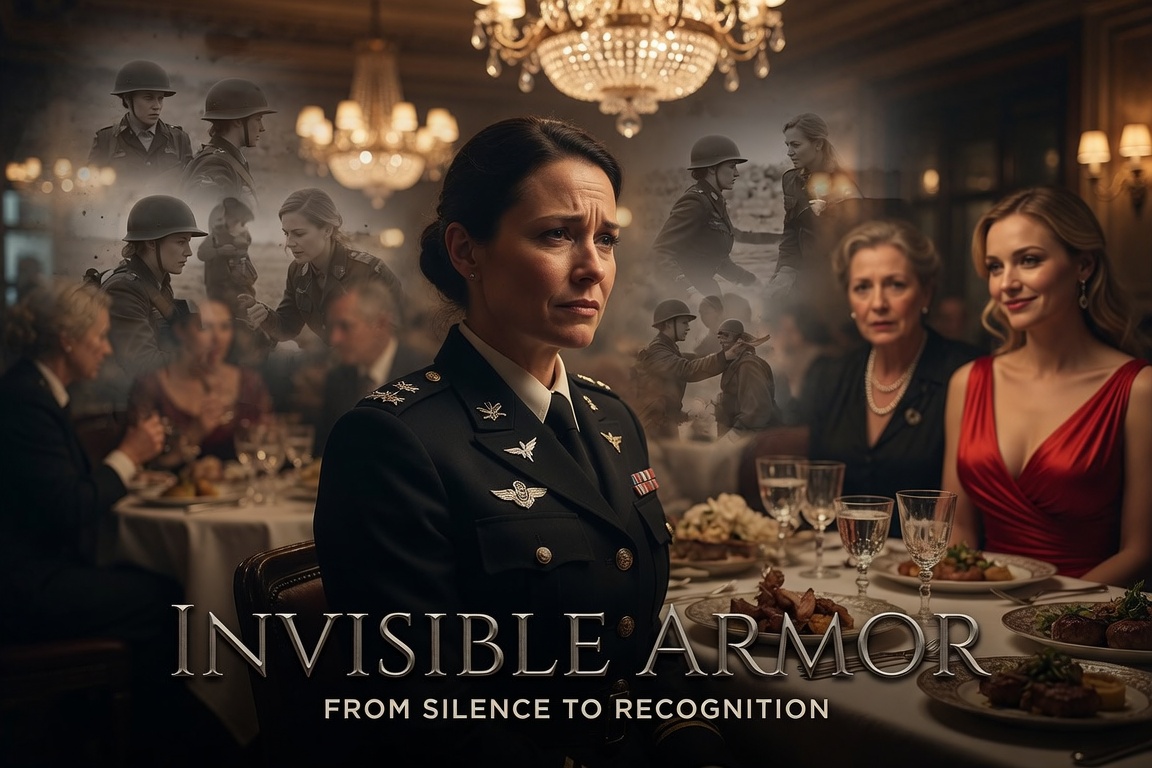
Then his face changed.
Only for a second.
But I saw it.
Soldiers notice small things because small things are where bodies survive.
Graham’s fingers went still around the phone. His jaw tightened. His eyes moved from my ribbons to my nameplate.
MONTGOMERY.
Then to the silver eagle on my shoulder.
Colonel.
Across the table, my sister raised her glass higher.
“Lighten up, Elise. You’re not at war here.”
The table laughed.
My mother laughed because she hated silence.
My father smiled because Victoria was his favorite.
My cousin Daniel laughed too loudly because he had always mistaken cruelty for sophistication when it came with expensive wine.
Everyone laughed.
Everyone except Graham.
And me.
What they did not know was that forty-seven minutes earlier, I had stood in a military mortuary and identified the bodies of two soldiers who never made it home. One had a wedding ring tied to his dog tags because his fingers were too damaged to hold it. The other had a folded drawing from his daughter sealed in a plastic evidence bag.
I had washed my hands three times before driving to my parents’ house.
The smell of smoke still lived under my nails.
I sat down.
The dining room was warm, golden, overdecorated. Rain ticked against the tall windows. White roses crowded the center of the table. The air smelled of rosemary lamb, butter, perfume, and the old lemon polish my mother used when she wanted the house to feel richer than it was.
Victoria leaned back, pleased with herself.
“You always did know how to make a family dinner feel like a court-martial.”
I unfolded my napkin.
My hands were steady.
That disappointed her.
Graham had not moved.
His face had gone pale under the chandelier light.
Finally, he spoke.
Not to my sister.
Not to my parents.
To me.
“You’re the Colonel?”
The laughter died so fast the rain sounded louder.
Victoria turned toward him, annoyed.
“What does that mean?”
Graham did not answer.
He was staring at me as if a locked door in his life had just opened from the wrong side.
I looked at him.
And in that moment, I understood two things.
First, my sister’s husband knew more about my work than he had ever admitted.
Second, the two dead soldiers I had identified were not the reason my day had ended badly.
They were the warning.
My name is Elise Montgomery.
For years, my family thought I was dramatic about duty because they had never paid the price of ignoring it.
Victoria was two years younger than me and had been born with the gift of making every room choose her. She had our mother’s blue eyes, our father’s smile, and a talent for turning need into charm. When she cried, people rushed. When she failed, someone explained. When she hurt me, the family called it personality.
I was the serious one.
The difficult one.
The one who corrected details, remembered debts, noticed when our father’s business partner lied about numbers, and refused to clap when Victoria performed innocence after breaking something.
By twelve, I learned that truth could make a child unpopular at her own breakfast table.
By twenty-two, I joined the Army.
My father told neighbors I was “finding discipline.”
My mother told church friends I was “going through a phase.”
Victoria told her college roommates I had joined because I liked being yelled at by men.
I let them talk.
Then I built a career in military intelligence and logistics command, the kind of work that sounded dull until men died without it. Routes. suppliers. convoys. threat maps. casualty chains. procurement anomalies. The hidden bloodstream of war.
I learned that bullets make noise, but corruption kills quietly.
I also learned that family contempt is easier to survive from another continent.
Then Victoria married Graham Ellis.
He arrived in our family like a polished apology. Tall, handsome, controlled. Former defense contractor, now partner in a private logistics firm. He shook my father’s hand firmly, complimented my mother’s cooking, laughed at Victoria’s jokes exactly half a beat too late.
I disliked him before I had proof.
That was not intuition.
It was pattern recognition.
At dinner, Victoria loved watching me become small.
She had invited me three times that week, each message more insistent than the last.
Mom says you never come anymore.
Dad thinks you’re avoiding us.
Graham wants to finally hear about your “secret Army stuff.”
I almost declined.
Then the bodies arrived.
Two soldiers from a convoy attack near the Syrian border. Staff Sergeant Evan Pierce and Specialist Nolan Reed. Both attached to a humanitarian security transfer that should never have been exposed.
The route had been compromised.
Not guessed.
Sold.
I saw it in the damage pattern before the investigation file confirmed it. The ambush team knew the convoy would stop at Checkpoint Lark at 0410. They knew which vehicle carried medical satellite equipment. They knew the American escort strength had been reduced by two that morning.
Someone had fed them the schedule.
Forty-seven minutes after leaving the mortuary, I walked into my parents’ dining room in uniform because I had not had time to change, and because part of me no longer cared who felt uncomfortable seeing what service looked like before dessert.
Now Graham knew my rank.
And he was afraid of it.
My father cleared his throat.
“Elise,” he said, “is there some reason Graham should know your rank?”
I looked at Graham.
“Ask him.”
Victoria laughed, brittle now.
“Don’t be weird.”
Graham placed his phone face down beside his plate.
“Victoria.”
“What?”
“Stop talking.”
The room froze.
My sister blinked.
No one told Victoria to stop talking.
Not in that tone.
Her cheeks flushed. “Excuse me?”
Graham did not look at her.
His eyes stayed on me.
“I didn’t know your first name.”
A small chill moved through me.
My mother frowned. “What on earth does that mean?”
Graham swallowed.
“I knew a Colonel Montgomery. From contract briefings. But files only used rank and last name.”
My father leaned back.
“Contract briefings?”
I set my napkin beside the plate.
“What company?”
Graham’s lips pressed together.
Victoria’s eyes darted between us.
“Elise, don’t interrogate my husband at dinner.”
I looked at her.
“Your husband just recognized me from classified logistics files.”
Her face changed.
Not enough.
But some.
Graham said, “It wasn’t classified on my side.”
“That’s not reassuring.”
The room seemed to tighten around the chandelier.
Rain slid down the windows in silver lines.
My father’s voice lowered.
“Graham, answer her.”
He sounded annoyed, not concerned.
He still thought this was a manners problem.
Graham reached for his water glass, then stopped before touching it.
“Northstar Meridian.”
The name landed like a second body on the table.
Northstar Meridian had bid on military humanitarian supply contracts for three years. Clean website. veteran hiring page. patriotic language. Their paperwork always arrived perfect.
Too perfect.
My team had flagged them twice for routing irregularities.
Both times, the inquiry disappeared into contractor review.
I looked at Graham’s phone.
“Who called you before dinner?”
He went still.
Victoria’s voice sharpened.
“Why are you looking at his phone?”
“Because he checked it every thirty seconds until I sat down.”
Graham closed his eyes once.
The first crack.
My mother whispered, “Elise, please.”
Please what?
Please don’t ruin dinner.
Please don’t embarrass Victoria.
Please don’t make truth louder than lamb and candles.
I turned back to Graham.
“Who called you?”
He answered so quietly I almost missed it.
“Julian Crest.”
My father’s hand tightened around his wineglass.
He knew the name.
Of course he did.
Julian Crest was not just Northstar Meridian’s chief executive.
He was an old friend of my father’s.
Golf partner. donor. guest at Victoria’s wedding. A man who sent Christmas baskets filled with imported pears and cards signed in black fountain pen.
My father said, “Julian is a reputable businessman.”
I looked at him.
“Two soldiers came home in bags today because a convoy route was sold.”
My mother gasped.
Victoria went pale.
My father’s face hardened.
“You don’t know that.”
“No,” I said. “I know enough to ask why your son-in-law is receiving calls from a contractor under review after recognizing me as the colonel attached to the compromised route.”
Graham whispered, “I didn’t sell anything.”
The table went silent.
Not because he denied guilt.
Because he knew what the crime was.
Victoria slowly turned toward him.
“Graham?”
He looked at her then.
And for the first time since I had known him, his polished face broke into something ugly and human.
“I thought it was equipment routing,” he said. “Civilian channeling. Nothing tactical.”
My chair scraped back.
My father stood. “Stop.”
I turned to him.
His face had gone red.
“Sit down, Elise. This is not your command.”
I stared at the man who had spent my whole life confusing volume with authority.
Then my phone buzzed.
A secure number.
I answered.
“Montgomery.”
A man’s voice came through, tight and breathless.
“Ma’am, this is Captain Rios. We found the leak marker. It ties to a civilian procurement mirror.”
“Name.”
“Northstar Meridian.”
Graham lowered his head.
Rios continued.
“There’s more. The access relay came through a domestic IP registered to Ellis Residential Holdings.”
Victoria stood so fast her wine spilled.
Red spread across the tablecloth like a wound.
“Ellis?” she whispered.
Graham covered his face with one hand.
My sister looked at me then.
Not mocking.
Not angry.
Afraid.
And for one brief, terrible moment, she looked young.
The way she had at nine after breaking our mother’s vase, waiting for me to take blame because I always did.
I ended the call.
Outside, headlights swept across the front windows.
One car.
Then another.
Black SUVs stopped in my parents’ driveway.
My father looked at the windows.
“What did you do?”
There it was.
The family reflex.
Not what happened.
What did you do?
I picked up my cover from the chair.
“What I’m trained to do.”
The doorbell rang.
My mother made a small sound.
Graham whispered, “I’m sorry.”
Victoria stared at him.
“You said your company was just consulting.”
He did not answer.
I walked to the foyer.
The house seemed different now. Same polished floors. Same framed family portraits. Same staircase where Victoria had once cried until my father grounded me for “upsetting her.” But truth changes architecture. Rooms shrink around lies.
I opened the door.
Two Army CID agents stood beneath the porch light, rain darkening their coats.
Behind them, a federal investigator I knew too well.
Special Agent Mara Voss.
Sharp eyes. No umbrella. Patience of a woman who had spent years watching powerful men explain why paperwork could not be crime.
“Colonel Montgomery,” she said.
“Agent Voss.”
Her gaze moved past me into the dining room.
“Is Graham Ellis inside?”
“Yes.”
“Is he armed?”
I thought of Graham’s shaking hands.
“No.”
“Is Julian Crest present?”
My blood cooled.
“No.”
Voss’s jaw tightened.
“He was seen entering this residence through the rear gate twelve minutes ago.”
Behind me, from the kitchen, glass shattered.
I moved before anyone else understood.
Agent Voss drew her weapon.
The dining room erupted in shouting.
I ran through the hall, past my mother’s cry, past my father calling my name like a command he no longer owned.
The kitchen smelled of garlic, rain, and broken wine.
The rear door stood open.
Cold air rushed in.
Victoria stood near the counter, one hand pressed to her mouth.
Graham was on the floor, blood at his temple, alive but dazed.
And Julian Crest stood behind my mother with a knife pressed lightly against her throat.
He looked exactly as he always had.
Silver hair. tailored suit. calm smile.
A man who could discuss treason while choosing pears.
“Colonel Montgomery,” he said. “I was hoping dinner would last longer.”
Agent Voss entered behind me, weapon raised.
My father stopped in the doorway.
His face emptied.
“Julian?”
Crest’s smile softened.
“Edward. You always did host memorable evenings.”
My mother trembled against him.
The knife touched a bead of blood to her skin.
I lifted one hand.
“Let her go.”
Crest looked at my uniform.
“You’re younger than I expected. In the files, Colonel Montgomery seemed more…” He tilted his head. “Abstract.”
“Most problems do until they arrive armed.”
He chuckled.
Graham groaned on the floor.
Victoria dropped beside him, her hands fluttering uselessly near his face.
Crest’s eyes flicked to her.
“Sweet girl. Always so easy to impress.”
My sister froze.
That insult landed where mine never could.
My father took one step forward.
“Julian, what is this?”
Crest’s expression cooled.
“This is your daughter bringing a federal investigation to your dining room.”
“My daughter identified a breach.”
“She identified a revenue stream.”
Voss’s voice cut in.
“Drop the weapon.”
Crest ignored her.
He looked at my father.
“You knew Northstar moved sensitive supply data.”
My father’s mouth opened.
No sound.
The room shifted.
I turned slowly toward him.
“Dad?”
His eyes met mine.
For once, no anger came.
Only fear.
“I thought it was bid intelligence,” he said. “Procurement timing. Vendor advantage. Julian said everyone did it.”
My mother’s eyes filled with tears under the knife.
Victoria whispered, “Daddy?”
Crest sighed.
“You see? Family is so sentimental. Edward only wanted his daughter’s husband to succeed. A few introductions. A few harmless advisory calls. A retired executive helping another generation.”
I stared at my father.
The man who had called my uniform excessive at dinner had helped feed the channel that exposed my convoy.
Maybe not knowingly.
But comfortingly.
That was almost worse.
“You gave Crest access to Graham,” I said.
My father swallowed.
“I made introductions.”
“And when I asked questions, you told me to sit down.”
His face twisted.
“I didn’t know soldiers died.”
The kitchen went silent except for my mother’s shaky breathing.
I believed him.
That hurt.
Ignorance can be real and still unforgivable.
Crest shifted toward the rear door.
“Enough family therapy.”
His grip tightened on my mother.
“Colonel, you will give Agent Voss your phone and order your people to pause whatever digital seizure they’re running.”
“No.”
The word left my mouth before strategy could dress it.
My mother whimpered.
Crest’s eyes narrowed.
“I will cut her.”
“Yes,” I said.
My father made a broken sound.
I kept my eyes on Crest.
“You’ll cut her if I comply too. Maybe not here. Maybe later. People like you don’t leave witnesses. You repurpose them or remove them.”
His smile vanished.
There he was.
Not the donor.
Not the family friend.
The contractor who had sold routes and called blood a market adjustment.
My phone buzzed again.
Crest’s eyes dropped.
I did not move.
Agent Voss shifted slightly left.
Crest noticed.
Smart.
He dragged my mother backward toward the open door.
Then Graham spoke from the floor.
“Julian.”
His voice was weak.
Crest looked down despite himself.
Graham’s hand slid beneath the fallen tablecloth.
Not toward a weapon.
Toward the wine bottle Victoria had knocked over.
He rolled it hard across the tile.
It struck Crest’s ankle.
Small thing.
Enough.
My mother twisted away.
Voss moved.
I crossed the space in three steps.
Crest swung the knife.
It opened a line across my left forearm before I drove his wrist into the counter edge.
The knife clattered into the sink.
Voss took him down hard against the tile.
My father caught my mother before she fell.
Victoria sobbed over Graham.
The kitchen filled with agents.
Boots. voices. radios. cuffs.
Crest looked up from the floor, cheek pressed to tile, blood at his lip.
His eyes found mine.
“Two soldiers,” he said softly. “You think this is about two soldiers?”
I knelt beside him.
“No,” I said. “It’s about every person you counted before they were dead.”
His smile returned faintly.
“Then count your family carefully.”
The words stayed with me.
They were not a threat.
They were a direction.
By midnight, my parents’ house had become a crime scene.
Yellow markers on kitchen tile. Blood on the counter. Wine drying into the dining tablecloth. CID agents photographing my father’s study. Federal technicians imaging Graham’s phone while a medic checked the cut on my arm.
Victoria sat on the staircase in her silk dinner dress, knees drawn together, mascara streaked under both eyes. She looked at my uniform differently now.
Not with respect.
Not yet.
With accusation turned inward.
That can look similar from a distance.
Graham had been taken to the hospital under guard. He was conscious when they loaded him into the ambulance. He kept asking for Victoria. She did not go with him.
My father stood in the foyer with Agent Voss.
He was speaking.
Finally.
Names. dates. golf outings. consulting calls. documents Crest had asked him to forward. harmless favors that were not harmless. harmless introductions that had formed a chain of access from my family dining room to a convoy ambush site.
My mother sat in the living room, wrapped in a blanket, touching the small bandage at her throat.
I stood in the hallway listening to my father confess in the careful language of men who still hope precision can reduce guilt.
Then Victoria approached me.
She had taken off her heels.
Without them, she seemed smaller.
“Were they young?” she asked.
I looked at her.
“The soldiers.”
I saw them again.
Pierce’s ring.
Reed’s daughter’s drawing.
“Yes.”
She wrapped her arms around herself.
“Did they suffer?”
That question nearly undid me.
Not because it was cruel.
Because it was the first real one she had asked.
“Yes,” I said.
Her lips trembled.
“And I laughed at your uniform.”
I did not comfort her.
Some pain should be allowed to do its work.
Victoria looked toward the dining room.
“I thought you wore it to make us feel small.”
“No.”
“Why did you wear it?”
I looked down at the sleeve where blood had soaked through the fresh bandage.
“Because I didn’t have time to take off the day.”
She closed her eyes.
The sentence reached her.
Finally.
“I was jealous of you,” she whispered.
That surprised me enough to make me silent.
Victoria laughed once, bitter and broken.
“I know. Ridiculous. Everyone chose me, right?”
I said nothing.
She looked at me.
“Dad protected me. Mom excused me. You cleaned up after me. And still, whenever you walked into a room, I felt like you had already survived something I would never understand.” Her mouth twisted. “So I made fun of what I couldn’t reach.”
The old anger in me stirred.
Tired.
Still alive.
“You made my life smaller because yours felt shallow?”
She flinched.
“Yes.”
Honesty can be ugly and still be necessary.
She wiped her face with the heel of her hand.
“Graham used me, didn’t he?”
I thought about it.
“He married into access.”
Her face crumpled.
“And me?”
“You were part of the access.”
She sat down on the bottom stair like her bones had gone loose.
For years, I had imagined Victoria finally being humbled.
It did not feel like victory.
It felt like watching a chandelier fall and realizing it could crush anyone underneath.
Agent Voss approached.
“Colonel.”
I turned.
“We found something in Crest’s encrypted messages. There are references to ‘the sister channel.’”
Victoria looked up sharply.
“What does that mean?”
Voss’s eyes moved to her.
“Mrs. Ellis, your charity foundation processed donations from Northstar Meridian-linked entities.”
Victoria’s mouth opened.
No sound.
Of course.
Victoria’s military spouse wellness charity.
Her galas. Her glossy brochures. Her speeches about supporting families who serve, delivered while she mocked the only soldier at her own table.
She looked at me, horror rising.
“I didn’t know.”
I believed that too.
Again, it was not enough.
Voss said, “We’ll need your records.”
Victoria nodded quickly.
“Yes. Yes, anything.”
My father turned from the foyer.
For the first time in my life, he looked at both his daughters and did not know which one needed saving.
Good.
Maybe uncertainty would teach him something command never had.
The next morning, rain gave way to a hard blue sky.
My parents’ house looked obscene in daylight.
Too normal.
White columns. wet lawn. roses bent under water. A small American flag near the porch that my mother changed every Memorial Day. Crime scene tape fluttered near the rear gate.
I had slept one hour in my childhood bedroom.
The room had become a guest room years ago. Pale gray walls. No trophies. No posters. No evidence I had once lived there except a small dent in the windowsill where I used to tap Morse code with a pencil when I could not sleep.
I woke before dawn and found my father in the kitchen.
The broken glass was gone.
The blood cleaned.
The room smelled of bleach and coffee.
He stood at the sink in shirtsleeves, staring at the backyard.
For the first time, he looked like an old man borrowing his own house.
“Elise,” he said without turning.
“Dad.”
He flinched at the formality.
I let him.
“I gave Voss everything I remembered.”
“Good.”
“I thought Crest was helping Graham.”
“He was.”
My father turned.
His eyes were red.
“I thought I was helping Victoria.”
“You were.”
The words struck him because they did not absolve him.
He gripped the counter.
“I never understood your work.”
“You never tried.”
His mouth tightened.
“I didn’t know how to talk to you.”
“So you chose not to respect me?”
He looked down.
There it was.
Not denial.
Not defense.
Shame.
“You scared me,” he said.
That was not the answer I expected.
He swallowed.
“Victoria needed me. She always needed someone. You came home from war zones and stood in my hallway like nothing could touch you. I told myself you were fine because I did not know what to do if you weren’t.”
The coffee machine hissed.
Outside, water dripped from the gutters.
I thought of myself at twenty-six, home for one week, waking from nightmares in this very house and walking circles around the backyard until dawn because I refused to wake anyone.
Had I wanted him to notice?
Yes.
Had he?
Maybe.
Had he chosen comfort over courage?
Definitely.
“I wasn’t fine,” I said.
His face folded.
“I know that now.”
“No. You know it because my uniform became useful evidence.”
He closed his eyes.
Pain moved through him.
Good.
Let it.
He opened them.
“I am sorry.”
The words were heavy.
Late.
Small against the dead.
Still, they existed.
I poured coffee into a mug.
Not for him.
For myself.
“I don’t know what to do with that yet.”
He nodded.
“I don’t expect you to.”
That was new.
Expectation had always been the tax he placed on apology.
Victoria came downstairs wrapped in one of our mother’s robes.
She looked from him to me and stopped in the doorway.
For once, she did not enter like the room belonged to her.
“Agent Voss is coming back at nine,” she said.
My father nodded.
Victoria looked at me.
“I’ll give them the charity files.”
“You should.”
Her lips pressed together.
“I asked because I wanted you to tell me it wasn’t my fault.”
I looked at her.
“I know.”
“And you won’t.”
“No.”
She nodded, tears rising.
“Okay.”
A hard little word.
Maybe the first honest foundation she had ever laid.
The investigation lasted months.
Northstar Meridian collapsed within six weeks. Julian Crest was indicted on conspiracy, fraud, and providing material intelligence to hostile intermediaries through humanitarian logistics channels. Graham cooperated after two days in federal custody and three hours alone with Victoria, who left the detention center without her wedding ring.
My father avoided indictment, but his testimony destroyed his reputation in the circles he had spent decades trying to impress. He resigned from three boards. Friends stopped calling. The country club suspended his membership with the kind of polite cruelty rich men reserve for contaminated peers.
Victoria’s charity survived only after she stepped down, surrendered records, and publicly apologized for allowing donor vanity to outrun oversight. The apology was stiff, imperfect, and visibly painful.
That made it better.
Graham’s cooperation revealed the final piece: my name had appeared in Northstar’s internal risk files for eight months.
Not Elise.
Not sister.
Colonel Montgomery.
The obstacle.
The one they thought could be managed through family embarrassment, dinner invitations, and the soft pressure of old wounds.
They had not planned on death arriving before dessert.
Staff Sergeant Evan Pierce and Specialist Nolan Reed received posthumous honors after the inquiry confirmed their convoy had been deliberately compromised. I attended both ceremonies. Pierce’s widow handed me his ring and asked me to touch it before she placed it back in the display case. Reed’s daughter gave me a drawing of three people holding hands under a yellow sun.
I kept a copy in my office.
Some days, command is numbers, routes, signatures, and threat windows.
Some days, it is a child’s sun drawn in crayon because her father cannot come home to draw one with her.
Six months after the dinner, Victoria asked to see me.
I almost said no.
Then I chose a coffee shop near the river, neutral ground with scratched wooden tables and windows fogged by winter breath. It smelled of espresso, cinnamon, wet coats, and burnt sugar.
Victoria arrived early.
That was new.
She wore no jewelry except small silver earrings. Her hair was tied back. Without the glossy armor, she looked tired in a way I understood too well.
She stood when I approached.
Then seemed unsure whether to hug me.
I sat.
She sat.
For a while, we listened to the espresso machine scream.
Finally, she placed an envelope on the table.
“What’s that?”
“Copies of every charity record I gave investigators.”
“Why give them to me?”
“Because I don’t want you to have to wonder later whether I kept anything.”
I looked at the envelope.
Then at her.
“Did you?”
“No.”
She met my eyes.
For once, I believed her without needing to.
That was something.
Victoria wrapped both hands around her cup.
“Graham signs the plea next week.”
“I heard.”
“He says he loved me.”
I said nothing.
She laughed softly, without humor.
“I think he loved what I gave him access to. And maybe he loved how easy I was to flatter.”
The old Victoria would have waited for me to disagree.
This one did not.
She looked out at the gray river.
“I mocked your uniform because I thought it took you away from us.”
“No,” I said. “The family pushed me out before the uniform gave me somewhere to stand.”
Her eyes filled.
She nodded.
“I know.”
We sat with that.
No dramatic forgiveness.
No violin music.
No sisterly embrace strong enough to erase years.
Just two women at a small table with coffee cooling between them and a truth neither could unknow.
After a while, Victoria said, “Were you really identifying bodies that night?”
My throat tightened.
“Yes.”
She closed her eyes.
“I am so sorry.”
This time, the words did not ask me to absolve her.
They simply arrived and stayed.
I nodded once.
“Thank you.”
It was not enough.
It was real.
The next time I wore the uniform to my parents’ house, no one laughed.
It was late spring.
My mother had asked if I would come for dinner. She did not say Victoria needed it or Dad wanted peace or please don’t make this difficult.
She just asked.
That mattered.
I arrived in uniform because I had a base ceremony afterward and no time to change.
My father opened the door.
His eyes moved once to the eagle on my shoulder.
Then to my face.
“Colonel,” he said.
Not teasing.
Not stiff.
Acknowledging.
I stepped inside.
“Dad.”
The house smelled of roast chicken, lemon polish, and rain on the garden outside. The dining room table had no roses this time. Just plates, water glasses, and a small drawing framed near the sideboard.
Reed’s daughter’s yellow sun.
My mother had asked if she could frame a copy.
I had said yes.
Victoria was already seated, sleeves rolled, no wineglass in hand.
She looked nervous.
Graham was gone.
His chair had been removed from the table.
That silence was part of the meal.
My father held out a chair.
Not the one near the end.
The one beside him.
It would have been easy to call that too little, too late.
It was.
I sat anyway.
Dinner was quiet at first.
Real quiet.
Not the old kind, full of things swallowed whole.
This one had space.
Halfway through, my father set down his fork.
“Elise,” he said.
Everyone looked at him.
He swallowed.
“I read the public report today. The corrected one.”
My hand tightened once under the table.
“Did you?”
He nodded.
“The two soldiers. Pierce and Reed.”
Their names in his mouth changed the room.
“I’m sorry,” he said. “For speaking before I understood what your day had been. For all the times I did that.”
My mother’s eyes filled.
Victoria looked down at her plate.
I watched my father carefully.
No performance.
No command voice.
No request for forgiveness hidden beneath apology.
Just a man placing the truth on the table and leaving it there.
“Thank you,” I said.
His eyes reddened.
He nodded.
Outside, rain began again.
Soft this time.
The kind that made the windows glow instead of vanish.
After dinner, Victoria helped me carry plates to the kitchen.
We stood at the sink together, shoulders nearly touching, washing dishes like ordinary sisters in a life that had never quite been ours.
She handed me a wet plate.
“I still don’t know how to talk to you sometimes,” she said.
I dried it.
“Start without jokes.”
She nodded.
“I can try.”
“That’s a start.”
She looked toward the dining room, where Dad and Mom spoke quietly beneath the chandelier.
“Do you think families can recover from what they helped break?”
I thought of Pierce’s widow.
Reed’s daughter.
Graham’s face when he realized cowardice had become crime.
Crest on the kitchen floor.
My father saying Colonel for the first time like he meant person, not rank.
“I think families can stop pretending nothing broke,” I said. “Recovery is what happens after, if people keep showing up honestly.”
Victoria looked at me.
“And if they don’t?”
I placed the plate on the counter.
“Then you stop bleeding to prove you belong.”
She absorbed that.
So did I.
Later, as I left for the base ceremony, my father walked me to the door.
The porch smelled of wet wood and spring soil.
He cleared his throat.
“I know I don’t have the right to ask.”
I waited.
“Would you tell me sometime,” he said, “about your work? Only what you can. Only if you want.”
The old me would have given him everything because he asked softly.
The new me knew softness was not the same as safety.
“Maybe,” I said.
He nodded.
“Maybe is more than I deserve.”
That was true.
It was also more than he had asked for before.
I stepped into the rain.
“Elise.”
I turned.
My father stood framed in the doorway, older, diminished, trying.
“Be careful.”
I almost smiled.
“I’m not at war here, remember?”
Pain crossed his face.
Then something like humility.
“No,” he said. “But I should have known you still carried it.”
I drove to the ceremony under a gray sky.
The road shone with rain. Traffic lights blurred red and green across the windshield. In the passenger seat lay the framed copy of Reed’s daughter’s drawing. I was taking it to my office, where it would sit beside maps, threat charts, logistics reports, and all the quiet machinery that keeps people alive when no one at dinner understands what command costs.
My phone buzzed at a stoplight.
Victoria.
Thank you for coming tonight. No joke. Just thank you.
I read it once.
Then set the phone down.
Not everything needs immediate reply.
Some messages deserve to breathe.
At the base, I parked near the ceremony hall and sat for a moment listening to rain tick against the roof.
Months ago, my sister mocked my uniform at dinner.
Then her husband froze and said, “You’re the Colonel?”
Everyone thought that was the moment my hidden rank was revealed.
They were wrong.
Rank was never the secret.
The secret was how much I had carried while letting them call me dramatic.
The secret was how many rooms I had entered after death and still walked into family dinner without screaming.
The secret was that being invisible had never made me powerless.
It had only made them careless.
I adjusted my collar.
Checked the silver eagle on my shoulder.
Then I stepped out into the rain and walked toward the lighted hall.
Not to prove who I was.
Not anymore.
I knew.
And for the first time, that was enough.