The DARKEST Truth Of The Nazi Breeding Farms

The room looked nothing like a place of terror.
Fresh white sheets covered the beds. Nurses moved quietly through spotless corridors. Newborn babies slept in polished wooden cribs beneath carefully folded blankets.
There were no guard towers outside.
No barbed wire.
No smoke rising from chimneys.
Yet every child inside that building had already been judged.
Before the baby could speak, walk, or recognize its own mother, Nazi officials had examined its ancestry, measured its body, and decided whether its life was valuable.
The building belonged to Lebensborn, the SS-controlled program often remembered as Hitler’s network of “breeding farms.”
For decades, stories described secret compounds where selected women were paired with SS officers to manufacture blond-haired, blue-eyed children.
That image was horrifying.
But it was not the darkest truth.
The real system was quieter, more bureaucratic, and in many ways even more disturbing.
Because Lebensborn was not simply an attempt to produce more babies.
It was part of a plan to decide which children deserved to exist, which mothers deserved to keep them, and which families could have their identities erased forever.
Lebensborn—German for “Fountain of Life”—was founded under Heinrich Himmler’s authority in December 1935. Its stated purpose was to increase the birth rate among people the Nazi regime classified as racially valuable and “hereditarily healthy.”
At first glance, the program could almost appear compassionate.
Germany still carried a powerful stigma against unmarried mothers. A pregnant woman without a husband could lose her job, be rejected by her family, or be publicly humiliated.
Lebensborn offered another option.
Women who passed the organization’s racial investigations could enter secluded maternity homes. There, they received food, medical care, protection from public judgment, and the possibility of giving birth anonymously.
Brochures were reportedly passed discreetly through doctors and nurses to pregnant women considered suitable for the program.
But the protection came with a condition.
The mother was not treated as an individual whose dignity mattered.
She was treated as the carrier of desirable blood.
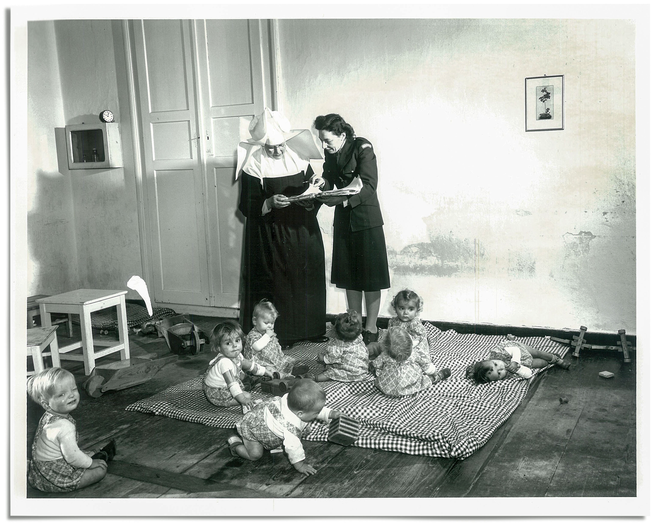
Before admission, officials investigated the ancestry of both parents. They wanted evidence that the child would fit the Nazi fantasy of a biologically superior German population.
The questions were not merely medical.
Who were the grandparents?
Was there Jewish ancestry?
Was there a history of mental illness?
Did the father belong to the SS?
Was the mother physically and politically acceptable?
A pregnancy that met the racial rules was welcomed.
A pregnancy that did not was evidence of contamination.
Inside the homes, births took place beneath the authority of an organization run by the same SS that enforced racial persecution across Europe.
That contradiction was the heart of the system.
The Nazis could surround one infant with nurses, milk, clean clothing, and careful medical attention while condemning another child to starvation, forced labor, deportation, or death.
The difference was not innocence.
Both children were innocent.
The difference was a racial classification written on paper.
The first Lebensborn maternity home, Heim Hochland, opened in 1936 near Steinhöring in Bavaria. Other facilities followed in Germany and, during the war, in occupied countries—especially Norway. Thousands of children were born in the network’s maternity homes.
The mothers were often unmarried.
Some had relationships with SS men or German soldiers. Some hoped the program would shield them from disgrace. Some kept their babies. Others surrendered them for adoption.
Lebensborn could arrange guardianship and place children with families approved by the regime.
Everything was presented as orderly.
There were forms.
Medical files.
Ancestry certificates.
Birth registrations.
Adoption documents.
The horror did not always arrive shouting.
Sometimes it arrived carrying a stamp.
The popular legend of Lebensborn describes women forced into compounds and systematically impregnated by chosen SS officers.
Historical research has not supported that simplified image of organized human mating farms.
The maternity homes were not generally brothels where women and officers were mechanically paired according to a breeding schedule.
But correcting that myth does not make Lebensborn less sinister.
It reveals something worse.
The program did not need rows of locked bedrooms to control reproduction.
It used social pressure, racial law, institutional secrecy, financial support, medical authority, adoption systems, and the enormous power of the SS.
It rewarded the births the regime wanted.
It rejected the births it considered dangerous.
It turned private relationships into raw material for the state.
And then the war expanded its reach.
As German forces occupied vast areas of Europe, Nazi officials encountered children who did not speak German but possessed features the regime considered valuable.
Some had fair hair.
Some had light eyes.
Some looked, in the twisted language of Nazi racial experts, as though they contained “Germanic blood.”
These children presented the regime with a question.
If a child in Poland, Yugoslavia, Czechoslovakia, Ukraine, or another occupied territory looked “Aryan,” why allow that child to grow up as a Pole, a Slovene, a Czech, or a Ukrainian?
Why not take the child?
That was when the “Fountain of Life” became entangled with one of the most devastating crimes against families in occupied Europe.
Children were removed from their homes and subjected to racial examinations.
Officials inspected their skulls, eyes, hair, bodies, behavior, and family backgrounds.
Those judged capable of Germanization could be transferred into institutions, assigned German identities, taught the German language, and eventually placed with German families.
Their original names could disappear.
Their documents could be altered.
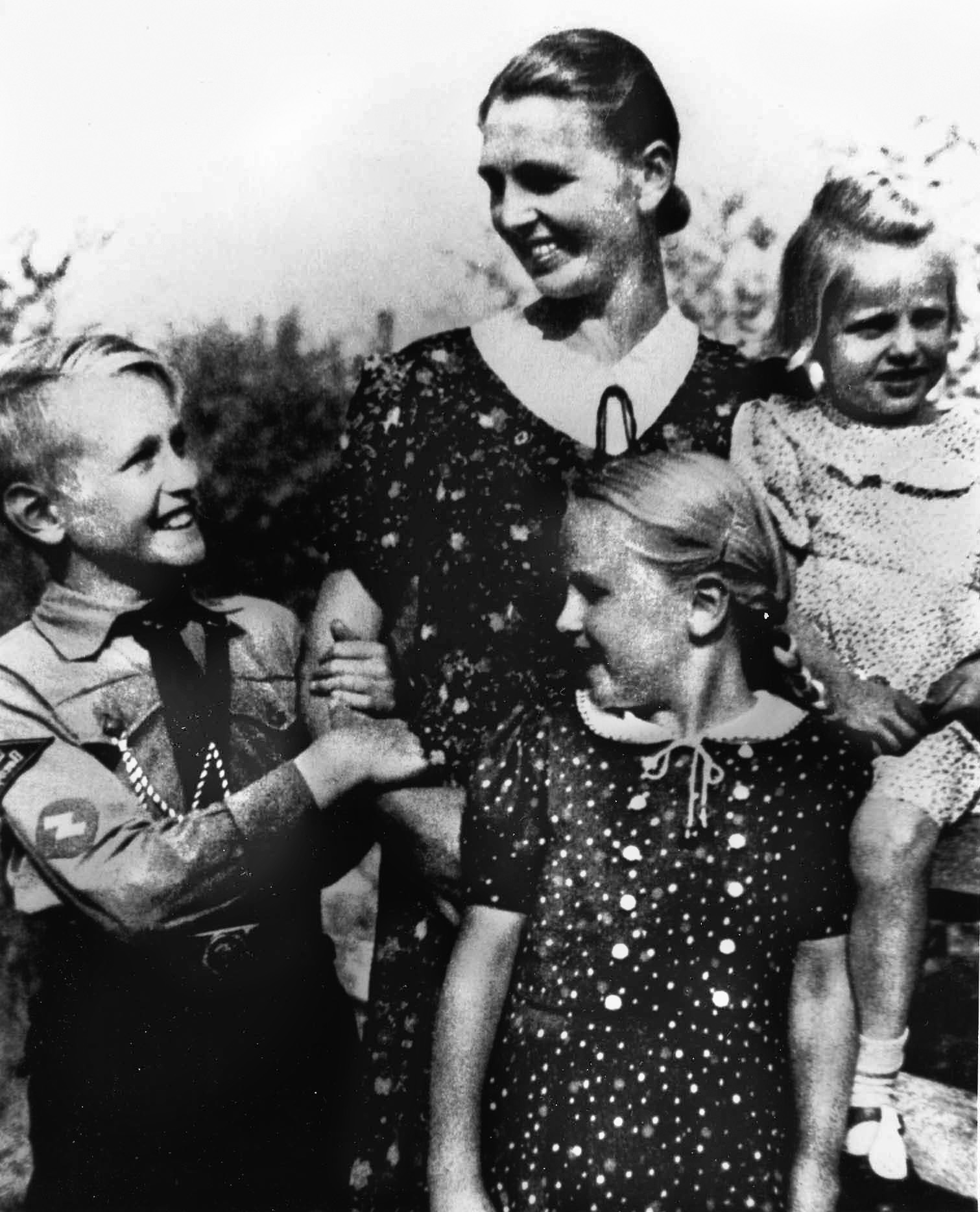
Their memories of home became obstacles to be overcome.
The United States Holocaust Memorial Museum notes that, during the war, Lebensborn became complicit in the kidnapping of foreign children selected for supposedly “Aryan” characteristics.
Imagine what that process meant from the child’s side.
One morning, a girl had a mother whose voice she knew.
She had a name spoken at the dinner table.
She knew which floorboard creaked near her bed and which road led home.
Then strangers examined her.
They spoke words she did not understand.
They placed her on a train.
At the next institution, people began calling her by a different name.
When she used her own language, she might be punished.
When she asked for her mother, she might be told that her mother was dead, unsuitable, or had abandoned her.
Eventually, a German family could receive her as though she had been waiting for them all along.
The family might not know the full truth.
The child almost certainly did not.
This was not simply kidnapping.
It was the attempted destruction of a human identity.
The regime wanted more than the child’s body.
It wanted the child’s memory.
Children who resisted Germanization faced abuse and further punishment. Those who failed racial selection could be sent elsewhere into the machinery of Nazi persecution. Records were incomplete, scattered, or destroyed, making the total number of stolen children difficult to establish with certainty.
And that uncertainty became part of the tragedy.
When Nazi Germany collapsed in 1945, Allied forces entered institutions and found children whose histories had been rewritten.
Some were too young to remember where they came from.
Some spoke only German by then.
Some believed the adults raising them were their biological parents.
Some had been told that their real families had never wanted them.
Investigators faced forged identities, missing files, destroyed records, and conflicting testimony.
A child could stand alive in front of them while the documentary trail leading back to that child’s mother had vanished.
For some families, liberation did not bring reunion.
It brought a search with no answer.
For some children born in Lebensborn homes, the end of the regime created a different wound.
They became associated with the Nazi project before they were old enough to understand what Nazism was.
In countries that had lived under German occupation, children fathered by German soldiers could be mocked, excluded, or treated as living evidence of collaboration.
Their mothers could be publicly shamed.
Children inherited anger for decisions they had never made.
They had first been valued by the Nazis for their supposed blood.
Then they were condemned by others for the same blood.
The ideology changed direction, but the child remained trapped inside it.
Years passed.
Some survivors began searching archives for proof of who they were.
A name in a file.
A hospital entry.
A photograph.
A letter.
A signature.
Anything that could connect the adult they had become to the child who had once been taken or surrendered.
The Arolsen Archives now preserve extensive documentation concerning Nazi persecution, including collections related to Lebensborn and the postwar search for personal identities. The German Federal Archives also points researchers toward hundreds of surviving Lebensborn files and related collections.
For many, the discovery did not arrive like a dramatic courtroom revelation.
It arrived silently.
An archivist opened a folder.
A date matched.
A birthplace appeared.
A German name was connected to a Polish one.
A woman listed as a guardian was not the mother.
An adoption described as legitimate had begun with removal.
In that moment, an entire life could split in two.
The childhood remembered.
And the childhood stolen.
That is the plot twist hidden beneath the myth of the Nazi breeding farms.
The darkest secret was not that the Nazis discovered some mysterious new way to create children.
It was that they took ordinary parts of human life—pregnancy, childbirth, medicine, welfare, adoption, family records—and converted them into instruments of racial power.
A nurse could hold a baby gently while working inside a brutal system.
A clean nursery could serve an ideology connected to mass murder.
A birth certificate could become a weapon.
A comfortable home could conceal a kidnapped child.
And a program called the “Fountain of Life” could help destroy the very thing that gives a human life continuity: the knowledge of where one comes from.
Lebensborn also exposes a truth that is easy to miss when history is reduced to its most spectacular images.
We expect evil to look evil.
We imagine darkness wearing a uniform, carrying a gun, or shouting an order.
Sometimes it does.
But some of the most dangerous systems present themselves as care.
They speak about health.
Protection.
Family.
The future.
They build clean facilities and hire trained professionals.
They describe cruelty as science and prejudice as policy.
Then they place a form in front of an ordinary person and ask for a signature.
The officials who designed Lebensborn believed they had the authority to rank human beings before birth.
They believed motherhood should serve the state.
They believed children could be separated from language, family, and nationality if the regime considered their bodies useful.
They believed identity was something government officials could assign.
That confidence did not remain hidden in a few maternity homes.
It belonged to the same worldview that divided millions of people into categories of value and worthlessness.
The newborn in the white crib and the prisoner behind barbed wire existed at opposite ends of the same racial calculation.
One had been selected for preservation.
The other had been selected for destruction.
That was the real face of the system.
Not uncontrolled madness.
Controlled administration.
Not only hatred.
Classification.
Not merely violence.
The calm, official decision that one life mattered more than another.
The children of Lebensborn grew old.
The regime that classified them collapsed.
Its racial science was exposed as pseudoscience, its empire destroyed, and its leaders brought before courts.
But no verdict could return every stolen name.
No archive could reconstruct every family.
No government could give survivors back the childhood in which they should have known who they were.
The Nazis claimed they were creating a superior future.
What they actually created were generations of people forced to search for their own beginnings.
And that is why the story of Lebensborn must not be remembered only as a bizarre tale about secret breeding farms.
The myth is sensational.
The truth is more important.
Because the myth allows us to imagine that such evil could happen only in strange compounds run by obvious monsters.
The truth shows how easily cruelty can hide behind medicine, paperwork, respectable language, and promises to protect society.
A civilization does not lose its humanity only when it begins killing children.
It begins losing its humanity the moment it accepts that a child’s worth can be decided by blood, ancestry, race, or the signature of someone behind a desk.