Chapter One
The First Warning
The first mortar round landed three hundred yards beyond the eastern wire.
It struck the dry riverbed with a flat, brutal concussion, throwing a black column of dirt into the copper-colored sky. Tin cups jumped on folding tables. A rack of rifles rattled against the plywood wall. Somewhere near the vehicle yard, a man shouted a curse, then laughed too loudly.
Major Evelyn Shaw did not laugh.
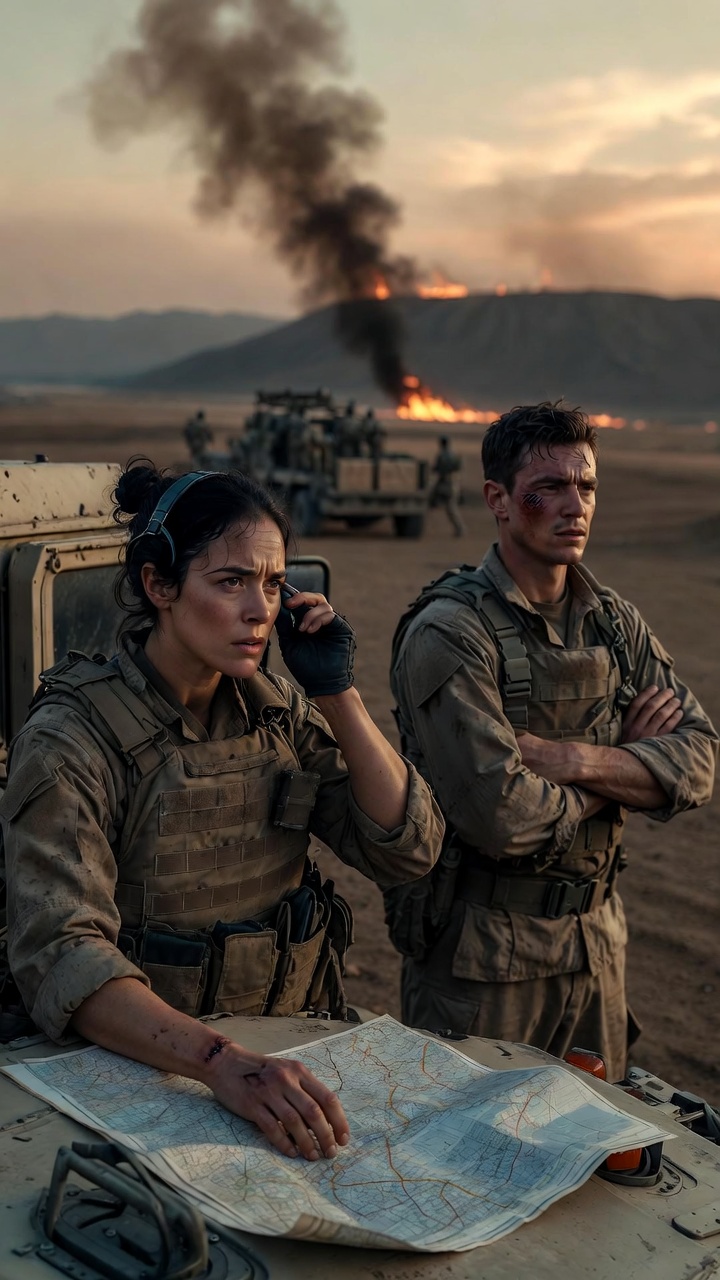
She stood in the center of Forward Operating Base Calder with one hand pressed against the headset covering her left ear. The other hovered above a laminated map spread across the hood of a dust-coated Humvee.
“Say again,” she said.
Static hissed.
A voice returned, thin beneath the interference.
“Movement along Ridge Seven. Six, maybe eight heat signatures. They stopped when our drone banked east.”
Evelyn looked toward the ridge.
It rose beyond the concertina wire like the spine of some buried animal, black against the last light. Heat shimmered above the rocks. Nothing moved.
That was the problem.
Captain Daniel Mercer approached from behind, boots grinding over gravel. At thirty-eight, Mercer carried command like a tailored jacket: clean, visible, slightly too tight around the shoulders. His sleeves were rolled with regulation precision. A pale scar ran from his right ear to the corner of his jaw, a white seam left by an explosion in Helmand that had killed two men and made him famous among people who had never met him.
“Another ranging shot?” he asked.
Evelyn lowered the headset.
“No.”
Mercer studied the distant smoke. “You can tell that from one round?”
“I can tell because it didn’t come from the village.”
He glanced at the map. “Counter-battery puts the launch point near the village.”
“The system is wrong.”
His mouth tightened.
The wind shifted, carrying diesel fumes, burned coffee, hot canvas, and the faint sewage odor from the waste trench. Beyond them, soldiers continued unloading ammunition crates. An armored convoy of six vehicles waited in a row, engines ticking as they cooled.
At dawn, Mercer intended to lead that convoy through the Al-Safa Pass and deliver medical supplies to an isolated observation post. The route had already been cleared twice.
Evelyn tapped the ridge on the map.
“They’re watching our eastern response time.”
Mercer crossed his arms. “Who is ‘they’?”
“The people who fired that round.”
“You just said it didn’t come from the village.”
“It didn’t.”
“Then where?”
She pointed to a dry irrigation channel north of the ridge.
Mercer leaned closer. “That channel is outside effective range.”
“For a standard tube.”
“And for a homemade launcher.”
“Not if they built the barrel into the ground and used the slope to absorb the signature.”
His eyes lifted from the map.
Around them, the base moved with evening routines. A mechanic lay beneath a truck, singing off-key. Two soldiers argued about a baseball game delayed by nearly twelve hours on Armed Forces Radio. Inside the mess tent, metal trays struck stainless-steel counters.
Normal sounds.
Evelyn had learned to fear normal sounds when they came too easily.
Mercer straightened. “You’re constructing an ambush from a single bad round and a drone operator who saw goats.”
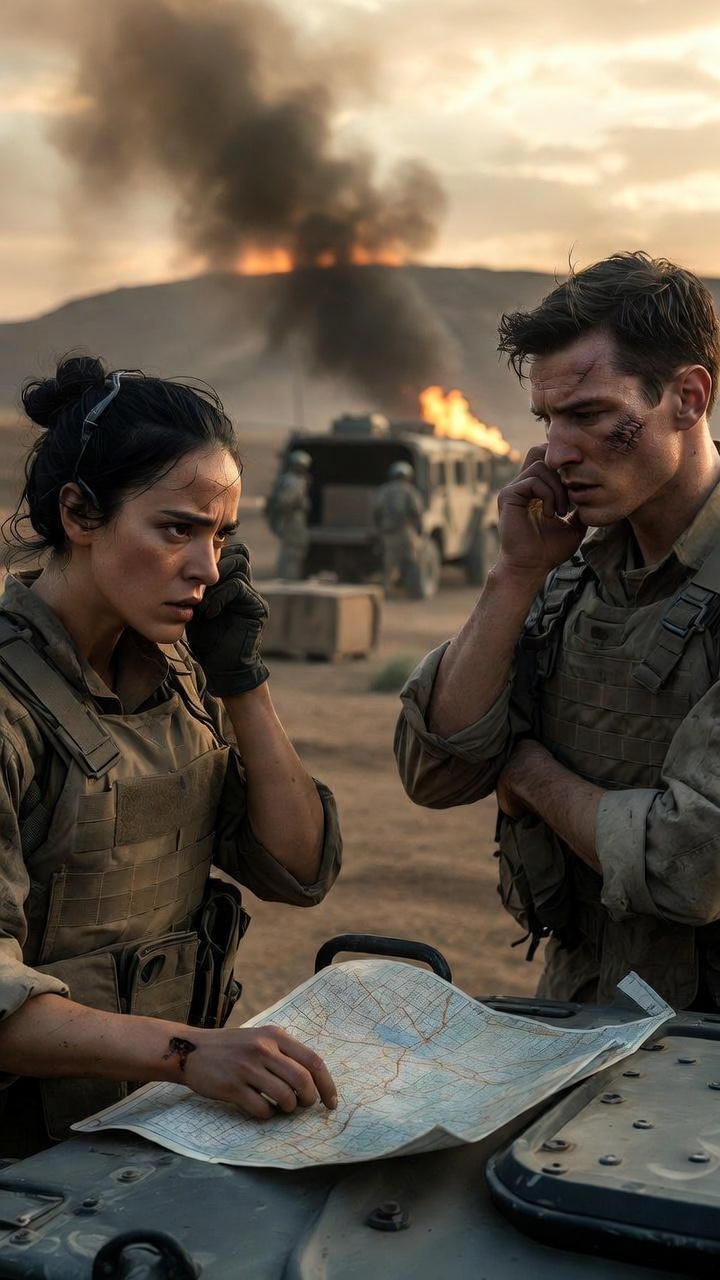
“Heat signatures don’t carry rifles.”
“They also don’t always carry rifles.”
“Cancel the convoy.”
The mechanic stopped singing.
Mercer’s face did not change, but the silence around them did. Soldiers nearby found reasons to look elsewhere.
“You don’t have authority to cancel it,” he said.
“I have authority to advise you.”
“You have.”
“Then listen.”
His eyes hardened at the word.
Evelyn knew the history pressing against him. Three weeks earlier, headquarters had delayed another convoy after one of her intelligence assessments. The threat had never appeared. Supplies had arrived late. An Afghan interpreter died at a remote position because antibiotics did not reach him in time.
Mercer had attended the burial.
He had not forgotten.
Neither had she.
“What exactly are you seeing?” he asked.
Evelyn placed two fingers on the map.
“One inaccurate mortar round. Drone movement on Ridge Seven. No civilian traffic through the pass for six hours. And this.”
She reached into her vest and removed a folded sheet of paper.
Mercer opened it.
A line of numbers had been written in blue ink.
“Intercepted radio traffic?” he asked.
“Three bursts from different frequencies. Same number sequence.”
“What does it mean?”
“I don’t know yet.”
“Then it means nothing.”
“It means they want us to think it means nothing.”
Mercer folded the paper and handed it back.
“Convoy rolls at zero-five-thirty.”
Evelyn did not take the paper.
He held it between them.
“Daniel.”
The use of his first name drew his gaze.
She spoke quietly. “This is my first warning. Do not take the pass tomorrow.”
Something moved behind his expression. Not fear. Not yet.
In another life, before the uniforms and command briefings and casualty reports, they had known each other well enough to hear what silence meant.
That life had ended on a road outside Fallujah seven years earlier.
Mercer placed the paper on the Humvee’s hood.
“Get some sleep, Major.”
He walked away.
The base loudspeaker cracked to life, announcing evening chow. Soldiers began moving toward the mess tent, their shadows stretching long across the gravel.
Evelyn remained beside the map.
The sun slipped behind Ridge Seven.
For a moment, the entire landscape became flat and black.
Then the radio operator’s voice returned through her headset.
“Major, we’ve got another transmission.”
She lifted the earpiece.
Static washed over her.
Beneath it came three sharp clicks.
A pause.
Then a man’s voice speaking accented English.
“Tomorrow,” he said, “the gate opens from the inside.”
The transmission ended.
Evelyn turned slowly toward the base.
Hundreds of soldiers, contractors, interpreters, mechanics, medics, and local workers moved between canvas tents and prefabricated buildings.
Somewhere among them, someone was helping the enemy.
And the convoy was only ten hours from departure.
Chapter Two
The Man Who Needed the Road Open
Captain Daniel Mercer sat alone in the operations room, watching the digital clock turn from 22:47 to 22:48.
The room smelled of hot electronics and stale tobacco trapped in uniforms. Fluorescent lights flattened every face on the wall photographs: soldiers killed during the deployment, each image bordered in black tape.
Mercer kept his eyes on one photograph in particular.
Staff Sergeant Lucas Bell.
Thirty-two years old. Married. Father of twin girls. Killed when Mercer’s patrol remained inside a disabled vehicle too long because Daniel had insisted on recovering classified equipment before withdrawing.
The official investigation cleared him.
His own memory had not.
A knock sounded against the doorframe.
Lieutenant Aaron Pike stepped inside carrying two mugs. He was twenty-nine, broad-shouldered, red-haired, and permanently sunburned across the nose. He moved with the restless energy of a man who believed stillness was the first symptom of death.
“Coffee,” Pike said. “Or something legally adjacent to it.”
Mercer accepted the mug.
Pike looked toward Bell’s photograph. “You planning to argue with the dead all night?”
“They’re quieter than the living.”
“Not in this room.”
Mercer took a sip and winced.
Pike dropped into the chair opposite him. “Shaw’s turning the base upside down.”
“She received a threat.”
“She receives threats every day.”
“This one mentioned an insider.”
Pike’s grin faded. “Credible?”
“She thinks so.”
“And you?”
Mercer looked through the glass wall toward the intelligence section. Evelyn stood beneath a hanging lamp, questioning two radio operators. Her dark hair was pulled into a severe knot. A burn scar curved beneath her right wrist, disappearing under her sleeve.
Seven years earlier, Daniel had wrapped that wrist in gauze while she screamed at him to leave her and drag another soldier from a burning vehicle.
The soldier died.
Evelyn survived.
Some wounds healed into scars.
Others learned to speak.
“I think she’s wrong often enough to remember she’s human,” Mercer said.
Pike watched him. “That wasn’t an answer.”
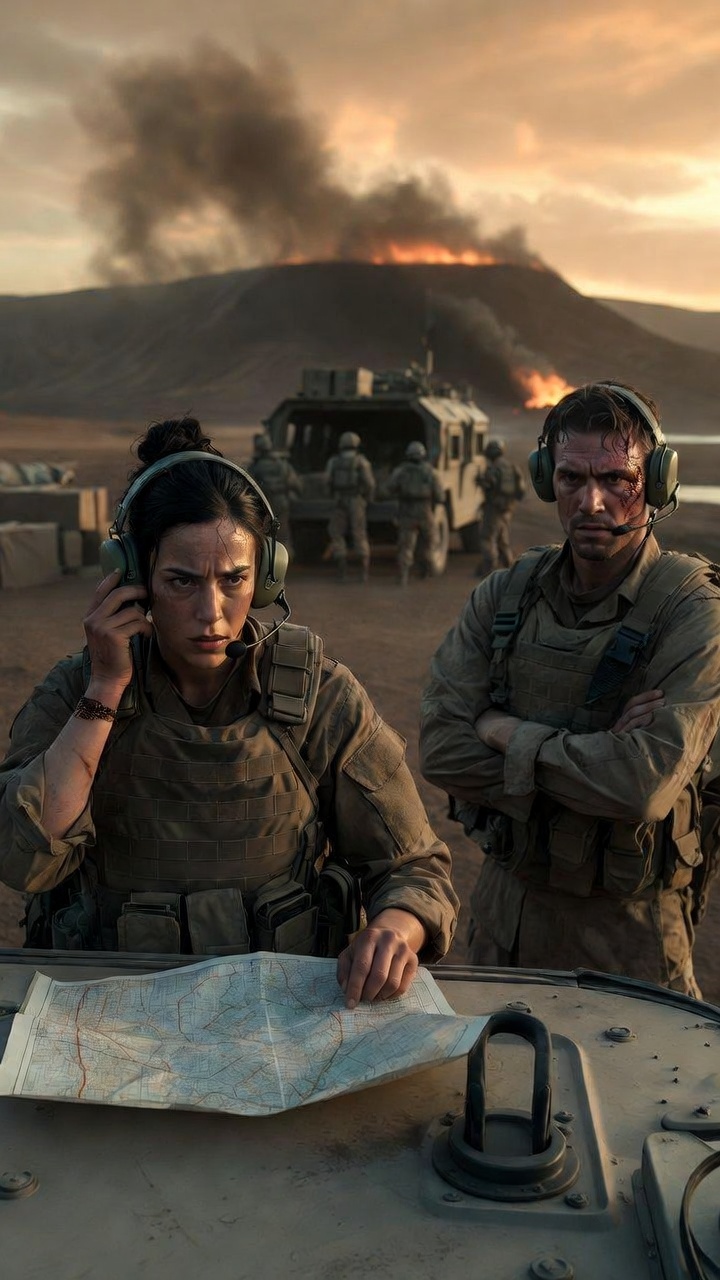
“The convoy moves.”
Pike leaned back. “The colonel pressing you?”
“Observation Post Marston has forty-three people and less than two days of medical stock.”
“There are alternate routes.”
“Two add ten hours. One crosses a flood basin. The other runs through tribal territory we haven’t secured.”
“And the pass?”
“Three hours.”
Pike rubbed his jaw. “Fast roads get expensive.”
Mercer stared into his coffee.
“The last delay cost an interpreter his life.”
“That wasn’t Shaw’s fault.”
“She made the recommendation.”
“You made the decision.”
Mercer’s gaze snapped up.
Pike did not look away.
A year earlier, Pike would have apologized. Tonight, he simply waited.
Mercer placed the mug on the table.
“Get some rest, Lieutenant.”
Pike stood. “You keep giving that order to people who know you never follow it.”
When he reached the door, Mercer spoke.
“Who has access to tomorrow’s route?”
“Convoy personnel, operations, intelligence, maintenance, medical, local liaison.”
“Too many.”
“That’s how secrets work on a base. Everybody knows the shape, even if nobody knows the center.”
After Pike left, Mercer opened the convoy manifest.
Thirty-one names.
He read them one by one.
Specialist Raul Mendoza, driver.
Sergeant First Class Nolan Price, lead vehicle commander.
Corporal Jenna Walsh, gunner.
Sergeant Omar Haddad, interpreter.
Staff Sergeant Leah Vaughn, medic.
The names formed no pattern.
His phone vibrated.
A secure message from brigade headquarters appeared.
CONVOY DELAY NOT AUTHORIZED WITHOUT VERIFIED THREAT. OP MARSTON RESUPPLY CRITICAL. EXECUTE AS PLANNED.
Mercer read it twice.
Then a third time.
The door opened without a knock.
Evelyn entered carrying a tablet.
“I need the convoy suspended,” she said.
“You already asked.”
“I’m asking again.”
“Based on what?”
She placed the tablet before him.
A grainy security image showed a local contractor standing beside the fuel bladders. A timestamp marked the photograph at 02:13 the previous night.
“Farid Nasser,” she said. “Electrical subcontractor. His work area is on the western side of the base.”
“Maybe he got lost.”
“He was carrying a maintenance bag.”
“He’s an electrician.”
“The bag was empty when he entered.”
Mercer looked at the second photograph.
Farid leaving the area forty minutes later.
The bag sagged heavily in his hand.
“Did you detain him?”
“He didn’t report for work today.”
“Search his quarters.”
“Already done.”
“And?”
“Gone.”
Mercer’s jaw tightened.
Evelyn swiped to another image: tire tracks near the eastern perimeter.
“He may have removed something,” she said, “or placed something.”
“Security swept the fuel yard.”
“Security swept what they could see.”
“You think he planted a device?”
“I think he was testing access.”
Mercer pushed back from the table and paced toward the map wall.
“You have a missing contractor and a vague radio message.”
“I have a pattern.”
“You always have a pattern.”
“And you always wait for a body before believing it.”
The words landed harder than she intended.
Mercer’s shoulders became rigid.
Evelyn’s face changed, but she did not apologize.
“Tomorrow’s convoy goes through a narrow pass with no lateral escape,” she continued. “If the enemy controls the high ground and has help inside this base, you will drive thirty-one people into a prepared kill zone.”
“And if I delay, Marston runs out of blood products.”
“Then use helicopters.”
“Air support is grounded by the dust front.”
“It may clear.”
“It may not.”
“Daniel, this isn’t about being right.”
“No. It’s about choosing who might die.”
The fluorescent light buzzed above them.
Evelyn lowered her voice. “That is always what command is about.”
He looked at her.
For a moment, neither wore rank.
They were simply two exhausted people standing beneath photographs of the dead, each convinced the other was about to create another one.
Mercer turned to the security monitor.
Outside, a soldier walked between pools of floodlight. Beyond him, darkness pressed against the perimeter fence.
“What would make you satisfied?” he asked.
“A full inspection of every vehicle. New route assignments issued at the last possible moment. Remove all local contractors from the base until the convoy clears.”
“That will tell the enemy we know.”
“Good.”
“It may trigger them early.”
“Better here than in the pass.”
He looked at her reflection in the dark monitor.
“And if we find nothing?”
“Cancel anyway.”
Mercer laughed once, without humor. “There it is.”
“My second warning will come before dawn.”
“What does that mean?”
“It means I’m not finished.”
She turned to leave.
“Evelyn.”
She stopped at the door.
“You blamed me for Fallujah,” he said.
Her fingers tightened around the tablet.
“I blamed both of us.”
“That’s not how I remember it.”
“No,” she said. “You remember the version that lets you keep moving.”
The door closed behind her.
Mercer stood motionless.
Then every light in the operations room went out.
The air-conditioning died.
Monitors vanished into black.
Across the base, alarms began to howl.
A second later, something exploded near the fuel yard.
Chapter Three
The Second Warning
The blast threw Evelyn against the corridor wall.
She struck shoulder-first, lost the tablet, and tasted blood where her teeth cut the inside of her cheek. Emergency lights flickered red along the ceiling.
“Fire in the fuel yard!” someone shouted.
She pushed herself upright.
Men and women poured from rooms, half-dressed, fastening body armor as they ran. Smoke rolled through the open doorway at the end of the corridor, thick and oily. Outside, orange flames climbed behind the barriers, bending sideways in the wind.
Mercer emerged from operations with a radio in one hand.
“Report!”
“Generator line’s down,” a communications specialist shouted. “Main power and backup.”
“Get the secondary generator running.”
“It’s not responding.”
Evelyn retrieved her tablet. The screen had cracked but still glowed.
“Daniel.”
He turned.
“This is not an attack on the fuel.”
Another explosion punched the night.
The blast came from the opposite side of the base.
The eastern gate.
Gunfire erupted a heartbeat later.
Long bursts.
Disciplined.
Mercer’s face changed.
He ran.
Evelyn followed.
They crossed the center yard under pulsing red lights. Sirens screamed from every tower. Soldiers stumbled from tents, some carrying rifles, others dragging ammunition cans. Smoke smeared the floodlights into dirty halos.
At the eastern gate, a Humvee burned beside the concrete barriers.
One gate guard lay facedown in the gravel. Another crouched behind a wall, firing through a gap toward the darkness.
“Contact, Ridge Seven!” he yelled.
Tracers cut down from the ridge.
They struck the barriers in showers of sparks.
Mercer dropped behind a concrete block and keyed his radio.
“All units, defensive positions! Seal the interior roads. Nobody leaves the base.”
Evelyn knelt beside the fallen guard.
No pulse.
A dark hole marked the base of his skull.
She examined the angle, then looked toward the nearest watchtower.
The bullet had entered from behind.
“Daniel.”
He fired two rounds toward a muzzle flash.
“Not now.”
“The guard was shot from inside.”
Mercer froze.
A soldier ran toward them from the communications bunker.
“Sir, eastern gate controls were overridden locally. Someone opened the outer barrier six seconds before the power failed.”
“Close it.”
“Manual controls are damaged.”
“Get a vehicle across the opening.”
The soldier sprinted away.
Evelyn scanned the base.
Fire near the fuel yard. Gunfire from the ridge. Gate open. Power disabled.
Three distractions.
The real attack had not begun.
She looked toward the convoy line.
Six armored vehicles waited in shadow, loaded and fueled for dawn.
One of them was moving.
At first, she thought the slope had caused it to roll.
Then its headlights came on.
“Daniel!”
The lead medical truck accelerated toward the open gate.
Mercer saw it.
“Stop that vehicle!”
Soldiers turned. Rifles rose.
The truck swerved around a barrier, engine roaring.
Mercer stepped into the road.
Evelyn seized the back of his vest and dragged him aside as the truck passed within inches. The side mirror clipped his shoulder and spun him to the ground.
Pike appeared from the smoke, carrying a light machine gun.
“Who’s driving?”
“No idea,” Mercer said.
Pike dropped to one knee and fired at the tires.
Rounds sparked beneath the chassis.
The truck kept moving.
It reached the open gate.
A figure rose from behind the rear cargo shield and fired back into the base.
Pike threw himself flat.
Bullets struck the gravel around him.
Evelyn drew her pistol and fired twice.
The figure vanished.
The truck disappeared through the gate, heading toward the ridge.
Mercer shouted into his radio. “Tower Three, disable that vehicle!”
No response.
“Tower Three!”
A searchlight snapped on above them.
Instead of sweeping the road outside, it turned inward.
The brilliant beam washed across the soldiers gathered near the gate, illuminating them for the shooters on the ridge.
Gunfire intensified.
Men dove for cover.
Mercer raised his rifle toward the tower, but Evelyn caught the barrel.
“Alive,” she said.
The tower gunner stood behind the mounted weapon, hands lifted.
Another figure pressed a pistol against the back of his neck.
Evelyn saw only a silhouette.
Then lightning flashed beyond the ridge.
For a fraction of a second, the infiltrator’s face became visible.
Lieutenant Aaron Pike.
Mercer stared upward.
Pike shoved the gunner aside and swung the mounted weapon toward the base.
“Aaron!” Mercer shouted.
Pike hesitated.
Just once.
Then he opened fire.
Evelyn and Mercer rolled behind the concrete barrier as heavy rounds chewed through vehicles, walls, and stacked supply crates. Screams cut through the thunder of the weapon.
Mercer fired at the tower supports.
“Don’t!” Evelyn shouted.
“He’s killing our people!”
“He’s covering the truck!”
“Then he made his choice.”
The mounted gun stopped.
Evelyn risked a glance.
Pike had vanished from the tower platform.
A rope hung over the outer wall.
Mercer rose as if to follow.
Evelyn blocked him.
“That’s what they want.”
His eyes burned. “Move.”
“The medical truck was loaded with supplies.”
“And now they have them.”
“No.” She looked toward the dark road beyond the gate. “They wanted us to think they were stealing supplies.”
Mercer stared at her.
Evelyn pulled the convoy manifest from a pouch on her vest.
“The truck had twelve units of refrigerated blood, antibiotics, surgical kits, and morphine.”
“Yes.”
“It also had two hundred pounds of ammonium-nitrate blasting agent seized last week and scheduled for transport to the disposal site.”
Mercer’s face drained of color.
The confiscated explosives had been stored inside sealed evidence containers in the medical truck because the hardened ammunition bunker was full.
Only a handful of officers knew.
Pike had known.
Evelyn looked toward the pass.
“They’re not stealing a truck,” she said. “They’re delivering a bomb.”
“To Marston?”
“Maybe.”
Mercer keyed the radio. “All vehicles, prepare pursuit.”
Evelyn seized his wrist.
“No.”
His voice dropped. “He betrayed us.”
“And he wants you angry.”
“He has a truck full of explosives.”
“He also has a head start, night cover, ridge support, and a route he knows you’ll follow.”
Mercer tore his arm free.
“You warned me twice. Congratulations. You were right.”
“This isn’t about being right.”
“Then get out of my way.”
Evelyn stepped closer.
Rain began to fall, large drops hissing against the burning Humvee.
“My second warning,” she said, “is that Pike is not the traitor.”
Mercer stared at her as if she had struck him.
“He shot at us.”
“He fired wide.”
“Tell that to the wounded.”
“The ridge shooters caused most of the casualties. Pike aimed at vehicles and empty barriers.”
“He murdered the gate guard.”
“The angle came from the ground.”
“He opened the gate.”
“Under duress, deception, or for a reason we don’t understand.”
Mercer’s breathing grew shallow.
Behind them, medics dragged a wounded soldier across the mud. Flames snapped in the rain. The open gate stood like a black mouth.
Evelyn held his gaze.
“If Pike wanted us dead,” she said, “we would be dead.”
A secure handset crackled on Mercer’s vest.
He answered.
For several seconds, only breathing came through.
Then Pike’s voice whispered, “Daniel, don’t follow the truck.”
Mercer gripped the handset.
“Aaron, where are you?”
“They’re listening.”
“Who?”
“The man you trust most.”
A gunshot sounded through the line.
The transmission ended.
Chapter Four
The Road Beneath the Road
Colonel Marcus Vane arrived at the eastern gate twelve minutes later in a command vehicle surrounded by armed military police.
He stepped into the rain wearing body armor over a clean uniform.
At fifty-four, Vane was tall, silver-haired, and controlled in the manner of a surgeon preparing to cut. He had built his career across three wars and possessed the unsettling ability to make silence feel like testimony.
His gaze moved over the burning Humvee, the dead guard, the wounded, and the open gate.
Then he looked at Mercer.
“Explain.”
Mercer stood with rain running from his jaw. “Lieutenant Pike compromised the gate, stole the lead convoy vehicle, and fled toward Al-Safa.”
“Casualties?”
“Three dead. Seven wounded.”
Vane’s eyes shifted to Evelyn. “Major Shaw?”
“I believe Pike may be operating under coercion.”
Mercer gave her a hard look.
Vane did not. “Evidence?”
“He warned us not to pursue.”
“After attacking the base?”
“Yes.”
“Convenient.”
“He also said the threat came from the man Captain Mercer trusts most.”
Vane looked at Mercer.
Mercer’s voice was flat. “Pike may have been referring to himself.”
“Or to me,” Vane said.
Nobody answered.
Rain struck the metal roof of the gatehouse like scattered gravel.
Vane stepped closer to the barrier and studied the road.
“Where is the truck now?”
“Tracker disabled,” a communications officer said. “Drone feed is down because of the power failure.”
“Restore it.”
“Working on it.”
Vane turned to Mercer. “Deploy pursuit.”
Evelyn moved forward. “Sir, the pass is likely prepared for an ambush.”
“We cannot allow two hundred pounds of explosives to disappear.”
“We may be reacting exactly as intended.”
Vane faced her.
His expression carried no anger. That made him more dangerous.
“Major, you predicted an attack. The attack occurred. Now you are recommending inaction?”
“I am recommending that we determine the true target.”
“The truck is the target.”
“No, sir. The truck is bait.”
Mercer’s eyes flicked toward her.
Vane folded his hands behind his back.
“Then enlighten me.”
Evelyn opened her cracked tablet.
“The fuel-yard blast disabled the main generator line. The eastern gate attack drew our response forces. The truck departed during the confusion. But the attackers did not attempt to enter the base, seize weapons, or inflict maximum casualties.”
“They stole explosives.”
“They stole a delivery system.”
“For what?”
“I don’t know.”
Vane’s mouth tightened slightly.
Evelyn swiped to the base schematic.
“There are three possible targets along the truck’s route: Observation Post Marston, the Al-Safa bridge, and the Kajir pumping station.”
“The pumping station is abandoned,” Mercer said.
“Officially.”
Vane looked at the schematic. “What is beneath it?”
Evelyn hesitated.
She had found the records two months earlier while reviewing Soviet-era infrastructure maps. The files were buried beneath outdated engineering surveys and redacted intelligence reports.
“An underground channel,” she said. “Possibly part of an old water-transfer system.”
“Possibly?”
“The lower sections were sealed before our forces arrived.”
Vane’s gaze sharpened. “By whom?”
“I don’t know.”
“That phrase appears often in your assessments.”
Evelyn ignored the insult.
“The number sequence in the intercepted transmissions may be coordinates. Not map coordinates—engineering markers. Tunnel sections.”
Mercer stepped closer. “Where does the channel lead?”
Evelyn enlarged the diagram.
A faded blue line ran from the abandoned pumping station, beneath the dry riverbed, and ended near the center of FOB Calder.
No one spoke.
Vane studied the map.
“The base was surveyed before construction.”
“Only the surface layer,” Evelyn said. “The channel is twenty feet below grade.”
“What is directly above the terminus?”
She zoomed in.
The blue line ended beneath the communications bunker and command operations center.
Mercer looked toward the center of the base.
“If they detonate beneath operations…”
“The blast could collapse the entire structure,” Evelyn said. “And sever every hardened communication line in the sector.”
Vane remained still.
Too still.
Evelyn watched him.
“What?” Mercer asked.
Vane’s eyes remained on the tablet. “Nothing.”
“You recognized the tunnel.”
Vane looked up.
Rainwater rolled from the edge of his helmet.
“I recognize the consequences.”
Evelyn stepped closer. “Sir, did you know about this?”
Vane’s voice cooled. “Be careful, Major.”
“That was not an answer.”
Mercer shifted between them. “Enough.”
Vane pointed toward the convoy yard. “You will take two vehicles and intercept the truck before it reaches the pumping station.”
Evelyn shook her head. “No.”
The soldiers nearby went silent.
Vane turned his full attention toward her.
“Major Shaw, you are relieved from operational intelligence duties pending investigation.”
Mercer stared at him. “Sir—”
“She withheld information regarding a possible subterranean threat beneath this base.”
“I found an unverified map,” Evelyn said.
“You failed to elevate it.”
“I submitted it six weeks ago.”
“To whom?”
Evelyn looked at him.
The rain filled the silence.
“To your office.”
Mercer’s face tightened.
Vane’s hand rested near his sidearm. “Military police, remove Major Shaw.”
Two officers approached.
Evelyn did not resist as they took her arms.
Mercer stepped forward. “Colonel, we need her.”
“We need discipline.”
“We also need to know why your office ignored that map.”
Vane’s expression hardened.
“You are allowing your personal history with Major Shaw to compromise your judgment.”
Mercer’s face went pale with anger.
Vane leaned closer.
“Take the pursuit team,” he said. “Recover the truck. That is a direct order.”
Mercer looked at Evelyn.
For years, she had hated the way he made decisions with his shoulders before his mouth. They would pull back, as though bracing against invisible weight.
Now they dropped.
Not in surrender.
In acceptance.
He turned to the soldiers.
“Prepare two vehicles.”
The military police led Evelyn toward the detention building.
As she passed Mercer, she spoke without looking at him.
“The truck is not carrying the detonator.”
He stopped.
“What?”
She turned her head.
“The blast at the fuel yard cut power ten seconds before the gate opened. The sequence was too precise for a handheld trigger. Someone connected to our internal system is controlling the operation.”
“Who?”
Evelyn looked past him toward the command center.
Behind its rain-streaked windows, Colonel Vane stood alone, watching them.
“The man Pike warned you about,” she said.
Then the military police pushed her onward.
Chapter Five
The Prisoner Who Could Still See
The detention room had no windows.
Its walls were concrete, painted the color of old bone. Water dripped somewhere beyond the ceiling. A single fluorescent tube blinked above Evelyn’s chair.
Her wrists were cuffed to a metal ring bolted into the table.
Across from her sat Sergeant First Class Nolan Price, the convoy’s lead vehicle commander. He had been assigned to guard her until a formal investigator arrived.
Price was forty-one, thick-necked, with tired eyes and a mustache that looked borrowed from an older decade. He had three children, a mortgage in Ohio, and a habit of chewing the inside of his cheek whenever he lied.
He had been chewing for six minutes.
“You don’t believe I’m dangerous,” Evelyn said.
Price stared at the door. “Didn’t say that.”
“You loosened the left cuff.”
His eyes dropped involuntarily.
Evelyn turned her wrist. The cuff shifted.
“Why?”
Price looked back toward the door.
“Because,” he said quietly, “Lieutenant Pike came to me two nights ago.”
Evelyn waited.
“He asked if I’d noticed anything strange in the convoy maintenance logs.”
“Had you?”
“A replacement relay was installed in the lead truck. I signed the authorization, but I never ordered it.”
“What kind of relay?”
“Remote ignition interface.”
Her pulse quickened.
“For the explosives?”
“For the truck.”
Price leaned forward.
“Someone modified the vehicle so it could be controlled externally. Steering assist, ignition, braking. Not fully autonomous, but enough to keep it moving if the driver lost control.”
“Who installed it?”
“The paperwork listed Specialist Mendoza.”
“The driver.”
“He swore he didn’t touch it.”
“Did Pike believe him?”
“Yeah.”
“What did Pike do next?”
Price’s jaw worked.
“He told me not to report it through normal channels. Said the leak was above us.”
“Did he name Vane?”
“No.”
“Why was Pike driving the truck?”
Price shook his head. “He wasn’t.”
Evelyn went still.
“You saw the driver?”
“Security footage before the power died. Pike climbed the tower after the truck began moving.”
“Who was behind the wheel?”
“Couldn’t see the face.”
“Then Pike may have been trying to stop it.”
Price nodded slowly.
“He told me if anything happened, I should find you.”
“Why?”
“He said you were the only person on this base who distrusted everyone equally.”
Despite herself, Evelyn almost smiled.
A muffled explosion sounded in the distance.
Dust drifted from the ceiling.
Price stood.
“That came from the south.”
The detention door opened.
Colonel Vane entered alone.
Price snapped upright.
“Sir.”
“Leave us.”
Price hesitated.
Vane’s gaze settled on him.
“That was an order.”
Price left, closing the door behind him.
Vane sat across from Evelyn.
For several seconds, he said nothing.
The fluorescent tube flickered.
“You submitted the tunnel report,” he said at last.
“Yes.”
“I read it.”
“I assumed so.”
“I buried it.”
Evelyn watched his face.
“Why?”
“Because Calder was built over that channel intentionally.”
The room seemed to narrow.
Vane folded his gloves on the table.
“Eight years ago, before this base existed, the tunnel was used to move weapons across the border. Not rifles. Chemical precursors.”
Evelyn’s cuff clicked softly as she shifted.
“Whose operation?”
“Ours.”
The word fell between them.
Vane continued.
“A joint intelligence program infiltrated the network. We permitted controlled shipments to pass so we could identify buyers.”
“And people died.”
“People always die around weapons.”
“Who authorized the base construction?”
“I did.”
Evelyn stared at him.
“You built Calder over the tunnel to conceal it.”
“To control it.”
“Then why is it still active?”
“Because control is a temporary word.”
He looked tired now. Older than he had outside.
“The network resurfaced six months ago. Someone obtained the original channel plans and began using the lower passage again.”
“Pike discovered it?”
“He discovered fragments.”
“And you recruited him.”
Vane’s eyes narrowed.
Evelyn followed the logic.
“You needed someone close to Mercer. Someone trusted, capable, and expendable. Pike pretended to defect so he could enter the network.”
“Not quite.”
“What part?”
“He volunteered.”
Rainwater tapped somewhere inside the walls.
Vane leaned back.
“Pike’s younger brother died from chemical exposure during an attack that used precursors transported through that tunnel. Pike learned of the old operation and came to me.”
“You sent him undercover without informing Mercer.”
“Daniel would have stopped him.”
“Because Pike is his friend.”
“Because Daniel still believes saving one man can repair the men he failed to save.”
Evelyn felt anger rise beneath her ribs.
“You turned that loyalty into a weakness.”
“I turned it into cover.”
“Where is Pike now?”
“I don’t know.”
“Who controls the truck?”
“The network.”
“Then why arrest me?”
“Because they believe you were removed from the board.”
Evelyn studied him.
“You staged this.”
“Not the attack.”
“But my detention.”
“Yes.”
“You could have told me.”
“No.”
“Why?”
Vane looked at her burned wrist.
“Because seven years ago, you warned a convoy commander twice and he ignored you.”
Her chest tightened.
Fallujah.
The burning vehicle.
The dead soldier.
Vane had read the file.
“You no longer know how to act as though you are not suspicious,” he said. “I needed your reaction to be genuine.”
Evelyn leaned forward as far as the chain allowed.
“You used my history.”
“I used what the enemy already knew.”
“Who are they?”
“A former local defense commander named Hamid Sayegh. He cooperated with us during the original operation. We promised relocation for his family.”
“And?”
“The request was denied.”
Vane’s voice remained controlled, but shame moved behind it.
“His wife and two daughters were killed after our withdrawal from the valley.”
“So now he wants the base.”
“He wants every record of the operation destroyed. He also wants the officers responsible buried under it.”
“You.”
“Yes.”
“And Mercer?”
“Mercer escorted one of the controlled shipments without knowing what it carried. His patrol drew enemy attention away from the tunnel.”
Evelyn’s mind turned.
Fallujah had not been random.
The ambush. The delayed extraction. The burning vehicle.
“Daniel’s men died protecting your operation.”
Vane looked toward the wall.
“Yes.”
Evelyn pulled against the cuff.
“You let him blame himself.”
“The truth would have destroyed his career and exposed the program.”
“You mean it would have destroyed yours.”
Vane’s face hardened.
“Self-righteousness is a luxury purchased by people who never had to decide which secret kept more people alive.”
“And did it?”
He did not answer.
The door opened.
Price staggered inside.
Blood covered the front of his uniform.
Vane rose.
Price tried to speak, but only a wet breath emerged. He collapsed against the wall.
Behind him stood Specialist Raul Mendoza.
The convoy driver held a suppressed pistol.
Vane reached for his weapon.
Mendoza shot him in the chest.
The colonel struck the table and fell.
Mendoza closed the door.
Evelyn stared at him.
His face was streaked with tears.
“My family is in the village,” he said. “They said they’d kill them.”
He raised the pistol toward her.
“I’m sorry, ma’am.”
Evelyn looked at the loosened cuff.
Then at Price.
The dying sergeant’s fingers moved once against the floor.
A warning.
Or permission.
Mendoza squeezed the trigger.
Chapter Six
The Man in the Tower
The shot cracked through the room.
Evelyn dropped sideways.
The bullet tore through the back of the chair.
She twisted her left hand free of the loosened cuff, seized the table, and drove it upward. The metal edge struck Mendoza’s wrist.
The pistol fired again into the ceiling.
Vane, bleeding beneath the table, kicked Mendoza’s knee.
The specialist fell.
Evelyn lunged across the tabletop and caught his gun hand with both of hers. Mendoza was stronger. Panic made him stronger still.
He drove her backward.
The chain on her right wrist snapped tight.
Pain shot through her shoulder.
Mendoza forced the pistol toward her face.
“I don’t want to do this,” he gasped.
“Then stop.”
“They have my daughters.”
“Then help me save them.”
His grip faltered.
Only slightly.
It was enough.
Evelyn slammed her forehead into his nose.
Cartilage crunched.
Mendoza recoiled. She tore the pistol free and struck him across the temple. He collapsed beside Price.
Evelyn found the cuff key on his vest and freed herself.
Price lay against the wall, breath shallow and bubbling.
She knelt beside him.
“Who shot you?”
“Mendoza,” he whispered. “But… others…”
“How many?”
“Inside uniforms.”
Vane coughed.
Evelyn moved to him.
The bullet had struck his armor high on the left side, but blood seeped beneath the vest.
“Can you stand?”
“With a better incentive.”
“The base may explode.”
“That will do.”
She pulled him upright.
An alarm began pulsing overhead.
Not the attack siren.
The bunker evacuation signal.
Vane’s face changed.
“They found the tunnel.”
“Who?”
“Mercer.”
They left the detention room.
Smoke filled the corridor. Two military police officers lay unconscious near the stairwell, both breathing. Their weapons were gone.
Outside, rain hammered the base.
The fires near the fuel yard had diminished, but tracer rounds still crossed the eastern perimeter. Soldiers fought from sandbag positions. Floodlights swung wildly.
A voice boomed over the public-address system.
“All personnel evacuate command operations. Repeat, evacuate command operations.”
Mercer.
Evelyn seized a radio from one of the fallen officers.
“Daniel, respond.”
Static.
Then his voice. “Evelyn?”
“I’m free. Vane is alive. Mendoza was compromised.”
“Where are you?”
“South detention corridor.”
“Get everyone away from operations. The tunnel entrance is inside the communications bunker.”
“How did you find it?”
“Pike.”
Her grip tightened.
“He’s alive?”
“He’s beneath us.”
Mercer’s transmission broke beneath a burst of gunfire.
“Daniel?”
“I’m here. The truck is at the pumping station, but it’s empty.”
“Empty?”
“No explosives.”
Evelyn stopped in the rain.
Vane leaned against the wall beside her.
“The evidence containers,” Mercer continued, “were loaded with scrap metal. The explosives never left the base.”
Evelyn looked toward the command center.
“They moved them before the attack.”
“Into the tunnel,” Mercer said. “Pike followed the network down there. He found charges attached to the support columns beneath operations.”
“How long?”
“Fifteen minutes, maybe less.”
“Can he disarm them?”
“He says there are two control circuits. One wired, one remote.”
Vane reached for the radio.
“Mercer, listen to me. Sayegh will maintain visual confirmation. He won’t trust remote telemetry alone.”
“Meaning?”
“He has an observer inside the base.”
Evelyn scanned the rooftops, towers, and windows.
The attacker needed line of sight to the command center and the eastern gate.
Only one location offered both.
Tower Three.
The same tower Pike had occupied.
She looked up.
The searchlight was dark now, but a shape moved behind the armored shield.
“Observer located,” she said.
A muzzle flashed.
Vane jerked backward.
The bullet struck his thigh.
Evelyn dragged him behind a concrete water barrier.
“Sniper, Tower Three!”
Soldiers turned their weapons upward.
“Hold fire!” Evelyn shouted. “We need the trigger.”
The figure in the tower shifted.
Not a sniper.
A woman in a U.S. Army uniform stood behind the shield, holding a compact transmitter.
Evelyn recognized her.
Staff Sergeant Leah Vaughn.
The convoy medic.
Vaughn had treated wounded soldiers throughout the attack. She had carried blood-soaked bandages with steady hands. She had comforted a dying gate guard.
Now she watched Evelyn through the rain.
Evelyn raised the radio.
“Leah.”
Vaughn’s voice answered.
“Major.”
“Put down the transmitter.”
“I can’t.”
“Your wounded are still inside the command bunker.”
“They have three minutes to leave.”
“You know they won’t all make it.”
Vaughn looked toward the bunker.
Her face was pale beneath the tower light.
“I gave them enough time.”
“For what?”
“To understand what it felt like.”
Vane closed his eyes.
Evelyn looked at him.
“You know her.”
Vane’s voice was strained. “Her father served as Sayegh’s interpreter.”
Vaughn heard him over the radio.
“My father believed your promises,” she said. “He gave you names. Routes. Safe houses. Then you left him behind.”
Vane pressed a hand against his wound.
“I requested extraction.”
“You signed the denial.”
“I signed a prioritization order.”
“You chose twelve assets over him.”
“I chose the people most likely to be killed first.”
“My father was hanged from a bridge.”
Vane’s face folded inward for one brief second.
Vaughn continued.
“My mother found his body. My little brother stopped speaking. Sayegh paid for us to escape. He was the only man who kept his word.”
Evelyn stepped from behind the barrier.
Vane caught her sleeve.
She pulled free.
Rain struck her face as she walked toward the tower.
Vaughn aimed the transmitter at her as though it were a weapon.
“Stop.”
Evelyn kept walking.
“You believe destroying the records will honor him?”
“The records protect the people who abandoned him.”
“They also prove what happened.”
“No one cares what happened.”
“I do.”
“You care because it happened to you.”
Evelyn stopped at the base of the tower.
Vaughn stared down.
“You lost someone on that road,” she said. “Mercer lost men. Pike lost his brother. We are all living inside Colonel Vane’s decisions.”
“Yes.”
“And you still protect him?”
Evelyn looked back.
Vane sat bleeding against the barrier, stripped of authority, age, and certainty.
“No,” she said. “I’m protecting the truth he tried to bury.”
Vaughn’s thumb rested over the trigger.
“The truth doesn’t bring anyone back.”
“No. But killing people who never knew about the operation only creates more families like yours.”
For the first time, Vaughn’s hand trembled.
Evelyn placed her pistol on the ground.
“Come down.”
“You’ll arrest me.”
“Yes.”
Vaughn laughed bitterly. “At least you’re honest.”
“I will also testify about the operation. So will Mercer. So will Pike, if we get him out alive.”
Vaughn looked toward the command bunker.
A section of the roof shuddered.
Dust burst from the seams.
The tunnel supports were failing.
Her radio crackled.
A man spoke in Arabic.
Evelyn understood enough.
Detonate now.
Vaughn closed her eyes.
“Leah,” Evelyn said.
The medic opened them.
“What did your father believe?”
Vaughn’s mouth tightened.
“That promises mattered.”
“Then make one.”
“To whom?”
“To the people below us.”
The radio hissed.
Sayegh repeated the order.
Vaughn lifted the transmitter.
Evelyn’s pulse hammered.
The medic’s thumb moved.
She pressed the button.
Nothing exploded.
Instead, the tower searchlight illuminated the ridge.
Coordinates flashed across every active tactical screen on the base.
Vaughn had transmitted the enemy firing positions.
American guns answered.
The ridge erupted in fire.
Vaughn dropped the transmitter.
“I already disabled the remote trigger,” she said. “But the wired circuit is still active.”
“How long?”
Vaughn looked at her watch.
“Ninety seconds.”
Beneath their feet, the ground began to shake.
Chapter Seven
Beneath Calder
Mercer descended into the tunnel with water up to his shins and a rifle pressed against his shoulder.
Emergency lights mounted along the concrete walls blinked in irregular red intervals. Rusted pipes ran overhead. The air smelled of wet stone, fertilizer, and burned insulation.
Pike waited at the first junction.
Blood covered the right side of his face. His left arm hung uselessly.
Mercer stopped ten feet away.
For one second, neither man spoke.
Then Mercer crossed the distance and struck him in the mouth.
Pike staggered against the wall.
“You shot at my soldiers,” Mercer said.
“I shot near your soldiers.”
“Three are dead.”
“Not by me.”
“You could have told me.”
Pike wiped blood from his lip. “You would’ve stopped me.”
“Yes.”
“That’s why.”
Mercer seized the front of his vest.
“I trusted you.”
“I counted on it.”
The words hurt more than the betrayal.
Pike looked toward the dark passage behind him.
“We can fight after we stop the bomb.”
Mercer released him.
“Show me.”
They moved deeper.
The tunnel widened beneath the command center. Concrete support columns rose into darkness. Yellow evidence containers had been split open along the walls, exposing gray sacks of explosive material.
Wires ran between them like black veins.
At the center stood a metal junction box.
A dead man lay beside it wearing local clothing and a stolen U.S. security badge.
Pike pointed with his good hand.
“Remote circuit is dead. Wired circuit runs to a pressure failsafe.”
Mercer crouched near the box.
“Can you disarm it?”
“Maybe.”
“Comforting.”
“The detonator is connected to the support load. Cut the wrong wire, it fires. Move the charge, it fires. Lose power, it fires.”
Mercer looked at the digital timer.
01:04.
“How did they expect to leave?”
“They didn’t.”
A sound came from the passage behind them.
Boots in water.
Mercer raised his rifle.
Hamid Sayegh stepped into the red light.
He was in his late fifties, thin, with silver in his beard and a long coat soaked dark by rain. He held a pistol loosely at his side.
Three armed men followed him.
Sayegh looked at Pike.
“You disappointed me.”
Pike’s voice was calm. “That makes two fathers.”
Sayegh’s face tightened.
Mercer glanced at the timer.
00:48.
“You built this attack to kill Vane,” Mercer said.
“To expose him.”
“By burying the evidence?”
“Evidence belongs to whoever survives.”
“You won’t.”
Sayegh smiled faintly.
“I stopped planning to survive years ago.”
Mercer saw no madness in him.
That was worse.
Only exhaustion sharpened into purpose.
“What happened to your family was wrong,” Mercer said.
“You know nothing about my family.”
“I know what Vane did.”
“You know what he admitted after he was caught.”
Sayegh stepped closer.
“Men like him call betrayal strategy. They call abandonment prioritization. They bury the dead beneath classifications and medals.”
“He’ll answer for it.”
“To whom?”
“To us.”
Sayegh looked at Mercer with something close to pity.
“You still believe the institution that protected him will punish him.”
“I believe people can force it to.”
“And if they cannot?”
“Then we keep forcing.”
The timer reached 00:35.
Pike knelt at the junction box.
“I need silence.”
Sayegh raised his pistol.
Mercer aimed at him.
The three gunmen raised their weapons.
Water dripped from the ceiling.
00:29.
Sayegh’s voice softened.
“Your men died for Vane’s operation.”
Mercer’s finger tightened on the trigger.
“Yes.”
“And you still wear the uniform.”
“Yes.”
“Why?”
Mercer saw Lucas Bell’s photograph.
He saw a burning vehicle outside Fallujah.
He saw Evelyn dragging him away from the stolen truck while gunfire cut through the rain.
“Because the uniform is not his,” Mercer said.
Sayegh’s expression changed.
Behind him, one of the gunmen shifted.
Pike spoke without looking up.
“Blue wire carries the pressure loop. Red is timer. Black is power.”
Mercer kept his rifle trained forward.
“What do you need?”
“Someone to hold the pressure plate manually while I cut power.”
“Where?”
Pike pointed to a steel lever beside the central charge.
Mercer moved toward it.
Sayegh fired.
The bullet struck the floor near Mercer’s foot.
“Do not touch it.”
The timer showed 00:18.
Mercer looked at him.
“You came here to die.”
“Yes.”
“Then die knowing Vane survives.”
Sayegh’s eyes flashed.
The hesitation lasted less than a second.
Mercer lunged for the lever.
Gunfire exploded through the tunnel.
Pike threw himself across the junction box.
Mercer caught the steel handle and pulled down with both hands.
A crushing force slammed into his shoulders as the pressure system engaged.
Someone screamed.
One of Sayegh’s men fell into the water.
Pike cut the black wire.
The emergency lights vanished.
Darkness swallowed the tunnel.
The timer’s red numbers remained.
00:07.
A muzzle flashed.
Mercer felt a bullet tear across his ribs.
He held the lever.
“Pike!”
“I need five seconds!”
“We have six!”
“That’s almost enough!”
The red numbers dropped.
00:04.
Pike tore open the junction box with his bare hand.
00:03.
Sayegh emerged from the darkness and seized Mercer’s rifle.
They struggled beside the charge.
00:02.
Pike shouted, “Let go!”
Mercer released the lever.
The pressure mechanism snapped upward.
00:01.
Pike drove a combat knife through the detonator relay.
The timer reached zero.
A metallic click echoed through the tunnel.
Nothing happened.
For half a heartbeat, everyone froze.
Then the ceiling cracked.
A support column split from top to bottom.
The explosives had not detonated, but the earlier damage was already collapsing the tunnel.
“Move!” Pike shouted.
Concrete crashed into the water.
Mercer struck Sayegh with the rifle stock. The older man fell beneath a broken beam.
Mercer turned toward the exit.
Then he heard Sayegh gasp.
A slab pinned the man’s leg.
Pike grabbed Mercer’s arm.
“Leave him.”
Mercer looked at the collapsing passage.
Dust filled the air.
Sayegh stared back, waiting to be abandoned one final time.
Mercer shoved his rifle aside and lifted the beam.
Pike cursed, then joined him with his good arm.
Together they dragged Sayegh free.
The three men staggered toward the passage as the chamber collapsed behind them.
A wall of dust and water chased them through the red darkness.
Ahead, daylight appeared as a thin gray square.
Evelyn stood at the tunnel entrance, shouting their names.
Mercer pushed Pike forward.
The floor buckled.
Sayegh slipped.
Mercer caught him by the coat.
For one instant, the two men hung above a widening crack.
Sayegh looked up.
“You should let go.”
Mercer’s wounded ribs screamed.
“No.”
“Why?”
Mercer tightened his grip.
“Because someone should have held on to your father.”
He pulled.
Evelyn reached them and seized Sayegh’s other arm.
Together they dragged him onto solid ground.
The tunnel collapsed seconds later.
A roar rolled beneath the entire base. The command center sank several inches, windows shattering outward, but the structure remained standing.
Rain washed the dust from Mercer’s face.
Soldiers gathered around the entrance, weapons raised.
Pike lay on his back, laughing weakly.
Vaughn sat nearby in handcuffs, treating Vane’s leg wound while a military police officer watched her.
Vane looked at Mercer.
Mercer looked away.
Sayegh remained on his knees in the mud.
He stared at the base he had nearly destroyed.
No triumph remained in his face.
Only grief.
Epilogue
The Third Time
Six months later, the hearing room in Washington was so quiet that Evelyn could hear the air moving through the vents.
Colonel Marcus Vane sat at the witness table without uniform or decorations. His left hand rested on a cane. His right lay flat beside a stack of declassified reports.
Behind him, families filled the gallery.
Lucas Bell’s widow sat in the second row.
Aaron Pike sat near the aisle with his arm still braced beneath his jacket.
Leah Vaughn entered under guard. She had accepted responsibility for conspiracy, sabotage, and aiding hostile forces. In exchange for her cooperation and the evidence she preserved, prosecutors removed the possibility of a life sentence.
Hamid Sayegh would face trial separately.
Specialist Mendoza’s daughters had been recovered from a safe house across the border. He remained in military custody, awaiting judgment for his actions.
Nothing had ended cleanly.
Real things rarely did.
Mercer took the seat beside Evelyn.
The scar along his jaw looked sharper beneath the white hearing-room lights.
“You were right,” he whispered.
She kept her eyes on the witness table.
“About which disaster?”
He almost smiled.
Then Bell’s widow looked toward him.
The smile vanished.
Mercer’s fingers closed around the edge of his chair.
“I spent years thinking command meant never hesitating,” he said.
Evelyn glanced at him.
“What do you think now?”
“That hesitation is sometimes the last honest thing you have.”
At the witness table, Vane began reading his statement.
He described the tunnel operation.
The controlled shipments.
The rejected extraction requests.
The convoy outside Fallujah.
The decisions that had killed soldiers and abandoned informants.
His voice remained steady until he reached the names of Sayegh’s wife and daughters.
Then it broke.
No one in the room moved.
When the hearing ended, reporters crowded the corridor. Camera shutters clicked. Questions flew toward Mercer and Evelyn.
“Major Shaw, did your warnings save the base?”
“Captain Mercer, should Colonel Vane face criminal charges?”
“Was the Army aware of the tunnel operation?”
Evelyn said nothing.
She walked through the crowd until she reached a tall window overlooking the city.
Morning rain streaked the glass.
Mercer joined her.
“You warned us twice,” he said.
“No one listened the first time.”
“I listened the second.”
“You argued for ten minutes.”
“That counts as listening.”
She looked at him.
For the first time in years, the silence between them did not feel like an accusation.
Pike approached from behind.
“You two planning to stare dramatically out the window all day?”
Mercer turned. “You were always more likable when everyone thought you were a traitor.”
“That explains my dating history.”
Evelyn shook her head.
Pike’s expression grew serious.
“Brigade intelligence intercepted something this morning.”
Mercer’s face tightened. “What?”
Pike handed Evelyn a folded sheet of paper.
A sequence of numbers had been written across it.
The same format as the transmissions before the attack on Calder.
Evelyn read them once.
Then again.
“These aren’t tunnel markers,” she said.
Pike nodded.
“What are they?” Mercer asked.
Evelyn looked through the rain toward the gray outline of the Pentagon.
“Personnel identification numbers.”
“Whose?”
She unfolded the lower half of the page.
Twelve names appeared beneath the sequence.
Some were officers.
Some were intelligence contractors.
One was a United States senator.
At the bottom, a message had been typed in capital letters.
CALDER WAS NOT THE ONLY BASE BUILT OVER A SECRET.
Mercer read it over her shoulder.
The color left his face.
Pike looked toward the crowded hearing room behind them.
“So,” he said quietly, “who do we warn this time?”
Evelyn folded the paper.
“Everyone.”
And somewhere far below Washington, behind locked doors and unmarked walls, a red light switched on.