
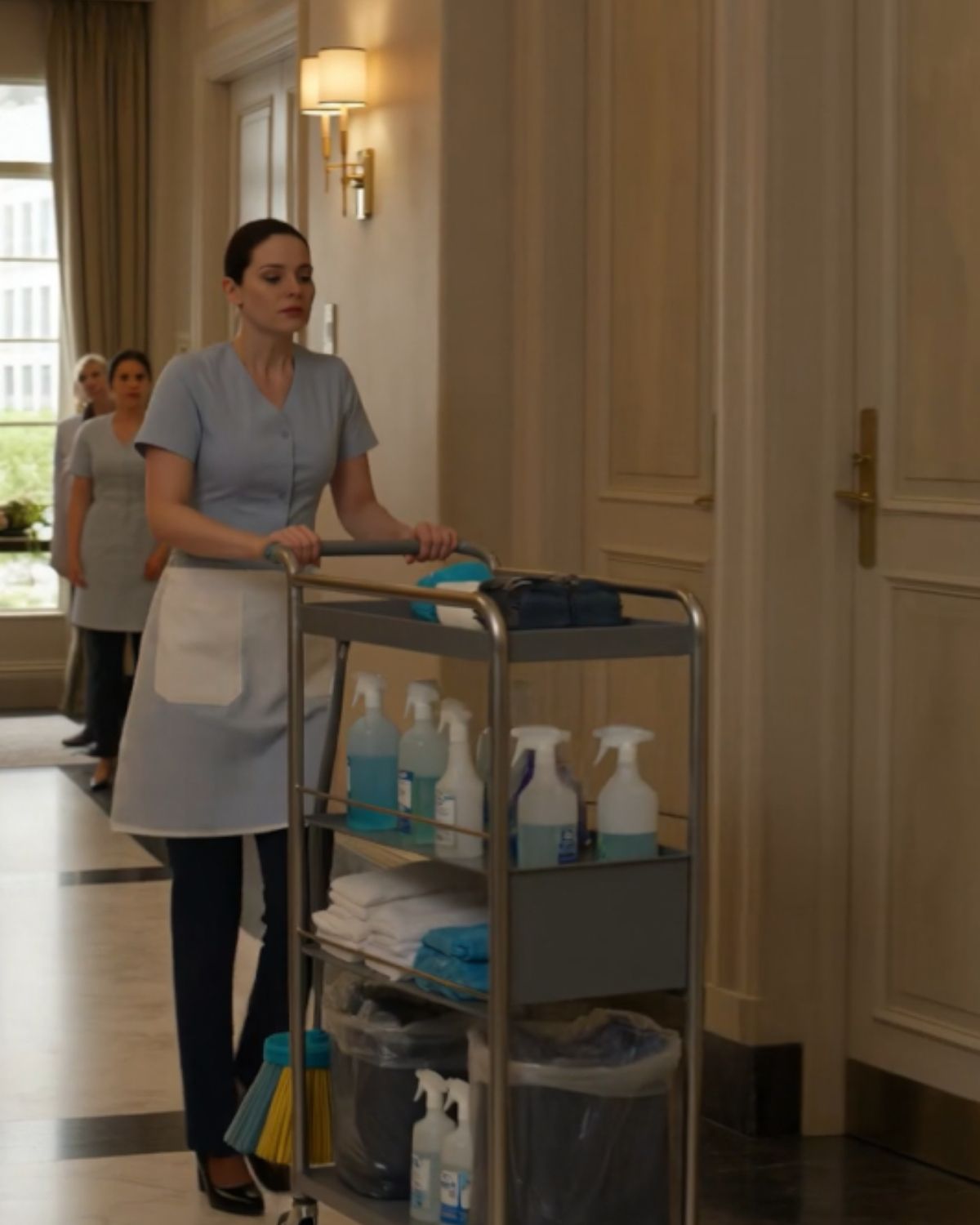
The manager did not ask why she was sitting.
He did not ask why her face had gone pale, why one hand was pressed against the wall, or why the housekeeping cart beside her had stopped at an angle in the middle of the hallway.
He looked at the pregnant cleaner on the floor and said only one thing.
“Why are you sitting during work hours?”
The twelfth floor of the Langford Hotel was usually one of the quietest places in the building.
Thick carpet softened every footstep. Brass room numbers gleamed beneath warm wall lights. Fresh flowers stood on narrow tables between the elevators and the executive suites.
That afternoon, sunlight stretched through the windows at the end of the corridor, turning the cream-colored walls gold.
A housekeeping cart rolled slowly past Room 1210.
Its wheels made a faint clicking sound each time they crossed the seams in the carpet.
Behind it walked Maria Alvarez.
She was thirty-one years old and seven months pregnant.
Her gray housekeeping uniform had been washed so many times that the fabric had softened around the sleeves. Her dark hair was tied neatly behind her head, and a plastic name badge rested above her left pocket.
Maria had been working since six-thirty that morning.
By two in the afternoon, she had cleaned thirteen rooms.
Three had required extra bedding.
One had been left with food containers across the floor.
Another had taken nearly an hour because a family had checked out late and the next guest was already waiting downstairs.
Maria had not complained.
She had emptied bins, changed sheets, scrubbed bathrooms, replaced towels, and restocked bottles of shampoo while her lower back ached and the baby pressed heavily beneath her ribs.
At lunch, she had eaten half a sandwich in the housekeeping area near the service elevator.
Then her supervisor told her two employees had called in sick.
“We need everyone to move faster today,” he said.
Maria folded the rest of the sandwich back into its wrapper.
“I’ll finish my floor.”
She always said that.
She needed the job.
Her husband, Luis, worked irregular shifts in a warehouse. Some weeks he had forty hours. Other weeks he had sixteen.
Their apartment was small, but the rent had increased twice in three years.
The baby was due in ten weeks.
Maria had already bought a secondhand crib from a woman online and washed the tiny sheets by hand. She had placed them in a drawer beside a stack of folded baby clothes donated by her sister.
She had planned to keep working until her doctor told her to stop.
So when the first wave of dizziness came near Room 1205, Maria ignored it.
She gripped the cart and waited.
The corridor tilted slightly, then steadied.
She took a slow breath.
“Just a few more rooms,” she whispered to herself.
She checked her list.
Room 1207.
Room 1209.
Room 1211.
Then the executive corner suite.
She pushed the cart forward.
The wheels clicked again.
Near the elevator corridor, another housekeeper named Nina stepped out of the service area carrying fresh linens.
“You look tired,” Nina said.
“I’m fine.”
“You’re pale.”
Maria gave a small smile.
“I didn’t sleep well.”
Nina glanced at her stomach.
“Sit down for a minute.”
Maria shook her head.
“Mr. Collins is checking the floors.”
“He can wait.”
Maria’s smile disappeared.
“No, he can’t.”
Everyone in housekeeping knew Richard Collins.
He had been promoted to housekeeping manager six months earlier after working in operations at another hotel. He wore dark suits, carried a tablet, and spoke often about efficiency.
He liked words such as performance, standards, and accountability.
When room inspections went well, he told senior management that his system was working.
When they did not, he asked which employee had failed.
Maria had been written up once for taking twelve extra minutes to clean a bathroom after a guest became sick.
She had explained what happened.
Mr. Collins told her explanations did not change the schedule.
Since then, Maria had tried not to give him any reason to notice her.
“I’ll rest downstairs,” she told Nina.
Nina studied her face.
“At least drink some water.”
“I will.”
Nina returned to the service elevator.
Maria continued down the hallway.
She reached Room 1201 just as the door opened.
A woman in a navy professional suit stepped into the corridor while speaking quietly on the phone. She appeared to be in her late forties, with composed features and silver beginning to show in her dark hair.
Maria moved the cart aside immediately.
“I’m sorry, ma’am.”
The woman covered the phone and smiled.
“You’re not in my way.”
“Would you like your room serviced?”
“Not yet, thank you.”
The woman glanced at Maria’s face.
“Are you feeling all right?”
Maria adjusted the towels on the cart.
“Yes, ma’am.”
The answer came too quickly.
The guest looked as though she might ask again, but someone spoke through her phone.
She nodded politely and walked toward the elevator.
Maria watched her go.
Then she placed both hands on the cart.
Another wave of dizziness rose without warning.
This one was stronger.
The lights along the hallway blurred.
A low ringing filled her ears.
Maria stopped breathing for a second.
She closed her eyes.
The carpet seemed to move beneath her feet.
Her right hand slipped from the cart handle.
A bottle of cleaning solution fell from the side pocket and struck the floor.
Maria caught herself against the wall.
She stood there, one palm flat against the wallpaper, breathing through her nose.
The baby shifted.
Her heart began beating faster.
She knew she needed to sit.
Not later.
Now.
Maria lowered herself carefully beside the wall near Room 1201.
She bent one knee and leaned back against the paneling.
Her hands trembled.
She placed one hand over her stomach and the other on the carpet.
“Breathe,” she whispered.
She was not trying to avoid work.
She was not taking an unauthorized break.
She was trying not to fall.
Thirty seconds passed.
Then a minute.
The hallway remained quiet.
Maria closed her eyes and counted each breath.
At the far end of the corridor, the service elevator opened.
Richard Collins stepped out.
He was carrying his tablet beneath one arm and speaking to a junior supervisor.
“We are already behind on the east side,” he said. “I don’t want to hear that rooms are still pending at three.”
Then he saw the housekeeping cart.
It was parked near the wall, unattended.
His expression tightened.
He walked faster.
The junior supervisor followed.
As they rounded the corner, Richard saw Maria sitting on the floor.
He stopped.
“What are you doing?”
Maria opened her eyes.
She tried to stand immediately, but the movement made the dizziness return.
She pressed one hand against the wall.
“I’m sorry. I felt dizzy for a minute.”
Richard looked at his watch.
“Why are you sitting during work hours?”
Maria looked up at him.
“I just needed a moment.”
“You needed a moment?”
His voice carried down the corridor.
The junior supervisor lowered her eyes.
Maria tried again to rise.
Richard gestured sharply.
“Stay there if standing is so difficult.”
The words sounded less like concern than accusation.
Maria froze.
“I’ll continue in a minute.”
Richard looked at the cart.
“How many rooms are left?”
“Four.”
“Four?”
“One room needed extra cleaning.”
“There is always a reason.”
Maria swallowed.
“I’m not making an excuse.”
“Then what are you doing?”
She looked toward the service corridor.
Two more housekeeping employees had appeared near the elevator.
Nina was one of them.
They stood still, listening.
Maria’s face grew hot.
“I felt light-headed,” she said quietly.
Richard gave a short breath through his nose.
“We all get tired.”
Maria placed her hand protectively over her stomach.
“I know.”
“This is a luxury hotel. Guests do not pay to see employees sitting on the floor.”
“I understand.”
“Do you?”
Richard stepped closer.
“Because from where I’m standing, it looks like you abandoned your cart and decided the hallway was a break room.”
Maria stared at him.
“I almost fell.”
“Then perhaps you are not fit to complete the job.”
The sentence landed more heavily than he seemed to realize.
Nina took one step forward.
“Mr. Collins, she has been working since early morning.”
Richard turned his head.
“Did I ask you?”
Nina stopped.
“No.”
“Then return to your floor.”
No one moved.
Maria looked from Nina back to Richard.
“I can finish,” she said. “I only need a few minutes.”
Richard’s jaw tightened.
“This has been a repeated issue.”
Maria blinked.
“What repeated issue?”
“You are slower than the other attendants.”
“I’m pregnant.”
“That cannot become the department’s responsibility.”
The junior supervisor looked uncomfortable.
Maria’s eyes filled, but she held the tears back.
“I have completed every shift.”
“And everyone else has had to adjust around you.”
“That isn’t true.”
“You require more time. You ask for help lifting linen bags. You take additional bathroom breaks.”
“My doctor told me not to lift heavy bags.”
Richard tapped the side of his tablet.
“Exactly.”
Maria looked at him in disbelief.
Around them, the hallway had become completely still.
A bell attendant near the elevator pretended to check his phone.
A maintenance worker stood beside the service door, watching.
No one spoke.
Richard looked toward the cart again.
“You have four unfinished rooms during one of our busiest weeks.”
“I will finish them.”
“You are sitting on the floor.”
“I felt dizzy.”
“And I am telling you that this position requires someone who can perform the work.”
Maria slowly pushed herself upright using the wall.
Her legs were unsteady.
Nina moved forward instinctively, but Maria raised a hand.
She did not want Richard to accuse her of needing more help.
She stood beside the cart.
“I am able to work.”
Richard looked at her pale face.
He did not ask whether she needed water.
He did not ask whether she had eaten.
He did not ask whether the hotel should call its medical team.
Instead, he opened a staffing page on his tablet.
“This is not working.”
Maria’s expression changed.
“What does that mean?”
“It means we need someone reliable on this floor.”
“I am reliable.”
“Reliable employees do not stop in guest corridors.”
“I almost fainted.”
Richard lowered the tablet.
“If you can’t do the job, you shouldn’t be here.”
One tear escaped Maria’s eye.
She wiped it away immediately.
“Please don’t say that.”
“I’m not discussing this in the hallway.”
“You started this in the hallway.”
For the first time, her voice carried something stronger than fear.
Richard stared at her.
The junior supervisor looked up.
Maria’s hands were shaking, but she continued.
“You asked why I was sitting. I told you I felt dizzy. You have not asked once if I am okay.”
Richard glanced toward the employees watching.
His face hardened.
He had expected an apology.
He had not expected resistance.
“Come downstairs.”
Maria gripped the cart.
“Am I in trouble?”
“You have been warned about performance.”
“I was warned once because a guest was sick in the bathroom.”
“That was still a delayed room.”
Maria stared at him.
Richard tapped his tablet again.
“I do not have time for arguments.”
“Mr. Collins, please.”
She lowered her voice.
“I need this job.”
“That does not change the requirements.”
“My maternity leave starts in a few weeks.”
“This decision is not about maternity leave.”
“Then what is it about?”
Richard looked at the employees near the elevator.
Then he pointed at the cart.
“You’re fired. Leave your uniform downstairs.”
A quiet gasp came from the end of the corridor.
Maria did not move.
For a moment, she seemed not to understand the words.
“What?”
“Your employment is terminated.”
“Because I sat down?”
“Because you are unable to meet the standards of the position.”
“I sat for two minutes.”
“You have had ongoing performance concerns.”
“Which concerns?”
“We are not doing this here.”
“You just fired me here.”
Richard’s face reddened.
Maria’s voice broke.
“I have never missed a shift. I worked when I was sick. I stayed late last week because two rooms were added to my list.”
Richard looked away.
“Turn in your uniform and access card.”
Maria pressed her lips together.
Her eyes moved toward the other employees.
Nina looked furious.
The junior supervisor looked ashamed.
No one seemed to know what to do.
Maria reached for the plastic card clipped to her waist.
Her fingers could not open the clasp.
She tried again.
The tears came faster now.
Not loud.
Not dramatic.
They simply rolled down her face as she struggled with the small piece of plastic.
Then the door behind Richard opened.
Room 1201.
The sound was quiet, but everyone turned.
The woman in the navy suit stepped into the hallway.
She no longer held her phone.
Her expression was calm.
“Stop,” she said. “I saw everything.”
Richard turned.
The woman closed the door behind her.
He straightened his jacket.
“Ma’am, I apologize for the disturbance.”
She walked toward them.
“You should.”
Richard looked surprised.
“This is an internal staffing matter.”
“No,” she said. “It became something else the moment you ignored a visibly unwell pregnant woman and humiliated her in a public hallway.”
Maria stared at the guest.
The woman stopped beside her.
“Please sit down again.”
Richard raised a hand.
“Ma’am, with respect, she has been instructed—”
The guest looked at him.
“You are not going to instruct her to remain standing while she is dizzy.”
Her voice was not loud.
It did not need to be.
Richard hesitated.
“And who are you?”
The woman turned fully toward him.
“I’m Dr. Elaine Porter. I’m staying in 1201.”
The name changed the expression of the junior supervisor.
She recognized it from the executive arrival list.
Dr. Elaine Porter was speaking at a national medical leadership summit taking place in the hotel the following day. She was a senior physician and hospital director known for her work in maternal health.
Richard did not appear to know that.
He only heard the title.
He glanced at Maria.
Dr. Porter continued.
“I saw her pass my room ten minutes ago. She was pale, unsteady, and gripping the cart for support.”
Maria looked down.
“She then developed clear signs of dizziness. She sat because remaining upright could have caused her to collapse.”
Richard shifted his weight.
“She told me she felt dizzy.”
“Yes,” Dr. Porter said. “And your response was to question her work ethic.”
“This employee has performance issues.”
“Did you review them before firing her?”
Richard did not answer immediately.
“Her records are documented.”
“Did you have them with you?”
He lifted the tablet slightly.
“I have access.”
“Did you open them?”
Silence.
Dr. Porter looked at the screen.
“You did not.”
Richard’s face tightened.
“This is not your concern.”
Dr. Porter’s eyes remained steady.
“I witnessed a pregnant employee nearly faint outside my room. That makes her immediate safety my concern.”
She turned toward Maria.
“How many weeks are you?”
“Thirty.”
“Have you had dizziness before?”
“A little. Not this strong.”
“Did you eat lunch?”
Maria hesitated.
“Half a sandwich.”
Dr. Porter nodded.
“Any chest pain?”
“No.”
“Shortness of breath?”
“Only when I felt dizzy.”
“Headache?”
“A small one.”
Dr. Porter placed two fingers lightly on Maria’s wrist.
“Please sit.”
This time, Maria obeyed.
Nina pushed the cart aside and brought a folded towel for her to lean against.
Dr. Porter crouched beside Maria without concern for the expensive suit she was wearing.
“Slow breaths,” she said. “Do not try to stand again yet.”
Richard remained in place.
A manager who had controlled the hallway moments earlier now looked like an intruder in his own confrontation.
Dr. Porter looked up at him.
“Has hotel medical assistance been called?”
“No.”
“Why not?”
“She said she only needed a minute.”
“You did not believe her.”
Richard opened his mouth.
Dr. Porter continued.
“You didn’t ask if she needed help. You punished her for being unwell.”
The words settled over the hallway.
No one moved.
Richard glanced toward the watching employees.
“This situation is being misrepresented.”
Dr. Porter stood.
“I heard your exact words.”
“You heard part of a broader performance conversation.”
“I heard her explain that she felt faint. I heard you list pregnancy-related needs as evidence that she was a burden.”
Richard’s face changed.
“I never used that word.”
“You did not need to.”
The junior supervisor looked at the floor.
Nina folded her arms.
Richard lowered his voice.
“Dr. Porter, I appreciate your concern. But managing staff requires decisions guests may not understand.”
Elaine looked toward Maria’s housekeeping cart.
The shelves were organized.
Fresh towels were folded by size.
Cleaning products were labeled.
The task sheet clipped to the side showed thirteen completed rooms.
She removed it carefully.
“Is this today’s assignment?”
Maria nodded.
Elaine counted the checked boxes.
“Thirteen completed rooms.”
Richard said nothing.
Elaine turned the page toward him.
“Does that suggest someone who refused to work?”
“She was behind schedule.”
“By how much?”
Richard looked at the sheet.
“Twenty-eight minutes.”
Elaine glanced at the room notes.
“One room is marked for additional sanitation.”
“That is included in the schedule.”
“Was she given extra time?”
“No.”
“Was she given a lighter workload after reporting her pregnancy?”
Richard’s silence answered.
Elaine looked toward Nina.
“Have there been staffing shortages today?”
Nina hesitated.
Richard gave her a warning look.
Dr. Porter saw it.
“Nina,” Maria said softly, “you don’t have to answer.”
Nina looked at Maria sitting on the floor.
Then she looked at Richard.
“Two people called in sick.”
Richard’s jaw tightened.
Dr. Porter nodded.
“So the department was short-staffed. She completed thirteen rooms while seven months pregnant, became dizzy, and sat down for a few minutes.”
Richard crossed his arms.
“You are simplifying a management issue.”
“No,” Elaine said. “You are complicating a basic failure of judgment.”
The hallway went silent again.
A hotel guest stepped out of the elevator and slowed when he saw the group.
A staff member quietly directed him toward the opposite corridor.
Dr. Porter returned her attention to Maria.
“Do you have a prenatal care provider?”
“Yes.”
“Any history of low blood pressure or anemia?”
“My doctor said my iron was low.”
“Are you taking supplements?”
Maria nodded.
“Good. You still need to be checked today, especially because the dizziness was stronger than usual.”
Maria’s face tightened.
“I can’t afford an ambulance.”
“We are not discussing cost yet.”
“I don’t have good insurance.”
Richard shifted uncomfortably.
The reality of Maria’s situation was now visible to everyone.
She had continued working not because she felt well, but because losing a shift meant losing money.
She had tried to stand because resting looked dangerous in a workplace that treated time as evidence.
Elaine placed a hand gently on Maria’s shoulder.
“We will contact your doctor or a local clinic. First, you need water and something to eat.”
Nina moved toward the service area.
“I’ll get both.”
The junior supervisor followed her.
Richard remained beside the wall.
“This does not reverse the termination.”
Elaine slowly looked at him.
“Are you serious?”
“I have authority over departmental staffing.”
“Do you have authority to terminate an employee without a formal review?”
Richard hesitated.
“It depends on the circumstances.”
“Was Human Resources consulted?”
“No.”
“Was she given written notice?”
“No.”
“Was a witness present for the termination?”
Richard glanced at the junior supervisor.
Elaine followed his eyes.
The supervisor shook her head faintly.
Richard’s confidence began to fade.
Elaine took out her phone.
“I suggest you contact Human Resources now.”
His expression sharpened.
“That is unnecessary.”
“I disagree.”
“This is still an internal matter.”
Elaine held up the task sheet.
“It is also an incident involving an employee’s health, possible pregnancy discrimination, public humiliation, and a termination announced without documented review.”
The words were clinical.
Precise.
Richard understood each one.
So did the employees listening.
His face lost color.
“What exactly are you planning to do?”
Elaine looked at him with quiet disbelief.
“You are still asking about consequences for yourself.”
Richard said nothing.
“You should be asking whether she is safe.”
Nina returned with bottled water, juice, and a plate of crackers from the staff pantry.
She handed them to Maria.
Elaine helped her open the water.
“Small sips.”
Maria drank.
Her hands were still trembling.
The baby moved again beneath her uniform.
She placed her palm over the spot.
Elaine noticed.
“Movement is good,” she said softly. “But you still need an evaluation.”
Maria nodded.
“Thank you.”
Her voice was barely audible.
Elaine smiled.
“You do not need to thank someone for treating you like a person.”
That sentence caused the junior supervisor to look away.
Richard reached for his phone.
“I’ll call Human Resources.”
“No,” said a new voice from the elevator corridor. “You will come with me.”
The hotel’s director of operations, Helen Shaw, was walking toward them.
Someone had quietly called her from downstairs.
She wore a black suit and a hotel identification badge. Her expression was controlled, but the pace of her steps revealed urgency.
She looked at Maria first.
“Are you injured?”
“I felt dizzy.”
“Has medical assistance been contacted?”
“Not yet,” Elaine said. “I’m Dr. Elaine Porter. I recommend that she be evaluated.”
Helen nodded immediately.
“I’ll arrange it.”
Then she turned to Richard.
“What happened?”
Richard began.
“I found an employee sitting during an active shift. There have been performance concerns, and—”
Helen raised a hand.
“Did you ask whether she needed medical help?”
Richard stopped.
“Not initially.”
“Did you call Human Resources before terminating her?”
“No.”
“Did you review her file?”
“I am familiar with her work.”
“That was not my question.”
Richard looked down.
“No.”
Helen turned toward the employees.
“Did anyone hear the conversation?”
Every person in the hallway remained still.
Then Nina raised her hand.
The junior supervisor did the same.
The maintenance worker nodded.
Helen’s expression became colder.
“Richard, go to the management office. Do not contact Maria directly. Do not alter any schedules, records, or notes.”
His eyes widened.
“Helen—”
“Now.”
The authority in the hallway shifted completely.
Richard looked at the employees who had stood silently minutes earlier.
None met his eyes.
He walked toward the elevator corridor.
At the corner, he stopped.
For the first time, he looked back at Maria.
She was sitting against the wall with Dr. Porter beside her, drinking water while Nina held the juice.
The image appeared to reach him in a way her words had not.
Maria did not look lazy.
She looked exhausted.
She looked frightened.
She looked like a woman who had tried to continue working until her body forced her to stop.
Richard’s shoulders lowered.
His gaze fell to the tablet in his hand.
The screen still displayed the termination menu he had opened before speaking to Human Resources.
He seemed to understand, finally, how quickly he had made a decision that could have damaged someone’s life.
“I should have asked if you were okay,” he said.
Maria looked at him.
His voice was quieter now.
“I was focused on the schedule.”
No one responded.
Richard swallowed.
“That is not an excuse.”
Maria held the bottle in both hands.
“No,” she said. “It isn’t.”
He nodded once.
Then he turned and walked away.
No one offered him relief from the silence.
Helen crouched beside Maria.
“Your termination is suspended immediately. No employment decision will be made until a full review is completed.”
Maria’s eyes filled again.
“Do I still have a job?”
“At this moment, yes.”
Maria lowered her head.
The tension left her body all at once.
Nina placed an arm around her shoulders.
Helen continued.
“You will be paid for the rest of today. We will also review your workload, medical accommodations, and all previous warnings.”
Maria looked uncertain.
“Will I be punished for not finishing the rooms?”
“No.”
Helen glanced at the cart.
“Someone else will finish them.”
A hotel medical responder arrived a few minutes later with a wheelchair and a blood pressure monitor.
Maria resisted the chair at first.
“I can walk.”
Dr. Porter shook her head.
“Today is not the day to prove that.”
Maria gave a weak smile.
The responder checked her blood pressure.
It was low.
Not dangerously low, but low enough to explain the dizziness.
He recommended that she be evaluated at a clinic and not return to work that day.
Helen arranged transportation.
Before Maria left, she turned to Elaine.
“I don’t know what would have happened if you had stayed inside your room.”
Elaine looked toward the door of 1201.
“I almost did.”
Maria waited.
Elaine continued.
“I heard him ask why you were sitting. At first, I assumed someone else would step in.”
Her eyes moved toward the staff.
“A lot of harm survives because everyone assumes someone else will say something.”
Nina lowered her gaze.
Maria shook her head.
“You came out.”
“Yes.”
“Why?”
Elaine looked at her.
“Because I have treated too many women who ignored warning signs because they were afraid of losing wages, disappointing a supervisor, or being called difficult.”
Her voice softened.
“Pregnancy is not a failure of discipline. Illness is not disobedience. Rest is not laziness when the body is asking for help.”
Maria pressed her lips together.
Then she reached for Elaine’s hand.
“Thank you.”
This time, Elaine accepted it.
“You’re welcome.”
The medical responder helped Maria into the wheelchair.
As they moved toward the elevator, employees stepped aside.
Some looked embarrassed.
Others offered small words of support.
Nina carried Maria’s handbag.
Helen carried the faded lunch bag containing the uneaten half of her sandwich.
The housekeeping cart remained near Room 1201.
Thirteen boxes were checked on the task sheet.
Four were not.
By the end of the afternoon, those rooms were cleaned by three employees working together.
It took less than an hour.
The next morning, hotel leadership reviewed the hallway cameras, employee statements, staffing records, and Maria’s file.
They found no pattern of poor performance.
They found a pattern of understaffing.
They found that Maria’s previous warning had been issued after a biohazard cleaning assignment that should have received additional time.
They found repeated requests from housekeeping employees for safer linen handling and more predictable breaks.
They also found that Richard Collins had described pregnancy-related accommodations as productivity problems in internal notes.
He was removed from supervisory duties while the investigation continued.
Maria was not made wealthy.
She was not promoted to an executive office.
No stranger handed her a life-changing check.
She remained a hotel housekeeper with rent due, a baby on the way, and a family counting every dollar.
But her workload was adjusted.
Her medical restrictions were formally recorded.
Her previous warning was removed.
She was given paid medical leave earlier than planned after her doctor recommended it.
And every housekeeping supervisor in the hotel was required to complete new training on employee health, pregnancy accommodations, and emergency response.
Two weeks later, Maria returned briefly to the Langford to complete paperwork.
She wore comfortable clothes and moved slowly.
When the elevator opened on the twelfth floor, she hesitated.
The hallway looked exactly the same.
Warm lights.
Cream walls.
Brass numbers.
Room 1201 stood quietly near the corner.
Elaine had already checked out.
But a small envelope was waiting for Maria at the housekeeping office.
Inside was a handwritten note.
Dear Maria,
I hope you never again feel that you must choose between being a good worker and listening to your own body. The people who depend on your labor also have a duty to protect your dignity.
Please take care of yourself and your baby.
Elaine Porter
Maria folded the note and placed it inside her handbag.
Months later, after her daughter was born healthy, Maria returned to the hotel.
On her first shift back, she pushed a housekeeping cart toward the elevator.
The wheels clicked softly against the floor.
Near the service corridor, a new supervisor handed her an updated room list.
“Your lifting restrictions are noted,” he said. “And your break is scheduled at ten-thirty. Tell me immediately if you feel unwell.”
Maria studied his face, waiting for the hidden judgment.
There was none.
“Thank you,” she said.
As she stepped into the elevator, Nina joined her.
“You all right?”
Maria smiled.
“Yes.”
The doors began to close.
Down the corridor, employees passed Room 1201 without knowing the guest who had once stayed there.
But Maria remembered.
She remembered the door opening.
She remembered the calm voice saying, “Stop.”
She remembered someone choosing to step into a situation that would have been easier to ignore.
A workplace can measure rooms cleaned, minutes used, and tasks completed.
But the moment it stops measuring how people are treated, efficiency becomes another word for cruelty.
And sometimes dignity is protected by one person who opens a door and refuses to let silence become permission.


