 The sound of tearing fabric cut through the bridal corridor like a gunshot.
Everyone froze.
The bride stopped three steps from the ballroom entrance.
One bridesmaid covered her mouth.
The wedding coordinator looked down at the back of the gown, and the color disappeared from her face.
A long tear had opened near the waist of the dress.
The ceremony was starting in seven minutes.
And the only person in the hallway who did not panic was the woman everyone had been ignoring all afternoon.
Her name was Rosa Delgado.
She was fifty-four years old, wore a plain gray cardigan over a black blouse, and had spent most of the day sitting beside a small sewing table near the service corridor.
To the hotel staff, she was simply the temporary seamstress.
To the bride, she was about to become the reason the wedding happened at all.
The wedding was being held inside the Bellmore Grand, one of the most expensive hotels in the city.
White flowers covered the ballroom entrance.
Crystal chandeliers glowed above tables dressed in ivory linen. Photographers adjusted their cameras near the aisle while musicians played softly beneath an arch of roses.
Nearly three hundred guests had arrived.
Waiters moved through the crowd carrying silver trays. Men in tailored suits checked their watches. Women in formal dresses posed for photographs beside the grand staircase.
Every detail had been planned for more than a year.
The bride, Olivia Hart, had chosen the hotel because her parents had celebrated their anniversary there when she was a child.
The flowers had been imported.
The cake had been designed to match the lace on her dress.
The gown itself had taken eight months to complete.
It was made of silk and hand-sewn lace, with delicate beading across the waist and a long train that followed her like water.
It had cost more than Rosa earned in several months.
Backstage, however, no one was thinking about price.
They were thinking about time.
The bridal suite was crowded with makeup artists, photographers, bridesmaids, relatives, and hotel employees carrying garment bags, flowers, shoes, and emergency supplies.
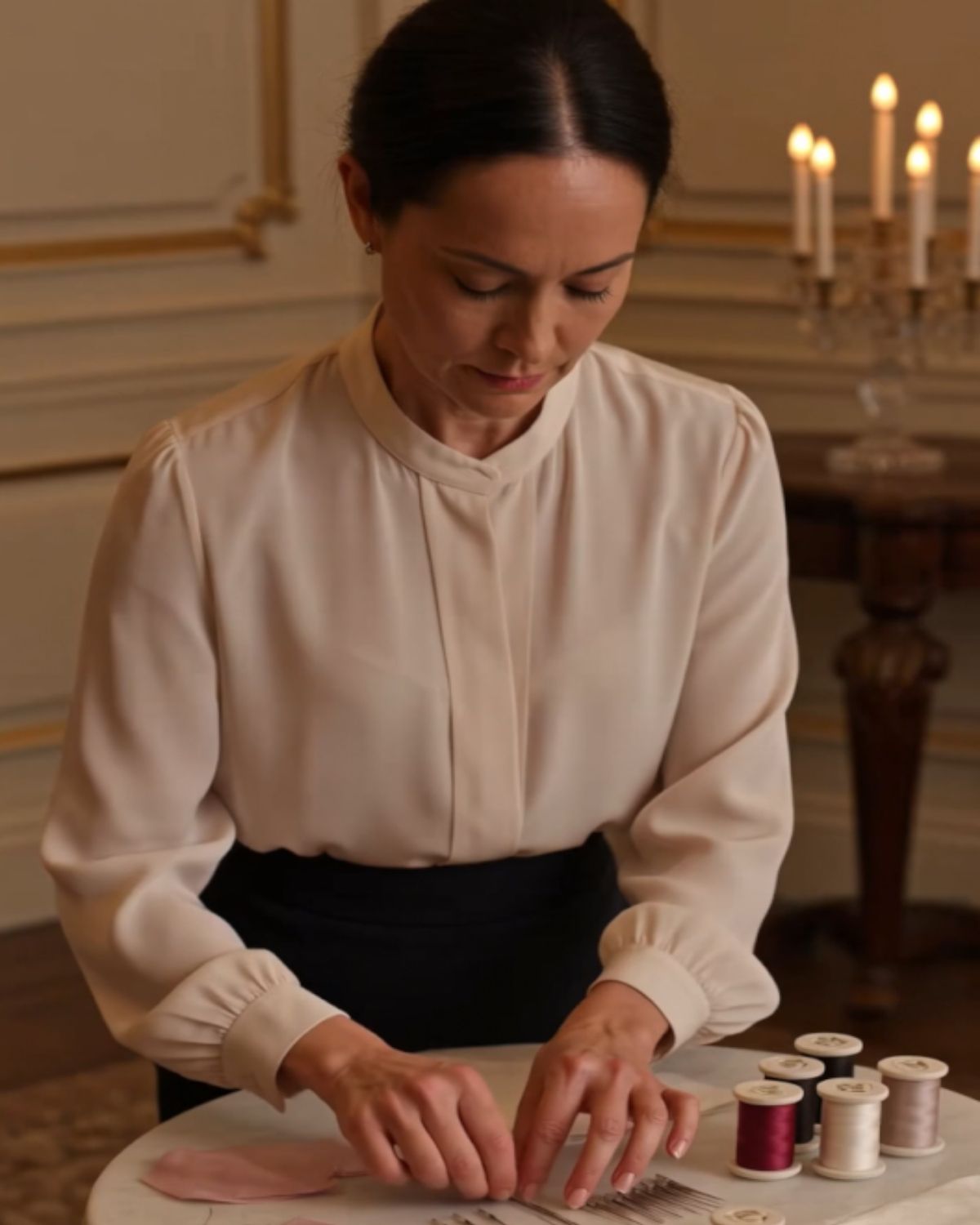
In one corner, beside a narrow window, Rosa organized needles by size.
She lined up white, ivory, and cream thread.
She checked a pair of embroidery scissors.
Then she folded a square of spare silk and placed it beside a small pincushion.
She worked quietly.
No one asked how long she had been sewing.
No one asked where she had learned.
Most people barely looked at her.
Rosa had been hired through a temporary staffing agency three days before the wedding.
The hotel’s regular wardrobe assistant had broken her wrist, and management needed someone to handle minor clothing emergencies.
Loose buttons.
Broken straps.
Small tears in bridesmaid dresses.
Nothing complicated.
The agency had sent Rosa after reviewing photographs of her work.
She had sewn for more than thirty years.
For most of that time, she worked from a small room behind a dry-cleaning shop. She repaired school uniforms, shortened trousers, replaced coat linings, and altered wedding dresses for families who could not afford luxury bridal boutiques.
She had never owned a large shop.
She had no fashionable website.
She did not post photographs of her work online.
Most of her clients came because someone’s mother, aunt, or neighbor had written her phone number on a piece of paper.
Rosa earned enough to pay rent on a modest apartment and help support her older sister.
Some months were better than others.
When the dry-cleaning shop reduced her hours, she accepted temporary hotel work.
That was why she was at the Bellmore Grand.
She arrived through the employee entrance at nine that morning carrying a metal sewing box that had once belonged to her mother.
A junior wedding assistant looked at the box and frowned.
“Is that all your equipment?”
Rosa nodded.
“It has what I need.”
The assistant glanced at the worn handle.
“We have expensive gowns here today.”
“I understand.”
“Please be careful around them.”
Rosa gave a small smile.
“I always am.”
The assistant introduced herself as Madison.
She was twenty-six, wore a headset, and moved as though every hallway belonged to her schedule.
She pointed toward the sewing station.
“Stay in that corner unless someone calls you.”
Rosa placed her box on the table.
“I’ll be here.”
Throughout the morning, people passed without acknowledging her.
A bridesmaid handed her a dress with a loose hook and continued talking on the phone.
Rosa repaired it in less than two minutes.
A groomsman brought her a jacket with a missing button.
She matched the thread so perfectly that the replacement looked original.
A flower girl tore the hem of her dress while running down the corridor.
Rosa crouched beside her, calmed her down, and stitched the lace before the child’s mother returned.
Each time, the clothing was taken from Rosa’s hands with a hurried thank-you.
Then everyone rushed away.
Near noon, two wedding assistants stood beside the sewing station reviewing the schedule.
One looked toward Rosa.
“Who is she?”
Madison answered without lowering her voice.
“She’s just the temp seamstress.”
The other assistant nodded.
“Make sure she stays out of the photography area.”
Rosa kept threading a needle.
She had heard similar comments before.
People often decided that quiet workers knew less because they spoke less.
Rosa had learned not to waste energy correcting every assumption.
She simply continued preparing.
At one-thirty, Olivia entered the bridal suite.
Conversation stopped.
Even Rosa looked up.
The bride’s gown was extraordinary.
The fitted waist had been shaped precisely to her body. Small beads reflected the light around the neckline. Layers of silk formed a soft train behind her.
Olivia stood in front of the mirror while two assistants adjusted the veil.
Her mother began crying.
One bridesmaid laughed and handed her a tissue.
“You’re going to ruin your makeup.”
Olivia smiled nervously.
“Is it too late to cancel?”
Everyone laughed.
But Rosa noticed the bride’s hands.
They were trembling.
Olivia took a slow breath.
“I feel like I can’t breathe.”
Madison stepped forward.
“The dress is fitted correctly. We checked it twice.”
“I know. I’m just nervous.”
Rosa watched the fabric near the waist.
The gown was beautiful, but the fit was extremely tight.
When Olivia inhaled deeply, the back seam pulled harder than it should.
Rosa stood.
“Excuse me.”
Madison turned sharply.
“What is it?”
Rosa pointed gently toward the waist.
“The seam is under tension.”
The room became quieter.
Madison looked at the dress.
“It was fitted by the designer.”
“Yes,” Rosa said. “But the fabric may have tightened slightly after pressing.”
One of the bridal stylists frowned.
“The dress was steamed this morning.”
“That can change how some silk sits.”
Madison shook her head.
“It looks perfect.”
Rosa approached slowly, stopping several feet from the bride.
“May I check the inside seam?”
Olivia looked toward Madison.
The coordinator gave a small, impatient sigh.
“We don’t have time for unnecessary adjustments.”
Rosa remained calm.
“It may only need a little reinforcement.”
The stylist crossed her arms.
“The gown came from one of the best bridal houses in the city.”
“I’m sure it did.”
Rosa looked at Olivia.
“I only want to prevent a problem.”
Madison glanced at the clock.
“The photographer is waiting downstairs.”
Then she looked directly at Rosa.
“Please stay at your station unless someone asks for help.”
Rosa returned to the table.
She did not argue.
But she chose a stronger ivory thread and placed it near the top of her box.
Twenty minutes later, the bridal party left the suite.
The corridor outside the ballroom had been cleared for the entrance procession.
Music drifted through the closed doors.
The bride’s father waited near the staircase, adjusting his cuffs for the third time.
Olivia approached him.
His expression changed the moment he saw her.
“You look like your mother did.”
Olivia smiled.
Her mother began crying again.
Photographers moved backward, taking pictures as the bride walked toward the ballroom entrance.
Rosa followed at a distance.
Madison had told her to remain nearby in case of an emergency, but not to appear in photographs.
So Rosa stayed close to the wall, carrying her sewing box.
The bridal party gathered near the doors.
A hotel employee straightened the train.
The musicians inside changed songs.
The coordinator lifted one finger.
“Five minutes.”
Olivia inhaled slowly.
The dress tightened around her waist.
Rosa saw the seam pull again.
She stepped forward.
“Please,” she said quietly. “Let me reinforce it before she walks.”
Madison turned.
“Not now.”
“It will take less than two minutes.”
“We are not opening the dress in the hallway.”
Rosa looked at the bride.
Olivia shifted uncomfortably.
“I do feel a little pressure.”
The stylist adjusted the fabric.
“It’s normal.”
Rosa did not believe that.
But the coordinator was already giving instructions.
“Bridesmaids, line up. Father of the bride, stay with Olivia. Doors open in four minutes.”
Rosa stepped back.
A photographer asked Olivia to turn slightly.
The bride moved one foot behind the other.
A bridesmaid lifted the edge of the train.
Then someone called from the ballroom that the officiant was ready.
Olivia took one step.
Then another.
The fabric tore.
The sound was loud enough to stop everyone.
Olivia’s body went still.
Madison stared at the back of the dress.
A split had opened along the waist seam, running several inches toward the side.
The inner lining was visible.
One section of beadwork hung loose.
Olivia reached behind her.
“What happened?”
No one answered.
She turned toward the mirror near the corridor wall.
When she saw the tear, her face changed.
“Oh no.”
Her mother rushed toward her.
“It’s all right.”
“It’s not all right.”
Olivia’s voice rose.
“My dress is ripped.”
The bridesmaids crowded around her.
One began searching through an emergency bag.
Another tried holding the fabric together.
Madison touched her headset.
“Close the ballroom doors.”
“They’re already closed,” an assistant replied.
“The ceremony starts in minutes,” someone said.
“I know.”
Madison turned toward the stylist.
“Can you fix it?”
The stylist looked horrified.
“I style gowns. I don’t sew construction seams.”
“What about safety pins?”
“No,” the stylist said immediately. “They’ll pull through the silk.”
Olivia looked at her mother.
“What do we do?”
Her father stood nearby, helpless.
Guests inside had begun whispering about the delay.
The musicians repeated the same piece.
A bridesmaid tried fastening the tear with fashion tape.
The fabric separated again.
“It won’t hold.”
Madison’s voice became sharper.
“Someone call the designer.”
“She’s in another city.”
“Call the bridal boutique.”
“They’re closed for a private event.”
The panic spread quickly.
Olivia’s breathing became shallow.
“I can’t walk in like this.”
Her mother took both her hands.
“We’ll figure something out.”
“How?”
No one had an answer.
Then Rosa stepped out from beside the wall.
“I can fix it.”
Everyone turned.
Madison looked at her as though she had forgotten Rosa was there.
“You?”
Rosa nodded.
“Yes.”
The stylist looked at the tear.
“This is not a loose button.”
“I know.”
“The lace is attached to the structural seam.”
“I can see that.”
“You could damage the beading.”
Rosa opened her sewing box.
“If we continue pulling on it, the damage will spread.”
Madison glanced at the ballroom doors.
“How long?”
“Five minutes if everyone gives me space.”
The coordinator looked doubtful.
“We have hundreds of people waiting.”
Rosa met her eyes.
“Then let me work.”
Olivia looked toward the older woman in the gray cardigan.
“Can you really fix it?”
Rosa’s expression softened.
“Yes.”
The bride studied her for one second.
Then she nodded.
“Please.”
Rosa moved immediately.
She asked the bridesmaids to take Olivia into a small preparation room beside the ballroom entrance.
The room was usually used for storing programs and floral supplies.
It had a full-length mirror, two chairs, and a narrow table.
Rosa placed her sewing box on the table.
“Everyone except the bride, her mother, and one assistant should wait outside.”
Madison started to object.
Rosa looked at her.
“I need room.”
The quiet temporary seamstress suddenly sounded like the only person who knew what to do.
The others stepped back.
Inside the preparation room, Rosa examined the damage.
The outer silk had torn where the original seam allowance was too narrow.
The internal support tape had also loosened.
The dress had not failed because Olivia moved incorrectly.
It had failed because the seam had been carrying too much pressure.
Rosa turned toward the bride.
“I need you to stand very still.”
Olivia nodded.
“Can you save it?”
“Yes.”
“Will anyone see the repair?”
“Not if I do this correctly.”
Rosa washed her hands quickly at a small sink.
Then she dried them on a clean towel and knelt beside the bride.
She selected a fine curved needle, ivory silk thread, and a small piece of reinforcement fabric.
Olivia’s mother watched.
“You knew this might happen.”
Rosa did not look up.
“I saw the seam pulling earlier.”
“Why didn’t anyone listen?”
Rosa threaded the needle.
“They were busy.”
It was a kinder answer than the truth.
Outside, Madison checked the time.
“Four minutes.”
Rosa heard her.
“Stop counting aloud.”
The hallway went silent.
Rosa loosened two hidden stitches near the waist to reduce the pressure.
Then she inserted the reinforcement fabric beneath the damaged area.
Her hands moved quickly but never carelessly.
She used tiny stitches along the inner layer first, rebuilding the support without changing the shape of the gown.
Then she pulled the silk edges together.
Olivia watched in the mirror.
At first, she looked terrified.
Then she saw the opening begin to disappear.
“How are you doing that?”
Rosa smiled faintly.
“One stitch at a time.”
The bride’s mother crouched nearby.
“Have you worked on gowns like this before?”
“Many.”
“At this hotel?”
“No.”
“Where?”
“Mostly in my neighborhood.”
Rosa tied a hidden knot.
“Families bring me dresses they bought used. Sometimes I turn a mother’s gown into a daughter’s. Sometimes I repair something that has been stored for thirty years.”
Olivia looked down.
“You do wedding dresses?”
“Wedding dresses, school uniforms, funeral clothes, work trousers.”
Rosa shifted to the beadwork.
“People need sewing for many important days.”
Outside, guests were still waiting.
The wedding coordinator whispered with hotel management.
“We may need to announce a delay.”
A bridesmaid shook her head.
“Not yet.”
In the preparation room, Rosa reattached the loose beads individually.
She used thread that matched the lace so closely that the repair vanished beneath the pattern.
Olivia’s breathing slowed.
Her mother watched Rosa’s hands.
They were not the hands of someone improvising.
They were the hands of someone who had repeated these movements thousands of times.
Steady.
Precise.
Patient.
Rosa pulled the last stitch through and pressed the repaired area gently with her fingertips.
Then she reinforced the opposite side of the waist to balance the tension.
She stepped back.
“Turn slowly.”
Olivia turned.
The seam held.
“Take a deep breath.”
The bride inhaled.
Nothing moved.
“Lift your arms slightly.”
Olivia did.
The waist remained smooth.
Rosa checked the back one last time.
“It’s done.”
Olivia stared at herself in the mirror.
The tear was gone.
Not hidden beneath a pin.
Not covered by a ribbon.
Gone.
The lace pattern continued across the repaired area as though it had never broken.
The bride touched the waist carefully.
“I can’t see it.”
“You shouldn’t.”
Olivia looked at Rosa through the mirror.
Her eyes filled with tears.
“You saved it.”
Rosa closed her sewing box.
“We should get you married.”
Olivia laughed through the tears.
Her mother pressed one hand to her mouth.
Then she hugged Rosa.
The embrace surprised her.
Rosa stood stiffly for a second before returning it.
“Thank you,” the woman whispered.
Outside, Madison heard the preparation room door open.
Rosa stepped out first.
The assistants looked past her toward Olivia.
The bride entered the corridor.
Everyone stared at the gown.
The stylist moved closer.
She examined the waist from several angles.
“Where is the tear?”
Rosa pointed to the repaired seam.
The stylist looked again.
Her expression changed.
“I can’t see the stitches.”
“You are not supposed to.”
Madison checked the dress.
Then she looked at Rosa.
For the first time that day, the coordinator seemed to see her.
Not the cardigan.
Not the temporary agency badge.
Not the metal sewing box.
Her.
“How did you do that so quickly?”
Rosa placed the stronger thread back inside the box.
“I have had practice.”
The ballroom manager opened the door slightly.
“We are ready.”
The music changed.
Olivia’s father offered his arm.
Before taking it, the bride turned toward Rosa.
“Will you stay?”
Rosa looked confused.
“I should return to the sewing station.”
“No.”
Olivia reached for her hand.
“Please stay near the entrance.”
Madison glanced toward the photographers.
Then she hesitated.
Earlier, she would have told Rosa to remain out of sight.
Now she stepped aside.
“Of course.”
Rosa stood near the ballroom doors as Olivia took her father’s arm.
The doors opened.
Nearly three hundred guests rose.
The chandeliers reflected across the polished floor. White flowers framed the aisle. The musicians began the processional.
Olivia stepped forward.
The repaired seam held perfectly.
She walked slowly through the ballroom while guests smiled, cried, and lifted phones to capture the moment.
No one knew what had happened in the corridor.
They saw only a bride in a flawless gown.
Rosa watched from behind the flowers.
Her work was designed to disappear.
That had always been part of the job.
A good seam did not demand attention.
It held quietly.
It allowed someone else to stand in the light.
Rosa was prepared to pack her equipment and leave after the ceremony began.
Then Olivia stopped halfway down the aisle.
The music softened.
The bride whispered something to her father.
He nodded.
Olivia turned toward the entrance.
“Rosa?”
The entire ballroom looked back.
Rosa froze.
Madison touched her arm.
“She means you.”
Rosa shook her head slightly.
“I shouldn’t interrupt.”
Olivia smiled.
“You already made sure there was no interruption.”
A soft wave of laughter moved through the room.
Rosa stepped into view.
She still wore the gray cardigan.
Her temporary staff badge remained clipped to her blouse.
She held the old sewing box in one hand.
Olivia extended her arm.
“Please come here.”
Rosa walked slowly toward the bride.
Guests looked at one another, unsure what was happening.
The photographer lowered his camera.
Then raised it again.
When Rosa reached the middle of the aisle, Olivia took her hand.
The bride turned toward the guests.
“There is something you should know before we continue.”
The ballroom became silent.
“A few minutes ago, my dress tore outside these doors.”
A murmur moved through the room.
Olivia looked down at the repaired waist.
“The seam opened just before I was supposed to walk in.”
Her mother wiped away tears from the front row.
“Everyone panicked,” Olivia continued. “People called designers. They searched for tape and pins. We thought the ceremony would have to be delayed.”
She looked at Rosa.
“But this woman stayed calm.”
Rosa’s eyes lowered.
“She knelt on the floor, rebuilt the seam, repaired the lace, and made the dress look perfect again.”
Guests began turning toward the gown.
Olivia squeezed Rosa’s hand.
“She saved this wedding.”
The applause started near the front.
Then it spread.
Within seconds, the entire ballroom was clapping.
People stood who had already been standing.
The musicians smiled.
Bridesmaids wiped their eyes.
The bride’s father applauded with both hands raised.
Rosa remained in the aisle, stunned.
She had repaired hundreds of garments.
She had worked through nights to finish school uniforms before the first day of class.
She had altered funeral dresses for grieving daughters.
She had turned old curtains into costumes for children whose parents could not afford them.
She had helped brides walk into community halls, church basements, back gardens, and crowded apartments.
No room had ever applauded.
Rosa covered her mouth.
Her eyes filled.
Olivia leaned closer.
“Take it in.”
Rosa shook her head.
“I was only doing my job.”
“No,” Olivia said softly. “You were doing what everyone else failed to recognize you could do.”
The applause grew louder.
Near the ballroom entrance, Madison stood beside the assistant who had called Rosa “just the temp seamstress.”
Both women looked ashamed.
Madison remembered telling Rosa to stay out of the way.
She remembered dismissing the warning about the seam.
She remembered assuming that the designer’s name meant more than the judgment of the woman standing three feet away.
Now the bride stood in front of hundreds of guests because Rosa had been right.
When the applause finally quieted, Olivia hugged her.
The photographer captured the moment.
A bride in an expensive gown holding a woman in simple clothes.
A crystal chandelier above them.
An old sewing box on the floor.
Rosa returned to the side of the aisle, and the ceremony continued.
This time, she did not hide behind the flowers.
She stood beside Olivia’s mother in the front row.
After the vows, the couple exchanged rings.
Then the officiant pronounced them married.
The ballroom erupted again.
As guests moved toward the reception, dozens approached Rosa.
One bridesmaid thanked her.
An elderly guest asked how long she had been sewing.
A woman from the groom’s family requested her business card.
Rosa smiled apologetically.
“I don’t have cards.”
The woman took out her phone.
“Then tell me your number.”
Madison waited until the others moved away.
She approached slowly.
“Rosa.”
Rosa turned.
The coordinator looked toward the sewing box.
“I owe you an apology.”
Rosa said nothing.
Madison continued.
“You warned us about the seam.”
“Yes.”
“I dismissed you.”
Rosa gave a small nod.
Madison glanced toward the ballroom.
“I thought I knew more because I worked here.”
“You knew the schedule.”
Madison looked at her.
“You knew the dress.”
Rosa’s expression softened, but she did not rescue the coordinator from the discomfort.
Madison needed to feel it.
“I also told people you were just the temporary seamstress.”
“I heard.”
Madison closed her eyes briefly.
“I’m sorry.”
Rosa studied her face.
Then she said, “Temporary does not mean unskilled.”
“I know that now.”
“The next person should not have to save a wedding for you to know it.”
Madison lowered her eyes.
“You’re right.”
The hotel’s events director joined them.
He had watched the scene from the edge of the ballroom.
“Ms. Delgado, I would like to discuss adding you to our regular event team.”
Rosa looked surprised.
“As a seamstress?”
“As a wardrobe specialist.”
Rosa smiled faintly.
“The title is not important.”
“What is?”
“Enough time to inspect the dresses before guests walk down the aisle.”
The director laughed.
“Agreed.”
Rosa did not become famous that evening.
She did not suddenly own a fashion house.
No wealthy guest handed her a fortune.
She went home to the same apartment.
She continued taking alterations behind the dry-cleaning shop.
She still repaired school uniforms and replaced coat linings.
But the hotel began hiring her regularly for weddings and formal events.
Her pay increased.
She was given a proper workspace, better lighting, and permission to inspect gowns before ceremonies.
More importantly, staff began listening when she spoke.
Three months later, another wedding was held at the Bellmore Grand.
A young assistant rushed into the wardrobe room with a torn veil.
“We need help.”
Rosa looked up from her table.
The assistant did not say, “She’s just the seamstress.”
She said, “Ask Rosa. She’ll know what to do.”
Rosa repaired the veil in four minutes.
Then she returned to her chair and continued working.
On the wall above the sewing station was a photograph from Olivia’s wedding.
The bride stood in the middle of the aisle holding Rosa’s hand.
Guests filled the background, all of them applauding.
Beneath the photograph, someone had placed a small brass plaque.
It read:
Skill does not become valuable only when important people finally notice it.
Rosa never asked for the plaque.
She found it one morning after arriving for work.
She touched the words once, then opened her sewing box.
Inside were the same needles.
The same scissors.
The same threads.
The tools had not changed.
Neither had the hands using them.
Only the way the room looked at her was different.
And that was the lesson everyone at the wedding remembered:
Some people stand beneath chandeliers and receive applause.
Others work quietly behind closed doors so those moments can happen.
But dignity belongs to both.
And no one is “just” the person whose skill holds everything together.