They emptied her backpack in front of everyone.
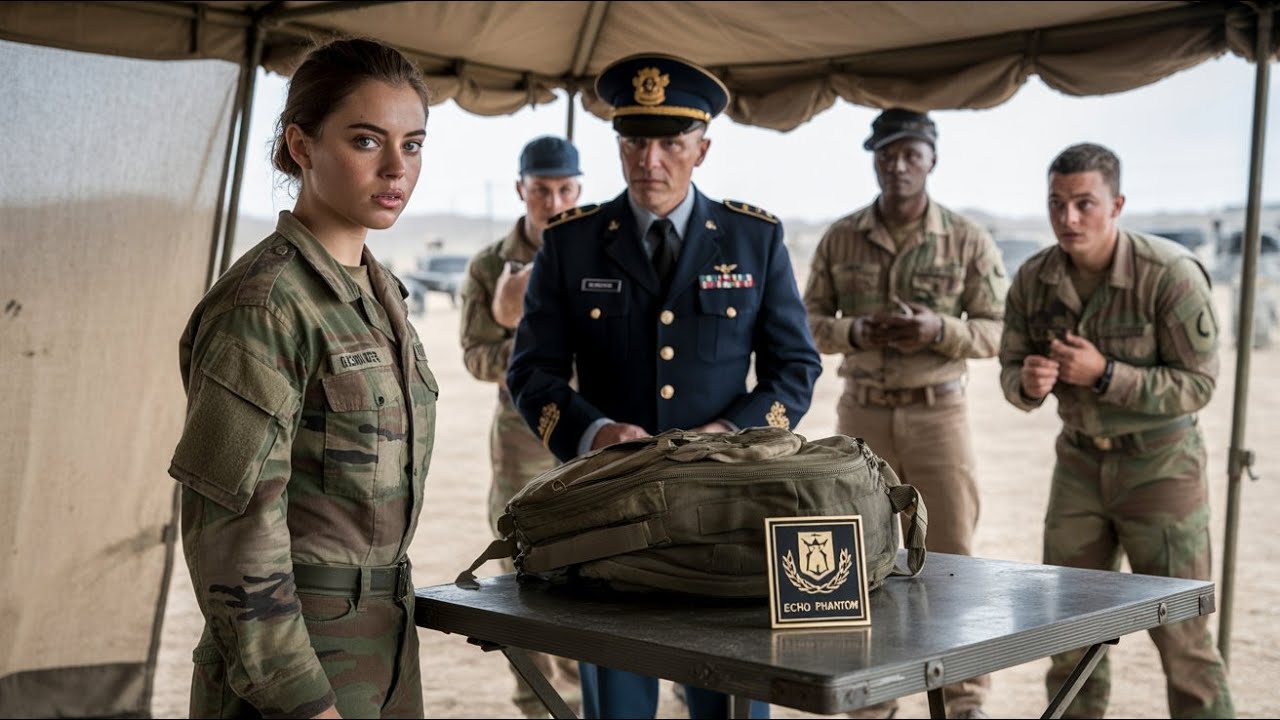
Not because she had done anything wrong.
Not because they had found anything suspicious.
They did it because they had already decided what kind of person she was.
The young woman standing at the security checkpoint looked exactly like someone they thought they could intimidate.
A faded hoodie.
Old sneakers.
A worn canvas backpack with a broken zipper.
No designer clothes. No expensive watch. No assistant following behind her.
Just a quiet woman holding a folder of papers and trying to make it to a ceremony she had spent years working toward.
The security officer looked at her identification card, then looked back at her.
“Are you sure this is yours?” he asked.
The question sounded harmless.
But the way he said it made people nearby turn their heads.
Her name was Dr. Maya Bennett.
At least, that was what the identification card said.
But to the people at the entrance of the National Defense Innovation Summit that morning, she didn’t look like someone who belonged there.
She looked like someone who had slipped through.
And the man responsible for security that day was determined to prove it.
His name was Richard Cole, the head of event security.

He had spent 18 years protecting executives, politicians, and military officials.
He believed he could read people within seconds.
And when he saw Maya walk toward the restricted entrance carrying an old backpack, he made his decision immediately.
“Everyone attending this section should have a formal invitation,” he said.
Maya calmly handed him her badge.
“I do,” she replied.
Richard scanned it.
The machine beeped.
Approved.
But instead of letting her pass, he stared at the screen.
“You’re listed as a keynote researcher?”
“Yes.”
He looked her up and down.
“You?”
A few people standing behind her exchanged uncomfortable glances.
Maya heard the whispers.
“Maybe it’s a mistake.”
“Someone probably entered the wrong name.”
“She doesn’t look like a speaker.”
She didn’t argue.
She had learned a long time ago that defending herself against assumptions usually made people believe those assumptions mattered.
So she simply waited.
Richard wasn’t satisfied.

He called over another security employee.
“Open her bag.”
Maya’s expression changed slightly.
“Is that necessary?”
“If everything is fine, you won’t have a problem.”
The sentence was polite.
But everyone understood what it meant.
You are guilty until proven otherwise.
The younger security employee hesitated.
He had seen Maya’s badge.
He knew the system had approved her.
But Richard was his supervisor.
So he unzipped the backpack.
The first things that came out were ordinary.
A notebook filled with handwritten equations.
A water bottle.
A laptop.
A small pouch of pens.
Nothing unusual.
Richard watched closely.
Still, he looked disappointed.
Almost as if he wanted to find something.
Then the employee reached into the bottom compartment.
His hand stopped.
“What is this?”
The crowd became quiet.
He pulled out a small velvet case.
It looked old.
The fabric was worn at the edges.
Richard frowned.
“Open it.”
The employee slowly opened the case.
And the entire atmosphere changed.
Inside was a medal.
Not a souvenir.
Not a school award.
A military medal.
A rare one.
The kind most people never see outside museums or official archives.
The employee’s face went pale.
Richard leaned closer.
For the first time that morning, the confidence disappeared from his expression.
Because the medal had a marking he recognized.
A marking that was not supposed to exist.
The room became completely silent.
“What is that?” someone whispered.
Richard didn’t answer.
He couldn’t.
Because the medal in Maya Bennett’s backpack was connected to one of the most classified rescue operations in the country’s recent history.
And according to official records…
That medal had never been awarded.
At least, not publicly.
Twenty-two years earlier, before Maya became a scientist, she was just a teenager living in a small town in Colorado.
Her father, Thomas Bennett, was an aerospace engineer.
He wasn’t famous.
He didn’t appear on television.
He spent most of his career working behind the scenes, solving problems other people never knew existed.
But one night changed everything.
A military aircraft carrying experimental technology suffered a catastrophic failure during a test mission.
The aircraft went down in a remote mountain region during a violent winter storm.
The rescue operation lasted three days.
Several teams searched through impossible conditions.
But the weather destroyed communication systems, blocked roads, and trapped rescuers miles away from the crash site.
Thomas Bennett was not part of the official rescue team.
He was a civilian engineer.
But when he heard about the crash, he realized something nobody else had considered.
The aircraft’s emergency system had a design flaw.
A flaw he had discovered months earlier.
A flaw that could help locate the survivors.
He spent 36 hours working with rescue teams, providing calculations and technical guidance.
Because of his information, rescuers found the crash site before it was too late.
Three crew members survived.
The mission was later classified.
The details disappeared into government archives.
Thomas Bennett received recognition privately.
A ceremony was held.
A medal was created.
But because of political complications and security concerns, the award was never officially announced.
Then, years later, the records were sealed.
The medal became a piece of history that almost nobody knew existed.
Including Richard Cole.
Until that morning.
Maya watched as he stared at the engraving.
His face had changed.
The man who had confidently emptied her backpack was now holding something that made him question everything he believed.
“Where did you get this?” he asked.
Maya looked at the medal.
Then she looked at him.
“It belonged to my father.”
Richard swallowed.
“Thomas Bennett?”
She nodded.
The security officer holding the case suddenly stepped back.
Several people nearby recognized the name.
Not because Thomas Bennett was famous.
But because their parents, colleagues, and mentors had spent years talking about the engineer who helped save lives and never asked for recognition.
Richard slowly closed the case.
But Maya wasn’t finished.
She reached into her backpack again.
This time, she pulled out a document folder.
Inside was an old photograph.
A younger Thomas Bennett standing beside rescue workers after the operation.
And next to him was a handwritten note from a military commander.
“Your work saved three lives. History may forget your name. We never will.”
Richard stared at the note.
The confidence he had carried all morning was gone.
He looked around.
The same people who had watched Maya being searched were now watching him.
The power in the room had shifted.
The woman everyone thought didn’t belong there had become the person everyone wanted to hear from.
Richard quietly stepped closer.
“I owe you an apology.”
Maya looked at him.
“For searching my bag?”
“For assuming you didn’t belong.”
Nobody spoke.
Because everyone knew that was the real issue.
The backpack wasn’t the problem.
The medal wasn’t the surprise.
The surprise was how quickly people had judged someone they knew nothing about.
Richard handed the medal back carefully.
Almost respectfully.
Then he asked a question that surprised everyone.
“Why didn’t you mention who your father was when I stopped you?”
Maya placed the medal back into the case.
“Because I shouldn’t have to.”
The words were simple.
But they stayed in the room.
She continued.
“My work should be enough. My badge should be enough. My actions should be enough.”
Nobody had a response.
Because she was right.
Later that day, Maya walked onto the main stage of the summit.
Thousands of people watched as she presented her research on improving emergency technology for disaster response.
The irony was impossible to miss.
The woman who had been treated like an outsider because of an old backpack was now teaching leaders how to save lives.
Richard Cole watched from the side of the room.
He never forgot the moment he opened that backpack.
Not because he found the medal.
But because he realized the medal had been there the entire time.
The greatness was never hidden.
Only his ability to recognize it.
Years later, a photo from that summit continued to circulate online.
It showed Maya holding her father’s medal before beginning her speech.
The caption underneath became widely shared:
“Never judge the person carrying the old backpack. You have no idea what history they might be carrying with them.”
Because sometimes the people who look like they have the least to prove are the ones who have already proven more than anyone will ever know.