The receptionist looked at the old phone before she looked at the woman holding it.
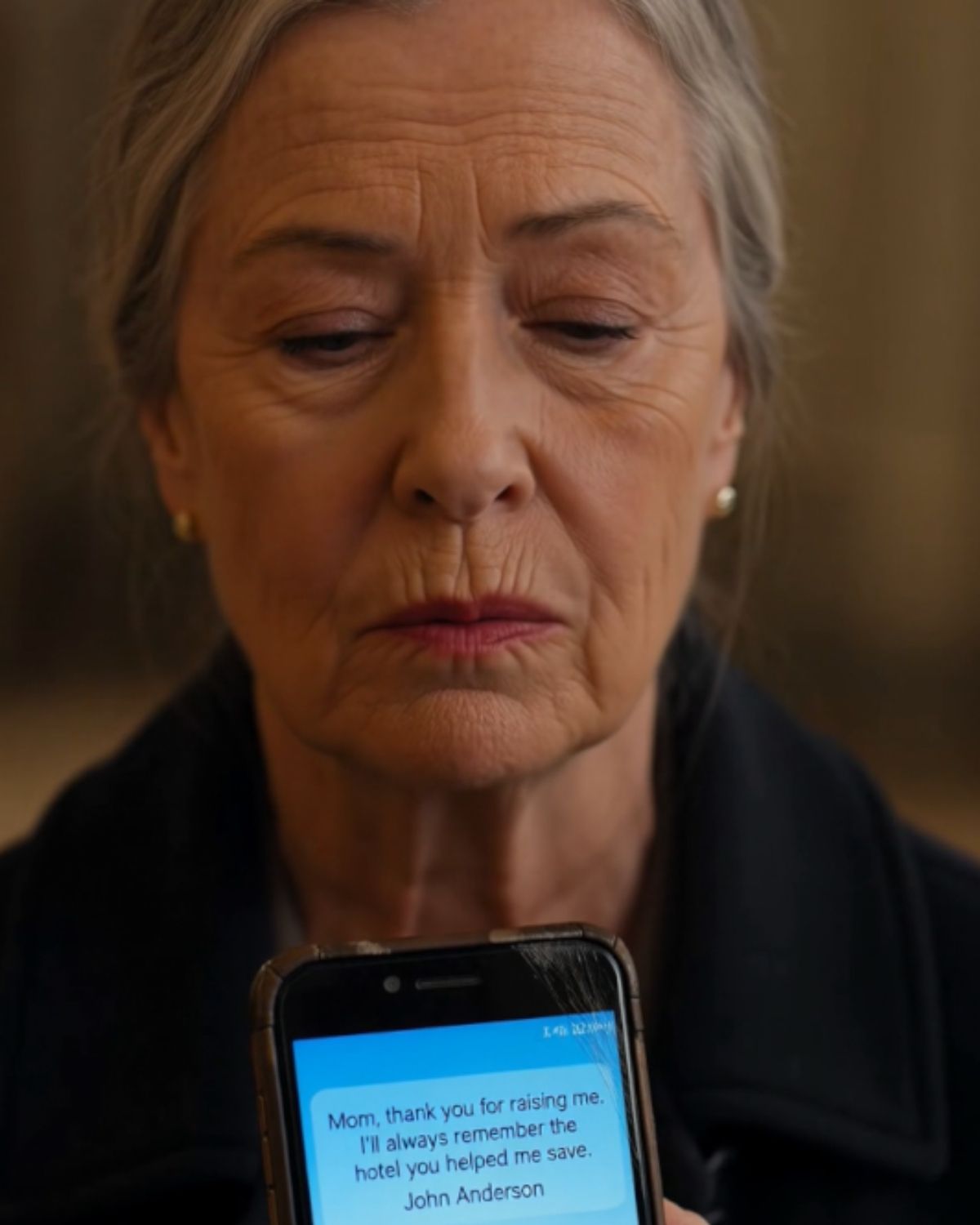
The screen was cracked.
The case was faded.
A piece of tape covered one corner where the plastic had started separating.
To the receptionist, it looked like something that belonged in a drawer, not inside one of the city’s most luxurious hotels.
The woman holding it did not ask for a room.
She did not ask for money.
She did not ask for anything expensive.
She only asked for a few minutes of electricity.
“Excuse me,” the elderly woman said softly. “Could I charge my phone for a little while?”
The receptionist glanced at her simple coat, worn handbag, and old shoes.
“Are you staying at the hotel?”
The woman shook her head.
“No.”
“I’m sorry. Charging services are only available for hotel guests.”
The woman looked down at her phone.
“But it’s the only way I can contact my family.”
The receptionist offered a polite smile that felt empty.
“I understand, but those are the hotel policies.”
The woman nodded slowly.
“Of course.”
She did not argue.
She did not complain.
She simply stepped away from the desk and held her old phone carefully in both hands.
She had no idea that within minutes, someone would recognize the message glowing on that damaged screen.
A message connected to the person who had once saved the entire hotel.
The Grand Meridian Hotel was one of the most recognizable buildings in the city.
Its marble floors reflected the golden light from enormous chandeliers hanging above the lobby.
Business travelers moved quickly through the entrance carrying briefcases.
Guests checked in beside fresh flower arrangements.
Executives held meetings near the lounge while waiters served coffee on silver trays.
Everything about the hotel suggested success.
Everything looked carefully designed.
But the woman walking through the entrance looked like she belonged somewhere else.
Her name was Margaret Anderson.
She was seventy-two years old.
She wore a simple brown coat that had been repaired at the sleeve. Her gray hair was neatly tied back, and she carried a small cloth handbag that looked older than some of the guests entering the building.
Inside the bag was her wallet, a few tissues, a small notebook, and her old smartphone.
The phone had belonged to her for nearly eight years.
The battery barely lasted half a day.
The camera no longer worked properly.
The charging port only worked when the cable was placed at a certain angle.
But Margaret kept it because it was her connection to her family.
Her son, Daniel, lived several states away.
He called every Sunday evening.
He sent messages every morning.
The phone was the one thing that made the distance feel smaller.
That afternoon, Margaret had taken two buses across the city to visit the neighborhood where she used to live.
On the way home, her phone battery dropped to three percent.
She needed to send Daniel a message.
She needed him to know she had arrived safely.
That was why she entered the Grand Meridian.
She saw the hotel’s charging station near the entrance and thought perhaps someone would help.
She did not know luxury hotels had different rules for different people.
At the reception desk, the young employee named Jessica had been trained to handle guests efficiently.
She knew how to welcome business travelers.
She knew how to arrange transportation.
She knew how to respond to complaints.
But when Margaret approached holding an old phone, Jessica’s first thought was not how to help.
It was whether she belonged there.
“Could I charge this?” Margaret asked.
Jessica looked toward the lobby.
“There is a charging area, but it is intended for guests.”
“I only need a few minutes.”
“I’m sorry.”
Margaret nodded.
“That’s all right.”
Those words made Jessica feel slightly uncomfortable.
Because Margaret was not angry.
She was disappointed.
And disappointment was harder to dismiss.
Near the entrance, Margaret noticed a small seating area beside a public charging station.
The station was designed for visitors waiting for transportation.
She sat down carefully.
Her hands trembled slightly as she connected the old cable.
The phone screen flickered.
Then turned on.
Margaret smiled.
“Thank goodness.”
She placed the phone beside her and waited.
She was only there for a few minutes.
But in a large lobby, people noticed things.
Two employees near the concierge desk glanced toward her.
One lowered her voice.
“She’s been sitting there for a while.”
The other looked over.
“She doesn’t look like she belongs here.”
The first employee shrugged.
“Maybe she got lost.”
Margaret heard the words.
She pretended not to.
She had lived long enough to understand that some people decided your value before learning your name.
She looked down at her phone instead.
A photograph of her son and granddaughter appeared briefly on the screen.
She smiled.
Then the battery icon began flashing.
One percent.
Margaret held the phone carefully.
“Please last a little longer.”
At that moment, the hotel’s main entrance doors opened.
A group of executives entered the lobby.
At the center was a man wearing a dark suit and carrying a folder.
His name was Michael Grant.
He was the CEO of the Grand Meridian Hotel Group.
Unlike many executives, Michael did not spend his days behind closed doors.
He often walked through the hotels he managed.
He believed numbers could show performance.
But only people could show the truth.
That afternoon, he was reviewing improvements planned for the lobby renovation.
Several department heads followed behind him.
“After the update, we should improve the guest charging areas,” one executive said.
Michael nodded.
“Small details matter.”
Then he stopped.
Not because of the lobby.
Not because of the employees.
Because of a phone screen.
As he passed the seating area, Margaret’s phone lit up with a new message.
The screen was visible for only a few seconds.
But Michael saw the name.
And he saw the first line of the message.
Daniel Anderson
Below it:
Mom, thank you for everything. I’ll always remember the hotel you helped me save.
Michael stopped walking.
The executives behind him continued for two steps before realizing he had stopped.
“Mr. Grant?”
He did not answer.
His eyes remained fixed on the phone.
Impossible.
The name could not be a coincidence.
Daniel Anderson.
The engineer who had changed the history of the Grand Meridian.
The engineer who had saved hundreds of people.
The engineer who had prevented the hotel from closing during its darkest moment.
Michael slowly walked toward the elderly woman.
“Excuse me.”
Margaret looked up.
“Yes?”
His voice softened.
“May I ask your name?”
She looked surprised.
“Margaret.”
“Margaret what?”
“Anderson.”
The lobby became quiet.
Michael’s expression changed.
“Mrs. Anderson?”
Margaret looked confused.
“Yes?”
Michael glanced at the phone.
Then back at her.
“Is your son Daniel Anderson?”
The woman smiled slightly.
“Yes. Do you know him?”
Michael took a breath.
“I knew his work.”
Margaret looked uncertain.
“My son is an engineer.”
“He was much more than that.”
Michael looked toward the executives standing behind him.
They knew that expression.
Something important had happened.
Years earlier, the Grand Meridian had faced its greatest crisis.
A severe electrical failure had affected the hotel during a holiday weekend.
Hundreds of guests were inside.
Elevators had stopped.
Emergency systems were unstable.
The hotel’s backup systems were not responding correctly.
Engineers were called from across the city.
Daniel Anderson was one of them.
At the time, he was not famous.
He was not a senior executive.
He was a young engineer working for a small technical company.
But he stayed when others left.
He spent hours inside the building tracing the failure.
He discovered that a critical wiring problem had been missed during a previous renovation.
Fixing it required working through the night.
Daniel refused to leave until every safety system was functioning.
Because of his work, the hotel avoided a major disaster.
The company later recognized him publicly.
But Daniel never spoke much about it.
He simply told his mother:
“I did my job.”
Michael had never forgotten.
He had tried to thank Daniel personally many times.
But years passed.
Daniel moved to another state.
They lost contact.
Now his mother was sitting quietly in the lobby with a cracked phone.
Michael looked at her.
“Your son saved this hotel.”
Margaret’s eyes widened.
“Oh.”
She looked embarrassed.
“He never told me it was a big deal.”
Michael smiled.
“That sounds like him.”
She touched the phone.
“He always says helping people is just what you do.”
Michael nodded.
“That is exactly why we survived.”
The lobby had gone silent.
Guests nearby watched as the CEO of the hotel stood beside an elderly woman holding an old phone.
The same woman who had been ignored minutes earlier.
Michael turned toward Jessica at the reception desk.
“Jessica.”
The receptionist immediately stepped forward.
“Yes, Mr. Grant.”
“Did this woman ask for help?”
Jessica hesitated.
“Yes.”
“Did she receive it?”
The question was simple.
But everyone understood.
Jessica lowered her eyes.
“No.”
Michael nodded slowly.
“Why?”
Jessica struggled.
“I thought hotel services were only for guests.”
Michael looked around the lobby.
“The ability to offer a glass of water or a charging cable is not what makes someone a guest.”
Jessica remained silent.
“It is what makes someone human.”
The words stayed in the air.
Michael turned back to Margaret.
“Mrs. Anderson, I apologize.”
Margaret looked surprised.
“You don’t need to apologize.”
“Yes, I do.”
He picked up the phone cable.
“May I?”
She handed it to him.
Michael walked with her to the charging station himself.
Not an employee.
Not an assistant.
The CEO.
He carefully connected the charger and waited until the phone screen showed the charging symbol.
“There.”
Margaret smiled.
“Thank you.”
Michael looked at the old phone.
“Is Daniel still calling every Sunday?”
She smiled warmly.
“Every Sunday.”
“That’s good.”
“He worries too much.”
Michael laughed softly.
“He gets that from someone.”
Margaret smiled.
The tension in the lobby began to disappear.
Jessica approached slowly.
“Mrs. Anderson?”
Margaret looked up.
The receptionist looked uncomfortable.
“I’m sorry.”
Margaret waited.
“I should have helped you.”
The apology was not dramatic.
It was simply honest.
Margaret nodded.
“Thank you.”
Jessica looked at the phone.
“Would you like us to arrange a replacement charger? This one looks damaged.”
Margaret immediately shook her head.
“No, no. This one still works.”
Michael smiled.
“That sounds like Daniel.”
Margaret laughed.
“Yes. He says if something can be repaired, you shouldn’t throw it away.”
Michael looked around the hotel lobby.
The sentence stayed with him.
Because perhaps people were the same.
Sometimes they were not broken.
Sometimes they were simply overlooked.
Later that afternoon, Michael invited Margaret to the hotel lounge.
Not as a VIP.
Not because she was connected to someone important.
Because she was a person who had walked in needing a little kindness.
She was given tea while her phone charged.
She called Daniel.
When he answered, Margaret smiled.
“Daniel, you won’t believe where I am.”
Michael stepped away and let her talk.
He did not want recognition.
He wanted her to have a comfortable moment.
Before leaving, Margaret stopped near the reception desk.
She looked at Jessica.
“Thank you for helping me today.”
Jessica looked surprised.
“Thank you for giving me the chance to do better.”
Margaret smiled.
Then she walked toward the entrance.
Michael watched her leave.
She was still wearing the same simple coat.
Still carrying the same old handbag.
Still using the same cracked phone.
Nothing about her appearance had changed.
Only what people knew about her had changed.
The next week, the Grand Meridian installed additional public charging stations in the lobby.
Not hidden.
Not restricted.
Available for anyone who needed them.
A small sign was placed beside them.
It read:
Sometimes a small kindness is the most important service we provide.
Employees often asked Michael why he made the change.
He always gave the same answer.
“Because we never know who is sitting in front of us.”
Years later, Margaret still used that old phone.
Daniel offered to replace it many times.
She always refused.
“It still works,” she would say.
And every Sunday evening, when Daniel called, she remembered the day when a cracked screen carried a message that changed how an entire hotel saw kindness.
The woman in the simple coat was never rich.
She never owned the building.
She never needed to.
Her value was already there.
The only thing that changed was that people finally stopped looking at what she carried and started seeing who she was.