CHAPTER ONE — THE MOMENT THE MUSIC STOPPED
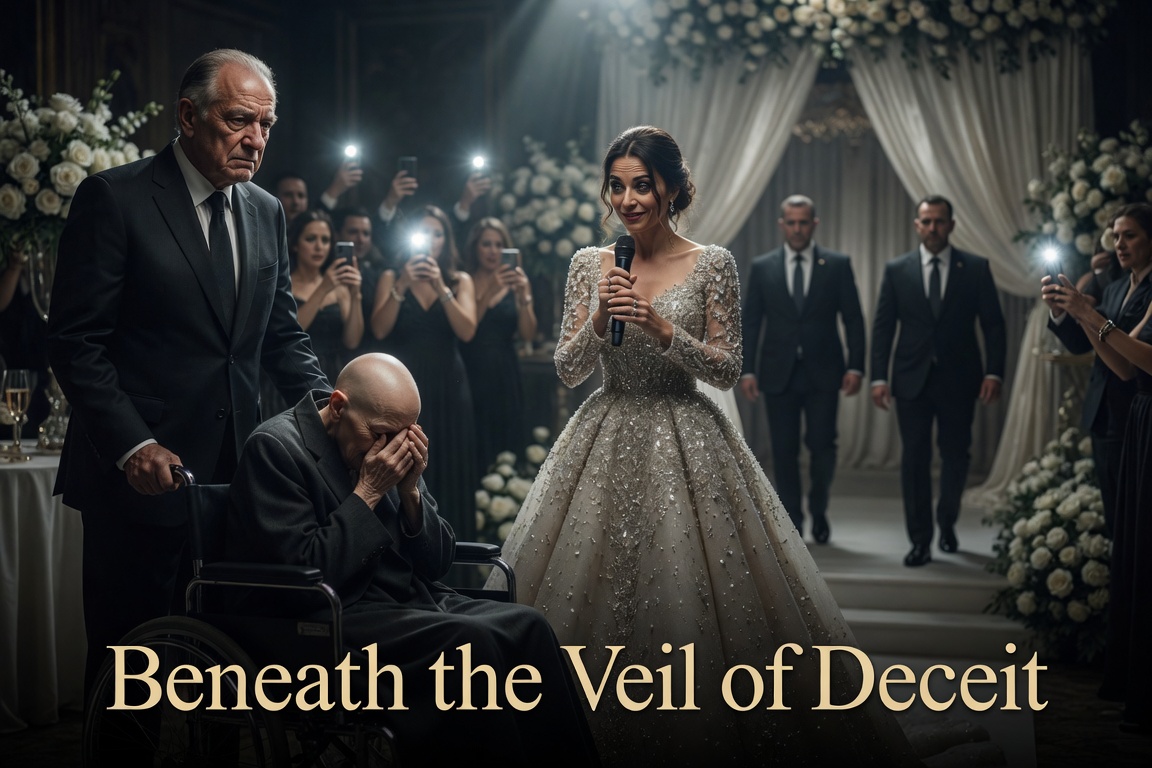
The wedding band was playing when my wife’s wig hit the floor.
Not dropped.
Not slipped.
Thrown.
The sound it made when it landed on the polished marble stage was almost nothing.
A soft, meaningless sound.
But everyone in that ballroom heard it.
Because silence arrived first.
One second, there was music.
Champagne glasses.
Laughter.
The warm glow of a thousand golden lights reflecting off crystal decorations.
The next second, there was nothing.
My wife stood in the center of the stage with one hand raised instinctively toward her head.
Her other hand trembled.
And my daughter-in-law was laughing.
Actually laughing.
“Did everyone see that?”
Jessica Whitmore covered her mouth dramatically, pretending surprise.
“Oh my God.”
A few people near her table laughed too.
Nervous laughter.
The kind people make when they realize something is wrong but are too afraid to be the first person to say it.
My wife, Margaret, did not move.
She just stood there.
Beneath the lights.
In front of two hundred guests.
Without the wig she had carefully chosen that morning.
Without the small piece of confidence she had borrowed from herself before walking into the room.
The chemotherapy had taken her hair months ago.
But cancer had not taken her dignity.
Jessica had.
At least, she thought she had.
I was sixty-three years old.
I had spent forty years learning how to control my reactions.
As a firefighter, panic killed people.
You could not run into a burning building screaming.
You could not carry someone out while losing control.
You breathed.
You focused.
You moved.
That was what I did.
I breathed.
I focused.
I moved.
I took off my jacket.
Walked onto the stage.
And covered my wife.
The ballroom was still frozen.
My son, Ethan, stood near the altar.
His face was white.
Not angry.
Not yet.
Just shocked.
Because he had watched the woman he loved humiliate his mother.
And he had not stopped it.
I wrapped my jacket around Margaret’s shoulders.
She looked at me.
Her eyes were full of something worse than pain.
Embarrassment.
“James,” she whispered.
I leaned closer.
“Don’t look at them.”
Her lips trembled.
“I’m sorry.”
Those two words almost destroyed me.
Sorry.
She was apologizing.
My wife.
The woman who had spent six months fighting cancer.
The woman who smiled through hospital visits so nobody else would be uncomfortable.
The woman who woke up every morning pretending she was not afraid.
She was apologizing because someone else was cruel.
I held her hand.
“You did nothing wrong.”
Across the stage, Jessica was still smiling.
She thought this was a joke that had gone too far.
She thought people would laugh, then move on.
She did not understand something important.
Cruel people often mistake silence for permission.
I turned toward her.
“Jessica.”
Her smile faded slightly.
“Yes?”
I walked to the gift table.
A white envelope sat there.
The one she had been asking about for months.
The wedding gift.
The money.
The thing she cared about more than the marriage itself.
She had asked Ethan repeatedly.
“How much did your parents give?”
“Is it enough for the house?”
“Are they finally helping us?”
I picked up the envelope.
The room watched.
Jessica’s eyes followed it immediately.
That told me everything.
Not my wife.
Not the damage.
The envelope.
“James,” she said carefully.
I walked back toward her.
“You wanted this.”
She smiled again.
A little.
“Of course.”
I handed it to her.
“Open it.”
She laughed.
“Now?”
“Yes.”
Something in my voice made people stop breathing.
Jessica tore the envelope open.
She pulled out the papers.
Her smile remained for three seconds.
Then disappeared.
The first page.
The second page.
The signature.
Her eyes moved faster.
Her face changed.
“What is this?”
I looked at her.
“Read it.”
Her fingers tightened around the documents.
The ballroom remained silent.
My son stepped closer.
“Dad?”
I did not look away from Jessica.
The papers were not money.
They were not a check.
They were not the gift she expected.
They were legal documents.
Documents my wife and I had prepared weeks earlier.
Documents changing everything.
Because before Jessica humiliated Margaret, she had no idea what Margaret had quietly discovered.
And she had no idea what was written in those papers.
CHARACTER FILES
James Carter — 63
Retired firefighter, husband, father.
Appearance: Silver hair, strong build, tired but steady eyes, simple suits, hands marked by decades of physical work.
Personality: Calm, disciplined, protective, patient.
Deep wound: He spent his life saving others but fears failing the people closest to him.
Greatest fear: Losing Margaret after already watching too many people leave.
Secret desire: To enjoy a quiet life with the woman he loves.
Moral belief: Strength exists to protect, never to dominate.
Greatest weakness: He carries pain silently until someone he loves is threatened.
Greatest strength: He stays calm when others reveal who they truly are.
Margaret Carter — 61
James’s wife, cancer survivor undergoing chemotherapy.
Appearance: Elegant, gentle expression, soft voice, carefully chosen wigs and scarves, warm eyes.
Personality: Kind, resilient, emotionally intelligent.
Deep wound: Cancer made her feel like she lost control over her own body.
Greatest fear: Becoming a burden to her family.
Secret desire: To be treated as Margaret, not “the sick woman.”
Moral belief: Kindness is strength.
Greatest weakness: She hides her suffering to protect others.
Greatest strength: She maintains compassion even when hurt.
Ethan Carter — 35
James and Margaret’s son.
Appearance: Successful professional, thoughtful face, usually composed but emotionally conflicted.
Personality: Intelligent, loving, conflict-avoidant.
Deep wound: Grew up believing keeping peace was the same as being good.
Greatest fear: Losing his marriage.
Secret desire: To stop disappointing everyone.
Moral belief: Family should stay together.
Greatest weakness: He avoids confrontation until damage is done.
Greatest strength: He is capable of admitting mistakes.
Jessica Whitmore — 34
Ethan’s wife.
Appearance: Stylish, confident, always perfectly presented.
Personality: Ambitious, charming, image-focused.
Deep wound: Grew up believing status determined whether people respected her.
Greatest fear: Becoming ordinary.
Secret desire: To be admired without needing appearances.
Moral belief: Winning means being seen as superior.
Greatest weakness: She underestimates quiet people.
Greatest strength: She understands social situations quickly.
Victor Whitmore — 67
Jessica’s father.
Appearance: Wealthy businessman, expensive suits, controlled expression.
Personality: Strategic, proud, intimidating.
Deep wound: Built his identity around financial success after growing up poor.
Greatest fear: Losing influence.
Secret desire: To be respected beyond his money.
Moral belief: Money creates security.
Greatest weakness: He believes everything can be negotiated.
Greatest strength: Strategic thinking.
CHAPTER TWO — BEFORE THE HUMILIATION
Margaret chose the wig herself.
That detail matters.
Because people often think losing hair is only about appearance.
It is not.
It is about identity.
Cancer had taken pieces of her life one appointment at a time.
First came the diagnosis.
Then the tests.
Then the waiting.
Then the words nobody wants to hear.
“You’ll need chemotherapy.”
I remember sitting beside her in the doctor’s office.
The room was too bright.
The chairs were uncomfortable.
A machine hummed somewhere behind the wall.
Margaret held my hand.
Not because she was weak.
Because she knew I was trying not to fall apart.
The doctor explained treatment plans.
Numbers.
Schedules.
Possible side effects.
I listened.
Margaret asked questions.
That was her.
Even when afraid, she prepared.
The day her hair started falling out, she tried to make a joke.
She stood in the bathroom looking at the brush.
“Well,” she said.
I looked up.
“What?”
“I finally have an excuse for not doing my hair.”
I laughed.
Then she cried.
Quietly.
The kind of crying people do when they are tired of pretending.
I held her.
“You’re still you.”
She whispered:
“What if I don’t feel like me?”
That question stayed with me.
So when she found the wig she liked, she treated it like armor.
Not a disguise.
Armor.
She wore it to doctor appointments.
To grocery stores.
To coffee with friends.
And when Ethan announced his wedding date, she said:
“I want to look beautiful.”
Not young.
Not perfect.
Beautiful.
That was all.
The morning of the wedding, she stood in front of the mirror wearing a blue dress.
The same color she wore when we renewed our vows ten years earlier.
She touched her wig.
“How does it look?”
I smiled.
“Like my wife.”
She laughed.
“Good answer.”
“I mean it.”
She looked at me through the mirror.
“You’re nervous.”
“I’m not.”
“James.”
I sighed.
“Okay. A little.”
“Why?”
I looked away.
Because I had known Jessica for two years.
Because I had seen how she spoke about people.
Because I had heard her call Margaret “fragile” when she thought nobody was listening.
Because I knew she cared about appearances.
Margaret touched my hand.
“Don’t start a war on my behalf.”
“I’m not.”
“Promise?”
I looked at the woman I loved.
The woman who still worried about everyone else while fighting for her own life.
“I promise.”
I kept that promise.
That day.
I did not start a war.
I ended one.
CHAPTER THREE — THE WEDDING SPEECH
Before Jessica ripped off Margaret’s wig, she gave a speech.
That was what made it worse.
Because cruelty often introduces itself as affection.
The reception began beautifully.
The ballroom was filled with candlelight.
The windows showed the city glowing beneath a dark sky.
A jazz band played softly near the dance floor.
Guests smiled.
Photographers moved between tables.
For a few minutes, everything looked perfect.
Then Jessica took the microphone.
“I want to say something about family.”
I noticed Margaret tense slightly.
Not fear.
Awareness.
Jessica smiled toward the crowd.
“Marriage means joining two worlds.”
She looked at her parents.
“Our family has always believed in building a future.”
Applause.
Then her eyes moved toward us.
“My new family has taught me something too.”
A pause.
“They taught me that love means sacrifice.”
Margaret smiled politely.
I did not.
Because I knew Jessica.
She was setting something up.
“And sometimes,” Jessica continued, “people need to accept when they are no longer able to contribute the way they used to.”
The room quieted.
Ethan looked uncomfortable.
Jessica laughed.
“I just mean life changes.”
Her eyes moved toward Margaret’s wig.
A small glance.
Almost invisible.
Almost.
“Some people hold onto things because they are afraid of being left behind.”
My hand tightened around my glass.
Ethan whispered:
“Jessica.”
She ignored him.
That was when I understood.
This was not a joke.
This was planned.
She was testing how much she could get away with.
Then came the wig.
A few minutes later, during the photo session, Jessica approached Margaret.
“Oh, your wig is slipping.”
Margaret touched her hair.
“I’m okay.”
“No, wait.”
Jessica reached out.
Too quickly.
Too casually.
Then pulled.
The ballroom changed forever.
CHAPTER FOUR — THE PAPERS
The documents Jessica held were not what she expected.
The first page was a legal notice.
The second was a financial disclosure.
The third was a transfer agreement.
Her eyes moved.
Then stopped.
“What is this?”
I looked at my son.
Ethan was reading over her shoulder.
His face became pale.
“Dad…”
Jessica looked between us.
“You can’t do this.”
“Do what?”
“This.”
She waved the papers.
“The house?”
“Yes.”
The house.
The one Margaret and I had paid for over thirty years.
The one Jessica had repeatedly hinted should become Ethan’s.
The one she assumed would be handed over eventually.
She had not known Margaret changed the estate plan.
She had not known we had documented every conversation.
Every request.
Every financial demand.
Every comment about “helping family.”
The papers stated that the property would go into a medical survivor foundation.
Not inheritance.
Not a gift.
A foundation.
One that helped families dealing with cancer treatment costs.
Jessica stared.
“You’re giving away the house?”
Margaret stepped forward.
Covered by my jacket.
Still dignified.
“Yes.”
Jessica’s face twisted.
“But Ethan is your son.”
“Yes.”
“And I’m his wife.”
“Yes.”
“Then why?”
Margaret looked at her.
For the first time that night, my wife’s voice became completely steady.
“Because I learned something.”
Jessica waited.
“People who love you do not make you prove your worth while you are suffering.”
The room went silent.
Ethan closed his eyes.
Because he knew.
He knew exactly how badly he had failed.
Jessica looked around.
Searching for support.
Nobody moved.
Not her friends.
Not the guests.
Not even her parents.
Because everyone had finally seen what we had seen.
CHAPTER FIVE — THE APOLOGY THAT CAME TOO LATE
Ethan found us outside.
The night air was cold.
The hotel lights reflected on the wet pavement.
Margaret sat in the car while I stood beside the door.
Ethan looked broken.
“Dad.”
I said nothing.
“I didn’t know.”
I looked at him.
“That is the problem.”
His face fell.
“I should have stopped her.”
“Yes.”
“I’m sorry.”
I believed he meant it.
But apologies are not time machines.
They cannot return a moment.
They can only decide what happens next.
“I love my wife,” Ethan said.
“I know.”
“But I hurt Mom.”
“Yes.”
He looked down.
“I don’t know how to fix this.”
I looked through the window at Margaret.
She was tired.
But peaceful.
“She doesn’t need you to fix what happened.”
“Then what?”
“Make sure it doesn’t happen again.”
Ethan nodded.
Slowly.
For the first time in years, he looked like my son instead of someone trying to please everyone.
EPILOGUE — THE WOMAN WHO KEPT HER DIGNITY
Months later, Margaret’s foundation opened its first support center.
The building was small.
Nothing like the hotels and luxury spaces where people judged each other.
Just warm lights.
Comfortable chairs.
Coffee in the waiting room.
A place where families could breathe.
At the opening ceremony, Margaret wore no wig.
She wore a scarf.
Not because she had to.
Because she wanted to.
A reporter asked her:
“Why did you decide to do this?”
She smiled.
“Because everyone deserves a place where they are treated like a person, not a problem.”
I stood beside her.
Holding her hand.
Thinking about the wedding.
The laughter.
The silence.
The moment when everyone saw her without the wig.
What they did not understand was this:
They thought they exposed her.
They thought they showed weakness.
They were wrong.
The wig was never her strength.
The strength was the woman underneath it.
The woman who survived.
The woman who forgave.
The woman who stood in a ballroom after being humiliated and still chose kindness over cruelty.
And that was something nobody could ever take away.


