The front door opened before I could defend myself.
Until that moment, the loudest sound in the living room had been my daughter’s frightened breathing against my neck.
Emma was one year old, warm and heavy in my arms, wearing the cream dress I had saved for our homecoming. A white bow rested above her left ear. She had spent the entire drive from Fort Brannon pointing at Christmas lights, laughing whenever red and gold reflections slid across the windshield.
I had been laughing too.
Three hours earlier, my husband had texted:
Don’t be late tonight. Mom has a surprise waiting for you.
I imagined food warming in the oven. A cake. Perhaps balloons for the daughter I had missed learning to walk.
Instead, I found twelve relatives arranged around our living room like a jury.
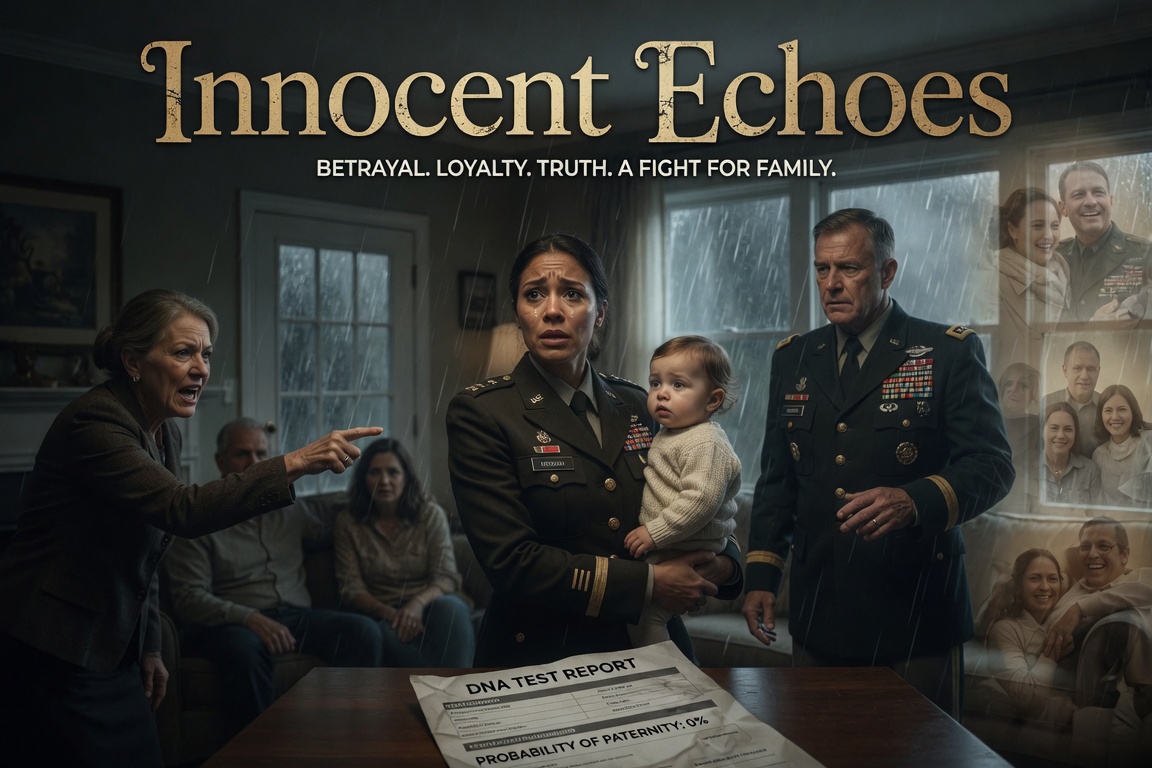
My husband, Daniel, stood beside the fireplace. His mother occupied my chair. My suitcase had already been placed near the front door.
And on the coffee table, beneath the yellow light of the chandelier, lay a white envelope stamped with the name of a private DNA laboratory.
Daniel slapped one page against the table.
“She’s not my child.”
No one asked whether I wanted to sit down.
No one came forward to take my coat.
No one noticed that I was still wearing my Army uniform because my replacement had arrived late and I had driven home without changing.
My mother-in-law, Ruth, pointed toward the entrance.
“Get out of my son’s house.”
Emma startled at the sharpness in her voice. Her small fingers knotted in the collar of my uniform.
I tightened one arm around her.
The room smelled of cinnamon candles, roasted meat and the cold rain that had followed us through the doorway. Family photographs covered the mantel: Daniel in college, Daniel beside his mother, Daniel holding Emma in the hospital.
The photograph of me in uniform had disappeared.
I looked at the DNA report.
Then at my husband.
Daniel’s face was pale, but his eyes were bright with something that resembled triumph from a distance and terror up close.
“Where did you get that?” I asked.
He gave a short laugh.
“That’s your question?”
“Yes.”
“Not whether it’s true?”
“I know whether it’s true.”
Ruth rose from my chair. She wore a burgundy dress, pearl earrings and the expression of a woman who believed indignation made evidence unnecessary.
“My son spent eleven months raising another man’s baby while you played soldier.”
A cousin lowered her eyes.
Daniel’s younger brother studied the carpet.
Everyone had been told what role to play before I arrived.
Ruth was the wounded grandmother.
Daniel was the betrayed husband.
I was the unfaithful military wife who had returned from base with medals on her chest and shame in her arms.
Emma pressed her face into my shoulder.
I kept my voice low.
“Who collected the samples?”
Daniel’s jaw tightened.
“I did.”
“How?”
“I swabbed her cheek while you were at Fort Brannon.”
“You haven’t had unsupervised access to Emma in six weeks.”
The room shifted.
Ruth stepped forward. “He is her father. He does not require supervision.”
“He has required it since the pediatrician documented that Emma returned from his care with an untreated fever.”
Daniel’s face reddened.
“You said you weren’t going to use that against me.”
“I said I wouldn’t use it to humiliate you.”
Ruth laughed bitterly. “Listen to her. She comes home in uniform and thinks she’s commanding the room.”
I looked at the report again.
The laboratory logo sat at the top. Beneath it were identification numbers, collection dates and a conclusion declaring a zero-percent probability of paternity.
It looked official.
That was its purpose.
But official documents have habits.
Margins. accession codes. chain-of-custody fields. certification numbers. Names printed where signatures should be. Details most people ignore because confidence is easier to read than evidence.
The laboratory address lacked a suite number.
The accreditation symbol was outdated.
The collection date fell on a federal holiday when the listed clinic had been closed.
And the report called Emma Emily on page two.
I lifted my eyes.
“This is fake.”
Daniel’s hand flattened against the table.
“You don’t get to dismiss science because you don’t like the answer.”
“This isn’t science.”
His mouth opened.
Before he could speak, the front door swung inward.
Cold air entered first.
Then a woman in a dark gray coat stepped across the threshold, rain shining on her shoulders. She was in her late fifties, with silver threaded through her black hair and a leather document case in one hand.
Behind her stood two uniformed military police officers and a county sheriff’s deputy.
Every face in the room turned.
The woman looked at me.
“Major Sarah Mitchell?”
Daniel stared at the silver oak leaf on my shoulder as if he were seeing it for the first time.
Ruth recovered first.
“This is a private family matter.”
The woman removed her gloves.
“No, Mrs. Whitmore. It stopped being private when someone forged the credentials of a Defense Department medical contractor.”
Daniel’s lips parted.
The woman showed her identification.
“Dr. Evelyn Hart, director of Northbridge Genetic Services.”
Then she placed a second DNA report on top of Daniel’s.
“The document your son presented is not ours.”
The rain tapped the open door.
No one moved.
Dr. Hart looked at Daniel.
“And the biological sample submitted under Major Mitchell’s daughter’s name did not come from her daughter.”
Chapter One
The Homecoming They Rehearsed Without Me
My name is Sarah Mitchell.
I was thirty-six years old the night my husband tried to turn my daughter into evidence against me.
I had served in the Army for fourteen years, first as a medical logistics officer and later as part of an investigative task force responsible for tracking stolen pharmaceuticals, falsified casualty records and fraudulent military-family contracts.
That description sounds clean.
The work was not.
Corruption rarely arrives wearing a black mask. It wears identification badges. It sends professional emails. It knows when auditors take leave. It calls theft an administrative discrepancy until someone dies because insulin, antibiotics or blood products never reach the place listed on the manifest.
I had spent the previous six months at Fort Brannon assisting an inquiry into a contractor suspected of diverting medical supplies through military-family charities.
Daniel told everyone I was on routine base duty.
That was partly true.
The rest was classified.
When I married him six years earlier, he admired my uniform.
At least, he admired what it allowed him to tell people.
“My wife is Army,” he would say at parties, placing one hand against my back as if my service were a framed certificate he owned.
He liked the photographs.
He disliked deployments.
He liked my salary arriving on schedule.
He disliked that command sometimes called after midnight.
He liked introducing me as Major Mitchell once I was promoted.
At home, when we argued, he called me Sarah and said rank did not matter in a marriage.
He was right.
But accountability did.
Daniel Whitmore had grown up in a house where responsibility was assigned according to gender and blame traveled toward whoever was least likely to make a scene.
Ruth raised him after his father left. She had worked two jobs, paid his college tuition and built her entire identity around the belief that sacrifice gave her permanent authority over his life.
She was not evil.
She was frightened of becoming unnecessary.
Daniel learned early that keeping his mother calm was easier than telling her no.
When he married me, Ruth did not lose a son.
She acquired competition.
At first, her intrusions were small.
She rearranged my kitchen while I was at work.
She criticized the way I folded Daniel’s shirts.
She called during our anniversaries because she felt lonely.
When Emma was born, Ruth stopped pretending boundaries were anything but insults.
She entered the delivery room after I had refused visitors.
She announced the baby’s name online before Daniel and I had told my parents.
She referred to Emma as “our girl” and corrected me whenever I said “my daughter.”
Daniel’s response remained the same.
“She means well.”
That phrase can hide years of damage.
Six months before the DNA ambush, I discovered Daniel had opened a credit line in both our names.
He claimed the money went toward repairs on the house.
There had been no repairs.
Then I found withdrawals from Emma’s education account.
Daniel blamed a banking error.
The bank blamed Daniel.
We began counseling.
He attended twice.
After the second session, he sat in the parking lot gripping the steering wheel and said, “You describe everything like an investigation.”
I looked at his hands.
“You answer everything like a suspect.”
That was the beginning of our separation, though neither of us called it that yet.
I moved temporarily into base housing with Emma when my assignment intensified. Daniel agreed she would stay with me during the week and see him on weekends.
Then Emma returned from one visit feverish, dehydrated and wearing the same diaper I had packed eight hours earlier.
Daniel said she had seemed fine.
The pediatrician disagreed.
Supervised visits followed.
Ruth called it kidnapping.
Daniel called it punishment.
I called it documentation.
Now he stood in our living room beside a forged DNA report while the actual director of the laboratory explained that the sample attached to Emma’s name belonged to an adult male.
Dr. Hart opened her leather case and removed a chain-of-custody form.
“Major Mitchell contacted our compliance department this afternoon after receiving an image of the report from an unknown number.”
Daniel turned toward me.
“You already knew?”
“I saw the photograph while driving.”
His face twisted.
“And you still came here?”
“You told me my daughter was inside a house with people preparing to remove her from my custody.”
“She is my—”
He stopped.
The contradiction caught in his throat.
Ruth stepped between us.
“How convenient. She arrives with military police and a laboratory director. She planned this.”
Dr. Hart looked at her.
“Mrs. Whitmore, your son used a counterfeit report bearing my signature.”
Ruth’s eyes flicked toward Daniel.
Only for a moment.
Then loyalty closed over doubt.
“He was deceived.”
The sheriff’s deputy, a broad-shouldered woman named Carla Ruiz, moved closer to the coffee table.
“By whom?”
No one answered.
Deputy Ruiz picked up the false report without touching the printed surface.
“Mr. Whitmore, did you create this?”
Daniel’s eyes moved around the room.
He had expected witnesses to strengthen him.
Instead, they gave him nowhere private to lie.
“I downloaded a template.”
Ruth whispered, “Daniel.”
He ignored her.
“I paid someone to prepare it.”
“Who?” Ruiz asked.
“A consultant.”
“What consultant?”
His mouth tightened.
“I don’t know his legal name.”
Dr. Hart’s expression hardened. “You submitted a sample to our actual laboratory last month using falsified guardianship documents.”
Daniel looked at her sharply.
“You said the sample wasn’t Emma’s.”
“It wasn’t. But the accompanying document identified it as hers.”
I watched his breathing change.
He knew what came next.
Dr. Hart continued.
“The sample matched a male donor already present in our contractor database.”
One of the military police officers shifted.
I looked at Dr. Hart.
“Who?”
She met my eyes.
“Jonathan Whitmore.”
Daniel’s younger brother lifted his head from the carpet.
Every person turned toward him.
Jonathan looked confused.
“What?”
Dr. Hart held up the verified report.
“The swab submitted as Emma Mitchell-Whitmore’s sample belongs to you.”
Jonathan stared at Daniel.
“You took my DNA?”
Daniel’s face had gone colorless.
Ruth gripped the back of a chair.
“How would he even do that?”
Jonathan touched his mouth.
Then his expression changed.
“The toothbrush.”
Daniel said nothing.
“You stayed at my apartment after the football game,” Jonathan said. “You used my bathroom.”
“It was a sample.”
“You stole my toothbrush?”
“I needed a non-match.”
The sentence left his mouth before he could stop it.
Silence filled the room.
Emma shifted in my arms and began to cry.
Not loudly.
A tired, frightened sound.
I moved toward the hallway.
Ruth stepped in front of me.
“You are not taking her.”
Deputy Ruiz’s voice cut across the room.
“Move away from the child.”
Ruth stared at her.
“This is my granddaughter.”
“And Major Mitchell is her mother.”
“My son has rights.”
“Your son created fraudulent medical evidence.”
Ruth’s jaw trembled.
She looked at Daniel.
For the first time, her certainty weakened.
“Tell them you had a reason.”
Daniel looked at her as if she had offered him a rope too thin to hold both of them.
“I did.”
I stopped.
He met my eyes.
“You were going to leave me.”
“I already had.”
“No. You moved to base housing. You said we needed space.”
“You emptied Emma’s account.”
“I was putting it back.”
“You forged my signature on a credit line.”
“I was fixing it.”
“You tried to use a fake DNA test to take my daughter.”
His voice broke.
“I was trying to stop you from taking everything.”
There it was.
Not hatred.
Fear.
Fear sharpened by entitlement until he could no longer see the difference between losing control and being harmed.
He pointed at my uniform.
“You have the Army. You have a career. You have lawyers and people who show up when you call. What do I have?”
Ruth whispered, “You have me.”
The room heard the tragedy inside that answer.
Daniel laughed once, hollow and exhausted.
“Exactly.”
Chapter Two
The Lie Beneath the Lie
Deputy Ruiz asked the relatives to leave one by one.
Some avoided my eyes.
Others attempted small apologies in the doorway.
My cousin-in-law murmured, “We only heard his side.”
I looked at the suitcase waiting beside the entrance.
“That was enough for you.”
She lowered her head and left.
Within twenty minutes, the house looked abandoned after a party no one enjoyed. Half-filled glasses stood on side tables. A roast cooled beneath foil in the kitchen. Coats disappeared from hooks.
Ruth refused to go.
She sat on the sofa with both hands locked around her purse.
Daniel remained near the fireplace while the officers documented the forged report and Dr. Hart explained the laboratory breach.
Emma had stopped crying. She rested against me, thumb in her mouth, eyes following every stranger who crossed the room.
I kissed her hair.
It smelled of baby shampoo and rain.
Dr. Hart approached carefully.
“May I speak with you privately?”
I carried Emma into the dining room.
The table had been set for fourteen people. A small cake sat near the window. Pink frosting. One candle shaped like the number one.
For a child they intended to take from me.
Dr. Hart closed the door.
“There is another issue.”
I looked at her.
“The forged report is not why I came personally.”
She opened her case again and removed a page marked with a federal evidence number.
“The unauthorized account used to request the DNA analysis was tied to a military contractor under investigation by your task force.”
Cold moved beneath my skin.
“Which contractor?”
“Valence Family Solutions.”
I knew the name.
Valence administered emergency childcare grants, genetic counseling referrals and family-support services for deployed personnel. On paper, it existed to protect military households during long absences.
In reality, my task force suspected someone inside Valence was selling sensitive family data.
Deployment schedules.
Home addresses.
Children’s medical details.
Spousal financial records.
Information that could be used for fraud, blackmail or targeted theft.
The case had stalled because the company’s internal requests appeared to come from valid military-family accounts.
I looked toward the living room.
“Daniel had a Valence account.”
Dr. Hart nodded.
“He requested one during your last temporary deployment.”
“How did he receive access to contractor credentials?”
“We don’t know yet.”
The dining room lights reflected in the rain-dark window.
Behind my own reflection, I saw the pale shape of my daughter sleeping against me.
The false DNA test had never been only about custody.
Daniel had reached into the same network I had been investigating.
“Did he know what Valence was doing?”
Dr. Hart hesitated.
“That is what federal investigators need to determine.”
A crash sounded from the living room.
I opened the door.
Daniel stood over the shattered remains of his whiskey glass.
Ruth had risen from the sofa.
Deputy Ruiz’s hand rested near her holster.
Daniel looked at me.
“You brought your investigation into our home.”
“No,” I said. “You did.”
His face twisted. “I found messages on your laptop.”
My body went still.
“What messages?”
“Contractor reports. Valence records. Notes about accounts.”
“You accessed my government computer?”
“I accessed my wife’s computer.”
“It was secured.”
“You left it in the house.”
“Inside a locked office.”
His breathing turned shallow.
Ruth said, “Daniel, stop speaking.”
He looked at her, surprised.
For the first time that night, she was not protecting him with noise.
Deputy Ruiz took one step forward.
“How did you access the device?”
Daniel stared at the broken glass.
“I had help.”
“From the consultant?” I asked.
He said nothing.
Dr. Hart entered behind me.
“Was the consultant named Caleb Vane?”
Daniel’s head rose.
That was enough.
I knew Caleb Vane.
Not personally.
By pattern.
He was Valence’s regional compliance director, a former Army administrative specialist who had left service after an investigation into falsified dependent claims. The charges had disappeared after a key witness withdrew.
Vane presented himself as a veterans’ advocate.
He spoke at family readiness events.
He donated computers to military spouses.
He knew which households had deployed officers and which spouses felt ignored.
Daniel’s resentment had not created the scheme.
It had made him available to it.
“Where is Vane?” I asked.
Daniel shook his head.
“I don’t know.”
“When did you last speak?”
“This morning.”
“What did he tell you?”
His eyes flicked toward Ruth.
She knew something.
I turned to her.
“Mrs. Whitmore?”
Her lips pressed together.
Daniel said, “Leave her out of this.”
Ruth looked at him.
The command in his voice startled her.
Then she opened her purse and removed a key.
Small. Brass. Attached to a blue plastic tag.
Dr. Hart inhaled sharply.
The tag bore the Valence logo.
Ruth placed it on the coffee table.
“He gave me this yesterday.”
Daniel stared at her.
“Mom.”
“You said it was for a storage unit.”
“It is.”
“What’s inside?” Deputy Ruiz asked.
Ruth’s fingers trembled.
“I don’t know.”
Daniel closed his eyes.
The answer had cost her.
Good.
Truth should cost the person who protected the lie.
I looked at the tag.
A storage unit number had been written on the back.
B-214.
The same number appeared in three missing-inventory reports from Valence.
My phone buzzed.
A secure message from Lieutenant Colonel Owen Beck, my task-force commander.
DO NOT APPROACH VANE. WARRANT TEAM EN ROUTE. POSSIBLE CHILD IDENTITY FILES IN STORAGE.
I looked at Daniel.
“Did you take Emma there?”
His face emptied.
Ruth whispered, “Daniel?”
I stepped closer.
“Did you take our daughter to Vane?”
Daniel’s eyes filled.
“Once.”
The room seemed to tilt.
“When?”
“Two months ago.”
“She was supposed to be with you at the park.”
“He said he needed a photograph and fingerprints for the custody filing.”
My grip tightened around Emma.
“You let a stranger photograph and fingerprint our daughter?”
“He was helping me.”
“What did he promise?”
Daniel’s voice dropped.
“That you would never be able to take her away.”
The words entered me slowly.
Not because they surprised me.
Because he still said take her away, as if I were not the parent carrying her.
Dr. Hart’s phone rang.
She answered, listened and turned pale.
“What?”
She ended the call.
“The storage facility’s security system was disabled twelve minutes ago.”
Deputy Ruiz reached for her radio.
Then every light in the house went out.
Chapter Three
The Man at the Rear Door
Darkness fell with the suddenness of a curtain.
Emma woke and screamed.
I dropped behind the dining-room wall before thought caught up with training. One hand protected the back of her head. The other reached beneath my uniform jacket for a weapon that was not there.
I had driven home from base but left my service pistol secured.
A mother’s homecoming should not require one.
The military police officers drew theirs.
Deputy Ruiz called for units through her radio.
No response.
The signal crackled and died.
Outside, rain struck the windows.
Then came three soft knocks from the rear of the house.
Not urgent.
Not frightened.
Deliberate.
Daniel whispered, “That’s him.”
Ruth’s voice shook. “Who?”
No one answered.
The emergency lights in the hallway flickered once, then failed.
A shape passed beyond the kitchen window.
Deputy Ruiz signaled one officer toward the rear entrance.
The second moved beside me.
“Major, take the child upstairs.”
“No.”
“Ma’am—”
“This house has a second rear stair from the laundry room. If he knows the floor plan, upstairs becomes containment.”
The officer studied me, then nodded.
Daniel said from the darkness, “He knows the floor plan.”
I turned toward his voice.
“How?”
“He helped install the security cameras.”
A floorboard creaked near the kitchen.
Ruth inhaled sharply.
The rear-door lock clicked.
Someone had a key.
The officer near the kitchen raised his weapon.
The door opened.
Cold air swept through the house carrying rain and the metallic smell of wet pavement.
A man stepped inside.
Tall. Dark raincoat. Baseball cap pulled low.
His right hand held a pistol.
His left carried a small insulated medical bag.
“Daniel,” he said calmly. “You were supposed to be gone by now.”
The military police officer ordered him to drop the weapon.
Caleb Vane fired first.
The shot shattered a cabinet door.
The officer moved behind the island and returned fire.
Ruth screamed.
Daniel grabbed her and pulled her toward the hallway.
Vane disappeared behind the kitchen wall.
I handed Emma to Dr. Hart.
“Hold her.”
Her eyes widened.
“Major—”
“Do not move from this corner.”
I slid across the dining-room threshold toward the pantry.
Vane’s shoes struck tile.
Slow.
Controlled.
He was not trying to escape.
He was moving toward the living room.
Toward the false report and the storage key.
Deputy Ruiz fired once.
A grunt answered.
Then silence.
I reached the pantry entrance and saw Vane’s shadow cross the floor.
He held his left arm close now.
Wounded.
Still armed.
He stopped near the coffee table.
The brass key glinted beside the forged DNA report.
Vane bent for it.
I drove the heavy dining chair into the back of his knees.
He fell sideways.
The pistol struck the carpet but remained in his hand.
He swung toward me.
I kicked his wrist.
The weapon slid beneath the sofa.
Vane caught my ankle and pulled.
My shoulder hit the floor.
Pain flashed white behind my eyes.
He climbed over me, one hand closing around my collar.
Up close, he smelled of rain, antiseptic and blood.
“You should have stayed on base,” he whispered.
I drove my thumb into the wound in his left arm.
His face changed.
I rolled him off, trapped his wrist and pressed my forearm across his throat.
Deputy Ruiz arrived with her weapon aimed at his head.
“Do not move.”
Vane smiled beneath me.
Not because he believed he would win.
Because he believed the damage had already been done.
“You think this is about her husband?” he said.
I tightened my hold.
“What is in B-214?”
His smile widened.
“Every military child whose parent thought privacy was paperwork.”
Sirens rose outside.
Real ones this time.
Vane looked toward the sound.
Then back at me.
“You can arrest me,” he said. “But the files already left.”
Chapter Four
The Children in the Database
Caleb Vane survived.
That mattered, though part of me hated that it did.
Dead men become mysteries. Living men can be questioned.
He was transported under armed guard with a gunshot wound through the upper arm. The insulated medical bag contained sedatives, blank collection swabs, forged guardianship forms and six encrypted drives.
None contained Emma’s data.
That was worse.
At two in the morning, I sat in the back of an ambulance while a medic cleaned the cut near my temple. Emma slept against Dr. Hart inside the house, wrapped in my field coat.
Daniel stood beneath the porch light in handcuffs.
Not because he had helped Vane attack us.
Because he had admitted providing Vane access to my secured office and allowing him to copy information from my government device.
Ruth stood near him under an officer’s umbrella.
She had not stopped crying.
When the investigators led Daniel toward a vehicle, she moved to follow.
He turned.
“Mom, don’t.”
She froze.
He looked at her as if seeing the architecture of his entire life.
“You kept telling me she would leave,” he said.
Ruth’s mouth trembled.
“I was afraid.”
“So was I.”
“I only wanted to protect you.”
Daniel laughed once.
It sounded painful.
“No. You wanted me to need you.”
Ruth’s face folded.
The accusation was cruel.
It was also true.
She reached for him.
The officer moved between them.
Daniel looked at me across the rain.
Emma’s pink blanket was visible through the living-room window.
“I didn’t know Vane was selling children’s files,” he said.
I believed him.
Belief did not erase consequence.
“You knew he was forging evidence.”
His eyes lowered.
“Yes.”
“You knew he accessed my secure computer.”
“Yes.”
“You let him collect information from Emma.”
His breath caught.
“Yes.”
The rain ran down his face.
For a moment, I saw the man I had married.
Daniel at twenty-nine, standing in my apartment kitchen trying to cook pasta and reading the instructions after putting everything in the pot.
Daniel asleep beside Emma’s hospital bassinet, one hand resting through the bars.
Daniel laughing when our daughter sneezed milk over his shirt.
Human beings rarely become monsters in one decision.
They become dangerous by excusing the previous one.
“I’m sorry,” he said.
The phrase arrived too early.
Some apologies are attempts to escape the full shape of what happened.
I did not answer.
He was placed in the vehicle.
Ruth watched the red taillights disappear into the rain.
Then she turned toward me.
Without pearls, certainty or her son beside her, she looked old.
“I thought you would take him away from me.”
“I married him.”
“That is what I mean.”
I stared at her.
She wrapped both arms around herself.
“When his father left, Daniel was all I had.”
“He was a child, not a replacement husband.”
Her eyes closed.
The truth struck where polite language never had.
“I know that now.”
“No. You know it because he finally said no to you.”
She opened her eyes.
The pain there was real.
I did not soften.
Pain does not automatically make a person innocent.
“What happens to him?” she asked.
“That depends on what he did and what he tells investigators.”
“And Emma?”
I looked through the window.
My daughter slept safely in another woman’s arms because her father and grandmother had built a courtroom in our living room.
“You will not see her without my permission.”
Ruth began to cry again.
Quietly now.
“I love her.”
“I know.”
The words startled her.
I continued.
“Love that ignores safety is appetite.”
She lowered her head.
For once, she had no defense.
At dawn, Lieutenant Colonel Beck arrived.
Owen Beck was fifty-two, narrow-faced and calm, with a habit of rolling a coin across his knuckles while thinking. He had commanded medical logistics in two wars and trusted charm less than inventory numbers.
He found me in the dining room holding Emma beside the untouched birthday cake.
“You look terrible,” he said.
“Thank you, sir.”
“That was not criticism.”
“It usually is in my family.”
He sat across from me.
Federal agents moved through the house behind him. Evidence bags covered the table where relatives had expected to witness my humiliation.
Beck looked at Emma.
“She all right?”
“The medic says yes.”
“And you?”
“Yes.”
He waited.
Good commanders know the first answer is often protective reflex.
“No,” I said.
He nodded.
“Better.”
He placed a folder beside the cake.
“B-214 was cleared before our team arrived.”
My stomach tightened.
“What remained?”
“Empty shelving. Bleach. Burn residue. One broken server rack.”
“Security footage?”
“Deleted.”
“Backups?”
“Working on it.”
Emma opened her eyes and looked at him.
Beck made a face at her so severe that she smiled.
He looked offended.
Then returned to the folder.
“Vane’s home is empty. Financial accounts drained. But we found communications between him and Daniel.”
I held my daughter closer.
“How extensive?”
“Eighty-three messages over four months.”
The number entered me like cold water.
“What did they discuss?”
“Custody strategy. Your schedule. Emma’s medical appointments. Your task-force assignment.”
“Did Daniel know the assignment details?”
“Not all. Enough to make Vane nervous.”
I looked at the forged DNA report.
“He encouraged Daniel to accuse me publicly.”
“Yes.”
“Why?”
Beck rolled the coin once.
“To discredit you before your team linked Valence to the data theft. If you appeared unstable, vindictive and involved in a custody scandal, defense counsel could argue your investigation was compromised by personal motives.”
Daniel had not merely tried to take Emma.
He had allowed himself to be used to destroy my credibility.
“Did he know?”
Beck’s silence lasted too long.
“Some of it,” he said.
That hurt more than a simple no.
Chapter Five
The Husband Who Needed Me Guilty
Daniel asked to speak with me the following afternoon.
I refused.
He asked again through his attorney.
I refused.
Then investigators recovered an audio message in which Vane threatened to “remove the child from the equation” if Daniel failed to deliver my task-force files.
I agreed to the meeting.
Not for closure.
For information.
The interview room at the county detention center was painted the color of old teeth. A steel table divided us. The fluorescent light flattened everything: exhaustion, anger, grief.
Daniel entered wearing a gray jail uniform.
He stopped when he saw me.
For six years, I had known every version of his face.
The charming one.
The wounded one.
The defensive one.
The boyish one he used after lying.
This face was new.
It had no audience.
He sat.
Neither of us spoke at first.
The ventilation system hummed overhead.
Finally, he said, “How is Emma?”
“Safe.”
His eyes filled.
“I miss her.”
“You risked her.”
“I didn’t know.”
“You knew enough.”
He looked at the steel table.
“Vane found me through a military-spouse forum.”
“How?”
“I posted about custody. About you moving to base housing.”
“You posted our family details publicly?”
“Under another name.”
I waited.
He rubbed his hands together.
“He messaged me saying he had helped fathers in military divorces. He knew things about command, legal protections, deployment clauses. He said judges always believed service members.”
“So he told you that you needed evidence.”
Daniel nodded.
“At first, he said financial evidence. Then infidelity.”
“And when none existed?”
“He said paternity would create immediate doubt.”
I studied him.
“You agreed to fake a DNA test.”
His mouth tightened.
“Yes.”
“Why Jonathan’s sample?”
“Vane said it had to be a real non-match in case anyone checked the laboratory accession.”
“And Emma’s actual DNA?”
Daniel looked up.
“I never gave it to him.”
“Did he collect anything from her?”
“Photographs. Fingerprints. A strand of hair.”
The room narrowed.
“A strand of hair?”
“He said it was for identity verification.”
I leaned forward.
“Where did you meet him?”
“At B-214.”
“What was inside?”
His breathing changed.
“Boxes. File cabinets. Computers.”
“Did you see names?”
“Yes.”
“Children?”
He closed his eyes.
“Military families.”
“How many?”
“I don’t know.”
“Estimate.”
“Hundreds.”
The word sat between us.
I forced my voice to remain level.
“And you said nothing?”
“He told me it was authorized support data.”
“You broke into my secure office for a man storing children’s identity files.”
“I was desperate.”
“No. You were entitled.”
He flinched.
Good.
Desperation explains risk taken against oneself.
Entitlement risks others.
Daniel’s voice cracked.
“You were leaving me.”
“I was protecting Emma.”
“You made me feel like a criminal before I became one.”
The sentence left him bitterly.
Then his face changed.
He heard himself.
I sat back.
“No, Daniel. Documentation did not make you a criminal. Your choices did.”
He covered his face.
For a moment, I watched his shoulders shake.
I had comforted that body through his father’s death, job loss, panic attacks and the night Emma struggled to breathe with croup.
My hands remained in my lap.
Eventually, he lowered his palms.
“Vane said your team would raid the storage unit Friday.”
“How did he know?”
“He had someone inside Fort Brannon.”
“Name.”
“I don’t know.”
“Description.”
“He called her Finch.”
The task-force code name stopped my breath.
Finch was not a random alias.
It belonged to Captain Laura Finch, our data-compliance liaison.
She had access to warrant schedules, contractor audits and family-data subpoenas.
She had also sat beside me at Emma’s first birthday lunch on base.
Daniel saw recognition.
“You know her.”
I stood.
He reached across the table, stopped by the chain attached to his waist.
“Sarah.”
I looked down at him.
“I never wanted to hurt Emma.”
“You wanted to hurt me more than you wanted to protect her.”
His mouth opened.
No words came.
That was the difference between intention and truth.
Chapter Six
Finch
Captain Laura Finch did not report to work the next morning.
Her apartment had been emptied.
Her car sat at an airport garage.
Her passport remained in her desk at Fort Brannon, which meant she either had another identity or never planned to fly.
The breach was no longer outside our task force.
It sat inside every decision we had made for six months.
Owen Beck locked down the office.
Phones were collected. Systems isolated. Staff interviewed in pairs. People who had eaten lunch together for years began looking at one another like locked doors.
I sat in a secure briefing room while Emma played on a blanket near my chair under the supervision of a family-assistance officer.
I refused to leave her anywhere else.
Beck projected Finch’s access history onto the wall.
“She opened forty-two family files outside assignment scope,” he said. “Twenty-seven involved deployed officers. Eight involved pending divorce or custody disputes.”
A civilian analyst raised her hand.
“Common factor?”
“All had children under five.”
The room changed.
Young children have clean identities.
No credit history.
No tax complications.
No criminal records.
Their personal information can be used for years before anyone notices.
Another analyst displayed financial activity tied to shell guardianship accounts, fraudulent health claims and military dependent benefits.
Vane’s network had not been selling simple data.
They had been creating substitute identities.
Children listed under false guardians.
Benefits redirected.
Medical services billed.
In some cases, custody documents altered to isolate the legitimate parent.
The fake DNA report was one tool among many.
Beck looked at me.
“Daniel’s public accusation was supposed to establish a family record that Emma’s paternity was disputed. Finch could then flag her dependent status as unresolved.”
“And transfer her identity into a shell case,” I said.
“Yes.”
My daughter sat six feet away stacking soft blocks.
Red.
Blue.
Yellow.
She knocked them over and laughed.
Every person in the room looked away.
The human mind prefers fraud as numbers.
A laughing child makes it unbearable.
Beck shut off the screen.
“We find Finch, we find the mirrored database.”
My phone vibrated.
A message from an unknown number.
A photograph loaded.
Ruth stood outside a grocery store holding Emma’s pink blanket.
The picture had been taken that morning.
Then came a text.
You protect records. We protect leverage. Ask Ruth where she put the blue key.
I stood so quickly my chair struck the floor.
Beck read the screen.
“Where is Ruth?”
“She was supposed to be at her sister’s house.”
He reached for his phone.
I called her.
No answer.
Again.
No answer.
The family-assistance officer lifted Emma.
I stared at the phrase.
Blue key.
The brass storage key had a blue Valence tag.
But that key was in evidence.
Unless there had been another.
Ruth’s purse.
The night Vane arrived, she had removed one key and placed it on the table.
What if she had kept a second?
I called Daniel’s attorney.
“Ask him whether Vane gave Ruth more than one key.”
The answer came seven minutes later.
Yes.
One brass key for B-214.
One blue plastic key card for a “family safe room.”
Ruth had never mentioned it.
Chapter Seven
A Mother’s Fear
We found Ruth at an abandoned pediatric clinic twenty miles outside town.
She was alive.
Barely conscious.
Her car sat behind the building with the driver’s door open. Inside the clinic, exam rooms had been converted into document stations. Cameras, biometric scanners, printers, medical forms.
A counterfeit childhood waited in every drawer.
Ruth lay on the floor of a former waiting room, drugged but breathing. The blue key card rested beneath her hand.
She had gone there voluntarily.
We learned that later.
After receiving a message claiming Daniel could be released if she retrieved documents proving Vane had deceived him, Ruth drove to the location without contacting police.
Because even after the attack, she still believed she could fix her son’s life privately.
Finch had met her there.
The clinic cameras showed Ruth arguing, refusing to hand over the key card until she saw Daniel.
Then Finch injected her.
Finch escaped before our team arrived.
But she left in a hurry.
A server remained active.
Our technicians recovered part of the mirrored database.
Among the files was Emma’s.
Her photograph.
Fingerprints.
Hair sample analysis.
A fabricated medical history.
A blank guardianship transfer with Ruth listed as temporary custodian.
I stared at her name.
Ruth woke in the hospital that evening.
She looked at me from the bed, face gray, oxygen beneath her nose.
“I didn’t know,” she whispered.
I stood beside the window.
The city glowed beyond the glass. Cars moved below like blood cells through dark arteries.
“You knew enough to hide the key.”
Her eyes filled.
“I thought I could use it to help Daniel.”
“You thought you could negotiate with people who forged a child’s identity.”
“I was afraid he would go to prison.”
“You were more afraid of consequences than danger.”
She closed her eyes.
Tears slipped into her hair.
“I ruined him.”
“No.”
Her eyes opened.
I continued.
“You trained him to believe fear excused harm. He chose how far to take it.”
She looked at the blanket over her hands.
“When he was six, his father left us at a gas station.”
I said nothing.
Ruth’s voice shook.
“We had one suitcase. Daniel kept asking when his father would return. I promised him no one would ever take his family again.” Her fingers curled into the blanket. “I made that promise into a cage.”
Pain moved across her face.
For the first time, she was not asking me to comfort her.
“I loved him wrong,” she said.
The sentence stayed in the room.
Ugly.
Accurate.
I looked at the woman who had pointed toward the door while I held my daughter.
“You will tell investigators everything.”
“Yes.”
“You will not contact Daniel without his attorney.”
She flinched.
“Yes.”
“You will not see Emma until a court and a therapist agree it is safe.”
Her mouth trembled.
Then she nodded.
“Yes.”
It was not redemption.
It was the first boundary she accepted without calling it cruelty.
Chapter Eight
The Birthday Video
Finch contacted me forty-eight hours later.
Not through a secure channel.
Through the video monitor in Emma’s nursery.
I was staying in protected housing on base. The device should not have connected to our home network.
At 2:13 a.m., the screen lit.
Laura Finch appeared sitting in darkness.
She looked tired, hair loose, military composure gone.
“Sarah,” she said. “You’re going to think this is about money.”
I reached for the alarm button but did not press it yet.
“Where are you?”
“Somewhere Vane cannot reach.”
“He is in custody.”
“Vane was middle management.”
The phrase chilled me.
“Who is above him?”
Finch smiled sadly.
“You know how military families are praised for resilience? That word creates profit. Deployments, divorces, emergency guardianships, bereavement. Every fracture produces paperwork. Every piece of paperwork can be owned.”
“Names.”
“I will give you the database.”
“In exchange for what?”
“Protection.”
“You endangered children.”
Her face tightened.
“I built a system to prevent dependents from vanishing between agencies. Vane turned it into a marketplace.”
“And you continued feeding it.”
“He had my son.”
That stopped me.
Finch’s personnel file listed no children.
She read my face.
“Not legally. He was born when I was nineteen. Closed adoption. Vane found him through an old medical database and threatened to expose his identity to people tied to his adoptive father.”
Fear had made another person available.
It did not make her innocent.
“Where is he now?”
“Safe. I think.”
“You think?”
Her eyes filled.
“That is why I need you.”
I pressed the alarm.
No sound.
A silent response team began moving.
Finch leaned toward the camera.
“There is a veterans’ charity banquet tomorrow at the Ellison Hotel. Valence’s parent company will transfer the final server during the event. They hide everything inside public goodness.”
“Who controls the parent company?”
She looked offscreen.
Then back.
“Your husband’s attorney.”
The name struck immediately.
Martin Shaw.
The man who had advised Daniel to request emergency custody before the DNA accusation.
The man who represented military spouses in high-conflict divorces.
The man who had filed the first motion claiming my deployment made me an unstable parent.
Finch continued.
“Shaw identifies families in crisis. Vane creates the evidence. I validated the records. The charity provides legitimate access.”
“How many children?”
Her lips trembled.
“Four thousand six hundred and twelve.”
The nursery felt too small to contain the number.
Finch gave me a hotel room number and disconnected.
The response team traced the signal.
It came from our old house.
Chapter Nine
The House We Thought Was Empty
We entered the house before dawn.
The family photographs remained on the mantel. The birthday cake had been removed, but a pale square marked the table where it had sat. Emma’s toys remained in the corner.
No Finch.
No visible equipment.
Then an agent found a cable behind the nursery wall.
It ran through the house into the basement.
Daniel had told me the basement network cabinet was for security cameras.
Behind it sat a hidden server.
Installed months earlier.
The entire scheme had operated beneath our home while Daniel complained that my military work made me absent.
On the server, we found recordings.
Ruth entering the nursery.
Daniel speaking with Vane.
Shaw touring the basement.
Finch remotely accessing my office.
Then a video recorded three days before the DNA ambush.
Daniel sat at the kitchen table with Shaw.
“You said no one would arrest Sarah,” Daniel said.
Shaw folded his hands.
“Major Mitchell will be discredited, not harmed.”
“And Emma?”
“She remains with family.”
“My family?”
“Your mother is the most practical temporary guardian.”
Daniel looked uneasy.
“I don’t want Sarah to lose her career.”
Shaw smiled.
“You cannot destroy someone halfway, Daniel. They use the surviving half against you.”
Daniel lowered his eyes.
Then he signed.
The camera captured the document title.
Dependent Identity Dispute Authorization.
He had known his accusation would affect my clearance.
He had known it could end my career.
He signed anyway.
I watched the video twice.
Not because I doubted it.
Because grief sometimes requires repetition before it accepts a new shape.
Beck stood beside me.
“I’m sorry.”
I looked at the screen.
“No, sir. You’re not the person who owes that.”
Chapter Ten
The Banquet
The Ellison Hotel charity banquet glittered with military uniforms, donor plaques and photographs of smiling children.
Perfect camouflage.
I entered in dress uniform with Emma safe in protected childcare on base. The cut at my temple had faded yellow. My ribs hurt when I breathed deeply.
Martin Shaw greeted guests beneath a banner reading:
STRONG FAMILIES. STRONGER SERVICE.
He wore a tuxedo and a blue ribbon pin.
When he saw me, his smile did not break.
That made him more dangerous than Vane.
“Major Mitchell,” he said. “I heard you had a difficult homecoming.”
“Your client helped arrange it.”
“Daniel is a frightened man in a collapsing marriage.”
“He committed fraud.”
“Fear makes people impulsive.”
“No. People make decisions. Fear provides commentary.”
His eyes cooled.
Around us, donors laughed. A military band played softly near the stage. Waiters carried champagne beneath crystal chandeliers.
Shaw lowered his voice.
“You believe your uniform makes you the honest person in every room.”
“No.”
I looked at the banner.
“I believe records make liars impatient.”
His smile disappeared.
The lights dimmed for the charity presentation.
Shaw moved toward the stage.
I followed.
He introduced a video about supporting deployed families. Children waved at parents through screens. Spouses opened care packages. Widows received keys to new homes.
Real people.
Real help.
That was how the scheme survived.
It did enough good to make questions look cruel.
Halfway through the video, the ballroom screens went black.
Finch appeared.
Live.
A murmur spread through the room.
Shaw froze at the podium.
Finch held a drive beside her face.
“My name is Captain Laura Finch,” she said. “For three years, I authenticated dependent records for Valence Family Solutions. I also helped falsify them.”
Guests began reaching for phones.
Federal agents closed the exits.
Finch continued.
“The charity represented by Martin Shaw has been used to identify vulnerable military households and redirect dependent identities for fraud, coercion and illegal custody manipulation.”
Shaw stepped away from the microphone.
I blocked the stairs.
He looked at me.
“You trusted her?”
“No.”
“Then this is inadmissible theater.”
Special Agent Renner emerged from the side aisle.
“We also trusted the warrant.”
Agents surrounded him.
His face changed at last.
Not fear.
Insult.
“How many families did you actually help?” I asked.
His jaw tightened.
“Thousands.”
“And how many did you exploit?”
He looked at the ballroom.
“The military abandons families in bureaucracy. We created solutions.”
“You created leverage.”
“I created order.”
There it was.
His moral belief.
Not greed alone.
Control.
He believed vulnerable people were raw material for systems cleverer than they were.
“You framed mothers,” I said. “You stole children’s identities.”
“I resolved unstable households.”
A gasp moved through the audience.
Shaw heard himself too late.
Agents cuffed him beneath the banner promising stronger families.
As they led him away, he looked over his shoulder.
“Your husband signed willingly.”
The words hit.
He wanted them to.
I did not look away.
“I know.”
That robbed him of the weapon.
Chapter Eleven
Daniel’s Testimony
Daniel accepted a plea agreement.
Fraud.
Unauthorized access to a protected government system.
Conspiracy to falsify medical evidence.
Child endangerment.
His cooperation reduced the sentence.
It did not erase it.
At the sentencing hearing, he testified against Shaw, Vane and Finch.
Ruth sat behind him wearing no pearls.
I sat across the aisle with Emma asleep against my shoulder.
Daniel looked at us before speaking.
His attorney asked why he agreed to use the fake DNA report.
Daniel swallowed.
“Because I believed if Sarah looked guilty, no one would examine me.”
The courtroom was silent.
He continued.
“I had taken money. Lied about it. Failed as a father during visits. I felt her documenting those failures meant she was building a life where I would become unnecessary.”
His attorney asked, “Did Caleb Vane manipulate you?”
“Yes.”
“Did your mother influence you?”
“Yes.”
“Were you responsible for your decisions?”
Daniel looked at me.
“Yes.”
That answer mattered more than the apology that followed.
“I loved my daughter,” he said, voice breaking. “But I treated her as something I could keep by hurting her mother. That was not love.”
Ruth covered her mouth.
Daniel lowered his eyes.
“I am sorry.”
Emma stirred.
I touched her back.
I did not forgive him in the courtroom.
Forgiveness should never be required as evidence that the victim is good.
The judge sentenced him to four years, with mandatory treatment and strict future custody review.
When deputies moved to take him away, he looked at Emma.
“Can I say goodbye?”
The judge looked at me.
I stood and carried her closer, stopping beyond his reach.
Daniel’s eyes filled.
“Hi, bug.”
Emma stared at him.
She did not remember enough to hate.
That was both mercy and danger.
“I’m going to get better,” he told her.
I answered before she could babble.
“Do it without making her wait.”
Daniel nodded.
Then they took him away.
Chapter Twelve
The Door Opened Again
A year later, I returned to the house.
Not to live there.
To sell it.
The evidence had been removed. The basement server was gone. Fresh paint covered the nursery wall where the hidden cable had run.
Emma, now two, walked from room to room holding a stuffed fox.
Ruth waited on the porch.
She had completed therapy, cooperated with investigators and followed every restriction placed on her contact with Emma.
She had not asked me to shorten the process.
That counted.
Not as redemption.
As work.
Emma saw her and paused.
Ruth crouched but did not reach.
“Hello, sweetheart.”
Emma looked at me.
I nodded.
She walked forward slowly and handed Ruth the stuffed fox.
Ruth began to cry.
Quietly.
She did not pull Emma into an embrace.
She accepted the toy with both hands.
That counted too.
Later, while Emma played in the yard under the supervision of the court-appointed family therapist, Ruth stood beside me in the empty living room.
“I keep seeing that night,” she said. “My finger pointing at the door.”
“So do I.”
She closed her eyes.
“I thought I was defending my family.”
“You were defending your version of it.”
“Yes.”
Sunlight moved across the floor where Daniel had slammed the false report.
Ruth looked toward Emma.
“Will she ever know?”
“She will know age-appropriate truth.”
“About Daniel?”
“Yes.”
“About me?”
“Yes.”
Ruth’s mouth trembled.
I continued.
“She will also know what you do after.”
That surprised her.
Hope appeared, careful and painful.
“What should I do?”
“Become safe without demanding credit.”
She nodded.
“I can try.”
I looked at her.
“Trying is private. Safety is consistent.”
She accepted that too.
The realtor arrived at noon.
Before leaving, I walked through the front doorway one final time.
The memory returned with brutal clarity.
Emma in my arms.
Relatives staring.
Daniel’s hand slamming paper against wood.
Ruth pointing toward the door.
Then the door opening behind me.
For a year, people called Dr. Hart the unexpected visitor who changed everything.
They were wrong.
She brought evidence.
The military police brought authority.
The investigators brought consequences.
But the person who changed everything was the woman standing inside that doorway with a frightened child in her arms.
Me.
Not because I outranked anyone.
Not because I had prepared a trap.
Because I did not let humiliation make the decision for me.
I asked who collected the sample.
I read the page.
I noticed the wrong name.
I stayed long enough for the lie to become clumsy.
That is what training taught me.
Not how to win every battle.
How to keep functioning while fear attempts to rename the truth.
Two months after the sale, Emma and I moved into a small house near Fort Brannon.
It had a yellow kitchen, an old oak tree and a bedroom window that caught the morning sun.
No hidden server.
No family portrait arranged to erase me.
On the first night, Emma refused to sleep.
She sat in the middle of her new room surrounded by boxes and demanded the same story three times.
A rabbit gets lost.
The rabbit follows a light.
The rabbit finds home.
When I finished, she touched the silver oak leaf on the uniform hanging near the closet.
“Mommy star.”
“Not a star.”
“Star.”
I smiled.
“All right.”
She leaned against me.
“Daddy?”
The question came softly.
I had prepared for it with therapists, books and careful language.
Still, my chest tightened.
“Daddy is somewhere he has to work on being safe.”
“Come home?”
“Not yet.”
She considered this.
Then held the stuffed fox against my face.
“Fox home.”
“Yes.”
I kissed her forehead.
“Fox is home.”
After she slept, I stood alone in the hallway.
My phone held an unread letter from Daniel.
The prison allowed one each month.
I opened it.
He wrote about therapy. Accountability groups. The first time he admitted he had used Emma as a possession rather than loved her as a person. He did not ask me to wait. He did not ask for forgiveness.
At the end, he wrote:
I thought losing control meant losing my family. I understand now that control was what destroyed it.
I read the sentence twice.
Then saved the letter in a folder for Emma to access someday under professional guidance.
Not hidden.
Not romanticized.
Documented.
Outside, wind moved through the oak tree.
The new house made unfamiliar sounds: pipes settling, branches brushing siding, a refrigerator humming from the kitchen.
No footsteps approaching with forged papers.
No relatives waiting to vote on my motherhood.
No door I had to earn the right to stand inside.
I checked Emma’s room.
She slept with one hand around the fox.
For years, I thought strength meant enduring whatever threatened the family because families were supposed to survive.
I was wrong.
Sometimes strength is recognizing that a structure can remain standing while becoming unsafe to live in.
Sometimes protecting a child means refusing the version of peace that requires her mother to disappear.
My husband used a fake DNA test to steal my daughter.
He failed because the test was false.
But he also failed because motherhood was never a claim printed on laboratory paper.
It was the fever I noticed.
The appointments I documented.
The nights I drove home exhausted and still sang until she slept.
The hand she reached for when the room turned cruel.
The life I rebuilt without asking the people who broke it whether I was allowed.
That night, Daniel’s family told me to leave.
A year later, I closed the door on the empty house and handed the keys to a stranger.
Then I carried my daughter home.