
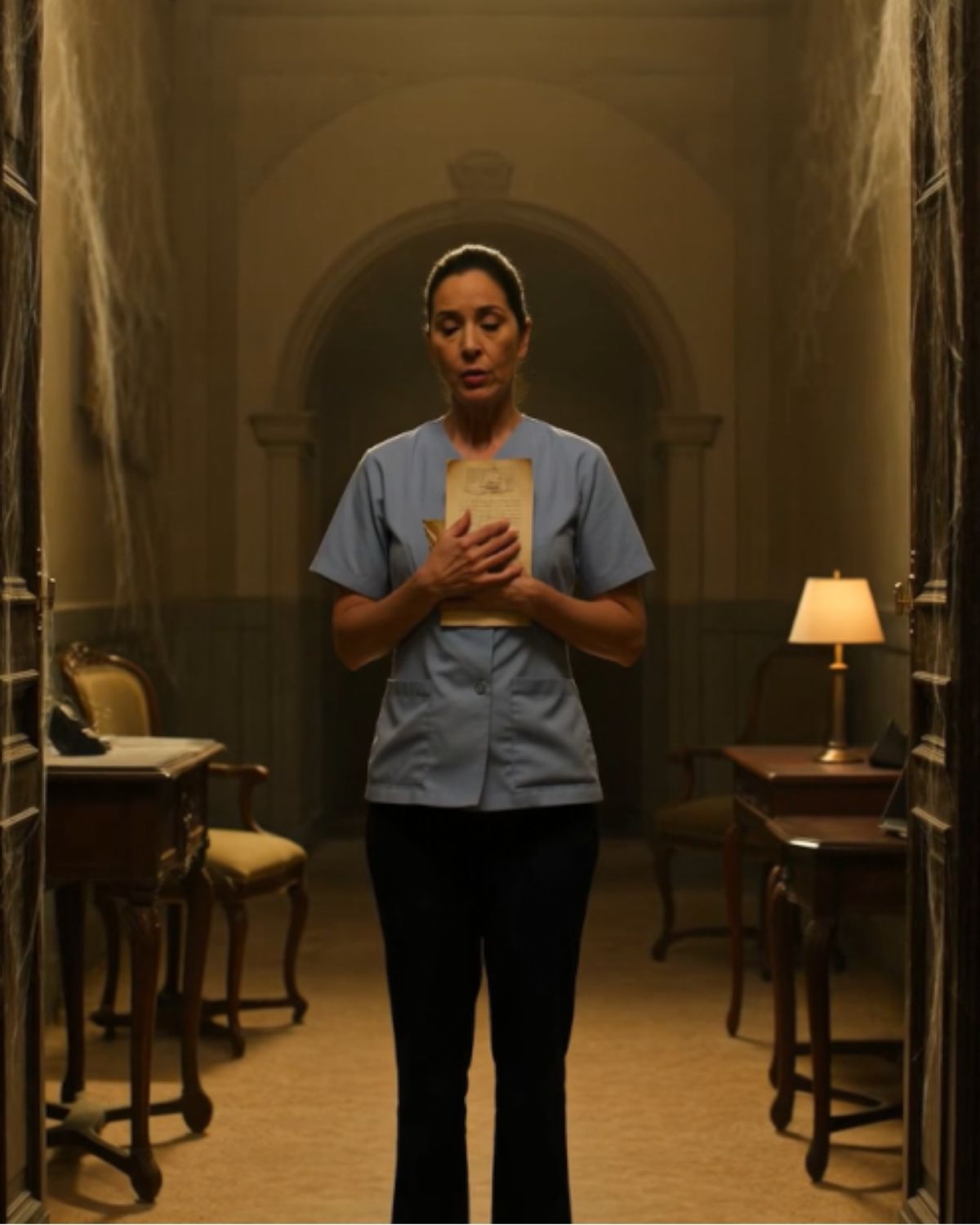
The first thing Maria noticed was the sound.
It was not loud.
It was not frightening.
It was simply unusual.
A soft tapping noise came from behind the old service hallway wall.
At first, she thought it was a pipe.
Then she heard it again.
Three quiet knocks.
Maria stopped pushing her cleaning cart.
The luxury hotel around her was almost completely silent.
The grand lobby downstairs was empty except for a night receptionist and a security guard near the entrance.
The golden lights still reflected across the marble floors.
The chandeliers still shined above the empty seating areas.
But on the fifth floor, away from the guests and the beautiful rooms, there was an older part of the building that most visitors never saw.
The service corridors.
The maintenance doors.
The forgotten corners of a hotel that continued working long after everyone went home.
That was where Maria heard the sound.
And that was where she discovered a part of the hotel’s history that had been hidden for decades.
Maria Torres had worked at the Whitmore Grand Hotel for eleven years.
She was not a manager.
She was not an executive.
Most guests never knew her name.
They only saw a clean room, fresh towels, and polished floors.
But Maria knew the building better than almost anyone.
She knew which elevators made strange noises.
Which doors needed extra force to close.
Which rooms had guests who preferred extra pillows.
She knew the small details because small details were her job.
At forty-six years old, Maria worked the evening shift.
She chose nights because it allowed her to take care of her elderly father during the day.
Her life was simple.
Work.
Family.
Home.
Repeat.
She did not consider herself special.
She just believed that if she was responsible for something, she should do it properly.
That night, the Whitmore Grand was preparing for its hundredth anniversary celebration.
The hotel was one of the oldest luxury properties in the city.
During the day, it was filled with business travelers, tourists, and events.
But after midnight, the building changed.
The voices disappeared.
The restaurants closed.
The hallways became quiet.
Only employees remained.
Maria pushed her cart through the fifth-floor service corridor at 1:15 a.m.
She was cleaning the older section of the hotel because several storage rooms needed attention before the anniversary event.
The hallway looked different from the newer guest areas.
The carpet was older.
The walls had darker wood panels.
Some doors had not been replaced in years.
Many employees rarely came here.
Maria wiped the surface of an old wooden cabinet.
Then she heard it.
Tap.
Tap.
Tap.
She stopped.
Her hand remained on the cloth.
She looked around.
Nothing moved.
The building was old.
Old buildings made sounds.
She knew that.
Pipes expanded.
Elevators shifted.
Air systems turned on and off.
She continued cleaning.
Then it happened again.
Tap.
Tap.
Tap.
This time, she looked directly at the wall beside her.
A section near the end of the corridor.
Maria slowly walked closer.
The wall looked normal.
A faded wooden panel.
A small decorative frame.
Nothing unusual.
She pressed her ear against it.
For a few seconds, there was silence.
Then another sound.
A faint hollow vibration.
Maria stepped back.
“That’s strange.”
She gently knocked on the wall.
Knock.
Knock.
The sound that came back was different.
Not solid.
Hollow.
There was space behind it.
Maria looked at the wall carefully.
She had walked past this hallway hundreds of times.
How had she never noticed?
A few minutes later, the night manager, David Collins, walked through the corridor during his routine inspection.
David was in his early fifties and had managed the hotel for six years.
He was practical.
Efficient.
He liked problems that could be solved quickly.
Maria approached him.
“Mr. Collins?”
He looked up.
“Yes?”
“I think there may be something behind the wall near the old storage area.”
David glanced toward the wall.
“What do you mean?”
“I heard a sound.”
“A sound?”
“Yes. Like tapping.”
David looked at the hallway.
Then at his watch.
“Maria, the building is almost one hundred years old.”
“I know.”
“Old buildings make noises.”
“I know. But I knocked on the wall, and it sounded hollow.”
David sighed.
“We have a major event tomorrow. Please don’t start opening walls because of a noise.”
“I’m not trying to cause trouble.”
“I know.”
His tone softened slightly.
“Just finish your cleaning. If maintenance finds something during inspections, they’ll handle it.”
Maria nodded.
“Okay.”
She returned to her cart.
But as she continued working, she kept looking back at the wall.
Because something about it bothered her.
Not fear.
Curiosity.
The next morning, the hallway was busy again.
Employees prepared for the anniversary celebration.
Guests arrived.
Decorations were installed.
Everyone forgot about the old service corridor.
Everyone except Maria.
During her break, she returned to the area.
She stood in front of the wall.
She studied the panels.
Years of cleaning had taught her to notice small changes.
A scratch.
A loose hinge.
A gap.
And now she saw one.
A narrow line between two wooden panels.
A line that did not match the others.
Maria touched it.
The panel moved slightly.
Her eyes widened.
It was not part of the wall.
It was a door.
A hidden door.
She immediately stepped back.
She knew she should report it.
She knew she should not open unknown areas alone.
So she contacted maintenance.
Within an hour, a maintenance worker arrived.
After carefully examining the old mechanism, he confirmed that the panel had likely been sealed shut for decades.
“Should we open it?” he asked.
Maria hesitated.
“Yes.”
The hotel manager was informed.
David arrived looking frustrated.
“I thought we agreed not to investigate this.”
“I didn’t open it,” Maria said.
David looked at the hidden panel.
Then sighed.
“Fine. Let’s see what is inside.”
The maintenance worker carefully released the old lock.
The panel moved slowly.
A cloud of dust escaped into the hallway.
Everyone stepped back.
Behind the wall was a narrow doorway.
Beyond it was darkness.
David turned on his flashlight.
The beam entered the room.
And everyone became silent.
It was not an empty space.
It was a forgotten room.
The air smelled old and dry.
Dust covered every surface.
Wooden shelves lined the walls.
A desk sat near the back.
On top of it were stacks of papers.
Old photographs.
Rolled blueprints.
A calendar from decades earlier.
Maria stepped closer.
“Someone used this room.”
David looked around.
“I have never seen this area on the hotel plans.”
The maintenance worker opened a drawer carefully.
Inside were more documents.
Old files.
Handwritten notes.
Construction records.
Maria picked up a photograph.
It showed the original Whitmore Grand Hotel under construction.
The building looked completely different.
Workers stood outside wearing old uniforms.
Behind them was the original landscape before the city expanded.
David looked at the photo.
“Where did this come from?”
Maria pointed toward the desk.
“There’s more.”
Among the papers was a large folder.
The cover was faded.
But the words were still readable.
Original Property Records — Whitmore Grand Development
David opened it carefully.
Inside were architectural drawings.
Legal documents.
Land agreements.
The original hotel plans.
Then Maria noticed something.
A section of the documents had been marked with a handwritten note.
She leaned closer.
“What does that say?”
David read it.
His expression changed.
The document described the land before the hotel was built.
It was not just an empty property.
It contained a protected historical structure from the early development of the city.
The original plans showed that part of the land had been preserved.
But later renovations had ignored that requirement.
The hidden room contained evidence that the hotel had been built around a protected historical site.
Evidence that had disappeared from official records.
Maria looked at the papers.
“This was never supposed to be hidden.”
No one answered.
Because she was right.
The discovery was not a treasure.
There was no money.
No secret fortune.
No dramatic mystery.
Just forgotten documents.
But sometimes documents could change everything.
The hotel’s anniversary celebration continued that day.
Guests arrived expecting a celebration of history.
Instead, the management team was suddenly facing questions about the history they had forgotten.
The documents were taken to the executive office.
Maria stood outside as senior managers reviewed them.
The hotel’s CEO, Andrew Whitmore, arrived after receiving the report.
He entered the office expecting a maintenance issue.
Instead, he found old blueprints spread across the table.
“What is this?”
David looked up.
“We found a hidden room.”
Andrew frowned.
“A hidden room?”
Maria stepped forward.
“I found it during my cleaning shift.”
Andrew looked at the documents.
Then at the blueprints.
The room became quiet.
“These are original plans.”
“Yes,” David said.
Andrew continued reading.
“These records were never digitized.”
“No.”
He looked through the pages.
“These prove the hotel was built with knowledge of the protected site.”
Everyone became silent.
An executive from the legal department studied the papers.
“If these are authentic, they could affect ownership records and preservation requirements.”
Andrew looked at Maria.
“You found this?”
She nodded.
“I heard a noise.”
The executive smiled slightly.
“A noise?”
Maria smiled.
“Yes.”
Andrew looked around the room.
At the executives.
At the documents.
Then back at Maria.
“How many people have walked through that hallway?”
Maria thought.
“Probably hundreds.”
“And you noticed something nobody else did.”
Maria shrugged.
“I clean carefully.”
Andrew smiled.
“That may be the most important skill in this building.”
The company immediately began verifying the documents.
Experts were brought in.
Historians reviewed the records.
Legal teams examined the original agreements.
Within weeks, the findings confirmed the truth.
The hotel had been built around a historically important site.
Previous owners had not intentionally destroyed it.
But over decades, the information had been lost.
The hidden room had preserved the original story.
Because someone had noticed a sound behind a wall.
The hotel decided not to hide the discovery.
Instead, they restored the room.
It became a small historical archive.
Guests could now learn about the building’s real history.
The original photographs were displayed.
The blueprints were preserved.
The workers who built the hotel were finally recognized.
And near the entrance of the archive was a small plaque.
It read:
Discovered by Maria Torres, whose attention to detail revealed the story this building almost forgot.
At the opening ceremony, Maria stood quietly near the back.
She did not like attention.
She still wore the same hotel uniform.
She still worked evening shifts.
She still cleaned rooms and hallways.
But now guests knew her name.
A young employee approached her.
“Is it true you found the hidden room?”
Maria smiled.
“Yes.”
“How?”
She looked toward the old hallway.
“I listened.”
The employee laughed.
“That’s all?”
Maria nodded.
“Sometimes people think important discoveries happen because someone is looking for something big.”
She paused.
“But sometimes you find something important because you cared enough to notice something small.”
Years later, the hidden archive remained one of the most visited parts of the Whitmore Grand.
Guests came to see the old photographs.
They came to read the original plans.
They came to understand the history beneath the luxury.
But every employee knew the real story.
The hotel’s past was not discovered by an executive.
Not by an architect.
Not by a historian.
It was discovered by a cleaner working late at night.
A woman who pushed a cart through an old hallway and stopped when something did not feel right.
Because sometimes the people who keep a place running are the same people who see what everyone else misses.
And sometimes the biggest changes begin with someone simply paying attention.


