Chapter One
The Chair in the Yard
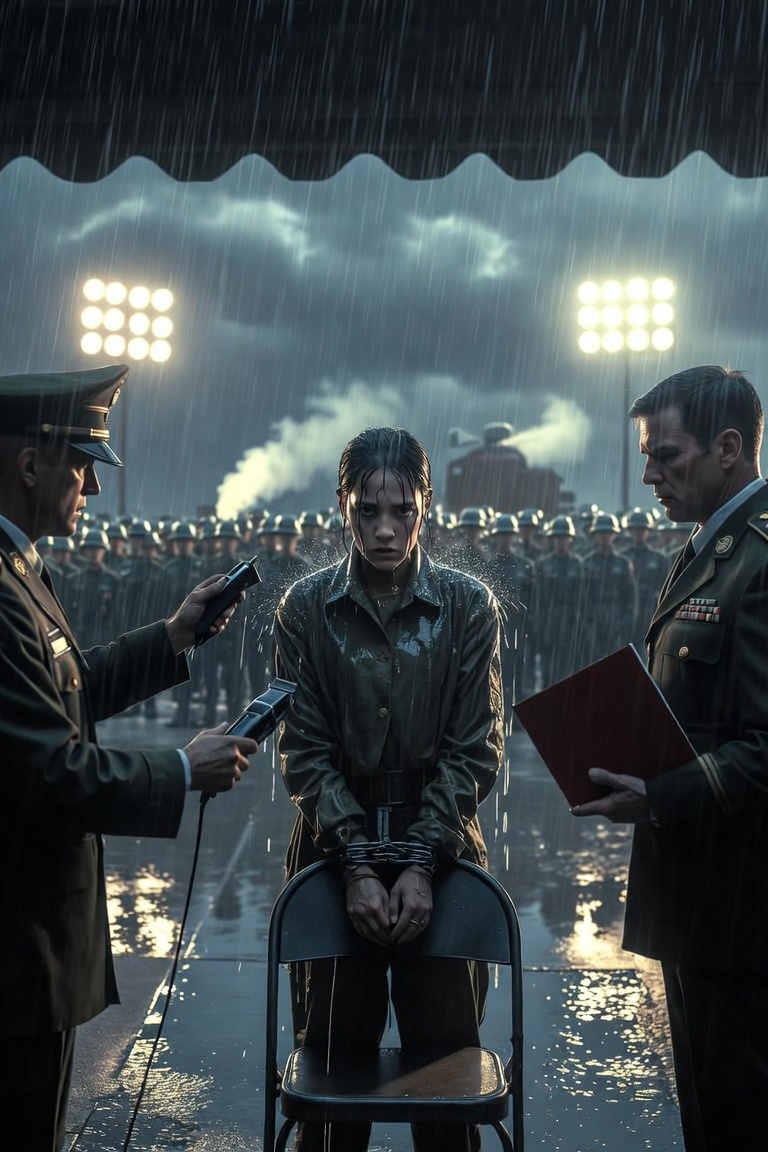
The clippers screamed before they touched her.
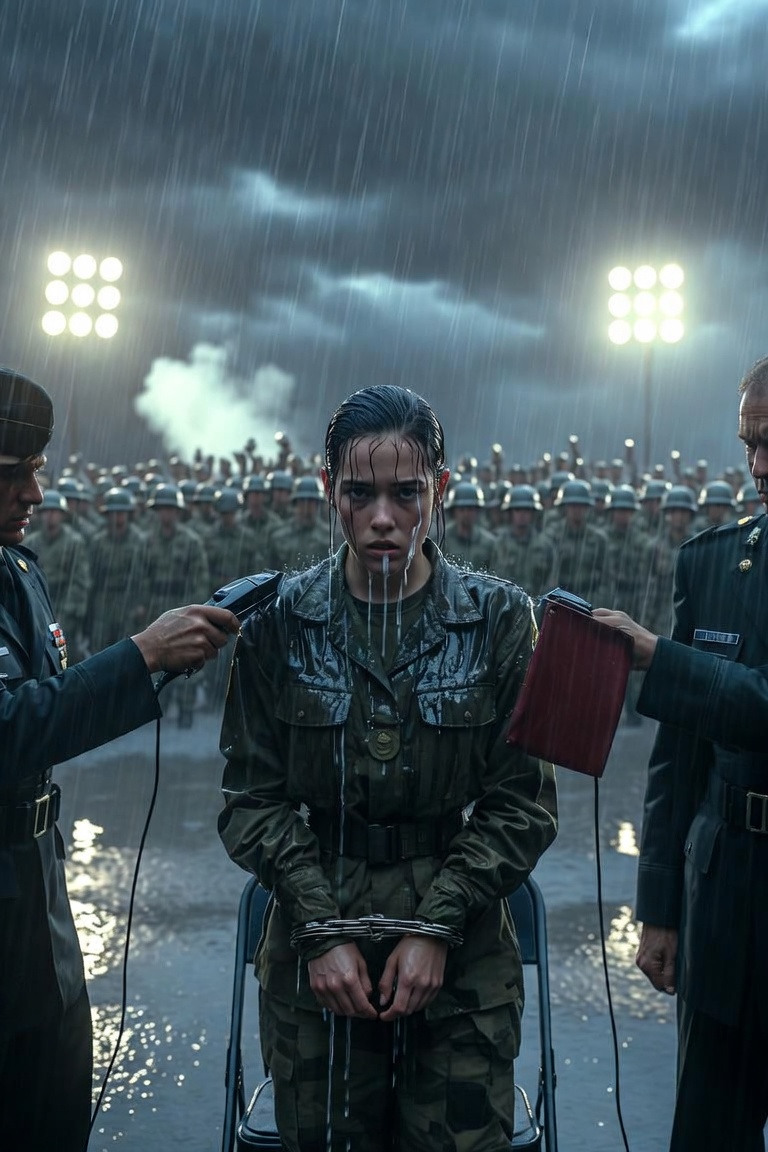
Specialist Nora Voss stood in the center of Fort Dagger’s assembly yard with her wrists locked behind her back, rainwater running from the collar of her uniform to the small of her spine.
Three hundred soldiers had been ordered outside to watch.
The storm had rolled down from the Appalachian ridges before dawn, turning the sky the color of old gunmetal. Floodlights blazed against the darkness. Diesel fumes drifted from parked Humvees. Water tapped against helmets, rifles, concrete barriers, and the corrugated roof of the operations building.
In the middle of it all waited a steel folding chair.
A military barber stood beside it, holding a pair of electric clippers.
Nora looked at the chair.
Then at the clippers.
Then at Lieutenant Colonel Elias Rourke.
Rourke stood beneath the awning, dry except for the toes of his polished boots. At forty-six, he had the hard, squared face of a man carved for command photographs. A silver combat badge rested above his left pocket. Two rows of ribbons crossed his chest. His eyes were pale and sleepless.
In his right hand, he held a red evidence folder.
“Specialist Voss,” he called over the rain, “you have been identified as the source of a classified operational breach that compromised Task Force Cinder.”
No one moved.
Behind Nora, a flag snapped violently against its halyard.
Rourke opened the folder.
“Your access credentials were used to extract route maps, radio frequencies, and the identities of local assets supporting Operation Black Veil.”
Nora’s jaw tightened.
She had heard the accusation six hours earlier inside a windowless interrogation room.
She had denied it until her voice went hoarse.
The investigators had shown her the logs.
Her identification number.
Her terminal.
Her authorization code.
Everything pointed toward her.
Everything except the truth.
“I did not access those files,” she said.
Her words nearly vanished beneath the rain.
Rourke stepped out from under the awning.
“You expect this command to believe that classified material walked out of a secure network by itself?”
“No, sir.”
“Then explain it.”
“I can’t explain something I didn’t do.”
A murmur passed through the formation.
Nora recognized some of the faces.
Sergeant Amos Reed, who had taught her to clear rooms without outrunning her rifle.
Corporal Vince Calder, who had once carried her eight miles after she tore a ligament during selection.
Staff Sergeant Lydia Shaw, her squad leader, who stood in the first row with rain streaming from the edge of her helmet.
None of them looked at Nora for long.
Rourke closed the folder.
“Three days after the breach, Task Force Cinder entered Sahrani Province. Their convoy was ambushed at the exact point identified in the stolen route package.”
His voice cracked on the last word.
Only slightly.
But Nora heard it.
Everyone did.
“Seven Americans died,” he continued. “Nine were wounded. Two local interpreters were executed after their identities were exposed.”
Nora swallowed.
The dead had names.
Captain Jonas Bell.
Master Sergeant Raul Ortega.
Sergeant First Class Peter Han.
Staff Sergeant Malcolm Pierce.
Sergeant Noah Davis.
Specialist Owen Kirk.
Private First Class Elijah Monroe.
One of them, Malcolm Pierce, had shared coffee with her two nights before deployment and complained that his daughter refused to speak to him because he had missed her birthday again.
Nora still had the packet of powdered creamer he had left beside her keyboard.
Rourke stepped closer.
His face was gray beneath the floodlights.
“My son was in that convoy.”
That explained the sleeplessness.
That explained the folder bending in his grip.
First Lieutenant Daniel Rourke had survived, but barely. The blast had shattered his pelvis and burned forty percent of his body. Doctors at Landstuhl had placed him in a medically induced coma.
Nora felt the formation’s anger sharpen around her.
To them, she was no longer a soldier awaiting judgment.
She was the reason their friends had come home beneath flags.
Rourke pointed toward the chair.
“Sit down.”
Nora did not move.
The rain gathered on her eyelashes.
“With respect, sir, there has been no court-martial.”
“This is an administrative security measure.”
“You’re humiliating me before an investigation is complete.”
Rourke’s mouth tightened.
“You surrendered the right to speak of humiliation when seven soldiers were placed in transfer cases.”
Nora stared at him.
Behind his authority, she saw grief.
Behind his grief, she saw something more dangerous.
Certainty.
A man in pain could still listen.
A man certain of his pain’s cause could destroy anything standing in front of him.
Staff Sergeant Shaw took one step out of formation.
“Sir.”
Rourke turned.
Shaw was thirty-eight, compact and broad-shouldered, with dark hair pulled into a bun beneath her patrol cap. A pale burn scar climbed from her left wrist into her sleeve.
“Return to formation, Staff Sergeant.”
“Specialist Voss has the right to counsel before punitive action.”
“This is not punitive.”
Shaw looked at the barber.
Then at the chair.
“No, sir?”
The yard went silent.
Even the rain seemed to soften.
Rourke’s nostrils flared.
“You are relieved from responsibility for this prisoner.”
Shaw held his gaze for another second.
Then stepped back.
Nora saw the apology in her eyes.
It hurt more than the accusation.
Two military police officers approached.
One reached for Nora’s arm.
She pulled away before he touched her.
“I’ll sit.”
She crossed the yard alone.
Every step sounded louder than it should have.
Boot.
Water.
Concrete.
Boot.
Water.
Concrete.
She lowered herself into the steel chair.
The barber draped a gray cape over her shoulders. His hands trembled as he fastened it beneath her chin.
He was young.
Nineteen, perhaps twenty.
A private who had probably expected his morning to involve trimming regulations around ears and necklines.
Nora looked at him through the reflection in the darkened operations window.
“What’s your name?”
He blinked.
“Private Mercer.”
“First name?”
“Caleb.”
“Don’t apologize, Caleb.”
His fingers stopped.
“I didn’t—”
“You were about to.”
The clippers buzzed in his hand.
Nora stared at her reflection.
Twenty-four years old.
Narrow face.
Brown eyes.
A small white scar at the edge of her chin from falling through a greenhouse roof when she was eleven.
Her dark hair was pulled into a tight regulation bun.
It was the last thing her mother had touched before Nora left home.
Marianne Voss had stood in the kitchen doorway, braided her daughter’s hair, and said, “People will try to name you before you understand yourself. Don’t wear every name they give you.”
Nora had laughed then.
Now Lieutenant Colonel Rourke stood behind her reflection.
“Proceed.”
Caleb Mercer pressed the clippers against the base of Nora’s skull.
The first strip fell across the cape.
Dark hair.
Rainwater.
A piece of herself sliding toward the concrete.
Whispers moved through the formation.
Someone spat near the drainage channel.
Someone else said, “Traitor.”
Nora’s shoulders stiffened.
The clippers moved again.
A second path.
Then a third.
Cold air touched exposed skin.
She kept her eyes open.
That became her only act of defiance.
She watched every pass.
She watched Rourke watching her.
She watched soldiers she had trained beside lower their eyes.
She watched Amos Reed’s lips move in a silent prayer.
She watched Vince Calder stare with open hatred.
When the clippers reached the crown of her head, a vehicle engine roared beyond the gate.
Headlights cut through the rain.
A black government SUV stopped beside the operations building.
A civilian stepped out.
He was tall, thin, and carried no umbrella. His charcoal suit darkened instantly beneath the downpour. Gray hair clung to his forehead.
“Stop!” he shouted.
The clippers went silent.
Everyone turned.
The man crossed the yard at a run, shoes splashing through standing water.
Rourke’s expression hardened.
“This is a restricted formation.”
The civilian held up an identification wallet.
“Dr. Simon Vale. Defense Counterintelligence and Security Agency.”
Rourke glanced at the credentials.
“You’re late.”
Vale looked at Nora’s half-shaved head.
His mouth opened.
Then closed.
“What have you done?”
“What command policy required.”
“No,” Vale said. “You acted on preliminary evidence.”
“The access logs are definitive.”
Vale stepped closer and lowered his voice, but the yard was too quiet to hide his words.
“The logs were manufactured.”
A tremor moved through the soldiers.
Nora did not breathe.
Rourke’s face emptied.
“What?”
“We found a shadow authentication sequence embedded in the network architecture. Someone duplicated Specialist Voss’s token and routed the extraction through her terminal.”
Rourke stared at him.
“You confirmed this?”
“We confirmed enough to suspend all disciplinary action.”
Nora turned slowly in the chair.
One side of her head was bare.
The other still held half its hair.
Rain rolled down her temple.
“Who did it?” she asked.
Vale looked at her.
“We don’t know yet.”
Rourke’s eyes moved from Vale to Nora.
For the first time that morning, certainty left his face.
Only grief remained.
And fear.
Not fear that he had made a mistake.
Fear that everyone had witnessed it.
He looked toward the formation.
Then toward the barber.
Then at the hair scattered around Nora’s boots.
“Continue,” Rourke said.
Vale stepped forward. “Absolutely not.”
Rourke’s voice sharpened.
“You cannot leave her like that.”
Nora rose from the chair.
The cape slid from her shoulders and collapsed into the rain.
She looked at Caleb Mercer.
“Finish it.”
“Specialist—” Vale began.
“Finish it.”
Mercer hesitated.
Nora sat again.
The clippers restarted.
This time, no one whispered.
No one called her a traitor.
No one looked away.
When the last strands fell, Nora ran one hand across the rough skin of her scalp.
She stood.
Lieutenant Colonel Rourke seemed to search for something to say.
An order.
An apology.
A defense.
Nora saved him the effort.
“Permission to return to duty, sir.”
Rourke’s lips parted.
Before he could answer, the operations building shook with the dull concussion of an explosion.
Windows flashed orange.
The ground jumped beneath their boots.
The alarm siren began to howl.
And from inside the secure communications wing, black smoke rolled into the rain.
Someone was destroying the evidence.
Chapter Two
Ashes in the Server Room
Nora reached the operations building before the military police.
She hit the outer door with her shoulder, pushed through smoke, and dropped beneath a layer of heat that rolled across the ceiling like boiling oil.
The building smelled of melted plastic, burning insulation, and something metallic enough to sting her teeth.
“Server wing!” Dr. Vale shouted behind her.
Nora tore the gray barber cape from around her neck and wrapped it over her mouth.
Emergency lights pulsed along the corridor.
Red.
Darkness.
Red.
Darkness.
A sergeant stumbled from the communications section, one sleeve on fire. Nora drove him against the wall and smothered the flames with the cape.
“Who’s inside?”
“Major—” He coughed. “Major Halden.”
Major Silas Halden ran Fort Dagger’s intelligence integration cell.
He had supervised Nora’s clearance.
He had signed the order restricting her after the breach.
Nora turned toward the smoke.
Vale caught her arm.
“The fire suppression system should have activated.”
“It didn’t.”
“Which means—”
“It was disabled.”
Another pop cracked inside the walls.
Nora pulled free.
“Call the fire team.”
“You’re not equipped.”
“Neither is whoever’s trapped in there.”
She moved low along the corridor.
Heat pressed against the shaved skin of her head. Every nerve felt exposed.
She passed a glass office wall spiderwebbed by the blast. Papers burned in slow curls across the floor. A ceiling tile dropped behind her and exploded in sparks.
The server room door was locked.
Nora touched the handle and jerked her hand back.
Hot.
She kicked once beside the latch.
The frame shuddered.
Again.
Metal tore.
On the third strike, the door opened six inches and stopped against something heavy.
Nora squeezed through.
Major Halden lay behind the door.
Blood covered the left side of his uniform.
He was conscious, but barely.
Beyond him, two server racks burned against the far wall. The primary data cabinets had not caught fire. Instead, small thermite charges had been attached directly to their storage arrays.
This was not panic.
This was erasure.
Nora dragged Halden away from the flames.
His hand clamped around her wrist.
“Voss.”
“I’ve got you.”
“No.” His pupils struggled to focus. “Listen.”
A beam groaned overhead.
Nora pulled harder.
“Save your air.”
“Not… breach.”
“What?”
“Not about the route.”
The words came through wet, shallow breaths.
Halden’s fingers tightened.
“Black Veil was cover.”
“For what?”
He looked toward the burning racks.
Then at Nora.
“Ledger.”
The overhead beam cracked.
Nora threw herself over Halden as plaster and sparks rained across them.
A second later, the fire suppression system finally activated.
Foam blasted from ceiling nozzles, swallowing the room in white.
By the time firefighters reached them, Major Halden had stopped breathing.
Nora knelt beside him in the corridor while a medic pressed gloved fingers against his neck.
The medic looked up.
“He’s gone.”
Water and suppression foam streamed across the floor.
Nora stared at Halden’s open eyes.
Not about the route.
Black Veil was cover.
Ledger.
Lieutenant Colonel Rourke entered through the smoke wearing a respirator. Two military police followed.
He saw Halden’s body.
The color left his face.
“What happened?”
Nora stood slowly.
“Someone planted thermite on the classified storage arrays.”
Rourke looked toward the server room.
“Who?”
“They killed the man who might have answered that.”
Vale emerged behind the firefighters, coughing into his sleeve.
“The building has been locked down,” he said. “Nobody leaves the installation.”
Rourke’s attention returned to Nora.
For one dangerous second, she saw the old suspicion flicker in his eyes.
She stepped toward him.
“Say it.”
His brow tightened.
“Specialist—”
“Say what you’re thinking.”
“This is neither the time nor place.”
“You think I started the fire.”
Several soldiers stopped moving.
Rourke glanced toward them.
Nora did not.
She was done helping him preserve his image.
“You had access,” Rourke said quietly.
“I was outside in a chair while your private shaved my head.”
“You entered the building before security established control.”
“To pull two men out.”
“One of them is dead.”
Nora moved close enough to see rainwater trapped in his eyelashes.
“Your grief is not evidence, sir.”
His face hardened.
“My son may never walk again because of that breach.”
“And seven families are burying people they love. I know what happened.”
“You know nothing about what I’ve lost.”
Nora’s voice dropped.
“You made sure everyone knew what you thought I deserved.”
Rourke looked at the hair plastered to the wet pavement outside.
For the first time, shame touched his face.
It lasted less than a second.
Then the commander returned.
“Specialist Voss, you are confined to quarters pending further investigation.”
Vale stepped between them.
“She is a material witness and possibly a target.”
“She is still under my command.”
“And this installation may be compromised at senior levels.”
Rourke’s eyes narrowed.
“Choose your next words carefully.”
“I chose them before I arrived.”
Vale reached inside his suit and removed a folded document.
“Effective immediately, Fort Dagger’s intelligence network falls under federal counterintelligence authority. No evidence is to be moved, destroyed, or accessed without my authorization.”
Rourke read the first page.
The muscles along his jaw shifted.
“You came prepared to take control.”
“I came prepared for the possibility that the breach originated inside this command.”
Rourke handed the document back.
“And now?”
Vale looked toward Halden’s body.
“Now I’m certain.”
A military police captain approached at a run.
“Sir, the gate logs show a maintenance vehicle exited three minutes before the blast.”
“Who authorized it?” Rourke asked.
“The digital order carries Major Halden’s credentials.”
Nora looked at the dead officer.
“His credentials were copied too.”
Vale turned to the captain.
“Find that vehicle.”
“We already dispatched units.”
A radio crackled on the captain’s vest.
He listened.
His face changed.
“What is it?” Rourke asked.
The captain swallowed.
“They found the truck two miles east of the base.”
“And the driver?”
“No driver. Vehicle was burning.”
Nora looked through the broken window toward the black smoke rising beyond the perimeter.
The evidence was not simply being destroyed.
It was being carried away first.
She remembered Halden’s last word.
Ledger.
A book of accounts.
Names.
Payments.
Debts.
Someone had framed her to hide something larger than an ambush.
Someone who knew Fort Dagger’s systems.
Someone who understood its people.
Someone who had just watched the entire command gather in the rain.
Nora scanned the soldiers moving outside.
Faces turned toward the fire.
Medics.
Engineers.
Cooks.
Operators.
Officers.
One person among them knew exactly why Major Halden had died.
And now that person knew Nora had heard his final words.
Chapter Three
The Woman No One Sat Beside
By sunset, the rain had turned to sleet.
Nora sat alone in the corner of the dining facility with a tray she had not touched.
The room was crowded, but the tables around her remained empty.
Her bare scalp reflected the fluorescent lights.
A bruise darkened her right wrist where the restraints had rubbed against bone.
Every few minutes, someone looked at her.
Some with guilt.
Some with suspicion.
Some with a hunger for certainty that the truth could not yet satisfy.
Nora cut into a piece of gray meat and watched steam escape.
Across the room, Vince Calder laughed at something one of his friends said.
Then he looked at her.
The laugh vanished.
Calder rose from his table.
He was twenty-seven, tall, thick through the chest, with a broken nose and the restless energy of a dog chained too long. He had lost two friends in the convoy. One was Sergeant Noah Davis, his roommate during selection.
Calder carried his tray toward Nora.
For one second, she thought he might sit.
Instead, he stopped beside her table.
“My mother used to shave my brother’s head when he got lice,” he said.
Nora kept cutting the meat.
“He cried for three days.”
Calder leaned closer.
“You didn’t cry once.”
“No.”
“That supposed to impress us?”
“No.”
“Then what was it?”
Nora set down the knife.
“Control.”
His eyes narrowed.
“You think you’re better than the men who died?”
“No.”
“Because you sit there like this is happening to somebody else.”
Nora looked up.
“What do you want from me, Calder?”
“I want you to break.”
“Why?”
“Because if you break, maybe I can believe you’re sorry.”
“For something I didn’t do?”
His tray hit the table.
Coffee jumped from a paper cup.
“You expect me to believe a ghost stole your credentials?”
“I expect you to decide whether facts matter more than your anger.”
His nostrils flared.
“You always did talk like a manual.”
“And you always mistook volume for truth.”
Several nearby conversations stopped.
Calder’s hands closed into fists.
Nora watched them.
A year earlier, she would have stood.
Matched threat with threat.
She had been raised by a mother who survived factory layoffs, foreclosure, and a husband who walked out during the worst winter their town had seen in twenty years. Nora had learned to meet danger by becoming sharper than it.
Fort Dagger was teaching her something different.
Sharp things broke under pressure.
Flexible things endured.
Calder bent until his face was inches from hers.
“Noah Davis had a little girl.”
“I know.”
“She asks where he is every morning.”
Nora’s throat tightened.
Calder saw it.
His expression flickered.
“You know what she asked me at the memorial?”
Nora waited.
“She asked if her dad died because somebody hated him.”
The dining facility seemed to shrink around them.
Calder straightened.
“I told her no.”
His voice grew rough.
“I told her he died because somebody was weak.”
Nora held his gaze.
“Then when the truth comes out, you may owe her a better answer.”
Calder’s tray lifted from the table.
For a heartbeat, Nora thought he would strike her with it.
Instead, he hurled it into a trash bin.
Plastic cracked.
Coffee splashed across the wall.
He walked away.
Staff Sergeant Lydia Shaw appeared from the serving line carrying two cups.
She sat across from Nora.
The surrounding soldiers watched.
Shaw placed one cup near Nora’s hand.
“Tea.”
Nora looked at it.
“You hate tea.”
“I hate coffee more.”
“That isn’t true.”
“No.” Shaw glanced around the room. “But everyone here already thinks I’m making bad decisions.”
Nora wrapped both hands around the cup.
Heat seeped into her fingers.
“You should keep your distance.”
“I did that this morning.”
“You challenged a lieutenant colonel.”
“I stepped back when it mattered.”
Nora’s thumb pressed into the cup seam.
“Rourke would have destroyed your career.”
“Maybe.”
“You have a son applying to college.”
Shaw’s eyes sharpened.
“Don’t use my family to make me feel better about failing you.”
Nora looked down.
Steam touched her face.
Shaw leaned forward.
“Listen carefully. You are going to survive this.”
“That sounded almost like an order.”
“It is.”
“They still think I did it.”
“Some do.”
“Calder does.”
“Calder thinks if he stops hating you, he betrays Noah.”
Nora watched him across the room.
He sat with his elbows on his knees, staring at the floor.
Shaw continued.
“People treat anger like armor. Most of the time, it’s a tourniquet. Remove it too early, and everything underneath starts bleeding.”
Nora gave a bitter half-smile.
“You read that somewhere?”
“My second husband said it during our divorce.”
“You were married once.”
“Exactly.”
For the first time since dawn, Nora nearly laughed.
It hurt.
A shadow fell across the table.
Dr. Vale stood beside them.
He had traded his wet suit jacket for a borrowed field coat. The sleeves were too short.
“Specialist Voss. Staff Sergeant.”
Shaw stood.
Nora remained seated.
Vale pulled out a chair.
“I need to speak with Voss alone.”
Shaw looked at Nora.
Nora nodded.
After she left, Vale slid a sealed plastic evidence sleeve across the table.
Inside was a photograph.
Major Halden stood beside an armored SUV outside a hotel in Amman. Next to him was a man with a trimmed beard and mirrored sunglasses.
Nora recognized the man.
“Farid Navarre.”
Vale studied her.
“You know him?”
“He coordinated secure transport for coalition intelligence contractors.”
“That was his cover.”
“What was he?”
“Broker. Weapons, identities, extraction routes. He sold information to anyone who could pay.”
“Why was Halden meeting him?”
“We don’t know.”
Nora looked closer at the photograph.
The SUV’s rear window reflected the hotel entrance.
A woman stood inside the lobby.
Only part of her face was visible.
But Nora knew the posture.
Straight back.
Chin angled slightly downward.
Hands folded behind the body.
Military habit.
“Zoom that reflection.”
Vale removed a tablet and enlarged the image.
Pixels blurred.
The woman became clearer.
Nora felt the heat leave her fingers.
“That’s Captain Mara Keene.”
Vale’s expression changed.
“You’re certain?”
“She ran network security before Halden.”
“Captain Keene died fourteen months ago.”
“I attended her funeral.”
A bomb had destroyed Keene’s vehicle outside Kandahar. No remains had been recovered beyond fragments of equipment and a blood sample.
Vale turned the tablet around.
“The photograph was taken five weeks ago.”
Nora stared at the woman in the reflection.
Captain Mara Keene had recruited Nora into the intelligence support cell.
She had taught her how to detect false patterns in surveillance data.
She had told Nora, “Systems don’t lie. People teach them how.”
Nora looked at Vale.
“Why frame me?”
“That’s what I hoped you could answer.”
“I was the lowest-ranked analyst with access to the route package.”
“And?”
“I filed an anomaly report three days before the leak.”
Vale’s fingers stopped over the tablet.
“What anomaly?”
“A series of encrypted synchronization requests originating from dormant contractor accounts.”
“Who received your report?”
“Captain Keene’s old distribution list.”
“But she was dead.”
“The list forwarded to Major Halden and three network administrators.”
“Names?”
Nora gave them.
Vale typed each one.
The last name made him pause.
“Chief Warrant Officer Grant Mercer.”
Nora nodded.
“Caleb Mercer’s father.”
The young barber who had shaved her head.
Vale leaned back.
“Where is Grant Mercer now?”
“Deployed.”
“No. He returned to Fort Dagger four days ago.”
Nora looked toward the dining facility entrance.
Private Caleb Mercer was standing there.
Pale.
Breathing hard.
He saw Nora and rushed toward the table.
“Specialist Voss.”
Vale rose.
Caleb stopped, hands shaking.
“My father called me.”
“When?” Nora asked.
“Ten minutes ago.”
“What did he say?”
“He told me not to trust anyone.”
Vale stepped closer.
“Where is he?”
“I don’t know. He said he made a mistake.”
“What kind of mistake?”
Caleb’s eyes filled.
“He said he helped build the door.”
Nora’s skin prickled.
Caleb swallowed.
“And now the people who walked through it are coming for him.”
The dining facility lights went out.
In the darkness, a gunshot cracked from the kitchen.
Chapter Four
The Door They Built
Nora dragged Caleb beneath the table.
A second shot punched through the plastic tabletop and sent fragments across her cheek.
Soldiers shouted.
Benches scraped.
Someone screamed for the doors to be secured.
Emergency lights flickered red along the walls.
Nora rolled onto one knee and scanned the dining facility.
The shooter had fired from behind the stainless-steel serving line.
Steam drifted from overturned food trays.
A dark figure moved toward the rear exit.
“There!” Nora shouted.
Vince Calder vaulted over a table and gave chase.
“Calder, wait!”
He ignored her.
Nora ran after him.
Behind them, Staff Sergeant Shaw began organizing the room.
“Lock the main entrance! Check for wounded! Nobody leaves alone!”
Nora pushed through the kitchen doors.
Pots swung from overhead hooks.
Water sprayed from a severed pipe.
The rear exit slammed open twenty feet ahead.
Calder reached it first.
He disappeared into the sleet.
Nora followed.
The loading yard was lit by one yellow security lamp. Refrigerated trucks stood beside stacks of supply crates. Ice covered the pavement.
Calder rounded the nearest vehicle.
A suppressed shot coughed.
Calder’s body jerked.
He fell behind the truck.
Nora slid on one knee and grabbed the back of his vest, pulling him toward cover.
“Where are you hit?”
Calder pressed a hand to his side.
Blood spread between his fingers.
“Plate caught most of it.”
“Stay down.”
“You giving me orders now?”
“Apparently.”
Footsteps moved beyond the truck.
Slow.
Measured.
The shooter was not running.
Nora picked up a broken strip of metal from the ground and angled it beyond the tire.
In the warped reflection, she saw a man moving toward them with a pistol held close to his chest.
No uniform insignia.
Maintenance jacket.
Black gloves.
He paused.
Nora tossed a chunk of ice toward the opposite side of the truck.
The shooter turned.
She moved.
Nora came around the bumper low, struck the pistol wrist with both hands, and drove her shoulder into the man’s chest.
He hit the pavement.
The pistol skidded beneath the truck.
The attacker hooked Nora’s ankle and pulled.
Her skull struck the frozen ground.
White light flashed across her vision.
He rolled over her and reached for a knife.
Calder appeared behind him.
One arm clamped around the attacker’s neck.
Blood soaked Calder’s uniform.
“Get off her.”
The attacker slammed the back of his head into Calder’s face.
Calder lost his grip.
Nora kicked the knife hand, caught the attacker behind the knee, and drove him down again.
Together, she and Calder pinned him.
Military police poured into the loading yard seconds later.
The attacker stopped struggling.
His cheek pressed against the ice.
He smiled at Nora.
“You look better without the hair.”
Nora’s grip tightened.
“You were in the yard.”
“So were three hundred others.”
“Who sent you?”
His eyes shifted toward Caleb, who stood in the doorway surrounded by soldiers.
“Ask the boy what his father built.”
The attacker bit down.
Vale shouted, “Open his mouth!”
Too late.
Foam appeared between the man’s lips.
His body convulsed once.
Then went still.
Calder rolled onto his back.
Nora pressed both hands against the wound in his side.
“You’re going to be fine.”
He looked at her.
“You always lie this badly?”
“Only to people I dislike.”
“Good.”
His eyelids fluttered.
“Wouldn’t want to feel special.”
Medics arrived with a litter.
As they lifted him, Calder caught Nora’s sleeve.
“Noah’s daughter.”
“What about her?”
His face twisted with pain.
“Don’t let the truth make her father’s death meaningless.”
Nora leaned closer.
“The truth is the only thing that can give it meaning.”
Calder released her.
Inside the dining facility, Vale searched the dead attacker’s pockets.
No identification.
No phone.
Only a plastic key card and a silver coin stamped with the number 17.
Nora recognized the card.
“Old range complex.”
Vale looked up.
“Which building?”
“Seventeen.”
Fort Dagger had been expanded over decades. Range Complex 17 sat beyond the active training area, abandoned after groundwater contamination made the site unsuitable for regular use.
Vale held up the coin.
“Subtle.”
“It isn’t a message for us,” Nora said.
“What is it?”
“A retrieval marker.”
“For whom?”
Nora looked at Caleb.
The private stood with his arms wrapped around himself.
“For Grant Mercer.”
They left the dining facility under armed escort.
Sleet rattled against the vehicles as the convoy moved through Fort Dagger’s eastern perimeter. Pine trees crowded both sides of the road. Their branches sagged beneath ice.
Caleb sat beside Nora in the rear of an armored truck.
He stared at her shaved head.
“I’m sorry.”
She looked through the narrow window.
“I told you not to apologize.”
“That was before I found out you were innocent.”
“You don’t know that.”
“My father does.”
“Your father knows something. That’s different.”
Caleb’s jaw trembled.
“He isn’t a bad man.”
Nora turned toward him.
“Most dangerous people aren’t.”
“What does that mean?”
“It means bad decisions don’t always begin with cruelty. Sometimes they begin with fear. Sometimes loyalty. Sometimes one compromise that seems survivable.”
“You think he betrayed the unit?”
“I think he built a system somebody used.”
Caleb lowered his voice.
“When I was twelve, my mom got sick. Some kind of autoimmune disease. The Army insurance covered treatments, but not the specialist she needed. Dad borrowed money.”
“From whom?”
“He never said.”
“How much?”
“Enough that we almost lost the house.”
Nora watched his face.
“Did your mother recover?”
“She died.”
The truck’s suspension groaned over a pothole.
Caleb looked down at his hands.
“Dad changed after that. Stopped sleeping. Started taking deployments nobody wanted. He said debt was a kind of leash. You could walk anywhere, but somebody else still decided how far.”
The convoy stopped.
Range Complex 17 appeared beyond the trees.
A concrete bunker stood at the base of a ridge, its windows covered by rusted shutters. A transmission tower leaned above the roof. Snow and sleet formed a shining skin across the old parade yard.
The front door was open.
Vale raised one fist.
The team spread out.
Nora entered behind two military police officers.
The bunker smelled of dust, mold, and recently burned fuel.
Boot prints crossed the floor.
They led to a stairwell.
At the bottom, a steel door stood open.
Inside was a hidden communications room.
New equipment lined the walls.
Satellite relays.
Encrypted radios.
A portable server array.
Photographs covered a corkboard.
Fort Dagger personnel.
Convoy routes.
Contractor badges.
Family members.
Nora found her own photograph near the center.
A red circle had been drawn around her face.
Below it, someone had written:
ANOMALY DETECTED.
Vale stood behind her.
“You weren’t chosen because you were convenient.”
“No.”
“You were chosen because you noticed them.”
Caleb called from the far side of the room.
“Dad?”
Grant Mercer sat against the wall beneath the transmission console.
His uniform shirt was soaked with blood.
A pistol lay near his hand.
Caleb ran toward him.
Grant lifted one trembling arm.
“Stop.”
Caleb froze.
A pressure switch was taped beneath Grant’s other hand.
Wires ran from the switch into the floor.
“Bomb,” Grant whispered.
Vale ordered everyone back.
Nora remained where she was.
Grant looked at her and gave a weak laugh.
“Voss.”
“You called your son.”
“I thought he’d understand.”
“He understands that you’re afraid.”
Grant’s eyes shifted toward Caleb.
“I wanted him away from this.”
“Then tell us how to disarm it.”
“You can’t.”
Nora studied the wires.
“Dead-man switch?”
Grant nodded.
“If my hand lifts, this room collapses.”
“Who did this?”
“You know.”
“Mara Keene?”
His eyes closed.
Caleb made a broken sound.
“Dad, please.”
Grant opened his eyes again.
“I built her a mirror.”
Nora crouched several feet away.
“What kind?”
“A network that copied credentials, behavior, access patterns. It could make any user appear anywhere.”
“Why?”
“She said it was for counterintelligence. To create false trails during hostile intrusion.”
“And you believed her?”
“At first.”
“What changed?”
Grant’s mouth twisted.
“She started using it to move money.”
“The ledger.”
He nodded.
Nora felt Vale shift behind her.
“What’s in it?” she asked.
“Payments. Shell companies. Operations sold before they happened. Names of officers, contractors, foreign brokers.”
“Where is it?”
Grant looked toward the portable server array.
“Gone.”
“Who took it?”
“Mara.”
Caleb stepped forward.
“Why didn’t you stop her?”
Grant looked at his son.
“Because she paid your mother’s bills.”
Silence filled the room.
Caleb’s face crumpled.
Grant continued before the boy could speak.
“She came to me when the hospital gave us another denial. Said she needed help testing a system. No harm. No stolen intelligence. Just architecture.”
His fingers shook over the switch.
“Then she showed me the first payment and told me it came from a classified research fund.”
“But it didn’t,” Nora said.
“No. By the time I understood, she owned every record of what I’d done.”
“So you kept helping.”
“I kept telling myself I was protecting Caleb.”
Caleb shook his head.
“You were protecting yourself.”
Grant flinched as if struck.
The truth had found the precise place armor could not cover.
Nora watched the pressure switch.
“What happened to Captain Keene in Kandahar?”
“She staged her death. Halden helped.”
“Why?”
“He wanted out. Thought if she disappeared, the network would die with her.”
“But she came back.”
“She never left.”
Grant’s breathing turned shallow.
“She sold Operation Black Veil.”
Rage flashed across Caleb’s face.
“You killed those soldiers.”
“No.” Grant’s voice cracked. “I tried to stop it.”
“How?”
“I altered the route package after she copied it.”
Nora leaned forward.
“Then why did the convoy hit the ambush?”
“Because someone restored the original route.”
“Who?”
Grant looked at her.
“Rourke.”
The room seemed to tilt.
Vale’s voice hardened.
“Lieutenant Colonel Rourke?”
“He rejected the last-minute route change. Said Halden’s revision lacked authorization.”
Nora remembered Rourke in the rain.
My son was in that convoy.
He had not sold the operation.
He had unknowingly returned his own son to the kill zone.
Grant’s fingers slipped.
Everyone tensed.
“Stay with me,” Nora said.
He looked at her.
“Mara’s coming back.”
“For what?”
“The final key.”
“What key?”
His gaze moved toward the corkboard.
A photograph of Lieutenant Colonel Rourke’s wounded son hung beside a medical transfer schedule.
“Daniel Rourke carried the ledger out of Sahrani.”
“How?”
“He didn’t know. Mara embedded the encryption seed in his biometric trauma monitor before the convoy left.”
Vale stepped closer.
“Where is Daniel now?”
Grant smiled without humor.
“On a medical flight landing here tonight.”
A sharp electronic tone sounded beneath the floor.
Grant’s face changed.
“She knows you found me.”
The countdown display near the server rack illuminated.
00:30.
Caleb lunged forward.
Grant shouted, “No!”
Nora seized Caleb’s vest and dragged him backward.
“Run!”
They reached the stairwell as the bunker began to shake.
Behind them, Grant Mercer released the switch.
The explosion swallowed Range Complex 17.
Chapter Five
The Son in the Sky
The blast threw Nora into the snow.
A wall of pressure rolled across the parade yard, lifting ice, dirt, and splintered pine branches into the air. The bunker roof rose in one piece, folded, and collapsed into the flames.
Caleb screamed for his father.
Two soldiers held him as he fought toward the burning crater.
Nora lay on her back, ears ringing, watching snowflakes melt against the heat above her face.
Grant Mercer had chosen the only confession he believed he deserved.
It was not redemption.
It was not justice.
It was a final attempt to prevent his son from carrying the weight alone.
Vale knelt beside Nora.
“Can you hear me?”
She saw his mouth move more clearly than she heard the words.
She nodded.
His radio crackled.
The transmission came through broken and distorted.
“—medical transport Falcon Six—approach delayed—possible navigation interference—”
Vale pressed the receiver against his ear.
“Repeat.”
“Falcon Six reports false landing coordinates. Aircraft diverted twenty-three miles north before crew detected the discrepancy.”
Nora sat up.
“Mara’s using the mirror network.”
Vale nodded.
“Daniel Rourke is on that aircraft.”
“What’s the new arrival time?”
“Forty minutes.”
Nora looked toward the flames.
The ledger’s encryption seed was attached to Daniel’s medical monitor.
Mara Keene needed physical access.
Which meant she would come to Fort Dagger.
Or she was already there.
The convoy raced back through the eastern gate.
Inside the command building, Lieutenant Colonel Rourke stood over a communications table while officers shouted into radios.
His face turned when Nora entered.
“You went to Range Seventeen without authorization.”
“Your son is carrying an encryption key Mara Keene wants.”
Rourke stared.
For once, rank could not protect him from confusion.
“Mara Keene is dead.”
“No,” Vale said. “She engineered the breach, sold Black Veil, framed Specialist Voss, and staged her own death.”
Rourke shook his head.
“I saw the casualty report.”
“You signed it,” Nora said. “That isn’t the same as seeing a body.”
His eyes snapped toward her.
“You said my son is involved.”
“He unknowingly carried the ledger’s encryption seed out of Sahrani.”
“How?”
“His medical monitor.”
Rourke’s hand went to the edge of the table.
Daniel’s evacuation had been chaos. Burns. Fractures. Blood loss. He had arrived in Germany wrapped in machines.
Any one of them could have been altered before deployment.
Rourke looked at Vale.
“Where is the aircraft?”
“Seven minutes out.”
“I want every medical team screened.”
“We don’t know who’s compromised,” Nora said.
Rourke turned on her.
“You are not part of this discussion.”
Vale’s voice went cold.
“She is the reason we understand what is happening.”
“She is a twenty-four-year-old specialist.”
Nora stepped toward the operations map.
“And Mara Keene chose me because I was the only person in your intelligence cell who saw her system moving.”
Rourke’s eyes hardened.
“You think this gives you authority?”
“No.”
“Then remember your place.”
Nora looked around the room.
Officers lowered their eyes.
The same reflex she had seen in the rain.
Preserve the chain.
Protect the image.
Obey the voice with the highest rank.
Even when that voice was wrong.
Nora pointed toward the flight line.
“Mara’s plan depends on that exact reflex.”
Rourke’s face changed slightly.
“What are you saying?”
“She knows you. She knows you’ll lock down the base, centralize command, and route your son through the primary medical bay.”
“That is standard procedure.”
“Yes.”
Understanding spread across Vale’s face.
Nora continued.
“She doesn’t need to infiltrate the perimeter. She only needs to be part of the procedure.”
Rourke looked toward the medical roster.
“Who controls receiving?”
“Colonel Esther Wynn,” an aide said.
“Verify her identity.”
The aide made the call.
No answer.
The operations room fell silent.
Nora moved toward the door.
Rourke blocked her.
“You are confined.”
“Then confine me after we save your son.”
“You think because I was wrong about the breach, every order I give is wrong?”
“No.”
Nora’s voice softened.
“I think you’re afraid of making another mistake.”
The words landed harder than a shout.
Rourke’s shoulders went still.
The room waited.
Nora stepped around him.
This time, he let her pass.
The medical transport descended through low clouds with navigation lights blinking against the sleet.
Fire crews lined the runway.
Military police surrounded the receiving area.
Inside Hangar Four, a medical team waited beside two ambulances.
Nora entered through the side access corridor with Vale and Staff Sergeant Shaw.
Shaw had changed into body armor.
She looked at Nora’s shaved head.
“You planning to keep that?”
“For tonight.”
“Good. Makes you easier to find.”
The aircraft touched down.
Its rear ramp lowered.
A flight medic appeared first.
Then two litter teams.
Daniel Rourke came down beneath a thermal blanket, surrounded by tubes and monitoring equipment.
Nora saw Lieutenant Colonel Rourke moving toward him from the opposite side of the hangar.
His command posture vanished.
For one heartbeat, he was only a father.
“Daniel.”
The patient’s eyes opened slightly.
“Dad?”
Rourke reached for him.
Nora saw the woman behind the litter.
Colonel Esther Wynn.
Fifty-two.
Silver hair.
Wire-framed glasses.
Medical insignia.
She carried an injector case.
Everything matched the file photograph.
Except her walk.
Chin lowered.
Hands controlled.
Weight balanced over the balls of her feet.
Captain Mara Keene had taught Nora that walk.
“Stop her!” Nora shouted.
Wynn looked up.
Her expression emptied.
Then she drove the injector into the neck of the medic beside her.
The man collapsed.
Mara seized the medical monitor attached to Daniel’s litter and tore free a data module.
Military police raised their weapons.
She dragged Daniel upright and pressed a pistol beneath his jaw.
“Back away.”
Rourke froze.
The hangar doors began to close.
Vale shouted for the control booth.
No response.
Mara smiled.
She had already taken it.
“Hello, Nora,” she said.
Her voice was older than Nora remembered.
Lower.
But unmistakable.
Nora stepped forward.
Mara’s pistol pressed harder against Daniel’s skin.
“You always did move before thinking.”
“You trained me to recognize patterns.”
“I trained you to obey them.”
Mara held up the data module.
“This is the difference between surviving history and becoming one of its footnotes.”
Daniel struggled for breath.
Rourke raised both hands.
“Let him go.”
Mara glanced at him.
“You sent him into Sahrani.”
Rourke flinched.
“You restored the original route,” she continued. “Halden tried to save them. Mercer tried to save them. You overruled both.”
“You sold the route.”
“Yes.”
Her calmness was more frightening than rage.
“And you delivered the convoy exactly where I promised it would be.”
Rourke’s face broke.
Not publicly.
Not dramatically.
A slight collapse around the eyes.
A man seeing the architecture of his worst day.
Nora moved another step.
Mara tracked her with the pistol.
“You should have stayed broken.”
“You miscalculated.”
“How?”
“You thought humiliation would make me desperate.”
“It usually does.”
“It made me patient.”
Mara’s smile faded.
“Patience is obedience with better posture.”
“No. Patience is learning the difference between the moment you want and the moment that matters.”
Nora looked at the data module.
“You don’t have the ledger.”
“I have the key.”
“But the server at Range Seventeen is gone.”
“Copies exist.”
“Where?”
Mara’s eyes flicked toward Vale.
That was enough.
Nora understood.
“You kept one inside the federal investigation.”
Vale went still.
Mara laughed softly.
“Dr. Vale has been chasing me for six years. Every report, every seized drive, every witness statement went into his protected evidence network.”
Vale’s face tightened.
“You used the investigation as storage.”
“I used bureaucracy as it was designed to be used.”
“By whom?”
“People who understand that institutions preserve themselves before they preserve truth.”
Nora thought of the yard.
The chair.
The soldiers watching an innocent woman punished because command needed certainty more than justice.
Mara had not built her network against the military.
She had built it from the military’s worst instincts.
Blind loyalty.
Fear of embarrassment.
Deference to rank.
The belief that admitting uncertainty was weakness.
Mara began moving Daniel toward a service door.
“Open it.”
No one moved.
She fired once into the ceiling.
Concrete dust rained over the litter team.
“Open the door.”
Rourke reached for the release.
Nora spoke.
“She won’t let him live.”
Rourke stopped.
Mara’s eyes narrowed.
Nora continued.
“The monitor proves he carried the key. His medical records connect him to the convoy. As long as he lives, someone can reconstruct the transfer.”
“Be quiet.”
“You need him dead.”
Rourke looked at Mara.
The truth entered his face.
Mara shifted the pistol toward Nora.
Daniel moved.
His burned hand closed around the tubing connected to his own monitor. He yanked hard.
The monitor cart rolled into Mara’s legs.
Rourke lunged.
The pistol fired.
Daniel fell.
Nora crossed the distance in three strides.
She struck Mara’s wrist, trapped the elbow, and drove her into the side of the ambulance.
Mara twisted free with a speed that erased twenty years from her face.
Her fist caught Nora beneath the ribs.
Nora hit the floor.
Mara kicked her once in the shoulder and ran toward the service corridor.
Shaw pursued.
Nora pushed herself up.
Rourke knelt beside Daniel.
Blood spread across the thermal blanket.
“Medic!”
Daniel’s eyes found Nora.
“Go.”
Rourke pressed both hands against the wound.
Nora hesitated.
Daniel coughed.
“Don’t let her… choose the ending.”
Nora ran.
Chapter Six
What Command Costs
The service corridor opened into the old aircraft maintenance wing.
Rows of decommissioned helicopters rested beneath hanging work lights. Their rotors cast enormous shadows against the walls.
Mara moved between them.
Shaw followed twenty feet behind.
Nora entered from the opposite side, cutting off the exit.
Mara stopped beside a stripped Black Hawk fuselage.
She still held the data module.
Her pistol was gone.
Shaw approached from the left.
Nora from the right.
Mara looked between them.
“Lydia Shaw,” she said. “Still collecting damaged soldiers?”
Shaw’s mouth tightened.
“You remember me?”
“I remember everyone I considered useful.”
“You denied my transfer after Kandahar.”
“You were unstable.”
“My vehicle burned with six people inside.”
“And you survived. Yet you turned survival into an accusation.”
Shaw’s burn scar disappeared beneath her glove.
Nora saw her breathing change.
Mara saw it too.
That was her strength.
She found the wound before deciding where to strike.
“You knew,” Shaw said.
“I knew the convoy would be attacked.”
“You left us there.”
“I had a larger objective.”
Shaw’s weapon rose.
Nora spoke quietly.
“Don’t.”
Shaw did not look at her.
Mara smiled.
“Listen to the specialist.”
“She wants you angry,” Nora said.
“She should.”
“No. She wants you simple.”
Shaw’s finger eased away from the trigger.
Mara’s smile disappeared.
Nora moved closer.
“You built the mirror network because you believed institutions were corrupt.”
“They are.”
“You watched officers hide failures, contractors steal money, commanders protect careers.”
“Yes.”
“You decided truth was just another commodity.”
Mara’s eyes sharpened.
“Truth has always been a commodity. Governments purchase it. Intelligence services bury it. Families reshape it to survive dinner.”
“So you sold soldiers.”
“I sold operations designed by men who would spend twenty lives to improve a briefing slide.”
“You sold names of local interpreters.”
“They chose their risk.”
“You knew they would be executed.”
“I knew war would eventually kill them.”
Shaw’s face twisted.
Nora kept her voice steady.
“No one is completely wrong, Mara. That’s what makes people like you dangerous.”
Mara tilted her head.
“People like me?”
“People who turn a true wound into permission.”
For the first time, Mara’s composure cracked.
Only a hairline fracture.
But Nora saw it.
“You think your shaved head taught you wisdom?”
“No.”
“It taught you theater.”
“It taught me what happens when leaders care more about appearing decisive than being just.”
Mara glanced toward the hangar entrance.
“You still believe justice exists inside this place?”
“I believe people can build it.”
“Rourke humiliated you.”
“Yes.”
“Your squad abandoned you.”
“Some did.”
“Mercer framed you.”
“He did.”
“Halden hid the truth.”
“Yes.”
“And you still serve them?”
Nora looked around the maintenance wing.
At the aircraft that had carried soldiers into dark valleys.
At the tools laid out by mechanics who trusted pilots they would never meet.
At Shaw, whose scar had not stopped her from protecting recruits.
At the doorway where Caleb Mercer now stood, tears dried white against his face.
“I don’t serve what they did,” Nora said. “I serve what they failed to be.”
Mara laughed once.
A tired sound.
“That belief will bury you.”
“Maybe.”
Nora took another step.
“But it won’t own me.”
Mara threw the data module beneath the Black Hawk and lunged toward Shaw.
She struck the rifle barrel aside and drove a knee into Shaw’s abdomen.
Shaw went down.
Nora intercepted Mara near the landing gear.
They collided against the fuselage.
Mara fought without wasted movement.
Elbows.
Thumbs.
Short strikes aimed at joints and nerves.
Nora absorbed the first blow, redirected the second, and lost the third beneath her jaw.
Blood filled her mouth.
Mara caught her shaved head with both hands and drove it against the metal skin of the helicopter.
Once.
Twice.
Nora’s knees buckled.
Mara leaned close.
“You were always too moral to become powerful.”
Nora hooked one foot behind Mara’s ankle.
“And you were always too afraid to trust anyone.”
She twisted.
They hit the floor together.
Mara reached beneath her coat.
Nora trapped her wrist.
A small blade appeared between them.
Its edge trembled inches above Nora’s throat.
Mara’s face hovered close.
No fury.
No cruelty.
Only effort.
The face of a woman who believed the world had forced her into every choice she made.
Nora understood her then.
Mara’s deepest fear was not prison.
It was dependence.
At some point, long before the stolen routes and dead interpreters, she had concluded that trusting another human being was surrender.
So she built systems that required no loyalty.
Only leverage.
Nora released one hand from Mara’s wrist.
The knife dropped closer.
Mara’s eyes widened.
Nora struck the pressure point below her ear.
Mara’s arm spasmed.
The blade fell.
Shaw kicked it away.
Caleb Mercer rushed forward and helped turn Mara onto her stomach.
He pressed a knee between her shoulders.
Mara looked toward him.
“Your father died because he was weak.”
Caleb’s face went white.
Nora saw his hand move toward the knife.
She caught his wrist.
“He died because he waited too long to tell the truth.”
Caleb looked at her.
His breathing came fast and shallow.
Nora held his gaze.
“Don’t let her choose what his last act makes you.”
His fingers opened.
The knife remained on the floor.
Military police entered the maintenance wing.
They shackled Mara Keene and lifted her to her feet.
As they led her away, she looked back at Nora.
“This institution will use you, Specialist.”
Nora wiped blood from her mouth.
“Then I’ll make it answer for the cost.”
Mara smiled faintly.
“You think they’ll let you?”
Nora looked toward the officers filling the doorway.
“No.”
She stood straighter.
“I think they’ll learn they have no choice.”
Chapter Seven
The Inquiry
Daniel Rourke survived.
The bullet passed beneath his collarbone, missing the artery by less than an inch.
For three weeks, Fort Dagger lived beneath investigation.
Agents seized computers.
Officers surrendered phones.
Contractors disappeared from the installation under armed escort.
The ledger was recovered from a hidden partition inside the federal evidence network exactly where Mara had placed it. It documented eleven years of sold operations, manipulated contracts, fabricated intelligence reports, and secret payments routed through humanitarian organizations.
The names inside it reached beyond Fort Dagger.
Colonels.
Private defense executives.
Foreign intermediaries.
Two members of a congressional oversight staff.
The arrests began before the snow melted.
Nora testified for six hours before a closed military inquiry.
She wore a clean uniform.
Her scalp had begun to show a dark shadow of hair.
Lieutenant Colonel Rourke sat at the opposite table.
He looked older.
The inquiry officer, Major General Henrietta Cole, studied Nora over a stack of reports.
“Specialist Voss, do you believe Lieutenant Colonel Rourke acted with malicious intent when he ordered the removal of your hair?”
Nora looked at Rourke.
He stared at the table.
“No, ma’am.”
Rourke’s shoulders shifted.
General Cole leaned forward.
“Do you believe his intent excuses the action?”
“No, ma’am.”
“Explain.”
Nora folded her hands.
“He believed public punishment would restore confidence in command.”
“Did it?”
“It restored fear.”
Several officers exchanged glances.
Cole continued.
“Lieutenant Colonel Rourke had lost soldiers. His son was critically wounded. Do you consider that relevant?”
“Yes.”
“How?”
“It explains his decision.”
Nora paused.
“It does not justify it.”
Rourke looked up.
Their eyes met.
Cole removed her glasses.
“What should a commander do when evidence appears definitive but consequences are irreversible?”
Nora thought of the chair in the rain.
“Slow down.”
A colonel beside Cole frowned.
“In combat, hesitation kills.”
“So does certainty without discipline.”
The colonel’s pen stopped.
Nora continued.
“A commander does not need to be emotionless. That is impossible. But authority magnifies emotion. Fear becomes policy. Grief becomes punishment. Pride becomes silence.”
The room had gone completely still.
“Leadership is not the absence of those things,” Nora said. “It is knowing they are present before you make someone else pay for them.”
General Cole watched her for a long moment.
Then turned toward Rourke.
“Do you wish to respond?”
Rourke stood.
His uniform fit loosely.
He faced the inquiry panel first.
Then Nora.
“I ordered an innocent soldier restrained before her unit. I declared her guilty without trial. I used humiliation as a substitute for command.”
His voice remained steady.
Only his hands betrayed him.
They shook at his sides.
“I told myself I was protecting the installation. I was protecting my need to believe the person responsible had been found.”
Nora felt every officer in the room watching them.
Rourke continued.
“When evidence emerged that contradicted me, I treated the contradiction as a threat.”
He swallowed.
“I cannot undo what I did.”
His eyes moved to Nora’s hair.
“But I can say plainly that Specialist Voss served this command with greater discipline while being disgraced than I demonstrated while leading it.”
The words carried no theater.
No plea for forgiveness.
Only fact.
That mattered.
Nora inclined her head once.
After the hearing, Rourke found her outside the administration building.
Cold wind moved across the empty parade ground.
The steel chair was gone.
He stopped several feet away.
“My son wants to see you.”
“How is he?”
“Angry.”
“At whom?”
Rourke gave a humorless smile.
“Everyone.”
“That’s progress.”
“He says you saved his life.”
“He saved his own.”
“He disagrees.”
Nora looked toward the mountains.
Clouds clung to the ridges.
Rourke stood beside her.
“I have been relieved of command.”
“I heard.”
“They offered me retirement.”
“Will you take it?”
“No.”
She glanced at him.
“I requested reassignment to training doctrine.”
“Why?”
“Because I spent twenty-four years believing command was proven by how quickly people obeyed me.”
He looked across the yard where soldiers once watched Nora lose her hair.
“I want to understand why.”
Nora studied him.
“Understanding isn’t the same as changing.”
“No.”
He nodded.
“But it may be where change begins.”
He removed a small object from his pocket.
A silver hair clip.
Bent from the rain.
Nora recognized it.
It had held her bun together before Caleb Mercer turned on the clippers.
“I found it near the drainage channel.”
Rourke held it out.
Nora did not take it immediately.
Her mother had bought the clip at a pharmacy the day before Nora left for basic training.
Cheap metal.
Spring nearly broken.
She had kept it through every deployment.
Rourke’s hand remained extended.
“I am sorry,” he said.
Nora looked at the clip.
Then at him.
“I believe you.”
Relief flickered across his face.
She did not reach for it.
“That does not mean I forgive you.”
The relief vanished.
Rourke lowered his hand.
“I understand.”
“No,” Nora said. “But you may someday.”
She walked away, leaving him alone with the clip.
Chapter Eight
The Years Between
Nora left Fort Dagger four months later.
She could have requested discharge.
Instead, she applied for intelligence officer training.
Her application was rejected.
The board cited insufficient command experience.
She applied again.
Rejected.
The board cited concerns about “institutional compatibility.”
She framed the letter and hung it above her desk.
On her third attempt, Major General Cole attached a handwritten recommendation.
One sentence:
She does not confuse loyalty with silence.
Nora was accepted.
The years that followed did not transform her in a montage of easy victories.
They came one difficult season at a time.
At Officer Candidate School, an instructor asked whether she expected special treatment because of Fort Dagger.
Nora replied, “No, sir. I expect accurate treatment.”
She ran until both feet bled.
She learned to speak before senior officers without apologizing for occupying the room.
She learned that command required decisions made with incomplete information.
She learned that justice could not mean endless delay.
The answer to reckless certainty was not paralysis.
It was disciplined judgment.
In Afghanistan, she led an intelligence team that refused to strike a suspected weapons convoy because one thermal image showed a child sleeping beneath a truck.
The convoy escaped.
Two officers accused her of weakness.
Three days later, surveillance confirmed the vehicles belonged to a displaced family transporting irrigation pipes.
In Jordan, she uncovered a contractor network stealing medical supplies from coalition hospitals.
One of the contractors had once recommended her for promotion.
She submitted the evidence anyway.
In Poland, she ordered the evacuation of a listening post minutes before an electrical fire destroyed the building.
The investigation found maintenance records had been falsified by a senior warrant officer.
She removed him quietly.
No public spectacle.
No formation.
No chair in the rain.
When asked why, Nora said, “Accountability does not require humiliation.”
She rose through the ranks.
Captain.
Major.
Lieutenant colonel.
Her hair grew back dark, then slowly threaded with silver near the temples.
She kept it short.
Not because regulations demanded it.
Because no one else would ever decide what it meant.
Lydia Shaw retired after twenty-two years and opened a rehabilitation center for veterans with spinal injuries.
Vince Calder recovered from the gunshot and became an instructor. He kept Noah Davis’s photograph above his office door.
Caleb Mercer left barber duty, attended college at night, and entered cybersecurity. He spent years helping investigators dismantle the last pieces of Mara Keene’s network.
He never defended his father.
He never stopped loving him.
Both truths remained.
Mara Keene received multiple life sentences in a federal military tribunal.
During sentencing, she refused to express remorse.
She asked to see Nora once.
Nora declined.
Some doors did not need to be reopened to prove they were locked.
Twelve years after the morning in the rain, Colonel Nora Voss received orders assigning her to Fort Dagger.
The installation had changed.
New buildings.
New surveillance systems.
A larger airfield.
Different unit designations.
But the mountains remained.
So did the eastern wind.
Her appointment was effective at 0600 on a Monday in November.
Commander, Special Operations Readiness Group Dagger.
The same command that had once placed her in a chair before hundreds of soldiers would now stand at attention when she entered the yard.
Nora read the orders twice.
Then placed them beside the bent silver hair clip Lieutenant Colonel Rourke had eventually mailed to her.
He had included no letter.
Only the clip.
She had never thrown it away.
Chapter Nine
The Commander Returns
The morning Nora returned to Fort Dagger, frost covered the assembly yard.
Soldiers formed ranks beneath a pale sky.
Their breath rose in white clouds.
The installation band waited near the flagpole.
A command podium stood where the steel chair had once been.
No one mentioned that.
Most of the soldiers were too young to remember the scandal.
But some knew.
Stories survived inside military installations the way smoke survived inside old walls.
Changed by time.
Thinned.
Never completely gone.
Colonel Nora Voss stepped from the command vehicle.
She was thirty-six now.
Lean.
Straight-backed.
A faint line crossed her chin.
Silver touched the hair above her ears.
Her uniform carried the insignia of someone who had worked hard enough to stop needing the symbols.
At the front of the formation stood Command Sergeant Major Vince Calder.
His broken nose had never been repaired.
A scar ran beneath his right eye.
When Nora approached, he saluted.
“Ma’am.”
She returned it.
“Sergeant Major.”
His mouth tightened against a smile.
“You’re late.”
She checked her watch.
“By whose clock?”
“Mine.”
“Then your clock is wrong.”
“Command climate is already deteriorating.”
They faced the formation.
Near the rear stood Chief Warrant Officer Caleb Mercer, now thirty-one, wearing cyber operations insignia.
He met Nora’s eyes.
Neither of them looked away.
The outgoing commander finished his remarks.
Then Nora approached the podium.
The microphone carried the sound of her boots across the yard.
She looked over the soldiers.
Young faces.
Tired faces.
Skeptical faces.
A few who had already heard too much about her.
A few who knew nothing.
The wind moved across her short hair.
“Twelve years ago,” Nora began, “I stood in this yard under accusation.”
The formation became completely still.
“I was restrained. Publicly condemned. And punished before the truth had been established.”
Calder looked straight ahead.
Caleb lowered his chin.
Nora continued.
“Some of the people involved acted from grief. Some from fear. Some from self-preservation. One acted from deliberate betrayal.”
Her eyes moved across the ranks.
“The lesson is not that commanders should distrust everyone.”
She paused.
“The lesson is that power does not improve judgment. It increases the cost of poor judgment.”
No one shifted.
“You will make mistakes under my command. So will I.”
A few faces changed at that.
Commanders rarely opened with promises of imperfection.
“When we do, we will not hide behind rank. We will not use humiliation as discipline. We will not call silence loyalty. And we will never punish someone simply because uncertainty makes us uncomfortable.”
The flag rope struck the pole.
Metal against metal.
“You will be held accountable here.”
Nora’s voice hardened.
“So will I.”
She stepped away from the podium.
The band began to play.
The ceremony ended.
By noon, the first test arrived.
A young communications specialist named Aaron Pike was discovered with restricted files copied onto an unauthorized device.
The evidence appeared absolute.
His access code.
His workstation.
His fingerprints on the drive.
Pike stood in Nora’s office, pale and shaking.
“I didn’t do it, ma’am.”
Behind him waited the brigade security officer and two military police investigators.
The security officer placed the device on Nora’s desk.
“We recommend immediate confinement and public suspension of duties.”
“Public?” Nora asked.
“To reassure the command that the breach is contained.”
Nora looked at the device.
Then at Pike.
He was twenty-two.
Close to the age she had been.
His hair was wet from morning drills.
Fear tightened the muscles in his neck.
For a heartbeat, the office disappeared.
Rain hammered the yard.
Clippers screamed.
A chair waited beneath the floodlights.
Nora touched the silver hair clip in her desk drawer.
Then closed it.
“Specialist Pike,” she said, “you are temporarily relieved from network access pending investigation.”
His face collapsed.
“But you will not be confined unless investigators establish cause beyond the device itself.”
The security officer frowned.
“Ma’am, the forensic trail—”
“Will be examined.”
“The command needs a decisive response.”
Nora looked at him.
“The command is receiving one.”
She turned to Caleb Mercer, who stood near the window.
“Chief, duplicate the device in an isolated environment. Audit the authentication sequence. Assume the evidence may be authentic. Also assume it may be designed to look authentic.”
Caleb nodded.
“Yes, ma’am.”
Pike swallowed.
“You believe me?”
Nora studied him.
“I believe evidence deserves discipline.”
His eyes dropped.
“That is not the same as believing you.”
He nodded slowly.
“Understood.”
As the investigators escorted Pike from the room, Calder entered.
He waited until the door closed.
“You think someone framed him?”
“I think someone wants us to stop thinking.”
Calder looked through the window toward the assembly yard.
“You know what the soldiers are saying?”
“That I’m protecting him because of what happened to me.”
“Some.”
“And the others?”
“That you’re afraid to make hard decisions.”
Nora leaned back.
“Are they right?”
Calder considered the question.
“That depends.”
“On what?”
“Whether you investigate him or adopt him.”
Nora gave him a flat look.
“Your emotional intelligence remains inspiring.”
“I’ve been working on it.”
Caleb called from the forensic lab forty minutes later.
The access logs were genuine.
There was no mirrored credential sequence.
No copied token.
No hidden network intrusion.
The device belonged to Pike.
The files had been copied by him.
Nora went to the interview room.
Pike sat alone with his hands folded on the table.
When she entered, he looked up.
Hope flickered in his face.
It hurt to extinguish it.
“The forensic evidence is valid,” Nora said.
Pike closed his eyes.
“Why did you take the files?”
He said nothing.
Nora sat across from him.
“I will not humiliate you.”
His mouth trembled.
“That does not mean I will protect you from consequences.”
A tear moved down his cheek.
“My sister.”
“What about her?”
“She disappeared six months ago.”
Nora waited.
Pike wiped his face with one sleeve.
“A man contacted me. Said she owed money. Said if I copied deployment schedules, they’d release her.”
“Did you verify she was alive?”
“He sent videos.”
“Why didn’t you report it?”
“They said they had someone inside the command.”
Nora felt the room narrow.
“Who?”
“I don’t know.”
“Show me the messages.”
Pike’s breathing broke.
“They’re on the device.”
Nora stood.
The past had not returned in the same form.
It never did.
That was how people failed to recognize it.
Calder met her outside.
“What is it?”
“Pike copied the files.”
Calder’s expression hardened.
“Then we charge him.”
“Yes.”
He studied her face.
“What else?”
“Someone coerced him.”
“Does that change what he did?”
“No.”
“Does it change what we do?”
“Yes.”
Calder nodded once.
That was the difference between justice and vengeance.
Not the absence of consequences.
The refusal to stop at the easiest guilty person.
Chapter Ten
No More Chairs
The investigation exposed a kidnapping ring targeting relatives of junior service members.
The criminals had chosen them because they believed young soldiers would fear command more than they trusted it.
In three cases, they had been right.
Nora’s unit recovered Pike’s sister alive from a warehouse outside Baltimore.
Pike pleaded guilty to mishandling classified material and conspiracy under coercion. He lost his clearance, rank, and freedom.
Before sentencing, Nora submitted a statement describing both the damage he caused and the circumstances that trapped him.
Some called it softness.
Others called it fairness.
Nora called it accuracy.
Six months later, she ordered Fort Dagger’s old disciplinary yard renovated.
The cracked concrete was removed.
Trees were planted along the perimeter.
A covered pavilion replaced the floodlights.
Near the flagpole, she installed a small bronze plaque.
Not with her name.
Not with the story of her humiliation.
Only eleven words:
AUTHORITY IS TESTED MOST WHEN THE TRUTH IS NOT YET CLEAR.
At the dedication ceremony, Lydia Shaw stood beside Vince Calder.
Caleb Mercer attended in dress uniform.
Daniel Rourke arrived using a cane.
His father came with him.
Elias Rourke had retired as a colonel after three years in training doctrine. His hair had turned completely white.
He waited until the crowd dispersed before approaching Nora.
The two stood beneath the new pavilion while rain began to fall beyond the roof.
“Looks different,” he said.
“It is.”
“I remembered it larger.”
“Shame changes scale.”
Rourke looked toward the plaque.
“Does it help?”
“What?”
“Changing the place.”
Nora considered the question.
“No.”
He nodded as if he had expected that answer.
“Then why do it?”
“Because memory should warn the future, not govern it.”
Rain darkened the far edge of the concrete.
Rourke leaned on his cane.
“I thought about that morning every day for twelve years.”
“So did I.”
“I used to imagine what I should have said when Vale arrived.”
Nora looked at him.
“What did you decide?”
“That I should have stopped before he arrived.”
They stood in silence.
Daniel laughed with Calder near the flagpole.
Lydia Shaw argued with a young captain about the poor quality of the pavilion coffee.
Caleb Mercer knelt to help a child retie her shoe.
Life had not erased what happened.
It had grown around it.
Rourke removed the bent silver hair clip from his pocket.
Nora stared at it.
“I thought you mailed that to me.”
“I did.”
She opened her hand.
The clip rested in her palm.
Her clip.
The one in Rourke’s hand was different.
“I bought another,” he said. “Years ago.”
“Why?”
“I don’t know.”
“That’s not true.”
Rourke looked out at the rain.
“I think I wanted a physical reminder of the moment I became the kind of commander I had always believed I despised.”
Nora closed her fingers around her own clip.
“What will you do with it?”
“Keep it.”
“Why?”
“So I never turn memory into forgiveness I haven’t earned.”
Nora studied his face.
The arrogance was gone.
So was much of the man he had once been.
Not destroyed.
Rebuilt around the shape of consequence.
“I forgive you,” she said.
Rourke did not move.
The rain continued beyond the pavilion.
“Why now?”
“Because I no longer need your punishment to prove what happened mattered.”
His eyes filled.
He looked away before the tears fell.
Nora allowed him that privacy.
After he left, she remained beneath the pavilion.
The young soldiers were returning to their duties.
Boots crossed the yard.
Radios crackled.
Engines started.
Orders moved through the installation.
Colonel Nora Voss ran one hand over her short hair.
Years earlier, a commander had believed shaving her head would strip away her dignity.
Instead, he had exposed where dignity truly lived.
Not in hair.
Not in rank.
Not in the approval of a formation.
Dignity lived in the part of a person that could be injured without becoming cruel.
It lived in the refusal to pass suffering downward.
It lived in the choice to remain disciplined when revenge would be easier.
The rain strengthened.
A young lieutenant hurried toward the pavilion carrying a folder.
“Ma’am, we have a situation at the northern range.”
Nora took the folder.
“What kind?”
The lieutenant hesitated.
“Two soldiers are accusing each other of sabotaging a live-fire exercise.”
“Anyone injured?”
“No, ma’am.”
“Evidence?”
“Conflicting.”
Nora looked once more at the plaque.
Authority is tested most when the truth is not yet clear.
She stepped into the rain.
“Then let’s not decide who is guilty before we learn what happened.”
The lieutenant followed.
Across the yard, soldiers moved aside for their commander.
Not because they feared her.
Not because she demanded the space.
Because they trusted what she would do with it.
And this time, there would be no chair waiting in the rain.