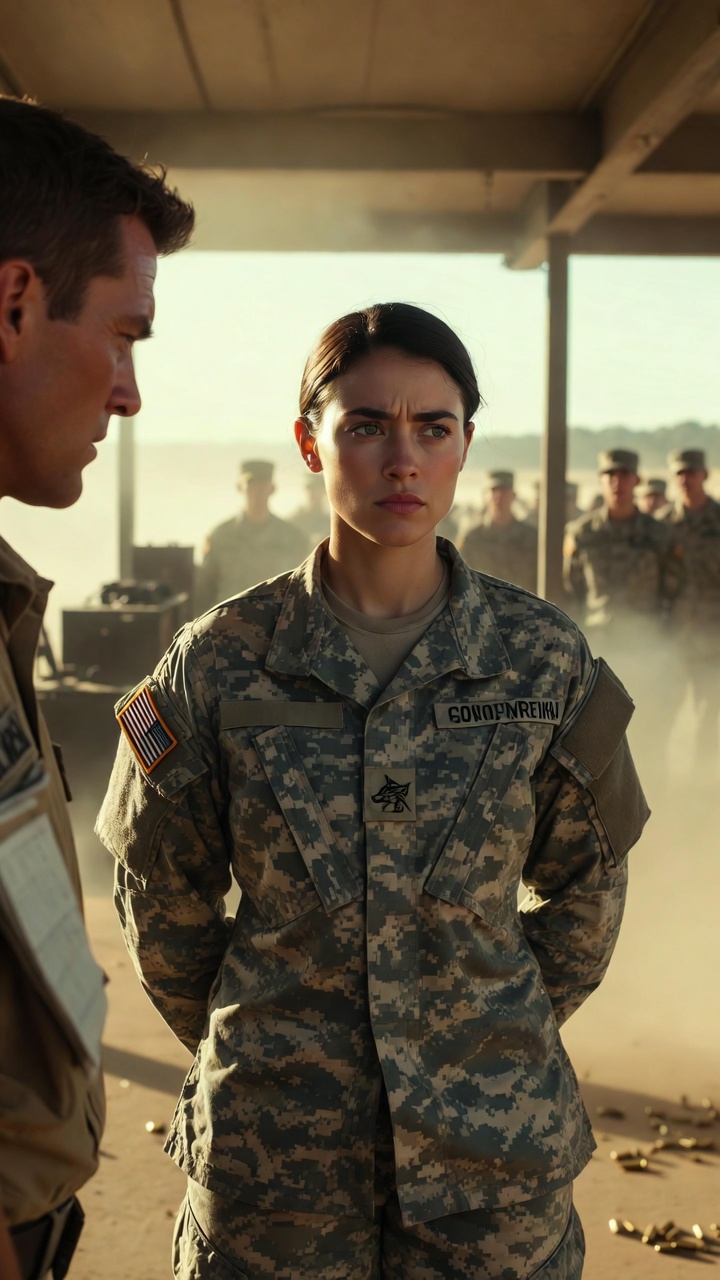
The first thing Lieutenant Daniel Morrison noticed was not her name.
It was the silence.
The firing range at Fort Liberty was usually a place where silence went to die.
The air shook with the crack of rifles. Brass casings bounced across the concrete like tiny pieces of sunlight. The smell of burnt gunpowder hung beneath the morning heat, mixing with dust, sweat, and the sharp metallic scent of weapons oil.
Thirty-two recruits stood behind the firing line, waiting for their turn.
Some looked nervous.
Some looked excited.
Some looked like they were trying desperately not to look afraid.
Staff Sergeant Dakota Reed looked like she was waiting for a storm.
She stood perfectly still.
Too still.
Her boots were planted shoulder-width apart. Her hands rested behind her back. Her eyes moved across the range—not staring, not wandering, but measuring.
The distance markers.
The wind flags.
The position of the sun.
The movement of the other shooters.
Lieutenant Morrison noticed.
And he didn’t like it.
“Reed.”
Dakota turned.
“Sir.”
Morrison walked toward her, clipboard tucked under one arm. He was thirty-four years old, a career infantry officer with ten years of service, a chest full of commendations, and the kind of confidence that came from believing he had already seen everything.
He had a sharp jaw, close-cropped brown hair, and a permanent expression that suggested disappointment was his natural state.
“Your weapons assignment says handgun qualification today.”
“Yes, sir.”
“You have a problem with that?”
Dakota glanced toward the weapon table.
“No, sir.”
Morrison raised an eyebrow.
“Then why did you request an M4?”
The other recruits slowed down.
Not stopped.
Just slowed.
Military personnel learned quickly that curiosity was dangerous, but impossible to eliminate.
Dakota kept her voice calm.
“Because I believe I can demonstrate better proficiency with a rifle platform, sir.”
A few people exchanged looks.
Morrison stared at her.
Then he laughed.
Not loudly.
Not cruelly.
Almost worse.
A quiet laugh that said he couldn’t believe what he had just heard.
“You believe?”
Dakota said nothing.
Morrison stepped closer.
“Staff Sergeant Reed, this is basic weapons training. Not some private competition on your grandfather’s farm.”
A few recruits smiled.
Dakota’s expression didn’t change.
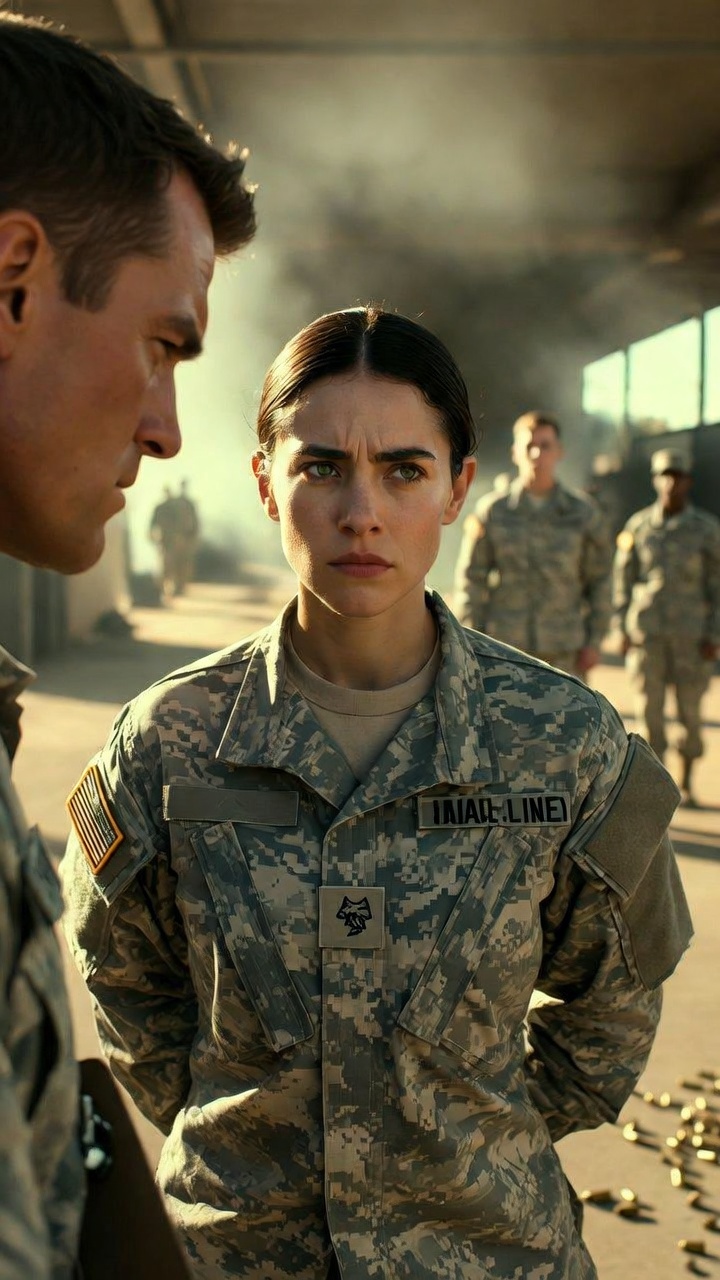
“My request was based on experience, sir.”
“Experience?”
Morrison looked around.
“Everybody hear that?”
Nobody answered.
He pointed toward the weapon rack.
“She thinks she needs something different because she’s special.”
A young recruit near the back whispered:
“Here we go.”
Morrison heard him.
He ignored it.
“Let me guess. You watched a few videos. Learned some tactical words. Now you think you belong in a special operations unit?”
The laughter started small.
A few nervous chuckles.
Then more.
Dakota heard every sound.
She had learned a long time ago that laughter was sometimes more dangerous than anger.
Anger came directly at you.
Laughter tried to make you disappear.
Morrison picked up a standard service pistol.
“This is what you’re assigned.”
Dakota looked at it.
Then back at him.
“Sir, respectfully, I would like to qualify with the rifle.”
The range went quiet.
Morrison’s smile faded.
“You’re refusing my instruction?”
“No, sir.”
“Then what exactly are you doing?”
“Requesting a different evaluation method.”
The recruits stopped pretending not to watch.
Morrison studied her face.
There was no arrogance there.
No attitude.
That bothered him more.
People who challenged authority usually wanted attention.
Dakota looked like she wanted the opposite.
“Why?” he asked.
A simple question.
But something about it changed the air.
Dakota hesitated.
Only for half a second.
“My grandfather taught me rifles, sir.”
Morrison nodded slowly.
“Your grandfather.”
The way he said it made it sound like an excuse.
“Let me guess. Military?”
“Yes, sir.”
“Rank?”
Dakota’s jaw tightened slightly.
“Colonel.”
A few recruits looked surprised.
Morrison looked amused.
“Retired?”
“Deceased.”
The amusement disappeared for a moment.
Only a moment.
Then it returned.
“I’m sorry.”
His voice said he wasn’t.
“What was his name?”
Dakota looked toward the range.
The wind moved through the flags.
“James Reed.”
Nobody reacted.
Morrison shrugged.
“Doesn’t ring a bell.”
Dakota said nothing.
Because that was the point.
People weren’t supposed to remember James Reed.
Not officially.
Not publicly.
Not anymore.
Morrison handed the pistol back to the weapons instructor.
“Fine.”
He looked at Dakota.
“You want the rifle?”
A pause.
“Yes, sir.”
“Then earn it.”
He turned toward the weapon rack.
“Give Staff Sergeant Reed an M4.”
A few recruits smiled.
One whispered:
“This is going to be painful.”
Morrison heard.
He smiled.
“Everyone watches.”
Dakota picked up the rifle.
The moment her hands touched it, something changed.
Not dramatically.
Not like the movies.
No one heard music.
No one suddenly realized they had underestimated her.
It was smaller than that.
Her shoulders relaxed.
Her breathing slowed.
The weapon stopped being equipment.
It became familiar.
The instructor noticed first.
Sergeant Caleb Hayes had spent twelve years teaching soldiers how to handle firearms.
He watched hundreds of people pick up weapons every year.
Most people held a rifle like they were holding something dangerous.
Dakota held it like she was holding something she understood.
“Range one hundred meters,” Morrison announced.
Dakota moved into position.
The recruits gathered behind the line.
The sun climbed higher.
Heat shimmered above the ground.
Morrison crossed his arms.
“Five rounds.”
Dakota placed the rifle against her shoulder.
The world became smaller.
The noise disappeared.
The voices disappeared.
The judgment disappeared.
There was only breath.
Wind.
Trigger.
Five seconds.
Five decisions.
The first shot cracked.
The round hit.
The second followed.
Then the third.
Fourth.
Fifth.
The sound echoed across the range.
Nobody spoke.
The instructor walked toward the target.
Morrison watched him.
The man’s expression changed.
Not much.
But enough.
He stopped in front of the paper target.
Then he looked back.
“Lieutenant.”
Morrison walked over.
“What?”
The instructor stepped aside.
The five rounds had landed almost perfectly together.
Not touching.
Almost.
A group so tight that from a distance it looked like a single damaged circle.
The laughter was gone.
Nobody moved.
Morrison stared.
“Beginner’s luck.”
Dakota lowered the rifle.
She said nothing.
Morrison looked at her.
“Again.”
She nodded.
Five more rounds.
Same result.
The third time, nobody laughed.
The fourth time, nobody whispered.
By the fifth group, even the recruits who disliked her were watching differently.
Morrison walked away without saying anything.
But Dakota saw his face.
He wasn’t angry.
He was confused.
And confusion was the first crack in certainty.
Three days later, General Sarah Mitchell arrived at Fort Liberty.
Nobody knew why.
That was the first thing everyone noticed.
Generals did not randomly visit basic training ranges.
Not without a reason.
The second thing everyone noticed was that she walked differently.
She wasn’t loud.
She didn’t need to be.
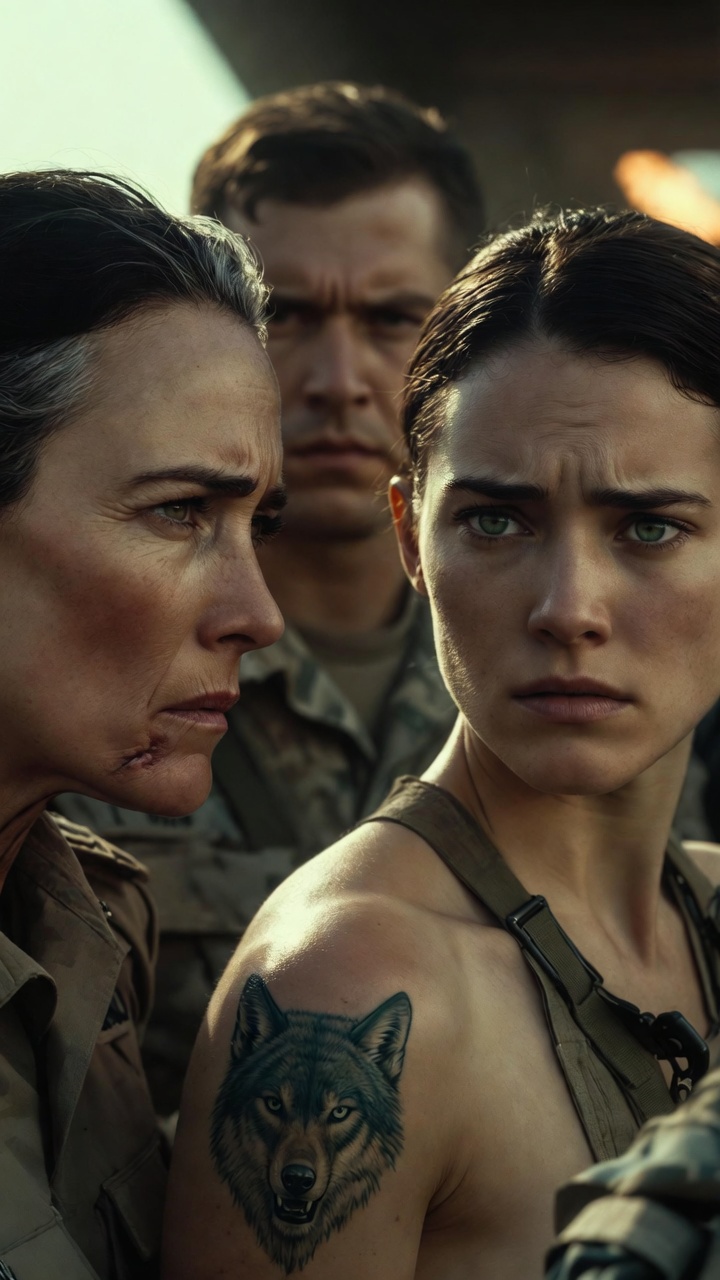
At fifty-two years old, Sarah Mitchell had spent three decades in the military. Her dark hair had silver at the edges. A thin scar crossed the left side of her chin, a reminder from a mission she never discussed.
She carried herself like someone who had spent years in rooms where every decision had consequences.
She walked past officers.
Past instructors.
Past recruits.
Then she stopped.
Because she saw Dakota Reed.
Not her face.
Her shoulder.
A small black tattoo was visible beneath the edge of her uniform sleeve.
A wolf’s head.
Simple.
Almost faded.
Most people would have ignored it.
General Mitchell did not.
Her expression changed.
Only slightly.
But the officers around her noticed.
Lieutenant Morrison stepped forward.
“General.”
Mitchell didn’t look at him.
Her eyes remained on Dakota.
“Staff Sergeant Reed.”
Dakota straightened.
“Ma’am.”
Mitchell walked closer.
“Where did you get that?”
Dakota’s stomach tightened.
The question wasn’t about the tattoo.
It was about everything behind it.
“Family, ma’am.”
The general stared at the wolf.
Then she said something so quietly that only Dakota and the closest officers heard.
“Wolfpack Alpha.”
The air seemed to stop.
Morrison frowned.
“Ma’am?”
Mitchell finally looked at him.
“How long has she been training here?”
“Three weeks.”
“And nobody reported this?”
Morrison looked confused.
“Reported what?”
General Mitchell looked back at Dakota.
For the first time in years, something close to disbelief crossed her face.
Because she knew exactly what that symbol meant.
And she knew exactly who had placed it on Dakota’s shoulder.
“Who was your grandfather?”
Dakota swallowed.
“Colonel James Reed.”
The general went completely still.
The name had not been spoken in official military circles for over a decade.
Then Sarah Mitchell whispered:
“Impossible.”
Because Colonel James Reed was not just a retired soldier.
He was a legend.
And according to every classified record General Mitchell had ever seen…
Wolfpack Alpha had died with him.
Or so everyone believed.
Until that morning.
Until Dakota Reed walked onto a firing range carrying a rifle nobody thought she should have.
And a secret nobody knew still existed.


