Chapter One
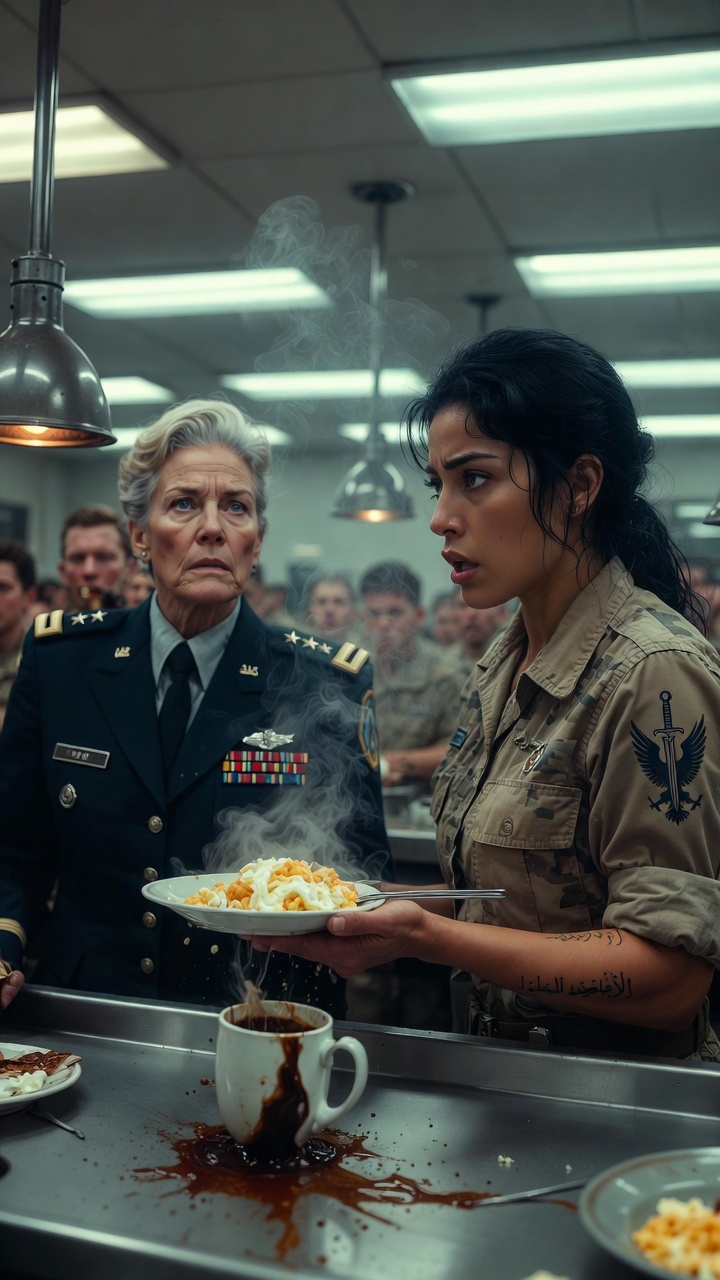
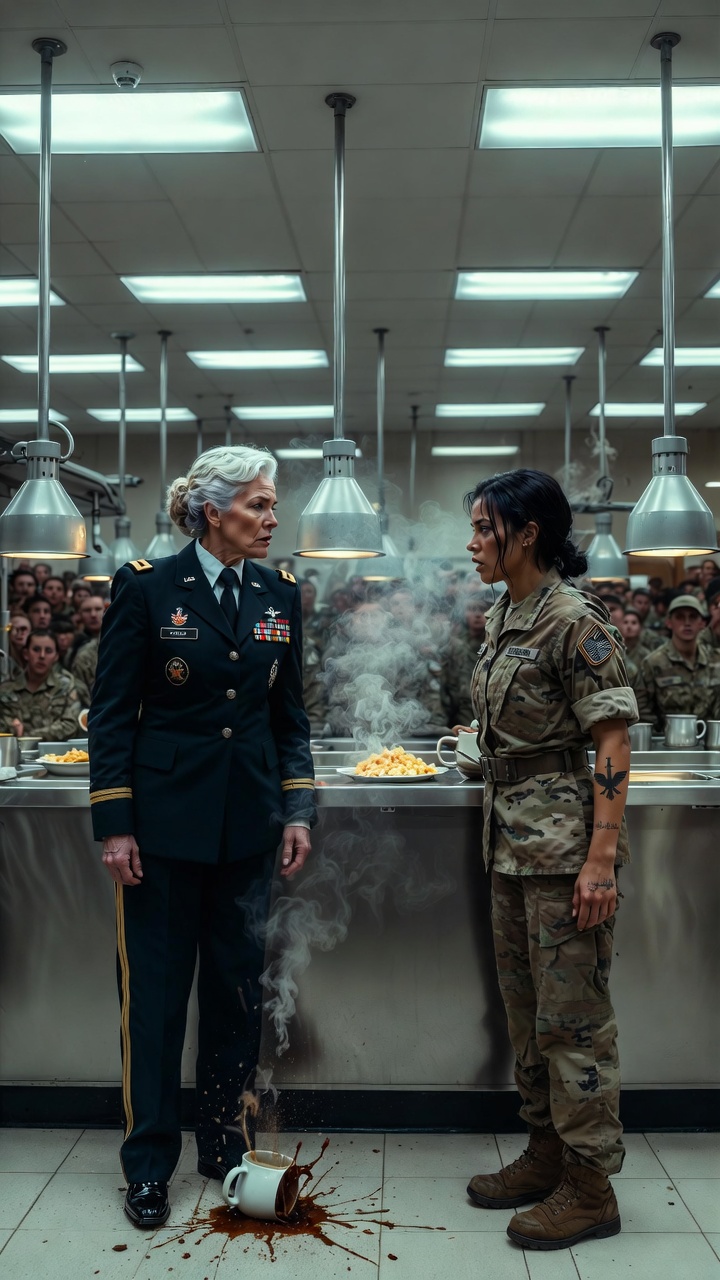
The coffee mug hit the tile before the tray did.
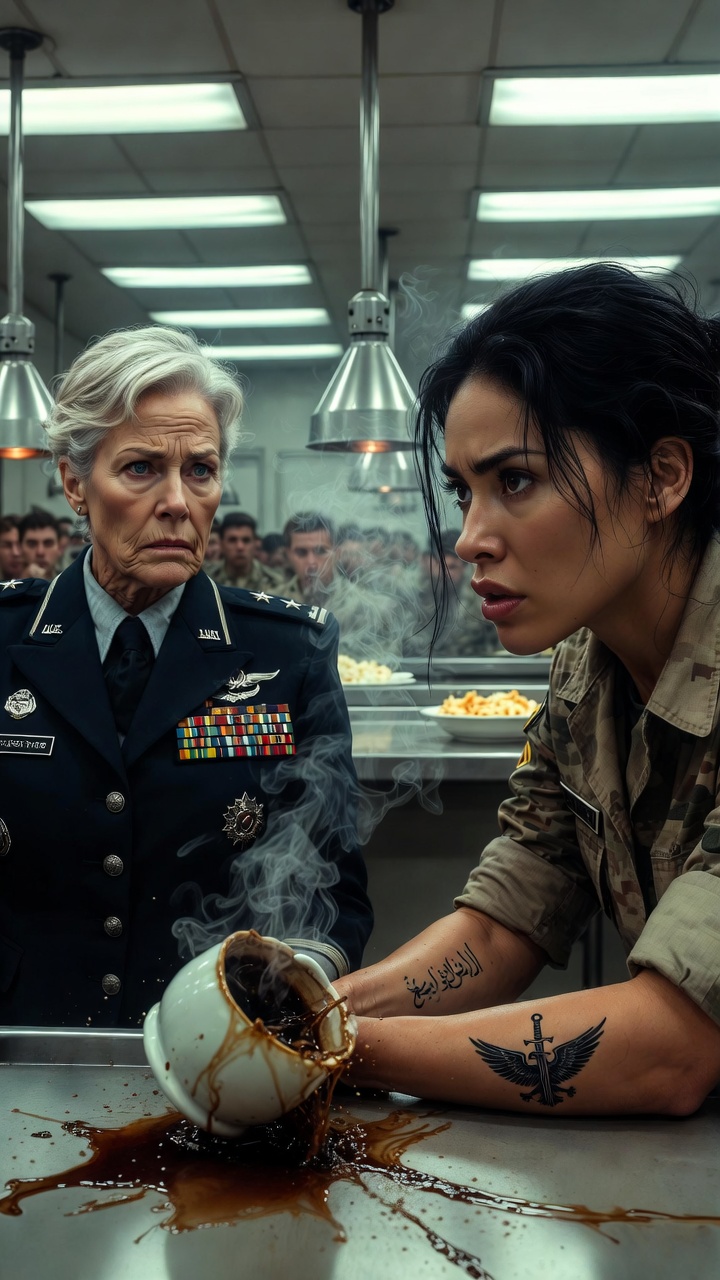
Porcelain shattered beneath Four-Star General Patricia Hawthorne’s boots, sending black coffee across the pale floor of Joint Base Falcon’s mess hall. Conversation died in widening circles. Forks stopped halfway to mouths. Chairs scraped once, then went still.
Eight hundred soldiers watched the general stare at the woman behind the serving counter.
Staff Sergeant Maria Santos stood beneath the heat lamps with a stainless-steel tray balanced against her hip. Steam from the scrambled eggs drifted between them. Her right sleeve had caught on the edge of a warming cabinet and rolled above her elbow.
A small black eagle was tattooed on the inside of her forearm.
Its wings were folded downward, not spread. A broken sword ran through its chest. Beneath the bird, three Arabic words curved like a burial inscription.
General Hawthorne’s face lost its color.
Maria saw the recognition happen.
First in the eyes.
Then in the mouth.
Then in the hand that reached toward the tattoo before Hawthorne remembered that four hundred armed witnesses were watching.
“Where did you get that?” the general asked.
Maria slowly lowered the tray.
The metal touched the counter without a sound.
“Ma’am?”
Hawthorne stepped over the broken mug. She was sixty-one, silver-haired, square-shouldered, and famous throughout the Army for never raising her voice because she had never needed to. That morning, however, something rough lived beneath each word.
“The mark on your arm.”
Maria tugged her sleeve down.
Too late.
Across the mess hall, Lieutenant Colonel Daniel Rourke rose from his table.
Rourke commanded Joint Base Falcon’s logistics battalion. At forty-seven, he had the thick neck and patient expression of a man who preferred giving orders quietly and punishing people privately. He glanced from Hawthorne to Maria, then toward the security cameras recessed in the ceiling.
Maria noticed.
She noticed everything.
A cook dropped a ladle in the kitchen behind her.
No one laughed.
General Hawthorne stopped on the other side of the counter. The steam between them smelled of powdered eggs, burnt toast, and industrial cleanser.
“That symbol belonged to Task Unit Kestrel,” she said.
A young private near the drink station whispered to the soldier beside him.
“What’s Kestrel?”
The older soldier shook his head without looking away.
Maria’s fingers closed around the edge of the counter.
Hawthorne continued. “Twelve operators. Compartmented authority. No public roster. No unit photographs. No insignia outside secured facilities.”
The general’s gaze dropped to Maria’s covered arm.
“All twelve were killed outside Al-Qaryatayn two years ago.”
Rourke approached through the silent tables.
“General,” he said, “perhaps this discussion should be moved somewhere more appropriate.”
Hawthorne did not turn.
“What is your full name, Sergeant?”
“Maria Santos, ma’am.”
“That isn’t what I asked.”
Maria looked beyond Hawthorne.
Rourke had stopped ten feet away. His hands rested loosely at his sides, but his right thumb rubbed the edge of his academy ring.
Once.
Twice.
Three times.
A nervous habit.
Maria had waited eighteen months to see it.
Hawthorne’s voice softened.
“Who are you?”
Maria’s eyes returned to the general.
For eighteen months, she had served meatloaf, scrubbed grease traps, cleaned tables after midnight, and listened while soldiers discussed deployments as though the woman carrying their plates had no ears.
For eighteen months, she had slept in a narrow room above the base laundry, kept one pistol inside a flour bin, and recorded names on the backs of discarded meal receipts.
For eighteen months, she had lived six hundred yards from the man she believed had sold her team to the enemy.
She had survived by being ordinary.
Then one rolled sleeve had destroyed everything.
“Ma’am,” Maria said, “I need you to walk away from this counter.”
Hawthorne’s eyes narrowed.
“That sounded like an order.”
“It’s a warning.”
Rourke took another step.
“Sergeant Santos, you will report to the command office immediately.”
Maria looked at his ring.
His thumb had stopped moving.
“Sir,” she said, “you should clear the mess hall.”
A faint smile touched Rourke’s mouth.
“On whose authority?”
Maria heard the first shot before anyone else recognized it.
Not because it was loud.
Because it was not.
A compressed cough came from the kitchen loading bay, followed by the soft metallic slap of a suppressed round entering steel.
Maria lunged across the counter.
She hit Hawthorne in the chest, driving the four-star general to the floor as a bullet passed through the space where her head had been.
The heat lamp exploded.
Glass rained over the scrambled eggs.
Someone screamed.
Then the mess hall windows turned white with gunfire.
Maria rolled over Hawthorne, ripped the general’s sidearm from its holster, and fired twice beneath the serving counter.
A man in a delivery uniform collapsed beside the kitchen doors.
The room erupted.
Soldiers overturned tables. Officers shouted contradictory commands. Trays crashed. Bodies pressed toward exits that Maria already knew had been chained from outside.
She grabbed Hawthorne’s collar.
“Stay below the counter.”
“Who are they?”
“The people who just learned I’m alive.”
Maria rose just high enough to see across the room.
Three shooters had entered through the loading bay. Two more fired through the eastern windows. They wore no uniforms, but their movements were disciplined—short bursts, controlled sectors, deliberate pressure toward the center aisle.
They were not trying to kill everyone.
They were shaping the room.
Driving Hawthorne toward the west corridor.
Maria fired at a ceiling pipe.
The round ruptured the sprinkler line. Water blasted downward, filling the air with mist and steam. Visibility collapsed.
“Everyone down!” Maria shouted. “Do not move toward the west doors!”
Rourke stood behind an overturned table, pulling two junior officers toward the forbidden exit.
Maria saw him.
He saw her.
For one second, the chaos narrowed to the space between them.
Then Rourke pushed the officers away and drew his pistol.
Not at the attackers.
At Maria.
She fired first.
The bullet struck the floor beside his hand, spraying tile fragments into his face.
“Next one goes through the ring,” she said.
Rourke froze.
Hawthorne looked from Maria to the lieutenant colonel.
Something passed across the general’s expression—not understanding yet, but the beginning of it.
Maria pointed toward the kitchen.
“There’s a cold-storage corridor behind the freezer. It leads to an exterior waste trench.”
Hawthorne stared at her. “How do you know?”
“I’ve cleaned every inch of this building.”
“You planned an escape route from a dining facility?”
“I planned one from every building on this base.”
Another burst tore through the counter.
Maria seized the general’s wrist and pulled her toward the kitchen.
Behind them, Rourke shouted, “Stop her! She may be part of the attack!”
Maria did not turn.
Hawthorne did.
The general’s voice cracked across the room like artillery.
“No one touches her.”
They reached the freezer as a grenade rolled beneath the serving line.
Maria shoved Hawthorne through the steel door.
The explosion lifted the floor behind them.
The freezer lights went out.
Darkness swallowed the general, the kitchen, and the woman the Army had buried two years earlier.
Then Maria heard the bolt slide on the other side of the cold-storage exit.
Someone was waiting for them.
Chapter Two
Maria pushed Hawthorne behind a stack of frozen beef before the exit opened.
A flashlight beam cut through the freezer.
“General?” a man called. “This is Captain Ellis, base security.”
Hawthorne started to answer.
Maria covered her mouth.
The general’s eyes flashed with anger.
Maria shook her head and pointed toward the floor.
No shadow moved beneath the door.
Whoever stood outside had placed the flashlight in the corridor while remaining against the wall.
A lure.
Maria leaned close to Hawthorne’s ear.
“Captain Ellis transferred to Germany three weeks ago.”
Hawthorne stared at her.
The voice outside came again.
“Ma’am, we need to move. The mess hall is compromised.”
Maria lifted three fingers.
Then two.
Then one.
She kicked a crate across the floor.
Gunfire punched through the door, shredding cardboard and frozen meat. Maria moved with the first burst, crossing low, firing through the lower hinge.
A cry came from the corridor.
She yanked the door open and struck the wounded shooter with the pistol before he could raise his rifle.
He wore civilian body armor beneath a maintenance jacket. A black strip of cloth covered his face.
Maria tore it away.
The man was young. Twenty-five, perhaps. Pale eyes. A burn scar climbed from his neck to his left ear.
He recognized her.
The hatred in his expression vanished.
“Falcon Six,” he whispered.
Maria’s grip tightened.
No one on Joint Base Falcon knew that call sign.
Hawthorne stepped closer. “Who sent you?”
The man smiled through blood.
“You did.”
His jaw shifted.
Maria jammed her fingers between his teeth, but the capsule had already broken.
The bitter almond odor arrived a heartbeat later.
His body convulsed once and became still.
Hawthorne looked down at him, then at Maria.
“He called you Falcon Six.”
Maria checked the man’s pockets.
No identification. No phone. One spare magazine. A brass token stamped with the number 47.
Her heartbeat changed.
Not faster.
Heavier.
She had seen the same token in Syria.
“What is it?” Hawthorne asked.
Maria closed her fist around the disk.
“We need to move.”
“That is not an answer.”
“Answers get people killed when they’re given in the wrong place.”
“I am the commanding general of Army Strategic Operations.”
“And somebody just tried to herd you into a kill zone inside an American military base.”
Maria met her gaze.
“Rank stopped protecting you the moment that coffee mug hit the floor.”
For most officers, speaking to a four-star general that way would have ended a career.
Hawthorne merely studied her.
Then she removed the stars from her collar and placed them in her pocket.
“Lead.”
They moved through the cold-storage corridor.
Emergency lights glowed red along the floor, painting the concrete walls like an underground artery. The air smelled of Freon, smoke, and scorched wiring. Behind them, gunfire rolled through the mess hall in short, disciplined bursts.
Maria reached the waste exit and stopped.
A thin filament crossed the bottom of the door.
She crouched.
The tripwire was nearly invisible, attached to a shaped charge packed beneath the outer hinge.
Hawthorne watched her work.
“You spotted that in the dark?”
“I knew where I would put it.”
Maria removed a small knife from her boot and cut through the rubber weather seal beside the frame. She slid the blade upward until it touched the wire, then wedged it in place.
“We open the door, the tension stays on the blade.”
“And when the blade slips?”
“We won’t be here.”
“That is not reassuring.”
“It wasn’t meant to be.”
Maria eased the door open.
Heat rushed inside.
Joint Base Falcon sat in the high desert of southern Arizona, where summer did not feel like weather so much as punishment. The morning sun hammered the loading yard. Smoke drifted above the mess hall roof. Sirens wailed beyond the barracks, but several security vehicles were blocking one another near the eastern checkpoint.
Poorly coordinated.
Almost intentionally.
Maria led Hawthorne into a concrete drainage trench lined with sun-bleached gravel. They crouched beneath the windows and moved toward the vehicle depot.
The general kept pace despite her age and dress uniform.
“You were declared dead,” Hawthorne said.
Maria did not answer.
“I saw the casualty report myself.”
“You signed it.”
Hawthorne stopped.
Maria continued three steps before turning.
The general stood in the trench, sunlight cutting across one half of her face.
“What did you say?”
“You signed the order closing the investigation into Operation Desert Falcon.”
“I signed a finding based on battlefield evidence.”
“There were no bodies.”
“There was biometric material, equipment wreckage, satellite confirmation, and intercepted enemy communications.”
“Manufactured evidence.”
Hawthorne’s jaw tightened. “By whom?”
Maria held up the brass token.
“Someone who uses dead soldiers as shipping labels.”
A vehicle engine started beyond the trench.
Maria pulled Hawthorne down as a military police truck crossed the road above them. Two armed men sat in front. The driver wore an MP helmet, but the passenger’s boots were civilian.
Rourke’s voice came over the truck’s loudspeaker.
“General Hawthorne has been abducted by an armed infiltrator posing as Staff Sergeant Maria Santos. Suspect is highly dangerous. Lethal force is authorized.”
Hawthorne listened until the vehicle disappeared.
Then she looked at Maria.
“Rourke does not have the authority to issue that order.”
“He does if everyone above him is dead, missing, or locked out of communications.”
“How many people on this base are compromised?”
Maria looked toward the communications tower.
“Enough.”
They reached the vehicle depot.
Rows of Humvees shimmered beneath corrugated metal shelters. No mechanics moved between them. No guards stood at the gate.
Too empty.
Maria checked the nearest vehicle.
The ignition system had been stripped.
The next had no battery.
The third contained a body.
Major Steven Cole, the base communications officer, lay across the back seat with a neat hole beneath his chin. His uniform shirt was open. A message had been carved into his chest.
TWELVE STAY BURIED.
Hawthorne turned away, but not quickly enough.
Maria stared at the words.
Not at the blood.
At the handwriting.
The letter R curved backward.
The same way Sergeant First Class Jonah Vale had written it on maps, ammunition crates, and birthday cards.
Jonah Vale.
Kestrel Two.
Her closest friend.
The man she had watched burn inside a Syrian safe house.
Hawthorne saw the change in Maria’s face.
“You know who did this.”
Maria reached into Cole’s shirt pocket and removed a folded strip of paper.
An address was written inside.
Building 47.
Beneath it, one sentence:
COME ALONE, ELENA.
Hawthorne read over her shoulder.
“Elena?”
Maria folded the message.
“My middle name.”
“No one on this base knew that.”
“One person did.”
Hawthorne glanced at the dead officer.
“A member of Kestrel?”
Maria looked at the backward R carved into Cole’s chest.
The desert heat pressed against her skin, but for one terrible second she smelled burning cedar, plastic explosives, and human hair.
She heard Jonah Vale’s voice through a Syrian radio.
Go, Maria. I’ll close the door.
She had obeyed.
She had spent two years hating herself for it.
“Yes,” she said.
“One of the dead just invited me to Building 47.”
Chapter Three
Building 47 did not appear on any current base map.
Officially, the structure had been demolished nine years earlier after an electrical fire. Its concrete footprint remained beyond the abandoned ammunition bunkers, where the desert climbed into a shelf of black volcanic rock.
Maria had discovered the truth six months into her assignment.
Building 47 still existed.
It had simply been buried.
She and Hawthorne crossed the vehicle depot and entered a maintenance tunnel through a hatch beneath a hydraulic lift. The tunnel ran west under the base, built during the Cold War and forgotten by everyone except the rodents, the plumbing crews, and Maria Santos.
Their footsteps echoed through ankle-deep water.
Hawthorne moved behind her, carrying the dead communications officer’s pistol.
“You spent eighteen months working in the mess hall,” the general said. “Why?”
“Food service touches every unit.”
“That is a thin explanation.”
“Soldiers talk when they eat. Drivers complain about routes. Supply sergeants mention missing cargo. Officers leave meeting notes on trays. Contractors flirt with cooks. People hide secrets from intelligence officers.”
Maria ducked beneath a pipe.
“They don’t hide them from the woman refilling the coffee.”
“And what did you find?”
“Medical shipments that weighed three times what the manifests reported. Refrigerated trucks arriving empty and leaving under armed escort. Weapon serial numbers from Syria appearing in maintenance logs here.”
“You reported it?”
“To three separate channels.”
“And?”
“The first investigator died in a car accident. The second retired without warning. The third sent me a two-word message.”
“What words?”
“Stop digging.”
Hawthorne’s boots splashed behind her.
“Why didn’t you contact me?”
Maria stopped beneath a flickering light.
“Because your signature was on the order that buried my team.”
The tunnel hummed around them.
Hawthorne lowered the pistol slightly.
“You believe I betrayed Kestrel.”
“I believe twelve soldiers entered Syria under an operational plan known to fewer than twenty people. I believe enemy forces were waiting at every extraction route. I believe our encrypted frequencies were compromised before we crossed the border.”
“And you believe I was responsible.”
“I believed you might be.”
“Past tense?”
Maria continued walking.
“The shooters in the mess hall tried to kill you.”
“They may have wanted us to think that.”
“Exactly.”
Hawthorne almost smiled.
“You distrust evidence that supports my innocence.”
“I distrust convenient evidence.”
“That must make life lonely.”
Maria stepped over a collapsed section of pipe.
“You learn to live with it.”
“No,” Hawthorne said. “You learn to survive with it. Living is something else.”
The words struck deeper than Maria expected.
She said nothing.
At the end of the tunnel, they climbed a rusted ladder into an unused armory. Dust covered the weapons racks. A single shaft of sunlight entered through a cracked vent, illuminating the skeleton of a pigeon in the corner.
Maria crossed to a wall panel and removed two loose bolts. Behind the panel sat a small radio transmitter, a compact pistol, six memory cards, and a photograph sealed in plastic.
Hawthorne picked up the photograph before Maria could stop her.
Twelve soldiers stood outside a mud-brick compound under a bruised Syrian sunset. Their faces were streaked with dust. None wore insignia.
Maria stood in the center.
She was thinner then. Her black hair was tied beneath a scarf. A crooked smile pulled at one corner of her mouth.
Beside her stood Jonah Vale, thirty-six, broad-faced and freckled, holding a burnt cooking pot like a trophy.
On the back, someone had written:
KESTREL — TWELVE IN, TWELVE OUT.
Hawthorne looked at Maria.
“You kept this here?”
“I kept it where I could destroy it quickly.”
“You were smiling.”
“We had not been betrayed yet.”
Hawthorne returned the photograph.
Maria inserted one memory card into the transmitter.
A series of coded logs appeared on the small screen—vehicle numbers, dates, cargo weights, personnel assignments.
Hawthorne read silently.
Her face hardened.
“These shipments were authorized through Strategic Operations.”
“Your command.”
“Not by me.”
“Someone used your authentication key.”
“That requires biometric confirmation.”
“Or a stored copy.”
Hawthorne looked up sharply.
“Biometric data from a secure system cannot be copied without physical access to my office.”
“Who had access two years ago?”
“My chief of staff. Communications director. Security detail.”
“And Lieutenant Colonel Rourke?”
“He served on my regional logistics review board.”
Maria watched the general’s expression.
“You trusted him.”
“I trusted many people.”
“That is why betrayal works.”
A noise moved through the armory.
Not footsteps.
Breathing.
Maria extinguished the screen and drew her pistol.
A man stepped from behind the weapons racks with both hands raised.
He was tall, lean, and dressed in a faded Army combat uniform without rank. Burn scars covered the left side of his neck.
Maria’s weapon remained fixed on his forehead.
“Jonah.”
Sergeant First Class Jonah Vale looked older than the man in the photograph. Gray threaded his beard. His left eye was filmed white. Three fingers were missing from his right hand.
But he was alive.
“Hello, Elena.”
Her name sounded like an apology in his mouth.
Maria’s arms did not shake.
The rest of her did.
Hawthorne raised her pistol.
“Identify yourself.”
“Sergeant First Class Jonah Vale. Formerly Kestrel Two.”
“Formerly deceased.”
“That too.”
Maria took one step toward him.
“I heard you die.”
“I needed you to.”
“Why?”
Jonah’s good eye moved to Hawthorne.
“Because General Hawthorne was listening.”
The general’s pistol lifted another inch.
Jonah smiled without humor.
“Still quick, ma’am.”
Maria moved between them.
“Talk.”
Jonah lowered his hands slowly.
“Operation Desert Falcon was never a rescue mission. We were sent to recover a ledger documenting a weapons pipeline between private contractors, foreign militias, and officers inside our own command.”
“We knew that,” Maria said.
“No. We knew the cover story. The ledger didn’t contain transactions. It contained identities.”
His gaze settled on Hawthorne.
“Including hers.”
Hawthorne’s voice became very quiet.
“You are lying.”
“I thought so too.”
Jonah reached inside his uniform.
Maria pressed the pistol against his chest.
“Slowly.”
He removed a battered digital recorder and placed it on the floor.
Maria picked it up.
A date was scratched into the casing.
Three days before Kestrel entered Syria.
She pressed play.
Static filled the armory.
Then General Hawthorne’s voice emerged from the speaker.
“Desert Falcon must not return with the ledger. If necessary, terminate the entire unit.”
Hawthorne stared at the recorder.
Her own voice continued.
“No witnesses. No survivors.”
Maria did not look at the general.
She kept watching Jonah.
“Where did you get this?”
“From the men who held me for twenty-two months.”
“Why release you?”
“They didn’t.”
His good eye moved toward the armory door.
“I escaped six days ago.”
A red laser dot appeared on his chest.
Maria tackled him as the wall erupted with gunfire.
Chapter Four
The first rounds tore through the weapons rack.
Hawthorne dropped behind a concrete support column. Maria dragged Jonah across the floor while bullets carved sparks from the walls.
“Rear exit?” Maria shouted.
“Sealed.”
“How many?”
“At least six.”
“You brought them?”
Jonah coughed. “They followed me.”
Maria fired through the vent opening, forcing the shooters to move.
Hawthorne pressed against the column, clutching the recorder.
“That voice is fabricated.”
Jonah laughed once.
“Excellent timing, General.”
Maria shot him a look.
“Save your strength.”
“For what?”
“To explain why you let me bury you.”
His expression changed.
The gunfire stopped.
Silence settled across the armory.
A loudspeaker crackled outside.
Rourke’s voice entered through the walls.
“General Hawthorne, you are currently in the company of two enemy intelligence assets. Exit the building with your hands visible, and your safety will be guaranteed.”
Hawthorne called back, “Lieutenant Colonel Rourke, by what authority have you assumed command of this installation?”
A pause.
“Continuity of government protocol, ma’am.”
“No such protocol places you above the base commander.”
“The base commander suffered a fatal heart attack thirty minutes ago.”
Hawthorne closed her eyes briefly.
Maria watched her absorb the death.
Then the general stood straighter behind the column.
“You killed Brigadier General Ames.”
“I regret that his health failed during a crisis.”
“You never were convincing when you lied, Daniel.”
Rourke’s voice softened.
“And you were never careful about whom you humiliated.”
Hawthorne looked toward the loudspeaker.
There it was.
Not ideology.
Not money.
A wound.
Rourke continued. “You built careers by breaking people in public. You called it standards. You called it discipline. Some of us called it cruelty.”
Hawthorne did not answer.
Maria glanced at her.
The general’s face remained controlled, but a pulse moved at her temple.
Rourke was not inventing the pain.
He was using it.
“Daniel,” Hawthorne said, “whatever grievance you carry against me does not justify murdering American soldiers.”
“No. Survival justifies it.”
The loudspeaker clicked off.
Jonah crawled toward the rear wall.
“They’ll breach from both sides.”
Maria checked her magazine.
Seven rounds.
Hawthorne had nine.
Jonah carried no weapon.
“Building 47,” Maria said. “Why send the message?”
“Because the men running the pipeline are transferring the final shipment today. Surface-to-air guidance systems. Enough to blind every friendly aircraft over three countries.”
“Where?”
“Under us.”
Maria looked at the floor.
Jonah struck a rusted drain cover with his palm.
“Hawthorne’s people built a secure storage chamber here during the first Gulf War. Rourke converted it into a transit vault.”
Hawthorne moved from the column.
“My people?”
“Your authorization code opened it.”
“That recording is false.”
Jonah studied her.
“I hope so.”
Maria knelt beside the drain cover. Fresh scratches marked its edge.
She inserted her knife and lifted.
A ladder descended into darkness.
The first explosive charge hit the front door.
Steel bowed inward.
Maria looked at Hawthorne. “You go first.”
The general tucked the recorder into her jacket and climbed down.
Jonah followed.
Maria waited until the second charge struck, then dropped into the shaft and pulled the cover over her head.
The armory door exploded above them.
They descended twenty feet into an underground chamber cold enough to raise bumps along Maria’s skin.
Emergency lights revealed rows of black shipping cases stacked beneath a curved concrete ceiling. Each case bore the symbol of a humanitarian medical organization.
Jonah opened one.
Inside lay six missile guidance assemblies wrapped in anti-static cloth.
Hawthorne’s mouth tightened.
“How many?”
“Two hundred cases,” Jonah said.
“Destination?”
“Officially, a disaster-response center in Jordan. In reality, they’ll be divided among four proxy groups before sunset tomorrow.”
Maria moved between the stacks.
Small digital timers had been attached to the support columns.
Eight minutes remained.
“They’re destroying the evidence.”
Jonah pointed toward a steel freight elevator at the far end.
“That leads to the western loading yard.”
Maria approached the control panel.
The biometric scanner glowed green.
Hawthorne stared at it.
“My clearance.”
Maria looked at her. “Use it.”
“What if that is what they expect?”
“Then we disappoint them afterward.”
Hawthorne placed her thumb against the scanner.
The elevator doors opened immediately.
Inside stood Lieutenant Colonel Rourke.
He held a pistol against the neck of a young woman in civilian clothes.
Maria recognized her.
Special Agent Leah Park, the third investigator who had sent the message: Stop digging.
Leah’s face was bruised. Blood covered one side of her blouse.
Rourke’s academy ring gleamed beneath the elevator light.
“Put the weapons down,” he said.
Maria aimed at the narrow strip of his forehead visible above Leah’s shoulder.
Rourke smiled.
“You still take impossible shots, Master Sergeant?”
Hawthorne looked at Maria.
“Master Sergeant?”
“Later,” Maria said.
Rourke pressed the gun harder into Leah’s neck.
“She has been helping Sergeant Santos falsify evidence for nearly a year.”
Leah’s voice came through clenched teeth.
“He’s lying.”
“Everyone says that eventually.”
Maria kept her weapon steady.
The timers reached six minutes.
Rourke glanced at Jonah.
“You should have stayed in Syria.”
Jonah’s face hardened. “You should have come yourself.”
“I sent professionals.”
“You sent frightened boys and told them murder was patriotism.”
Rourke’s expression tightened.
There was the weakness.
Not Hawthorne.
Judgment.
He could tolerate hatred. He could not tolerate contempt.
Maria lowered her pistol by one inch.
Rourke noticed.
“You understand, don’t you?” he said. “The wars changed. Governments became too slow, oversight too cautious. We placed weapons where they could shape outcomes before politicians even recognized the threat.”
“You armed militias.”
“We armed leverage.”
“You murdered my team.”
“I prevented twelve operators from bringing home a document that would have collapsed alliances, exposed covert partners, and handed our adversaries a decade of strategic advantage.”
His eyes moved to Hawthorne.
“She knew the ledger could not return.”
Hawthorne’s voice was flat. “I ordered the mission aborted.”
“You ordered containment.”
“I never ordered executions.”
“You signed a directive with language broad enough to protect yourself from the consequences.”
For the first time, uncertainty crossed Hawthorne’s face.
A memory.
A document.
Something she had signed without reading closely enough.
Rourke saw it too.
“Now you remember.”
The timers reached five minutes.
Maria looked at the missile components surrounding them.
Then at Leah.
Then at the brass token in her hand.
Number 47.
Not a building number.
A cargo designation.
She turned the token over.
A tiny groove ran through its edge.
A data key.
Maria inserted it into the elevator control panel.
The screen flickered.
Rourke’s smile vanished.
“What did you do?”
“All those months watching trucks,” Maria said. “I wondered why every shipment carried a brass token even though the system was digital.”
The panel displayed a manifest.
Two hundred cases.
Four routes.
Thirty-seven military and civilian names.
At the top of the authorization chain appeared General Patricia Hawthorne.
Beneath it was a biometric verification file.
Maria opened the raw data.
The fingerprint was Hawthorne’s.
The time stamp, however, came from the day General Hawthorne had undergone surgery at Walter Reed.
Someone had copied her print from a hospital access system.
Hawthorne saw it.
“So the recording—”
“Manufactured from command briefings,” Maria said. “Spliced phonemes. Correct cadence, false sentence.”
Jonah exhaled.
Rourke fired.
Not at Maria.
At the control panel.
Leah twisted at the same instant. The bullet struck her shoulder instead of her neck.
Maria fired.
Her round shattered Rourke’s academy ring and tore through the hand holding the pistol.
He screamed.
Jonah charged into the elevator.
Rourke slammed his wounded hand against the emergency switch. Steel doors closed between them.
Jonah disappeared inside with him.
Maria reached the doors a second too late.
The elevator rose.
From above came three gunshots.
Then silence.
The timers reached four minutes.
Chapter Five
Maria forced her fingers into the seam between the elevator doors.
They did not move.
“Manual release,” Leah gasped.
She pressed one hand against her bleeding shoulder and pointed toward a red lever beside the shaft.
Maria pulled it.
The doors opened onto darkness.
The elevator had already climbed beyond reach.
Jonah was gone.
Again.
Hawthorne crouched beside Leah and tore a strip from her own uniform shirt.
“Through-and-through wound,” she said. “No arterial spray.”
Leah looked at the general’s exposed undershirt.
“You know first aid?”
Hawthorne tightened the bandage.
“I knew it before you were born.”
The timers reached three minutes.
Maria moved to the manifest screen. “Can the charges be disabled remotely?”
Leah shook her head. “Rourke uses independent triggers. Hardwired.”
“Then we separate the detonators from the main line.”
“There are sixteen columns.”
“Three of us.”
“Two and a half,” Leah said.
Hawthorne helped her stand.
“Make it three.”
They split across the chamber.
Maria followed the wires running from the nearest timer into a conduit beneath the floor. The charges were not designed merely to destroy the cargo. They were positioned to collapse the ceiling and bury the vault beneath thirty feet of concrete.
No retrieval.
No investigation.
No survivors.
She cut the first firing line.
Across the chamber, Hawthorne ripped a detonator free with both hands.
Leah limped toward the southern columns, leaving drops of blood between the cases.
Two minutes.
Maria disabled the fourth charge.
Then the fifth.
A warning siren began pulsing through the chamber.
The screen flashed:
REMOTE OVERRIDE ACTIVE.
“Rourke!” Leah shouted.
The countdown changed.
One minute.
“He shortened it,” Hawthorne said.
Maria ran.
Thirty-seven years of discipline lived in Hawthorne’s posture, but age had stiffened her hands. She fought with the sixth detonator, unable to release the locking pin.
Maria reached her and struck the mechanism with the butt of her pistol.
The pin snapped.
Forty seconds.
“Freight shaft,” Maria said. “Move!”
“What about the evidence?”
Maria pulled the memory card from the control panel.
“This is enough.”
“It names everyone?”
“If it survives.”
They reached the shaft.
The elevator stood at the surface. No ladder ran along the walls.
Thirty seconds.
Leah looked up into darkness. “We can’t climb that.”
Maria scanned the chamber.
Cargo webbing hung from the nearest pallet.
She hooked three lengths together and threw one end over a maintenance cable inside the shaft.
“You first,” she told Hawthorne.
The general seized the webbing.
“I am not leaving you below me.”
“That wasn’t a request.”
Hawthorne’s eyes flashed.
Then the timer announced twenty seconds.
She climbed.
Leah followed one-handed, biting back a scream as her injured shoulder took weight.
Maria wrapped the line around her forearm and pulled them upward from below.
Ten seconds.
The first charge ignited before the timer reached zero.
The blast punched through the chamber. Cases lifted from the floor. Missile components became shrapnel.
Maria felt the webbing tear through her palms.
Hawthorne reached the surface and rolled into the loading yard.
Leah climbed after her.
The ceiling below Maria cracked.
A slab of concrete fell across the shaft.
Maria swung aside as it passed, crushing the lower section of webbing.
Five seconds.
Hawthorne lay at the edge, reaching down.
“Give me your hand!”
Maria climbed.
Another explosion struck.
The shaft twisted.
The webbing snapped.
Maria fell.
Hawthorne lunged forward and caught her wrist.
For one suspended second, Maria hung above the collapsing vault while the sixty-one-year-old general lay flat on the concrete, both hands locked around her arm.
Hawthorne’s face turned red with strain.
“Do not,” she gasped, “make me explain losing you twice.”
Leah crawled over and grabbed Maria’s sleeve.
Together, they pulled her onto the surface as the underground chamber collapsed.
The loading yard buckled behind them.
Dust rose in a rolling wall.
Maria covered Hawthorne and Leah with her body until fragments stopped falling.
Then gunfire sounded from the far side of the yard.
Rourke stood beside a transport truck, his wounded hand wrapped in a strip of Jonah’s uniform.
Jonah knelt in front of him with blood running down his face.
A dozen armed men surrounded them.
Rourke pointed his pistol at the tanker trucks parked along the perimeter.
“You have the manifest,” he shouted through the dust. “I have twelve thousand gallons of aviation fuel.”
Maria stood slowly.
Rourke’s face had changed.
The careful officer was gone. Pain and terror had stripped him down to the man beneath the uniform—a man who had built an empire from secrets and now saw every secret turning against him.
“Drop the card,” he said, “or this entire yard burns.”
Maria held up the memory card.
“You won’t shoot.”
Rourke almost laughed. “You think I care whether I survive?”
“I think you care very much.”
His smile disappeared.
“You spent two years erasing witnesses, forging orders, and building escape routes. Men ready to die don’t work that hard to stay alive.”
Jonah looked over his shoulder.
“Listen to her, Daniel.”
Rourke struck him across the head.
“You sold officers and soldiers into an illegal weapons network,” Hawthorne said. “For what? Money?”
Rourke’s eyes moved to her.
“No. Money was the insult they used to keep people obedient.”
“Then what?”
“My son died in Kabul because a strike package sat on a legal adviser’s desk for forty-three minutes. The target moved. The convoy reached a school. Thirty-one people died, including seven Americans.”
His voice cracked only once.
“My boy bled out while commanders debated authorization.”
Hawthorne’s expression softened.
“I remember Captain Aaron Rourke.”
“Do not say his name.”
“I signed the letter to your family.”
“You signed a letter.”
Rourke pressed his pistol against Jonah’s skull.
“I built a system that did not wait for permission. Weapons where they were needed. Partners who acted before committees met. I saved lives.”
“And how many did you sacrifice?” Maria asked.
His eyes cut toward her.
“As many as the old system would have sacrificed through hesitation.”
“Kestrel?”
“You became necessary losses.”
Maria looked at Jonah.
His good eye held hers.
No plea.
No fear.
Only the same command he had given her in Syria.
Go.
This time, she refused.
She dropped the memory card.
Rourke followed it with his eyes.
Jonah moved.
He drove his shoulder into Rourke’s knees as Maria fired at the nearest tanker valve. Fuel sprayed across the concrete—not igniting, but creating immediate confusion as Rourke’s men scattered from what they believed would become a fireball.
Hawthorne seized a fallen rifle.
Leah fired from the ground.
The loading yard erupted.
Maria crossed the open space through gunfire, shooting once, moving twice, using the transport truck’s wheels for cover. Jonah wrestled Rourke against the bumper.
Rourke struck him in the throat and reached for a backup pistol.
Maria arrived first.
She kicked the weapon away and drove Rourke against the truck.
He grabbed her wrist.
“You think exposing this changes anything?” he hissed. “They will classify the evidence. Seal the hearings. Promote the survivors who keep quiet.”
Maria slammed his wounded hand against the metal.
He collapsed to one knee.
“Maybe,” she said. “But you’ll still hear the cell door close.”
A distant roar passed overhead.
Three helicopters crossed the western ridge.
Not base aircraft.
Federal tactical teams fast-roped beyond the fence as armored vehicles broke through the southern gate.
Leah sagged against the concrete.
“My emergency signal,” she said. “Sent it before the mess hall attack.”
Rourke looked toward the arriving teams.
For the first time, true defeat entered his face.
Not because he had lost the battle.
Because witnesses had arrived.
He reached inside his jacket.
Maria aimed at his chest.
“Don’t.”
Rourke pulled out a photograph instead.
A young Army captain stood beside him beneath a Kabul sky.
His son.
Rourke looked at it once.
Then he placed the photograph carefully on the ground and raised his hands.
Chapter Six
The official hearings began eleven days later beneath the Pentagon.
No press attended.
No cameras recorded the testimony.
The room contained twelve chairs, one long table, and a wall clock that clicked too loudly.
Maria sat in dress uniform for the first time in two years.
Master Sergeant Maria Elena Santos.
The name felt strange on her chest.
Her scars felt familiar.
Across from her, Lieutenant Colonel Daniel Rourke wore an orange federal detention uniform. His right hand was bandaged. Without his rank, ring, and carefully tailored uniform, he appeared smaller.
Not harmless.
Merely human.
General Hawthorne sat at the head of the table. The stars were back on her collar, but the experience in the mess hall had changed the way she occupied a room. She listened longer. Interrupted less.
Jonah Vale sat beside Maria.
Doctors had removed a bullet from his side and fragments from his left leg. He had refused pain medication before testifying.
Leah Park watched from a wheelchair near the wall.
A civilian attorney activated the recorder.
“Master Sergeant Santos, why did you remain undercover after discovering evidence of criminal activity within Joint Base Falcon?”
Maria looked at Rourke.
“Because I did not know where the network ended.”
“Do you know now?”
“No.”
Murmurs moved around the table.
The attorney frowned.
“The principal suspects have been arrested.”
“Thirty-seven names appeared on the manifest. Six were aliases. Four died before arrest. Three disappeared. Two hold positions outside the United States.”
“And the others?”
Maria glanced at Hawthorne.
“One is still in this room.”
Every face turned.
Hawthorne did not move.
Rourke smiled faintly.
The attorney leaned forward. “Identify the individual.”
Maria removed the brass token marked 47 and placed it on the table.
“The biometric forgery used to access General Hawthorne’s authorization did not originate at Walter Reed.”
Hawthorne’s eyes narrowed.
“The metadata said it did.”
“The metadata was designed to be found. The actual print was lifted from a classified command tablet during a regional security briefing.”
The attorney looked around the room.
“Who attended?”
Maria named seven officers.
Six sat at the table.
The seventh was dead.
General Hawthorne’s current chief of staff, Major General Calvin Mercer, shifted in his chair.
Barely.
His left index finger moved toward his watch.
Maria saw it.
So did Jonah.
Mercer was fifty-eight, soft-spoken, and known for remembering the spouses and birthdays of everyone under his command. He had spent thirty years being the man behind important people.
His greatest strength was invisibility.
His greatest weakness was believing invisible meant unseen.
Maria continued.
“The copied fingerprint contained a pressure distortion consistent with a silicone transfer. The material used was manufactured for prosthetic training models.”
Mercer folded his hands.
“Interesting theory.”
“Your wife owns a medical simulation company.”
The room became still.
Mercer smiled sadly.
“My wife supplies hospitals and universities.”
“And a private security contractor called Meridian Response.”
Rourke’s head lifted.
For the first time, anger flared in his eyes.
Not toward Maria.
Toward Mercer.
“You told me Meridian had been dissolved,” Rourke said.
Mercer did not look at him.
The attorney raised a hand. “Lieutenant Colonel, remain silent.”
Rourke laughed.
“You still think I ran it?”
Mercer turned to Hawthorne.
“Patricia, this is becoming theater.”
The use of her first name changed the air.
Hawthorne studied the man who had managed her schedule, reviewed her orders, and stood beside her at military funerals for six years.
“You recommended Rourke for the logistics board,” she said.
“He was qualified.”
“You arranged my surgery transport.”
“You asked me to.”
“You drafted the containment language for Operation Desert Falcon.”
Mercer’s silence answered before his mouth did.
Hawthorne leaned back slowly.
Maria watched grief enter the general’s eyes.
Not shock.
Recognition.
The painful rearrangement of old memories.
Mercer looked around the table.
“Every person here has benefited from operations they were never required to understand.”
“No,” Hawthorne said. “Do not hide behind us.”
“I kept threats away from American cities.”
“You sold weapons.”
“I moved capabilities.”
“You murdered Kestrel.”
“I prevented strategic collapse.”
Jonah rose despite the pain in his leg.
“You left us in a basement while men cut pieces from us for information.”
Mercer finally looked at him.
“I did not authorize torture.”
Jonah’s laugh contained no humor.
“That must help you sleep.”
Mercer’s face tightened.
He believed his distinction mattered.
That was the horror of him.
He had separated action from consequence so many times that bodies had become paperwork.
Maria slid a folder across the table.
“Financial transfers. Meridian Response. Shell companies in Cyprus, Jordan, and Nevada. Your authorization code appears on all of them.”
Mercer did not touch the folder.
“You built this case while serving mashed potatoes?”
“Mostly meatloaf.”
Leah smiled despite herself.
Mercer stood.
The guards near the door moved closer.
“You think arresting me makes the system clean?” he asked. “It merely makes it slower. More frightened. Less capable of doing what must be done.”
Maria looked at him.
“No system becomes stronger by allowing one man to decide who counts as necessary loss.”
Mercer’s eyes moved to Hawthorne.
“You made those decisions.”
“Yes,” she said.
Her voice did not shake.
“And every one of them should be examined.”
The answer wounded him more than accusation could have.
Mercer had expected denial.
He had expected self-protection.
Hawthorne gave him neither.
The guards removed him from the room.
As the door closed, Rourke stared down at the photograph of his son, which the federal marshals had allowed him to keep.
“I thought he believed in the mission,” Rourke said.
Maria watched him.
“He believed in having someone else take the blame.”
Rourke’s shoulders lowered.
For years, he had carried the certainty that his crimes formed part of a necessary design.
Now he understood that he had been another tool.
A willing one.
The attorney stopped the recording.
No one spoke for several seconds.
Then Hawthorne looked at Maria.
“You were right not to trust me.”
Maria shook her head.
“I was wrong about your guilt.”
“That is not the same thing.”
The general removed a document from her folder.
It was the original Desert Falcon containment directive.
Her signature appeared at the bottom.
“I did not read the annex carefully enough,” she said. “Mercer inserted language that enabled the operation against your team. I signed it during a briefing with seventeen other documents.”
“You were deceived.”
“I was careless with authority.”
Hawthorne placed the document in front of Maria.
“Twelve people paid for that carelessness.”
Maria stared at the signature.
For two years, she had imagined confronting the person responsible. In those fantasies, truth had arrived like a weapon—clean, decisive, satisfying.
The real truth sat between them on cheap white paper.
Messy.
Shared.
Too late for the dead.
“What happens now?” Maria asked.
Hawthorne looked toward the closed door.
“Now we make sure no one seals this room.”
Chapter Seven
Three months later, Joint Base Falcon reopened its mess hall.
The bullet holes had been patched. New windows reflected the desert sky. Fresh tile covered the place where Hawthorne’s coffee mug had shattered.
At eleven thirty, eight hundred soldiers entered for lunch.
Conversation filled the room in waves.
Maria stood behind the serving counter wearing civilian clothes.
A white shirt.
Dark jeans.
No hidden weapon beneath her apron because she wore no apron.
The new food-service manager, Sergeant First Class Owen Bell, placed a tray in front of her.
“Chicken or beef?”
Maria studied both options.
“Which one is less dangerous?”
“Beef has survived three investigations.”
“Chicken.”
Bell served her a portion.
Eighteen months earlier, he had supervised her kitchen shifts and once written her up for failing to label a container of onions. After learning who she was, he had avoided her for two weeks.
Now he cleared his throat.
“I owe you an apology.”
“For the onions?”
“They were unlabeled.”
“They were onions.”
“Rules are rules.”
Maria almost smiled.
Bell lowered his voice.
“I mean for never seeing you.”
Maria looked across the mess hall.
Young soldiers carried trays between the tables. Officers waited in the same line as enlisted personnel. Cooks shouted through the kitchen doors. Ice rattled in plastic cups.
“You saw what I needed you to see,” she said.
“That does not make me feel better.”
“It should. You treated me like everyone else.”
“I made you clean the grease trap.”
“That part felt personal.”
Bell laughed.
The sound surprised both of them.
Maria carried her tray toward the back table.
Jonah waited there with a cane resting against his chair. His damaged eye had been covered with a black patch. He had gained weight and lost some of the gray from his face.
Leah Park sat opposite him, her arm still in a sling.
General Hawthorne arrived a moment later without an entourage.
She carried her own coffee.
Maria glanced at the mug.
“You planning to hold on to that one?”
Hawthorne sat.
“I have learned from experience.”
Jonah looked around the mess hall.
“First time all four of us have eaten together without somebody shooting.”
Leah unwrapped her fork.
“Lunch is young.”
They ate in silence for a while.
Not an uncomfortable silence.
The kind that exists among people who have survived something too large to explain in ordinary language.
Hawthorne placed a sealed envelope beside Maria’s tray.
“What is this?”
“An offer.”
Maria did not open it.
“To do what?”
“Lead a new investigative task force.”
“No unit name?”
“No permanent headquarters. Independent oversight. Direct reporting authority.”
“Sounds suspiciously like employment.”
“It includes dental.”
Jonah leaned forward.
“Take it.”
Maria looked at him. “You don’t know what it pays.”
“I know you’ll become unbearable without a mission.”
Leah nodded. “More unbearable.”
Maria turned the envelope over.
“What about the hearings?”
“Public summaries will be released next week,” Hawthorne said. “Not everything. Some operational details remain sensitive.”
“So the truth gets trimmed.”
“The truth gets through the door. That is more than Mercer expected.”
“Rourke?”
“Pled guilty to conspiracy, trafficking, murder, and treason-related offenses. He agreed to testify against the remaining network.”
Maria looked toward the western windows.
Beyond the glass, heat shimmered above the parade field.
“Why?”
Hawthorne stirred her coffee.
“His son’s photograph.”
Maria waited.
“Investigators found that Captain Aaron Rourke’s death report had been altered. The delayed strike package was not caused by legal review. Mercer redirected the aircraft to protect a Meridian convoy.”
Jonah stopped eating.
Leah lowered her fork.
Maria pictured Rourke inside his cell, learning that the tragedy he had used to justify years of bloodshed had been created by the man he later served.
“Did you tell him?” she asked.
“I did.”
“How did he react?”
Hawthorne looked into her coffee.
“He asked for the truth to be entered into the record.”
Maria felt no satisfaction.
Only weight.
Rourke had made choices.
Terrible ones.
The fact that someone had exploited his grief did not erase the graves he created.
But it explained the road that led him there.
Sometimes explanation was not forgiveness.
Sometimes it was simply the refusal to lie about how monsters were made.
Hawthorne pushed the envelope closer.
Maria opened it.
Inside was a formal appointment order and a list of names.
At the top:
TASK FORCE KESTREL.
She stared at it.
“I did not approve this name.”
“No,” Hawthorne said. “The families did.”
Maria’s vision blurred.
She read the names again.
Jonah reached into his pocket and placed the old unit photograph beside the envelope.
Twelve soldiers beneath a Syrian sunset.
TWELVE IN, TWELVE OUT.
The promise had been broken.
Yet in the mess hall around them, soldiers laughed, argued, ate, and prepared to return to duties they believed mattered.
Perhaps the dead did not ask the living to remain broken.
Perhaps remembrance was not a room one entered and locked from inside.
Maria touched the tattoo beneath her sleeve.
The black eagle.
The broken sword.
The Arabic words no one outside Kestrel had been meant to see.
We return through truth.
A shadow passed across the table.
Sergeant Bell stood beside them holding a small electronic device.
His earlier humor was gone.
“This was found inside the new freezer wall.”
Maria took it.
A transmitter.
Military grade.
Recently active.
Leah leaned closer. “Part of Mercer’s network?”
“Maybe,” Maria said.
The device displayed one stored outgoing message.
Sent that morning.
It contained only seven words.
KESTREL ACTIVE. THE SURVIVOR HAS ACCEPTED COMMAND.
Hawthorne looked toward the security cameras.
Jonah reached for his cane.
Maria folded the appointment order and placed it in her pocket.
Across the mess hall, eight hundred soldiers continued eating, unaware that somewhere beyond the base, someone had just confirmed that Maria Elena Santos was no longer hiding.
She stood.
“Lock the gates.”
The general did not question her.
Neither did anyone else.