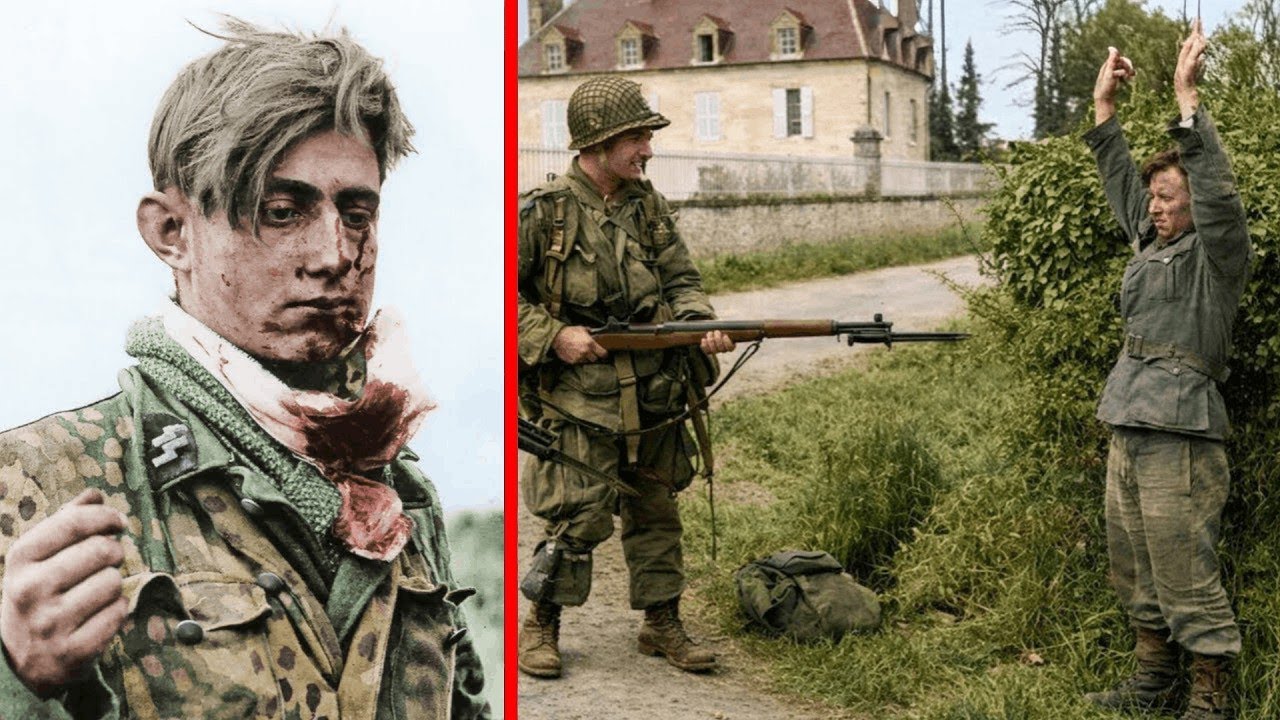
The soldiers had already surrendered.
Their weapons were gone. Their uniforms were covered in dust. Their hands were raised.
By the rules of war, they were prisoners.
But when American troops entered the concentration camp at Dachau in April 1945, they did not see ordinary prisoners of war.
They saw thousands of bodies stacked behind the walls.
They saw starvation, disease, and evidence of systematic murder.
And in the chaos of that moment, some captured SS personnel were shot.
For decades, people have asked the same question:
Why?
Why would soldiers who had surrendered be killed?
The answer is not a simple one. It is a story about war, revenge, justice, anger, and the moment when ordinary soldiers were forced to confront one of the darkest crimes in human history.
Because what happened at Dachau was not just a battlefield encounter.
It was a moment when the world discovered the full horror of what Nazi Germany had built.
When American forces approached Dachau on April 29, 1945, they were nearing the end of a brutal campaign across Europe.
For years, Allied soldiers had heard rumors about Nazi concentration camps.
They had heard stories from refugees.
They had seen photographs.
But many still struggled to understand the scale of what was happening.
Dachau changed that.
The camp, located near Munich, Germany, had been opened in 1933 and became one of the first and most infamous Nazi concentration camps.
Over 12 years, more than 200,000 prisoners passed through the Dachau system.
Many were political prisoners, Jews, resistance fighters, prisoners of war, and people targeted by the Nazi regime.
Thousands died from executions, starvation, forced labor, medical experiments, and brutal living conditions.
By the time American troops arrived, the camp was collapsing under the weight of its own crimes.
Inside the gates were prisoners barely alive.
Outside were trains filled with the dead.
The soldiers who entered Dachau were not prepared for what they saw.
The first American troops approaching the camp expected resistance.
They were entering enemy territory.
SS guards still controlled parts of the camp.
The SS, Hitler’s elite security organization, had been deeply involved in running concentration camps and carrying out Nazi racial policies.
Many of the guards were armed.
Some attempted to surrender.
Others tried to escape.
But then the American soldiers discovered something that changed the atmosphere instantly.
They found a train near the camp filled with hundreds of dead prisoners.
Many had died during a forced evacuation transport from another camp.
The bodies were visible.
The smell was overwhelming.
The evidence of mass death was impossible to ignore.
The soldiers who had spent years fighting the German army suddenly found themselves standing inside a place created specifically for human suffering.
The enemy was no longer just a uniform.
It was a system.
In the confusion following liberation, several SS guards were killed after surrendering.
Some were shot by American troops.
Others were killed during moments of anger and revenge.
The events were chaotic, and different accounts describe different circumstances.
Some soldiers believed they were confronting men directly responsible for the atrocities in front of them.
Some prisoners who had survived years of abuse also attacked former guards.
The normal emotional distance of combat disappeared.
A soldier on a battlefield usually sees an enemy trying to kill him.
At Dachau, soldiers saw something different.
They saw victims who had been deliberately starved.
They saw prisoners who weighed little more than children.
They saw evidence that people had been tortured and murdered simply because of who they were.
For some, the line between justice and revenge became dangerously blurred.
But here is the part many people miss.
Not every SS guard was immediately killed.
Many were captured, interrogated, and later investigated.
The Allied forces understood that crimes of this scale required evidence and trials.
They needed names.
They needed documents.
They needed testimony.
They needed the world to understand what had happened.
The Nuremberg Trials and other postwar trials were built around that principle:
The crimes of the Nazi regime had to be exposed publicly.
The guilty had to be identified.
The victims had to be heard.
Justice had to be recorded.
Because simply killing everyone responsible would have hidden the truth.
One of the most powerful moments after liberation came not from a battlefield.
It came from a realization.
Some captured SS men, who had spent years believing they were untouchable, suddenly understood that the world had changed.
For years, they had operated behind fences, uniforms, and orders.
They had believed the Nazi system would protect them forever.
Then the gates opened.
The prisoners were no longer powerless.
The cameras arrived.
The investigators arrived.
The witnesses arrived.
The same world they had tried to hide from was now looking directly at them.
Accounts from the period describe captured SS personnel facing the reality that their actions would no longer remain hidden.
The uniforms that once represented authority became evidence.
The symbols of power became symbols of guilt.
The uncomfortable truth about war is that it often creates moments where human emotions collide with human principles.
The shooting of some captured SS personnel at Dachau was not a simple story of heroes and villains.
It was a tragic example of what can happen when soldiers encounter unimaginable crimes and respond in the immediate aftermath.
But understanding why it happened does not mean excusing every action.
The laws of war exist precisely because emotions run highest during the darkest moments.
They exist because even against the worst criminals, societies must decide what kind of justice they believe in.
The difference between justice and revenge is one of the hardest lessons history teaches.
Years later, survivors returned to Dachau.
They walked through the gates that once represented fear.
They stood where their families, friends, and fellow prisoners had suffered.
They told their stories.
Many of them did not want revenge.
They wanted remembrance.
They wanted the world to understand what happened so it could never happen again.
The reason captured SS soldiers were sometimes shot was not because the rules of war had disappeared.
It was because soldiers had walked into a place where humanity itself had been violated.
They saw something so terrible that it changed them forever.
But the final lesson of Dachau was not about revenge.
It was about memory.
Because the greatest defeat of those who built the camps was not only losing the war.
It was that the truth survived.
The gates opened.
The world saw.
And history remembered.

