
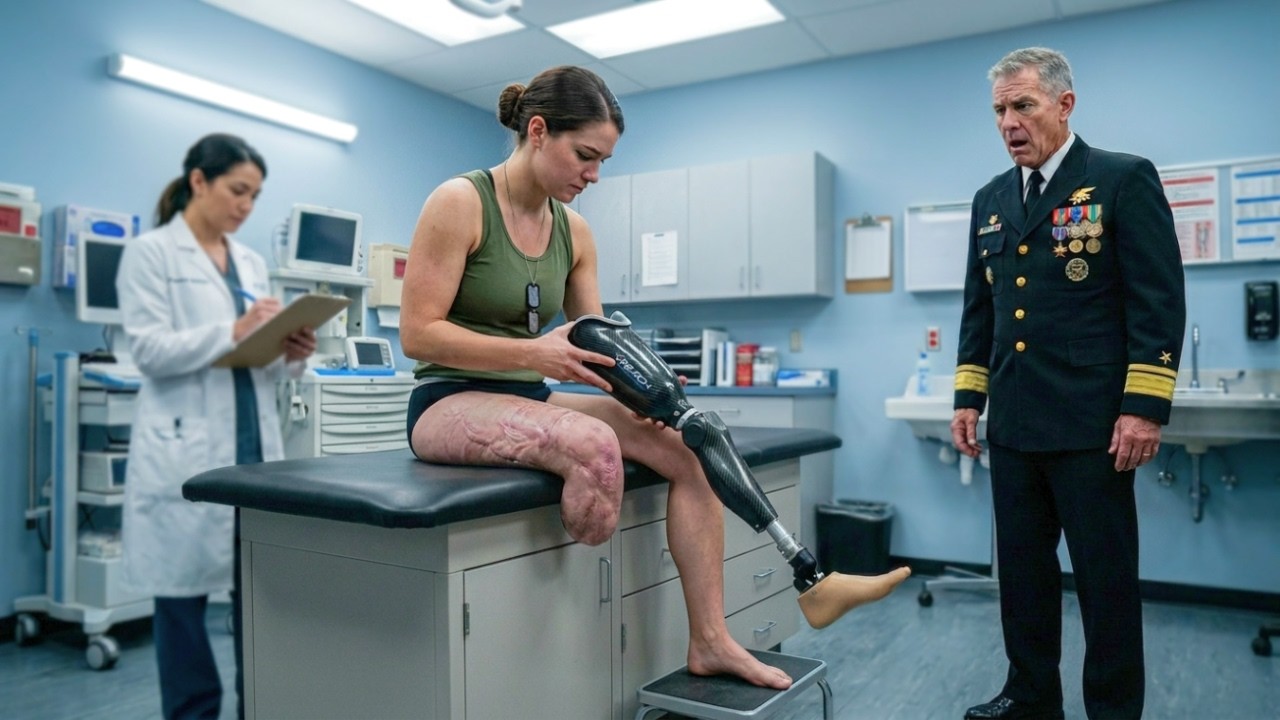
Sloane Merritt was lying in the dirt when the evacuation helicopter finally appeared over Helmand.
The afternoon sun turned the Afghan desert white. Dust rolled across the ground in thick sheets, coating the blood on her uniform until it looked almost black.
Her left leg ended beneath a field dressing she had tied herself.
Yet when she spoke into the radio, her voice was calm.
“Callaway, move Holt first. Keep pressure under the plate carrier. Do not lift his head.”
A young corpsman crouched beside her, staring at the tourniquet above her knee.
“Sergeant Merritt, you’re coming with us.”
“That wasn’t a suggestion.”
Another burst of gunfire cracked from the ridge. The helicopter descended lower, its rotors throwing sand into every open wound.
Callaway hesitated.
Sloane looked directly at him.
“Raymond Holt has four minutes before his airway closes. I have twenty before this tourniquet becomes your problem. Move.”
She said it the way someone might read a weather report.
No panic. No trembling. No request for help.
Callaway and two operators lifted Holt onto the litter and ran toward the helicopter. Sloane stayed behind, one hand on the radio and the other resting beside a small surgical pouch.
When the helicopter returned for her, she was still awake.
She lay beneath the bright, empty sky with both hands free, as though freeing those hands had been the objective all along.
Fifteen years later, retired Rear Admiral Raymond Holt opened an unmarked envelope in his Virginia home.
Inside were four items.
A damaged memory card.
A photocopy of a battlefield casualty card.
A photograph of Sloane Merritt before the deployment, standing on two legs beside a medical transport vehicle.
And a handwritten note.
You were told the explosion took her leg. It didn’t.
Holt read the sentence three times.
Then he locked the door to his study and began uncovering the story of the woman who had saved his life.
Sloane Merritt grew up outside Billings, Montana, at the end of a dirt road where winter could freeze the pipes before sunrise and summer winds could pull shingles from a roof.
Her father, Gunnery Sergeant Dale Merritt, had served twenty-two years in the Marine Corps.
He was not an affectionate man in the way television fathers were affectionate. He rarely said he was proud. He never gave long speeches.
Instead, he taught Sloane how to change a tire before she was tall enough to see over the hood.
He taught her how to stop bleeding with a torn shirt.
He taught her to listen when everyone else was shouting.
“When things go wrong,” he once told her, “fear will try to take your hands away from you. Don’t let it.”
Sloane remembered that sentence.
She remembered it when her mother died after a fast-moving illness.
She remembered it when her father sat alone at the kitchen table, unable to touch the cup of coffee in front of him.
And she remembered it when, at nineteen, she signed the papers to become an Army medic.
Sloane was never the loudest person in a room. She did not collect stories about herself or interrupt conversations to mention where she had served.
During training, instructors initially mistook her quietness for hesitation.
That misunderstanding usually lasted until the first emergency drill.
While others rushed, Sloane assessed.
While others shouted for equipment, she had already opened it.
She could place an IV inside a moving vehicle, recognize internal bleeding from the way a casualty breathed, and remember every medication administered without looking at her notes.
By 2009, Staff Sergeant Sloane Merritt had treated injuries most people could not look at.
She had also developed a reputation for refusing to be intimidated by rank.
That was how she first came into conflict with Colonel Adrian Voss.
Voss was the operations officer responsible for coordinating a joint mission in Helmand Province. He was polished, politically connected and known for delivering results quickly.
He also disliked being challenged.
The night before the mission, Sloane attended the route briefing with the medical team. Intelligence officers had identified signs of recent insurgent activity near a dry riverbed the convoy was expected to cross.
A local interpreter had warned them that farmers were avoiding the road.
Sloane pointed to the map.
“We should use the western route.”
Voss barely looked at her.
“The western route adds forty minutes.”
“It also has higher ground and fewer places to conceal pressure plates.”
Voss leaned back in his chair.
“Staff Sergeant, your responsibility begins after someone is injured.”
The room became quiet.
Sloane did not raise her voice.
“My responsibility begins before that.”
Several people looked down at the table.
Voss closed the folder in front of him.
“The route has been approved.”
At the far end of the room, Lieutenant Commander Raymond Holt watched the exchange.
Holt led the special operations element attached to the mission. He was respected for staying close to his men and for never asking them to enter a place he would not enter first.
But he was also under pressure.
The mission involved recovering intelligence from a compound believed to contain information about planned attacks on coalition forces. Command wanted speed, and Voss had promised it.
Holt studied the map one more time.
Then he accepted the approved route.
At 6:40 the next morning, the convoy entered the riverbed.
At 6:47, the first vehicle passed a broken stone wall.
At 6:48, the ground exploded beneath them.
The blast lifted the armored vehicle and dropped it onto its side.
The second explosion came before the dust from the first had settled.
Gunfire followed from the ridge.
Sloane woke with her face pressed against metal.
For several seconds, she heard nothing but a high ringing sound. Then the world returned all at once—shouting, bullets striking the vehicle, someone calling for a medic.
She tried to move.
Her left leg was trapped beneath a twisted section of the vehicle frame.
Across the riverbed, Holt had been thrown behind a low wall. A piece of metal had entered beneath his arm, where his body armor offered little protection.
Callaway reached him first.
“Holt’s hit!”
Sloane pulled against the wreckage.
Her leg did not move.
“Tell me where.”
“Right side. Heavy bleeding. Breathing’s getting worse.”
Sloane gave Callaway instructions while examining herself.
The lower half of her leg had been crushed. The frame pinned it so tightly that she could not feel her foot.
She tried to shift the metal with both hands.
It did not move.
Callaway shouted again.
“Holt’s fading!”
Sloane looked toward the ridge. Their gunners were returning fire, but the team was exposed. The helicopter could not land until the immediate threat was reduced.
She looked at her watch.
Then at Holt.
Then at her leg.
She opened her medical pouch.
No one saw exactly what she did from inside the dust.
What they heard was Sloane giving instructions between controlled breaths.
“Callaway, place your hand beneath the wound.”
A pause.
“Not over it. Beneath it.”
Another pause.
“When I reach you, we’re going to turn him.”
Callaway looked across the dirt.
Sloane was still trapped.
“How are you going to reach us?”
She did not answer.
Minutes later, Sloane crawled out from behind the damaged vehicle.
She left part of her leg beneath it.
The explosion had crushed the bone and destroyed most of the tissue, but it had not fully severed the limb. With no machinery capable of lifting the vehicle and Holt bleeding to death less than thirty yards away, Sloane had placed a tourniquet as high as she could.
Then she used the instruments in her surgical pouch to cut herself free.
She crawled through the sand under fire.
Callaway saw her coming and froze.
“Don’t look at me,” she said. “Look at him.”
She reached Holt, sealed the wound beneath his arm and inserted a needle into his chest to relieve the pressure building around his lung.
Holt gasped.
Sloane held his airway open while Callaway secured the dressing.
When the first helicopter arrived, she ordered them to take Holt.
There was room for one critical casualty.
Everyone believed that casualty should have been Sloane.
She refused.
Holt was unconscious before they loaded him. He never saw her in the dirt. He never saw the trail she had left between the wrecked vehicle and the wall.
He woke days later in a military hospital.
Colonel Voss was standing beside his bed.
Voss told him the mission had been compromised by an unusually large explosive device. He said Sloane Merritt had lost her leg in the initial blast but continued providing medical instructions despite her injuries.
Holt asked who had treated him.
“Callaway reached you first,” Voss said. “Merritt assisted over the radio.”
It was not entirely false.
That was what made the lie survive.
The official report described Sloane’s amputation as “blast-related traumatic limb loss.” It praised the entire medical team without explaining what she had done.
Callaway protested.
Voss called him into a private office.
“The route decision is under review,” Voss said. “If this report turns into an investigation, the mission will be examined from every angle. Careers will end. Units will be pulled. Families of the men we lost will spend years hearing that their sons died because someone chose the wrong road.”
“The report is wrong.”
“The report protects the mission.”
“It erases her.”
Voss stared at him.
“She is alive. She will receive medical care for the rest of her life. Do you think she wants to be dragged through hearings and turned into a symbol?”
Callaway did not know what Sloane wanted.
When he asked her, she was lying in a hospital bed after her third surgery.
She listened without interrupting.
Then she asked one question.
“Did Holt survive?”
“Yes.”
“And the others?”
“Everyone we evacuated made it.”
Sloane looked toward the window.
“Then don’t make them relive it for me.”
Callaway mistook her exhaustion for permission.
Voss treated it as silence he could use.
Over the next decade, Adrian Voss rose through military contracting circles. He became a paid leadership speaker and later joined the board of a national veterans’ foundation.
At conferences, he spoke about responsibility.
At fundraising dinners, he told carefully edited stories about sacrifice.
Sloane never attended those events.
After rehabilitation, she returned to Montana with a prosthetic leg and a box containing the uniform she had worn in Helmand.
She could have left medicine.
Instead, she earned an advanced degree in trauma care and began working with wounded veterans learning to live with limb loss.
She taught them how to fall without injuring themselves.
She showed them how to adjust a socket when heat caused swelling.
When they became angry, she did not tell them to be grateful.
She sat beside them until the anger passed.
Most of her patients did not know how she had lost her leg.
When they asked, she said, “It happened during an evacuation.”
That was all.
Raymond Holt saw her name only once during those years.
It appeared in a medical summary attached to his file.
He sent her a letter thanking her for staying on the radio after she was wounded.
She replied with two sentences.
I’m glad you made it home. Take care of the people who helped you get there.
Holt framed the letter.
He never understood why reading it made him feel as though he had missed something.
Fifteen years after Helmand, Callaway died from cancer.
While sorting his belongings, his wife found a sealed package addressed to Raymond Holt. Inside was the original casualty card Callaway had completed in the helicopter.
Voss had ordered it replaced.
The original contained one line that did not appear in the official file:
Patient Merritt performed self-amputation to access and stabilize priority casualty Holt.
Callaway had also kept a damaged memory card from a helmet camera.
Most of the footage was corrupted.
But the audio survived.
Holt sat alone in his study and listened.
He heard the explosions.
He heard Callaway shouting.
He heard Sloane’s voice giving instructions.
Then he heard Callaway ask how she planned to reach them.
There was a silence lasting eleven seconds.
After that came a sound Holt could not identify, followed by Sloane breathing through clenched teeth.
Then her voice returned.
“Don’t look at me. Look at him.”
Holt removed his glasses.
For several minutes, he did not move.
He looked down at his right side, where a long scar ran beneath his arm.
His survival had been explained to him as a combination of training, fast evacuation and luck.
Now he understood that his life had been purchased by a decision another person made in the dirt.
And the institution he had trusted had reduced that decision to a line about radio assistance.
Three weeks later, the National Veterans Leadership Foundation held its annual gala in Washington, D.C.
Adrian Voss was scheduled to receive an award for lifetime service.
Sloane Merritt had also been invited, though she had declined twice. Holt personally called her and asked her to attend as his guest.
She agreed only after he said Callaway’s name.
Voss was halfway through his acceptance speech when Holt walked onto the stage.
The audience recognized him immediately. Hundreds of conversations stopped.
Voss smiled, assuming Holt had come to congratulate him.
Holt took the microphone.
“Before this award is presented, I need Colonel Voss to answer one question.”
Voss’s smile tightened.
Holt held up the copied casualty card.
“Why was the original medical record from the Helmand evacuation replaced?”
The ballroom went silent.
Voss glanced toward Sloane.
For the first time that evening, he noticed her prosthetic leg beneath the table.
“This is neither the time nor the place,” he said.
“It became the place when you accepted an award for leadership.”
Voss’s jaw stiffened.
“The records from that mission were reviewed through appropriate channels.”
Holt turned toward the audio technician.
The recording began.
Gunfire filled the ballroom speakers.
Guests heard Callaway calling for help. They heard Sloane directing him. They heard the question.
How are you going to reach us?
Then came the silence.
The controlled breathing.
And the sentence that had remained buried for fifteen years.
Don’t look at me. Look at him.
A photograph appeared on the screen behind the stage.
It showed the wreckage after the fight.
Beneath the vehicle frame was Sloane’s boot.
Still attached to what she had left behind.
Voss’s face changed.
The color drained from his cheeks. His mouth opened, but no words came out.
He looked toward the foundation’s board members, then toward the cameras at the back of the room.
No one moved to help him.
Sloane sat perfectly still.
Holt faced the audience.
“The blast crushed Sergeant Merritt’s leg. It did not take it from her. She took it herself because I was bleeding to death, and she could not reach me while she was pinned.”
A woman near the front covered her mouth.
Several veterans lowered their heads.
Voss attempted to step away from the microphone.
Holt stopped him with one final question.
“You spent fifteen years telling people leadership means accepting responsibility. Are you prepared to demonstrate it now?”
Voss looked at Sloane.
She did not glare at him. She did not smile.
She simply waited.
That was the moment he understood that the room no longer belonged to him.
His shoulders dropped.
His eyes shifted toward the floor.
And the man who had built a career speaking about courage could not produce a single sentence in his own defense.
The foundation suspended Voss from its board that night. The award was withdrawn before it ever reached his hands.
A formal review later confirmed that he had ordered medical documentation changed and had failed to preserve evidence related to the route decision.
He lost his advisory positions and was publicly removed from two veterans’ organizations.
The military corrected Sloane’s record.
At a ceremony in Montana, Raymond Holt stood beside her as she received a long-delayed decoration for valor.
The room was filled with medics, amputees and families of service members she had treated after returning home.
When the citation was read, Sloane looked uncomfortable.
She had never wanted a stage.
Afterward, Holt approached her carrying the letter she had written him years earlier.
“You told me to take care of the people who helped me get home,” he said.
“I should have known you were talking about yourself.”
Sloane shook her head.
“I was talking about Callaway.”
Holt looked at the medal on her uniform.
“Why didn’t you tell me?”
She glanced down at her prosthetic leg, then toward the veterans waiting to speak with her.
“Because you were alive,” she said. “I thought that was the part that mattered.”
Holt’s eyes filled, but Sloane spared him the embarrassment of acknowledging it.
She reached out and straightened the edge of his jacket, the same practical gesture a medic might make before sending someone back to their unit.
Then she walked toward the people waiting for her.
Not because the story was finally about her.
Because someone in that line still needed help.
The people who save us are not always the ones standing in front of the cameras—sometimes they are the ones who walk away with less of themselves so the rest of us can come home whole.


