
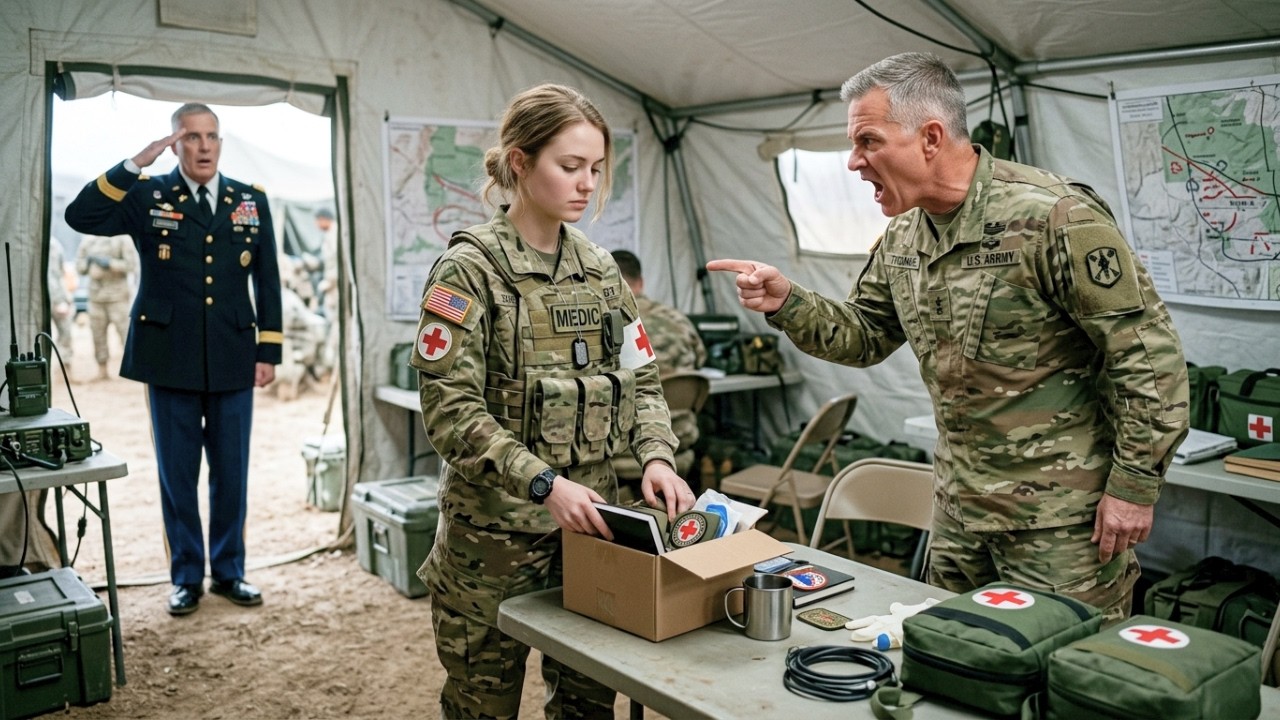
At 9:17 on a Monday morning, Daniel Mercer fired the quietest woman in the building.
He did it in front of twelve employees, two visiting executives, and a row of patients waiting for their appointments.
“You have no degree, no civilian medical license, and no skills this company can officially recognize,” he said, sliding a termination letter across the reception counter. “Frankly, I don’t understand how you were hired in the first place.”
The woman standing across from him did not argue.
She looked at the paper, read every line, then folded it once.
Her name was Elena “Lena” Ortiz.
She was thirty-four years old, wore plain black shoes, and rarely spoke about her past. Most people at Valor Recovery Center knew only that she had served in the military and had worked as an emergency medical technician overseas.
They did not know where.
They did not know what she had seen.
And they certainly did not know that the commander arriving for an inspection that afternoon would recognize her before she recognized him.
Lena had been hired six months earlier as a patient support coordinator at Valor Recovery Center, a rehabilitation clinic for injured veterans in Virginia.
The job was mostly administrative.
She checked patients in, coordinated transport, updated records, and helped nurses prepare treatment rooms. The salary was modest, but Lena liked the work because the patients reminded her of people she once served beside.
She was never the loudest person in the room.
When someone thanked her, she usually said, “That’s what I’m here for.”
When someone asked about the military, she smiled politely and changed the subject.
Within weeks, patients began asking for her by name.
A former infantryman with a traumatic brain injury trusted only Lena to explain his schedule. An elderly Vietnam veteran who became anxious in crowded waiting rooms would sit near her desk because she noticed his breathing before anyone else did.
Once, when a patient collapsed near the elevator, Lena was beside him before the nurses heard the alarm.
She checked his airway, positioned him safely, and gave the responding team a calm, precise report.
Blood pressure falling.
Pulse irregular.
Possible internal bleeding.
The emergency physician later said her observations probably saved them ten critical minutes.
Daniel Mercer did not thank her.
He called her into his office.
“You are not authorized to perform clinical assessments,” he said.
“I didn’t perform one,” Lena replied. “I kept him stable and told the nurses what I observed.”
“That distinction might make sense to you,” Daniel said, “but it won’t make sense to an attorney.”
Daniel had become regional operations director three months earlier.
He was polished, ambitious, and skilled at making every meeting sound more important than it was. He wore tailored suits inside a rehabilitation clinic and spoke often about standards, liability, and executive expectations.
He also disliked employees he could not categorize.
Lena’s military experience bothered him because it was not written in language he understood.
Her résumé listed eight years as a combat medic, multiple deployments, advanced trauma training, and an honorable discharge. But her state EMT certification had expired while she was caring for her mother during cancer treatment.
To Daniel, an expired certification meant she had become irrelevant.
To the patients, she was the person who remembered which prosthetic socket caused pain and which veteran needed the door left open during treatment.
The conflict began after Daniel ordered staff to reduce appointment times.
Valor Recovery Center had fallen behind its quarterly targets. Daniel decided each patient visit should be shortened by twelve minutes.
The clinicians objected.
Several patients had complex injuries. Some needed additional time transferring from wheelchairs. Others struggled with memory, speech, or anxiety.
Daniel called those concerns “resistance to efficiency.”
Lena said nothing during the meeting.
But after the new schedule began, she quietly adjusted transportation windows so patients were not stranded outside. She prepared forms in advance and called caregivers before appointments to prevent delays.
Her system worked.
Patients moved through the clinic more smoothly without losing treatment time.
Instead of asking how she had done it, Daniel accused her of changing operations without permission.
“You keep stepping outside your position,” he told her.
“I was trying to make your schedule possible,” Lena said.
“My schedule was already possible.”
“Not safely.”
The room went still.
Daniel leaned back in his chair.
“Be careful, Ms. Ortiz.”
Lena held his gaze for a moment, then nodded.
“Yes, sir.”
After that, he began documenting everything she did.
If she stayed late to help a patient find transportation, he wrote that she had worked unauthorized overtime.
If she corrected an error in a veteran’s emergency contact information, he accused her of accessing restricted files.
If a patient praised her, Daniel reminded the staff that popularity was not a professional qualification.
Then came the incident with Thomas Redding.
Thomas was twenty-seven and had lost part of his right leg during an overseas deployment. He had been attending rehabilitation for four months.
During a group session, his face suddenly turned pale.
His hands began trembling.
A therapist assumed he was having a panic attack and told him to breathe slowly.
Lena was passing the room when she saw him.
She noticed the sweat on his forehead, the gray color around his lips, and the way he kept pressing his palm against his lower abdomen.
She asked one question.
“Thomas, when did you last take your blood thinner?”
He tried to answer but could not finish the sentence.
Lena called emergency services immediately.
Daniel arrived while she was lowering Thomas carefully to the floor.
“What are you doing?” he demanded.
“He may be bleeding internally.”
“You cannot diagnose patients.”
“I’m not diagnosing him. I’m telling you he needs a hospital.”
Daniel ordered her to step away.
She did not move until the paramedics arrived.
At the hospital, doctors found internal bleeding caused by a medication complication. Thomas required emergency treatment.
His mother later called the clinic crying.
She said the hospital had told her that waiting another hour could have killed him.
Daniel listened to the voicemail, deleted it from the shared inbox, and summoned Lena the next morning.
“You directly disobeyed me in front of staff,” he said.
“A patient was in danger.”
“You created panic.”
“He was bleeding.”
“You didn’t know that.”
“I knew enough not to gamble with his life.”
Daniel’s jaw tightened.
He placed a disciplinary form on the desk.
“Sign it.”
Lena read the statement. It claimed she had acted recklessly, exceeded her authority, and disrupted patient care.
She pushed it back.
“That isn’t what happened.”
“Are you refusing to sign?”
“I’m refusing to confirm something false.”
Daniel smiled, but there was no warmth in it.
“Then perhaps we should review whether you belong here at all.”
The following week, he scheduled an all-staff compliance meeting.
He chose Monday morning because senior executives were expected to visit the center later that day. He wanted the clinic to appear disciplined and under control.
Lena arrived at 7:30, as usual.
She helped a patient whose transport van had left him at the wrong entrance. She found a missing referral form. She made coffee for a nurse who had been called in early.
At 9:10, Daniel asked everyone to gather near reception.
He began with a speech about standards.
“A caring personality is not a substitute for credentials,” he said. “Good intentions do not replace professional qualifications.”
Several employees glanced at Lena.
She remained still.
Daniel then announced that the company had completed a review of her record.
He said her military training was outdated, her certification had expired, and her behavior created unacceptable liability.
Then he placed the termination letter in front of her.
“You have no skills this company can officially recognize.”
The sentence landed harder than the firing itself.
One of the nurses looked down.
Thomas Redding, seated in the waiting area for a follow-up appointment, gripped the arm of his chair.
“You’re firing the woman who saved my life?” he asked.
Daniel turned toward him.
“Mr. Redding, this is an internal personnel matter.”
“She knew I was dying before any of you did.”
“That is not an accurate characterization.”
Thomas tried to stand, but Lena raised one hand gently.
“It’s all right,” she said.
It was not all right.
Everyone knew it.
But Lena did not beg, threaten, or list the things she had done.
She removed her identification badge and placed it beside the letter.
Then she walked toward the staff room to collect her bag.
That was when three black vehicles stopped outside the clinic.
The employees near the windows straightened immediately.
The company’s founder and board chairman had arrived.
Retired Major General Marcus Hale had built Valor Recovery after leaving military service. His public biography described him as a decorated officer who had survived severe injuries during a deployment almost fourteen years earlier.
Daniel had been preparing for Hale’s visit for weeks.
He rushed toward the entrance, adjusting his jacket.
“General Hale,” he said as the door opened. “It’s an honor to welcome you. We’ve made significant improvements to operational discipline.”
Hale entered with two board members and his chief of staff.
He was sixty-one, broad-shouldered, and walked with a slight stiffness in his left leg. A pale scar disappeared beneath his collar.
Daniel began introducing the leadership team.
Hale was only half listening.
His eyes had moved past Daniel toward the hallway.
Lena was walking out of the staff room with a canvas bag over her shoulder.
She stopped when she saw the visitors blocking the exit.
For two seconds, neither she nor Hale moved.
Then Hale’s face changed.
The formal expression disappeared.
His mouth opened slightly, and his eyes fixed on her as though the building around them had vanished.
“Ortiz?”
Lena stared at him.
“Sir?”
Hale took one step forward.
Then another.
“You’re alive.”
The entire reception area fell silent.
Daniel looked between them.
“General, you know Ms. Ortiz?”
Hale did not answer him.
He stood in front of Lena, studying her face.
“You disappeared after Landstuhl,” he said. “I tried to find you.”
“My mother got sick,” Lena replied. “I left the service after my last deployment.”
Hale’s voice dropped.
“I never got to thank you.”
Daniel gave a nervous laugh.
“There may be some confusion. Ms. Ortiz worked here in a nonclinical support position.”
Hale slowly turned toward him.
“Confusion?”
Daniel gestured toward the termination letter.
“We discovered she lacks the civilian qualifications required to make medical decisions. There have been multiple incidents of her overstepping her role.”
Hale looked down at the paper on the counter.
He picked it up and read the first page.
No one spoke.
As he read, the muscles in his jaw tightened.
Then he placed the letter back on the counter.
“Do you know why I walk with a limp, Mr. Mercer?”
Daniel swallowed.
“I understand you were injured during service.”
“Our convoy was hit outside Kandahar. The first blast overturned the lead vehicle. The second tore through mine.”
Hale pointed toward the scar beneath his collar.
“I had shrapnel in my neck and chest. My airway was closing, and our evacuation point was under fire.”
His eyes returned to Lena.
“She crawled through burning fuel to reach me.”
No one moved.
“She opened my airway with equipment from a damaged medical kit. Then she kept pressure on an arterial wound for forty-three minutes while rounds were hitting the wall behind her.”
Lena looked at the floor.
Hale continued.
“That was the first time she saved my life.”
Daniel’s face had lost its color.
“The first time?” one of the nurses whispered.
Hale nodded.
“Six months later, during a field briefing, I collapsed. The medical officer thought it was exhaustion. Ortiz noticed one side of my chest wasn’t moving correctly.”
He touched his ribs.
“She identified a delayed complication from the blast injury. She forced the team to evacuate me after a senior surgeon told her to wait.”
Hale paused.
“The hospital said another thirty minutes would have killed me.”
Thomas Redding stared at Daniel.
Several staff members did the same.
Daniel opened his mouth, but no words came out.
The confidence drained from his posture. His shoulders lowered, and his eyes moved toward the termination letter as if he were seeing it for the first time.
Hale stepped closer to him.
“You fired her for having no skills?”
Daniel’s lips moved.
“We have regulatory requirements. I was protecting the organization.”
“No,” Hale said. “You were protecting your authority.”
The words were quiet, but they carried across the entire room.
Daniel glanced toward the visiting board members.
One of them had already opened a tablet.
Hale asked the head nurse to bring Thomas Redding’s incident report.
The nurse hesitated.
“There isn’t one,” she said.
Daniel turned sharply.
She continued.
“Mr. Mercer instructed us to document it as an anxiety episode that required precautionary transport.”
Thomas’s mother had forwarded the hospital records to the clinic two days earlier.
They showed severe internal bleeding.
They also included a written statement from the emergency physician crediting Lena’s rapid response.
Hale’s chief of staff requested access to Daniel’s recent disciplinary files.
Within an hour, they found altered reports, deleted patient feedback, and multiple complaints from clinical employees that had never reached headquarters.
Daniel had not been enforcing standards.
He had been removing anything that challenged him.
By noon, he was no longer regional operations director.
He was escorted from the building carrying the same cardboard file box he had instructed staff to prepare for Lena.
As he passed reception, Thomas Redding did not say a word.
He simply looked at Daniel.
That silence seemed to weigh more than anger.
Lena was asked to remain.
Hale offered to restore her position immediately, with back pay and a formal apology.
She thanked him, but she did not accept right away.
“I don’t want a job because I saved you,” she said.
“You wouldn’t be getting one because you saved me.”
“Then why?”
“Because you saved Thomas while everyone else was afraid of a job title.”
The company launched an independent review of its patient safety procedures.
Several managers were retrained. A protected reporting system was created so employees could raise clinical concerns without going through local directors.
Lena’s expired certification was not ignored or magically erased.
Valor Recovery paid for her recertification and created a supervised pathway for former military medics whose battlefield experience did not translate cleanly into civilian paperwork.
Three months later, Lena returned as the center’s first Veteran Medical Transition Coordinator.
Her job was to help other former medics convert military training into recognized civilian credentials.
On her first day in the new role, she found a small envelope on her desk.
Inside was a handwritten note from Thomas.
It read:
“You knew what you were looking at when nobody else did. Thank you for refusing to step away.”
Lena placed the note in her desk drawer.
She never framed her medals.
She never displayed photographs from the war.
But she kept that note.
Because Daniel Mercer had made the same mistake many powerful people make.
He believed that if experience did not come with the right title, the right language, or the right piece of paper, then it had no value.
He looked at a quiet woman behind a reception desk and saw someone beneath him.
General Hale looked at the same woman and saw the reason he had lived long enough to build the company.
Never mistake someone’s silence for emptiness.
Sometimes the person being dismissed as “unqualified” is the only person in the room who knows exactly how to save a life.