Chapter 1 — The Gates That Hid the Truth
Dachau, Germany
April 29, 1945
The gate stood silently.
For twelve years, it had been a symbol of fear.
A simple metal structure.
A few words written above it.
“Arbeit Macht Frei.”
Work sets you free.
A lie made of iron.
A sentence designed to disguise suffering behind false promises.
For years, prisoners had walked beneath those words carrying everything they had left.
Their belongings.
Their memories.
Their names.
Many would never walk out.
On the morning of April 29, 1945, American soldiers approached Dachau.
They had fought across Europe.
They had seen destroyed villages.
Burned cities.
Dead soldiers lying in fields.
They believed they had already witnessed the worst of war.
They were wrong.
The men of the U.S. 45th Infantry Division moved cautiously toward the camp.
The war was almost over.
German forces were collapsing.
The Nazi empire that had once seemed unstoppable was falling apart.
But inside Dachau, something else remained.
A secret.
A crime scene hidden behind walls.
A young American soldier, Thomas Walker, stepped out of the vehicle.
He was twenty-four years old.
Before the war, he had been a factory worker from Ohio.
He knew machines.
He knew ordinary life.
He did not know how to react to what waited ahead.
The air smelled strange.
Not like a battlefield.
Not like gunpowder.
Something heavier.
Something he could not identify.
The soldiers expected resistance.
They expected German troops.
They expected a final battle.
Instead, they found silence.
Too much silence.
The Camp Built as a Model of Terror
Dachau had been established in March 1933, shortly after Adolf Hitler came to power.
It was the first regular concentration camp created by Nazi Germany.
At first, it was intended mainly for political prisoners.
Communists.
Social democrats.
Trade unionists.
Anyone considered an enemy of the new regime.
But Dachau became something much larger.
A model.
A blueprint.
A system.
The methods developed there influenced the expansion of the Nazi concentration camp network.
The SS studied control.
Punishment.
Forced labor.
Psychological destruction.
Dachau became a place where the regime tested how far human beings could be pushed.
Over the years, thousands of prisoners from many groups passed through its gates.
Political opponents.
Jews.
Roma and Sinti.
Jehovah’s Witnesses.
Homosexual prisoners.
Religious opponents.
Prisoners of war.
People who had been declared unwanted by a government obsessed with racial ideology and absolute control.
Behind the walls, the SS created a world where prisoners lost almost everything.
Their clothing.
Their possessions.
Their freedom.
Their identity.
They became numbers.
The SS System Inside Dachau
The camp was controlled by the SS.
The Schutzstaffel.
A Nazi organization that became central to terror throughout occupied Europe.
Its members were responsible for many of the regime’s most brutal crimes.
But history is not only about organizations.
It is also about individuals.
The guards who gave orders.
The officers who signed documents.
The men and women who chose to participate.
Dachau had its own command structure.
At the top stood camp commanders.
Below them were officers, guards, and administrators.
Some claimed after the war that they were only following orders.
But survivors remembered something different.
They remembered choices.
A guard who decided to beat someone.
An officer who decided punishment was necessary.
A person who chose cruelty when they could have chosen restraint.
The Last Winter
By 1945, Dachau was collapsing.
The Nazi regime was losing the war.
But instead of releasing prisoners, the SS continued transporting thousands into the camp system.
Evacuation trains and death marches brought exhausted prisoners from other camps as Allied forces advanced.
The result was catastrophe.
The camp became overcrowded.
Food supplies disappeared.
Disease spread.
Thousands of prisoners became trapped in conditions that were impossible to survive.
Typhus outbreaks devastated the population.
Bodies accumulated.
The SS system was falling apart, but the suffering continued.
Inside the camp, prisoners watched the war approaching.
They knew something was changing.
They heard distant artillery.
They saw confusion among guards.
For the first time in years, the SS looked uncertain.
The men who had controlled every movement were beginning to lose control.
One prisoner later remembered the strange feeling.
Hope.
But also fear.
Because prisoners had learned that liberation was not guaranteed.
The Nazis had killed witnesses before.
Everyone understood:
The final days could be the most dangerous.
The Train of Death
Near Dachau, American soldiers discovered something that would remain burned into their memories.
Railway cars.
Inside were bodies.
Hundreds of prisoners who had died during transport.
The doors opened.
The soldiers looked inside.
And the battlefield they knew suddenly seemed small compared to this.
A soldier stepped backward.
He had seen combat.
He had seen death.
But this was different.
These people had not died fighting.
They had been abandoned.
Starved.
Transported like objects.
The discovery changed the mood among the troops.
The enemy was no longer just an army.
The enemy was a system.
A system that had turned murder into administration.
The Gates Open
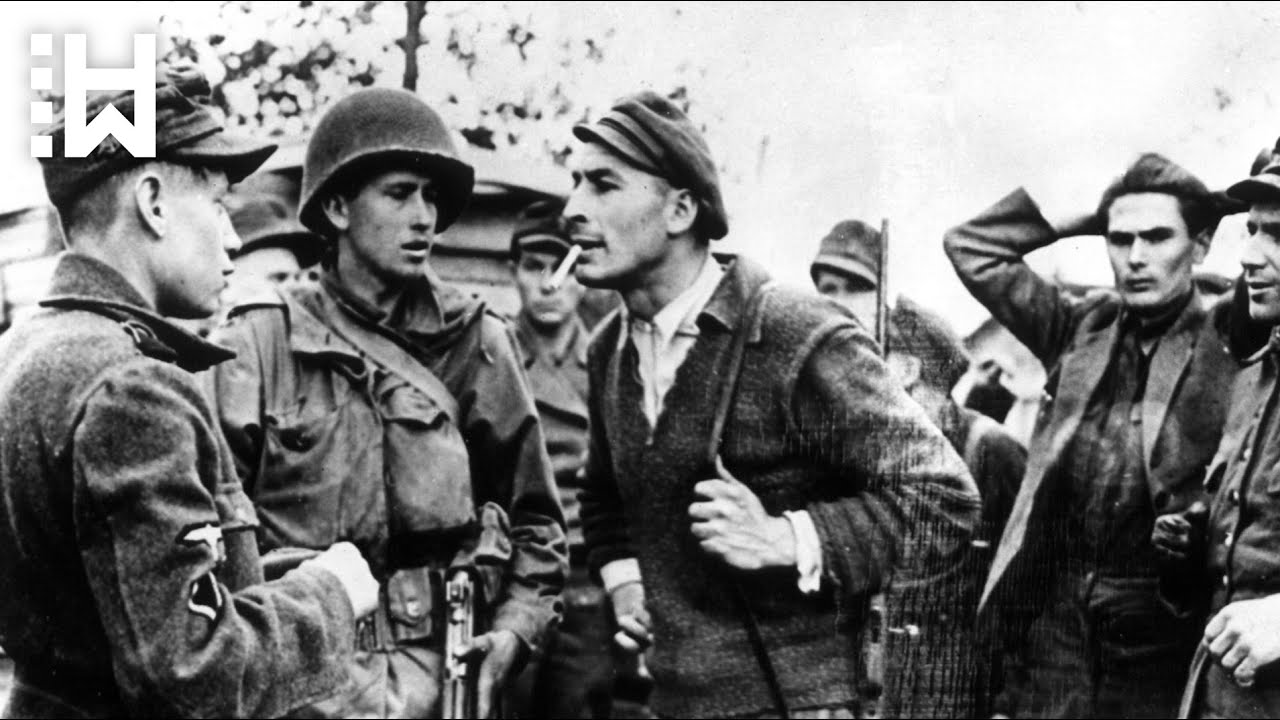
When American troops entered Dachau, they found survivors barely able to stand.
Many were skeletal.
Weak.
Unable to speak.
Some prisoners looked at the soldiers with disbelief.
After years of waiting, they were finally seeing uniforms that did not represent their captors.
An American soldier approached one survivor.
The prisoner stared at him.
No words came.
The soldier removed his helmet.
He did not know what to say.
There was no speech that could erase what had happened.
No gesture that could restore lost years.
Then came the realization.
The soldiers had not arrived at the end of a battle.
They had arrived at the beginning of a responsibility.
They were now witnesses.
But outside the camp, chaos was unfolding.
The SS guards who remained were captured.
The prisoners who had survived looked at the men who had controlled their suffering.
Years of fear.
Years of humiliation.
Years of loss.
All of it was standing in front of them.
And in the confusion of liberation, something happened that would create one of the most debated moments of World War II.
A moment when those who had suffered faced those who had caused the suffering.
A moment where the line between justice and revenge became dangerously thin.
Because when the gates of Dachau finally opened…
the war was not completely over.
And the question became:
What happens when victims are suddenly given power over their former captors?
To be continued — Chapter 2: Liberation, Rage, and the Dachau Reprisals