Chapter One
The Knock Beneath the Storm
The old woman was already dying when she knocked on Declan Shaw’s door.
Neither of them knew it yet.
She stood beneath the porch light with snow caught in her silver hair, one hand gripping the collar of a coat too thin for a Montana blizzard. Her husband hovered behind her, bent by age but refusing to lean on the cane tucked beneath his arm.
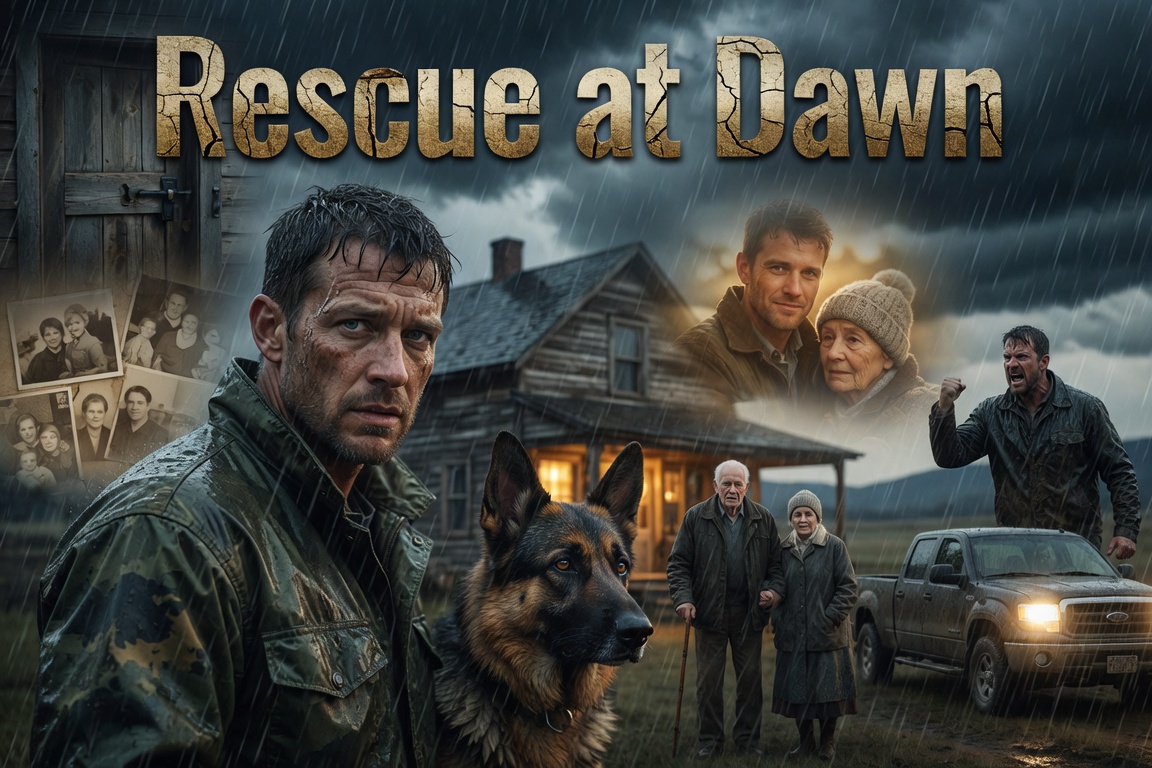
Beyond them, an ancient Ford pickup sat sideways in the driveway, its headlights dimmed by blowing snow.
“We don’t need your house,” the old man said. “Just the barn.”
Declan stared at them through the half-open door.
Wind pushed frozen needles across the porch. The temperature had fallen twelve degrees since sunset. Another foot of snow was predicted before morning, and the nearest paved road lay four miles beyond his eastern fence.
“No.”
The old man’s chin lifted.
“We’ll pay.”
“No one sleeps in the barn tonight.”
The woman’s lips curved faintly.
“Walter, I believe he’s saying we should freeze somewhere else.”
“I understood him, Ruth.”
Declan opened the door wider.
“I’m saying you’re coming inside.”
Warm light spilled across the porch.
Behind him, Bishop appeared without a sound.
The German Shepherd was nine years old, dark-backed, broad-chested, with a scar crossing the bridge of his muzzle. His right ear stood straight; the left leaned slightly from an injury sustained long before retirement.
Walter froze when he saw him.
“That dog bite?”
“Only when people ask.”
Ruth laughed once, then pressed a hand to her chest.
The sound ended too quickly.
Bishop’s head snapped toward her.
Declan noticed.
The dog stepped onto the porch and approached slowly. Ruth extended her fingers, but Bishop ignored them. He pressed his nose against the side of her coat, inhaled near her ribs, then looked at Declan.
Not curiosity.
Alert.
Declan had spent six years handling Bishop in places where roads had no names and medical help arrived only if weather, aircraft, and politics agreed.
He knew the difference.
“What medication are you taking?” he asked.
Ruth blinked.
“That is a personal question.”
“Answer it.”
Walter stepped forward.
“Now, hold on.”
Bishop nudged Ruth’s left hand.
Her fingers trembled.
Declan saw the bluish cast beneath her lips, the sheen of sweat at her temples despite the cold, and the slight confusion behind her smile.
“Diabetes?”
Ruth’s expression changed.
Walter looked at her.
“You checked before we left.”
“I thought I did.”
“When did you last eat?”
She looked toward the truck as if the answer might be waiting there.
“Ruth.”
Walter’s voice lost its stubbornness.
“Lunch,” she said. “Perhaps breakfast.”
Declan caught her before her knees struck the porch.
Bishop barked once.
The sharp sound scattered snow from the railing.
Declan carried her inside.
At forty-seven, he still moved with the economy drilled into him by two decades of Naval Special Warfare, but an old injury beneath his right shoulder protested as he lowered Ruth onto the kitchen floor.
Walter followed, breathing hard.
“What’s happening?”
“Her blood sugar may have crashed.”
Declan opened a cabinet, grabbed honey, glucose gel, and the medical kit he kept beside the stove.
Walter stared at the supplies.
“You expecting casualties at dinner?”
“I live alone.”
“That does not answer the question.”
“It usually does.”
Ruth’s eyes fluttered.
Declan checked her pulse.
Irregular.
Too fast.
Not only blood sugar.
“Call emergency services,” he told Walter.
The old man pulled a flip phone from his pocket.
No signal.
Declan’s landline had died with the first wind gust. The satellite phone in his locked office would work, but the county ambulance could not reach the farm until the plows cleared the west road.
Bishop lay against Ruth’s legs, warming her.
Declan placed glucose inside her cheek and spoke close to her ear.
“Ruth, open your eyes.”
She did.
Barely.
“That dog,” she whispered. “He has terrible manners.”
“He gets that from me.”
Her mouth moved toward a smile.
Good.
People who could insult him were usually still worth arguing with.
Declan checked her pulse again.
The rhythm stumbled.
He looked at Walter.
“How far did you drive?”
“From Fort Benton.”
“In this?”
“We left before the storm.”
“That was six hours ago.”
“We got turned around.”
“No. You came here.”
Walter’s eyes shifted.
Only for a second.
Declan saw it.
The old man had not reached the farm by accident.
Outside, wind struck the house hard enough to shake the windows. The lights flickered. Bishop lifted his head toward the eastern wall.
Walter removed his wet hat.
His hair had been flattened against his skull.
“We were looking for Declan Shaw.”
Declan’s fingers stopped against Ruth’s wrist.
“Why?”
Walter glanced toward his wife.
Then toward the dog.
“Our son died in prison eight years ago.”
The kitchen seemed to contract.
“I’m sorry.”
“No, you’re not.”
Walter’s voice sharpened.
“Not yet.”
Ruth opened her eyes more fully.
“Walter.”
“He deserves to know.”
“Not while you’re frightened.”
“I’ve been frightened thirteen years.”
Declan rose slowly.
Something old and unpleasant moved beneath his ribs.
“What was your son’s name?”
Walter reached inside his coat.
His fingers emerged holding a faded newspaper clipping sealed in clear plastic.
The photograph showed a young man being led from a courthouse in handcuffs.
Declan knew the face.
He had seen it in police reports, on courtroom screens, and inside every nightmare that ended with twisted metal beside a snow-covered highway.
“Aaron Price,” Walter said.
The man convicted of killing Declan’s pregnant wife.
The man Declan had once prayed would die in prison.
Bishop stood.
Not between Declan and the couple.
Beside Ruth.
Protecting her.
Walter placed the clipping on the table.
“We came because Aaron was innocent.”
Declan looked at the old man.
Wind roared around the farmhouse.
Ruth’s breathing remained thin.
Thirteen years of grief pressed against the room from every direction.
“Get out,” Declan said.
Walter did not move.
“My wife can’t.”
“Then you will leave when she’s stable.”
“We have proof.”
Declan stepped closer.
“If your son had not crossed the centerline, Naomi would be alive.”
Walter’s mouth trembled.
“He was not driving the truck that hit her.”
“I watched him confess.”
“You watched a terrified addict repeat what the sheriff told him to say.”
Declan’s jaw tightened.
“Careful.”
“I buried my only child while this county called him a coward and a drunk.”
“And I buried my wife and daughter in the same coffin.”
Ruth reached toward Bishop.
The dog placed his head beneath her palm.
Her eyes filled.
“That is why we came,” she said.
Declan turned toward her.
The room fell silent except for the stove and the storm.
Ruth looked directly at him.
“Your daughter was not in that coffin.”
The lights went out.
Darkness swallowed the kitchen.
And somewhere beyond the frozen windows, an engine started.
Chapter Two
What Bishop Found
Declan reached the front window before the emergency lights activated.
A pair of taillights disappeared beyond the cottonwoods.
Too far to identify the vehicle.
Too slow for someone merely passing through.
Someone had been watching the house.
Bishop stood at the door, muscles rigid beneath his coat.
“Stay.”
The dog remained, though every line of his body argued.
Declan retrieved a flashlight and the satellite phone from his office. The emergency generator should have started automatically.
It had not.
He checked the exterior camera feed.
Dead.
Not weather damage.
The wires had been cut at the junction box near the barn.
Walter watched him from the kitchen.
“You carry a pistol?”
Declan had not drawn one.
Walter had noticed the shape beneath his sweater.
“I carry many things.”
“Were you really a SEAL?”
Declan looked at him.
“Does that change whether your wife needs a hospital?”
“No.”
“Then it can wait.”
He contacted the county dispatcher through satellite service. Roads were blocked. A volunteer medical team might reach them by tracked vehicle within two hours.
Ruth had improved after the glucose, but her heartbeat still skipped beneath Declan’s fingers.
She insisted it was normal.
Walter said she had collapsed twice in the previous month.
Ruth told him betrayal was unattractive in old age.
Declan set up a portable cardiac monitor from an old field kit.
Walter stared at the equipment.
“You planning to invade Canada?”
“Only if they stop sending coffee.”
Bishop moved through the kitchen, sniffing the couple’s coats, shoes, and canvas suitcase.
He stopped beside the suitcase.
A low growl vibrated in his chest.
Walter looked down.
“What’s wrong with him?”
Declan opened the case.
Clothes.
Two books.
Medication.
A wooden box wrapped inside a wool scarf.
Bishop ignored the box.
He pressed his nose against the suitcase lining.
Declan cut one corner with a pocketknife.
A black device dropped onto the table.
GPS tracker.
Walter sank into a chair.
“They found us.”
“Who?”
The old man looked toward the window.
“We thought it was the nursing facility.”
“What nursing facility?”
“Silver Meadow.”
Declan knew it.
A private assisted-living center twenty miles south, funded partly by the Shaw Veterans Trust—his late father’s foundation.
Walter’s mouth twisted.
“Our doctor said Ruth needed full-time care. Two weeks after we moved in, the administrator took our truck keys and filed for emergency guardianship.”
“On what grounds?”
“Cognitive decline.”
Ruth lifted her head from the couch.
“Walter forgets where he leaves his glasses. Apparently that makes both of us incompetent.”
Walter continued.
“They searched our old house while we were in Silver Meadow. A neighbor called. Someone tore open the floorboards in Aaron’s room.”
Declan looked at the wooden box.
“What were they looking for?”
“This.”
Walter placed the box on the table.
The wood had darkened with age. A small brass lock held the lid.
He removed a key from around his neck.
Inside were three objects.
A microcassette.
A hospital identification bracelet.
A woman’s silver necklace with a broken clasp.
Declan stopped breathing.
Naomi had worn that necklace the day she died.
A small mountain charm hung from the chain.
He had given it to her after their first winter in Montana.
Police told him the necklace was never recovered from the crash.
He reached toward it.
His hand failed halfway.
Bishop pressed against his leg.
Not trained behavior.
Choice.
Declan rested one hand on the dog’s back.
“Where did Aaron get this?”
“He was the first person at the accident,” Ruth said.
“The report says a snowplow driver found the vehicles.”
“The report was written after Aaron was arrested.”
Walter held up the microcassette.
“Our son sent us a letter three weeks before he died. He said if anything happened, we should find a red toolbox in the old school workshop where he taught evening mechanics.”
“He was a mechanic.”
“And a recovering addict,” Walter said. “Both can be true.”
The words carried years of defending a son without denying the damage he had done.
“We didn’t find the toolbox until last month. The school was being demolished. A former student brought it to us.”
Declan picked up the hospital bracelet.
The print had faded but remained legible.
INFANT FEMALE — SHAW, NAOMI
A date.
The night of the crash.
A transfer code.
Status:
ALIVE
Declan’s knees weakened.
He sat.
His daughter had been thirty-six weeks in the womb when Naomi left the farmhouse to attend a medical appointment.
The crash report stated both died on impact.
He had returned from deployment to two graves, one name carved above the other.
NAOMI SHAW
AND INFANT DAUGHTER
He had never held the baby.
Never chosen her name.
Never questioned why the coffin remained closed.
His father had stood beside him in uniform and said the damage was too severe.
Declan stared at the bracelet.
“Who signed the transfer?”
Walter pointed toward a faded set of initials.
G.S.
Graham Shaw.
Declan’s younger brother.
Then the satellite phone rang.
The display showed county emergency services.
Declan answered.
“Shaw.”
A familiar voice came through.
“Declan, it’s Graham.”
His brother had been county sheriff for six years.
They spoke at funerals, official events, and once each Christmas when Graham’s daughter insisted on calling.
Never longer than necessary.
“I heard the Prices reached your farm,” Graham said.
“How?”
“Silver Meadow issued a vulnerable-adult alert.”
“They are not confused.”
“That isn’t for you to decide.”
Declan looked toward the tracker.
“You put surveillance on their suitcase?”
Silence.
Only for a fraction of a second.
Enough.
“Who is with you?” Graham asked.
“Why?”
“Because someone disabled your power.”
“You?”
“No.”
The answer sounded true.
That made everything worse.
Graham continued.
“I’m on my way with a deputy and medical support. Don’t play soldier. Let us handle it.”
Declan looked at Naomi’s necklace.
“Were you at the hospital the night she died?”
His brother stopped breathing on the other end.
Walter closed his eyes.
Ruth’s hand tightened in Bishop’s fur.
“Declan,” Graham said carefully, “we need to speak in person.”
“Answer me.”
The storm cracked across the roof.
Then Graham whispered:
“Yes.”
The call ended.
Declan lowered the phone.
Walter inserted the microcassette into a small recorder.
“Aaron said the beginning was damaged,” he said. “But the middle survived.”
He pressed play.
Static filled the kitchen.
A younger man’s frightened voice emerged.
“My name is Aaron Price. Sheriff James Shaw told me to say I was driving.”
Declan’s father.
The county sheriff before Graham.
A war hero.
The man whose photograph hung inside the courthouse, the veterans center, and nearly every business in town.
Aaron continued.
“I wasn’t. Graham was driving the other truck.”
Declan stared toward the black window.
The recording crackled.
“The woman was still alive when I reached her. She kept saying, ‘Save my baby. Tell Declan I tried to get home.’”
Declan’s throat closed.
Ruth covered her mouth.
Aaron’s voice shook.
“I delivered the baby before the ambulance came. She was breathing. Sheriff Shaw took her. He said the child needed a family that wasn’t broken.”
The cassette clicked off.
Outside, headlights appeared between the trees.
Three vehicles approached through the storm.
Walter whispered, “That is not medical support.”
Bishop stood in front of the door.
His growl deepened.
Declan picked up Naomi’s necklace.
For thirteen years, he had believed one man killed his family.
Now his dead father, his living brother, and perhaps half the county had built their lives around a different truth.
His daughter had survived.
And the brother driving toward him knew where she was.
Chapter Three
The Girl in the Sheriff’s Truck
Graham entered without drawing his weapon.
That was wise.
He stepped through the doorway wearing a brown sheriff’s coat powdered with snow. At forty-three, he had their father’s square face and their mother’s tired blue eyes. His hair had thinned at the crown. A wedding ring remained on his hand even though Rachel had been dead three years.
Chief Deputy Roman Vail followed.
Roman had served as James Shaw’s second-in-command the night Naomi died. Fifty-five now, thick through the chest, silver mustache, right leg stiff from an old Marine injury.
A county paramedic came behind them carrying a medical bag.
Declan let the paramedic examine Ruth.
He did not let Roman past the kitchen entrance.
The deputy looked toward the pistol beneath Declan’s sweater.
“You planning trouble?”
“No.”
“Then move your hand.”
“It isn’t on the weapon.”
Roman’s eyes narrowed.
That was true too.
Bishop remained beside Ruth, watching all three visitors.
Graham saw the open wooden box.
His face changed when he recognized Naomi’s necklace.
“Where did you get that?”
Walter stood.
“Our son saved it from the road.”
Graham removed his hat.
Snow melted along his shoulders.
“I need everyone to remain calm.”
Declan laughed once.
The sound held no humor.
“Is that what Dad said after you killed my wife?”
Roman stepped forward.
“Careful.”
Declan’s gaze shifted.
Roman stopped.
For one moment, the kitchen remembered what Declan had once been.
Not a rancher.
Not a widower.
A man trained to end movement before threats understood they had begun.
Graham raised one hand.
“Roman, stay back.”
The paramedic announced that Ruth needed hospital evaluation but was stable for the moment. The tracked ambulance was forty minutes out.
“Take them when it arrives,” Graham said.
“No,” Walter answered.
“You are subjects of a medical alert.”
“We are not prisoners.”
“You fled supervised care in a blizzard.”
“We fled people searching our belongings.”
Graham looked at the tracker.
“I did not authorize that.”
Roman’s expression remained still.
Declan noticed.
“So who did?” he asked.
Nobody answered.
A car door closed outside.
Light footsteps crossed the porch.
Then a girl entered.
Thirteen years old.
Long dark hair escaped beneath a knit cap. Snow covered her boots. She wore jeans, a red winter coat, and the guarded expression of a child who had learned that adults became less honest when they lowered their voices.
“Dad?”
Graham turned.
“I told you to stay in the truck, Madison.”
“It’s freezing.”
Her eyes found Declan.
She knew him as Uncle Declan, the silent man who sent birthday gifts without attending parties. She had Rachel’s last name, Graham’s home, and Naomi’s eyes.
Declan saw it immediately.
The shape of her eyebrows.
The small dimple near the right side of her mouth.
The way she rubbed her thumb against the side of her index finger when anxious.
Naomi had done that during every argument.
The room disappeared.
Only the girl remained.
Madison looked toward the wooden box.
“What’s going on?”
No one answered.
She turned to Graham.
“Dad?”
His face broke.
Not fully.
Enough.
Declan looked at the hospital bracelet.
Then at the girl.
“You raised her.”
Graham stepped between them.
“She is my daughter.”
“Biologically?”
Madison’s forehead creased.
“What does that mean?”
Graham’s voice sharpened.
“Declan, not here.”
“Where was she born?”
“Stop.”
“Was it Mercy County Hospital on February seventeenth?”
Madison looked at Graham.
“That’s my birthday.”
Silence struck the kitchen.
Snow rattled against the windows.
Bishop moved away from Ruth and approached Madison. The girl crouched automatically.
He smelled her face, hair, and hands.
Then the old dog did something Declan had never seen him do with a stranger.
He pressed his forehead against hers.
Madison smiled despite the tension.
“Hi, Bishop.”
She had met the dog twice before.
Both times he had remained distant.
Now his tail moved once.
Declan had no interest in mystical explanations.
Dogs responded to scent, memory, posture, and chemistry—not fate.
But Naomi’s necklace lay open on the table. Madison had touched it during a family memorial years earlier. Perhaps Bishop recognized the trace.
Or perhaps he simply sensed that everyone in the room was breaking around her.
Graham’s eyes filled.
“Madison, go into the living room.”
“No.”
“Please.”
“You never say please unless something’s bad.”
Declan’s anger lost direction.
A child stood inside the blast radius of decisions made before she could speak.
He lowered his voice.
“Madison, the Prices brought information about the accident that killed Naomi.”
“My aunt Naomi.”
Declan flinched.
Graham had raised her to believe Naomi was her aunt.
“Yes.”
“What information?”
Graham said, “We don’t know whether it’s accurate.”
Walter lifted the cassette.
“I heard my son’s voice.”
“You heard a convicted man protecting his memory.”
“He was protecting yours,” Declan said.
Graham’s jaw tightened.
Roman stepped into the room.
“Enough.”
Everyone turned.
The deputy pointed toward the recorder.
“That is evidence in an old criminal case. Hand it over.”
“No,” Walter said.
Roman moved.
Bishop stepped between them.
The growl that came from the dog was low enough to feel through the floor.
Roman stopped.
“Control your animal.”
Declan did not look away from Graham.
“Tell her.”
Graham’s shoulders dropped.
The sheriff disappeared.
A frightened younger brother remained.
“I had been drinking,” he said.
Madison stared.
Graham spoke to her, not Declan.
“I was twenty-nine. Your mother—Rachel—had lost a baby six months earlier. I was angry. Your grandfather called me weak. I left the lodge after a fight.”
Declan remembered the lodge.
A veterans’ fundraiser.
He had called from overseas that afternoon. Naomi said Graham sounded drunk and James was furious.
“I crossed the centerline,” Graham continued. “Naomi swerved. Her truck rolled down the embankment.”
Madison’s face had gone pale.
“You killed Aunt Naomi?”
Graham’s voice broke.
“Yes.”
Declan’s hand closed around the edge of the table until wood pressed beneath his nails.
“Dad arrived before the ambulance,” Graham said. “Aaron Price was already there. He had delivered the baby.”
Madison looked at the hospital bracelet.
Understanding arrived in pieces.
“No.”
Graham stepped toward her.
She moved back.
“Rachel and I took you to the hospital.”
“You said I was born in Helena.”
“We changed the record.”
“You’re lying.”
“I have lied. I’m not lying now.”
Madison looked at Declan.
Then back at Graham.
“Who is my father?”
No one answered quickly enough.
Her eyes widened.
She stared at Declan.
“No.”
He could not speak.
The word daughter pressed against thirteen years of absence he had not chosen but could never recover.
Graham reached for her.
“Maddie—”
She slapped his hand away.
“You let me call him Uncle.”
“I was afraid.”
“Of what?”
“Losing you.”
The honesty made everything worse.
Madison’s breathing shortened.
Bishop moved toward her, but she backed into the hallway.
Declan recognized panic.
“Look at me,” he said.
She did.
“Nothing has to be decided tonight.”
“You’re my father?”
“Yes.”
The word barely left him.
Madison’s face crumpled.
Then the generator exploded.
The blast shook the farmhouse.
Windows flashed orange.
The lights died again.
Roman drew his weapon.
Bishop barked.
In the confusion, someone outside fired through the kitchen window.
The bullet struck the wooden box and tore the microcassette from Walter’s hand.
Glass and splintered wood filled the room.
Declan pulled Madison to the floor.
Graham covered Ruth.
Roman fired toward the darkness beyond the window.
The attacker vanished into the storm.
When Declan rose, the recorder lay broken beneath the table.
The microcassette was gone.
And Roman Vail was no longer inside the house.
Chapter Four
The Men Who Protected the Dead
Declan found Roman’s tracks behind the barn.
One set led toward the disabled generator.
Another crossed the pasture toward the county road.
A snowmobile engine started beyond the western ridge.
Roman had not chased the attacker.
He was the attacker.
He had fired into the kitchen, entered through the dark hallway, taken the cassette, and escaped while everyone focused on protecting Madison.
Graham stood beneath the barn light, his service pistol hanging at his side.
“You knew he had the tracker,” Declan said.
“No.”
“You knew Silver Meadow was searching the Prices’ belongings.”
“I approved the guardianship request after their doctor recommended it.”
“Which doctor?”
Graham’s silence answered.
A physician on the Shaw Veterans Trust board.
Declan stepped closer.
“You sent them into a facility connected to Dad’s foundation, then Roman tracked them when they escaped.”
“I thought they were being exploited by someone who wanted to reopen the case.”
“They were trying to clear their son.”
“Their son was guilty of other crimes.”
“Not this one.”
Graham looked toward the farmhouse.
Madison stood behind the living-room window, Bishop beside her.
“I was going to tell her when she was older.”
“She is thirteen.”
“Exactly.”
“How old was I when you decided I could survive burying a child?”
Graham’s face tightened.
“That was Dad.”
“You signed the hospital transfer.”
“Because he told me you would take her away and return to deployment.”
“She was mine.”
“She was a premature infant whose mother had just died. You were unreachable in another country. Rachel had milk because of the baby we lost.”
“You let me stand over an empty grave.”
“I know.”
“No. You visited it with me.”
Snow gathered in Graham’s hair.
His eyes reddened.
“I loved her from the first night.”
Declan wanted to hit him.
He wanted to break every bone that had held his daughter.
He also saw the truth.
Graham had not raised Madison as stolen property.
He had held her through fevers, tied her shoes, attended school plays, buried the woman she believed was her mother, and stayed when Declan had been deliberately kept away.
Love did not erase the theft.
The theft did not make the love false.
That was the cruelty.
“What did Dad promise Aaron?” Declan asked.
Graham looked toward the storm.
“Aaron had been clean for ten months. But there were pills in his truck from an old prescription. Dad said he would charge him with intoxication, possession, and causing the crash.”
“So Aaron confessed.”
“Dad promised five years and financial support for his parents.”
“He served seven and died.”
“I know.”
“Did you ever visit him?”
Graham’s jaw worked.
“Once.”
“What did he say?”
“That I was raising another man’s child inside a house built with his silence.”
The words had remained.
Declan could see it.
“Why become sheriff?”
Graham looked almost offended.
“To do better than Dad.”
“You preserved his lie.”
“I kept crime low. I expanded addiction treatment. I stopped the department from treating every damaged person like Aaron.”
“And never cleared Aaron’s name.”
“If I confessed, Madison would lose the only family she knew. Rachel would have been prosecuted for falsifying records. Dad’s foundation would collapse.”
“The foundation matters more than a dead man?”
“It pays for veterans’ housing and medical care.”
The old equation.
One truth against hundreds of good outcomes.
James Shaw had taught both sons to calculate human lives as though grief could be distributed fairly.
Declan heard a soft sound behind them.
Walter stood near the barn door.
He had come outside without a coat.
“You used our son’s conviction to fund your redemption.”
Graham lowered his head.
Walter approached.
He looked smaller in the storm, but his voice did not.
“Aaron stole from us when he was using. He lied. He frightened his mother. He broke things I spent years repairing.”
His eyes filled.
“But he did not kill Naomi.”
“No,” Graham said.
“Then say his name properly.”
Graham looked up.
“Aaron Price was innocent of the crash.”
Walter nodded once.
Not forgiveness.
Recognition.
From the house, Madison screamed.
Declan ran.
The front door stood open.
Bishop was gone.
Madison’s red coat was missing.
A sheet of notebook paper lay on the floor.
I need to see where she died. Don’t follow me.
Graham grabbed his radio.
“The crash site is nine miles north.”
“Road’s closed.”
“She knows the trail. Rachel took her there every year to leave flowers.”
Declan turned.
“You let my daughter mourn her own mother as an aunt.”
Graham flinched.
Then the radio crackled.
Roman’s voice.
“Sheriff, call off the search.”
Graham raised the unit.
“Roman, where are you?”
“The girl took a horse from Shaw’s north pasture. She’s heading toward the ridge.”
Declan’s chest tightened.
The north trail crossed a frozen creek and a steep cut where wind buried the path within minutes.
“Stay away from her,” Graham ordered.
Roman’s voice hardened.
“She knows too much.”
Graham went still.
The deputy continued.
“James understood what this county needed. One family scandal will reopen every conviction he touched. The trust collapses. Silver Meadow closes. Veterans lose homes. All because an old addict wanted to feel innocent after death.”
“He was innocent,” Graham said.
“Not of being Aaron Price.”
Walter stepped toward the radio.
“My son was more than his worst year.”
Roman ignored him.
“Bring me the hospital bracelet and Naomi’s necklace. I give you the girl.”
Graham looked at Declan.
Roman believed the evidence remained intact.
He did not know the cassette was only one copy.
Ruth appeared in the doorway holding another microcassette.
“Librarians make copies,” she said.
Walter stared at his wife.
“You told me that was a recording of choir practice.”
“It was a poor choir.”
Bishop’s bark echoed faintly from the northern ridge.
Once.
Then again.
Declan retrieved his winter gear and rifle.
Graham reached for a coat.
“You’re staying.”
“That is my daughter.”
Declan looked at him.
“She is ours in different ways.”
The words cost him.
Graham understood.
They left together.
Not brothers.
Not allies.
Two men following a German Shepherd into a white wilderness, both terrified that the girl they loved would become one more person sacrificed to protect their family.
Chapter Five
Bishop’s Trail
The storm erased Madison’s tracks within minutes.
Bishop’s did not matter.
The dog carried a locator beacon inside his collar, an old habit Declan had never abandoned after retirement. Its signal moved steadily north through the pasture, then stopped near the frozen creek.
Declan drove a snowmobile.
Graham rode behind him.
Walter insisted on following in the tracked medical vehicle with Ruth and the paramedic, arguing that Roman wanted evidence only he could identify.
No one had the energy to stop him.
At the creek, they found the horse.
The mare stood among willows, reins tangled around a branch, saddle empty.
Blood darkened the snow beside one hoof.
Graham jumped from the snowmobile.
“Maddie!”
Wind swallowed the name.
Declan crouched beside the tracks.
Two human trails.
One smaller.
One adult.
Roman had reached her.
Bishop’s signal moved again, climbing toward the old accident site above Black Pine Cut.
Declan remembered that road.
He had never returned.
Not after the funeral.
Not after Aaron’s conviction.
He had built fences, restored barns, and deployed four more times rather than stand beside the guardrail where Naomi’s life ended.
Now his daughter was somewhere beyond it.
The snowmobile could not climb the last incline. They continued on foot.
Graham struggled with the elevation.
Declan slowed without mentioning it.
“What happens when we find her?” Graham asked.
“We bring her home.”
“Which home?”
The question cut through the storm.
Declan did not answer.
Graham stumbled, caught himself.
“She has school Monday. A piano lesson Tuesday. She hates tomatoes unless they’re in salsa. She sleeps with the hallway light on when thunderstorms hit.”
Declan kept moving.
“I know I stole years from you.”
“You stole all of them.”
“Yes.”
Snow accumulated along Graham’s eyebrows.
“But don’t punish her by taking away the father she knows.”
Declan stopped.
He turned.
“You think this is about winning?”
“I think you have every reason to hate me.”
“I do.”
Graham absorbed it.
“I also know she loves you.”
Something changed between them.
Not forgiveness.
The first space where it might someday exist.
Bishop barked from above.
They climbed.
The guardrail emerged through blowing snow.
Beyond it, the slope dropped toward a ravine filled with pine and buried wreckage from old storms.
A red coat lay near the road.
Empty.
Graham’s face collapsed.
“No.”
Declan touched the snow.
Still warm beneath the coat.
“She took it off to mark the trail.”
Smart.
Terrified.
Alive recently.
Bishop appeared near the ravine edge.
He barked, turned, then disappeared downslope.
Declan followed.
Branches tore at his jacket. Snow reached his thighs. Graham slid behind him, caught a tree, continued.
At the bottom, Bishop stood beside an overturned maintenance shed half-buried by drifts.
A faint cry came from beneath it.
“Maddie!”
Declan dropped to his knees.
The shed had collapsed over an old drainage culvert. Madison lay inside a narrow pocket beneath broken boards. One leg was trapped. Bishop had crawled through the opening and pressed his body against hers.
Her face was pale.
“Uncle Declan?”
The title hurt differently now.
“I’m here.”
“Roman took the tape.”
“We have another.”
“He said Aaron killed Mom.”
“No.”
She began to cry.
“He said you didn’t want me.”
Declan’s throat tightened.
“I did not know you were alive.”
“Would you have stayed?”
The storm roared above them.
There was no answer that could rewrite his life.
“I would have tried.”
She stared.
Not enough.
But honest.
“Graham stayed,” she whispered.
“Yes.”
“Even though he caused it.”
“Yes.”
“I don’t know who I’m supposed to hate.”
“No one gets to assign you that tonight.”
Bishop whined.
He shifted his weight away from Madison’s torso and looked toward Declan.
Her breathing was shallow.
Possible chest compression.
They had minutes.
Graham crawled beside him.
Madison saw him.
Her face tightened.
“Don’t call me Maddie.”
He stopped.
“All right.”
“Don’t call me anything.”
Pain crossed his face.
“All right.”
Together, the brothers lifted the broken roof beam.
The old wood shifted.
Snow poured into the opening.
Madison screamed as Declan pulled her free.
The slope cracked above them.
A low, deep sound moved through the ridge.
Snow slab.
“Move!”
Graham took Madison.
Declan called Bishop.
They ran toward the trees as the upper drift released.
A wall of snow swept down the slope, struck the collapsed shed, and buried the culvert.
Bishop leaped onto a fallen log.
Declan followed.
Graham slipped.
Madison fell from his arms.
Declan caught her coat.
Graham disappeared to his waist beneath the sliding snow.
Bishop doubled back and seized Graham’s sleeve, pulling as Declan dragged Madison onto higher ground.
The slide stopped.
Silence followed.
Then Bishop released the sleeve and stood over them, panting.
Madison reached for him.
The dog lowered himself beside her.
For the second time that night, Bishop had placed his body against someone who needed warmth more than pride.
A gun clicked behind them.
Roman Vail stood among the trees.
Snow covered his shoulders.
The stolen cassette hung from one hand. A pistol filled the other.
“You should have stayed at the farm.”
Graham rose slowly.
“Lower the weapon.”
“You are still giving orders as though you deserve the badge.”
Roman looked toward Madison.
“I’m sorry, kid.”
Her fingers tightened in Bishop’s fur.
“You lied to me.”
“I protected this county.”
“You shot at us.”
“To get the evidence.”
“You chased a child into a storm,” Declan said.
Roman’s pistol shifted toward him.
“Your father understood sacrifice.”
“My father was a coward with good public relations.”
Roman’s face hardened.
“James saved hundreds of veterans.”
“He also destroyed Aaron Price.”
“Aaron was already destroyed.”
The sentence came too quickly.
Too easily.
Roman believed it.
That was the wound beneath his loyalty.
His own son had died at twenty-six after years of opioid addiction. Roman had spent every day since believing some people were too damaged to rescue. James Shaw gave him a foundation and a story in which strong men saved the worthy.
Aaron threatened that story.
“Your son’s name was Caleb,” Declan said.
Roman’s weapon wavered.
“Do not speak about him.”
“He needed treatment.”
“He received treatment.”
“He relapsed.”
“He chose drugs.”
“And you decided Aaron’s life was worth less because he made the same choice.”
Roman’s jaw clenched.
“You know nothing.”
“I know grief becomes dangerous when we need someone else to deserve it.”
Graham stepped closer.
Roman aimed at him.
“Stay back.”
“You covered the crash report,” Graham said.
“I followed your father.”
“You tracked the Prices.”
“To recover stolen evidence.”
“You fired into Declan’s house.”
Roman’s breathing changed.
The certainty was slipping.
“I kept your daughter safe for thirteen years.”
“No.”
Graham looked at Madison.
“You kept my lie safe.”
He removed his badge and dropped it into the snow.
Roman stared.
Graham continued.
“My name is Graham Shaw. I was driving the truck that caused Naomi Shaw’s death. My father coerced Aaron Price into a false confession. I signed falsified hospital records and raised Declan’s daughter as my own.”
His body camera blinked red.
Recording.
Roman’s face went pale.
“Turn that off.”
“No.”
“You destroy yourself, the department, everything your father built.”
“Yes.”
The answer carried no heroism.
Only surrender to consequence.
Roman raised the pistol.
Bishop moved first.
Not an attack.
A warning bark directly beside him.
Roman flinched.
His boot slipped on the buried edge of the culvert.
The gun fired into the trees.
Declan reached him before he regained balance, drove the weapon aside, and pinned him against the snow.
He did not strike him.
Did not break him.
Simply held him until Graham secured the cuffs.
Roman looked up at Declan.
“You could have stopped all this by letting the past remain dead.”
Declan glanced toward Madison.
“No.”
“The past was the only thing alive in this family.”
Headlights appeared above the ridge.
Walter’s tracked vehicle.
Hope moving slowly through the storm.
Chapter Six
Aaron Price Comes Home
Aaron Price was exonerated eleven months after the storm.
A judge vacated his conviction using Graham’s recorded confession, the copied cassette, hospital records recovered from James Shaw’s private archive, and testimony from the retired paramedic who had transported the infant.
The paramedic admitted James threatened to end his career if he spoke.
He had remained silent thirteen years.
During the hearing, he stared at Walter and Ruth.
“I told myself the baby was safe,” he said.
Walter’s voice remained quiet.
“What did you tell yourself about our son?”
The paramedic had no answer.
Aaron’s photograph stood beside his parents at the courthouse.
Not the image of him in handcuffs.
A high-school portrait from before addiction hollowed his face.
He wore a shop apron and held a wooden sailboat he had built for Ruth.
The prosecutor read Aaron’s final letter.
He had written:
I made enough mistakes that people stopped believing I could be innocent of anything. Please don’t turn me into a saint when the truth comes. Just let me be a man who did one good thing on the worst night of his life.
Ruth wept without lowering her face.
Walter placed one hand over hers.
Declan sat behind them with Bishop at his feet.
The dog’s muzzle had gone grayer since the storm. He slept more. His hips stiffened in cold weather.
Madison sat between Declan and Graham.
She now used the name Madison Shaw-Reed.
Reed had been Naomi’s maiden name.
Not Declan’s choice.
Not Graham’s.
Hers.
Graham had resigned as sheriff the morning after the rescue. He pleaded guilty to falsifying records, obstruction, and conspiracy related to Aaron’s conviction.
The original vehicular charge was complicated by time, evidence, and statutes, but Graham waived several defenses and accepted a prison sentence of four years.
Some residents called him brave for confessing.
He refused the word.
“I was brave thirteen years late,” he told the judge. “That is another name for cowardice with better timing.”
Madison visited him once a month.
She did not call him Dad during the first three visits.
On the fourth, she did.
Then cried in the parking lot because the word felt both true and disloyal.
Declan did not tell her what to feel.
That had become his first responsibility as her father.
Not deciding the emotion that would make life easiest for the adults.
The Shaw Veterans Trust survived.
Barely.
Its board was dissolved. James Shaw’s name was removed. An independent organization took control of the housing and medical programs.
Roman Vail pleaded guilty to attempted evidence destruction, aggravated assault, and unlawful surveillance. At sentencing, he spoke about his son.
Not as an excuse.
As the place where his judgment had begun narrowing.
Walter listened.
Afterward, he said, “I understand him.”
Ruth looked surprised.
Walter continued, “I didn’t say I forgive him.”
Understanding did not cancel justice.
It only prevented hatred from becoming another lie.
Declan sold twenty acres of his farm to the independent trust for one dollar.
They built a small recovery residence for veterans and families facing addiction.
Walter became its maintenance supervisor despite being almost eighty.
Ruth ran the library and ignored every suggestion that residents did not need six different translations of The Odyssey.
They moved into the cottage beside the barn.
On their first night, Walter stood in the doorway and looked toward the hayloft.
“We only asked to sleep in there.”
“You would have frozen.”
“We have slept in worse places.”
Ruth called from inside, “He means our first apartment.”
Walter lowered his voice.
“There was a hole in the bathroom floor.”
“I heard that.”
“Your memory improves whenever I criticize you.”
Bishop lay beside Ruth’s chair.
He had begun alerting before her blood sugar dropped, though no one had formally trained him for it. The doctor said dogs could detect chemical changes long before humans recognized symptoms.
Ruth said he was simply bossy.
Either way, she had not collapsed again.
The dog who once searched shattered buildings for strangers now spent his retirement following an elderly librarian between a cottage, a barn, and a recovery center.
It seemed a more honorable assignment.
Chapter Seven
Learning Her Name
Declan did not become Madison’s father the night he learned the truth.
Biology arrived instantly.
Fatherhood did not.
She stayed in Graham’s house under the care of her maternal aunt for the first month. The rooms contained Rachel’s photographs, Graham’s books, and every version of childhood she understood.
Declan visited.
He sat at the kitchen table while Madison completed homework.
Some evenings she ignored him.
Others she asked questions with the precision of an interrogator.
“Did you want a boy or girl?”
“Healthy.”
“That’s what people say when they’re avoiding the question.”
“Your mother wanted a girl.”
“What did you want?”
“A girl.”
“What name?”
“Emma.”
“I hate it.”
“Then your disappearance saved us from an argument.”
She laughed before catching herself.
The sound gave him hope he did not deserve yet.
“What was Mom like?”
“Impatient.”
“You always say kind.”
“She was kind. Also impatient.”
“Did she sing?”
“Badly.”
“Graham said she had a beautiful voice.”
“Graham lies under pressure.”
The humor faded.
Madison stared at her notebook.
“Do you hate him?”
“Yes.”
The honesty surprised her.
Declan continued.
“I also know he loves you.”
“Can both be true?”
“Most painful things require at least two truths.”
She thought about that.
“Will you try to take his place?”
“No.”
“Why not?”
“Because he has one.”
Her eyes filled.
“What place do you have?”
“I don’t know yet.”
That answer seemed to comfort her more than a promise.
They began with Saturdays.
Then weekends.
She learned to groom horses, repair fence, and throw a ball for Bishop without exhausting him.
Declan learned she hated peas, loved astronomy, and became quiet rather than loud when angry.
He learned not to ask whether she was happy every ten minutes.
She learned that his silences did not always mean rejection.
Sometimes they meant he was searching for language he had neglected too long.
One evening, Madison found him in the barn holding Naomi’s necklace.
“Can I see it?”
He handed it to her.
She placed the mountain charm in her palm.
“Did she wear this when she died?”
“Yes.”
“Aaron saved it.”
“Yes.”
She looked toward Walter’s cottage.
“He never knew he would save me too.”
Declan’s throat tightened.
Aaron had delivered her in the snow, preserved proof of her survival, and accepted a false conviction under threat.
His life had not been clean.
His courage did not need it to be.
Madison fastened the necklace.
“Do I look like her?”
“Sometimes.”
“When?”
“When you’re about to argue.”
“That isn’t flattering.”
“She would have considered it a compliment.”
Bishop rose from his bed and walked toward the barn door.
He looked back.
The evening light turned the pasture gold. Snow had melted from the lower fields, leaving dark earth and bright water along the fences.
Madison followed him outside.
Declan followed her.
The dog led them toward the hill behind the farmhouse where Naomi’s memorial stone stood beneath two aspens.
The smaller inscription beneath Naomi’s name had been removed.
INFANT DAUGHTER
The grave had never contained a child, but the lie remained part of the family’s history. Declan chose not to erase the entire stone.
Beside the old inscription, Madison had added a new brass plate.
SHE LIVED. THE TRUTH TOOK THIRTEEN YEARS TO FIND HER.
Madison sat in the grass.
Bishop lowered himself beside her.
“Would Mom be angry?” she asked.
“At whom?”
“Everyone.”
“Yes.”
The answer came easily.
Madison smiled faintly.
“Good.”
They remained until the temperature dropped.
On the walk back, she slipped her hand into Declan’s.
He nearly stopped.
Did not.
They crossed the pasture without speaking.
At the barn, Madison looked up.
“Can I sleep in the loft tonight?”
“No.”
“Walter asked.”
“Walter was hypothermic and poorly supervised.”
“I’m thirteen.”
“My argument improves.”
She rolled her eyes.
“Fine.”
Then she hesitated.
“Dad?”
The word came quietly.
Declan looked at her.
She had called Graham the same thing that morning during a prison visit.
The title had not diminished through sharing.
It had expanded around the complicated truth of her life.
“Yes?”
“Bishop can sleep in my room.”
“That was not a question.”
“He already said yes.”
The dog walked toward the house without waiting.
Madison followed.
Declan remained beside the barn for several seconds, listening to their footsteps.
Thirteen years earlier, powerful men decided a grieving Navy SEAL could not be trusted with his own daughter. They called the decision protection. Then they built charity, careers, and a respectable family around the wound.
The truth did not return like justice in a clean uniform.
It arrived during a blizzard wearing wet coats and asking for a place in the barn.
It carried the voice of a flawed man who had died before anyone believed him.
It forced one brother to confess and another to admit that hatred could not raise a child.
And it came with an aging German Shepherd who noticed what people were too frightened, proud, or distracted to see.
Bishop sensed Ruth’s failing body before she collapsed.
He found the tracker hidden in the suitcase.
He followed Madison into the storm.
He pulled Graham from the snow despite having no reason to forgive him.
People later told the story as though the dog had uncovered the secret.
That was not exactly true.
The secret had always been there.
In forged records.
In Aaron’s prison letters.
In Graham’s fear.
In James Shaw’s foundation.
In the empty grave Declan visited every winter.
Bishop had done something harder than uncovering it.
He kept the people carrying the truth alive long enough to speak.
Declan entered the house.
Ruth was arguing with Walter about soup.
Madison sat on the floor beside Bishop, trying to convince him to wear a red bandanna.
The dog looked toward Declan with the long-suffering expression of a soldier abandoned by command.
For the first time in thirteen years, the farmhouse did not sound empty.
Declan closed the door against the cold.
And no one had to ask whether there was room.