CHAPTER ONE — THE SUITCASE IN THE SNOW
My father left me on my grandfather’s porch with one suitcase, a plastic bag of wrapped gifts, and a lie.
“It’s only for a week, Claire.”
That was the lie.
Not because the number was wrong.
Seven days.
That part was true.
But my father said it like a week was small.
Like seven days could not split a life in half.
Like Christmas Eve was not a cruel time to learn you had become inconvenient.
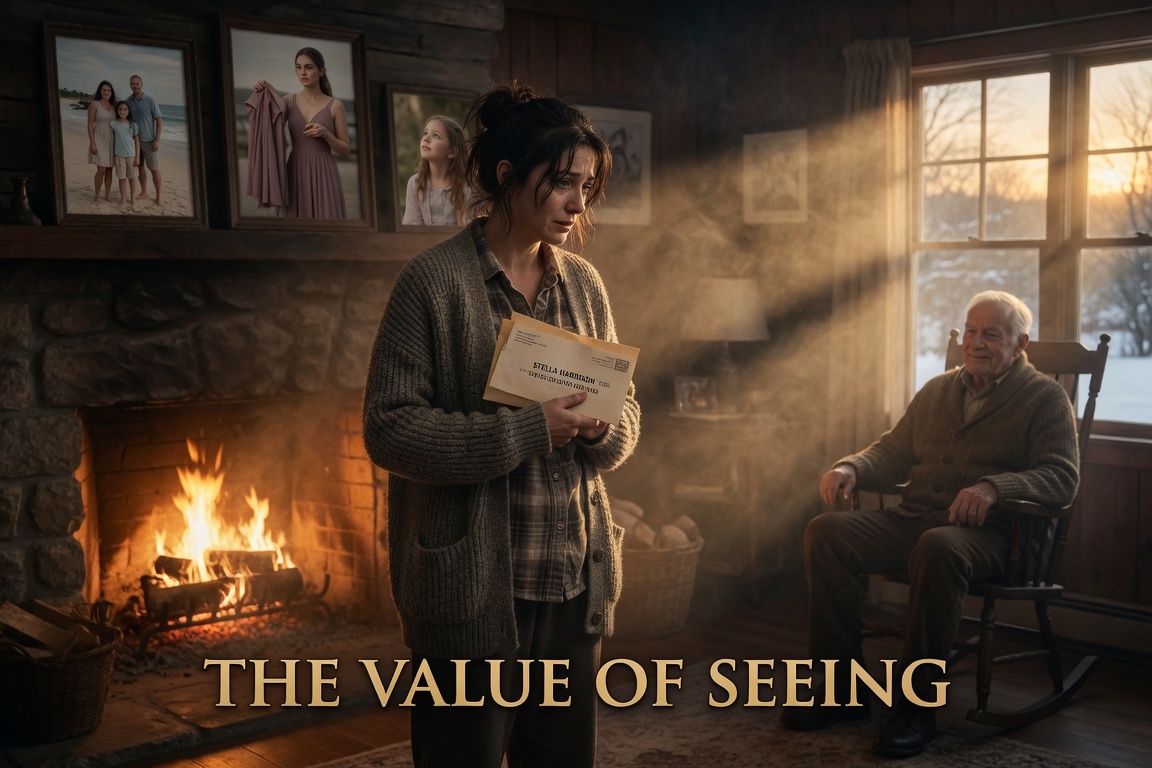
Snow fell over the dark road behind us, soft and steady, covering the tire tracks of my father’s black SUV before the engine even cooled. The old farmhouse stood at the end of Miller Ridge Road, surrounded by frozen fields, bare maple trees, and a sagging red barn that looked like it had been waiting years for someone to apologize to it. A yellow porch light flickered above the door. Wind moved through the pine trees with a low, tired sound.
In the passenger seat, my stepmother Elise kept her face turned toward the windshield.
She did not get out.
Neither did her twins.
Madison and Tyler sat in the back seat wearing matching ski jackets, their tablets glowing blue against their faces. There were suitcases behind them too, expensive ones with leather tags, packed for the Colorado resort where they were spending Christmas morning.
I knew because I had seen the tickets on the kitchen counter.
Four seats.
Not five.
My father stood beside me in his wool coat, one hand on my shoulder, gripping just tight enough to look loving if anyone happened to be watching.
Nobody was watching.
Except me.
“Grandpa’s excited to see you,” he said.
I looked at the dark window beside the porch.
No curtain moved.
“You said he doesn’t like visitors.”
My father’s mouth tightened.
“He’s old. Old people say things.”
“He hasn’t called me in two years.”
“That goes both ways.”
I turned and stared at him.
I was seventeen.
Old enough to understand blame when adults tried to dress it as balance.
“He didn’t have my number.”
My father looked away.
A snowflake landed on his eyebrow and melted instantly.
“Claire, don’t start.”
Don’t start.
That was what he said whenever I remembered something correctly.
I looked toward the SUV. Elise adjusted the heat vent without looking at me. Madison whispered something to Tyler, and both of them smiled in the quick, secret way people smile when they know they have been chosen.
My father bent down and picked up my suitcase.
It was the old purple one my mother used before she died.
One wheel was cracked.
The zipper caught if you pulled it too fast.
I hated that he had packed it.
I hated that he had touched it.
“Dad,” I said, and my voice came out smaller than I wanted, “why can’t I come?”
His face changed.
Not with guilt.
With irritation at being asked to say the quiet part out loud.
“Elise’s parents rented the lodge months ago. There isn’t room.”
“There was room last year.”
“That was different.”
“How?”
His jaw shifted.
In the warm SUV, Tyler laughed at something on his screen.
My father lowered his voice.
“Because everyone needs a break.”
The words landed softly.
That made them worse.
A break.
From what?
From me?
From the daughter who still remembered my mother’s birthday?
From the girl who did not call Elise Mom?
From the person who made his new family feel like something had been built on top of an old grave?
I looked down at the plastic bag of gifts.
I had wrapped them myself.
A scarf for my father.
A book for Elise because she liked historical gardens.
Colored pencils for Madison.
A small model plane for Tyler.
I had bought them with money from weekend shifts at the diner.
My father noticed the bag.
“Keep those here.”
My fingers tightened around the plastic handles.
“What?”
“We’ll do gifts when we get back.”
I stared at him.
“After Christmas?”
He looked toward the house.
“It’s still Christmas wherever you are.”
That was the kind of sentence adults use when they know they have done something ugly but want the victim to sound unreasonable for noticing.
The front door opened.
Light spilled onto the porch.
My grandfather stood inside the doorway wearing a brown cardigan, jeans, and old work boots. His white hair was combed back, but not neatly. His face looked carved rather than aged, all hard lines and deep-set eyes. He held a dish towel in one hand.
Jonah Whitaker.
My father’s father.
A man I knew mostly from stories told in angry voices.
Stubborn.
Cold.
Impossible.
A man who had driven my father away.
A man my mother had tried to visit until she got sick.
Grandpa looked at me.
Then at my suitcase.
Then at my father.
“What did you do, Daniel?”
The question cut through the cold.
My father stiffened.
“Don’t start, old man.”
Grandpa stepped onto the porch.
The wind caught his cardigan, but he did not seem to feel it.
“You brought her here on Christmas Eve with one suitcase.”
“It’s temporary.”
Grandpa looked at me again.
Something moved across his face.
Not surprise.
Pain.
He hid it quickly.
“You tell her that?”
My father’s hand left my shoulder.
“I don’t need a lecture.”
“No,” Grandpa said. “You need a mirror.”
The SUV door opened behind us.
Elise’s voice came sharp through the snow.
“Daniel, we’re going to miss the flight.”
My father exhaled.
Then he looked at me.
His face softened in that polished way adults use when they are ready to leave and need forgiveness before earning it.
“Claire.”
I hated how much I still wanted him to hug me.
“I’ll call.”
I nodded.
Because if I spoke, I might ask him not to go.
And some small, wounded part of me already knew the most humiliating thing was begging someone to choose you after they had packed the car without your seat.
My father kissed the top of my head.
Fast.
Dry.
Like checking a box.
Then he walked down the porch steps.
Grandpa did not move until the SUV turned around and disappeared down the snowy road.
The red taillights faded between the pines.
The silence afterward was enormous.
I stood on the porch holding the plastic bag of gifts.
Grandpa looked at my cracked suitcase.
Then at my face.
“You eaten?”
The question was so ordinary it almost broke me.
I shook my head.
He picked up my suitcase with one hand.
The old man was stronger than he looked.
“Come in, then.”
I stepped across the threshold into a house that smelled of woodsmoke, cinnamon, old paper, and something simmering on the stove.
Behind me, Grandpa closed the door against the snow.
He did not say Merry Christmas.
He did not say everything would be fine.
He did not lie.
He simply set my suitcase by the stairs and said, “There’s stew.”
That was how the week began.
Not with a miracle.
Not with forgiveness.
With a bowl of stew warming my hands while my father flew west without me.
CHARACTER FILES
Claire Whitaker — 17
High school senior, daughter of Daniel Whitaker and the late Hannah Whitaker.
Appearance: Dark blond hair usually tied carelessly, gray-blue eyes, thin from stress, always wearing her mother’s old silver bracelet.
Personality: Quietly observant, emotionally guarded, responsible beyond her age.
Deep wound: After her mother’s death, Claire became a reminder her father did not know how to face.
Greatest fear: Being left behind so many times that she finally stops expecting anyone to return.
Secret desire: To belong somewhere without having to earn her place.
Moral belief: Love should not require pretending pain did not happen.
Greatest weakness: She apologizes even when she has been hurt.
Greatest strength: She notices truth in small details adults overlook.
Jonah Whitaker — 74
Claire’s grandfather, retired carpenter and former volunteer fire captain.
Appearance: White hair, weathered hands, tall but slightly stooped, face lined by grief and discipline.
Personality: Reserved, blunt, protective, deeply loyal once trust is earned.
Deep wound: He lost his wife, then his daughter-in-law Hannah, and believes he failed to protect the family from Daniel’s bitterness.
Greatest fear: Dying before Claire knows the truth about her mother.
Secret desire: To repair what pride and silence destroyed.
Moral belief: A family is measured by who it protects when no one is watching.
Greatest weakness: He waits too long to say tender things.
Greatest strength: He shows love through action when words fail.
Daniel Whitaker — 43
Claire’s father, regional sales executive, remarried.
Appearance: Handsome, polished, controlled, always dressed like he is trying to prove stability.
Personality: Charming in public, defensive in private, restless, image-conscious.
Deep wound: He grew up believing Jonah loved work more than him, then lost his wife and never recovered emotionally.
Greatest fear: Being trapped in grief and failure like he believes his father was.
Secret desire: To start over without being reminded of what he lost.
Moral belief: Survival sometimes means cutting away what hurts.
Greatest weakness: He calls avoidance peace.
Greatest strength: When finally forced to face truth, he still has a conscience buried beneath fear.
Elise Whitaker — 39
Daniel’s second wife.
Appearance: Elegant, careful makeup, soft sweaters, smile that rarely reaches her eyes.
Personality: Practical, anxious, socially polished, protective of her own children.
Deep wound: Grew up in a chaotic home and believes control is safety.
Greatest fear: Being second place in a family haunted by a dead woman.
Secret desire: A clean life without emotional ghosts.
Moral belief: Stability matters more than sentiment.
Greatest weakness: She treats Claire as a threat instead of a grieving child.
Greatest strength: She can admit truth once denial becomes impossible.
Hannah Whitaker — deceased at 38
Claire’s mother.
Appearance: Remembered through warm brown eyes, paint-stained fingers, and scarves that smelled faintly of vanilla.
Personality: Gentle but strong, artistic, patient, quietly brave.
Deep wound: She spent years trying to bridge Daniel and Jonah’s broken relationship.
Greatest fear: Claire growing up without knowing she was deeply wanted.
Secret desire: For Claire to inherit love, not conflict.
Moral belief: Truth without kindness becomes another weapon.
Greatest strength: She left records because she knew silence could hurt the innocent.
CHAPTER TWO — THE HOUSE THAT DIDN’T FORGET
Grandpa gave me my mother’s old room.
He did not ask if I wanted it.
He simply carried my suitcase upstairs, pushed open a door at the end of the hallway, and turned on a lamp with a green glass shade.
The room looked like time had been told to sit down and stay.
A narrow bed with a blue quilt.
A wooden desk beneath the window.
A shelf of paperbacks with cracked spines.
A small mirror with dried lavender tied to one corner.
And above the desk, a photograph of my mother at sixteen, standing beside a half-built wooden boat, laughing at someone outside the frame.
I stood in the doorway.
The house creaked around us.
Grandpa placed my suitcase beside the bed.
“She painted that wall herself,” he said.
The wall was pale yellow.
Not bright.
Warm.
Like late afternoon.
I touched the doorframe.
“My dad said she hated this house.”
Grandpa’s face tightened.
“No. She hated goodbyes.”
I turned.
“What does that mean?”
He looked at the photograph instead of me.
“It means your father remembers pain and calls it proof.”
That was the first thing Grandpa said that sounded less like an answer and more like a locked drawer.
I did not push.
Not that night.
I was too tired.
Too cold.
Too aware of the empty space where Christmas was supposed to be.
Downstairs, he had placed stew, bread, and butter in front of me without watching too closely as I ate. He did not ask about school. He did not ask about Elise. He did not ask why my father had left me there, because he already knew enough to be angry and too much to be surprised.
After I changed into pajamas, I sat on the edge of my mother’s bed and listened.
The house made winter sounds.
Pipes ticking.
Wood settling.
Wind pressing against old windows.
Downstairs, dishes moved softly in the sink.
Then footsteps crossed the hall.
A pause.
Grandpa knocked once.
“You need extra blankets?”
I opened the door.
He held two folded quilts.
“No, thank you.”
He looked past me into the room.
His eyes went to the photograph.
Then away.
“Storm may cut power.”
“Okay.”
“There’s a flashlight in the drawer.”
“Okay.”
“If you get cold, come downstairs. Woodstove holds better than the furnace.”
“Okay.”
He nodded, as if we had completed something official.
Then he started to leave.
“Grandpa?”
He stopped.
The word felt strange in my mouth.
He turned back.
“Did my mom really like it here?”
His expression changed.
Not much.
But enough.
He looked down at the quilts in his hands.
“She used to sleep with the window open in February because she said the cold made dreams sharper.”
That sounded like my mother.
Pain moved through my chest so suddenly I had to hold the doorframe.
Grandpa saw it.
His hand lifted slightly, then stopped.
He did not know what to do with tenderness once it reached the air.
Finally, he handed me the blankets.
“She liked it here.”
His voice roughened.
“She liked you more.”
Then he walked away.
I closed the door and sat on the bed with the quilts in my lap.
For the first time that night, I cried.
Not loudly.
Not beautifully.
I cried the way people cry when they have been holding themselves together in front of someone who was not staying.
The snow kept falling outside my mother’s window.
Downstairs, the old man who was supposed to be cold placed another log in the stove.
CHAPTER THREE — CHRISTMAS MORNING WITHOUT HIM
My father did not call Christmas morning.
I woke at seven because some part of me still believed he might.
The room was blue with early light. Frost feathered the window corners. Snow covered the fields beyond the glass, smooth and untouched except for deer tracks near the stone wall. For a second, before memory returned, the house felt peaceful.
Then I saw my phone.
No missed calls.
No texts.
I stared at the blank screen until it dimmed.
Downstairs, bacon hissed in a pan.
The smell moved up the staircase, warm and impossible to ignore. I dressed slowly, brushed my hair, and walked down to the kitchen.
Grandpa stood at the stove wearing a flannel shirt and reading glasses low on his nose. A small radio played old Christmas music near the windowsill. The kitchen was not decorated except for a cedar branch tied with red string above the sink.
He looked up.
“Morning.”
“Merry Christmas,” I said.
The words felt fragile.
He paused.
Then nodded.
“Merry Christmas.”
There were pancakes on the table.
Not perfect ones.
One side slightly darker.
A bowl of blueberries.
Butter softening on a plate.
Orange juice in a glass pitcher.
I stood there too long.
Grandpa frowned.
“What?”
“Nothing.”
“You allergic to pancakes?”
“No.”
“Then sit.”
I sat.
He placed a plate in front of me.
I ate quietly.
After a few minutes, he said, “Your father call?”
I shook my head.
Grandpa’s jaw moved once.
He turned back to the stove and flipped another pancake with more force than necessary.
“He will,” I said, though I did not believe it.
Grandpa did not answer.
That was kind of him.
After breakfast, I carried the plastic bag of gifts from the hallway.
The handles had stretched overnight.
I placed it on the kitchen table.
Grandpa looked at it.
“What’s that?”
“Presents.”
“For who?”
“My dad. Elise. The twins.”
He looked at the bag for a long moment.
Then back at me.
“You wrap one for yourself?”
I almost laughed.
“No.”
He grunted.
“That’s poor planning.”
“It’s fine.”
“No, it isn’t.”
He walked out of the kitchen.
I heard him open a drawer in the front room. Something wooden slid. Papers rustled. He came back holding a small rectangular box wrapped in newspaper and tied with twine.
He placed it in front of me.
My throat tightened.
“What is it?”
“Open it and find out. That’s generally how gifts work.”
I smiled despite myself.
The newspaper came away carefully.
Inside was a wooden music box.
Small.
Handmade.
Dark walnut.
On the lid, someone had carved a maple tree with its roots visible beneath the ground.
I lifted the lid.
The melody began slowly.
Not a Christmas song.
Something softer.
Older.
I knew it.
My mother used to hum it when she brushed my hair.
My fingers froze on the box.
Grandpa looked at the stove.
“I made it for Hannah when she was eighteen. She left it here when she got married. Said she’d come back for it.”
The music kept turning.
“She never did.”
He cleared his throat.
“Should be yours now.”
I touched the carved roots.
“You made this?”
“Yes.”
“It’s beautiful.”
He frowned slightly, as if praise made him suspicious.
“It still works.”
That was his answer.
It still works.
As though beauty mattered less than endurance.
Maybe to him, that was the same thing.
I held the music box against my chest.
“Thank you.”
He nodded once.
“You’re welcome.”
Then my phone buzzed.
I grabbed it too fast.
Dad.
My heart moved before my brain could stop it.
I answered.
“Merry Christmas.”
Noise filled the background.
Laughter.
Music.
A woman’s voice calling for someone to take a picture.
“Hey, kiddo,” my father said.
Kiddo.
He only used that word when he felt guilty.
“Hi.”
“You okay?”
I looked at Grandpa, who had turned away but was listening with his whole body.
“Yes.”
“Good. Good.”
A pause.
Then he said, “We’re about to head to the slopes. Signal might be bad today.”
Of course.
“Okay.”
“Elise says Merry Christmas.”
In the background, Elise said something I could not hear.
My father covered the phone badly.
Then came back.
“And the kids too.”
The kids.
Not your siblings.
The kids.
I looked at the plastic bag of gifts.
“I brought their presents.”
“Oh. Great. We’ll do all that when we get back.”
“Okay.”
“You and Grandpa getting along?”
The question sounded more like surveillance than concern.
“Yes.”
Another pause.
“Don’t let him fill your head with things.”
I sat straighter.
“What things?”
“He has his version of the past.”
“And you have yours?”
“That’s not what I mean.”
Grandpa turned slowly from the stove.
I looked at him.
His face had gone still.
My father lowered his voice.
“Just remember, Claire, people can seem kind when they’re lonely. It doesn’t mean they were kind when it mattered.”
The sentence sat between three generations.
Me at the table.
Grandpa by the stove.
My father somewhere in a resort with the family he chose for Christmas.
I looked at the music box.
The carved roots.
The melody my mother never forgot.
“Dad,” I said quietly, “when did Grandpa stop mattering?”
Silence.
Not long.
But long enough.
“I’ll call later,” he said.
Then the line ended.
Grandpa turned back to the stove.
He did not ask what my father said.
He already knew.
CHAPTER FOUR — THE BARN WITH MY MOTHER’S NAME
On the second day, Grandpa gave me boots.
Not new boots.
Work boots.
Brown leather, scuffed at the toes, lined with wool.
“They were your mother’s,” he said.
I stared at them.
“My mom wore these?”
“She helped me repair the south fence in those boots. Also fell into a drainage ditch in them.”
I smiled.
“Did she get mad?”
“At the ditch.”
That sounded right.
We went outside after breakfast.
The cold hit my face so sharply it made my eyes water. Snow squeaked under the boots. The sky was pale and wide. The farmhouse behind us sent a thin ribbon of smoke from the chimney. Somewhere beyond the tree line, a crow called once and disappeared.
Grandpa handed me a shovel.
“Barn door’s stuck.”
“I’ve never fixed a barn door.”
“I noticed.”
He walked ahead.
That was how Grandpa taught.
No encouragement.
No explanation of confidence.
He simply put a tool in your hand and assumed you could become useful if you stayed.
The barn smelled of hay, dust, old wood, and cold iron. Light came through gaps in the siding. The door had swollen from years of weather, its lower track packed with ice.
Grandpa showed me how to clear it.
Not by doing it for me.
By placing his shovel next to mine and working slowly enough that I could copy him.
After twenty minutes, my fingers hurt.
After forty, my back hurt.
After an hour, the door moved three inches.
I almost cheered.
Grandpa looked at the gap.
“Still sticks.”
I laughed.
“I know.”
He looked at me.
The corner of his mouth moved.
Almost a smile.
Inside the barn, beneath a tarp, was an old pickup truck.
Forest green.
Rust at the edges.
Flat tires.
A cracked windshield.
On the hood, someone had written HANNAH in dusty letters.
My breath caught.
Grandpa pulled the tarp back.
“Your mother learned to drive in this.”
I stepped closer.
“She never told me.”
“She was going to.”
I heard the words he did not add.
Before she got sick.
Before time became appointments, medications, whispers in hallways.
I ran my hand over the truck’s fender.
“What happened to it?”
“Nothing.”
“It’s broken.”
“No,” Grandpa said. “It’s waiting.”
I looked at him.
He shrugged.
“Different things.”
We spent the afternoon clearing the barn around it.
Old boxes.
Wood scraps.
Rusty tools.
Coffee cans full of nails.
A cracked rocking chair.
A trunk covered in dust.
When Grandpa saw the trunk, he stopped.
I noticed because he had been moving steadily all day and suddenly became stone.
“What is it?”
He wiped dust from the latch.
“Your mother’s.”
I knelt beside it.
“Can I open it?”
He hesitated.
Then nodded.
Inside were sketchbooks.
Scarves.
A blue jacket.
Letters tied with ribbon.
And a stack of cassette tapes labeled in my mother’s handwriting.
For Claire.
My hand shook as I touched the top tape.
Grandpa sat back on his heels.
His face looked older in the barn light.
“She made those when she got sick.”
My throat closed.
“My dad never told me.”
“No.”
“Did he know?”
Grandpa’s silence answered.
The barn seemed to shrink around us.
Snow slid from the roof with a soft rush.
I picked up one tape.
My name written across it.
Claire — when you are angry.
Another:
Claire — when you forget my voice.
Another:
Claire — when your father cannot talk about me.
I looked at Grandpa.
His eyes were wet.
He turned away before I could see too much.
“Why didn’t you give these to me?”
His voice came rough.
“I tried.”
“When?”
“After the funeral.”
He stood slowly.
“Your father said you were too young. Then he stopped answering. Then he moved. Then he changed numbers. Then he told the lawyer I was upsetting you.”
The cold entered places my coat could not protect.
“My dad said you stopped coming.”
Grandpa’s hand closed around the edge of the trunk.
“I came twelve times.”
The number landed like a physical thing.
Twelve.
Twelve times I could have known him.
Twelve times my mother’s voice waited in a trunk because adults made grief into territory.
I sat back on the barn floor.
The anger did not arrive loudly.
It moved through me like freezing water.
Slow.
Deep.
Grandpa took one step toward me, then stopped.
“I should have fought harder.”
I looked at the tapes.
“Yes.”
He flinched.
I almost apologized.
Then didn’t.
Because some truths deserve the room they take.
He nodded.
“You’re right.”
That was the first time an adult in my family accepted blame without handing me half of it.
I picked up the tape labeled Claire — when you forget my voice.
“Do you have something that plays these?”
Grandpa looked toward the farmhouse.
“Your mother’s old radio.”
I held the tape carefully.
Like a match.
Like a key.
Like a piece of my life returned seven years late.
“Then I want to hear her.”
CHAPTER FIVE — WHEN YOU FORGET MY VOICE
My mother’s voice came through static.
At first, only a crackle.
Then a breath.
Then a laugh so familiar my entire body forgot how to move.
“Oh, sweetheart. If you’re listening to this, then you’re probably older than I can imagine you being.”
I sat on the floor of my mother’s bedroom with the old cassette player between my knees. Grandpa stood in the doorway for a few seconds, then quietly left. The house had gone dark except for the lamp on the desk. Outside, snow tapped the window like small fingers.
My mother continued.
“I hope your hair still does that impossible curl near your left ear. I tried everything. Nothing worked. Your father said it had personality.”
I touched my hair.
The curl was there.
I began to cry before she reached the second minute.
Not because she said anything profound.
Because she sounded alive.
Because memory had made her gentle and distant, but the tape made her human again.
She coughed once, covered the microphone, then came back.
“I need you to know something, Claire. People will tell you different versions of me. Some will make me softer than I was. Some will make me sadder. Some may not talk about me at all because grief frightens them. But I was here. I loved you. I wanted you. Every hard day, every appointment, every painful morning, I still wanted more time with you.”
I pressed my fist against my mouth.
The words entered old wounds I had stopped naming.
Wanted.
I had been wanted.
Not tolerated.
Not inherited.
Wanted.
Her voice lowered.
“Your father loves you too. But he is not brave with pain. That is not an excuse. It is a warning. If he closes doors to avoid missing me, do not believe you are the thing he wants to shut out. You are the best part of both of us.”
I paused the tape.
For a moment, I could not breathe.
My father had not just hidden Grandpa.
He had hidden this.
He had hidden the sentence I needed most.
The floor creaked behind me.
Grandpa stood in the hall.
“You okay?”
“No.”
He nodded.
“Want tea?”
“Yes.”
In Grandpa’s house, comfort came disguised as practical objects.
Tea.
Blankets.
Firewood.
Boots.
A fixed door.
A radio that still worked.
He made tea in the kitchen without speaking. I sat at the table, hands wrapped around the mug. The room smelled of peppermint and woodsmoke. The clock above the sink ticked steadily.
“Why did my dad hate you?” I asked.
Grandpa leaned against the counter.
“He thinks I chose this farm over him.”
“Did you?”
He looked out the window into the dark.
“Sometimes.”
The answer surprised me.
Most adults defended themselves automatically.
Grandpa did not.
“When your father was young, this place was failing. My wife was sick. Bills were bad. I worked constantly. Repairs, carpentry, winter plowing, volunteer calls at night. Daniel wanted me at games, school plays, normal things. I missed too many.”
He rubbed his thumb against a scar on his hand.
“Then your grandmother died, and I became quieter than a father should be. Daniel heard that quiet as rejection.”
“Was it?”
Grandpa’s face tightened.
“Some days, yes.”
The honesty hurt.
But it also made room for something more complicated than blame.
“He left at eighteen,” Grandpa said. “Said he’d never raise a child around broken things. Then he met your mother. She brought him back sometimes. She was the bridge.”
“And when she died?”
“The bridge went with her.”
I looked down at my tea.
“So he punished me for looking like the bridge.”
Grandpa closed his eyes briefly.
When he opened them, they were wet.
“Yes.”
There it was.
Not the whole truth.
But enough.
My phone buzzed.
Dad.
For one second, I did not want to answer.
Then I did.
“Hello?”
His voice sounded tight.
“Claire. Why did your grandfather send me a message asking about Hannah’s tapes?”
I looked at Grandpa.
He straightened.
“I found them.”
Silence.
“What tapes?”
The lie came too fast.
My hands went cold.
“The ones Mom made for me.”
Another silence.
Then my father exhaled.
“Claire, listen. Those tapes are old. Your mother was sick. She wasn’t always thinking clearly.”
Grandpa’s hand hit the counter.
Not hard.
But enough.
I looked at him.
His eyes had gone dark.
I spoke carefully.
“She said you loved me but weren’t brave with pain.”
My father said nothing.
“She was thinking clearly.”
His voice changed.
“You don’t understand what that time was like.”
“No. I don’t. Because you never told me.”
“I was trying to protect you.”
“From Mom’s voice?”
The question broke something.
He snapped.
“From that house. From him. From being dragged backward by people who refuse to let the dead stay dead.”
The kitchen went silent.
Grandpa looked like he had been struck.
My father breathed hard into the phone.
Then softer, “Claire, I’m sorry.”
I waited.
But the apology had no object.
Sorry you heard.
Sorry you asked.
Sorry this is uncomfortable.
Not sorry I hid her.
I looked at the cassette player sitting on the table.
“I’m going to listen to all of them.”
“Claire.”
“All of them.”
His voice lowered.
“I don’t want you alone with him anymore.”
I looked at Grandpa.
The man who fed me, gave me my mother’s music box, admitted his failures, and waited for me to decide whether to trust him.
Then I thought of my father at the airport.
Four tickets.
Not five.
“I was already alone,” I said.
And I ended the call.
CHAPTER SIX — THE ENVELOPE IN THE FREEZER
On the fourth day, the power went out.
The storm arrived before dawn, pressing snow against the windows until the world disappeared behind white. The house groaned under the wind. The furnace clicked once, tried to start, and gave up. Grandpa was already downstairs, feeding the woodstove with the solemn concentration of a priest tending an altar.
“Generator’s stubborn,” he said when I came into the kitchen wearing two sweaters.
“Meaning broken?”
“Meaning it has character.”
I had learned by then that broken and character were cousins in Grandpa’s language.
We spent the morning carrying wood from the porch, melting snow for extra water, and moving food from the refrigerator into coolers near the back door. Grandpa taught me how to bank a fire, how to listen for ice cracking on tree limbs, how to wrap pipes under the sink if the temperature dropped.
By noon, the house had narrowed to the kitchen and sitting room.
Firelight moved over the walls.
The rest of the house became shadow.
I was clearing the freezer when I found the envelope.
It was sealed in a plastic bag behind three frozen loaves of bread and a container of soup labeled LENTIL / TOO MUCH SALT.
The envelope had my father’s name on it.
Daniel.
I stared at it.
“Grandpa.”
He turned from the stove.
“What?”
I held it up.
His face changed immediately.
He crossed the kitchen faster than I thought he could move.
“Where was that?”
“In the freezer.”
He took it.
For a moment, he only looked at the handwriting.
My mother’s.
“What is it?”
His throat moved.
“I don’t know.”
“Why was it in the freezer?”
“Your mother used to hide things there because your father never cooked.”
Despite everything, I laughed.
Grandpa did too.
Just once.
Then he sobered.
“It’s addressed to him.”
I stared at the envelope.
“Are you going to give it to him?”
Grandpa did not answer.
The wind hit the house hard enough to rattle the windows.
Finally, he said, “It may be yours too.”
“That’s not how mail works.”
“No,” he said. “That’s how secrets work.”
He opened it carefully.
Inside was a letter and a folded legal document.
Grandpa read the first page.
His face drained.
He sat down slowly.
“What?” I asked.
He handed me the paper.
The first line read:
Last Addendum to the Hannah Whitaker Trust.
My eyes moved quickly.
I understood only pieces.
My mother had set aside money from her art sales, life insurance, and a settlement from the hospital where her diagnosis had been delayed. The trust was intended for me.
Education.
Housing.
Medical needs.
Emergency protection.
A trustee named Jonah Whitaker.
My grandfather.
Not my father.
A second document revoked Daniel’s control over the funds if he blocked contact between me and my maternal or paternal family “without cause related to safety.”
My hands shook.
“How much money?”
Grandpa looked at the page.
“Enough.”
“How much is enough?”
His voice came low.
“By now? With interest? Maybe two hundred thousand. Maybe more.”
The room tilted.
Two hundred thousand dollars.
College applications sat unfinished in my backpack because my father said money was tight.
I worked diner shifts because he said I needed to learn responsibility.
Elise told me community college was practical.
My father hid my mother’s voice, my grandfather, and a trust she had left to protect me.
“Did Dad know?”
Grandpa read the letter addressed to him.
His mouth tightened.
“Yes.”
I stood.
The chair scraped behind me.
“Where is it?”
“The trust?”
“Yes.”
Grandpa looked at the legal document.
“I don’t know.”
I laughed once.
It came out wrong.
Sharp.
Ugly.
“You were the trustee.”
“I never received final paperwork. After Hannah died, Daniel told me the estate was handled, then his lawyer sent a letter saying he had legal guardianship and all communication should go through him. I tried to challenge it.”
“And?”
“He disappeared with you.”
I walked to the window.
Snow hit the glass so hard it looked like static.
My reflection stared back.
My mother’s bracelet on my wrist.
My father’s abandonment still fresh as a bruise.
“How do we find it?”
Grandpa looked at me for a long moment.
Then stood.
“There’s a lawyer in town.”
“The power’s out.”
“He has a woodstove and hates your father.”
That was the most hopeful sentence I had heard all week.
CHAPTER SEVEN — MR. BELL’S OFFICE
Mr. Bell’s law office sat above the closed pharmacy on Main Street, between a church with a crooked steeple and a hardware store displaying snow shovels like weapons.
Grandpa drove there in the green truck.
Not my mother’s truck.
His.
A 1989 Ford that smelled of motor oil, pine needles, and coffee. The heater made an alarming clicking noise. Grandpa smacked the dashboard twice and said, “Don’t embarrass me today.”
The truck obeyed.
The town was buried in snow. Storefront windows glowed warm against the storm. Christmas wreaths hung from lampposts. A man in a red hat cleared the sidewalk outside the bakery and waved at Grandpa with his shovel.
“Everyone knows you,” I said.
“Small town.”
“Do they like you?”
“Mixed reviews.”
Mr. Bell was eighty-one, narrow as a broom, with white hair, sharp eyes, and a red cardigan under his suit jacket. His office smelled of paper, coffee, and old radiator heat. File boxes lined the walls. A plastic Santa sat on the windowsill beside a stack of probate codes.
He looked at me over his glasses.
“You’re Hannah’s girl.”
I nodded.
His face softened.
“She had your eyes.”
People had told me I had my father’s eyes.
No one had ever given me my mother’s.
I sat straighter.
Grandpa placed the documents on the desk.
Mr. Bell read them in silence.
The radiator hissed.
The clock ticked.
My heart beat so loudly I thought everyone could hear it.
Finally, Mr. Bell removed his glasses.
“Well.”
Grandpa leaned forward.
“Is it valid?”
“It was valid when drafted.”
“What happened to it?”
Mr. Bell looked at me.
“That is the question.”
He opened a cabinet, removed a file box, and searched through folders with hands that still knew exactly where history slept.
After ten minutes, he found a copy.
Hannah Whitaker Trust — Preliminary Filing.
Another.
Hospital Settlement Distribution.
Another.
Guardianship Petition.
Then he stopped.
His expression changed.
“What?” Grandpa asked.
Mr. Bell placed one page on the desk.
A court notice.
My father had petitioned to become sole manager of the trust after claiming Jonah Whitaker was emotionally unstable, estranged from the minor child, and likely to misuse funds for “maintenance of a failing rural property.”
Grandpa did not move.
His face went gray.
“That’s a lie.”
Mr. Bell looked at him.
“I know.”
“Did you fight it?”
“I was never notified until after the order.”
Grandpa’s voice roughened.
“I was her trustee.”
“Daniel claimed you refused contact.”
I stared at the page.
My father’s signature at the bottom.
Daniel Whitaker.
Neat.
Confident.
A signature I had seen on school forms, birthday cards, lease papers, checks.
Suddenly it looked like a weapon.
“Where’s the money?” I asked.
Mr. Bell’s eyes moved to me.
“Some of it may have been used legally if approved for your benefit.”
“My benefit?”
I heard my voice rising.
“My college fund disappeared while I worked breakfast shifts and he took Elise’s kids skiing.”
Grandpa’s hand closed slowly over the arm of his chair.
Mr. Bell’s expression hardened.
“That would require accounting.”
“Can we get it?”
“Yes.”
“How?”
He looked toward the storm outside.
“With a court order, if necessary. But first, we request records formally.”
Grandpa leaned forward.
“Do it.”
Mr. Bell glanced at him.
“This may get ugly.”
Grandpa’s mouth tightened.
“It already was.”
My phone rang then.
Dad.
I looked at it.
Mr. Bell looked at Grandpa.
Grandpa looked at me.
This time, I answered on speaker.
“Claire,” my father said immediately. “Where are you?”
I looked at the legal papers on the desk.
“With Grandpa.”
“That’s not what I asked.”
“I know.”
His breathing changed.
“You need to come home.”
I almost laughed.
Four days ago, he left me in the snow.
Now home had become urgent.
“Why?”
“Because this has gone far enough.”
Mr. Bell silently picked up a pen.
Grandpa sat very still.
My father continued, “Elise and I are coming back early.”
“From Colorado?”
A pause.
“Yes.”
“What happened to needing a break?”
Silence.
Then he said, “Claire, listen to me. Your grandfather is manipulating you.”
I looked at the document with my father’s signature.
“Did Mom leave me a trust?”
The line went dead quiet.
Not confused quiet.
Caught quiet.
Finally, my father said, “That is complicated.”
“No,” I said. “It’s a yes-or-no question.”
“Your mother left many things unfinished.”
“She left tapes. You hid them.”
“She was sick.”
“She left money. Did you spend it?”
His voice sharpened.
“Do not talk to me like that.”
For years, that tone would have folded me.
Not in Mr. Bell’s office.
Not with Grandpa beside me.
Not with my mother’s documents on the desk.
I leaned toward the phone.
“Did you spend my trust?”
My father said nothing.
Mr. Bell wrote something down.
Grandpa’s hand trembled once.
Then my father spoke in a lower voice.
“You have no idea what it cost to raise you alone.”
The sentence hit harder than denial.
Because it was not no.
Because it was not I would never.
Because somewhere beneath the anger was confession.
I ended the call.
The office stayed silent.
Mr. Bell set down his pen.
“Well,” he said softly, “that answers motive.”
CHAPTER EIGHT — WHEN MY FATHER CAME BACK
My father arrived on the sixth day in the middle of another storm.
Not alone.
Elise came with him.
The twins stayed with her parents.
That told me everything.
This was not a family reunion.
It was damage control.
The SUV pulled into Grandpa’s driveway just after dusk, headlights cutting through snow. I watched from the sitting room window while Grandpa stood beside the woodstove, one hand resting on the back of his chair. The house smelled of pine, smoke, and chicken soup. My mother’s tapes sat in a neat stack on the coffee table. The trust documents lay inside a folder on the kitchen counter.
My father got out first.
He looked tired.
Really tired.
Not polished tired.
Not business-trip tired.
A deeper exhaustion moved in his shoulders, under his coat, around his eyes.
Elise followed, wrapped in a white parka, her face tight with discomfort. She looked at the farmhouse the way people look at a hospital room they hope not to enter.
Grandpa opened the door before they knocked.
Cold air rushed in.
My father stepped onto the threshold.
“Dad.”
Grandpa’s face did not change.
“Daniel.”
That one word carried thirty years of injury.
Elise forced a smile.
“Jonah.”
He nodded once.
“Elise.”
No one moved to hug.
That would have been dishonest.
My father looked past him at me.
“Claire.”
I remained near the fireplace.
He stepped inside.
His eyes moved around the room: the tapes, the folder, the music box beside me, the house he had tried to erase and somehow found alive.
“We need to talk.”
Grandpa closed the door.
“Then talk.”
My father looked at him.
“Alone.”
“No,” I said.
He turned to me.
“Claire, this is adult business.”
I almost smiled.
That phrase.
Adult business.
As if adults had not made a business of my grief.
“I’m seventeen. The trust has my name on it.”
Elise inhaled sharply.
So she knew.
Maybe not all of it.
Enough to fear the word.
My father removed his gloves slowly.
“I made mistakes.”
Grandpa laughed once.
No humor.
“Mistakes are when you forget salt in bread.”
My father’s face reddened.
“I did what I had to do.”
Grandpa took one step forward.
“No. You did what you wanted and named it survival.”
Elise crossed her arms.
“Maybe everyone should calm down.”
I looked at her.
For years, I had tried to be kind to Elise in ways she never noticed. I had lowered my voice around her twins. I had smiled at holiday photos where my mother’s ornaments were missing. I had accepted being treated like a difficult guest in the life I was born into.
Not that night.
“Did you know?”
She blinked.
“Claire—”
“Did you know my mom left me money?”
Her eyes moved to my father.
There.
The answer.
My father stepped between us.
“Elise had nothing to do with this.”
That was the first protective thing he said all night.
Interesting.
Elise’s face tightened.
“Daniel.”
“No.”
He turned to her.
“This is on me.”
The room changed.
Not enough to forgive him.
Enough to stop moving for a second.
My father looked at me again.
“I used some of the money.”
Some.
The word tried to make itself small.
“How much?”
He swallowed.
“Most of it.”
Grandpa’s hand closed into a fist.
I felt my own body go still.
“On what?”
My father looked toward the fire.
“Mortgage. Medical bills. Your school. Therapy after Hannah died. Legal fees. Then things got complicated when Elise and I married.”
“Elise’s house,” Grandpa said.
My father’s jaw tightened.
“She had children.”
“So did you,” Grandpa said.
The words struck the room hard.
My father flinched.
I had never seen that before.
Elise looked away.
My voice came out calm.
“Did you use my mother’s money to pay for their life?”
My father’s eyes filled.
Not dramatically.
Not enough to absolve.
But real.
“I told myself I was keeping the family stable.”
“Which family?”
He had no answer.
That was answer enough.
I walked to the table and picked up the music box.
The melody started faintly when my thumb touched the lid.
“My mom made tapes so I wouldn’t forget her voice.”
My father closed his eyes.
“You hid them.”
“I couldn’t listen to them.”
“They weren’t for you.”
That broke him more than anything else.
His face changed.
For one moment, he was not the man who left me in the snow.
He was a widower standing in a house full of the woman he had lost, realizing grief had made him steal from the child she left behind.
He covered his mouth with one hand.
Elise whispered, “Daniel.”
He shook his head.
“I know.”
Grandpa’s voice was low.
“You don’t know. Not yet.”
He walked to the desk and picked up another envelope.
My father’s face changed when he saw it.
“What is that?”
Grandpa held it out.
“Hannah’s last letter to you.”
My father stared.
“I never got that.”
“No,” Grandpa said. “It was in my freezer.”
Even through the pain, I almost laughed.
My father took the envelope with shaking hands.
He opened it.
Read.
The room became silent except for the fire.
His face collapsed line by line.
Whatever my mother had written, it reached places none of us could.
When he finished, his hands were trembling.
He sat down hard in the nearest chair.
Elise moved toward him, then stopped.
My father looked at me.
His voice was broken.
“She asked me not to make you pay for losing her.”
I said nothing.
The truth did not need my help.
He looked at Grandpa.
“She asked me to bring her home every Christmas.”
Grandpa’s eyes filled.
Home.
Not the resort.
Not the new house.
Here.
This broken, stubborn, warm farmhouse full of things my father had called backward because he could not survive remembering who he had been before loss.
My father covered his face.
For a long time, nobody moved.
Then I asked the question that mattered.
“Are you sorry because you got caught?”
He looked at me over his hands.
The question hurt him.
Good.
It should.
He did not answer quickly.
That was the first honest thing he did.
Finally, he said, “I don’t know how to separate the two yet.”
I stared at him.
He continued, voice rough.
“I am ashamed because you know. I am sorry because it happened. I am terrified because I don’t know if there’s anything left to repair.”
That was not the apology I wanted.
It was messier.
Less satisfying.
More human.
Grandpa sat across from him.
“Start with accounting.”
My father looked at him.
“Dad—”
“No. Start with records. Then restitution. Then therapy. Then maybe, if she chooses, you get conversations.”
Elise wiped her face.
I had not noticed she was crying.
She looked at me.
“I knew there was money.”
Her voice shook.
“I didn’t know about the tapes. I didn’t know about the court petition. I didn’t ask enough because asking would have made my life harder.”
It was not a full confession.
But it was the first time she had placed herself inside the harm without pretending she had been only a passenger.
“I’m sorry,” she said.
I did not answer.
Some apologies need to sit outside in the cold before being invited in.
CHAPTER NINE — THE SEVENTH DAY
On the seventh day, the snow stopped.
Morning came clear and blue, with sunlight breaking across the fields so brightly the whole farm seemed newly made. Ice hung from the barn roof in glass teeth. The pine trees stood heavy and white. Smoke rose from the chimney in a straight line.
My father slept on the couch.
Grandpa insisted.
Not because he had forgiven him.
Because the roads were dangerous, and the old man’s moral code did not depend on whether someone deserved warmth.
Elise slept in my mother’s room.
I stayed in the small sewing room beside it, wrapped in one of Grandma’s quilts, listening through the wall to a house that contained too many histories to sleep easily.
In the morning, Grandpa made eggs.
No one spoke for ten minutes.
Then my father stood and carried his plate to the sink.
A tiny thing.
Ridiculous.
But in all my life, I had never seen him clean up in someone else’s house.
Grandpa noticed.
Said nothing.
After breakfast, Mr. Bell arrived with paperwork.
Trust accounting request.
Petition review.
Temporary protection order over remaining funds.
A proposed repayment agreement.
My father signed the initial disclosure authorization with a hand that moved slower than usual.
Elise signed a witness statement confirming she knew the trust existed and had benefited indirectly from funds she never verified.
Grandpa signed as restored interested trustee.
I signed nothing yet.
Mr. Bell made that clear.
“Claire has time,” he said.
My father looked at me.
For once, he did not argue.
Later, I walked to the barn alone.
The sun turned the snow almost gold.
Inside, my mother’s old truck waited under the beams.
I opened the door and sat behind the wheel. The seat smelled like dust and cold leather. My boots rested where hers once had. My hands touched the cracked steering wheel.
A week earlier, I had arrived with a suitcase and a plastic bag of gifts meant for people who had not made room for me.
Now I had my mother’s tapes, her music box, legal proof of what had been taken, a grandfather who was imperfect but present, and a father whose regret was finally too heavy to hide behind anger.
The barn door creaked.
Grandpa stepped in.
“Thought I’d find you here.”
I looked at the windshield.
“Can it run again?”
He walked toward the truck and placed one hand on the hood.
“With work.”
“Everything with you is work.”
“Most things worth keeping are.”
I smiled.
Then my father appeared in the doorway.
He did not enter immediately.
That was new.
He waited to be invited.
Grandpa saw him.
I saw him.
For a moment, three generations stood inside the barn with Hannah’s name written in dust across the hood.
My father’s voice came softly.
“She loved that truck.”
Grandpa nodded.
“She loved fixing things you thought were finished.”
My father swallowed.
Then looked at me.
“I don’t expect you to come home with me today.”
The sentence moved through me quietly.
Not a demand.
Not a guilt hook.
Not a performance.
Just truth.
I stepped out of the truck.
“Good.”
He nodded.
His face tightened, but he accepted it.
“I’m going to stay here until New Year’s,” I said.
Grandpa looked at me.
Then away quickly.
My father’s eyes filled again.
“Okay.”
“I’ll come back after that. Maybe. For school.”
“Okay.”
“And I want my own phone plan.”
A tiny laugh escaped Grandpa.
My father nodded.
“Yes.”
“And I want therapy.”
“Yes.”
“And I want all of Mom’s things.”
He flinched.
Then nodded again.
“Yes.”
“And I don’t want Elise or the twins touching her ornaments anymore.”
My father closed his eyes.
When he opened them, he looked ashamed.
“They’re in the attic.”
“I know.”
“You can have them.”
“They were already mine.”
He nodded.
“Yes.”
That one word mattered.
Not enough.
But it mattered.
Outside, the wind moved softly through the pines.
My father looked at Grandpa.
“I hated you for surviving her.”
Grandpa’s face changed.
My father continued, “Mom. Then Hannah. You stayed in the house where everything hurt, and I thought that meant you loved the pain more than you loved me.”
Grandpa’s jaw trembled.
“I didn’t know how to leave.”
“I didn’t know how to stay.”
There it was.
Not forgiveness.
Not yet.
But the first honest bridge.
Small.
Unsafe.
Necessary.
My father turned back to me.
“I left you here because I wanted you out of the way.”
The words hurt more than every excuse.
Because they were finally clean.
He did not soften them.
“I told myself it was temporary. I told myself you’d be fine. I told myself you were old enough. But the truth is, I wanted Christmas without grief looking at me.”
I held my mother’s bracelet.
He looked at it.
“And you are not grief,” he said. “You are my daughter.”
My throat tightened.
I wanted that sentence seven years earlier.
Maybe ten.
Maybe every day since my mother died.
It arrived late.
But late truth is still different from no truth.
I said, “I don’t forgive you today.”
He nodded.
“I know.”
“I don’t know when I will.”
“I know.”
“You don’t get to rush me.”
“I won’t.”
Grandpa looked at him.
“You better not.”
For the first time all week, my father almost smiled.
It vanished quickly.
But I saw it.
The three of us stood beside the old truck until the cold forced us back toward the house.
When my father left that afternoon, he did not kiss the top of my head quickly like a man checking a box.
He stood on the porch, hands in his coat pockets, and said, “Can I call tonight?”
I looked at Grandpa.
Then at the snowy road.
“Yes.”
His face changed.
Hope can make adults look frighteningly young.
“But if I don’t answer, you wait.”
He nodded.
“I’ll wait.”
The SUV drove away slowly this time.
No rushing toward an airport.
No family waiting in heated seats.
Just my father leaving the house he had once escaped, carrying a letter from my mother and the first honest consequences of his life.
Grandpa stood beside me on the porch.
After a while, he said, “Cold.”
“Yes.”
Neither of us moved.
Finally, he cleared his throat.
“You want to learn how to get that truck running?”
I looked at the barn.
At the place where my mother’s name waited in dust.
“Yes.”
He nodded.
“Good. First lesson: engines don’t care about feelings.”
I smiled.
“People do.”
Grandpa looked at me.
The old man’s eyes softened.
“Yes,” he said. “That’s why they’re harder to fix.”
CHAPTER TEN — WHAT CHRISTMAS LEFT BEHIND
Years later, people asked me when my family changed.
They expected a dramatic answer.
The court date.
The accounting hearing.
The day my father sold his boat to repay the first portion of the trust.
The afternoon Elise brought my mother’s ornaments in three careful boxes and stood on our porch crying because she finally understood that making room for someone cannot begin after you have thrown away their ghosts.
Those things mattered.
But they were not the moment.
The change began with smaller things.
My father calling and accepting voicemail.
Grandpa mailing me hand-drawn diagrams of truck parts with notes like “Don’t let your father explain carburetors, he was useless at them.”
Elise asking before touching my mother’s things.
The twins sending awkward apology cards because children often understand shame before adults know what to do with it.
Mr. Bell recovering enough of the trust to pay for college.
My father entering therapy and coming out quieter, which at first scared me because I had mistaken defensiveness for personality.
Grandpa visiting my graduation wearing a suit that smelled faintly of cedar and engine oil.
The green truck starting for the first time three summers after that Christmas, coughing smoke into the air while Grandpa shouted, “Don’t flood it!” and my father, standing beside him, shouted, “I know!” even though he absolutely did not.
They were never easy together.
Grandpa and Dad.
Some breaks do not heal into smoothness.
They heal into weathered seams.
But they stood beside each other more often.
That counted.
On my twenty-fifth birthday, Grandpa gave me the deed to a small corner of the farm.
“Don’t sell it to anyone who uses the phrase luxury rustic,” he said.
My father laughed so hard he had to sit down.
Later that evening, Dad found me by the barn.
The sky was purple over the fields.
Fireflies moved near the stone wall.
He stood beside me with his hands in his pockets.
“I still think about that Christmas.”
“So do I.”
“I hate that I left you here.”
“I know.”
He swallowed.
“But I’m grateful you stayed.”
I looked at him.
That was the complicated truth none of us liked admitting.
If he had not abandoned me, I might never have found the tapes.
If Grandpa had not been stubborn, I might never have known my mother’s voice.
If my father had not been forced into truth, he might have spent the rest of his life calling avoidance protection.
Pain had opened the door.
That did not make pain good.
It made what we did afterward matter more.
I said, “I’m grateful Grandpa opened the door.”
My father nodded.
“Yes.”
We stood there listening to crickets.
Then he said, “Do you think your mother would forgive me?”
I thought about the tapes.
Her voice.
Her warning.
Her mercy.
Her clarity.
“I think she would want you to stop asking the dead for what you owe the living.”
He closed his eyes.
Then nodded.
“That sounds like her.”
“It does.”
When Grandpa died five years later, he left me the farmhouse, the barn, the green truck, and a letter taped beneath the music box.
Claire,
You arrived here with snow in your hair and a suitcase your father should have carried back to the car.
I was angry before I was kind. I regret that.
But you stayed.
You listened.
You asked questions no one wanted answered.
You were braver at seventeen than most people become at seventy.
This house is yours if you want it. If you don’t, that’s all right too. Houses should be chosen, not inherited like sentences.
Your mother loved this place. I loved it badly sometimes. Maybe you can love it better.
Grandpa
I kept the house.
Not because I had to.
Because I wanted to.
Every Christmas, I open the music box and play my mother’s tapes while the old farmhouse fills with people who know not to call grief dramatic. My father comes early now. He brings firewood without being asked. Elise brings pie. The twins, grown and embarrassed by who they were as children, help set the table. Sometimes Dad stands too long in my mother’s old room. I let him.
Forgiveness, I learned, is not pretending the wound was small.
It is deciding what kind of life can grow around the scar.
That Christmas, my father left me alone with Grandpa.
One week changed everything.
Not because loneliness saved me.
Because inside that loneliness, I found the people, records, voices, and truths that had been waiting for someone to stop running from them.
My father thought he was leaving me behind.
He did not know he was bringing me home.