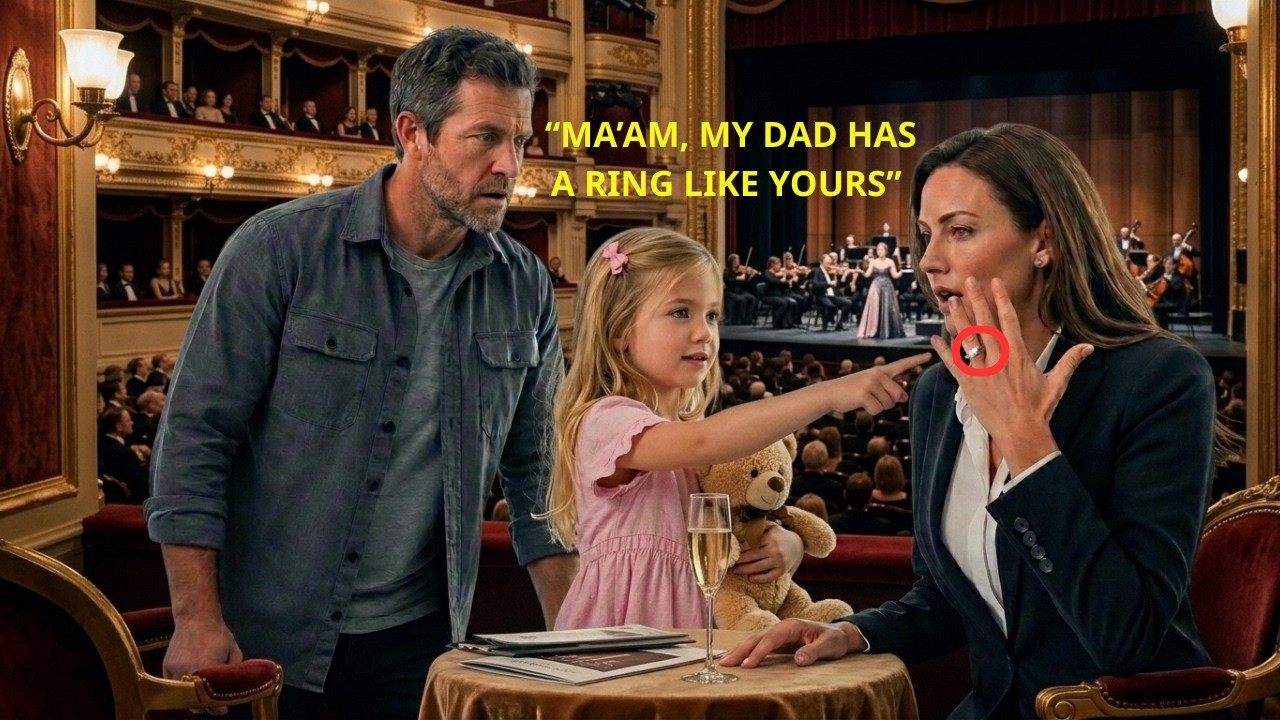
The entire executive dining room went silent when six-year-old Violet Cole pointed at Eleanor Whitfield’s hand and said, with the careless confidence only a child could manage:
“Ma’am, my dad has a ring like yours.”
Eleanor’s coffee cup stopped halfway to her lips.
Across the white linen table, two board members glanced at each other. The head of security shifted his weight. Violet’s father, standing near the service entrance in a gray maintenance uniform, looked as though someone had struck him in the chest.
“Violet,” Sebastian Cole said quietly.
But the little girl had already stepped closer.
“It has the same stars,” she continued, pointing at the white ring on Eleanor’s right hand. “Dad looks at his every morning before work.”
Eleanor Whitfield, founder and chief executive of Whitfield Aerospace, had spent thirty years training herself never to show surprise.
That morning, in front of twelve senior executives and a room full of employees, every bit of color drained from her face.
“Where did your father get his ring?” she asked.
Sebastian crossed the room before Violet could answer.
“We should go,” he said.
Eleanor looked up at him.
For a moment, neither of them moved.
Then her eyes dropped to his right hand.
He wore no ring.
But the pale line around his finger was unmistakable.
Sebastian gently took Violet by the shoulder and guided her toward the door.
Behind them, Eleanor rose so quickly that her chair scraped across the marble floor.
“Mr. Cole,” she called.
He stopped.

Her voice was no longer the voice she used in interviews, earnings calls, or board meetings.
It was smaller.
Almost afraid.
“Please.”
Sebastian did not turn around.
“My shift started seven minutes ago, Ms. Whitfield.”
Then he walked out with his daughter.
Every morning in apartment 4B began the same way.
Sebastian woke before sunrise, packed Violet’s lunch, fixed her hair with uneven concentration, and burned at least one piece of toast.
Their apartment was small enough that Violet could speak to him from almost anywhere and know he would hear her.
“Why do socks disappear in the washing machine?”
“I think they’re building a new life somewhere.”
“Why do grown-ups drink coffee if it tastes bad?”
“Because eventually sleep stops listening.”
“Why do you always check the door twice?”
“Because once is for the lock. Twice is for peace of mind.”
Violet accepted most answers, but she never stopped observing.
That morning, while Sebastian tightened the laces on his work boots, she saw him open the top drawer beside his bed.
Inside was a white ring.
It was wider than a wedding band, made of a material that looked like polished bone. Across its surface, tiny dark marks formed the shape of Orion.
Violet had seen it many times, but Sebastian rarely wore it.
He only held it.
He would turn it between his fingers, study the constellation, and place it back in the drawer.
“What does it do?” Violet asked.
“Nothing.”
“That’s not true.”
Sebastian smiled. “Why not?”
“Because you look at it like it talks.”
He lowered his eyes to the ring.
“It reminds me who I am.”
“You forget?”
“Sometimes.”
Violet considered that.
Then she pulled a purple marker from her backpack and drew three crooked stars on the back of his hand.
“There. Now you have a backup.”
Sebastian laughed, kissed her forehead, and drove her to school before starting his shift at Whitfield Aerospace.
He had worked there for eleven months as a facilities technician.
Most employees knew him as the man who fixed broken door sensors, replaced ceiling panels, and stayed late when conference room lights failed before important meetings.
He was quiet, capable, and nearly invisible.
That was how Martin Hale preferred people in maintenance to be.
Hale was Whitfield Aerospace’s chief operating officer, a polished executive with silver hair and a habit of checking people’s badges before making eye contact.
He had joined the company eight years earlier and risen quickly by making himself indispensable to Eleanor.
He controlled schedules, internal reports, contractors, department budgets, and access to the executive floor.
He also believed titles revealed a person’s value.
On Sebastian’s third week, Hale had found him studying a damaged ventilation control board outside the propulsion laboratory.
“Do you know what you’re looking at?” Hale had asked.
“The voltage regulator is overheating.”
Hale smiled as if speaking to a child. “Facilities doesn’t touch laboratory systems.”
“The lab system is connected to the building circuit.”
“It isn’t your concern.”
Three hours later, the regulator failed and shut down the lab’s environmental controls.
A test had to be postponed.
Hale blamed the maintenance department.
Sebastian said nothing.
That silence became a pattern.
When Sebastian warned that a subcontractor was installing the wrong grade of heat-resistant sealant, Hale dismissed him.
When Sebastian identified a software fault in the loading dock sensors, Hale told him to submit a ticket.
When Sebastian quietly repaired a calibration unit that had confused three engineers, Hale took credit for “coordinating the response.”
Sebastian never argued.
He went home, made dinner for Violet, checked her spelling homework, and looked at the white ring before bed.
Then came Bring Your Child to Work Day.
Violet’s school had closed unexpectedly because of a water main break. Sebastian had no family nearby and could not afford to lose a shift.
His supervisor, Lena Ortiz, told him to bring Violet.
“She can sit in the break room,” Lena said. “I’ll find her some colored pencils.”
Violet lasted twenty-three minutes in the break room.
By nine-thirty, she had met two engineers, asked a security guard why his shoes were shinier than his badge, and convinced a receptionist to show her the glass model of the company’s first satellite.
At ten, she followed Sebastian to the executive dining room, where a lighting panel had begun flickering during a board breakfast.
That was when she saw Eleanor’s ring.
The moment Sebastian had spent years avoiding arrived between a bowl of fruit and a silver coffee pot.
After he took Violet back downstairs, Lena found him standing inside a supply room with both hands braced against a metal shelf.
“You look sick,” she said.
“I’m fine.”
“That’s not what fine looks like.”
He closed his eyes.
Lena had worked at Whitfield Aerospace for eighteen years. She knew when not to push.
But before she could leave, Martin Hale appeared.
“What happened upstairs?” he demanded.
Sebastian straightened.
“My daughter commented on Ms. Whitfield’s ring.”
Hale studied him.
“What exactly did she say?”
“That I have one like it.”
“And do you?”
Sebastian did not answer.
Hale’s expression changed. Not much, but enough.
“Give me your badge.”
Lena stepped forward. “For what?”
“Hale—”
“This is a secure facility. An employee’s child approached the CEO during a confidential board breakfast.”
“She pointed at a ring,” Lena said. “She didn’t steal missile plans.”
Hale ignored her.
“Badge, Mr. Cole.”
Sebastian removed it and placed it in Hale’s palm.
Violet, standing behind him, looked from one adult to another.
“Is my dad in trouble?”
Hale glanced down at her.
“Your father should have understood his place.”
The supply room became completely still.
Sebastian’s face did not change, but Lena saw his jaw tighten.
He crouched beside Violet and zipped her jacket.
“We’re going home.”
“Did I do something bad?”
“No.”
“Then why are we leaving?”
“Because sometimes adults make decisions before they understand what happened.”
Hale folded his arms.
Sebastian stood.
“You’ll receive information from Human Resources,” Hale said.
Sebastian nodded once and walked away.
By noon, his access had been suspended.
By two, an email had been sent to department leaders saying a facilities employee had violated executive security protocols.
By four, someone had leaked the incident to an internal company chat.
The comments came quickly.
Who brings a kid to the executive floor?
Probably looking for money.
Maybe he planted the story about the ring.
Security should search his locker.
Sebastian read none of them.
He sat at the kitchen table while Violet colored a picture of Orion.
“Are you fired?” she asked.
“I don’t know.”
“Are we going to lose the apartment?”
He looked at her sharply.
“Who told you that?”
“No one. You always look at the bills twice when money is bad.”
Sebastian leaned back in his chair.
At six years old, Violet already understood more than he wanted her to.
“We’re going to be okay,” he said.
“Is that a true answer or a dad answer?”
He almost smiled.
“Both.”
A knock came at the door.
Sebastian expected Lena.
Instead, Eleanor Whitfield stood in the hallway.
There was no driver behind her, no assistant, no security team.
Only Eleanor, wearing the same navy suit from the breakfast and holding a slim leather folder.
Violet looked around Sebastian’s leg.
“That’s the ring lady.”
Eleanor gave her a faint smile.
“Yes. I suppose I am.”
Sebastian did not invite her inside.
“How did you find my address?”
“I own the company that employs you.”
“Employed.”
Her expression tightened.
“I did not authorize your suspension.”
“You created a company where Martin Hale could do it without asking you.”
The words landed harder than if he had raised his voice.
Eleanor looked past him into the apartment.
The secondhand furniture. The school drawings taped to the wall. The work boots beside the door.
Then she looked at Sebastian again.
“May I see the ring?”
“No.”
“Mr. Cole—”
“You came here because a child embarrassed you in front of your board.”
“I came because I have spent twenty-seven years looking for the other ring.”
Sebastian’s hand tightened on the doorframe.
Eleanor opened the folder.
Inside was an old photograph.
Three young engineers stood beside a silver prototype aircraft in a warehouse. One was Eleanor, decades younger. Beside her was a broad-shouldered man with Sebastian’s eyes.
The third man was Martin Hale.
Violet pushed closer.
“That looks like you, Dad.”
“It’s my father,” Sebastian said.
Eleanor nodded.
“Dr. Samuel Cole.”
The name seemed to change the air in the hallway.
Samuel Cole had been one of Whitfield Aerospace’s original engineers.
His name did not appear on the company’s website.
It did not appear in the lobby exhibit honoring the founding team.
It did not appear in Eleanor’s autobiography.
According to every official company history, Whitfield Aerospace had been founded by Eleanor Whitfield with early operational support from Martin Hale’s late father.
But the photograph told a different story.
“My father designed the first guidance system,” Sebastian said. “You designed the airframe. Together, you built the prototype.”
Eleanor’s eyes filled with something Violet did not understand.
Shame.
“Yes.”
“And when the investors came?”
Eleanor looked down at the ring on her hand.
“We were desperate. The prototype worked, but the company was weeks from collapsing. Samuel discovered that one of our backers planned to redirect military research funds through shell contractors. He wanted to report it.”
“You wanted him to wait.”
“I wanted time to save the company.”
“You wanted him quiet.”
Eleanor did not deny it.
Sebastian continued.
“Then the hangar fire destroyed the records. My father died six months later, and the company announced that he had been a consultant.”
“I did not write that statement.”
“But you signed it.”
Eleanor flinched.
Violet looked between them.
“Was Grandpa bad?”
“No,” Sebastian said immediately. “Grandpa told the truth.”
Eleanor’s voice broke.
“And I was too afraid to stand beside him.”
For several seconds, no one spoke.
Then Sebastian held out his hand.
Eleanor placed the photograph in it.
“You should leave,” he said.
“There’s more.”
“There’s always more after rich people are caught.”
She accepted the anger without defending herself.
“Martin knows who you are.”
Sebastian’s eyes lifted.
“He recognized your name the day you were hired,” Eleanor said. “He has been monitoring you ever since.”
That explained the dismissals.
The missing reports.
The way Hale’s face had changed when he heard about the ring.
Eleanor opened the folder again and removed several printed emails.
That afternoon, after leaving the executive dining room, she had ordered the company’s legal team to search archived communications related to Sebastian’s employment.
They found Hale’s messages to Human Resources.
Do not place Cole near executive operations.
Limit system access.
Flag any inquiries into historical project records.
If he raises concerns regarding legacy documentation, send them directly to me.
Sebastian read each page without speaking.
“He didn’t suspend me because Violet approached you,” he said.
“No.”
“He suspended me because she exposed the connection.”
“Yes.”
Violet tugged on Sebastian’s sleeve.
“Dad, why does Mr. Hale care about Grandpa’s ring?”
Sebastian looked at Eleanor.
She went pale again.
Because the ring was not only a symbol.
It was a key.
The original rings had been made from the heat shield of the first prototype. Samuel and Eleanor each received one after their first successful unmanned flight.
Inside both bands, invisible unless held under ultraviolet light, Samuel had engraved separate halves of an archive code.
He had feared the financial records would be destroyed.
So he had created two encrypted backups.
One code was hidden in Eleanor’s ring.
The other was hidden in his own.
Neither archive could be opened alone.
Eleanor had spent years believing Samuel’s ring had been lost after his death.
Martin Hale had spent years making sure it stayed lost.
The next morning, Whitfield Aerospace’s board convened an emergency meeting.
Martin Hale arrived first.
He wore a charcoal suit and carried a prepared statement explaining why a “disgruntled maintenance employee” had been removed for violating security policy.
At nine exactly, Eleanor entered.
Sebastian walked beside her.
He was no longer wearing his maintenance uniform.
He wore a plain dark jacket, a white shirt, and his father’s ring.
Violet came behind them holding Lena Ortiz’s hand.
Hale stopped speaking.
His gaze locked on Sebastian’s right hand.
The change in his face was immediate.
His confident expression collapsed. His lips parted, but no words came. One hand moved toward the table, searching for balance.
Eleanor placed her leather folder in front of the board chair.
“Before Mr. Hale continues,” she said, “the board will review a recovered archive concerning the company’s founding, the theft of intellectual property, and the deliberate concealment of financial crimes.”
Hale stood.
“This is absurd.”
Sebastian remained near the door.
Hale pointed at him.
“That man is a facilities worker. He has no standing in this room.”
Sebastian lifted his hand, and the white ring caught the light.
Hale’s finger slowly dropped.
Around the table, board members watched his face.
They saw the exact second he understood.
The maintenance worker he had humiliated was not looking for access to the company’s history.
He was the company’s history.
Eleanor placed her ring beside Sebastian’s under a portable ultraviolet scanner.
Two sequences appeared.
Legal counsel entered them into an isolated computer.
The archive opened.
It contained Samuel Cole’s original designs, investor correspondence, financial transfers, audio recordings, and a signed memorandum showing that Martin Hale’s father had redirected funds through contractors he controlled.
It also contained recent files.
Someone had accessed the old shell accounts within the past year.
The digital signatures belonged to Martin Hale.
His chair made a soft sound as he sat down.
No one asked him to.
“You don’t understand the pressure this company was under,” he said.
Eleanor stared at him.
“That is almost exactly what I told myself twenty-seven years ago.”
Hale looked around the room for support.
There was none.
The board chair closed the folder.
“Mr. Hale, security is waiting outside.”
Two officers entered.
For years, Hale had moved through the building without ever being asked to show his badge.
That morning, security removed it from his jacket before escorting him through the glass doors.
Employees lined the corridor.
No one spoke.
Lena stood beside Violet.
Violet watched Hale pass, then whispered, “He understands his place now.”
Lena covered a cough that sounded suspiciously like a laugh.
The consequences reached far beyond one executive.
Federal investigators opened a case into the shell companies and recovered millions in diverted funds.
Martin Hale was charged with fraud, evidence tampering, and obstruction.
Three board members resigned after records showed they had ignored irregularities.
Eleanor ordered the company’s official history removed from every public platform until it could be corrected.
One month later, a new exhibit opened in the main lobby.
At its center stood the restored prototype.
Beneath it were three words:
Designed by Samuel Cole.
Eleanor offered Sebastian an executive position overseeing systems integrity.
He declined.
Then she offered him the role of director of technical operations, with authority to create a reporting system that allowed any employee—engineer, custodian, technician, or intern—to raise safety concerns without approval from senior management.
That job, he accepted.
Not because of the title.
Because the first policy he wrote required every warning to be evaluated on evidence, not rank.
Lena became his deputy.
The technician who had once been told not to touch laboratory systems was now responsible for making sure no one’s expertise could be dismissed because of the uniform they wore.
Eleanor also transferred a significant portion of her founding shares into a trust bearing Samuel Cole’s name.
The trust funded scholarships for children of hourly workers and legal support for employees who reported corporate wrongdoing.
At the public announcement, reporters asked Sebastian whether he had forgiven her.
He looked toward Eleanor, who stood several feet away without trying to influence his answer.
“Forgiveness isn’t a press release,” he said. “It’s what someone earns after the cameras leave.”
Eleanor lowered her eyes.
She understood.
Months later, on an ordinary Tuesday morning, Sebastian stood in the apartment kitchen burning toast.
They could have moved immediately, but he had refused to make Violet’s life change overnight.
She still attended the same school.
She still asked impossible questions.
She still drew stars on his hands.
As Sebastian prepared to leave, he opened the drawer beside his bed.
The ring was no longer there.
He was wearing it.
Violet noticed.
“You don’t forget who you are anymore?”
Sebastian looked at the small white band.
For years, it had carried grief, anger, and a truth no one wanted to hear.
Now it carried something else.
Proof that silence could be broken.
“No,” he said. “But sometimes other people need reminding.”
Violet nodded as though this made perfect sense.
Then she picked up her backpack and reached for his hand.
A powerful man had spent years believing a maintenance uniform made Sebastian Cole invisible.
A frightened woman had spent decades believing the truth was too costly to admit.
In the end, it took a six-year-old girl pointing at a ring to expose them both.
Because the truth does not care how important you are.
It only waits for someone brave enough to say, “I’ve seen that before.”