The Colonel Asked Her Call Sign—Then “Phantom Seven” Brought a Dead Mission Back to Life
Chapter One
The Name That Broke the Room
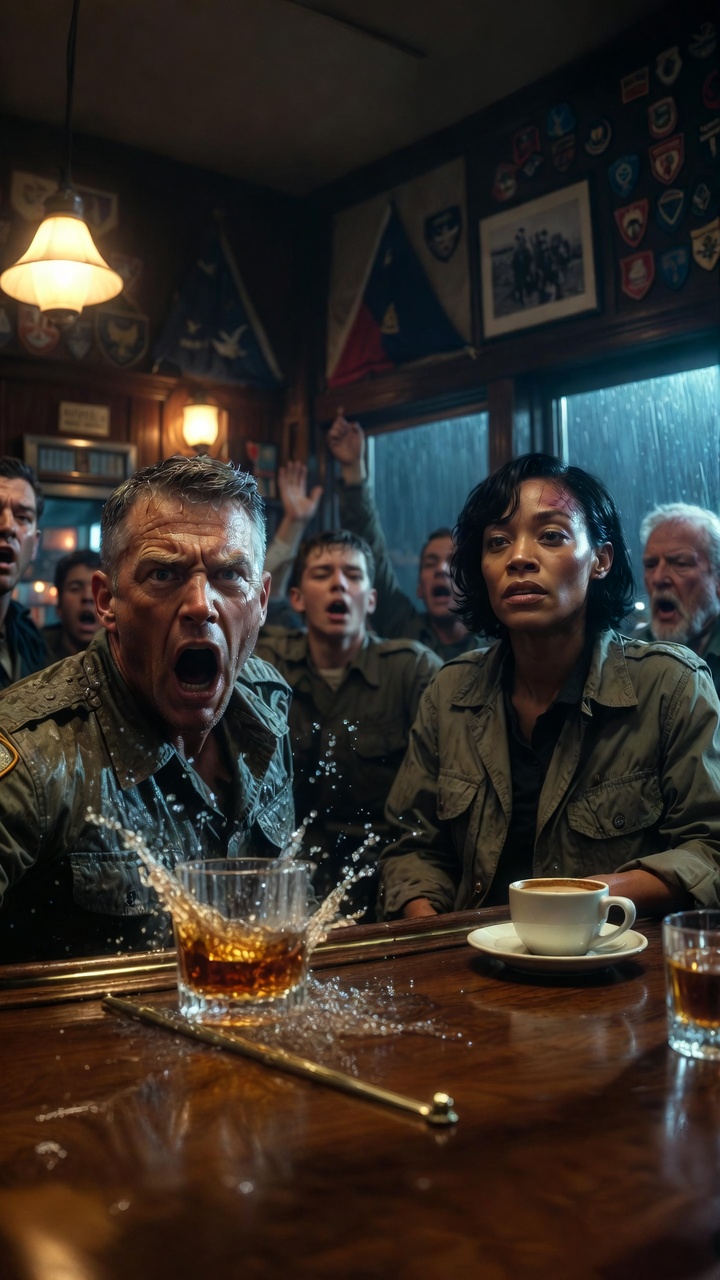
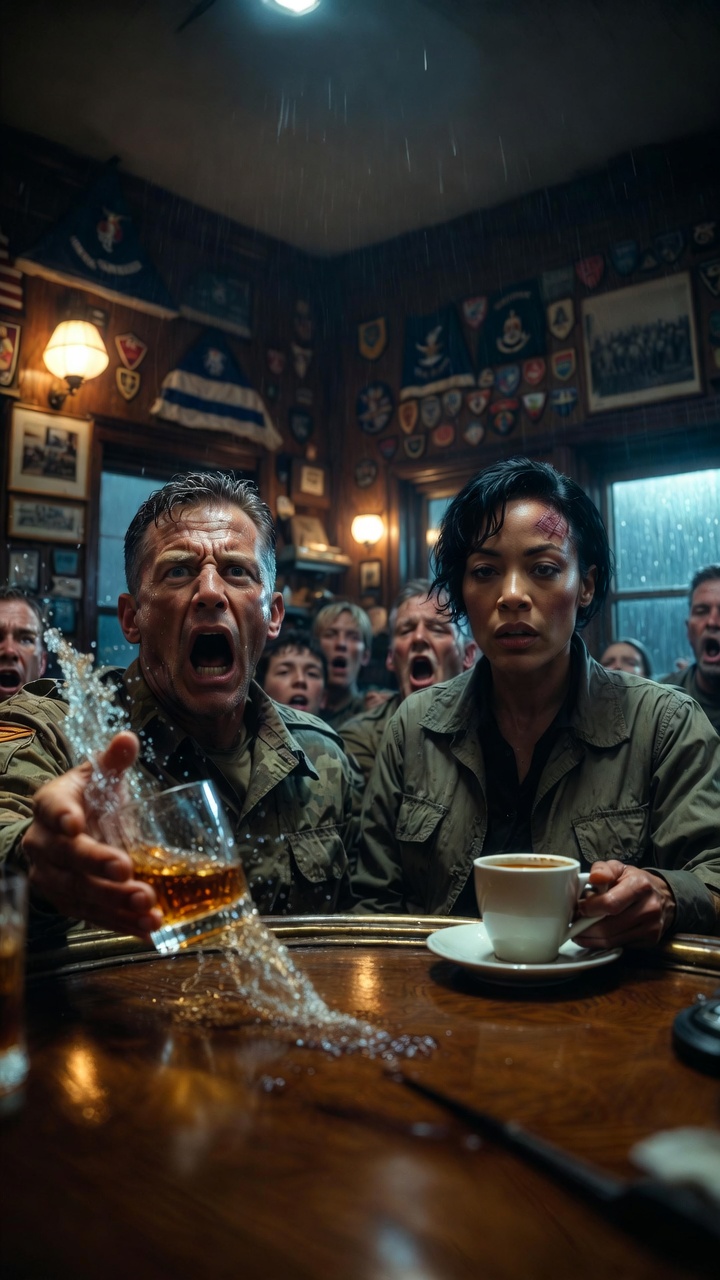
The glass slipped from Colonel Nathan Cole’s hand before anyone understood why.
It struck the brass rail beneath the bar, bounced once, and shattered across the floor of the Last Watch Tavern.
Conversation died in pieces.
A jukebox near the pool tables continued playing an old Johnny Cash song, but even the music seemed suddenly too loud.
Cole remained frozen on his stool.
Bourbon ran from his empty fingers. A thin line of it followed the creases in his knuckles and dripped onto the polished oak.
Across from him, the woman in the faded field jacket did not move.
She was perhaps forty-two, though the pale scar curving from her left temple to the edge of her eyebrow made age difficult to judge. Rain had darkened the shoulders of her coat. Her black hair was threaded with gray and cut short enough that it could not fall into her eyes.
Those eyes stayed on Cole.
Calm.
Watchful.
Not cold. Coldness required distance, and she appeared to notice everything—the bartender’s hand hovering beneath the counter, the retired sergeant near the door shifting his weight, the young Marine at the pool table reaching instinctively toward a weapon he was not permitted to carry inside.
Cole’s lips parted.
“Say it again.”
The woman rested both hands around a cup of untouched coffee.
“You heard me.”
“Call sign,” Cole said. “What was it?”
A pause.
Outside, wind drove rain against the tavern windows.
“Phantom Seven.”
The young Marine near the pool table stopped breathing.
At a corner booth, Gunnery Sergeant Paul Dempsey—retired twenty-one years and missing two fingers from his right hand—slowly rose to his feet.
“No,” he whispered.
The woman looked toward him.
Dempsey’s face drained of color.
Cole pushed away from the bar so quickly that his stool scraped backward.
“Who are you?”
“Mara Voss.”
“That isn’t what I asked.”
“It’s the only answer you’re getting in this room.”
The bartender, Lena Ortiz, stepped from behind the counter. She was fifty-six, broad-shouldered, and wore her silver hair braided down her back. The tattoo of a Navy corpsman’s caduceus showed beneath her rolled sleeve.
“Nathan,” she said softly, “sit down.”
Cole ignored her.
“Phantom Seven died in Sangar Pass.”
Mara lifted her coffee. Steam touched the scar beside her eye.
“People die in reports all the time.”
A murmur traveled through the tavern.
The Last Watch stood three miles from the gates of Camp Lejeune, and nearly every person inside had worn a uniform or loved someone who had. The walls were covered with unit patches, folded flags, framed photographs, and names carved into black walnut.
Among those photographs was a grainy image from eighteen years earlier.
Men crouched behind a mud wall under a sky the color of smoke. Several were wounded. One looked directly at the camera with blood across his face.
Beneath the photograph, a brass plate read:
SANGAR PASS — 3RD BATTALION, 8TH MARINES
FORTY-ONE CAME HOME
No photograph of Phantom Seven hung on the wall.
No one had ever known what Phantom Seven looked like.
Cole’s gaze moved from Mara to the framed picture.
“You’re lying.”
Mara reached beneath her field jacket.
Half the room tensed.
She withdrew a small metal object and placed it on the bar.
Cole stared at it.
It was a flattened rifle casing. A narrow groove had been cut around its center, and seven short lines had been scratched into the brass.
Cole had seen that symbol once before.
At dawn in Sangar Pass.
It had been tied to the radio antenna of a dead insurgent’s truck—the first marker in a path that led forty-one Marines out of a valley that should have become their grave.
Dempsey came closer.
His prosthetic fingers clicked softly against the table as he steadied himself.
“Where did you get that?”
“I made it.”
His eyes lifted to hers.
For a moment, the tavern disappeared from his face. He was no longer a retired gunnery sergeant standing beneath warm lights. He was twenty-six again, kneeling in dust while bullets struck the stones around him.
His voice trembled.
“You told us to follow the white rocks.”
Mara nodded once.
Dempsey swallowed.
“You said the eastern ridge was mined.”
“It was.”
“You said there would be a dry channel beneath the fig grove.”
“There was.”
His jaw tightened.
“We lost six men trying to reach it.”
“I know.”
Dempsey flinched as though she had struck him.
Mara did not look away.
“I heard every name over the radio.”
Cole seized the rifle casing.
“Where have you been?”
“Trying to stay dead.”
“Why come back now?”
“Because someone is finishing the mission.”
The bartender locked the front door.
The click of the bolt cut through the silence.
Cole’s fingers closed around the brass.
“What does that mean?”
Mara glanced toward the rain-streaked window.
A dark sedan sat across the road with its lights off.
It had been there when she arrived.
The figure behind the wheel had not entered the tavern.
“Three men who survived Sangar Pass died in the last eleven days,” she said. “Lieutenant Aaron Bell drove off a dry bridge in Virginia. Radio Chief Owen Park supposedly shot himself in his kitchen. Major Luis Ortega drowned in six feet of water.”
Cole’s face hardened.
“Ortega couldn’t swim.”
“He taught water survival at Quantico.”
A chair creaked in the back of the room.
Mara turned her head.
The motion was small, but every muscle beneath her jacket changed with it.
The dark sedan’s headlights came on.
“Down,” she said.
No one obeyed quickly enough.
The first round punched through the front window.
It crossed the tavern in a white blur and buried itself in the wooden wall exactly where Cole’s head had been.
Mara struck him behind the knees.
He fell as the second shot exploded a bottle above the bar.
Glass and bourbon rained over them.
People shouted. Tables overturned. Lena killed the lights.
Darkness swallowed the room.
Mara crawled behind the bar, seized Cole’s collar, and dragged him with surprising force.
“Back exit?”
“Kitchen.”
“Move.”
Another bullet tore through the window.
Dempsey shouted for everyone to stay low.
Mara and Cole reached the kitchen as Lena pulled a shotgun from beneath the counter.
“You brought this here?” Cole hissed.
Mara shoved open the rear door.
Cold rain swept inside.
“No,” she said. “You did.”
Cole stared at her.
She pointed toward his chest.
Beneath his shirt, suspended from a chain, was the corner of a folded plastic map sleeve.
Cole covered it instinctively.
Mara’s expression changed.
Not triumph.
Recognition.
“You kept it.”
His eyes narrowed. “Kept what?”
“The last map from Sangar Pass.”
A round struck the metal doorframe and sprayed sparks across the kitchen.
Mara pulled Cole into the alley.
They ran through the rain as the dark sedan accelerated around the corner.
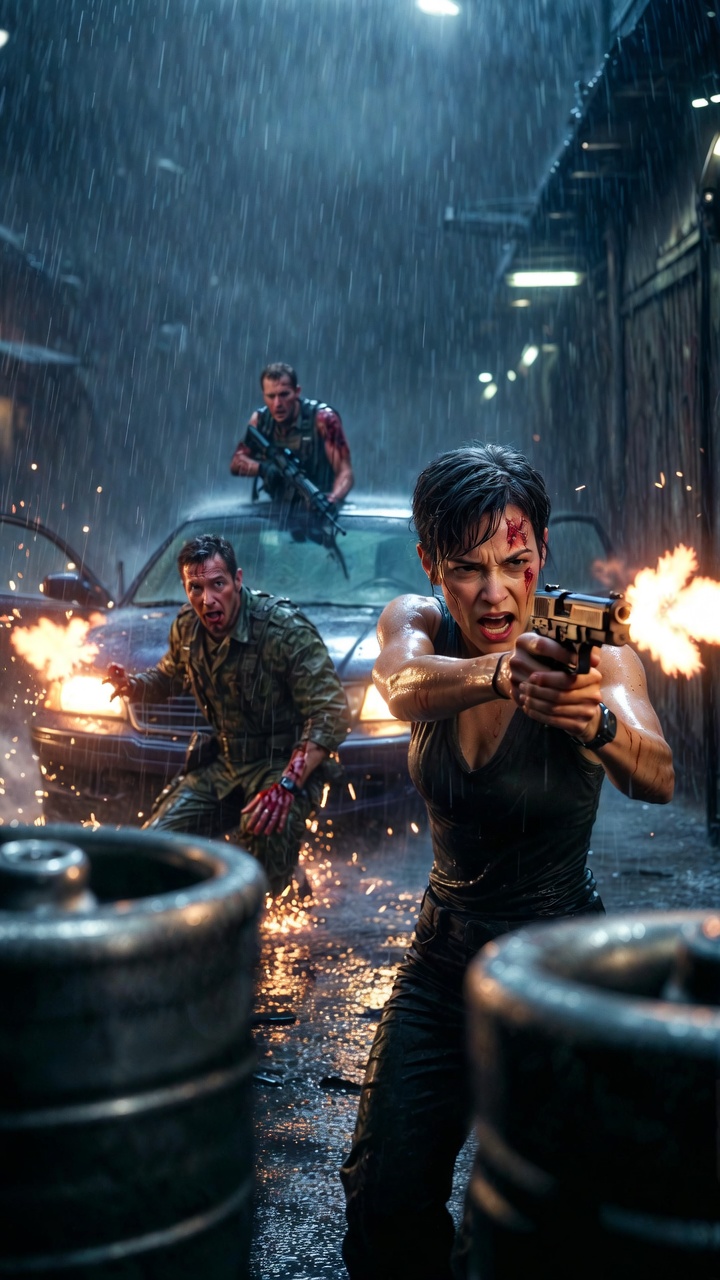
Before Cole could ask another question, Mara drew a compact pistol from the back of her waistband.
She fired twice.
One shot broke the sedan’s left headlight.
The other struck the front tire.
Rubber burst.
The car swerved toward them.
Mara pushed Cole behind a dumpster and rolled in the opposite direction. The sedan clipped a brick wall, spun across the alley, and slammed into a stack of beer kegs.
The driver’s door opened.
A man stepped out with a rifle.
He wore no mask.
Cole recognized him.
His mouth went dry.
“Evan?”
The shooter hesitated.
That half second saved Cole’s life.
Mara fired.
The round struck the man’s shoulder, turning him sideways. His rifle discharged into the pavement.
He scrambled back into the car and forced the damaged vehicle down the alley, sparks pouring from the wheel.
Cole remained on one knee in the rain.
“Captain Evan Shaw,” he said. “He served under me.”
Mara watched the sedan disappear.
“Not anymore.”
Cole looked at the shattered tavern window, at the people crouching inside, at the blood beginning to spread from a cut along his palm.
Then he looked down at the map sleeve beneath his shirt.
For eighteen years, he had told himself he kept it because Marines did not throw away the last thing their dead had touched.
Now someone had fired into a crowded bar to retrieve it.
“What’s on this map?” he asked.
Mara replaced her pistol.
“The reason Phantom Seven had to die.”
From somewhere beyond the buildings, sirens began to rise.
Mara turned toward the darkness at the end of the alley.
“And the man who buried me just learned I’m still breathing.”
Chapter Two
Forty-One Came Home
They abandoned Cole’s truck at a grocery store and left in Mara’s vehicle, an aging gray pickup with mud on the license plate and nothing inside that revealed who owned it.
Cole sat in the passenger seat with a towel wrapped around his bleeding hand.
Rain swept across the highway.
Mara drove without using the GPS. She took three unnecessary turns, passed beneath an overpass twice, and watched the mirrors more often than she watched the road ahead.
Cole noticed.
“You think we’re being followed?”
“I think people who ask that question usually haven’t checked.”
He turned in his seat.
The rear window showed nothing except wet pavement and scattered headlights.
“You shot one of my officers.”
“I shot a man who fired into a tavern.”
“Evan Shaw received the Silver Star.”
“So did men who left better people behind.”
Cole’s jaw tightened.
“You know nothing about him.”
“I know his rifle had a brass catcher.”
Cole looked at her.
“He didn’t want shell casings left at the scene,” Mara continued. “His plates were stolen, his face was uncovered, and he waited until you recognized him before retreating.”
“He hesitated.”
“No. He made sure you saw him.”
“Why?”
“To frighten you. Or to make you believe you know who the enemy is.”
Cole studied her profile.
A faint muscle pulsed beside her scar. She appeared composed, but her left hand held the steering wheel too tightly.
“Where are we going?”
“A place without windows.”
“That narrows it down.”
She glanced at him.
It was the first indication that she possessed a sense of humor.
They drove for twenty minutes before turning onto an industrial road lined with storage facilities. Mara stopped at a row of metal units, opened one with a key, and drove the pickup inside.
The door rolled down behind them.
Darkness pressed against the cab.
Mara switched on a battery lantern.
The storage unit held a folding table, two cots, bottled water, medical supplies, several sealed cases, and a wall covered in printed photographs.
Cole stepped from the truck.
The air smelled of oil, dust, and cold metal.
He approached the photographs.
Aaron Bell stood outside a courthouse with his wife.
Owen Park sat beside a fishing boat.
Luis Ortega held a grandchild on his shoulders.
Each image had a date written beneath it.
Beside them were photographs of men Cole had not seen in years.
Survivors of Sangar Pass.
Some had red lines drawn through their names.
Cole turned.
“How long have you been watching them?”
“Six months.”
“Why?”
“Because someone else started first.”
Mara removed her wet jacket.
Underneath, she wore a plain black shirt. The fabric pulled tightly across her right shoulder, revealing an old injury that limited the movement of her arm.
Cole noticed another scar along her forearm.
A burn, not a bullet wound.
“You knew Bell?”
“He found me last winter.”
“How?”
“He spent twelve years searching.”
“For Phantom Seven?”
“For the truth.”
Mara opened a metal box on the table. Inside were photocopies of military reports, satellite photographs, handwritten notes, and a small digital recorder.
She selected one report and handed it to Cole.
He recognized the cover page.
OPERATION BLACK LANTERN
SANGAR DISTRICT
14 OCTOBER 2008
Much of the text had been blacked out.
Cole read the first visible paragraph.
At 0410 local time, elements of 3rd Battalion, 8th Marines entered the Sangar Valley to secure a suspected weapons-transfer corridor.
He stopped.
“That wasn’t our mission.”
“No.”
“We were ordered to capture Hadi Qasem.”
“No.”
Cole looked up sharply.
Mara placed another document beside the report.
It was a satellite image of the valley. Several buildings had been circled in blue. A route ran through the center of the village.
Cole knew the route.
He had approved it.
“We were told Qasem would meet his commanders here.” He touched the largest building. “The source confirmed it twice.”
“The source never mentioned Qasem.”
“Then why were we sent in?”
“To create noise.”
Cole stared at her.
Mara tapped the western edge of the satellite image.
“While your battalion entered through the south, a classified recovery team crossed this ridge.”
“Recovery of what?”
“Not what. Who.”
The lantern hummed between them.
Cole removed the plastic map sleeve from beneath his shirt.
It was worn cloudy with age. Inside lay a folded grid map stained by water, dirt, and something brown at the edges.
Blood.
“I found this beside Sergeant Tully’s body,” he said. “It wasn’t part of our issued set.”
Mara’s gaze remained fixed on it.
“No. It was mine.”
“You carried it?”
“For nine hours.”
“You were on the eastern ridge.”
“For part of the night.”
Cole unfolded the map carefully.
Seven locations had been marked in red grease pencil. White lines followed a narrow route through terrain his battalion had believed impassable.
In the lower corner, a set of coordinates had been written in a different hand.
Cole had never understood them.
Mara touched the numbers.
Her fingers trembled once.
“Farid wrote these.”
“Your interpreter?”
“My partner.”
Cole’s eyes moved to her face.
The official report listed a local interpreter named Farid Najjar as a suspected enemy collaborator. His warning had allegedly directed the Marines into the ambush.
Cole remembered spitting on the ground when the name was read during the investigation.
“You worked with the man who betrayed us?”
Mara’s hand left the map.
“He didn’t betray you.”
“His radio transmissions brought three hundred fighters into that valley.”
“His transmissions kept them away from the western ridge.”
Cole struck the table with his uninjured hand.
“My Marines walked into interlocking machine-gun fire.”
“And Farid spent the next eleven hours preventing a second force from closing behind them.”
“I read the intercepts.”
“You read translations provided by Major Elias Rourke.”
The name silenced him.
Elias Rourke had been the senior intelligence officer assigned to Operation Black Lantern.
Today he was a retired three-star general, chairman of the National Veterans Security Council, and a regular presence on television whenever the country needed a calm voice in a dark suit.
He had attended funerals from Sangar Pass.
He had stood beside widows.
He had pinned medals on survivors.
Cole folded his arms.
“Rourke saved careers after Black Lantern.”
“He saved his own.”
“You expect me to believe a lieutenant general ordered those killings?”
“I expect you to believe he ordered a secret kept. Other people decided how far they were willing to go to keep it.”
Mara switched on the digital recorder.
Static filled the storage unit.
Then a man’s voice spoke.
“Colonel Cole, if you’re hearing this, I finally found her.”
Aaron Bell.
The recording had been made recently. His breathing sounded strained.
“Phantom Seven is alive. Her real name is Mara Voss. The official report is a fabrication. Farid Najjar was not the source of the ambush. He was part of a compartmented recovery operation run by Rourke.”
Cole gripped the edge of the table.
Bell’s voice continued.
“Luis has the flight logs. Owen has the original intercept. I have the witness list. Cole has the field map, though I doubt he knows what’s inside it.”
Cole looked down.
Mara watched him.
On the recording, Bell took a slow breath.
“We need all four pieces. Without them, Rourke will call it confusion from an old battle. With them, we can prove he held back extraction aircraft for fifty-three minutes while Marines died.”
The audio clicked.
A different sound followed.
A door opening.
Bell whispered, “Someone’s here.”
Footsteps moved across the recording.
A man spoke in the distance.
“Aaron, you should have left the dead alone.”
Cole recognized the voice.
Captain Evan Shaw.
A struggle erupted. Furniture crashed. Bell grunted.
Then another voice entered—faint, controlled, almost gentle.
“Find the map.”
The recording ended.
Cole stared at the device.
“Rourke?”
“I can’t prove it.”
“But you believe it.”
“I believe Evan Shaw takes orders from someone.”
Cole touched the coordinates on the map.
“What’s here?”
“Something Farid died protecting.”
“You said this map proves why they buried you.”
“It might.”
“Might?”
“I never reached those coordinates.”
“Why not?”
Mara’s eyes hardened.
“Because I was carrying your Marines out of Sangar Pass.”
Cole recoiled as though the words had physical weight.
A telephone began to ring.
Not Cole’s.
Not Mara’s.
The sound came from inside one of the sealed cases.
Mara drew her pistol and opened it.
A disposable phone vibrated among spare ammunition and medical equipment.
She stared at the screen.
No number appeared.
She answered without speaking.
A man breathed on the other end.
Then Evan Shaw said, “Colonel Cole has six hours to return the map.”
Cole stepped closer.
“Evan?”
Silence.
“Why did you fire at me?”
“I missed you by three inches.”
“You never missed on my range.”
“That was the point.”
Cole’s face tightened.
“Who are you protecting?”
Evan released a tired breath.
“My son.”
Mara looked at Cole.
Cole leaned toward the phone.
“What does your son have to do with Sangar Pass?”
“Nothing. Which is why I need you to listen carefully.”
A metallic click sounded through the speaker.
A weapon being prepared.
“If the map isn’t at Pier Nineteen before dawn, they’ll kill him.”
“Who are they?”
Evan’s voice broke.
“The same people who erased Phantom Seven.”
A muffled shout erupted in the background.
A young man calling for his father.
Then the line went dead.
Cole looked at Mara.
She removed the phone’s battery.
“Pier Nineteen is a trap,” she said.
“That boy is twenty-three.”
“So were half the Marines in Sangar Pass.”
Cole grabbed the front of her shirt.
The movement was fast.
Mara’s pistol touched the underside of his jaw faster.
They stood locked together beneath the harsh lantern light.
Cole’s breathing came through his nose.
“You don’t get to decide another son is expendable.”
Mara’s eyes flashed.
For the first time, the stillness broke.
“I decided no such thing.”
“Then we go.”
“We go smart.”
He released her.
She lowered the weapon.
Cole turned toward the wall of dead men.
“Six hours.”
Mara looked at the field map.
“No,” she said.
She pointed to a faint indentation near its sealed edge.
Something thin had been hidden beneath the paper.
“We have less.”
She took a knife and carefully opened the old plastic sleeve.
A narrow strip of photographic film slid onto the table.
Mara held it toward the lantern.
Seven tiny images appeared in sequence.
The final frame showed Elias Rourke standing beside a helicopter at Sangar Pass.
Next to him was Farid Najjar.
Alive.
And between them stood a woman wearing Mara’s face.
Cole stared at the date printed along the film.
It had been taken twelve hours after Phantom Seven was officially declared dead.
Chapter Three
The Ghost in the Photograph
Cole sat on the edge of a cot while Mara enlarged the film images using a portable scanner.
Neither spoke.
The photographs emerged on a laptop one by one.
The first showed a helicopter on a barren plateau northwest of Sangar Valley.
The second showed armed men loading a stretcher.
The third showed Rourke speaking with a woman in civilian clothing whose face had been obscured by a scarf.
The fourth showed Farid.
The fifth showed Mara.
In the sixth, Rourke appeared to be shouting at her.
The seventh had been taken from farther away.
Mara stood with both hands raised while two American operators pointed rifles at her.
Cole studied the image.
“You were arrested.”
“Temporarily.”
“For what?”
“Refusing a direct order.”
“That’s not enough to erase a person.”
“It is when the order never existed.”
Cole looked at the woman beside the helicopter.
“Who was she?”
“Dr. Samira Qadir. Surgeon. Widow. Mother of three.”
“That doesn’t answer the question.”
“She ran a clinic in Sangar. For five years, she passed information about Hadi Qasem’s network to American intelligence.”
“The source.”
Mara nodded.
Cole looked back at the mission map.
“You said our battalion was a distraction.”
“Rourke believed Qasem had discovered Samira. A recovery team was sent to remove her and her children. Your battalion entered the valley to pull his fighters south.”
“He used two hundred Marines as bait.”
“He would say he used a combat unit to support a high-value extraction.”
“What would you say?”
Mara stopped typing.
“I would say seventeen Marines died without knowing their real mission.”
“Why deny air support?”
“The extraction helicopter had to cross the same air corridor. Rourke believed any gunship or medevac movement would reveal Samira’s location.”
Cole remembered the radio calls.
Men screaming coordinates.
A corpsman trying to keep pressure on a wound with one hand while transmitting with the other.
A pilot circling beyond the mountains, begging for authorization to enter.
Fifty-three minutes.
Cole had measured every one of them for eighteen years.
“He chose her over us.”
“He chose the intelligence she carried.”
“Did it matter?”
Mara met his eyes.
“Her information led to the seizure of chemical agents intended for attacks on three European rail stations.”
Cole looked away.
There it was.
The part no widow wanted to hear.
The equation written by people far from the blood: seventeen dead weighed against hundreds who might have died elsewhere.
Rourke had not acted for money.
He had not sold weapons.
He had not betrayed his country.
He had decided which Americans could be sacrificed without being asked.
That was worse in a way Cole could not immediately name.
“What happened after the photograph?”
“Samira and her children were flown out. Farid was ordered aboard.”
“But he wrote the coordinates.”
“He refused to leave.”
“Why?”
“Because the Marines were still trapped.”
Mara leaned back in the folding chair.
For several seconds, only the rain tapping against the metal roof could be heard.
“Farid carried a short-range transmitter built to imitate insurgent command traffic. He used it to draw fighters north while I guided your battalion east. Rourke ordered us to stop transmitting once Samira’s aircraft cleared the valley.”
“You refused.”
“We both did.”
“Then what?”
“Rourke sent a recovery team to shut us down.”
Cole studied the photograph of Mara with her hands raised.
“They detained you.”
“For eleven minutes.”
“And Farid?”
“He ran.”
“To these coordinates?”
“Yes.”
“Why didn’t you follow him?”
Mara stared at the enlarged photograph.
“When I escaped the team, your western platoon had collapsed. Dempsey was calling for help. I could hear children inside the village. I could hear Marines dying.”
Her fingers curled beside the laptop.
“I had two choices.”
Cole’s voice softened.
“You came to us.”
“I told Farid I would find him afterward.”
“But you never did.”
“By sunrise, Rourke had sealed the valley. I was placed on a flight under guard. Three days later, I signed documents stating that I had never entered Sangar District.”
“Why sign?”
“They showed me photographs of Samira’s children arriving at a safe house. They showed me surveillance of my mother’s apartment in Minnesota. Then Rourke placed a list of every Marine we had saved on the table.”
Mara’s mouth tightened.
“He said if the operation became public, the survivors would be questioned, careers would end, and Samira’s relatives would be executed. He said Farid had already been classified as a hostile collaborator. My testimony would only make the scandal larger.”
Cole rose.
“And you accepted that?”
“No.”
“You disappeared.”
“I spent four years trying to find evidence. Every record led back to altered files. Every witness received a warning. My mother’s home was broken into twice.”
“So you gave up.”
Mara stood.
The old shoulder injury made the movement stiff, but she did not shrink from him.
“I stopped involving people who could be hurt.”
“That sounds like giving up with better language.”
Her eyes narrowed.
“And drinking in a bar beneath the photograph of your dead men sounds like grief with a membership card.”
Cole’s fist moved before his mind caught up.
It stopped inches from her face.
Mara did not flinch.
Cole looked at his own hand.
Slowly, he lowered it.
“My son was killed nine years after Sangar,” he said.
Mara’s expression shifted.
“He joined the Corps because of me. He thought the uniform could turn a frightened boy into someone worth following.”
Cole touched the scar along his palm.
“His vehicle struck an explosive outside Ramadi. I had spent his entire childhood telling him Marines never leave their own behind.”
Mara said nothing.
“The last thing I said to him was that fear was a debt. Pay it early or it collects interest.”
Cole laughed once, without humor.
“He died two weeks later. I don’t know whether he was brave or terrified. I wasn’t there.”
Mara looked at the photographs on the wall.
“Fear isn’t a debt.”
“What is it?”
“A signal.”
“For what?”
“That something matters.”
Cole lowered himself onto the cot.
The anger had left his face. What remained was older.
Mara closed the laptop.
“We can rescue Evan’s son without surrendering the map.”
“How?”
“Pier Nineteen has been abandoned since the hurricane damaged the terminal. One road in, water on three sides.”
“You’ve been there?”
“No.”
“Then how—”
“I know the kind of place men choose when they want control.”
Cole looked at her scar.
“What do you want, Mara?”
“The truth about Farid.”
“That’s all?”
“No.”
She opened a case and removed two pistols, a pair of compact radios, and a wrapped rifle.
“I want Elias Rourke to say the names of the men he sacrificed without hiding behind the word necessity.”
Cole accepted one of the pistols.
“And if he won’t?”
“Then we make sure he can’t bury them again.”
The disposable phone rang despite its missing battery.
Both of them stared at it.
A small red light blinked beneath the casing.
Mara seized the phone and threw it into an empty steel container.
“Tracker.”
The storage unit’s exterior lock snapped.
Cole raised his weapon.
Boots moved outside.
Not one person.
Several.
Mara killed the lantern.
Darkness swallowed them.
A voice came through the metal door.
“Colonel Cole, place the map on the floor and step away.”
Cole recognized the disciplined rhythm.
Former military.
Mara moved beside the truck and whispered, “Rear wall.”
“It’s steel.”
“So is the truck.”
She climbed into the driver’s seat.
Cole understood.
“That wall opens into another unit?”
“It opens into a drainage ditch.”
The outer door began to rise.
A thin blade of light spread across the floor.
Men in tactical gear crouched beyond it.
Mara started the engine.
The pickup roared inside the confined space.
The first attacker shouted.
Mara reversed.
The rear bumper struck the steel wall.
Once.
Twice.
On the third impact, bolts tore free.
The wall folded outward.
Rain rushed through the opening.
Gunfire erupted behind them.
Cole fired through the rear window while Mara forced the truck into the drainage ditch. Mud sprayed across the windshield. A round punched through the dashboard.
The pickup climbed the opposite bank and burst onto a service road.
Two black vehicles raced from the facility.
Mara accelerated.
Cole twisted toward the rear window.
“Who are they?”
“Not Evan.”
“How do you know?”
She pointed toward the lead vehicle.
A white emblem had been painted inside its windshield.
A sword beneath three stars.
The insignia of Rourke’s private security foundation.
Cole raised his pistol.
Before he could fire, the dashboard warning lights flickered.
The engine coughed.
Mara looked down.
The fuel gauge dropped toward empty.
A bullet had ruptured the tank.
The pickup began to slow.
Behind them, the black vehicles closed the distance.
Ahead, the service road ended at a swollen river.
Cole looked at Mara.
“No bridge.”
“I know.”
“You have a plan?”
She shifted into a higher gear.
“Not one you’ll enjoy.”
At the riverbank, the pickup struck a maintenance ramp and launched into the darkness.
For a breathless second, there was no road beneath them.
Only rain.
Only black water.
Then the truck fell.
Chapter Four
Sangar Pass
The impact slammed Cole’s head against the roof.
Water swallowed the windshield.
The pickup pitched forward, nose sinking into the river while the rear wheels spun uselessly above the surface.
Mara released her seat belt.
“Window.”
Cole struck the glass with the emergency hammer mounted beneath the dashboard. The first blow cracked it. The second opened a hole. River water exploded into the cab.
The cold stole his breath.
Mara kicked through the windshield and pulled herself out.
Cole followed.
They surfaced beside the sinking truck as headlights gathered on the bank above.
Rounds struck the water.
Mara caught Cole by the collar and dragged him beneath the overhang of the maintenance ramp.
They pressed against wet concrete while the pickup disappeared.
Cole coughed river water onto the stones.
“The map.”
He reached beneath his shirt.
The plastic sleeve remained tied to its cord.
Mara nodded.
“Then the plan worked.”
“You call that a plan?”
“We aren’t being shot.”
Bullets chipped concrete above them.
Cole wiped blood from his forehead.
“I’m beginning to understand why your command wanted you dead.”
A flicker of amusement crossed Mara’s face.
It vanished quickly.
They moved along the river beneath the cover of the embankment. After half a mile, Mara led him through a drainage pipe and into a stand of pines.
Dawn remained several hours away.
They walked in silence.
The cold sharpened Cole’s memories.
Sangar had been cold at night, though by noon the valley became a furnace. Dust entered every seam of clothing. The mountains trapped sound and threw it back altered. A rifle shot from one ridge seemed to come from another.
He had arrived believing maps were honest.
By sunset, the map had become a collection of lies.
“We entered at 0410,” he said.
Mara walked beside him.
“I know.”
“First contact at 0517.”
“North wall of the school.”
“We thought it was a probing attack.”
“It was.”
“By 0600, they had us fixed from three ridges.”
“Yes.”
Cole pushed through wet branches.
“Where were you?”
Mara’s face remained forward.
“Above you.”
Sangar Pass, 2008.
Staff Sergeant Mara Voss lay beneath a sheet of gray cloth on the eastern ridge, watching two hundred Marines enter the valley through the scope of a suppressed rifle.
She was twenty-four years old.
Rain from the previous night had hardened the dust into dark crusts. The village below appeared deserted. Doors stood open. Cooking fires had gone cold.
Beside her, Farid Najjar adjusted the wires of a transmitter hidden inside an ammunition box.
He was thirty-one, thin, and always smelled faintly of cardamom tobacco. He had studied engineering before war turned his university into a barracks.
“You are frowning,” he whispered.
“I’m looking through a scope.”
“You also frown when eating.”
“Your cooking is dangerous.”
“My cooking has survived three governments.”
“So have the rats.”
Farid smiled.
Then his headphones crackled.
The smile disappeared.
“They know the Marines are coming.”
“How many?”
“More than expected.”
Mara shifted the scope toward the northern ridge.
Figures moved between stones.
“Rourke said the corridor would be clear.”
“Rourke says many things while sitting indoors.”
Mara keyed her radio.
“Lantern Control, Phantom Seven. Increased movement north and east. Recommend delay.”
Major Elias Rourke answered immediately.
“Negative, Phantom. Continue support of extraction.”
“The diversion force is entering a prepared position.”
“Your assessment is noted.”
“Sir, they’re walking into an ambush.”
“The source is in immediate danger.”
Mara watched the lead Marine column turn into the village.
A boy appeared in a doorway.
He raised both hands.
Behind him, a machine gun opened fire.
The first burst struck three Marines.
The valley erupted.
Rifles flashed from windows. Rockets descended from the ridges. The air filled with dust, stone fragments, and screaming radio traffic.
Mara fired.
One machine gunner fell backward.
She shifted, fired again, and broke a second firing position.
Farid activated the transmitter.
Insurgent voices poured through the device as he imitated a field commander ordering fighters toward the northern ridge.
Some obeyed.
Not enough.
Mara heard Colonel Cole—then a lieutenant colonel—trying to reorganize the battalion.
His voice remained steady.
The voices beneath his did not.
At 0622, the first request for air support was denied.
At 0638, the first medevac request was denied.
At 0649, Rourke ordered Phantom Seven to cease firing.
Mara ignored him.
At 0711, Farid intercepted a message that changed the battle.
“They are moving a second force behind the Marines.”
“How many?”
“Perhaps one hundred.”
Mara looked west.
The extraction team had reached Samira Qadir’s clinic. Operators moved her children toward a concealed landing zone.
“We need to warn Cole.”
“If we use the American channel, they will hear.”
“Then let them.”
Farid seized her wrist.
“If they discover the extraction, they will kill Samira before the helicopter arrives.”
Below them, a Marine crawled through the dust with one leg.
Mara watched another Marine leave cover to reach him.
The rescuer was shot through the neck.
“Then we lie,” she said.
Farid understood.
He changed frequencies and began broadcasting false orders in an insurgent commander’s voice.
The second enemy force turned north, chasing an American team that did not exist.
For forty minutes, Farid became a ghost army.
Mara became its rifle.
They shifted positions, leaving marked casings tied to branches and stones—seven lines scratched into the brass.
Each marker pointed toward a route through the eastern ridge.
At 0813, Samira’s helicopter arrived.
At 0816, Rourke ordered Mara and Farid to cease all transmissions.
At 0817, they refused.
At 0820, Rourke threatened court-martial.
At 0824, Farid laughed into the radio.
“Major, first we survive. Then you may arrest us.”
Mara remembered the exact silence that followed.
Rourke did not shout.
He spoke quietly.
“That transmitter is protecting a source whose intelligence may save hundreds of lives.”
Farid looked toward the Marines trapped below.
“And what do you call them?”
Rourke answered, “The mission.”
The extraction helicopter lifted from the plateau.
Mara watched it disappear over the western ridge.
“Samira’s clear,” she said. “Release air support.”
No answer.
“Lantern Control, release air support.”
Rourke returned to the channel.
“The enemy force remains too close to the extraction corridor.”
“The corridor is empty.”
“That cannot be confirmed.”
“I am confirming it.”
“You are not authorized to make that assessment.”
Below them, another rocket struck the Marine position.
Mara heard men shouting for a corpsman.
Then she heard Dempsey.
“Any station, any station, this is Reaper Three! We’re cut off at the east wall! I’ve got nine wounded and maybe sixty fighters moving toward us!”
Mara looked at Farid.
He was already packing the transmitter.
“You go,” he said.
“Not without you.”
“If we both go, the false net dies. They close behind the Marines.”
“We move the transmitter downhill.”
“It will not work beneath the ridge.”
“Farid—”
He handed her the map.
On it, he had marked a dry irrigation channel leading out of the village.
“You guide them. I keep the north force chasing ghosts.”
“You have twenty minutes.”
“I require thirty.”
“You have twenty.”
Farid smiled.
“Then I will waste ten arguing.”
Mara caught the back of his neck and pressed her forehead to his.
Neither spoke.
Their fear passed between them without language.
Then she left.
Mara descended the ridge alone.
She shot two fighters at the school wall, crossed an open courtyard under fire, and reached Dempsey’s position with blood running from her left temple.
He stared at her.
“Who the hell are you?”
“Follow the white rocks.”
“That’s your plan?”
“My plan was to stay on the ridge.”
She guided the wounded through alleys, cellars, and the dry channel Farid had found on old agricultural maps.
Every few minutes, his voice entered her earpiece.
He issued false commands.
He mocked enemy officers.
He whistled fragments of songs.
At 0916, his breathing changed.
Mara heard gunfire near his transmitter.
“Farid?”
“I am moving.”
“Where?”
“Toward the old observatory.”
“Coordinates?”
He read them to her.
The numbers now written in the corner of Cole’s map.
Then he said, “They have found the first position.”
Mara stopped beneath the fig grove.
Behind her, wounded Marines stumbled through the channel.
“You need to break contact.”
“I am attempting.”
“Attempt faster.”
A weak laugh entered her earpiece.
“Your bedside manner remains poor.”
A burst of gunfire cracked across the transmission.
Farid grunted.
“Farid?”
“I am all right.”
“You’re lying.”
“Then I have become American.”
His signal weakened.
Mara climbed onto a wall to gain line of sight.
Below, Cole’s remaining Marines were trapped two hundred yards from the channel.
She could reach Farid.
Or she could return to the village.
Not both.
Farid understood before she spoke.
“Go to them,” he said.
“I’ll come back.”
“Yes.”
“I mean it.”
“I know.”
She heard him insert a fresh magazine.
“Mara?”
“What?”
“If they tell my mother I betrayed them—”
“They won’t.”
“If they do, you tell her yourself.”
The transmission broke.
Mara waited.
“Farid?”
Static.
Then his voice returned one final time.
“Phantom Seven changing position.”
He had taken her call sign.
Not to steal it.
To keep the ghost alive while she went back for the Marines.
Mara turned toward the village.
For the next three hours, Phantom Seven existed in two places at once.
A rifle on the eastern ridge.
A voice near the northern observatory.
A woman guiding wounded Marines through smoke.
A man drawing an army toward himself.
By noon, forty-one Marines had reached the extraction zone.
Farid never did.
Back in the wet North Carolina forest, Cole stopped walking.
Mara continued several steps before noticing.
“You never told anyone,” he said.
“About Farid?”
“That there were two of you.”
“The call sign was assigned to me.”
“He carried it.”
“At the end.”
“He saved us.”
“Yes.”
Cole looked down at the map beneath his shirt.
For eighteen years, he had cursed Farid Najjar’s name.
Now each memory returned with a different face.
“Those coordinates,” he said. “The observatory.”
Mara nodded.
“What’s there?”
“Farid’s transmitter had a recording system. Every intercepted message. Every order from Rourke. Everything.”
“If the recorder survived—”
“It can prove Farid was innocent.”
“And prove Rourke delayed support.”
“Yes.”
Cole looked toward the pale edge of the sky.
“Then why is everyone hunting the map here? The coordinates are overseas.”
Mara’s expression darkened.
“Because Sangar Valley isn’t overseas anymore.”
She removed the film strip from a waterproof pouch.
In the last image, the old observatory stood behind Rourke’s helicopter.
A number had been stenciled on a shipping container beside it.
Cole recognized the markings of an American defense contractor.
Mara pointed to the number.
“The observatory was dismantled three years after the mission. Every piece was shipped to the United States for intelligence exploitation.”
“Where?”
“The same place Evan told us to go.”
Cole’s eyes narrowed.
“Pier Nineteen.”
A branch snapped behind them.
Mara turned.
A laser sight settled on Cole’s chest.
Evan Shaw stepped from the trees with one arm in a sling and a pistol in his other hand.
“I’m sorry, Colonel,” he said.
Then he looked at Mara.
“They have my son inside the pier.”
His weapon shifted toward her.
“And they told me only one of you needs to arrive alive.”
Chapter Five
The Price of Obedience
Cole stepped between them.
Evan’s pistol remained steady.
“Move, sir.”
“No.”
“They’ll kill Daniel.”
“And murdering her saves him?”
“It buys him a chance.”
Mara’s weapon stayed lowered.
She watched Evan rather than the gun.
His face was gray from blood loss. Rain ran from his hair into his eyes. His injured shoulder hung lower than the other.
“You wanted Cole to recognize you at the tavern,” she said.
Evan’s gaze flickered.
“You deliberately missed him.”
“Don’t.”
“You placed the call to the storage unit.”
“Stop talking.”
“You’re trying to warn us without letting them hear you.”
The barrel of his pistol shook.
Cole saw it.
“Who has Daniel?”
Evan’s jaw worked.
“Mercer.”
Mara knew the name.
Graham Mercer had commanded the recovery team sent to detain her at Sangar Pass. After leaving government service, he became director of field operations for Rourke’s security foundation.
A man who converted secrets into contracts.
“Is Rourke there?” Mara asked.
“I don’t know.”
“Does Mercer have the recorder?”
“He has the container. He can’t find the compartment.”
“But he knows the map shows him where to look.”
Evan nodded.
Cole stepped closer.
“Give me the gun.”
“I can’t.”
“You came into my house after my son died. You sat beside me until sunrise.”
“Don’t use that.”
“You told me there are orders a Marine cannot obey.”
Evan’s eyes shone.
“This isn’t an order. It’s my boy.”
Cole reached for the pistol.
Evan backed away.
Mara moved.
She caught his wrist, turned beneath his injured arm, and stripped the weapon before he could fire. Evan struck the ground on one knee.
A cry escaped him.
Mara pressed the pistol against his neck.
Cole grabbed her arm.
“Enough.”
For a moment, something savage remained in her eyes.
Then she stepped away.
Evan bent over his wounded shoulder.
“I deserve that.”
“No,” Mara said. “You deserve to help us get him back.”
She returned his empty pistol.
Cole stared at her.
“You trust him?”
“No.”
Evan looked at the weapon in his hand.
“Then why give it back?”
“Because trust and usefulness are different problems.”
They reached Pier Nineteen shortly before dawn.
The terminal sat beyond an abandoned shipping yard where weeds grew through cracked asphalt. A storm surge had twisted the outer fence and left salt stains halfway up the warehouse walls.
The pier extended into black water.
At its end stood a corrugated metal building with two loading bays and a collapsed office tower.
Mara observed through binoculars from the roof of a customs shed.
“Four outside.”
“Mercer has at least ten,” Evan said.
“Cameras?”
“Two on the eastern entrance. One thermal unit above the loading bay.”
Cole checked his pistol.
“What about Daniel?”
“Office level. Last room on the north side.”
“How do you know?”
“They sent video.”
Mara handed Evan the binoculars.
“Find him.”
Evan searched the windows.
His breath stopped.
“There.”
A young man sat bound to a chair behind dirty glass. His face was bruised.
A guard stood behind him.
Evan began to rise.
Mara pulled him down.
“You go now, he dies first.”
“What’s the alternative?”
“We give Mercer what he wants.”
Cole looked at the map.
“No.”
“Not the real one.”
Mara removed the map from its plastic sleeve and photographed both sides. Then she folded a blank piece of paper inside the bloodstained plastic.
“In low light, he’ll see the stains and the markings through the sleeve.”
“And when he opens it?”
“He’ll be looking at me.”
Evan studied the pier.
“You’re going inside.”
“All three of us are.”
Cole shook his head.
“I can surrender the map.”
“You’re the one person he may hesitate to kill.”
“Why?”
“Because your testimony is dangerous only if you’re alive. Your murder would bring attention.”
Cole gave her a humorless smile.
“That is not comforting.”
They approached the terminal without weapons visible.
Floodlights snapped on before they reached the loading bay.
Men emerged from behind concrete barriers.
Mercer stepped into the center.
He was sixty now, with cropped white hair and a face weathered by places not listed on passports. He wore a dark raincoat over body armor.
“Staff Sergeant Voss,” he called.
Mara stopped.
“No one has called me that in eighteen years.”
“No one was supposed to.”
Mercer looked at Cole.
“Colonel.”
“Release the boy.”
“When we finish.”
Evan’s son was dragged onto the upper walkway.
A guard pressed a pistol to his head.
Evan’s knees nearly buckled.
“Dad?”
“I’m here, Danny.”
“I’m sorry.”
“No. Don’t you say that.”
Mercer held out his hand.
“The map.”
Cole removed the sleeve from beneath his jacket.
“First tell me why Aaron Bell had to die.”
Mercer’s expression remained unchanged.
“Bell suffered from obsession.”
“You pushed his car off a bridge.”
“He made choices that endangered lives.”
“Whose lives?”
“People whose names you will never know.”
Mara watched the loading bay.
Behind Mercer stood the dismantled remains of the Sangar observatory—rusted antenna sections, instrument housings, and several faded shipping containers.
One container bore the number from the film strip.
“You kept all of it,” she said.
“Sentiment is wasteful. Evidence is useful.”
“Rourke know you’re killing witnesses?”
Mercer’s eyes shifted toward her.
“General Rourke understands that some truths have blast radiuses.”
“That wasn’t my question.”
“No. It wasn’t.”
Mara understood.
Mercer had moved beyond orders.
Perhaps Rourke had begun the cover-up, but Mercer had transformed it into a private empire. Every secret gave him leverage. Every frightened official became a client.
Cole held up the map sleeve.
“You want this? Come take it.”
Mercer smiled faintly.
“You’re still trying to sound like a battalion commander.”
“And you’re still hiding behind other men’s guns.”
Mercer’s smile disappeared.
He walked forward.
Mara counted the guards.
Two on the walkway.
Four near the bay.
Three behind the concrete barriers.
One beside the eastern door.
Ten.
Evan stood three feet behind Cole.
His left hand opened and closed.
When Mercer reached for the sleeve, Cole dropped it.
The plastic landed in a puddle.
Mercer looked down.
Evan moved first.
He lunged toward the nearest guard and drove his head into the man’s face.
Cole seized Mercer’s raincoat.
Mara drew the small pistol taped beneath her forearm.
The terminal erupted.
She fired at the upper walkway, striking the guard beside Daniel in the thigh.
Evan shot the lights.
Darkness crashed over the loading bay.
Cole and Mercer fell behind a steel crate.
Gunfire flashed across the terminal.
Mara moved between the bursts.
One guard fired where he had last seen her.
She was already beneath the walkway.
She shot him through the calf, caught his falling rifle, and rolled behind a forklift.
“Daniel!” Evan shouted.
“I’m here!”
“Get down!”
The young man threw himself sideways as bullets tore through the office window.
Cole struck Mercer across the face.
Mercer drove a knee into Cole’s ribs and pulled a knife from his belt.
“You think Sangar was the first time men died for something they didn’t understand?”
Cole caught his wrist.
“No.”
The knife descended toward his throat.
“I think it should have been the last.”
Mara shot the blade from Mercer’s hand.
He rolled away and vanished behind the container.
Evan reached the stairs.
A guard stepped from the office and fired.
Evan twisted.
The bullet struck him beneath the ribs.
He fell against the railing.
“Dad!”
Daniel kicked the guard’s knee from behind. The man stumbled. Evan fired upward and struck him in the chest.
Mara reached the container from Sangar.
Its doors had already been cut open.
Inside, rusted pieces of the observatory lay beneath tarps.
She unfolded the real map on the floor and found Farid’s coordinates.
The numbers were not only latitude and longitude.
They were measurements.
Seven paces from the eastern wall.
Three feet above the floor.
Mara moved deeper into the container.
Her hands found a metal support beam.
There—a seam beneath layers of rust.
She inserted her knife.
A narrow compartment opened.
Inside sat a black recording unit wrapped in oilcloth.
Mara stopped breathing.
Farid’s handwriting covered the cloth.
For the woman who always comes back.
Her fingers touched the words.
A shadow moved behind her.
Mercer struck her wounded shoulder with a steel bar.
Pain burst through her body.
She fell.
The recorder slid across the floor.
Mercer picked it up.
“You should have stayed dead.”
Mara tried to rise.
Her right arm would not respond.
Mercer aimed his pistol at her.
Then a voice filled the terminal.
“Put it down, Graham.”
Lieutenant General Elias Rourke stood in the loading bay.
He wore no body armor.
No raincoat.
Only a dark suit soaked by the storm.
Two federal agents stood behind him with weapons drawn.
Mercer’s face changed.
“You weren’t supposed to come.”
Rourke’s eyes moved from the wounded men to Daniel bound on the walkway, to Mara on the floor.
“What have you done?”
“What you lacked the courage to finish.”
Mercer held up the recorder.
“I protected the operation.”
“You murdered Marines.”
“I contained exposure.”
Rourke’s jaw tightened.
“That was never the order.”
Mercer laughed.
“You told me no one could learn the truth.”
“I told you to secure classified material.”
“And Bell? Ortega? Park?”
Rourke said nothing.
Mercer’s smile widened.
“You knew.”
The silence answered for him.
Mara pushed herself onto one elbow.
“You knew enough not to ask.”
Rourke looked at her.
Eighteen years fell between them.
The ridge.
The helicopter.
Her hands raised beneath American rifles.
“You were given a life,” he said.
“No. I was given a grave with air in it.”
Mercer backed toward the open end of the container.
The recorder remained in his left hand.
His pistol swept between Mara and Rourke.
“The files will be released next month,” he said. “Congress will drag every operation into daylight. Sources will die. Officers will rewrite history to save themselves.”
Rourke stepped forward.
“Give me the recorder.”
“You still think you command this.”
“I command you.”
“You retired.”
“So did you.”
Mercer’s eyes hardened.
“That’s the difference between us, Elias. You wanted history to call you honorable.”
“And you?”
“I stopped caring what history calls the men who win.”
Mercer fired.
Rourke moved in front of Mara.
The bullet struck him high in the chest.
Federal agents opened fire.
Mercer disappeared behind the container doors as rounds tore into the metal.
Mara caught Rourke before he hit the floor.
Blood spread across his white shirt.
He looked down at her hand pressing against the wound.
“You should let me die.”
“I don’t take orders from you.”
Outside, an engine roared.
Mercer had reached a vehicle.
Mara looked toward the recorder lying near the doors.
Then at Rourke.
Then toward Cole, who was cutting Daniel free while Evan bled on the stairs.
Once again, two directions.
Two lives.
One choice.
Rourke saw the calculation in her face.
“Go,” he whispered.
Mara tightened her grip on his wound.
“No.”
Mercer’s vehicle crashed through the outer gate.
The recorder lay in the rain behind it.
Rourke’s eyes began to close.
“Mara.”
She shouted for the federal agents.
“Keep pressure here.”
One agent knelt beside Rourke.
Mara rose and ran into the storm.
Mercer’s taillights disappeared among the shipping containers.
A second vehicle stood near the terminal.
Mara climbed inside, found the keys, and accelerated.
The pier vanished behind her.
Ahead, Mercer raced toward the highway with the only evidence that could clear Farid’s name.
Lightning opened the sky.
For one white second, Mara saw the road, the flooded yard, and the black vehicle turning toward an unfinished bridge.
She pressed the accelerator.
Phantom Seven began to hunt.
Chapter Six
The Man Who Chose the Mission
Mercer’s vehicle reached the unfinished bridge first.
Concrete barriers blocked the far end where the hurricane had torn away thirty feet of roadway. Mercer braked hard, spun sideways, and emerged with the recorder under one arm.
Mara stopped fifty yards behind him.
Wind drove rain across the bridge.
The river below had become a black, moving wall.
Mercer fired at her windshield.
Mara dropped from the vehicle and crawled behind the engine block.
“You can’t leave,” she called.
“Neither can you.”
“You’re out of road.”
“I have a boat beneath the eastern support.”
Mara looked toward the edge.
A steel ladder descended below the bridge.
Mercer had planned more than one exit.
He moved backward, firing controlled shots.
Mara answered twice, forcing him behind a concrete divider.
Her shoulder burned. Blood from a cut along her forehead entered her eye.
“Farid recorded everything,” she shouted. “Including your team detaining an American operator during combat.”
“Farid died a traitor.”
“Only because you wrote it.”
“He endangered the source.”
“He saved forty-one Marines.”
“He compromised command authority.”
A bitter laugh escaped Mara.
“That’s what frightened you? Not the deaths. Disobedience.”
Mercer fired again.
The round struck the concrete beside her face.
“You think armies survive when every soldier decides which orders are moral?”
“No.”
Mara shifted position.
“I think they rot when no one does.”
Silence followed.
Then Mercer ran toward the ladder.
Mara fired.
Her bullet struck the recorder.
The casing spun from his hand and landed near the bridge’s edge.
Mercer stopped.
Mara stepped from cover.
They stood twenty yards apart.
His pistol pointed at her chest.
Hers pointed at his.
The recorder lay between them.
“You were never a legend,” Mercer said. “You were a communications specialist with a rifle and a discipline problem.”
“Legends are usually mistakes made by witnesses.”
“You need them to love you.”
“No.”
“What, then?”
Mara looked at the recorder.
“I need one dead man’s mother to know her son kept his promise.”
Mercer’s expression flickered.
There.
The weakness beneath the armor.
“You met her,” Mara said.
He did not answer.
“Farid’s mother. Rourke sent you to silence her.”
“I delivered compensation.”
“You told her he betrayed both sides.”
“She needed a reason not to ask questions.”
“You watched her believe you.”
Mercer’s pistol dipped less than an inch.
Mara saw it.
“Did she cry?”
“Stop.”
“Did she defend him?”
“Stop.”
“Did she tell you he was a good son?”
Mercer fired.
Mara moved as the round tore through her jacket.
She fired once.
The bullet struck Mercer’s gun hand.
His pistol fell.
He charged her.
They collided near the center of the bridge.
Mercer outweighed her by forty pounds. He drove his wounded hand into her shoulder, reopening an old injury. Pain turned the rain white.
Mara struck his throat.
He caught her hair, slammed her against the barrier, and reached for the knife at her waist.
She trapped his wrist.
Below them, the river hammered the bridge supports.
Mercer’s face was inches from hers.
“You could have saved Farid.”
The words found the deepest wound with surgical precision.
Mara weakened.
Only for a heartbeat.
Mercer tore the knife free.
“You chose the Marines.”
He forced the blade toward her ribs.
“Just as Rourke chose the source.”
Mara stared into his eyes.
“No.”
She twisted beneath him.
“I went back.”
She drove her forehead into his nose.
Mercer staggered.
Mara seized his coat and used his momentum to throw him against the broken railing.
Metal cracked.
Mercer fell halfway over the edge.
One hand caught a support cable.
Mara stood above him.
The recorder lay three feet away.
Mercer looked down at the river.
Then up at her.
“Help me.”
Mara’s breathing came hard.
“You killed Bell.”
“Yes.”
“Park?”
“Yes.”
“Ortega?”
Mercer closed his eyes.
“Yes.”
“Why?”
“Because once one man spoke, every source connected to Black Lantern would be exposed.”
“You could have gone to prison.”
“I could have started a war.”
Mara crouched and caught his wrist.
Mercer stared at her.
“You’re saving me?”
“I want you alive when Farid’s name is cleared.”
The damaged railing groaned.
Mercer’s bloody hand slipped in hers.
“Rourke will deny everything.”
“He took a bullet for me.”
“He took a bullet for the version of himself he still hopes exists.”
“Then he can meet that man in court.”
Mara pulled.
Mercer reached upward with his free hand.
A small blade flashed between his fingers.
He had hidden a second knife.
He slashed at her arm.
Mara released him.
Mercer fell.
His face vanished into the rain before the river swallowed him.
Mara remained crouched at the broken railing.
Her cut hand hung in the air where his wrist had been.
She had tried to save him.
That fact did not comfort her.
Behind her, tires approached.
Cole stepped from a federal vehicle.
His shirt was torn. Blood marked one side of his face.
“Evan?”
“Alive. Bullet missed his liver.”
“Daniel?”
“With him.”
“Rourke?”
“In surgery.”
Mara picked up the recorder.
Its casing had been cracked by the bullet.
A small status light blinked green.
Cole released a breath.
“Does it work?”
Mara pressed playback.
Static emerged.
Then Farid’s voice crossed eighteen years.
“Phantom Seven changing position.”
Mara closed her eyes.
The rain continued to fall.
Cole came to stand beside her.
The recorder played gunfire, radio calls, and Major Rourke’s order to withhold air support.
Then another voice.
Mara’s younger voice.
“Farid, I’ll come back.”
His answer was almost lost beneath the static.
“You always do.”
The recording continued.
Farid breathing.
Farid moving through stone ruins.
Farid drawing fighters away from the Marines.
At last, he spoke directly into the recorder.
“If this machine is found, my name is Farid Najjar. I am not a traitor.”
Mara’s legs gave way.
She sat on the wet bridge.
Cole lowered himself beside her.
Farid’s voice remained calm.
“The American woman called Phantom Seven has gone to save the Marines. I have taken her call sign so the enemy will believe she remains on the ridge.”
A burst of gunfire sounded.
Farid coughed.
“We are two people carrying one shadow.”
Mara covered her mouth.
Cole stared into the storm.
“I cursed him,” he said. “At every reunion. Every memorial.”
Mara did not answer.
“I called him a coward.”
“He expected that.”
“How can you know?”
“He understood soldiers.”
The recording grew weaker.
Farid’s final words were spoken in his own language. Then he repeated them in English.
“Tell my mother I did not run from good men. I ran so they could go home.”
The audio ended.
Cole bowed his head.
For a long time, neither moved.
The storm began to loosen.
Beyond the clouds, the first pale line of morning appeared.
Cole looked at the recorder in Mara’s hands.
“What happens now?”
“Rourke talks.”
“And if he dies?”
“He already recorded a statement.”
Cole turned toward her.
“How do you know?”
“The federal agents did not arrive by accident.”
“You contacted him?”
“No. Evan did.”
Cole understood.
Evan’s visible betrayal had been part warning, part desperate signal. He had gone to Rourke before the pier, forcing the general to confront what Mercer had done in his name.
Mara rose.
Her body protested every movement.
“Rourke came because he finally realized silence had stopped protecting the mission.”
“What was it protecting?”
“Him.”
Cole looked at the broken railing where Mercer had disappeared.
“And you?”
Mara slipped the recorder beneath her jacket.
“I’m done protecting ghosts.”
Chapter Seven
The Hearing
Elias Rourke survived.
The bullet passed through his upper chest, fractured a rib, and missed his heart by less than two inches.
He awakened in a guarded hospital room thirty-six hours later.
Mara stood near the window when he opened his eyes.
Morning sunlight touched the machines around his bed. Outside, reporters filled the street.
Rourke saw her and released a dry breath.
“Still disobeying orders.”
“You’re not in command.”
“I wasn’t sure you understood that.”
She placed Farid’s recorder on the table beside him.
His face tightened.
“You found it.”
“You knew it existed.”
“I suspected.”
“You sent Mercer to retrieve it eighteen years ago.”
“Yes.”
“And after Bell started searching?”
Rourke looked toward the window.
“I told Mercer to secure any surviving classified material.”
“You knew what he might do.”
“I knew what he had done before.”
“But you didn’t ask.”
Rourke’s eyes returned to hers.
“No.”
The admission entered the room without defense.
Mara pulled a chair to the bedside.
“Why did you delay the aircraft?”
“You know why.”
“I want to hear you say it.”
Rourke looked older without a uniform or suit. His hair lay flat against the pillow. Tape held tubes against his skin.
“Samira Qadir had provided intelligence for five years,” he said. “She identified financing networks, weapons routes, and chemical storage sites. Her reports prevented attacks.”
“So you chose her.”
“I chose the operation.”
“Seventeen Marines died.”
“If the helicopter corridor had been exposed, Samira and her children would have been killed. The chemical network would have continued.”
“You could have warned Cole.”
“And risked the information being intercepted?”
“You could have told him the valley was prepared.”
“The source reported only increased movement.”
“Farid reported an ambush.”
“Farid was emotionally compromised.”
“Because he could see Marines walking into guns?”
“Because Samira was his sister.”
Mara went still.
Rourke watched the realization cross her face.
“You didn’t know.”
“No.”
“Farid insisted that ignorance protected you.”
Mara looked at the recorder.
Farid had spoken of Samira with respect, never intimacy. He had hidden one final truth even from her.
“He stayed behind for her,” Rourke said. “And for the Marines.”
“He stayed because it was right.”
“Perhaps.”
“No. Not perhaps.”
Rourke’s voice sharpened.
“Do you think command is the luxury of choosing between right and wrong? Those choices are easy. Command is choosing between two forms of guilt and living long enough for strangers to simplify it.”
Mara leaned toward him.
“You don’t get to turn the dead into philosophy.”
His mouth closed.
“You made a decision under pressure,” she continued. “Then you lied afterward. You marked Farid as a traitor because his courage embarrassed your command. You erased me because my testimony threatened your career.”
“It threatened Samira’s family.”
“At first.”
Rourke looked away.
“At first,” he admitted.
Silence filled the hospital room.
Mara studied him.
He was not a monster.
That would have been easier.
He was a man who had made one terrible decision for reasons he believed were honorable, then committed a hundred smaller acts of cowardice to avoid facing its cost.
“Your statement,” she said. “Will you release it?”
“Yes.”
“Without redactions hiding Farid?”
“Yes.”
“Without describing Mercer as a rogue actor you barely knew?”
Rourke’s eyes tightened.
“He became one.”
“You built the road.”
He breathed slowly through the pain.
“Yes.”
Mara stood.
At the door, Rourke spoke.
“My son died because of an intelligence leak.”
She stopped.
“He was twenty-nine. Working with a medical team in North Africa. A classified report entered the press, and the militia identified the clinic assisting us.”
His fingers tightened around the hospital blanket.
“They filmed what they did to him.”
Mara waited.
“Afterward, I believed secrecy was not bureaucracy. It was armor. Anyone who threatened it became indistinguishable from the people who killed him.”
“And Farid?”
Rourke’s face broke slightly.
“Farid reminded me of my son.”
“Yet you destroyed his name.”
“That is the part I cannot explain.”
“You can.”
Rourke looked at her.
“You were afraid the better man had disobeyed you.”
Mara left him with that.
The congressional hearing began six weeks later.
The chamber was packed.
Families of the Sangar dead filled the first rows. Veterans sat behind them in dress uniforms, wheelchairs, and dark suits. Some wore medals. Others wore nothing that identified their service.
Cole sat beside Dempsey.
Evan Shaw, recovering from surgery and facing charges for his role in the cover-up, sat with his son.
Mara waited in a side room.
She wore a dark blue suit borrowed from Lena Ortiz. The collar felt too tight. Her scar showed clearly beneath the lights.
A legal adviser handed her a prepared statement.
“You may read this exactly as written.”
Mara scanned the first paragraph.
On October 14, 2008, I participated in a classified operation supporting United States national security objectives—
She folded the pages in half.
Then again.
When her name was called, she entered the chamber without them.
Cameras turned.
Whispers followed her.
The legend had finally acquired a face, and the country did not know what to do with it.
Mara sat before the committee.
A senator adjusted his glasses.
“Ms. Voss, were you known during Operation Black Lantern by the call sign Phantom Seven?”
“Yes.”
“Did your actions contribute to the survival of forty-one Marines?”
“Yes.”
“Would you describe those actions?”
“No.”
The senator blinked.
“You refuse?”
“I object to the question.”
A stir moved through the room.
“On what grounds?”
“It assumes Phantom Seven was one person.”
Mara turned toward the audience.
At the edge of the first row sat an elderly woman in a black headscarf.
Farid’s mother had arrived from overseas the previous evening.
Her hands rested in her lap.
Mara looked back at the committee.
“The call sign was assigned to me. But during the battle, Farid Najjar carried it. His transmissions drew enemy forces away from the Marines while I moved through the valley.”
The senator consulted his notes.
“Mr. Najjar was listed as a hostile collaborator.”
“That was false.”
“Do you have evidence?”
Mara placed the recorder on the desk.
“His voice.”
The chamber listened.
Farid’s final statement filled the speakers.
No one moved.
When he said, I ran so they could go home, Dempsey lowered his head.
Cole covered his face.
Farid’s mother did not cry.
She sat straighter.
When the recording ended, Mara spoke.
“Forty-one Marines came home because dozens of people refused to abandon one another. Some wore uniforms. Some did not. Some followed orders. Some broke them.”
She looked toward Rourke.
He sat at a separate witness table, thinner after surgery.
“The truth is not that one ghost saved a battalion. The truth is that institutions often turn complicated courage into simple legends because legends do not demand accountability.”
The room remained silent.
Rourke was called next.
He did not hide behind classification.
He admitted the delay.
He admitted altering reports.
He admitted allowing Farid to be labeled a traitor.
He admitted knowing Mercer had intimidated witnesses.
When asked whether he believed the original extraction decision had been correct, he paused for seventeen seconds.
“I believed it was necessary,” he said. “I no longer believe necessity absolves the person who chooses it.”
His testimony did not satisfy everyone.
It did not resurrect the dead.
It did not return the years stolen from Mara or the honor taken from Farid.
But it opened the locked rooms.
Investigations followed.
Medals were reviewed.
Families received corrected reports.
Rourke resigned from every board and advisory position he held. Federal prosecutors charged him with obstruction, conspiracy, and falsification of official records.
Evan Shaw pleaded guilty to lesser charges in exchange for testimony. His son visited him every week.
The government offered Mara the Navy Cross.
She declined.
Then Farid’s mother asked her to reconsider.
So Mara accepted one condition.
The ceremony would honor them both.
Epilogue
Two People Carrying One Shadow
Six months later, the Last Watch Tavern closed for a private gathering.
Rain touched the windows, gentler than on the night Mara first entered.
Lena Ortiz had replaced the shattered front glass. She had also added a new frame to the memorial wall.
Inside it was the last photograph taken of Mara and Farid together.
They sat on the hood of a truck beneath a desert sky. Farid held a chipped cup. Mara appeared to be arguing with him. Both were smiling.
The brass plate beneath the photograph read:
PHANTOM SEVEN
STAFF SERGEANT MARA VOSS
FARID NAJJAR
TWO PEOPLE CARRYING ONE SHADOW
Forty-one small names had been engraved below theirs.
The survivors.
Beside them appeared the seventeen names of those who did not return.
No division.
No hierarchy.
Cole stood at the bar with a cup of black coffee.
Dempsey approached and examined it suspiciously.
“You sick?”
“I’ve had enough bourbon.”
“That sentence doesn’t sound American.”
Cole raised the cup.
“I’m learning.”
Across the room, Mara stood with Farid’s mother.
The elderly woman touched the scar beside Mara’s eyebrow.
“My son said you were difficult,” she said through an interpreter.
Mara almost smiled.
“He was correct.”
“He said you always came back.”
Mara looked at the photograph.
“Not soon enough.”
Farid’s mother took her hand.
“He did not ask you to come soon. Only to come.”
Mara’s eyes lowered.
For years, she had imagined this conversation ending in accusation.
Instead, the woman placed a small object in her palm.
Farid’s old prayer bead.
The one he had worn around his wrist at Sangar.
“They found it with him,” his mother said.
Mara closed her fingers around it.
Farid’s remains had been recovered near the ruins of the observatory after the coordinates became public. He had been buried in his hometown with military representatives from two countries standing beside his family.
His official record now described him as an allied operative killed while protecting American forces.
The word traitor had been removed.
Cole approached Mara after Farid’s mother left.
“You disappearing again?”
“I haven’t decided.”
“That usually means yes.”
Mara looked around the tavern.
People laughed beneath the memorial photographs. Younger Marines listened while older ones told stories that became less accurate with every repetition.
“What would I do here?” she asked.
“Lena needs help fixing the roof.”
“I’ve been shot at with greater dignity.”
Cole nodded toward a table near the back.
A group of veterans waited there. Men and women from different wars, each carrying the careful stillness of people who had learned how quickly rooms could change.
“They asked whether you’d speak with them.”
“About Sangar?”
“About coming home when the war doesn’t.”
Mara studied the group.
One man kept his back to the wall.
A woman flinched each time someone dropped a glass.
Another stared at the door as though expecting a name from his past to walk through it.
“I’m not a counselor.”
“No.”
Cole looked toward the photograph of Phantom Seven.
“You’re a witness.”
Mara considered the word.
For most of her life, she had believed witnesses were dangerous. They remembered what powerful people needed forgotten. They carried voices that could not defend themselves.
But witnesses also kept the dead from being reduced to numbers.
She crossed the room and sat at the table.
No one applauded.
No one asked for the legend.
The man facing the door spoke first.
“Is it true you saved forty-one Marines?”
Mara placed Farid’s prayer bead on the table.
“No,” she said. “But I knew a man who helped.”
The veterans leaned closer.
Outside, rain moved softly across the roof.
Colonel Cole returned to the bar and raised his coffee toward the memorial wall.
For eighteen years, Phantom Seven had been a ghost invented to make survival easier to explain.
Now the room knew the truth.
A frightened woman had gone downhill.
A wounded man had stayed behind.
Neither had acted without doubt.
Neither had acted alone.
And at last, the shadow they carried belonged to both of them.