
At 8:03 p.m., Isaiah Bennett looked across the grand ballroom of the Beaumont Hotel and realized that not one person was coming.
Thirty-two chairs surrounded the long dining tables.
Thirty-two place cards had been printed in gold.
Thirty-two people had personally confirmed they would be there.
Yet every chair remained empty.
Above him, crystal chandeliers scattered warm light across polished silverware, white roses, and a three-tier birthday cake decorated with the logo of the technology company Isaiah had built from a rented basement office.
The room looked perfect.
That somehow made it worse.
His phone vibrated again on the table beside his wheelchair.
“Sorry, Isaiah. Something urgent came up.”
Another message followed seconds later.
“Traffic is impossible. Let’s celebrate another time.”
Then one from the chairman of his own board.
“Unexpected investor dinner. You understand.”
Isaiah stared at the screen until the words blurred.
Two years earlier, the same people had competed for seats beside him at charity galas. They had laughed too loudly at his jokes, praised his leadership in interviews, and called him “family” whenever cameras were nearby.
Then a highway collision damaged his spinal cord.
The surgeries saved his life, but they could not restore movement to his legs.
After that, the invitations slowed.
The private dinners stopped.
Meetings were moved without consulting him. Decisions were made before he entered the room. Executives who once waited outside his office began speaking over him as though the wheelchair had also damaged his judgment.
Tonight was supposed to prove that he was imagining it.
Instead, it proved something much harder.
Gloria Mills, his longtime assistant, stood near the ballroom entrance holding a clipboard she no longer needed.
She had spent three weeks organizing the evening.
No press.
No investors.
No speeches.
Isaiah had asked for only the people he believed had mattered.
“I can call them again,” Gloria said quietly.
Isaiah placed his phone facedown.
“No.”
“Some of them may still be—”
“They’re not coming.”
Gloria looked toward the untouched cake.
The chef had prepared Isaiah’s favorite: chocolate sponge with orange cream, the same flavor his mother used to make when he was a child.
Back then, birthdays had taken place in a cramped kitchen above a laundromat.
There had been no chandeliers. No catered dinner. No tailored suit.
But there had always been people.
His mother, Ruth, would save coins in a coffee tin for weeks. She would hang paper decorations across the ceiling and invite neighbors who arrived carrying mismatched plates and folding chairs.
Every year, before Isaiah blew out the candles, she told him the same thing.
“A birthday is proof that your life has been a gift to someone.”
Isaiah had believed her.
Sitting alone in the ballroom at forty-eight years old, he wondered whether that had stopped being true.
“Please ask the kitchen staff to take the food home,” he said. “Their families should have it.”
Gloria’s expression tightened.
“Isaiah—”
“And make sure everyone working tonight receives the full gratuity.”
Even now, humiliated in a room built to celebrate him, his first instinct was to make sure no hourly worker lost money because powerful people had broken their promises.
That was who Isaiah had always been.
He had grown up watching his father leave for a factory before sunrise and return with grease beneath his fingernails. His mother cleaned offices at night and still found the energy to ask every person in the building about their children.
When Isaiah founded Bennett Systems, he carried those lessons with him.
He knew the security guards’ names.
He ate lunch with engineers and maintenance staff in the same cafeteria.
When the company became worth billions, he refused to install a private elevator.
“Success should shorten the distance between people,” he once told a reporter, “not increase it.”
Many executives repeated that quote.
Few lived by it.
At 8:17, the ballroom doors opened.
Isaiah did not turn around.
He assumed another hotel employee had come to begin clearing the room.
Then he heard a child whisper, “Mom, is that him?”
A woman’s voice answered, “Yes, baby. I think it is.”
Isaiah looked toward the entrance.
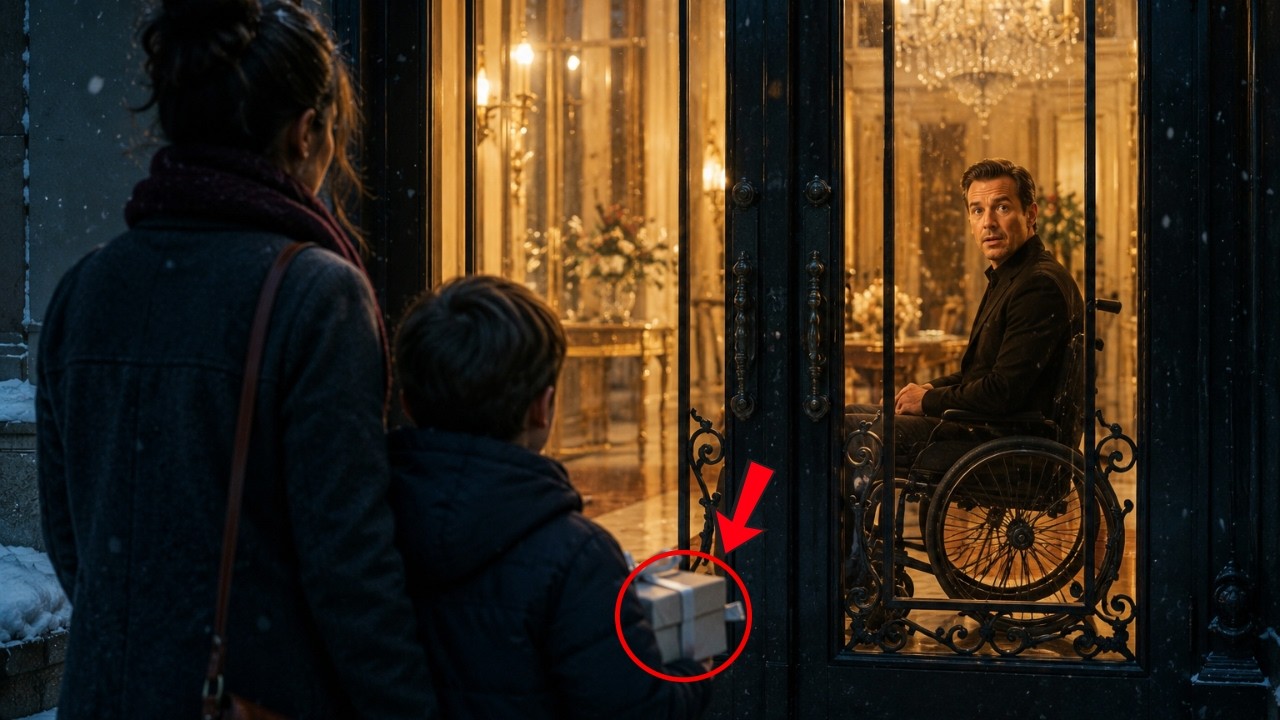
A woman in a navy delivery uniform stood beneath the gold archway, one hand resting on the shoulder of a little girl wearing a yellow raincoat.
The woman appeared to be in her early thirties. Her hair was tied back, and exhaustion showed in the careful way she shifted her weight from one foot to the other.
She carried a paper bag in one hand and a small gift wrapped in grocery-store tissue paper in the other.
A hotel supervisor hurried behind them.
“I’m sorry, Mr. Bennett,” he said. “The delivery entrance was locked, and they came through the lobby. I’ll escort them out.”
The little girl looked at the empty tables.
Then she looked at Isaiah.
Her face changed.
Not with pity.
With recognition.
The kind children sometimes have before adults learn to hide it.
“Mom,” she whispered, not quietly enough, “he’s trying not to cry.”
The supervisor froze.
Gloria lowered her clipboard.
Isaiah felt heat rise behind his eyes.
The woman in the delivery uniform quickly crouched beside her daughter.
“Ava, we don’t say everything we notice.”
“But he is.”
The woman stood and faced Isaiah.
“I’m sorry. We didn’t mean to interrupt.”
Isaiah cleared his throat.
“You haven’t.”
Her eyes moved across the empty room again.
“Is this your birthday party?”
“It was supposed to be.”
Ava pointed toward the cake.
“That is too much cake for one person.”
For the first time that evening, Isaiah almost smiled.
“You’re right about that.”
The woman seemed to make a decision.
She handed the food delivery to the hotel supervisor.
“Could you give me five minutes?”
The man hesitated.
“I still have to close out the order.”
“I’ll sign for it,” Gloria said.
The woman nodded gratefully, then approached Isaiah.
“My name is Nia Carter,” she said. “This is my daughter, Ava.”
Isaiah offered his hand.
“Nia.”
She held it for a second longer than strangers normally did.
“You probably don’t remember me.”
Isaiah studied her face.
“I’m sorry. Should I?”
“No. We only met once. I was nineteen, terrified, and trying very hard not to look pregnant.”
Something in her voice drew Gloria closer.
Nia placed the small wrapped gift on the table.
“My mother was Evelyn Carter.”
Isaiah’s expression shifted immediately.
“Evelyn from payroll?”
Nia smiled.
“Twenty-six years.”
“She wore purple every Friday.”
“Even to my grandmother’s funeral.”
Isaiah’s smile finally appeared.
“Your mother corrected my expense reports when the company had twelve employees.”
“She corrected everyone.”
“She saved that company from more mistakes than our accountants ever knew.”
Nia glanced at Ava, then back at him.
“She also never forgot what you did for us.”
Isaiah’s smile faded into confusion.
“What did I do?”
Nia looked around the ballroom, as though the emptiness had confirmed something she had not wanted to believe.
“When I was nineteen, I was working mornings at a grocery store, taking classes at night, and sleeping about four hours whenever I could. Ava’s father had already left. My mother was helping me, but she was behind on rent and hiding it.”
Isaiah listened without interrupting.
“I was going to quit school,” Nia continued. “I had already filled out the withdrawal form. My mother mentioned it at work. She didn’t ask you for anything. She was embarrassed that I was struggling.”
Ava stood close to her mother’s side, holding the edge of the yellow raincoat.
Nia’s voice softened.
“Three days later, the college called. My tuition had been paid for the year. Then the daycare told me someone had covered six months of childcare.”
Isaiah lowered his eyes.
Nia noticed.
“So it was you.”
“I asked your mother not to tell you.”
“She didn’t. Not until she got sick.”
Silence filled the ballroom.
Nia reached into her delivery bag and removed a plastic folder. Inside was a faded sheet of company stationery.
“My mother kept this for twenty-eight years.”
She unfolded it carefully.
Isaiah recognized his own handwriting before she read the words.
“A person working to protect her family should not have to choose between education and survival. Please tell Nia this is not charity. It is an investment in the life she is trying to build.”
Isaiah looked away.
The note had been written before the company’s first major contract, when he was still borrowing money to make payroll.
“I finished school,” Nia said. “It took longer than I planned. I changed programs twice. I worked nights. I made mistakes. But I finished.”
She rested a hand on Ava’s shoulder.
“I became a medical billing specialist. I do delivery shifts in the evenings because rent keeps rising and children keep needing shoes. But we’re stable. We’re together. And my daughter has never had to wonder whether she’ll eat.”
Isaiah’s eyes returned to hers.
“I’m glad.”
“My mother died last year.”
“I’m sorry.”
“Before she passed, she made me promise something. She said, ‘Never let the kindness that saved you become a story you only tell at funerals.’”
Nia looked toward the empty chairs.
“So when I saw your name on the hotel event board downstairs, I knew I couldn’t leave without saying thank you.”
She pushed the small gift toward him.
“It isn’t much.”
Isaiah opened the tissue paper.
Inside was a handmade birthday card covered in crooked blue stars.
On the front, Ava had written:
HAPPY BIRTHDAY TO THE MAN WHO HELPED MY MOM NOT GIVE UP.
Isaiah stared at it.
Ava stepped forward.
“I made the stars because Mom said your company makes things people thought were impossible.”
“That’s very good reasoning,” Isaiah said, his voice unsteady.
“There’s something else,” Nia said.
She removed a tablet from her bag.
“It belongs to my neighbor. Mine stopped charging.”
She tapped the screen.
A video began playing.
An older man appeared, standing in a security uniform outside Bennett Systems headquarters.
“Mr. Bennett, this is Marcus from night security. Happy birthday, sir. You probably don’t remember this, but when my son was in the hospital, you changed my schedule for three months and made sure I kept my benefits. My son is twenty-two now.”
The video changed.
A woman in a hospital cafeteria held up a photograph.
“My name is Teresa. I cleaned the fourth floor at Bennett Systems. When my house burned down, Mr. Bennett paid for a hotel before the insurance company called me back. Happy birthday from my whole family.”
Another face appeared.
Then another.
A former receptionist.
A retired engineer.
A cafeteria worker.
A driver.
A warehouse supervisor.
People Isaiah had not seen in years looked into the camera and told him exactly how his choices had changed their lives.
Some stories he remembered.
Most he did not.
He had paid for certification classes.
Approved emergency leave.
Visited hospitals.
Written recommendation letters.
Sent groceries.
Moved meetings so employees could attend school events.
None of it had seemed extraordinary at the time.
It had seemed like the minimum a person should do when given power over someone else’s working life.
The video continued for eleven minutes.
By the end, more than fifty people had wished him a happy birthday.
Isaiah sat completely still.
Gloria wiped her eyes.
The hotel supervisor looked down at the floor.
Ava climbed onto a chair near Isaiah.
“Mom said rich people would probably give you expensive gifts,” she said. “So we should give you something you couldn’t buy.”
Isaiah looked at the child.
“What’s that?”
“Proof.”
The word struck him harder than any of the cancellations.
Proof.
His mother had called a birthday proof that a life had been a gift.
For the first time that night, the ballroom no longer felt empty.
Isaiah looked at Nia.
“How did you find all these people?”
“I posted in an old employee group yesterday. I said I was making a private birthday message for you.”
“Yesterday?”
“I only learned about the event yesterday. My delivery company sent tonight’s schedule early.”
Isaiah glanced at the tablet.
“So all these people responded in one day?”
“Those are only the ones I had time to edit.”
She opened a folder.
There were 137 additional videos.
Isaiah covered his mouth with one hand.
He had spent weeks measuring his worth by the attendance of thirty-two powerful people.
Meanwhile, hundreds of ordinary people still carried evidence of his kindness.
Gloria stepped closer.
“Isaiah, there is something you should know.”
Her tone had changed.
“What?”
She looked toward Nia.
“When Ms. Carter posted in the employee group, someone forwarded it to me.”
Nia blinked.
“You knew?”
Gloria nodded.
“At first, I planned to add the video to the program. Then I started receiving calls from former employees asking whether they could attend.”
Isaiah looked around the empty ballroom.
“Attend?”
Before Gloria could answer, the ballroom doors opened again.
Marcus, the security guard from the first video, entered with his wife and son.
Behind them came Teresa, carrying two trays of homemade food.
Then a retired engineer named Alan Brooks rolled in an oxygen tank beside him.
A former receptionist arrived with three grandchildren.
Two dozen warehouse employees entered wearing work jackets.
Then cafeteria staff, drivers, assistants, technicians, cleaners, and former interns began filling the room.
Some carried flowers.
Some carried handwritten letters.
Some had come directly from work.
None had been included on the original guest list.
Within minutes, the thirty-two empty chairs were not enough.
Hotel employees brought more from a conference room.
People stood along the walls.
Someone began moving the untouched place settings to make room for children.
A woman Isaiah had once helped through chemotherapy hugged him without asking for a photograph.
A former programmer introduced him to the daughter whose college recommendation he had written.
A man from the loading dock placed a scratched company badge on the table and said, “You gave me my first chance after prison. I’ve been employed eighteen years because of that chance.”
Isaiah could barely speak.
Nia leaned toward him.
“My mother used to say you made one mistake.”
“What was that?”
“You believed kindness disappeared after you gave it away.”
She looked around the crowded ballroom.
“It doesn’t disappear. It waits inside people.”
At 8:51, the hotel supervisor closed the doors because the room had reached capacity.
That was when the original guests began arriving.
Not all at once.
Just enough to expose them.
The first was board chairman Douglas Crane.
He entered holding his phone, speaking rapidly to someone from a public relations agency.
Behind him came two senior executives and a local business columnist.
Douglas had not returned because he felt guilty.
He had returned because videos from the ballroom were already spreading online.
One of the former employees had posted a short clip of Ava handing Isaiah the card. Within twenty minutes, it had been shared thousands of times.
The caption read:
The people he made rich did not come. The people he treated like human beings did.
Douglas stepped inside expecting an empty room he could rescue.
Instead, he found a celebration already alive without him.
Laughter filled the ballroom.
Children surrounded the cake.
Former employees crowded around Isaiah, showing him photographs and introducing family members.
No one noticed Douglas at first.
He stood near the entrance holding an expensive gift bag, waiting to be recognized.
Then Marcus saw him.
The security guard’s expression hardened.
Conversation near the door quieted.
The silence moved through the room in waves.
Isaiah turned his wheelchair.
Douglas forced a smile.
“Isaiah. There you are.”
Isaiah looked at the chairman’s tuxedo.
“I thought you had an investor dinner.”
“It ended early.”
The columnist behind him lowered her phone slightly.
Gloria’s face remained unreadable.
Douglas lifted the gift bag.
“We would never miss your birthday.”
The room became so still that the soft hum of the chandeliers could be heard.
Then Ava spoke from beside the cake.
“But you did.”
A few people looked down to hide their smiles.
Douglas’s face tightened.
“I’m sorry?”
“You missed it,” Ava said. “We already sang in the hallway.”
Nia gently touched her daughter’s shoulder, but she did not correct her.
Douglas looked at Isaiah, waiting for him to smooth over the moment.
Isaiah had done that for years.
He had protected executives from embarrassment. Redirected criticism. Allowed people to take credit because he believed loyalty would eventually be returned.
Tonight, surrounded by those who had remembered him without needing anything, he finally understood the cost of that habit.
“You canceled at 7:42,” Isaiah said.
Douglas lowered the gift bag.
“As I explained, there was a conflict.”
“The investor you named is in Singapore.”
Douglas’s smile disappeared.
Gloria opened her clipboard.
“I checked.”
One of the senior executives shifted backward.
Isaiah continued.
“Caroline said she was ill, but she posted photographs from a restaurant forty minutes ago. Martin said his flight was delayed, though his assistant confirmed he never left the city.”
The faces of the executives changed one by one.
Their confidence did not collapse dramatically.
It drained.
Douglas glanced at the columnist and realized she was still recording.
His eyes moved toward the crowd.
Toward the uniforms.
The handmade signs.
The children eating cake.
The former employees watching him with a kind of quiet disgust that no corporate statement could repair.
That was the moment he understood.
The wheelchair had not made Isaiah powerless.
It had only revealed who had been mistaking physical mobility for authority.
Isaiah placed Ava’s card on the table in front of him.
“For two years,” he said, “I have watched members of my leadership team reduce my role, exclude me from decisions, and speak about my condition as though it were a business liability.”
Douglas’s jaw tightened.
“This is neither the time nor the place.”
“It became the place when you invited a reporter.”
The columnist slowly turned her camera toward Douglas.
Several people raised their phones.
Isaiah’s voice remained calm.
“You assumed I needed this room filled with important people to prove I still mattered.”
Douglas said nothing.
“You were wrong.”
The room erupted in applause.
Isaiah lifted one hand, and the sound settled.
“Effective Monday, I am calling a special meeting of the board. Gloria has already distributed documentation showing unauthorized governance changes, withheld communications, and conflicts of interest involving three senior officers.”
Douglas’s face went pale.
This was not a threat made in anger.
It was a decision already prepared.
The confidence left his posture first. His shoulders dropped. His fingers tightened around the gift bag until the paper creased.
For the first time that evening, he looked at Isaiah not as a disabled man to be managed, but as the founder who still controlled the largest voting block in the company.
“Isaiah,” he said quietly, “we should discuss this privately.”
“You had two years to speak to me privately.”
No one moved.
Then Isaiah looked toward Nia.
“Ms. Carter, what do you do when you are not delivering food?”
“I work in medical billing compliance.”
“Are you good at it?”
Nia seemed caught off guard.
“My manager says I notice what other people miss.”
Ava nodded proudly.
“She finds mistakes all day.”
A few people laughed.
Isaiah turned to Gloria.
“Bennett Foundation has an open compliance position, doesn’t it?”
“It does.”
Nia immediately shook her head.
“I didn’t come here for a job.”
“I know.”
“That matters.”
Isaiah smiled.
“You came here because someone was kind to you a long time ago, and you refused to let that kindness be forgotten. That is exactly the kind of person I want protecting a foundation.”
Nia looked around the ballroom.
Her eyes filled, but she did not answer immediately.
“I would have to apply properly.”
“Of course.”
“And interview.”
“Absolutely.”
“And I’m not accepting anything because you feel emotional tonight.”
Isaiah’s smile widened.
“Your mother raised you well.”
“The best.”
“Then apply properly.”
“I will.”
Near the door, Douglas remained motionless.
No one asked him to stay.
One by one, the executives who had arrived with him stepped away, as though physical distance could separate them from the decisions they had made.
The columnist lowered her phone.
“This is going to be a significant story,” she said.
Isaiah looked around the room.
“No.”
She blinked.
“No?”
“The story is not that powerful people skipped my birthday.”
He gestured toward the former employees, the hotel staff, the children, and Nia.
“The story is that we often look for proof of our value in the wrong rooms.”
The columnist said nothing.
Isaiah continued.
“We count titles, invitations, and public attention. But the true measure of a life is not who appears when being seen beside you benefits them.”
His eyes moved to Ava’s handmade card.
“It is who remembers what you did when there was no audience.”
Later that night, the three-tier cake was cut into uneven slices because no one could find enough plates.
Hotel workers joined the celebration after their shifts ended.
Marcus’s son played the piano.
Teresa taught Ava how to fold napkins into roses.
Nia finally sat down for the first time since dawn.
At 10:36, Gloria handed Isaiah a folder containing the official resolutions for Monday’s board meeting.
He signed them at a table covered in frosting, paper stars, and photographs from people whose names rarely appeared in company reports.
Within six weeks, Douglas Crane and two executives were removed from their positions after an independent investigation confirmed they had concealed governance changes and attempted to weaken Isaiah’s authority after his accident.
The company adopted new accessibility and ethics standards.
Nia applied for the compliance role.
She completed three interviews, challenged one of Isaiah’s proposals during the final meeting, and was hired by a unanimous panel.
Ava’s card was framed and placed in Isaiah’s office.
Not behind his desk.
Beside the door, where every executive had to see it before entering.
A year later, Isaiah celebrated his next birthday in the employee cafeteria.
There were no gold place cards.
No press list.
No imported flowers.
There were simply people.
Hundreds of them.
Before he blew out the candles, Isaiah told the room what his mother had once told him.
“A birthday is proof that your life has been a gift to someone.”
Then he looked toward Nia and Ava.
“And sometimes the people with the least power are the ones brave enough to show us how much our lives were worth all along.”
The loudest applause did not come from the boardroom.
It came from the people who remembered who Isaiah had been when nobody important was watching.
Because status can fill a guest list, but only kindness can fill a room.


