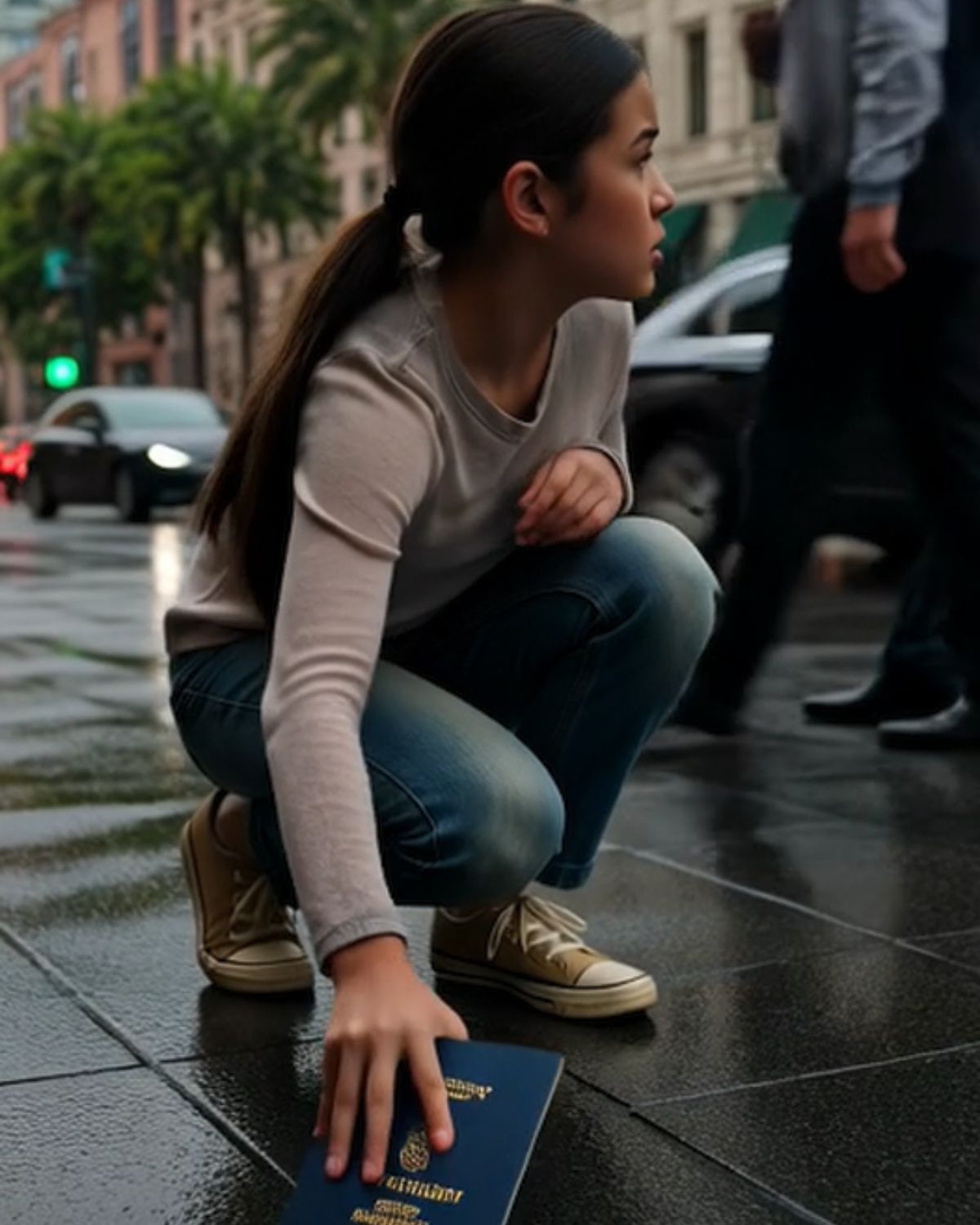
The passport lay open on the wet pavement outside one of the most expensive hotels in the city.
People stepped around it without looking.
Black cars rolled beneath the golden entrance canopy. Hotel staff hurried to open doors for wealthy guests. A businessman barked into his phone. Two women in evening dresses rushed past, lifting their skirts away from the rainwater.
Then a thin girl in worn sandals stopped.
Her name was Linh Tran.
She was nineteen years old, dressed in a faded blue shirt and black trousers that had been repaired twice at the knee. A plastic bag hung from her wrist, carrying two boxes of leftover rice she had received from the restaurant where she washed dishes.
Linh looked down.
The passport was dark blue, soaked around the edges but still intact.
She picked it up carefully.
For a moment, she stared at the gold lettering on the cover.
She had never owned a passport.
She had never been on an airplane.
She had never even entered the hotel standing in front of her.
Behind the glass doors, chandeliers glowed above polished marble floors. The people inside wore watches worth more than her family’s entire house.
Linh opened the passport just enough to see the photograph.
A middle-aged foreign man.
The kind of man who probably had assistants carrying his bags and drivers waiting outside.
Tucked between the pages was a boarding pass.
The flight was early the next morning.
Linh looked around.
“Sir?” she called.
No one turned.
She raised the passport higher.
“Did someone lose this?”
The crowd continued moving.
Rain began to fall harder.
Linh glanced at the hotel entrance.
A security guard stood beneath the canopy. His eyes moved from her wet hair to her cheap clothes, then to the passport in her hand.
His expression changed.
Not with concern.
With suspicion.
Linh knew that look.
She had seen it in stores when she stood too close to expensive shelves. She had seen it from customers who counted their change after she served them. She had seen it from people who assumed poverty and dishonesty were the same thing.
She could have placed the passport on the security desk and walked away.
She could have ignored it like everyone else.
Instead, she tightened her grip and ran toward the hotel.
The guard stepped in front of the doors.
“Where are you going?”
“Someone lost this,” Linh said, holding up the passport. “They might be staying here.”
The guard looked at it, then at her.
“Give it to me.”
Linh hesitated.
Something about his tone made her uncomfortable.
“I want to return it to reception,” she said.
“I said give it to me.”
“It has a boarding pass inside. The owner may need it tonight.”
The guard reached for the passport.
Linh pulled it back.
“I’m not stealing it.”
“I didn’t say you were.”
But his face did.
Several hotel guests had started watching.
One man slowed down near the revolving doors. A woman whispered to her companion. Linh felt the heat rising in her cheeks.
She hated being watched.
She hated having to prove she was honest before anyone had even accused her.
“I found it on the ground,” she said louder. “Right there.”
The guard sighed as though she were creating a problem.
Then the revolving doors turned, and a group of guests entered.
Linh slipped through beside them.
“Hey!”
She ran across the lobby.
Her wet sandals squeaked against the marble. People turned as she passed. A bellman nearly dropped a suitcase trying to avoid her.
At the center of the lobby stood a long reception desk made of black stone.
Linh rushed toward it and placed the passport on the counter.
“Someone lost this,” she said urgently. “They need it.”
The receptionist stared at her.
Her name tag read: MAI — GUEST RELATIONS.
Mai was perfectly dressed, with her hair pulled into a neat bun and a silk scarf tied around her neck. She looked at the water dripping from Linh’s sleeves onto the polished counter.
Then she looked at the passport.
“Where did you get that?”
“Outside. Near the entrance.”
Mai did not touch it.
“You found a foreign guest’s passport outside?”
“Yes.”
“And you brought it in here?”
“Yes.”
Mai’s eyes narrowed.
Linh understood the question hidden inside the question.
Why would a girl like you have something belonging to a man like this?
“I just want to return it,” Linh said.
“Did you open it?”
“Only to see the photo.”
“Did you take anything from inside?”
Linh’s fingers curled around the edge of the counter.
“No.”
The security guard arrived behind her, breathing heavily.
“She forced her way inside,” he said.
“I did not force my way in.”
“You ignored me.”
“Because you wouldn’t listen.”
Mai picked up the passport using only two fingers.
She opened it.
A hotel manager appeared from a nearby office.
“What is happening?”
“This girl says she found a guest’s passport outside,” Mai explained.
The manager looked at Linh.
His gaze paused on her sandals.
“Which guest?”
Mai read the name silently.
Her face changed slightly, but she quickly closed the passport.
“It belongs to someone in the presidential suite.”
The manager immediately lowered his voice.
“Are you certain?”
Mai nodded.
The guard reached for Linh’s arm.
“Come with me.”
Linh stepped back.
“Why?”
“We need to ask you some questions.”
“I already told you where I found it.”
“If nothing is missing, you have nothing to worry about.”
Those words made several people in the lobby stop and stare.
Linh felt suddenly trapped.
She thought about her mother waiting at home.
She thought about the medicine she still needed to buy.
She thought about the restaurant owner who would fire her if police officers came asking questions.
“I didn’t take anything,” she repeated.
The manager opened the passport again.
“There was probably cash inside.”
“There wasn’t.”
“How would you know?”
Linh looked at him.
“Because I saw what was inside.”
“So you did search it.”
“No. The boarding pass was between the pages.”
The manager exchanged a glance with the receptionist.
It was a small movement.
But Linh saw it.
They had already decided what kind of girl she was.
The manager turned to the guard.
“Take her to the security office. Check the cameras.”
Linh’s face went pale.
“I returned it.”
“We are simply confirming your story.”
“I could have walked away.”
“But you didn’t.”
The words landed harder than he intended.
For the first time, Linh’s voice shook.
“My father taught me never to walk away when something belongs to someone else.”
The manager barely reacted.
“Security office.”
The guard moved toward her again.
Then the hotel’s main doors opened.
The atmosphere in the lobby changed instantly.
Four men in dark suits entered first, scanning the room. Behind them walked a tall foreign man in a charcoal coat, speaking quickly to a woman carrying a tablet.
He looked tired, impatient and important.
Hotel employees straightened as he approached.
The manager abandoned Linh in the middle of the lobby and hurried forward.
“Mr. Laurent, welcome back. We’ve been trying to reach your team.”
The foreign man stopped.
“What happened?”
The manager forced a smile.
“A small issue. Nothing for you to worry about.”
Then the man saw the passport in Mai’s hand.
He froze.
“That is mine.”
Every face turned toward the reception desk.
The man crossed the lobby quickly.
One of his assistants followed.
“Where did you find it?” he demanded.
Mai pointed toward Linh.
“She brought it in.”
The man looked at her for the first time.
Linh stood soaked beneath the chandelier, surrounded by employees who had been ready to escort her away.
“I found it outside,” she said. “Near the entrance.”
The man took the passport.
He checked inside.
The boarding pass was there.
His credit card was there.
Several large banknotes were still tucked into the back cover.
Nothing had been taken.
He exhaled.
“You found this on the street?”
“Yes.”
“And you came in to return it?”
“Yes.”
His assistant leaned closer.
“Mr. Laurent, we need to leave for the embassy dinner in ten minutes.”
But the man was still looking at Linh.
“What is your name?”
“Linh.”
“Your full name.”
The manager shifted impatiently.
“Sir, we can handle this. We were just about to verify—”
“Her name,” the man repeated.
The lobby went quiet again.
Linh swallowed.
“Linh Tran.”
The man’s eyes narrowed.
“Tran?”
“Yes.”
“Your father’s name?”
The question surprised her.
“Minh Tran.”
The man stopped breathing for a moment.
The passport slipped slightly in his hand.
His assistant noticed.
“Sir?”
The foreign man stared at Linh as though the crowded lobby had disappeared.
“What did you say?”
“My father’s name was Minh Tran.”
“Was?”
“He died six years ago.”
The man’s expression changed so quickly that even the manager stepped back.
All the authority left his face.
His lips parted, but no words came.
He looked down at the passport.
Then at Linh.
Then at the repaired knee of her trousers and the plastic bag of food hanging from her wrist.
“Your father…” he whispered.
Linh waited.
The receptionist stopped typing.
The guard lowered his hand.
Even the guests near the elevators fell silent.
The foreign man took one slow step closer.
“Did your father work near the old river port?”
Linh’s eyes widened.
“He repaired engines there.”
“Small fishing boats?”
“Yes.”
“He had a scar above his left eyebrow.”
Linh gripped the counter.
“How do you know that?”
The man closed his eyes.
For several seconds, the only sound in the lobby was rain striking the glass doors.
When he opened his eyes again, they were wet.
“My name is Adrian Laurent,” he said quietly. “Twenty-three years ago, I came to this country as a junior engineer.”
Linh said nothing.
Adrian turned slightly toward the people around them, but his eyes remained on her.
“I was not a CEO then. I was twenty-seven years old, arrogant and certain I understood everything.”
His assistant lowered the tablet.
Adrian continued.
“I had been sent to inspect equipment at the river port. A storm began while I was crossing a service platform. The metal railing broke.”
A faint tremor entered his voice.
“I fell into the river.”
The hotel manager’s face slowly changed.
Adrian looked at Linh.
“The current pulled me under a cargo barge. I could not breathe. I remember hitting my head. I remember people standing on the dock.”
He paused.
“Everyone was shouting.”
Linh’s eyes did not move from his face.
“Your father jumped in.”
Her lips parted.
Adrian nodded.
“He tied a rope around his waist and entered the water during the worst storm that port had seen in years. He reached me beneath the barge and kept my head above the surface until workers pulled us back.”
Linh’s fingers began to shake.
“My father never told me this.”
“He probably didn’t.”
Adrian smiled through the pain in his face.
“He refused every reward my company offered him.”
A memory seemed to return to him.
“He said, ‘A life is not something you sell back to its owner.’”
Linh covered her mouth.
That sounded like her father.
It sounded so much like him that her knees almost weakened.
Adrian reached into his coat and removed his phone.
His hands were no longer steady.
“I have carried something for twenty-three years.”
He searched through an old digital folder.
Then he turned the screen toward her.
The photograph was faded and grainy.
Two men stood beside the river.
One was a much younger Adrian, with a bandage wrapped around his forehead.
The other wore oil-stained work clothes.
He had a scar above his left eyebrow.
Linh stared at the screen.
“Papa.”
The word escaped before she could stop it.
Adrian looked away for a moment.
“I returned to France two weeks later,” he said. “I sent letters. Money. Offers of work. Most came back unopened.”
Linh wiped her eyes.
“We moved after my father became sick.”
“I tried to find him again years later.”
Adrian’s voice dropped.
“I was too late.”
The entire lobby was motionless now.
The receptionist’s face had gone pale.
The manager looked at the floor.
The security guard who had tried to take Linh away stood with both hands clasped in front of him, avoiding her eyes.
Adrian glanced at the passport.
Then he looked toward the hotel entrance, where the rain continued to fall.
“Tonight, I lost the document that allows me to travel, the money I was carrying and cards that could have been used anywhere.”
He looked back at Linh.
“Hundreds of people walked past it.”
His voice broke slightly.
“But Minh Tran’s daughter picked it up.”
Linh shook her head.
“Anyone should have done it.”
Adrian gave a sad smile.
“Yes.”
He looked around the lobby.
“But only you did.”
The manager stepped forward.
“Mr. Laurent, we deeply apologize for the inconvenience.”
Adrian turned toward him.
“What inconvenience?”
The manager opened his mouth.
Adrian’s face hardened.
“I recovered my passport.”
He pointed toward Linh.
“She is the one who was inconvenienced.”
No one spoke.
Adrian looked at the guard.
“What were you about to do?”
The guard swallowed.
“We were going to check the security footage.”
“After she returned my passport?”
“We needed to confirm her account.”
Adrian turned to the manager.
“And while confirming it, you surrounded her in your lobby?”
The manager’s smile had disappeared.
“It was standard procedure.”
“Would that procedure have been the same if she had been wearing an expensive coat?”
The question cut through the room.
The manager’s eyes dropped.
That was the moment he understood.
It showed first in his shoulders.
Then in the stiffness of his jaw.
Then in the long silence that followed.
Across the desk, Mai slowly removed her hands from the keyboard.
Her face held the same realization.
They had judged Linh before checking a single camera.
Before asking one respectful question.
Before discovering that every banknote and card was still inside the passport.
Adrian turned back to Linh.
“Did they accuse you of stealing?”
Linh looked at the manager.
Then at the guard.
“No one used that exact word.”
Adrian understood.
Sometimes humiliation did not need to be spoken clearly.
It could be delivered through a stare, a hand on the arm or a question asked in a tone that already contained the answer.
He faced the manager again.
“Check the cameras.”
The manager nodded quickly.
“Of course.”
“Not to investigate her.”
Adrian’s voice became colder.
“To document how your staff treated the person who protected your guest.”
The manager’s face lost its color.
Adrian’s assistant stepped forward and quietly began taking notes.
The balance of power in the lobby had changed.
Minutes earlier, Linh had stood alone, trying to defend her honesty.
Now every person who had doubted her was waiting for her next word.
Adrian looked at the plastic bag on her wrist.
“Were you going home?”
“Yes.”
“From work?”
“I wash dishes at a restaurant behind the market.”
“Are you studying?”
Linh hesitated.
“I was.”
“What happened?”
“My mother became ill. I left school to work.”
Adrian’s expression tightened.
“What were you studying?”
“Accounting.”
“Were you good at it?”
Before Linh could answer, a woman near the elevators spoke.
“She returned a passport full of money while wearing shoes held together with glue.”
Everyone turned.
The woman had watched the entire confrontation.
“I think that answers your question.”
A few guests nodded.
Linh looked down, embarrassed.
Adrian did not smile.
He seemed to be making a decision.
“My company has an education foundation in this region,” he said. “It supports students whose families face financial hardship.”
Linh immediately shook her head.
“I didn’t return your passport for money.”
“I know.”
“I don’t want a reward.”
“I know that too.”
His answer was gentle but firm.
“This is not payment for honesty.”
He paused.
“It is a debt I should have repaid long ago.”
Linh’s eyes filled again.
“My father would not want—”
“Your father refused money for himself.”
Adrian looked at the old photograph on his phone.
“But I do not believe he would refuse a future for his daughter.”
Linh could not answer.
Adrian turned to his assistant.
“Contact the foundation director tonight. I want Ms. Tran’s tuition, books and living expenses covered through graduation, provided she wishes to return.”
The assistant nodded.
“And find the best hospital in the city for her mother.”
Linh took a step back.
“That is too much.”
Adrian shook his head.
“Your father gave me twenty-three years I was not supposed to have.”
His voice softened.
“Nothing I do tonight will be too much.”
The receptionist began to cry quietly.
The guard stared toward the doors.
The manager looked as though he wished the marble floor would open beneath him.
Adrian held out his hand.
Linh stared at it.
His hand belonged to a man whose company employed thousands of people across several countries.
Hers was rough from detergent, hot water and carrying heavy trays.
She slowly placed her hand in his.
Cameras from several phones rose around the lobby, but neither of them looked away.
Adrian gripped her hand with both of his.
“Your father saved my life,” he said.
Linh tried to speak, but no sound came.
Adrian continued.
“And tonight, when no one was watching and you had every reason to think only about yourself, you made the same choice he did.”
The manager closed his eyes.
The receptionist lowered her head.
The security guard stood completely still.
Adrian looked at Linh with tears shining beneath the chandelier light.
“Today, his kindness came back to his daughter.”
For the first time that evening, Linh did not feel small inside the luxury hotel.
She stood in the center of the lobby while executives, guests and employees watched in silence.
Not because of what she owned.
Not because of whom she knew.
But because of the choice she had made when she believed no one important would ever know.
The next morning, the hotel issued a formal apology.
The manager and security staff were required to undergo an internal review, and the hotel introduced new procedures for handling non-guests with respect.
Linh returned to school three months later.
Her mother received treatment.
And in the accounting building of Linh’s university, framed beside the scholarship office, there is now a copy of the photograph taken beside the old river port.
Under it are two names:
Minh Tran, the mechanic who jumped into a storm to save a stranger.
And Linh Tran, the daughter who proved that character can survive poverty, grief and humiliation without becoming bitter.
Because true kindness is never lost.
It waits quietly in the world until the day it finds its way home.