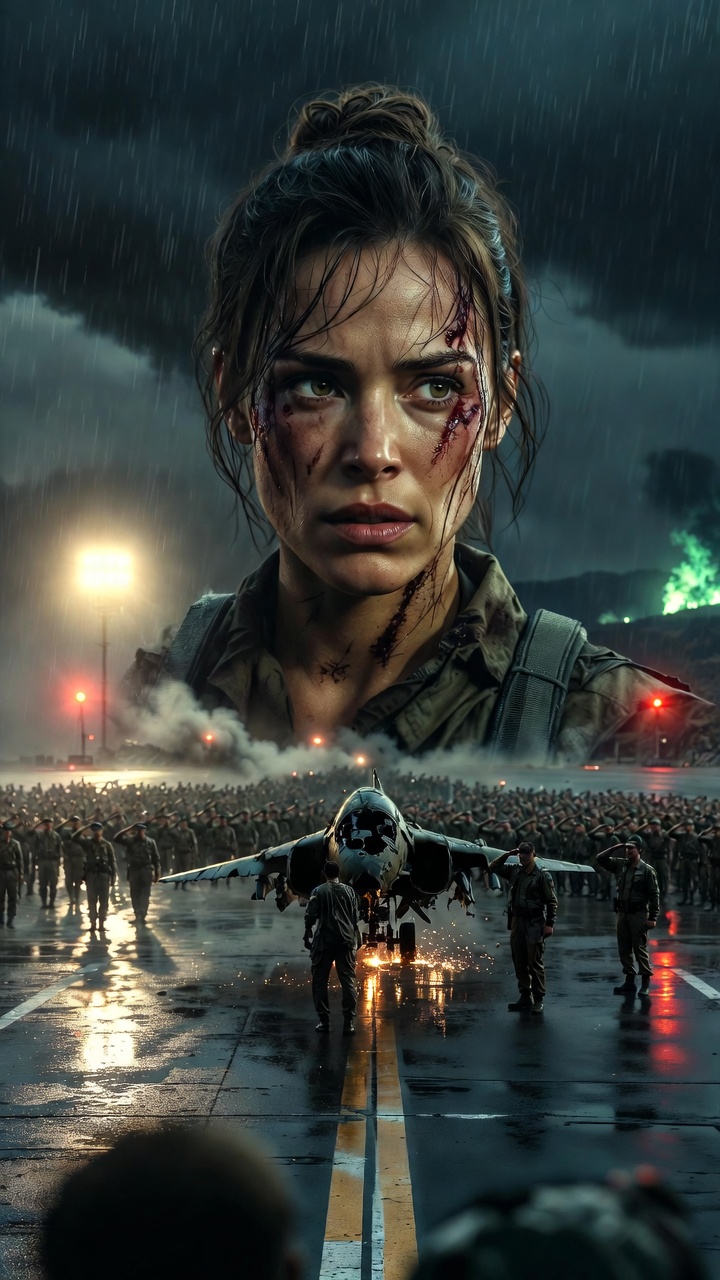
At 11:47 p.m., the operations room stopped talking about 540 Marines as if they were people.
They became a red block on a digital map.
A probability curve.
A projected casualty figure.
Outside, a storm system the size of a small country was rolling over the mountains, swallowing radar coverage and turning the canyon roads into rivers of mud. Inside the command center, officers stood beneath fluorescent lights while software calculated how many aircraft might be lost attempting a rescue.
The answer was enough to end the discussion.
Colonel Warren Hale folded his arms and looked at the risk matrix glowing on the wall.
“Recovery probability is below twenty percent,” an intelligence officer said. “Enemy positions control both entrances to the canyon. Air support would have to operate below the storm ceiling.”
“And the fuel situation?” Hale asked.
“Critical. The trapped unit has perhaps three hours before generators, vehicles, and medical equipment begin shutting down.”
No one spoke for several seconds.
Then Hale gave the order.
“All rescue assets remain grounded until the weather improves.”
Major Elena Voss sat at the communications station near the back of the room, listening to static scrape through her headset.
She was not supposed to be making decisions.
Not anymore.
Her flight status had been revoked fourteen months earlier after a review board accused her of “disobedience under operational stress.” The official report said she had ignored a direct withdrawal order during a border evacuation.
What it did not say was that eleven wounded soldiers had been left behind when command decided the landing zone was too dangerous.
Elena had gone back for them.
She saved nine.
The military grounded her anyway.
Now she worked logistics, monitoring fuel tables, cargo schedules, and radio traffic while younger pilots flew the missions she once led.
Another burst of static came through her headset.
Then a voice.
Weak. Broken. Barely human beneath the interference.
“…Iron… Actual… still holding… grid follows…”
Elena straightened.
“Repeat your transmission.”
Only static answered.
She adjusted the frequency manually, isolating the signal from the storm noise.
The voice returned.
“…five-four-zero personnel… casualties increasing… enemy closing from north ridge…”
Every person in the room looked toward her station.
Elena pulled off one side of her headset.
“They’re alive.”
Colonel Hale did not turn around.
“We know there may be survivors.”
“No,” Elena said. “They are organized. They’re transmitting coordinates. They’re still fighting.”
Hale looked back at her with the tired irritation of a man being challenged in front of his staff.
“The assessment has been completed, Major.”
“Then the assessment is wrong.”
A few officers lowered their eyes.
Elena stood.
“They are United States Marines.”
Hale stared at her for a long moment.
Then he said, quietly enough that everyone had to listen closely:
“They were Marines.”
The room went still.
Elena looked at the digital map, at the red shape representing hundreds of people surrounded in a canyon, and understood something she had spent years trying not to believe.
The system had not failed to see them.
The system had seen them clearly and decided they were too expensive to save.
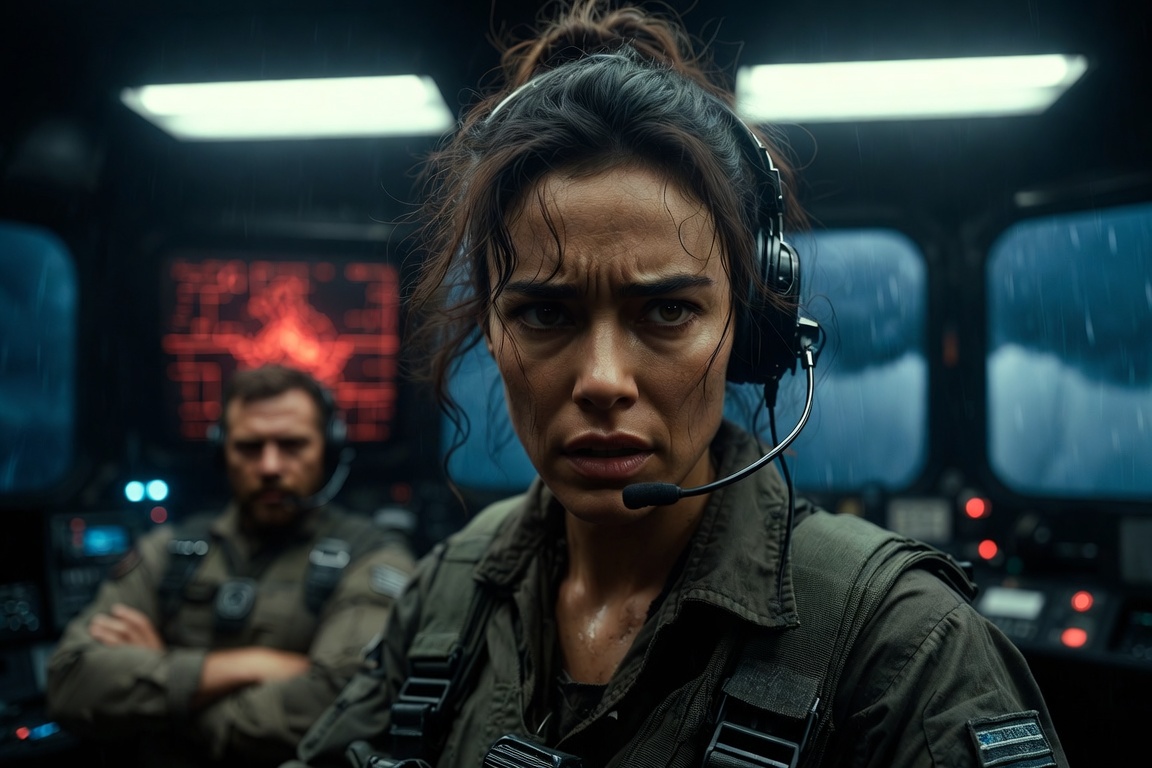
She removed her headset, placed it on the desk, and walked out without requesting permission.
No one stopped her.
Not at first.
The flight hangar was almost silent at midnight.
Rain hammered the roof. Emergency lights cast long red reflections across the polished floor. Most maintenance crews had been reassigned to storm preparation, leaving only a handful of personnel near the aircraft.
At the far end sat an AT-9 Raven, a single-seat light attack aircraft designed for low-altitude support.
It was not built to win wars.
It was built to survive ugly places.
Elena had flown one for six years.
Her body remembered it before her mind did.
She climbed the access ladder, opened the cockpit, and began the preflight sequence.
Battery.
Fuel.
Hydraulics.
Navigation.
Weapons systems.
The movements returned with frightening ease. Her hands crossed switches in the correct order without hesitation, as if the fourteen months behind a desk had never happened.
“Major?”
Chief Petty Officer Sam Ortiz stood below the wing, staring up at her.
He had maintained her aircraft years earlier. He also knew exactly why she was no longer allowed to fly.
“Your authorization code is inactive,” he said.
“I know.”
“There’s no mission order.”
“I know.”
“Colonel Hale grounded everything.”
Elena looked down at him.
“Then do not officially confirm this aircraft as airworthy.”
Ortiz studied her face.
“You’re stealing a military aircraft.”
“I’m borrowing a fuel problem.”
The chief glanced toward the hangar doors. The storm sirens were already sounding outside.
“You won’t make it through the canyon.”
“Then you won’t have to explain why you helped me.”
For a moment, he remained motionless.
Then he stepped toward the wheel chocks.
“I didn’t hear the engine start,” he said.
Elena closed the canopy.
The Raven’s turbine ignited with a scream that tore through the empty hangar.
Red warning lights began flashing across the base.
Ortiz pulled the chocks free and backed away as the aircraft rolled forward.
Security vehicles appeared near the southern taxiway. Military police flooded the radio frequency, ordering the unidentified pilot to shut down immediately.
Elena switched to the operations channel.
“Command, this is Rogue One.”
The name hit the control room like a ghost walking through a locked door.
It had been Elena’s call sign before the board grounded her.
Colonel Hale grabbed a headset.
“Major Voss, abort taxi immediately.”
She aligned the Raven with the runway.
“Unable.”
“You are not authorized to operate that aircraft.”
“Noted.”
“You will be arrested the moment you return.”
Elena pushed the throttle forward.
“Then I’d better return.”
The Raven accelerated into the rain.
Security vehicles reached the runway seconds too late. The aircraft lifted sharply, cleared the perimeter fence, and disappeared into the black wall of the storm.
Inside the command center, every radar operator watched a single green symbol fly toward a region the entire rescue wing had been ordered to avoid.
The first turbulence strike slammed Elena against the restraints.
Rain swallowed the windshield. Lightning illuminated the mountains in violent white flashes, revealing cliffs only seconds before she reached them.
The autopilot issued repeated terrain warnings.
She silenced them.
The safe route climbed above the mountains, but the storm made that impossible. The only path forward was beneath the cloud ceiling, through narrow valleys where the ridgelines rose on both sides like walls.
“Rogue One, turn back,” Colonel Hale ordered. “You do not have reliable navigation.”
“I have the coordinates.”
“You have an incomplete transmission.”
“I have enough.”
The Raven dropped lower.
At 12:26 a.m., Elena’s thermal display began registering heat sources inside the canyon.
Hundreds of them.
Vehicles.
Fires.
Groups of Marines positioned behind rock formations.
And along the northern ridge, a line of enemy weapons firing down into them.
Tracer rounds crossed the darkness.
Elena switched to the emergency ground frequency.
“Iron Actual, this is Rogue One. Confirm you can hear me.”
Static.
Then a man answered.
“Rogue One, whoever you are, you just became the most beautiful voice in the world.”
“This is Major Elena Voss. Mark your forward position.”
A green flare rose from the canyon floor.
Elena saw it through the rain.
“I have you.”
The ground commander’s voice tightened.
“Major, enemy controls the northern pass. Southern route is blocked by two heavy positions. We have wounded who cannot move. Command told us weather prevented support.”
Elena looked at the weapons data on her display.
“Command was mistaken.”
“You alone?”
“Yes.”
There was a pause.
Then the Marine said, “One aircraft cannot evacuate 540 people.”
“No,” Elena replied. “But one aircraft can change the math.”
She disengaged the automatic flight protections.
Warning messages filled the screen.
BANK LIMIT DISABLED.
TERRAIN PROTECTION DISABLED.
STALL RECOVERY DISABLED.
The Raven was now completely in her hands.
She rolled the aircraft onto its side and dropped between the canyon walls.
The first enemy position fired before she completed the turn.
Rounds passed beneath the fuselage.
Elena used the cliff face as cover, climbed for less than two seconds, then broke into view at an angle the gunners had not expected.
Her first burst destroyed the weapon emplacement.
The explosion lit the ridge.
Marines on the ground began shouting over the radio.
Elena did not celebrate.
“North ridge, second position, two hundred meters east,” she said.
The ground commander corrected her.
“Three hundred. Behind the rock shelf.”
“Seen.”
She climbed into the storm, reversed direction, and came back through the canyon.
The second position vanished beneath a precise strike.
The Raven’s fuel estimate dropped faster than projected.
Elena ignored it.
For the next forty minutes, she turned the canyon into a moving corridor.
She attacked roadblocks, suppressed ridge positions, and used the mountains to disappear before enemy gunners could track her. When the Marines became separated in the rain, she released illumination flares to mark the southern route.
Each flare burned above the canyon like a small artificial sun.
Under their light, the trapped unit began moving.
The wounded went first.
Then ammunition teams.
Then the companies holding the perimeter.
Back at the base, the operations staff watched the impossible take shape on their screens.
A single unauthorized aircraft had reopened the extraction zone.
Colonel Hale stood behind the radar operators, saying nothing.
One officer approached him.
“Sir, the storm cell is shifting east. We may have a twenty-minute window.”
Hale looked at the canyon map.
The northern ridge was no longer firing.
The southern route was partially open.
The trapped unit was moving in organized groups toward three landing zones Elena had marked with flares.
The risk matrix on the main screen recalculated automatically.
Recovery probability: 71 percent.
Hale’s face changed.
Not much.
Just enough for the people nearest him to see that he understood.
The mission had not been impossible.
It had become possible the moment someone refused to accept his conclusion.
“Launch the rescue helicopters,” he said.
The room erupted into movement.
Six heavy-lift helicopters lifted from the base twelve minutes later, followed by two medical aircraft.
They entered the canyon under Elena’s protection.
The first evacuation removed ninety-three wounded Marines.
The second took another hundred and twelve.
By the fourth rotation, the enemy had regrouped near the eastern ridge and begun firing toward the landing zone.
Elena’s weapons system showed only limited ammunition remaining.
Her fuel warning had turned red.
“Rogue One, disengage,” the rescue commander ordered. “We can take it from here.”
Elena looked at the thermal image.
A final group of Marines was still climbing toward the extraction point. Behind them, enemy fighters were closing through a narrow ravine.
“You cannot take it from here yet.”
She turned back.
The Raven descended so low that dust and rainwater spiraled beneath its wings.
Elena fired her remaining ammunition into the ravine entrance, collapsing part of the rock wall and forcing the enemy column to stop.
The final helicopter dropped into the landing zone.
“Last group boarding,” the ground commander reported.
Elena circled once more.
“Confirm total personnel.”
“Stand by.”
The helicopter rose from the canyon floor.
For several seconds, there was only static.
Then the answer came.
“Five hundred and forty accounted for.”
Inside the command center, no one cheered immediately.
The number appeared on the main screen.
540 RECOVERED.
It remained there, bright and undeniable.
Then someone near the communications station began clapping.
Another person joined.
Within seconds, the entire room was on its feet.
Colonel Hale was not.
He stood frozen beneath the screen, looking at the number he had previously accepted as a loss.
For the first time that night, the Marines were not a percentage.
They were alive.
Elena turned the Raven toward home.
That was when the engine coughed.
The aircraft shuddered violently.
Hydraulic pressure dropped in two systems at once. The fuel estimate changed from twelve minutes to six.
“Rogue One, your telemetry is unstable,” the tower controller said.
“That makes two of us.”
“You do not have sufficient fuel to reach the base.”
“I’m aware.”
“Eject while you’re over the southern valley. Recovery teams can reach you after the storm.”
Elena looked down.
The valley was flooded, dark, and surrounded by enemy-controlled terrain.
“No.”
“Major, your aircraft is no longer considered recoverable.”
She almost laughed.
An hour earlier, command had used the same language about the Marines.
“Your definitions need work,” she said.
She reduced power to preserve the dying engine and began a shallow glide toward the base.
Every kilometer became a negotiation between gravity and machinery.
The left control surface responded slowly.
The landing gear warning remained active.
Oil pressure continued falling.
The storm followed her home.
At the airfield, emergency crews lined the runway. Fire engines waited beneath rotating lights. Military police stood near the hangar, ready to take her into custody if she survived.
Colonel Hale came to the tower personally.
“Voss, the runway is yours.”
Elena’s voice returned through heavy static.
“That almost sounds like authorization.”
No one in the tower smiled.
The Raven emerged from the clouds too low and too fast.
Its right engine panel was blackened. Hydraulic fluid streamed behind it. The landing gear extended only after Elena cycled the emergency release three times.
The aircraft struck the runway hard.
One tire burst immediately.
The Raven veered left, throwing sparks across the pavement. Elena fought the controls, corrected once, then again, before the aircraft spun near the end of the runway and stopped in a cloud of smoke.
Emergency crews surrounded it.
For several seconds, the canopy did not open.
Ortiz ran past the fire team and climbed onto the wing.
Then the canopy lifted.
Elena removed her helmet.
Blood ran from a cut above her eyebrow, but she was conscious.
Ortiz let out a breath that sounded like anger.
“You destroyed my aircraft.”
Elena looked at the smoking Raven.
“You said it wasn’t officially airworthy.”
He laughed despite himself.
When she climbed down, two military police officers approached.
Colonel Hale arrived behind them.
The applause from the control room had not followed him outside. On the runway, in the rain, there were only regulations, witnesses, and the wreckage of an unauthorized mission.
“Major Elena Voss,” Hale said, “you disobeyed a direct order, operated a military aircraft without authorization, entered a restricted combat zone, disabled multiple safety systems, and initiated weapons engagement without clearance.”
“Yes, sir.”
“You understand the seriousness of those actions?”
“Yes, sir.”
Hale stepped closer.
“You could have caused the loss of additional aircraft and personnel.”
Elena glanced toward the arriving medical helicopters.
Stretchers were being unloaded beneath floodlights. Marines stepped onto the runway, exhausted and soaked, helping one another walk.
“But I didn’t,” she said.
Hale’s jaw tightened.
The senior ground commander from the canyon emerged from the first helicopter. His uniform was covered in mud, and one arm was strapped across his chest.
He walked directly toward Elena.
“Major Voss?”
“Yes.”
He saluted.
Behind him, Marines began doing the same.
One after another, across the rain-soaked runway, hundreds of rescued personnel raised their hands.
No one had ordered them to.
Colonel Hale looked around.
The color drained from his face.
His mouth opened, but no words came.
This was the moment every person present understood that his authority had not disappeared.
It had simply become smaller than the truth standing in front of him.
The military police waited for instructions.
Hale looked at Elena, then at the 540 Marines he had declared lost.
Finally, he said, “Stand down.”
The officers lowered their hands.
Three days later, Elena was ordered to appear before a formal review panel.
The charges were extensive.
Unauthorized flight.
Theft of military equipment.
Violation of operational command.
Reckless engagement.
Conduct prejudicial to good order.
Colonel Hale testified first.
He explained the weather models, the intelligence gaps, and the casualty projections. He spoke for nearly an hour about the responsibility of command and the danger of allowing individual officers to replace procedure with personal judgment.
Then the panel chair asked a single question.
“Colonel, when Major Voss departed, did you believe the Marines were still alive?”
Hale hesitated.
“Yes.”
“And did you believe they could be saved?”
“Not within acceptable risk.”
The chair looked down at a document.
“Yet once Major Voss opened the extraction corridor, you launched eight aircraft.”
“The conditions had changed.”
“Because of her actions?”
Hale did not answer immediately.
“Yes.”
The panel then reviewed the Raven’s flight data.
That was when the story changed.
Elena had not simply flown into the canyon recklessly.
Before leaving the operations room, she had downloaded the raw weather telemetry, enemy heat signatures, fuel reports, and terrain maps. She had identified a seven-minute atmospheric cycle that the official risk software had filtered out because it fell below the model’s reliability threshold.
The storm was not random.
It shifted in repeating waves.
Elena had timed every canyon pass between them.
She had not ignored the data.
She had understood it better than the system that condemned the Marines.
The former review board that grounded her had made the same mistake fourteen months earlier.
In that mission, Elena had also identified a safe approach window that senior officers dismissed because it did not appear in the automated recommendation.
Her alleged pattern of disobedience was, in fact, a pattern of being correct before the software caught up.
The panel dismissed the charge of reckless engagement.
It upheld the finding that she had disobeyed orders.
Then it issued its recommendation.
Major Elena Voss would not return to logistics.
Her flight status would be reinstated.
She would be promoted to lieutenant colonel and assigned to lead a new combat recovery doctrine unit responsible for rewriting the very risk procedures that had nearly abandoned 540 Marines.
Colonel Hale was relieved of operational command pending a separate inquiry.
The phrase “acceptable losses” was removed from the rescue planning directive.
In its place appeared a new requirement:
No unit could be classified as unrecoverable while direct communication remained possible and viable human-led alternatives had not been assessed.
Months later, a small metal plate was installed inside the cockpit of Elena’s replacement aircraft.
It carried no rank, no decoration, and no official slogan.
Only one sentence:
THEY ARE STILL OUR PEOPLE UNTIL THE LAST ONE COMES HOME.
Rules are meant to protect human lives—but the moment they become an excuse to abandon them, obedience is no longer discipline.
It is surrender.